



Retail Ready Packaging Market
Retail Ready Packaging Market Size, Share, Insights, Competitive Landscape, and Forecast 2026 to 2033
Retail Ready Packaging Market Analysis, 2026–2033
Retail Ready Packaging Market
Retail Ready Packaging Market Size, Share, Insights, Competitive Landscape, and Forecast 2026 to 2033
Retail Ready Packaging Market Size and Trend Analysis
How Fast Is the Retail Ready Packaging Market Growing?
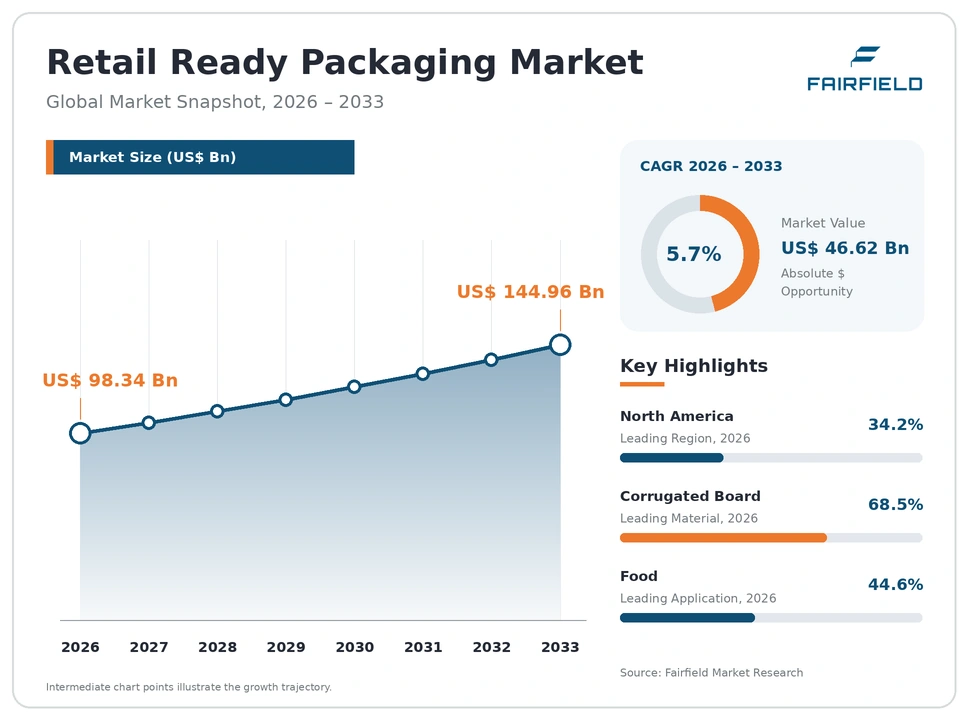
The global retail ready packaging market size is expected to be valued at US$ 98.34 billion in 2026 and projected to reach US$ 144.96 billion by 2033, growing at a CAGR of 5.7% between 2026 and 2033.
Between 2020 and 2025, the market grew at a CAGR of about 4.9%, as grocery demand surged during the pandemic and retailers sought faster shelf replenishment amid labor shortages. Three factors now drive growth: retailers’ push to cut store labor costs, rapid expansion of discount and club store formats, and brand owners’ need for strong on-shelf visibility. The market is shifting toward lightweight corrugated designs, easy-open perforations, high-quality printing, and recyclable fiber-based materials that replace plastic trays. Consolidation among large corrugated producers is reshaping supply and pricing across major markets.
Key Report Takeaways
- By Product: Corrugated Cardboard Boxes held 34.6% share in 2026, while Die-cut Display Containers are projected to expand at a 6.9% CAGR through 2033, driven by branded shelf displays in discount stores.
- By Material: Corrugated Board held 68.5% share in 2026, while Molded Fiber & Recycled Board is projected to expand at a 7.0% CAGR through 2033, driven by plastic tray replacement in fresh produce.
- By Retail Channel: Supermarkets & Hypermarkets held 52.4% share in 2026, while Discount & Club Stores are projected to expand at a 7.2% CAGR through 2033, driven by store expansion by Aldi, Lidl, and Costco.
- By Application: Food held 44.6% share in 2026, while Personal Care & Cosmetics is projected to expand at a 6.8% CAGR through 2033, driven by attractive shelf presentation and frequent product launches.
- By Region: North America held 34.2% share in 2026, while Asia Pacific is projected to expand at a 7.1% CAGR through 2033, driven by modern retail growth in China, India, and Indonesia.
Global Retail Ready Packaging Market Trends and Insights
Drivers Impact Analysis
Two drivers carry the strongest influence on retail ready packaging demand during the forecast period.
| Driver | Impact on CAGR Forecast | Geographic Relevance | Impact Timeline |
| Retail labor savings and shelf efficiency | High | North America, Europe, Asia Pacific | Medium term (2-4 years) |
| Expansion of discount and club store formats | High | North America, Europe | Medium term (2-4 years) |
Store Labor Savings Are Driving Retail Ready Packaging Adoption
Retail labor savings and shelf efficiency are the strongest drivers of retail ready packaging adoption. Shelf-ready packaging lets store staff move products from the delivery pallet to the shelf in one step, instead of unpacking individual items.
The mechanism is rising labor costs and staff shortages in retail. Grocery and mass retailers face higher minimum wages and difficulty hiring, so they want packaging that cuts restocking time. Retail ready formats are designed to be easy to identify, open, display, and dispose of, often following the “Five Easies” principles promoted by industry groups such as the Efficient Consumer Response organizations. Perforated corrugated boxes and trays reduce handling and product damage. Retailers such as Walmart, Tesco, and Carrefour often require suppliers to use shelf-ready packaging for fast-moving goods. These requirements push brand owners to invest in new packaging designs and printing.
Discount Store Expansion Is Expanding Retail Ready Packaging Demand
The expansion of discount and club store formats is expanding retail ready packaging demand. These retailers stock fewer products, sell high volumes, and rely heavily on products displayed in their shipping cases.
The cause is consumer demand for value and retailers’ low-cost operating models. Aldi and Lidl use shelf-ready cases for most products to keep staffing lean and prices low. In March 2024, Aldi announced plans to open about 800 new stores in the United States by 2028. Costco, Sam’s Club, and BJ’s Wholesale display bulk products on pallets and in display-ready cases. Discount formats are also expanding in Europe, Australia, and Asia Pacific. Inflation in 2022 and 2023 pushed more shoppers to discounters. Each new store and supplier creates demand for die-cut display cases and trays designed to retailer specifications.
Restraints Impact Analysis
Two restraints limit how quickly retail ready packaging demand grows.
| Restraint | Impact on CAGR Forecast | Geographic Relevance | Impact Timeline |
| Higher packaging costs and design complexity for brand owners | Medium | Global | Short term (≤2 years) |
| Raw material and energy cost volatility | Medium | Europe, North America | Short term (≤2 years) |
Higher Packaging Costs and Design Complexity Limit Retail Ready Packaging Adoption
Higher packaging costs and design complexity limit retail ready packaging adoption among some brand owners. Shelf-ready cases often cost more than standard shipping boxes because they need special cutting, perforations, and high-quality printing.
The specific causes are customization and retailer-specific requirements. Each retailer may set its own case sizes, opening methods, and display standards, forcing brands to produce multiple packaging versions. Retail ready cases must balance shipping strength with easy opening, which requires careful engineering and testing. Printing graphics on corrugated board adds cost. Smaller manufacturers may lack automated case-packing equipment designed for retail ready formats. Poorly designed packaging can tear during shipping or fail to open cleanly, frustrating store staff. These issues slow adoption among smaller brands and in markets where retailers have not mandated shelf-ready formats.
Raw Material and Energy Cost Volatility Squeeze Retail Ready Packaging Margins
Raw material and energy cost volatility squeezes margins for retail ready packaging producers. Corrugated board prices depend on recovered paper, virgin fiber, starch, and energy.
The specific cost sources are containerboard, recycled fiber, and natural gas. Containerboard prices rose sharply in 2021 and 2022 and then fell as demand weakened and new capacity opened. Energy costs in Europe spiked after 2022, raising mill operating costs. Recovered paper supply depends on collection rates and exports. Trade tariffs raise the cost of imported paperboard and equipment. Packaging producers often adjust prices with a lag, squeezing margins during cost spikes. Lower demand from consumer goods companies during inventory corrections also leads to mill downtime and plant closures, as producers consolidate capacity and close older, less efficient mills and box plants.
Market Opportunities
Plastic-to-Paper Conversion Opens a Sustainable Retail Ready Packaging Revenue Pool
Plastic-to-paper conversion opens a sustainable revenue pool in the retail ready packaging market. Retailers and brands want to replace plastic shrink wrap, trays, and clamshells with recyclable fiber-based alternatives.
Corrugated and carton producers can capture this demand. Paper-based trays, wraparound sleeves, and fiber display cases replace plastic shrink film for multipacks of cans and bottles. Fresh produce packaging is moving from plastic punnets to cardboard trays. The European Union Packaging and Packaging Waste Regulation, in force since February 2025, sets reuse and recyclability requirements and restricts some single-use plastic packaging formats. Tesco, Walmart, and Unilever have set packaging reduction goals. Grocery retailers, beverage companies, and fresh food suppliers are the main customers, and converters with design expertise can win premium contracts.
Digital Printing and Promotional Displays Create a Premium Revenue Pool
Digital printing and promotional displays create a premium revenue pool for retail ready packaging. Brands want eye-catching, short-run designs for seasonal campaigns, product launches, and regional promotions.
Packaging makers with digital printing and structural design capabilities can capture this opportunity. Digital presses print high-quality graphics directly on corrugated board without needing printing plates, making short runs and personalized designs affordable. Point-of-purchase displays and shelf-ready cases with bold graphics help brands stand out in crowded aisles and discount stores. Interactive features such as QR codes link shoppers to promotions, recipes, and product information. Consumer goods companies, beverage brands, and personal care firms are the main customers. Faster turnaround and design flexibility allow converters to charge higher prices and build stronger relationships with brand marketing teams.
Segment Analysis
By Product: Corrugated Cardboard Boxes Lead While Die-cut Display Containers Gain Momentum
Corrugated Cardboard Boxes held 34.6% share in 2026. Perforated corrugated cases that open into shelf trays are the most common retail ready format for groceries, beverages, and household goods because they are strong, low-cost, and recyclable.
Die-cut Display Containers are the fastest-growing product, expanding at a 6.9% CAGR through 2033. These custom-shaped cases with printed graphics create branded displays directly on shelves, end caps, or in aisles. Discount stores, club stores, and pharmacies use them to save labor and attract shoppers. Digital printing makes short runs for promotions affordable. Shrink-wrapped trays, folding cartons, and plastic containers remain important formats. For the market, display container growth adds value through design, printing, and customized engineering.
By Material: Corrugated Board Leads While Molded Fiber & Recycled Board Grows Fastest
Corrugated Board held 68.5% share in 2026. Its strength, stacking performance, and printability make it the standard material for shelf-ready cases and trays. High recycled content and established recycling systems support its use under packaging regulations.
Molded Fiber & Recycled Board is the fastest-growing material, expanding at a 7.0% CAGR through 2033. Molded pulp trays and recycled board punnets are replacing plastic trays for fruit, vegetables, eggs, and meat. Retailers in Europe and North America promote plastic-free fresh food aisles. New barrier coatings improve moisture and grease resistance. Folding boxboard and plastic remain important for cartons and shrink-wrapped trays. For the market, molded fiber growth expands retail ready packaging into fresh and chilled categories.
By Retail Channel: Supermarkets & Hypermarkets Lead While Discount & Club Stores Grow Fastest
Supermarkets & Hypermarkets held 52.4% share in 2026. Large grocery chains handle huge volumes of packaged goods and increasingly require suppliers to deliver products in shelf-ready packaging to save labor and improve shelf appearance.
Discount & Club Stores are the fastest-growing retail channel, expanding at a 7.2% CAGR through 2033. Aldi, Lidl, Costco, and other value retailers rely on products displayed in their shipping cases and pallets to keep costs low. Their rapid store expansion in North America, Europe, and Australia increases demand. Convenience stores, pharmacies, and online grocery fulfillment also use retail ready formats. For the market, discount growth increases standardized, high-volume packaging orders and pressures suppliers on cost.
By Application: Food Leads While Personal Care & Cosmetics Grows Fastest
Food held 44.6% share in 2026. Packaged foods such as cereals, snacks, canned goods, confectionery, and dairy products are commonly delivered in shelf-ready cases and trays. High volumes and frequent restocking make retail ready formats valuable.
Personal Care & Cosmetics is the fastest-growing application, expanding at a 6.8% CAGR through 2033. Brands use attractive display-ready packaging to stand out in drugstores, beauty aisles, and discount stores. Frequent product launches and seasonal campaigns require eye-catching designs. Beverages, pharmaceuticals, household products, and electronics remain important applications. Beauty retailers and pharmacy chains also want compact displays for counters and checkout lanes. For the market, personal care growth increases demand for high-quality printing and premium display designs.
Geography Analysis
Which Region Is Leading the Retail Ready Packaging Market?
North America is leading the retail ready packaging market with a 34.2% share in 2026. The United States has large grocery, discount, and club store chains, including Walmart, Kroger, Costco, and Aldi, which drive demand for shelf-ready cases and pallet displays. High labor costs make store efficiency a priority. Major corrugated producers such as International Paper, Smurfit Westrock, and Packaging Corporation of America operate extensive box plant networks. Canada adds grocery demand through chains such as Loblaw and Sobeys, which also use shelf-ready formats. One change shaping the region is Aldi’s rapid store expansion.
Europe Advances Retail Ready Packaging Through Discount Retail and Sustainability Rules
Europe is a mature retail ready packaging market where discount retailers and sustainability rules drive demand. Germany, the United Kingdom, France, and the Netherlands have strong discount chains such as Aldi and Lidl, which helped pioneer shelf-ready packaging. Retailers such as Tesco and Sainsbury’s set detailed shelf-ready requirements for suppliers. The Packaging and Packaging Waste Regulation encourages recyclable fiber packaging. Mondi and Smurfit Westrock have major mill and box plant operations in the region. High energy costs challenge paper mills and have led to some capacity closures. One opportunity is replacing plastic shrink wrap with fiber solutions.
Which Region Is Growing Fastest in the Retail Ready Packaging Market?
Asia Pacific is growing fastest in the retail ready packaging market at a 7.1% CAGR through 2033. Modern retail formats are expanding rapidly in China, India, Indonesia, and Vietnam, replacing traditional markets and small shops. Retailers such as Walmart, Reliance Retail, and DMart are adding stores and adopting efficient replenishment practices. Australia has strong discount retail with Aldi and Costco. Japan has high convenience store density and strict packaging quality expectations. Fragmented manufacturing, many small suppliers, and cost sensitivity remain challenges. One opportunity is standardized shelf-ready packaging for growing retail chains.
Latin America Expands Retail Ready Packaging Through Modern Grocery Retail
Latin America is an emerging retail ready packaging market where modern grocery retail drives demand. Brazil and Mexico have large supermarket, hypermarket, and cash-and-carry chains such as Walmart de México, Carrefour Brasil, and Atacadão. Wholesale club formats such as Sam’s Club and Costco are growing in Mexico, along with discount chains. Chile, Colombia, and Peru add demand as modern retail expands. Key barriers include price sensitivity, informal retail, economic volatility, and limited high-quality printing capacity at local converters. One opportunity is shelf-ready packaging for fast-growing cash-and-carry stores.
Middle East & Africa Develops Retail Ready Packaging Through Hypermarket Growth
Middle East & Africa is a developing retail ready packaging market where hypermarkets and supermarkets drive demand. Saudi Arabia and the United Arab Emirates have large, modern retail chains such as Carrefour, operated by Majid Al Futtaim, and Lulu Hypermarket. In Africa, South Africa has well-developed supermarket chains such as Shoprite and Pick n Pay, while Nigeria, Egypt, and Kenya are growing. Key barriers include highly fragmented retail, limited corrugated capacity, and reliance on imported containerboard in many countries. One opportunity is local box and display production for fast-growing grocery chains.
Competitive Landscape
The retail ready packaging market is moderately concentrated. Smurfit Westrock, International Paper, Mondi, Graphic Packaging International, Packaging Corporation of America, and Georgia-Pacific lead with integrated paper mills and box plants. Regional converters such as Green Bay Packaging, STI - Gustav Stabernack, and Weedon Group compete on design and service. Consolidation has increased the scale of leading players.
Companies compete on design capability, printing quality, cost, supply reliability, sustainability, and proximity to customer plants. Retail ready packaging requires close collaboration between packaging designers, brand owners, and retailers. Digital printing and structural design centers are key differentiators. Large producers offer design studios where brands and retailers test shelf-ready cases before launch, while smaller converters compete on speed, short runs, and local service. Integrated mill ownership helps leaders manage raw material costs, and long-term supply contracts with major consumer goods companies provide volume stability.
Strategic moves show how competition is changing. In June 2024, Green Bay Packaging acquired SMC Packaging Group, a custom corrugated and point-of-purchase display provider. In July 2024, Smurfit Kappa and WestRock completed their merger to form Smurfit Westrock, the world’s largest paper-based packaging company. In January 2025, International Paper completed its acquisition of DS Smith, expanding its presence in Europe. These moves show competition shifting toward scale and broader geographic coverage.
Three themes shape vendor strategy. First, companies are consolidating to gain scale. Second, they are replacing plastics with fiber. Third, they are investing in digital printing and design.
Retail Ready Packaging Market Industry Leaders
- Smurfit Westrock
- International Paper
- Mondi
- Graphic Packaging International
- Packaging Corporation of America
Recent Industry Developments
- January 2025: International Paper completed its acquisition of DS Smith - expands corrugated packaging in Europe.
- July 2024: Smurfit Kappa and WestRock completed their merger to form Smurfit Westrock - creates the largest paper-based packaging company.
- June 2024: Green Bay Packaging acquired SMC Packaging Group - adds point-of-purchase display capabilities.
Companies Covered in the Report
- Smurfit Westrock
- International Paper
- Mondi
- Graphic Packaging International
- Packaging Corporation of America
- Georgia-Pacific
- Green Bay Packaging
- STI - Gustav Stabernack
- Weedon Group
- Vanguard Packaging
- Amcor
- Huhtamaki
Retail Ready Packaging Market Report Scope
This report covers retail ready packaging, such as corrugated cardboard boxes, die-cut display containers, shrink-wrapped trays, folding cartons, and other shelf-ready formats, used across supermarkets, discount stores, and other retail channels for food, beverages, personal care, and household products. It excludes standard shipping cases not designed for display. The base year is 2025, and the forecast period runs from 2026 to 2033. All values are expressed in US$ Billion.
Product
- Corrugated Cardboard Boxes
- Die-cut Display Containers
- Shrink-wrapped Trays
- Folding Cartons
- Others
Material
- Corrugated Board
- Molded Fiber & Recycled Board
- Folding Boxboard
- Plastic
Retail Channel
- Supermarkets & Hypermarkets
- Discount & Club Stores
- Convenience Stores
- Pharmacies & Drugstores
- Others
Application
- Food
- Beverages
- Personal Care & Cosmetics
- Pharmaceuticals
- Household Products
- Others
Regions
- North America
- Europe
- Asia Pacific
- Latin America
- Middle East & Africa
Key Questions Answered in the Report
How big is the retail ready packaging market in 2026?
The retail ready packaging market is valued at US$ 98.34 billion in 2026, led by corrugated cardboard boxes for groceries.
What is the retail ready packaging market forecast to 2033?
The market is projected to reach US$ 144.96 billion by 2033, growing at a 5.7% CAGR and adding US$ 46.62 billion.
Which retail channel is growing fastest for retail ready packaging?
Discount & Club Stores are growing fastest at a 7.2% CAGR through 2033, driven by Aldi, Lidl, and Costco store expansion.
Which region is growing fastest in the retail ready packaging market?
Asia Pacific is growing fastest at a 7.1% CAGR through 2033, driven by modern retail growth in China, India, and Indonesia.
Which region holds the largest retail ready packaging market share?
North America holds the largest share at 34.2% in 2026, supported by large grocery, discount, and club store chains.
1. Executive Summary
1.1. Global Retail Ready Packaging Market Snapshot
1.2. Future Projections
1.3. Key Report Takeaways
1.4. Regional Snapshot
2. Market Overview
2.1. Market Definition and Report Scope
2.2. Historical Trends 2020–2025
2.3. Market Dynamics
2.3.1. Drivers
2.3.1.1. Store Labor Savings Are Driving Retail Ready Packaging Adoption
2.3.1.2. Discount Store Expansion Is Expanding Retail Ready Packaging Demand
2.3.2. Restraints
2.3.2.1. Higher Packaging Costs and Design Complexity Limit Retail Ready Packaging Adoption
2.3.2.2. Raw Material and Energy Cost Volatility Squeeze Retail Ready Packaging Margins
2.3.3. Market Opportunities
2.3.3.1. Plastic-to-Paper Conversion Opens a Sustainable Retail Ready Packaging Revenue Pool
2.3.3.2. Digital Printing and Promotional Displays Create a Premium Revenue Pool
3. Global Retail Ready Packaging Market Outlook, 2020-2033
3.1. Global Retail Ready Packaging Market Outlook, by Product, Value (US$ Billion), 2020-2033
3.1.1. Corrugated Cardboard Boxes
3.1.2. Die-cut Display Containers
3.1.3. Shrink-wrapped Trays
3.1.4. Folding Cartons
3.1.5. Others
3.2. Global Retail Ready Packaging Market Outlook, by Material, Value (US$ Billion), 2020-2033
3.2.1. Corrugated Board
3.2.2. Molded Fiber & Recycled Board
3.2.3. Folding Boxboard
3.2.4. Plastic
3.3. Global Retail Ready Packaging Market Outlook, by Retail Channel, Value (US$ Billion), 2020-2033
3.3.1. Supermarkets & Hypermarkets
3.3.2. Discount & Club Stores
3.3.3. Convenience Stores
3.3.4. Pharmacies & Drugstores
3.3.5. Others
3.4. Global Retail Ready Packaging Market Outlook, by Application, Value (US$ Billion), 2020-2033
3.4.1. Food
3.4.2. Beverages
3.4.3. Personal Care & Cosmetics
3.4.4. Pharmaceuticals
3.4.5. Household Products
3.4.6. Others
3.5. Global Retail Ready Packaging Market Outlook, by Region, Value (US$ Billion), 2020-2033
3.5.1. North America
3.5.2. Europe
3.5.3. Asia Pacific
3.5.4. Latin America
3.5.5. Middle East & Africa
4. North America Retail Ready Packaging Market Outlook, 2020-2033
4.1. North America Retail Ready Packaging Market Outlook, by Product, Value (US$ Billion), 2020-2033
4.1.1. Corrugated Cardboard Boxes
4.1.2. Die-cut Display Containers
4.1.3. Shrink-wrapped Trays
4.1.4. Folding Cartons
4.1.5. Others
4.2. North America Retail Ready Packaging Market Outlook, by Material, Value (US$ Billion), 2020-2033
4.2.1. Corrugated Board
4.2.2. Molded Fiber & Recycled Board
4.2.3. Folding Boxboard
4.2.4. Plastic
4.3. North America Retail Ready Packaging Market Outlook, by Retail Channel, Value (US$ Billion), 2020-2033
4.3.1. Supermarkets & Hypermarkets
4.3.2. Discount & Club Stores
4.3.3. Convenience Stores
4.3.4. Pharmacies & Drugstores
4.3.5. Others
4.4. North America Retail Ready Packaging Market Outlook, by Application, Value (US$ Billion), 2020-2033
4.4.1. Food
4.4.2. Beverages
4.4.3. Personal Care & Cosmetics
4.4.4. Pharmaceuticals
4.4.5. Household Products
4.4.6. Others
4.5. North America Retail Ready Packaging Market Outlook, by Country, Value (US$ Billion), 2020-2033
4.5.1. United States Retail Ready Packaging Market Outlook, by Product, 2020-2033
4.5.2. United States Retail Ready Packaging Market Outlook, by Material, 2020-2033
4.5.3. United States Retail Ready Packaging Market Outlook, by Retail Channel, 2020-2033
4.5.4. United States Retail Ready Packaging Market Outlook, by Application, 2020-2033
4.5.5. Canada Retail Ready Packaging Market Outlook, by Product, 2020-2033
4.5.6. Canada Retail Ready Packaging Market Outlook, by Material, 2020-2033
4.5.7. Canada Retail Ready Packaging Market Outlook, by Retail Channel, 2020-2033
4.5.8. Canada Retail Ready Packaging Market Outlook, by Application, 2020-2033
5. Europe Retail Ready Packaging Market Outlook, 2020-2033
5.1. Europe Retail Ready Packaging Market Outlook, by Product, Value (US$ Billion), 2020-2033
5.1.1. Corrugated Cardboard Boxes
5.1.2. Die-cut Display Containers
5.1.3. Shrink-wrapped Trays
5.1.4. Folding Cartons
5.1.5. Others
5.2. Europe Retail Ready Packaging Market Outlook, by Material, Value (US$ Billion), 2020-2033
5.2.1. Corrugated Board
5.2.2. Molded Fiber & Recycled Board
5.2.3. Folding Boxboard
5.2.4. Plastic
5.3. Europe Retail Ready Packaging Market Outlook, by Retail Channel, Value (US$ Billion), 2020-2033
5.3.1. Supermarkets & Hypermarkets
5.3.2. Discount & Club Stores
5.3.3. Convenience Stores
5.3.4. Pharmacies & Drugstores
5.3.5. Others
5.4. Europe Retail Ready Packaging Market Outlook, by Application, Value (US$ Billion), 2020-2033
5.4.1. Food
5.4.2. Beverages
5.4.3. Personal Care & Cosmetics
5.4.4. Pharmaceuticals
5.4.5. Household Products
5.4.6. Others
5.5. Europe Retail Ready Packaging Market Outlook, by Country, Value (US$ Billion), 2020-2033
5.5.1. Germany Retail Ready Packaging Market Outlook, by Product, 2020-2033
5.5.2. Germany Retail Ready Packaging Market Outlook, by Material, 2020-2033
5.5.3. Germany Retail Ready Packaging Market Outlook, by Retail Channel, 2020-2033
5.5.4. Germany Retail Ready Packaging Market Outlook, by Application, 2020-2033
5.5.5. United Kingdom Retail Ready Packaging Market Outlook, by Product, 2020-2033
5.5.6. United Kingdom Retail Ready Packaging Market Outlook, by Material, 2020-2033
5.5.7. United Kingdom Retail Ready Packaging Market Outlook, by Retail Channel, 2020-2033
5.5.8. United Kingdom Retail Ready Packaging Market Outlook, by Application, 2020-2033
5.5.9. France Retail Ready Packaging Market Outlook, by Product, 2020-2033
5.5.10. France Retail Ready Packaging Market Outlook, by Material, 2020-2033
5.5.11. France Retail Ready Packaging Market Outlook, by Retail Channel, 2020-2033
5.5.12. France Retail Ready Packaging Market Outlook, by Application, 2020-2033
5.5.13. Netherlands Retail Ready Packaging Market Outlook, by Product, 2020-2033
5.5.14. Netherlands Retail Ready Packaging Market Outlook, by Material, 2020-2033
5.5.15. Netherlands Retail Ready Packaging Market Outlook, by Retail Channel, 2020-2033
5.5.16. Netherlands Retail Ready Packaging Market Outlook, by Application, 2020-2033
6. Asia Pacific Retail Ready Packaging Market Outlook, 2020-2033
6.1. Asia Pacific Retail Ready Packaging Market Outlook, by Product, Value (US$ Billion), 2020-2033
6.1.1. Corrugated Cardboard Boxes
6.1.2. Die-cut Display Containers
6.1.3. Shrink-wrapped Trays
6.1.4. Folding Cartons
6.1.5. Others
6.2. Asia Pacific Retail Ready Packaging Market Outlook, by Material, Value (US$ Billion), 2020-2033
6.2.1. Corrugated Board
6.2.2. Molded Fiber & Recycled Board
6.2.3. Folding Boxboard
6.2.4. Plastic
6.3. Asia Pacific Retail Ready Packaging Market Outlook, by Retail Channel, Value (US$ Billion), 2020-2033
6.3.1. Supermarkets & Hypermarkets
6.3.2. Discount & Club Stores
6.3.3. Convenience Stores
6.3.4. Pharmacies & Drugstores
6.3.5. Others
6.4. Asia Pacific Retail Ready Packaging Market Outlook, by Application, Value (US$ Billion), 2020-2033
6.4.1. Food
6.4.2. Beverages
6.4.3. Personal Care & Cosmetics
6.4.4. Pharmaceuticals
6.4.5. Household Products
6.4.6. Others
6.5. Asia Pacific Retail Ready Packaging Market Outlook, by Country, Value (US$ Billion), 2020-2033
6.5.1. China Retail Ready Packaging Market Outlook, by Product, 2020-2033
6.5.2. China Retail Ready Packaging Market Outlook, by Material, 2020-2033
6.5.3. China Retail Ready Packaging Market Outlook, by Retail Channel, 2020-2033
6.5.4. China Retail Ready Packaging Market Outlook, by Application, 2020-2033
6.5.5. India Retail Ready Packaging Market Outlook, by Product, 2020-2033
6.5.6. India Retail Ready Packaging Market Outlook, by Material, 2020-2033
6.5.7. India Retail Ready Packaging Market Outlook, by Retail Channel, 2020-2033
6.5.8. India Retail Ready Packaging Market Outlook, by Application, 2020-2033
6.5.9. Indonesia Retail Ready Packaging Market Outlook, by Product, 2020-2033
6.5.10. Indonesia Retail Ready Packaging Market Outlook, by Material, 2020-2033
6.5.11. Indonesia Retail Ready Packaging Market Outlook, by Retail Channel, 2020-2033
6.5.12. Indonesia Retail Ready Packaging Market Outlook, by Application, 2020-2033
6.5.13. Vietnam Retail Ready Packaging Market Outlook, by Product, 2020-2033
6.5.14. Vietnam Retail Ready Packaging Market Outlook, by Material, 2020-2033
6.5.15. Vietnam Retail Ready Packaging Market Outlook, by Retail Channel, 2020-2033
6.5.16. Vietnam Retail Ready Packaging Market Outlook, by Application, 2020-2033
6.5.17. Australia Retail Ready Packaging Market Outlook, by Product, 2020-2033
6.5.18. Australia Retail Ready Packaging Market Outlook, by Material, 2020-2033
6.5.19. Australia Retail Ready Packaging Market Outlook, by Retail Channel, 2020-2033
6.5.20. Australia Retail Ready Packaging Market Outlook, by Application, 2020-2033
6.5.21. Japan Retail Ready Packaging Market Outlook, by Product, 2020-2033
6.5.22. Japan Retail Ready Packaging Market Outlook, by Material, 2020-2033
6.5.23. Japan Retail Ready Packaging Market Outlook, by Retail Channel, 2020-2033
6.5.24. Japan Retail Ready Packaging Market Outlook, by Application, 2020-2033
7. Latin America Retail Ready Packaging Market Outlook, 2020-2033
7.1. Latin America Retail Ready Packaging Market Outlook, by Product, Value (US$ Billion), 2020-2033
7.1.1. Corrugated Cardboard Boxes
7.1.2. Die-cut Display Containers
7.1.3. Shrink-wrapped Trays
7.1.4. Folding Cartons
7.1.5. Others
7.2. Latin America Retail Ready Packaging Market Outlook, by Material, Value (US$ Billion), 2020-2033
7.2.1. Corrugated Board
7.2.2. Molded Fiber & Recycled Board
7.2.3. Folding Boxboard
7.2.4. Plastic
7.3. Latin America Retail Ready Packaging Market Outlook, by Retail Channel, Value (US$ Billion), 2020-2033
7.3.1. Supermarkets & Hypermarkets
7.3.2. Discount & Club Stores
7.3.3. Convenience Stores
7.3.4. Pharmacies & Drugstores
7.3.5. Others
7.4. Latin America Retail Ready Packaging Market Outlook, by Application, Value (US$ Billion), 2020-2033
7.4.1. Food
7.4.2. Beverages
7.4.3. Personal Care & Cosmetics
7.4.4. Pharmaceuticals
7.4.5. Household Products
7.4.6. Others
7.5. Latin America Retail Ready Packaging Market Outlook, by Country, Value (US$ Billion), 2020-2033
7.5.1. Brazil Retail Ready Packaging Market Outlook, by Product, 2020-2033
7.5.2. Brazil Retail Ready Packaging Market Outlook, by Material, 2020-2033
7.5.3. Brazil Retail Ready Packaging Market Outlook, by Retail Channel, 2020-2033
7.5.4. Brazil Retail Ready Packaging Market Outlook, by Application, 2020-2033
7.5.5. Mexico Retail Ready Packaging Market Outlook, by Product, 2020-2033
7.5.6. Mexico Retail Ready Packaging Market Outlook, by Material, 2020-2033
7.5.7. Mexico Retail Ready Packaging Market Outlook, by Retail Channel, 2020-2033
7.5.8. Mexico Retail Ready Packaging Market Outlook, by Application, 2020-2033
7.5.9. Chile Retail Ready Packaging Market Outlook, by Product, 2020-2033
7.5.10. Chile Retail Ready Packaging Market Outlook, by Material, 2020-2033
7.5.11. Chile Retail Ready Packaging Market Outlook, by Retail Channel, 2020-2033
7.5.12. Chile Retail Ready Packaging Market Outlook, by Application, 2020-2033
7.5.13. Colombia Retail Ready Packaging Market Outlook, by Product, 2020-2033
7.5.14. Colombia Retail Ready Packaging Market Outlook, by Material, 2020-2033
7.5.15. Colombia Retail Ready Packaging Market Outlook, by Retail Channel, 2020-2033
7.5.16. Colombia Retail Ready Packaging Market Outlook, by Application, 2020-2033
7.5.17. Peru Retail Ready Packaging Market Outlook, by Product, 2020-2033
7.5.18. Peru Retail Ready Packaging Market Outlook, by Material, 2020-2033
7.5.19. Peru Retail Ready Packaging Market Outlook, by Retail Channel, 2020-2033
7.5.20. Peru Retail Ready Packaging Market Outlook, by Application, 2020-2033
8. Middle East & Africa Retail Ready Packaging Market Outlook, 2020-2033
8.1. Middle East & Africa Retail Ready Packaging Market Outlook, by Product, Value (US$ Billion), 2020-2033
8.1.1. Corrugated Cardboard Boxes
8.1.2. Die-cut Display Containers
8.1.3. Shrink-wrapped Trays
8.1.4. Folding Cartons
8.1.5. Others
8.2. Middle East & Africa Retail Ready Packaging Market Outlook, by Material, Value (US$ Billion), 2020-2033
8.2.1. Corrugated Board
8.2.2. Molded Fiber & Recycled Board
8.2.3. Folding Boxboard
8.2.4. Plastic
8.3. Middle East & Africa Retail Ready Packaging Market Outlook, by Retail Channel, Value (US$ Billion), 2020-2033
8.3.1. Supermarkets & Hypermarkets
8.3.2. Discount & Club Stores
8.3.3. Convenience Stores
8.3.4. Pharmacies & Drugstores
8.3.5. Others
8.4. Middle East & Africa Retail Ready Packaging Market Outlook, by Application, Value (US$ Billion), 2020-2033
8.4.1. Food
8.4.2. Beverages
8.4.3. Personal Care & Cosmetics
8.4.4. Pharmaceuticals
8.4.5. Household Products
8.4.6. Others
8.5. Middle East & Africa Retail Ready Packaging Market Outlook, by Country, Value (US$ Billion), 2020-2033
8.5.1. Saudi Arabia Retail Ready Packaging Market Outlook, by Product, 2020-2033
8.5.2. Saudi Arabia Retail Ready Packaging Market Outlook, by Material, 2020-2033
8.5.3. Saudi Arabia Retail Ready Packaging Market Outlook, by Retail Channel, 2020-2033
8.5.4. Saudi Arabia Retail Ready Packaging Market Outlook, by Application, 2020-2033
8.5.5. United Arab Emirates Retail Ready Packaging Market Outlook, by Product, 2020-2033
8.5.6. United Arab Emirates Retail Ready Packaging Market Outlook, by Material, 2020-2033
8.5.7. United Arab Emirates Retail Ready Packaging Market Outlook, by Retail Channel, 2020-2033
8.5.8. United Arab Emirates Retail Ready Packaging Market Outlook, by Application, 2020-2033
8.5.9. South Africa Retail Ready Packaging Market Outlook, by Product, 2020-2033
8.5.10. South Africa Retail Ready Packaging Market Outlook, by Material, 2020-2033
8.5.11. South Africa Retail Ready Packaging Market Outlook, by Retail Channel, 2020-2033
8.5.12. South Africa Retail Ready Packaging Market Outlook, by Application, 2020-2033
8.5.13. Nigeria Retail Ready Packaging Market Outlook, by Product, 2020-2033
8.5.14. Nigeria Retail Ready Packaging Market Outlook, by Material, 2020-2033
8.5.15. Nigeria Retail Ready Packaging Market Outlook, by Retail Channel, 2020-2033
8.5.16. Nigeria Retail Ready Packaging Market Outlook, by Application, 2020-2033
8.5.17. Egypt Retail Ready Packaging Market Outlook, by Product, 2020-2033
8.5.18. Egypt Retail Ready Packaging Market Outlook, by Material, 2020-2033
8.5.19. Egypt Retail Ready Packaging Market Outlook, by Retail Channel, 2020-2033
8.5.20. Egypt Retail Ready Packaging Market Outlook, by Application, 2020-2033
8.5.21. Kenya Retail Ready Packaging Market Outlook, by Product, 2020-2033
8.5.22. Kenya Retail Ready Packaging Market Outlook, by Material, 2020-2033
8.5.23. Kenya Retail Ready Packaging Market Outlook, by Retail Channel, 2020-2033
8.5.24. Kenya Retail Ready Packaging Market Outlook, by Application, 2020-2033
9. Competitive Landscape
9.1. Market Concentration and Industry Leaders
9.2. Competitive Differentiation
9.3. Strategic Moves and Market Direction
9.4. Recent Industry Developments
9.5. Company Profiles
9.5.1. Smurfit Westrock
9.5.2. International Paper
9.5.3. Mondi
9.5.4. Graphic Packaging International
9.5.5. Packaging Corporation of America
9.5.6. Georgia-Pacific
9.5.7. Green Bay Packaging
9.5.8. STI - Gustav Stabernack
9.5.9. Weedon Group
9.5.10. Vanguard Packaging
9.5.11. Amcor
9.5.12. Huhtamaki
10. Appendix
10.1. Research Methodology
10.2. Report Assumptions
10.3. Acronyms and Abbreviations
| Segment | Categories |
|---|---|
| Product | Corrugated Cardboard Boxes, Die-cut Display Containers, Shrink-wrapped Trays, Folding Cartons, Others |
| Material | Corrugated Board, Molded Fiber & Recycled Board, Folding Boxboard, Plastic |
| Retail Channel | Supermarkets & Hypermarkets, Discount & Club Stores, Convenience Stores, Pharmacies & Drugstores, Others |
| Application | Food, Beverages, Personal Care & Cosmetics, Pharmaceuticals, Household Products, Others |
| Regions | North America, Europe, Asia Pacific, Latin America, Middle East & Africa |
Our Research Methodology
Considering the volatility of business today, traditional approaches to strategizing a game plan can be unfruitful if not detrimental. True ambiguity is no way to determine a forecast. A myriad of predetermined factors must be accounted for such as the degree of risk involved, the magnitude of circumstances, as well as conditions or consequences that are not known or unpredictable. To circumvent binary views that cast uncertainty, the application of market research intelligence to strategically posture, move, and enable actionable outcomes is necessary.
View Methodology
Quality Assured
Rigorous Validation Process

Confidentiality Assured
End-to-end Data Security

Custom Research Services
Tailored To Your Objectives
FAQs
The retail ready packaging market is valued at US$ 98.34 billion in 2026, led by corrugated cardboard boxes for groceries.
The market is projected to reach US$ 144.96 billion by 2033, growing at a 5.7% CAGR and adding US$ 46.62 billion.
Discount & Club Stores are growing fastest at a 7.2% CAGR through 2033, driven by Aldi, Lidl, and Costco store expansion.
Asia Pacific is growing fastest at a 7.1% CAGR through 2033, driven by modern retail growth in China, India, and Indonesia.
North America holds the largest share at 34.2% in 2026, supported by large grocery, discount, and club store chains.
Related Reports
Graphene-Enhanced Plastics Market Size, Share, Insights, Competitive Landscape, and Forecast 2026 to 2033
Graphene-enhanced plastics market to reach US$ 154.10 billion by 2033 at a 20.2% CAGR. Explore polymers, applications and regional trends.
Dimethylaminoethyl Methacrylate Market Size, Share, Insights, Competitive Landscape, and Forecast 2026 to 2033
Dimethylaminoethyl methacrylate market to reach US$ 0.282 billion by 2033 at a 4.5% CAGR. Explore grades, applications and regional trends.
Algae-based Building Materials Market Size, Share, Insights, Competitive Landscape, and Forecast 2026 to 2033
Algae-based building materials market to reach US$ 2.82 billion by 2033 at a 15.7% CAGR. Explore products, algae types and regional trends.
PCR Cosmetic Tube Market Size, Share, Insights, Competitive Landscape, and Forecast 2026 to 2033
PCR cosmetic tube market to reach US$ 1.55 billion by 2033 at 11.8% CAGR. Explore materials, recycled content, applications and regional trends.
Metalized Flexible Packaging Market Size, Share, Insights, Competitive Landscape, and Forecast 2026 to 2033
Metalized flexible packaging market to reach US$ 20.80 billion by 2033 at 5.0% CAGR. Explore materials, formats and regional trends.
Baby Food Packaging Market Size, Share, Insights, Competitive Landscape, and Forecast 2026 to 2033
Baby food packaging market to reach US$ 13.53 billion by 2033 at 5.4% CAGR. Explore materials, pack formats, closures and regional growth trends.