



Dimethylaminoethyl Methacrylate Market
Dimethylaminoethyl Methacrylate Market Size, Share, Insights, Competitive Landscape, and Forecast 2026 to 2033
Dimethylaminoethyl Methacrylate Market Analysis, 2026–2033
Dimethylaminoethyl Methacrylate Market
Dimethylaminoethyl Methacrylate Market Size, Share, Insights, Competitive Landscape, and Forecast 2026 to 2033
Dimethylaminoethyl Methacrylate Market Size and Trend Analysis
How Fast Is the Dimethylaminoethyl Methacrylate Market Growing?
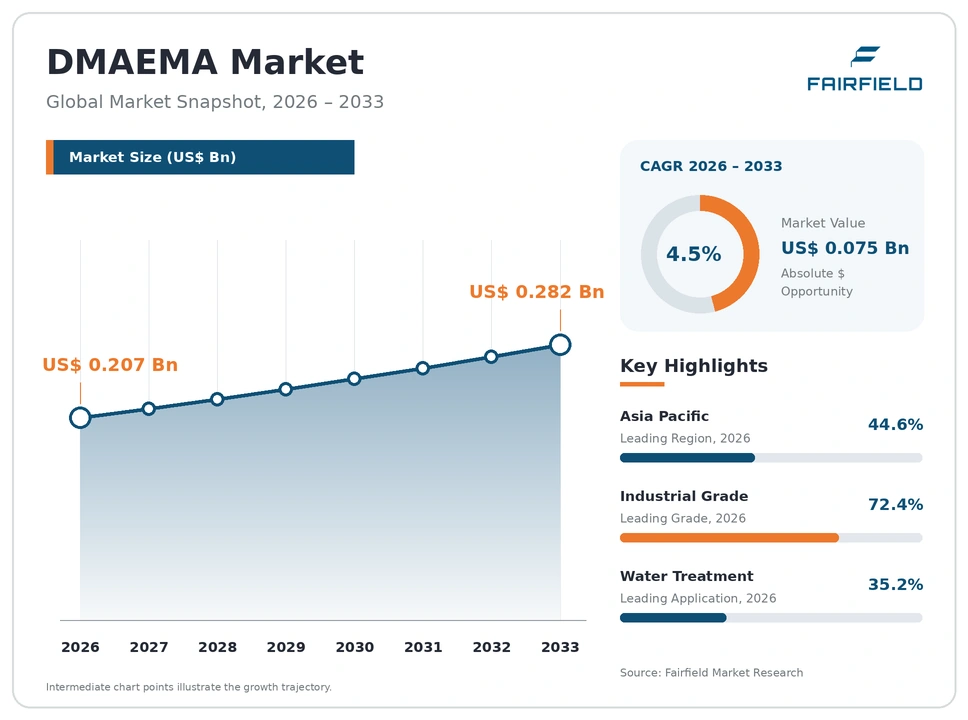
The global dimethylaminoethyl methacrylate market size is expected to be valued at US$ 0.207 billion in 2026 and projected to reach US$ 0.282 billion by 2033, growing at a CAGR of 4.5% between 2026 and 2033.
Between 2020 and 2025, the market grew at a CAGR of about 3.8%, as industrial demand dipped during the pandemic and then recovered, while raw material and energy costs rose sharply in 2022. Three factors now drive growth: rising demand for water treatment chemicals and flocculants made from cationic monomer derivatives, growth in pharmaceutical coatings and drug delivery polymers, and use in paper, textiles, and coatings. The market is shifting toward higher-purity grades, quaternized derivatives, and production in Asia Pacific, where water treatment and pharmaceutical output are growing fastest.
Key Report Takeaways
- By Grade: Industrial Grade held 72.4% share in 2026, while Pharmaceutical Grade is projected to expand at a 6.2% CAGR through 2033, driven by enteric and taste-masking coatings and gene delivery research.
- By Derivative Use: Quaternary Ammonium Monomers held 53.6% share in 2026, while Specialty Copolymers are projected to expand at a 5.7% CAGR through 2033, driven by coatings, adhesives, and biomedical polymers.
- By Application: Water Treatment held 35.2% share in 2026, while Coatings & Adhesives is projected to expand at a 5.5% CAGR through 2033, driven by waterborne and functional coatings.
- By Region: Asia Pacific held 44.6% share in 2026, while India is projected to expand at a 6.4% CAGR through 2033, driven by water treatment investment and pharmaceutical manufacturing.
Global Dimethylaminoethyl Methacrylate Market Trends and Insights
Drivers Impact Analysis
Two drivers carry the strongest influence on dimethylaminoethyl methacrylate demand during the forecast period.
| Driver | Impact on CAGR Forecast | Geographic Relevance | Impact Timeline |
| Water and wastewater treatment growth | High | Asia Pacific, Europe, Middle East & Africa | Long term (≥4 years) |
| Pharmaceutical coatings and biomedical polymers | Medium | Europe, North America, Asia Pacific | Medium term (2-4 years) |
Water Treatment Growth Is Driving the Dimethylaminoethyl Methacrylate Market
Water and wastewater treatment growth is the strongest driver of the dimethylaminoethyl methacrylate market. Dimethylaminoethyl methacrylate, or DMAEMA, is converted into cationic monomers used to make polymer flocculants that remove solids from water and sludge.
The mechanism is stricter water rules and rising treatment capacity. Cities in China, India, Indonesia, and Brazil are building new sewage treatment plants as populations grow. The European Union revised its Urban Wastewater Treatment Directive, which entered into force in January 2025 and raises treatment requirements. Cationic polyacrylamide flocculants dewater sludge, clarify drinking water, and treat industrial effluent from mining, paper, and food plants. Desalination in Saudi Arabia and the United Arab Emirates also uses treatment chemicals. Oil and gas operations use polymers for produced water. These trends create steady demand for water treatment chemicals based on DMAEMA and related monomers.
Pharmaceutical Coatings Are Expanding the Dimethylaminoethyl Methacrylate Market
Pharmaceutical coatings and biomedical polymers are expanding the dimethylaminoethyl methacrylate market. DMAEMA is a building block for polymers that dissolve at specific pH levels, useful in drug coatings.
The cause is growth in oral drugs and advanced drug delivery research. Aminoalkyl methacrylate copolymers, such as Evonik’s EUDRAGIT E grades, are used to mask bitter tastes and protect tablets from moisture, dissolving in the acidic stomach. Generic drug production in India and China increases demand for coating excipients. Researchers use poly(DMAEMA) as a cationic polymer for gene and nucleic acid delivery because it binds DNA and RNA. Evonik opened a new spray-drying facility for EUDRAGIT excipients in Darmstadt in September 2024 to meet rising demand. Pharmaceutical grades require high purity and strict quality control, supporting higher prices. These uses add high-value growth to the market.
Restraints Impact Analysis
Two restraints limit how quickly the dimethylaminoethyl methacrylate market grows.
| Restraint | Impact on CAGR Forecast | Geographic Relevance | Impact Timeline |
| Raw material price volatility | High | Global | Short term (≤2 years) |
| Toxicity, handling, and regulatory requirements | Medium | Europe, North America | Medium term (2-4 years) |
Raw Material Price Volatility Squeezes the Dimethylaminoethyl Methacrylate Market
Raw material price volatility squeezes the dimethylaminoethyl methacrylate market. DMAEMA is made from methyl methacrylate and dimethylaminoethanol, whose prices follow petrochemical and energy markets.
The specific causes are cyclical feedstock supply and energy costs. Methyl methacrylate prices swing with demand for acrylic sheets, coatings, and plastics, and new capacity in China has added price pressure. Dimethylaminoethanol depends on ethylene oxide and dimethylamine, which are also volatile. High natural gas and electricity prices in Europe in 2022 raised production costs and squeezed margins. Smaller producers lack long-term supply contracts and struggle to pass on cost increases. Flocculant makers buying DMAEMA derivatives face strong price competition and push suppliers to lower prices. These factors limit profitability and make production planning and long-term pricing agreements difficult for both producers and buyers.
Toxicity and Regulations Restrict the Dimethylaminoethyl Methacrylate Market
Toxicity, handling, and regulatory requirements restrict the dimethylaminoethyl methacrylate market. DMAEMA is a reactive chemical that requires careful handling and storage.
The underlying causes are hazard classification and compliance costs. DMAEMA is classified as harmful if swallowed or inhaled and can cause skin sensitization and eye damage, so plants need ventilation, protective equipment, emergency systems, and trained staff. It must be stabilized with inhibitors and kept cool to prevent unwanted polymerization during transport and storage. Registration under REACH in Europe and the Toxic Substances Control Act in the United States adds testing and paperwork costs. Residual monomer limits in drinking water treatment polymers and pharmaceutical excipients require precise production control. These requirements raise barriers for new suppliers and slow use in some sensitive applications, especially pharmaceutical and drinking water uses.
Market Opportunities
High-purity Pharmaceutical and Biomedical Grades Open a Premium Revenue Pool
High-purity pharmaceutical and biomedical grades open a premium revenue pool in the dimethylaminoethyl methacrylate market. Drug makers and researchers need monomers and polymers with very low impurity levels.
Specialty chemical producers can capture this opportunity. Pharmaceutical-grade aminomethacrylate copolymers serve taste masking, moisture protection, and immediate-release coatings for tablets. Drug delivery polymers based on DMAEMA are studied for gene therapy, vaccines, and antimicrobial coatings, while smart hydrogels respond to pH and temperature changes. Contract manufacturers, biotech companies, and research institutes buy small volumes at high prices. Good manufacturing practice certification and long qualification processes create loyal customers. Producers with strong quality systems, such as Evonik, can expand capacity in Europe and India. Higher margins offset smaller volumes, and long qualification cycles protect established suppliers from price competition.
Asia Pacific Water Treatment and Paper Industries Create a Volume Revenue Pool
Water treatment and paper industries in Asia Pacific create a volume revenue pool in the dimethylaminoethyl methacrylate market. The region is expanding sewage treatment, industrial water reuse, and paper production.
Monomer and flocculant producers with local capacity can capture this opportunity. China and India are investing heavily in urban wastewater treatment, river cleanup, and industrial discharge rules. Paper and board mills use cationic polymers as retention aids and strength additives. Mining operations in Australia and Indonesia use flocculants for tailings. Local production of DMAEMA and quaternized monomers lowers costs and import dependence. SNF, the largest flocculant producer, has expanded capacity worldwide, including a US$ 250 million plan in Oman. Partnerships with flocculant makers secure long-term volume and help producers plan capacity in line with regional demand growth.
Segment Analysis
By Grade: Industrial Grade Leads While Pharmaceutical Grade Gains Momentum
Industrial Grade held 72.4% share in 2026. Industrial-grade DMAEMA is used to make cationic monomers for flocculants, paper chemicals, textile auxiliaries, and coating resins. Large volumes and lower prices make this the largest segment. Producers in China, Germany, and Japan supply most industrial demand, and purity above 99.0% is typical.
Pharmaceutical Grade is the fastest-growing grade, expanding at a 6.2% CAGR through 2033. High-purity DMAEMA, often above 99.5%, is used to produce aminomethacrylate copolymers for tablet coatings and research polymers for gene delivery. Generic drug production in India and China and growing use of taste-masked medicines for children and older patients support demand. Strict quality systems limit the number of qualified suppliers. For the market, pharmaceutical growth raises average selling prices.
By Derivative Use: Quaternary Ammonium Monomers Lead While Specialty Copolymers Grow Fastest
Quaternary Ammonium Monomers held 53.6% share in 2026. DMAEMA is quaternized with methyl chloride or dimethyl sulfate to make cationic monomers such as methacryloyloxyethyl trimethylammonium chloride. These cationic monomer products are copolymerized with acrylamide to produce cationic polyacrylamide flocculants for water treatment and paper making.
Specialty Copolymers are the fastest-growing derivative use, expanding at a 5.7% CAGR through 2033. DMAEMA is copolymerized with other methacrylate esters to make pharmaceutical coatings, cationic coating resins, adhesives, hair care polymers, and antistatic agents. Its amine group adds adhesion, pH response, and antimicrobial properties. Research into smart and biomedical polymers creates new uses. Homopolymers for research form a small niche. For the market, specialty copolymers add higher-value demand beyond water treatment.
By Application: Water Treatment Leads While Coatings & Adhesives Grow Fastest
Water Treatment held 35.2% share in 2026. DMAEMA-based flocculants treat municipal sewage, drinking water, and industrial wastewater, and dewater sludge. Stricter discharge rules and growing urban populations support demand in Asia Pacific, Europe, and Middle East & Africa. Paper making forms the second-largest application.
Coatings & Adhesives are the fastest-growing application, expanding at a 5.5% CAGR through 2033. DMAEMA improves adhesion, pigment dispersion, and corrosion resistance in waterborne and cationic coatings, including electrodeposition coatings for metal parts. Functional and smart coatings that respond to pH or have antimicrobial properties use DMAEMA copolymers. Fiber, textile, plastics and rubber, pharmaceutical, and personal care uses form other segments. For the market, coatings growth broadens demand.
Geography Analysis
North America Advances the Dimethylaminoethyl Methacrylate Market Through Specialty Uses
North America is a major dimethylaminoethyl methacrylate market driven by water treatment, oil and gas, and pharmaceutical demand. The United States has large municipal water treatment, shale oil and gas, and paper industries that use cationic polymers. SNF has expanded production of cationic monomer feedstock at its Riceboro, Georgia, plant. Pharmaceutical and biotech research uses high-purity grades. Strict Environmental Protection Agency rules on water quality support treatment chemical demand. Canada uses flocculants in oil sands tailings and mining, and paper mills in both countries use cationic retention aids. Mexico adds municipal water demand. One change shaping the region is local supply growth, which reduces reliance on imported monomers.
Europe Shapes the Dimethylaminoethyl Methacrylate Market Through Regulation and Pharmaceuticals
Europe is an important dimethylaminoethyl methacrylate market shaped by strict regulation and pharmaceutical demand. Germany hosts Evonik and BASF, two leading producers of methacrylate monomers and specialty polymers. France is home to SNF, the world’s largest flocculant producer, and Arkema. The revised Urban Wastewater Treatment Directive requires more advanced treatment. Italy, Spain, and the United Kingdom add demand from paper, textiles, and coatings. High energy costs pressure producers, and imports from Asia Pacific compete on price in industrial grades. REACH registration favors established suppliers. One opportunity is pharmaceutical-grade copolymers for Europe’s large drug industry.
Which Region Is Leading the Dimethylaminoethyl Methacrylate Market?
Asia Pacific is leading the dimethylaminoethyl methacrylate market with a 44.6% share in 2026. China is the largest producer and consumer, with suppliers such as Fushun Anxin Chemical and Zibo Yili New Chemical Material serving domestic flocculant, paper, and textile industries. Japan hosts Mitsubishi Gas Chemical, while South Korea adds specialty chemical demand. India is growing fastest, as detailed below. Large textile, paper, and coatings industries across China, Indonesia, and Vietnam use DMAEMA derivatives, while Australia uses flocculants in mining. Stricter discharge rules in China push factories to upgrade treatment. One change shaping the region is rising wastewater treatment capacity.
Which Country Is Growing Fastest in the Dimethylaminoethyl Methacrylate Market?
India is growing fastest in the dimethylaminoethyl methacrylate market at a 6.4% CAGR through 2033. Government programs such as Namami Gange and AMRUT fund sewage treatment and drinking water projects, increasing flocculant demand. India is also a global hub for generic drug manufacturing, which uses aminomethacrylate coatings, and Evonik operates pharmaceutical research in Mumbai. Paper, textile, and mining industries add further demand for cationic polymers. Import dependence on monomers from China and Europe remains a challenge. Rising pharmaceutical exports to regulated markets require high-quality excipients. One opportunity is local monomer production supported by government efforts to reduce chemical imports.
Latin America Grows the Dimethylaminoethyl Methacrylate Market Through Mining and Paper
Latin America is a growing dimethylaminoethyl methacrylate market driven by mining, paper, and water treatment. Chile and Peru have large copper mining industries that use flocculants for tailings. Brazil is a major pulp and paper producer that uses cationic polymers as retention and drainage aids. Municipal water and sanitation investment is rising in Brazil and Mexico, supported by new private concessions. Colombia and Argentina are upgrading sewage treatment in large cities. Key barriers include reliance on imports from North America, Europe, and Asia Pacific, along with currency swings. One opportunity is flocculants for mining and water projects.
Middle East & Africa Expands the Dimethylaminoethyl Methacrylate Market Through Water and Oil
Middle East & Africa is an emerging dimethylaminoethyl methacrylate market driven by desalination, water reuse, and oil and gas. Saudi Arabia, the United Arab Emirates, and Oman invest in water treatment, desalination, and enhanced oil recovery, which use water-soluble polymers. SNF announced a US$ 250 million expansion in Oman in 2024. South Africa uses flocculants in gold, platinum, and coal mining. Egypt and Morocco are investing in water reuse to address growing scarcity. Key barriers include limited local production and reliance on imported monomers. One opportunity is regional polymer manufacturing near large water and oil customers.
Competitive Landscape
The dimethylaminoethyl methacrylate market is moderately concentrated. Evonik, BASF, Mitsubishi Gas Chemical, SNF, and Fushun Anxin Chemical are leading producers and users, while Arkema, Zibo Yili New Chemical Material, Monomer-Polymer & Dajac Labs, and other Chinese suppliers compete in regional and specialty markets.
Companies compete on purity, consistency, price, supply reliability, technical support, and regulatory compliance. Long-term supply contracts with flocculant and excipient makers give producers stable volumes. Large producers integrate DMAEMA into downstream products, such as SNF flocculants and Evonik pharmaceutical excipients, which secures demand and margins. Chinese producers compete strongly on price in industrial grades and are expanding exports, while European and Japanese producers focus on high-purity and specialty grades.
Strategic moves show how competition is changing. In January 2024, SNF announced a US$ 250 million expansion plan in Oman to support regional customers. In September 2024, Evonik opened a new spray-drying facility for EUDRAGIT pharmaceutical excipients in Darmstadt. In January 2025, the European Union’s revised Urban Wastewater Treatment Directive entered into force, raising long-term demand for treatment chemicals. These moves show competition shifting toward integrated production and specialty grades, as producers seek to secure demand and protect margins against low-cost industrial-grade supply.
Three themes shape vendor strategy. First, companies are integrating monomer and polymer production. Second, they are expanding pharmaceutical-grade capacity. Third, they are adding capacity in high-growth regions such as Asia Pacific, Saudi Arabia, and Oman.
Dimethylaminoethyl Methacrylate Market Industry Leaders
- Evonik
- BASF
- Mitsubishi Gas Chemical
- SNF
- Fushun Anxin Chemical
Recent Industry Developments
- January 2025: The European Union’s revised Urban Wastewater Treatment Directive entered into force - raises treatment standards and long-term flocculant demand.
- September 2024: Evonik opened a new spray-drying facility for EUDRAGIT excipients in Darmstadt - expands supply of methacrylate copolymers for drug coatings.
- January 2024: SNF announced a US$ 250 million expansion plan in Oman - strengthens water-soluble polymer supply for the region.
Companies Covered in the Report
- Evonik
- BASF
- Mitsubishi Gas Chemical
- SNF
- Fushun Anxin Chemical
- Arkema
- Zibo Yili New Chemical Material
- Monomer-Polymer & Dajac Labs
- Himtek Engineering
- Dormer Laboratories
- Kowa American
- Tokyo Chemical Industry
Dimethylaminoethyl Methacrylate Market Report Scope
This report covers dimethylaminoethyl methacrylate monomer, including industrial and pharmaceutical grades, used to make quaternary ammonium monomers, specialty copolymers, and homopolymers for water treatment, paper making, coatings and adhesives, fibers and textiles, plastics and rubber, pharmaceuticals, and personal care. It excludes dimethylaminoethyl acrylate and finished flocculant polymers. The base year is 2025, and the forecast period runs from 2026 to 2033. All values are expressed in US$ Billion.
Grade
- Industrial Grade
- Pharmaceutical Grade
Derivative Use
- Quaternary Ammonium Monomers
- Specialty Copolymers
- Homopolymers
Application
- Water Treatment
- Paper Making
- Coatings & Adhesives
- Fiber & Textiles
- Plastics & Rubber
- Pharmaceuticals
- Others
Regions
- North America
- Europe
- Asia Pacific
- Latin America
- Middle East & Africa
Key Questions Answered in the Report
How big is the dimethylaminoethyl methacrylate market in 2026?
The dimethylaminoethyl methacrylate market is valued at US$ 0.207 billion in 2026, led by industrial grades used in water treatment flocculants.
What is the dimethylaminoethyl methacrylate market forecast to 2033?
The market is projected to reach US$ 0.282 billion by 2033, growing at a 4.5% CAGR and adding US$ 0.075 billion.
Which grade is growing fastest in the dimethylaminoethyl methacrylate market?
Pharmaceutical Grade is growing fastest at a 6.2% CAGR through 2033, driven by tablet coatings and gene delivery research.
Which country is growing fastest in the dimethylaminoethyl methacrylate market?
India is growing fastest at a 6.4% CAGR through 2033, driven by water treatment investment and generic pharmaceutical manufacturing.
Which region holds the largest dimethylaminoethyl methacrylate market share?
Asia Pacific holds the largest share at 44.6% in 2026, supported by large production and consumption in China.
1. Executive Summary
1.1. Global Dimethylaminoethyl Methacrylate Market Snapshot
1.2. Future Projections
1.3. Key Report Takeaways
1.4. Regional Snapshot
2. Market Overview
2.1. Market Definition and Report Scope
2.2. Historical Trends 2020–2025
2.3. Market Dynamics
2.3.1. Drivers
2.3.1.1. Water Treatment Growth Is Driving the Dimethylaminoethyl Methacrylate Market
2.3.1.2. Pharmaceutical Coatings Are Expanding the Dimethylaminoethyl Methacrylate Market
2.3.2. Restraints
2.3.2.1. Raw Material Price Volatility Squeezes the Dimethylaminoethyl Methacrylate Market
2.3.2.2. Toxicity and Regulations Restrict the Dimethylaminoethyl Methacrylate Market
2.3.3. Market Opportunities
2.3.3.1. High-purity Pharmaceutical and Biomedical Grades Open a Premium Revenue Pool
2.3.3.2. Asia Pacific Water Treatment and Paper Industries Create a Volume Revenue Pool
3. Global Dimethylaminoethyl Methacrylate Market Outlook, 2020-2033
3.1. Global Dimethylaminoethyl Methacrylate Market Outlook, by Grade, Value (US$ Billion), 2020-2033
3.1.1. Industrial Grade
3.1.2. Pharmaceutical Grade
3.2. Global Dimethylaminoethyl Methacrylate Market Outlook, by Derivative Use, Value (US$ Billion), 2020-2033
3.2.1. Quaternary Ammonium Monomers
3.2.2. Specialty Copolymers
3.2.3. Homopolymers
3.3. Global Dimethylaminoethyl Methacrylate Market Outlook, by Application, Value (US$ Billion), 2020-2033
3.3.1. Water Treatment
3.3.2. Paper Making
3.3.3. Coatings & Adhesives
3.3.4. Fiber & Textiles
3.3.5. Plastics & Rubber
3.3.6. Pharmaceuticals
3.3.7. Others
3.4. Global Dimethylaminoethyl Methacrylate Market Outlook, by Region, Value (US$ Billion), 2020-2033
3.4.1. North America
3.4.2. Europe
3.4.3. Asia Pacific
3.4.4. Latin America
3.4.5. Middle East & Africa
4. North America Dimethylaminoethyl Methacrylate Market Outlook, 2020-2033
4.1. North America Dimethylaminoethyl Methacrylate Market Outlook, by Grade, Value (US$ Billion), 2020-2033
4.1.1. Industrial Grade
4.1.2. Pharmaceutical Grade
4.2. North America Dimethylaminoethyl Methacrylate Market Outlook, by Derivative Use, Value (US$ Billion), 2020-2033
4.2.1. Quaternary Ammonium Monomers
4.2.2. Specialty Copolymers
4.2.3. Homopolymers
4.3. North America Dimethylaminoethyl Methacrylate Market Outlook, by Application, Value (US$ Billion), 2020-2033
4.3.1. Water Treatment
4.3.2. Paper Making
4.3.3. Coatings & Adhesives
4.3.4. Fiber & Textiles
4.3.5. Plastics & Rubber
4.3.6. Pharmaceuticals
4.3.7. Others
4.4. North America Dimethylaminoethyl Methacrylate Market Outlook, by Country, Value (US$ Billion), 2020-2033
4.4.1. United States Dimethylaminoethyl Methacrylate Market Outlook, by Grade, 2020-2033
4.4.2. United States Dimethylaminoethyl Methacrylate Market Outlook, by Derivative Use, 2020-2033
4.4.3. United States Dimethylaminoethyl Methacrylate Market Outlook, by Application, 2020-2033
4.4.4. Canada Dimethylaminoethyl Methacrylate Market Outlook, by Grade, 2020-2033
4.4.5. Canada Dimethylaminoethyl Methacrylate Market Outlook, by Derivative Use, 2020-2033
4.4.6. Canada Dimethylaminoethyl Methacrylate Market Outlook, by Application, 2020-2033
4.4.7. Mexico Dimethylaminoethyl Methacrylate Market Outlook, by Grade, 2020-2033
4.4.8. Mexico Dimethylaminoethyl Methacrylate Market Outlook, by Derivative Use, 2020-2033
4.4.9. Mexico Dimethylaminoethyl Methacrylate Market Outlook, by Application, 2020-2033
5. Europe Dimethylaminoethyl Methacrylate Market Outlook, 2020-2033
5.1. Europe Dimethylaminoethyl Methacrylate Market Outlook, by Grade, Value (US$ Billion), 2020-2033
5.1.1. Industrial Grade
5.1.2. Pharmaceutical Grade
5.2. Europe Dimethylaminoethyl Methacrylate Market Outlook, by Derivative Use, Value (US$ Billion), 2020-2033
5.2.1. Quaternary Ammonium Monomers
5.2.2. Specialty Copolymers
5.2.3. Homopolymers
5.3. Europe Dimethylaminoethyl Methacrylate Market Outlook, by Application, Value (US$ Billion), 2020-2033
5.3.1. Water Treatment
5.3.2. Paper Making
5.3.3. Coatings & Adhesives
5.3.4. Fiber & Textiles
5.3.5. Plastics & Rubber
5.3.6. Pharmaceuticals
5.3.7. Others
5.4. Europe Dimethylaminoethyl Methacrylate Market Outlook, by Country, Value (US$ Billion), 2020-2033
5.4.1. Germany Dimethylaminoethyl Methacrylate Market Outlook, by Grade, 2020-2033
5.4.2. Germany Dimethylaminoethyl Methacrylate Market Outlook, by Derivative Use, 2020-2033
5.4.3. Germany Dimethylaminoethyl Methacrylate Market Outlook, by Application, 2020-2033
5.4.4. France Dimethylaminoethyl Methacrylate Market Outlook, by Grade, 2020-2033
5.4.5. France Dimethylaminoethyl Methacrylate Market Outlook, by Derivative Use, 2020-2033
5.4.6. France Dimethylaminoethyl Methacrylate Market Outlook, by Application, 2020-2033
5.4.7. Italy Dimethylaminoethyl Methacrylate Market Outlook, by Grade, 2020-2033
5.4.8. Italy Dimethylaminoethyl Methacrylate Market Outlook, by Derivative Use, 2020-2033
5.4.9. Italy Dimethylaminoethyl Methacrylate Market Outlook, by Application, 2020-2033
5.4.10. Spain Dimethylaminoethyl Methacrylate Market Outlook, by Grade, 2020-2033
5.4.11. Spain Dimethylaminoethyl Methacrylate Market Outlook, by Derivative Use, 2020-2033
5.4.12. Spain Dimethylaminoethyl Methacrylate Market Outlook, by Application, 2020-2033
5.4.13. United Kingdom Dimethylaminoethyl Methacrylate Market Outlook, by Grade, 2020-2033
5.4.14. United Kingdom Dimethylaminoethyl Methacrylate Market Outlook, by Derivative Use, 2020-2033
5.4.15. United Kingdom Dimethylaminoethyl Methacrylate Market Outlook, by Application, 2020-2033
6. Asia Pacific Dimethylaminoethyl Methacrylate Market Outlook, 2020-2033
6.1. Asia Pacific Dimethylaminoethyl Methacrylate Market Outlook, by Grade, Value (US$ Billion), 2020-2033
6.1.1. Industrial Grade
6.1.2. Pharmaceutical Grade
6.2. Asia Pacific Dimethylaminoethyl Methacrylate Market Outlook, by Derivative Use, Value (US$ Billion), 2020-2033
6.2.1. Quaternary Ammonium Monomers
6.2.2. Specialty Copolymers
6.2.3. Homopolymers
6.3. Asia Pacific Dimethylaminoethyl Methacrylate Market Outlook, by Application, Value (US$ Billion), 2020-2033
6.3.1. Water Treatment
6.3.2. Paper Making
6.3.3. Coatings & Adhesives
6.3.4. Fiber & Textiles
6.3.5. Plastics & Rubber
6.3.6. Pharmaceuticals
6.3.7. Others
6.4. Asia Pacific Dimethylaminoethyl Methacrylate Market Outlook, by Country, Value (US$ Billion), 2020-2033
6.4.1. China Dimethylaminoethyl Methacrylate Market Outlook, by Grade, 2020-2033
6.4.2. China Dimethylaminoethyl Methacrylate Market Outlook, by Derivative Use, 2020-2033
6.4.3. China Dimethylaminoethyl Methacrylate Market Outlook, by Application, 2020-2033
6.4.4. Japan Dimethylaminoethyl Methacrylate Market Outlook, by Grade, 2020-2033
6.4.5. Japan Dimethylaminoethyl Methacrylate Market Outlook, by Derivative Use, 2020-2033
6.4.6. Japan Dimethylaminoethyl Methacrylate Market Outlook, by Application, 2020-2033
6.4.7. South Korea Dimethylaminoethyl Methacrylate Market Outlook, by Grade, 2020-2033
6.4.8. South Korea Dimethylaminoethyl Methacrylate Market Outlook, by Derivative Use, 2020-2033
6.4.9. South Korea Dimethylaminoethyl Methacrylate Market Outlook, by Application, 2020-2033
6.4.10. India Dimethylaminoethyl Methacrylate Market Outlook, by Grade, 2020-2033
6.4.11. India Dimethylaminoethyl Methacrylate Market Outlook, by Derivative Use, 2020-2033
6.4.12. India Dimethylaminoethyl Methacrylate Market Outlook, by Application, 2020-2033
6.4.13. Indonesia Dimethylaminoethyl Methacrylate Market Outlook, by Grade, 2020-2033
6.4.14. Indonesia Dimethylaminoethyl Methacrylate Market Outlook, by Derivative Use, 2020-2033
6.4.15. Indonesia Dimethylaminoethyl Methacrylate Market Outlook, by Application, 2020-2033
6.4.16. Vietnam Dimethylaminoethyl Methacrylate Market Outlook, by Grade, 2020-2033
6.4.17. Vietnam Dimethylaminoethyl Methacrylate Market Outlook, by Derivative Use, 2020-2033
6.4.18. Vietnam Dimethylaminoethyl Methacrylate Market Outlook, by Application, 2020-2033
6.4.19. Australia Dimethylaminoethyl Methacrylate Market Outlook, by Grade, 2020-2033
6.4.20. Australia Dimethylaminoethyl Methacrylate Market Outlook, by Derivative Use, 2020-2033
6.4.21. Australia Dimethylaminoethyl Methacrylate Market Outlook, by Application, 2020-2033
7. Latin America Dimethylaminoethyl Methacrylate Market Outlook, 2020-2033
7.1. Latin America Dimethylaminoethyl Methacrylate Market Outlook, by Grade, Value (US$ Billion), 2020-2033
7.1.1. Industrial Grade
7.1.2. Pharmaceutical Grade
7.2. Latin America Dimethylaminoethyl Methacrylate Market Outlook, by Derivative Use, Value (US$ Billion), 2020-2033
7.2.1. Quaternary Ammonium Monomers
7.2.2. Specialty Copolymers
7.2.3. Homopolymers
7.3. Latin America Dimethylaminoethyl Methacrylate Market Outlook, by Application, Value (US$ Billion), 2020-2033
7.3.1. Water Treatment
7.3.2. Paper Making
7.3.3. Coatings & Adhesives
7.3.4. Fiber & Textiles
7.3.5. Plastics & Rubber
7.3.6. Pharmaceuticals
7.3.7. Others
7.4. Latin America Dimethylaminoethyl Methacrylate Market Outlook, by Country, Value (US$ Billion), 2020-2033
7.4.1. Chile Dimethylaminoethyl Methacrylate Market Outlook, by Grade, 2020-2033
7.4.2. Chile Dimethylaminoethyl Methacrylate Market Outlook, by Derivative Use, 2020-2033
7.4.3. Chile Dimethylaminoethyl Methacrylate Market Outlook, by Application, 2020-2033
7.4.4. Peru Dimethylaminoethyl Methacrylate Market Outlook, by Grade, 2020-2033
7.4.5. Peru Dimethylaminoethyl Methacrylate Market Outlook, by Derivative Use, 2020-2033
7.4.6. Peru Dimethylaminoethyl Methacrylate Market Outlook, by Application, 2020-2033
7.4.7. Brazil Dimethylaminoethyl Methacrylate Market Outlook, by Grade, 2020-2033
7.4.8. Brazil Dimethylaminoethyl Methacrylate Market Outlook, by Derivative Use, 2020-2033
7.4.9. Brazil Dimethylaminoethyl Methacrylate Market Outlook, by Application, 2020-2033
7.4.10. Mexico Dimethylaminoethyl Methacrylate Market Outlook, by Grade, 2020-2033
7.4.11. Mexico Dimethylaminoethyl Methacrylate Market Outlook, by Derivative Use, 2020-2033
7.4.12. Mexico Dimethylaminoethyl Methacrylate Market Outlook, by Application, 2020-2033
7.4.13. Colombia Dimethylaminoethyl Methacrylate Market Outlook, by Grade, 2020-2033
7.4.14. Colombia Dimethylaminoethyl Methacrylate Market Outlook, by Derivative Use, 2020-2033
7.4.15. Colombia Dimethylaminoethyl Methacrylate Market Outlook, by Application, 2020-2033
7.4.16. Argentina Dimethylaminoethyl Methacrylate Market Outlook, by Grade, 2020-2033
7.4.17. Argentina Dimethylaminoethyl Methacrylate Market Outlook, by Derivative Use, 2020-2033
7.4.18. Argentina Dimethylaminoethyl Methacrylate Market Outlook, by Application, 2020-2033
8. Middle East & Africa Dimethylaminoethyl Methacrylate Market Outlook, 2020-2033
8.1. Middle East & Africa Dimethylaminoethyl Methacrylate Market Outlook, by Grade, Value (US$ Billion), 2020-2033
8.1.1. Industrial Grade
8.1.2. Pharmaceutical Grade
8.2. Middle East & Africa Dimethylaminoethyl Methacrylate Market Outlook, by Derivative Use, Value (US$ Billion), 2020-2033
8.2.1. Quaternary Ammonium Monomers
8.2.2. Specialty Copolymers
8.2.3. Homopolymers
8.3. Middle East & Africa Dimethylaminoethyl Methacrylate Market Outlook, by Application, Value (US$ Billion), 2020-2033
8.3.1. Water Treatment
8.3.2. Paper Making
8.3.3. Coatings & Adhesives
8.3.4. Fiber & Textiles
8.3.5. Plastics & Rubber
8.3.6. Pharmaceuticals
8.3.7. Others
8.4. Middle East & Africa Dimethylaminoethyl Methacrylate Market Outlook, by Country, Value (US$ Billion), 2020-2033
8.4.1. Saudi Arabia Dimethylaminoethyl Methacrylate Market Outlook, by Grade, 2020-2033
8.4.2. Saudi Arabia Dimethylaminoethyl Methacrylate Market Outlook, by Derivative Use, 2020-2033
8.4.3. Saudi Arabia Dimethylaminoethyl Methacrylate Market Outlook, by Application, 2020-2033
8.4.4. United Arab Emirates Dimethylaminoethyl Methacrylate Market Outlook, by Grade, 2020-2033
8.4.5. United Arab Emirates Dimethylaminoethyl Methacrylate Market Outlook, by Derivative Use, 2020-2033
8.4.6. United Arab Emirates Dimethylaminoethyl Methacrylate Market Outlook, by Application, 2020-2033
8.4.7. Oman Dimethylaminoethyl Methacrylate Market Outlook, by Grade, 2020-2033
8.4.8. Oman Dimethylaminoethyl Methacrylate Market Outlook, by Derivative Use, 2020-2033
8.4.9. Oman Dimethylaminoethyl Methacrylate Market Outlook, by Application, 2020-2033
8.4.10. South Africa Dimethylaminoethyl Methacrylate Market Outlook, by Grade, 2020-2033
8.4.11. South Africa Dimethylaminoethyl Methacrylate Market Outlook, by Derivative Use, 2020-2033
8.4.12. South Africa Dimethylaminoethyl Methacrylate Market Outlook, by Application, 2020-2033
8.4.13. Egypt Dimethylaminoethyl Methacrylate Market Outlook, by Grade, 2020-2033
8.4.14. Egypt Dimethylaminoethyl Methacrylate Market Outlook, by Derivative Use, 2020-2033
8.4.15. Egypt Dimethylaminoethyl Methacrylate Market Outlook, by Application, 2020-2033
8.4.16. Morocco Dimethylaminoethyl Methacrylate Market Outlook, by Grade, 2020-2033
8.4.17. Morocco Dimethylaminoethyl Methacrylate Market Outlook, by Derivative Use, 2020-2033
8.4.18. Morocco Dimethylaminoethyl Methacrylate Market Outlook, by Application, 2020-2033
9. Competitive Landscape
9.1. Market Concentration and Industry Leaders
9.2. Competitive Differentiation
9.3. Strategic Moves and Market Direction
9.4. Recent Industry Developments
9.5. Company Profiles
9.5.1. Evonik
9.5.2. BASF
9.5.3. Mitsubishi Gas Chemical
9.5.4. SNF
9.5.5. Fushun Anxin Chemical
9.5.6. Arkema
9.5.7. Zibo Yili New Chemical Material
9.5.8. Monomer-Polymer & Dajac Labs
9.5.9. Himtek Engineering
9.5.10. Dormer Laboratories
9.5.11. Kowa American
9.5.12. Tokyo Chemical Industry
10. Appendix
10.1. Research Methodology
10.2. Report Assumptions
10.3. Acronyms and Abbreviations
| Segment | Categories |
|---|---|
| Grade | Industrial Grade, Pharmaceutical Grade |
| Derivative Use | Quaternary Ammonium Monomers, Specialty Copolymers, Homopolymers |
| Application | Water Treatment, Paper Making, Coatings & Adhesives, Fiber & Textiles, Plastics & Rubber, Pharmaceuticals, Others |
| Regions | North America, Europe, Asia Pacific, Latin America, Middle East & Africa |
Our Research Methodology
Considering the volatility of business today, traditional approaches to strategizing a game plan can be unfruitful if not detrimental. True ambiguity is no way to determine a forecast. A myriad of predetermined factors must be accounted for such as the degree of risk involved, the magnitude of circumstances, as well as conditions or consequences that are not known or unpredictable. To circumvent binary views that cast uncertainty, the application of market research intelligence to strategically posture, move, and enable actionable outcomes is necessary.
View Methodology
Quality Assured
Rigorous Validation Process

Confidentiality Assured
End-to-end Data Security

Custom Research Services
Tailored To Your Objectives
FAQs
The dimethylaminoethyl methacrylate market is valued at US$ 0.207 billion in 2026, led by industrial grades used in water treatment flocculants.
The market is projected to reach US$ 0.282 billion by 2033, growing at a 4.5% CAGR and adding US$ 0.075 billion.
Pharmaceutical Grade is growing fastest at a 6.2% CAGR through 2033, driven by tablet coatings and gene delivery research.
India is growing fastest at a 6.4% CAGR through 2033, driven by water treatment investment and generic pharmaceutical manufacturing.
Asia Pacific holds the largest share at 44.6% in 2026, supported by large production and consumption in China.
Related Reports
Graphene-Enhanced Plastics Market Size, Share, Insights, Competitive Landscape, and Forecast 2026 to 2033
Graphene-enhanced plastics market to reach US$ 154.10 billion by 2033 at a 20.2% CAGR. Explore polymers, applications and regional trends.
Algae-based Building Materials Market Size, Share, Insights, Competitive Landscape, and Forecast 2026 to 2033
Algae-based building materials market to reach US$ 2.82 billion by 2033 at a 15.7% CAGR. Explore products, algae types and regional trends.
Retail Ready Packaging Market Size, Share, Insights, Competitive Landscape, and Forecast 2026 to 2033
Retail ready packaging market to reach US$ 144.96 billion by 2033 at 5.7% CAGR. Explore products, materials, retail channels and regional trends.
PCR Cosmetic Tube Market Size, Share, Insights, Competitive Landscape, and Forecast 2026 to 2033
PCR cosmetic tube market to reach US$ 1.55 billion by 2033 at 11.8% CAGR. Explore materials, recycled content, applications and regional trends.
Metalized Flexible Packaging Market Size, Share, Insights, Competitive Landscape, and Forecast 2026 to 2033
Metalized flexible packaging market to reach US$ 20.80 billion by 2033 at 5.0% CAGR. Explore materials, formats and regional trends.
Baby Food Packaging Market Size, Share, Insights, Competitive Landscape, and Forecast 2026 to 2033
Baby food packaging market to reach US$ 13.53 billion by 2033 at 5.4% CAGR. Explore materials, pack formats, closures and regional growth trends.