



Automotive Electric Vacuum Pump Market
Automotive Electric Vacuum Pump Market Size, Share, Insights, Competitive Landscape, and Forecast 2026 to 2033
Report Overview
Automotive Electric Vacuum Pump Market Size and Trend Analysis
How Fast Is the Automotive Electric Vacuum Pump Market Growing?
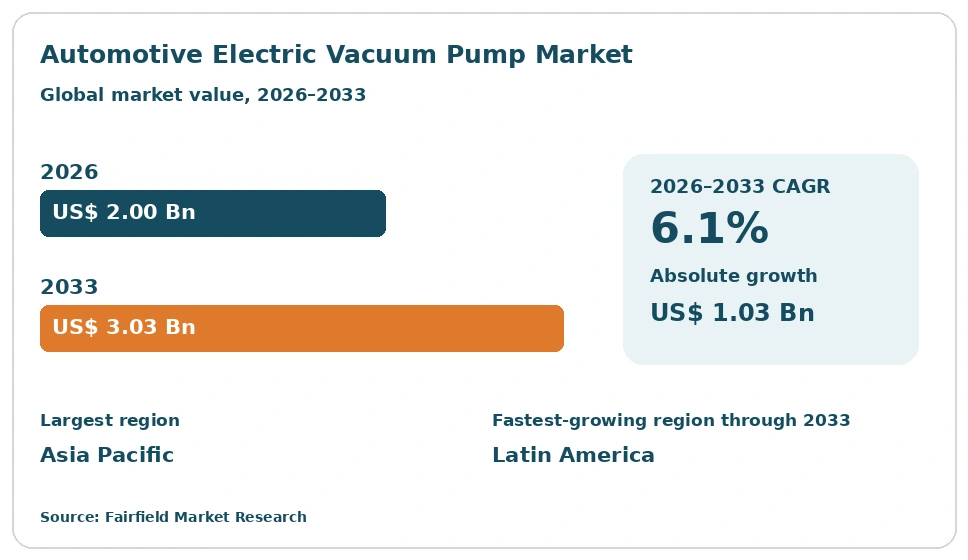
The global automotive electric vacuum pump market size is expected to be valued at US$ 2.00 billion in 2026 and projected to reach US$ 3.03 billion by 2033, growing at a CAGR of 6.1% between 2026 and 2033.
Between 2020 and 2025, the market grew at a CAGR of about 5.9%, rising from roughly US$ 1.35 billion to US$ 1.80 billion, as vehicle production recovered after pandemic shutdowns and chip shortages, electric and hybrid vehicle sales rose quickly, and stricter fuel economy rules pushed automakers to replace engine-driven pumps with electric ones. The automotive electric vacuum pump market covers electrically driven pumps that create vacuum for brake boosters and other systems in vehicles. Traditional gasoline engines create vacuum naturally, but electric vehicles, hybrids, turbocharged engines, and diesel engines do not produce enough, so they need a separate pump. Electric pumps run only when needed, saving fuel and energy compared with mechanical pumps driven all the time by the engine. Main types include rotary vane, diaphragm, and scroll pumps. In June 2025, FORVIA HELLA expanded electric vacuum pump production capacity in China.
Key Report Takeaways
- By Pump Type: Rotary Vane Pumps held about 48% share in 2025, while Scroll Pumps are projected to expand at a 7.4% CAGR through 2033, driven by quieter operation, compact size, and lower vibration that suit premium electric and hybrid vehicles.
- By Propulsion: Internal Combustion Engine Vehicles held about 65% share in 2025, while Electric Vehicles are projected to expand at a 7.1% CAGR through 2033, driven by rising battery-electric production and the need for vacuum supply where no engine exists.
- By Vehicle Type: Passenger Cars held about 77% share in 2025, while Commercial Vehicles are projected to expand at a 6.8% CAGR through 2033, driven by electric vans, light trucks, and buses that need reliable braking support.
- By Region: Asia Pacific held about 53% share in 2025, while Latin America is projected to expand at a 7.8% CAGR through 2033, driven by vehicle production growth in Brazil and Mexico and rising hybrid and electric vehicle adoption.
Global Automotive Electric Vacuum Pump Market Trends and Insights
Drivers Impact Analysis
Two drivers carry the strongest influence on automotive electric vacuum pump market demand during the forecast period.
| Driver | Impact on CAGR Forecast | Geographic Relevance | Impact Timeline |
| Electric and hybrid vehicle growth | High | Global | Long term (≥4 years) |
| Fuel economy and emission rules | Medium | Europe, North America, Asia Pacific | Medium term (2-4 years) |
Vehicle Electrification Is Driving the Automotive Electric Vacuum Pump Market
Electric and hybrid vehicle growth is the strongest driver of the automotive electric vacuum pump market. Electrified vehicles need a separate source of vacuum.
The mechanism is simple. Conventional gasoline engines create vacuum in the intake manifold, which powers the brake booster that makes braking easier. Battery-electric vehicles have no engine, and hybrids often switch the engine off at stops and low speeds, so they need an electric pump to keep brakes working safely. Sales of electric and hybrid cars are growing in China, Europe, North America, and other regions, supported by government targets and incentives. The share of electric vacuum pump value from electrified vehicles rose from about 27% in 2022 to about 35% in 2025. Mild-hybrid systems using 48-volt power add further demand. These trends support steady long-term growth for pump suppliers.
Emission Rules Are Expanding the Automotive Electric Vacuum Pump Market
Fuel economy and emission rules are expanding the automotive electric vacuum pump market. Automakers must cut fuel use and carbon emissions.
The cause is tighter regulation. Rules such as Euro 7 in Europe, corporate fuel economy standards in North America, and fuel consumption limits in China, India, and Japan push automakers to reduce engine losses. Mechanical vacuum pumps run whenever the engine runs, wasting energy, while electric pumps run only when needed. Downsized turbocharged gasoline engines and direct-injection systems also create less natural vacuum, so they need electric pumps to support braking. Start-stop systems, which shut the engine off at traffic lights, also require a vacuum source when the engine is off. These changes increase the number of conventional vehicles fitted with electric pumps, supporting demand even before full electrification.
Restraints Impact Analysis
Two restraints limit how quickly the automotive electric vacuum pump market grows.
| Restraint | Impact on CAGR Forecast | Geographic Relevance | Impact Timeline |
| Shift to brake-by-wire and electromechanical boosters | High | Europe, North America, Asia Pacific | Long term (≥4 years) |
| Cost pressure and vehicle production swings | Medium | Global | Short term (≤2 years) |
Brake-by-Wire Slows the Automotive Electric Vacuum Pump Market
The shift to brake-by-wire and electromechanical boosters slows the automotive electric vacuum pump market. Some new braking systems do not need vacuum at all.
The problem is that suppliers such as Robert Bosch, Continental, and ZF offer electromechanical brake boosters and integrated brake systems that use an electric motor to create brake pressure directly, removing the need for a vacuum booster and pump. These systems also support regenerative braking and advanced driver assistance features such as automatic emergency braking, which makes them attractive for new electric vehicle platforms. Full brake-by-wire systems are also being developed. As more automakers adopt these technologies, especially in premium and electric models, demand for vacuum pumps in those vehicles may fall. This trend could limit long-term growth, particularly after 2030, as new platforms replace older designs.
Cost Pressure Restricts the Automotive Electric Vacuum Pump Market
Cost pressure and vehicle production swings restrict the automotive electric vacuum pump market. Automakers push suppliers to lower prices.
The constraint is that vehicle manufacturers negotiate hard on component prices, especially for high-volume parts, and expect yearly price cuts. Electric pumps need motors, electronics, and sensors, which cost more than mechanical pumps, and rising prices for copper, magnets, and chips squeeze margins. Vehicle production can drop sharply during economic slowdowns, supply shortages, or trade disputes, as seen during the chip shortage in 2021 and 2022. Tariffs on vehicles and parts between major economies add uncertainty for global suppliers. Competition from lower-cost Chinese manufacturers also puts pressure on established brands. Smaller suppliers often lack the scale to absorb these pressures. These factors limit profitability and make investment planning more difficult.
Market Opportunities
Hybrid and Commercial Vehicles Open a Fast-Growth Revenue Pool
Hybrid and commercial vehicles open a fast-growth revenue pool. These vehicles still rely on vacuum braking systems.
The opportunity comes from strong growth in hybrid vehicles, which many automakers are expanding as a bridge to full electrification, and from electric vans, light trucks, and buses. Many of these vehicles use conventional vacuum brake boosters, which need reliable electric pumps that can run often without overheating. 48-volt mild-hybrid systems are spreading across many car models, creating demand for compatible pumps. Commercial vehicles need durable, high-capacity pumps that last through heavy daily use. Supply contracts for new hybrid pickup and sport utility vehicle programs in North America show this demand. Taxi and ride-hailing fleets are also switching to hybrids. Suppliers that offer robust, efficient pumps for these platforms can win long-term contracts.
Quieter and Smarter Pumps Create a Growth Revenue Pool
Quieter and smarter pumps create a growth revenue pool. Electric vehicles are very quiet, so pump noise is noticeable.
The opportunity reflects demand for pumps with lower noise and vibration, better energy efficiency, and longer life. Scroll pumps and brushless motor designs run more quietly than older rotary vane pumps, which matters in electric cars where there is no engine sound to hide noise. Smart pumps with sensors and electronic control can adjust speed to demand, report faults, and connect with vehicle diagnostics. Compact pumps integrated into brake modules save space and assembly time. Aftermarket sales are also rising as early electric and hybrid vehicles age. Automakers increasingly test pump noise inside the cabin during development. Suppliers that invest in quiet, connected, and compact designs can earn higher prices and stronger relationships with automakers.
Segment Analysis
By Pump Type: Rotary Vane Pumps Lead While Scroll Pumps Grow Fastest
Rotary Vane Pumps held about 48% share in 2025. They use rotating vanes to move air and create vacuum, offering reliable performance, compact size, and low cost. They are widely used in passenger cars and light commercial vehicles across all regions and remain the standard design for many automakers. Their simple construction also makes them easy to service and replace.
Scroll Pumps are the fastest-growing pump type, expanding at a 7.4% CAGR through 2033. Two interlocking spiral parts compress air smoothly, giving quiet operation, low vibration, and long life, which suits electric and premium vehicles. Diaphragm Pumps form another segment, valued for oil-free operation and durability. For the market, scroll growth reflects demand for quieter pumps in electric vehicles and rising expectations for cabin comfort.
By Propulsion: Internal Combustion Engine Vehicles Lead While Electric Vehicles Grow Fastest
Internal Combustion Engine Vehicles held about 65% share in 2025. Turbocharged gasoline, direct-injection, and diesel engines often need electric pumps because they do not create enough natural vacuum, and start-stop systems require vacuum when the engine is off. Large global production keeps this the biggest segment.
Electric Vehicles are the fastest-growing propulsion type, expanding at a 7.1% CAGR through 2033. Battery-electric vehicles have no engine to create vacuum, so those using vacuum brake boosters need an electric pump. Hybrid Vehicles form another segment, growing steadily as automakers add mild and full hybrid models. Some electric vehicles skip vacuum pumps by using electromechanical boosters, which limits this segment. For the market, electric vehicle growth shifts demand toward quieter, more efficient pumps with higher value.
By Vehicle Type: Passenger Cars Lead While Commercial Vehicles Grow Fastest
Passenger Cars held about 77% share in 2025. Sedans, hatchbacks, and sport utility vehicles are produced in very large numbers worldwide, and many use electric vacuum pumps for brake support. Growing hybrid and electric car sales keep demand rising.
Commercial Vehicles are the fastest-growing vehicle type, expanding at a 6.8% CAGR through 2033. Electric vans, delivery trucks, pickups, and buses need strong and durable pumps to support braking under heavy loads and frequent stops. Growth in e-commerce delivery fleets and electric buses supports demand. Fleet operators value pumps that need little maintenance and can run for many hours each day. Electric school buses are another growing use. For the market, commercial vehicle growth adds higher-capacity pumps with longer service life and stronger replacement demand.
Geography Analysis
Which Region Is Leading the Automotive Electric Vacuum Pump Market?
Asia Pacific is leading the automotive electric vacuum pump market with about 53% share in 2025. China alone was worth about US$ 618 million in 2025, supported by the world’s largest vehicle production and electric vehicle market. Japan and South Korea have major automakers and suppliers such as Denso, while India is growing vehicle production and adopting hybrid technology. Global suppliers such as FORVIA HELLA are expanding local production in China. Key barriers include price competition from local makers and the shift to electromechanical brakes. Exports of Chinese vehicles also carry local pumps to other markets. One change shaping the region is rapid electric vehicle growth.
Europe Shapes the Automotive Electric Vacuum Pump Market Through Emission Rules
Europe holds about 21% of the automotive electric vacuum pump market and is expanding at about 7.4% CAGR. Germany, France, Italy, Spain, and the United Kingdom have major automakers and leading suppliers such as FORVIA HELLA, Rheinmetall, Robert Bosch, and Continental. Strict carbon dioxide limits and Euro 7 rules push electrification and efficient components. Mild-hybrid systems are widely used in new cars. Key barriers include high energy costs and weak vehicle sales. Many automakers are moving some production to lower-cost countries within the region. Aftermarket demand is also steady in the region’s large vehicle fleet. One opportunity is pumps for hybrid and electric models.
Which Region Is Growing Fastest in the Automotive Electric Vacuum Pump Market?
Latin America is the fastest-growing automotive electric vacuum pump market, expanding at a 7.8% CAGR through 2033. Brazil is a major vehicle producer, with flex-fuel and hybrid models growing, while Mexico builds large numbers of cars, pickups, and parts for export to North America. Argentina and Colombia add demand from local assembly and imports. Rising fuel economy standards and electric vehicle imports also support growth. Key barriers include economic swings and currency changes. Chinese automakers are building new plants in Brazil and Mexico. Local suppliers are also starting to make pumps for these plants. One change shaping the region is rising hybrid vehicle production.
North America Drives the Automotive Electric Vacuum Pump Market Through Hybrid Trucks
North America holds about 15% of the automotive electric vacuum pump market and is expanding at about 7.3% CAGR. The United States has large production of pickups and sport utility vehicles, and automakers are adding hybrid versions that need electric pumps. Supplier BorgWarner has won contracts for hybrid pickup and sport utility vehicle programs. Canada and Mexico are part of an integrated vehicle supply chain. Key barriers include tariffs and changing electric vehicle policies. Electric vehicle sales continue to grow despite policy changes. Aftermarket sales are rising as early hybrids age. Many suppliers serve automakers from plants in Mexico. One opportunity is pumps for hybrid trucks.
Middle East & Africa Builds the Automotive Electric Vacuum Pump Market Through Vehicle Imports
Middle East & Africa is a small but growing automotive electric vacuum pump market. Saudi Arabia and the United Arab Emirates have high vehicle ownership and are investing in local vehicle assembly and electric vehicle programs. South Africa and Morocco are important vehicle production hubs exporting to Europe, while Egypt is expanding local assembly. Key barriers include limited local parts production and reliance on imports. Hybrid taxis and fleet vehicles are becoming common in large cities. Hot climates also put extra stress on pump motors and electronics. Government programs in Saudi Arabia support local electric vehicle production. One opportunity is supplying local assembly plants and the replacement parts market.
Competitive Landscape
The automotive electric vacuum pump market is moderately consolidated. FORVIA HELLA, Rheinmetall, Robert Bosch, Continental, and Denso are leading players, together holding about 62.4% of the market, with FORVIA HELLA leading at about 22.7%. BorgWarner, Aisin, ZF Friedrichshafen, Mikuni, Youngshin Precision, Tuopu Group, and Wabco compete strongly. Chinese suppliers are gaining share by serving domestic electric vehicle makers with lower-cost pumps.
Companies compete on reliability, noise and vibration levels, energy efficiency, size and weight, durability, price, and the ability to supply automakers in several regions. Long development cycles and strict safety testing for braking parts create high barriers to entry, so established suppliers with proven designs and quality systems keep strong positions. Close engineering partnerships with automakers on new vehicle platforms are essential to winning contracts that often last many years.
Strategic moves show how competition is changing. In November 2024, BorgWarner won contracts for hybrid pickup and sport utility vehicle programs in North America. In February 2025, Robert Bosch integrated a compact pump into its iBooster 2.0 module, and in April 2025, Continental showed a 48-volt pump for mild hybrids. In June 2025, FORVIA HELLA expanded capacity in China. These moves show suppliers targeting hybrids and integrating pumps into braking modules.
Three themes shape vendor strategy. First, suppliers are developing quieter scroll and brushless pumps for electric vehicles. Second, they are integrating pumps into compact brake modules and supporting 48-volt hybrid systems. Third, they are expanding production in Asia Pacific and Latin America to serve growing vehicle output.
Automotive Electric Vacuum Pump Market Industry Leaders
- FORVIA HELLA
- Rheinmetall
- Robert Bosch
- Continental
- Denso
Recent Industry Developments
- June 2025: FORVIA HELLA expanded production capacity for electronically controlled vacuum pumps in China - strengthens local supply in the largest region of the automotive electric vacuum pump market.
- April 2025: Continental presented a 48-volt compatible vacuum pump module for mild-hybrid platforms, with production planned from 2026 - targets fast-growing mild-hybrid vehicles.
- February 2025: Robert Bosch integrated a compact brushless vacuum pump into its iBooster 2.0 module, reducing the assembly footprint by about 15% - shows the move toward integrated brake systems.
- November 2024: BorgWarner announced supply agreements with two North America automakers for hybrid pickup and sport utility vehicle programs - expands electric vacuum pump use in hybrid trucks.
Companies Covered in the Report
- FORVIA HELLA
- Rheinmetall
- Robert Bosch
- Continental
- Denso
- BorgWarner
- Aisin
- ZF Friedrichshafen
- Mikuni
- Youngshin Precision
- Tuopu Group
- Wabco
Automotive Electric Vacuum Pump Market Report Scope
This report covers the automotive electric vacuum pump market, including rotary vane, scroll, and diaphragm pumps used in internal combustion engine, hybrid, and electric vehicles, across passenger cars and commercial vehicles, sold through original equipment and aftermarket channels. The base year is 2025, and the forecast period runs from 2026 to 2033. All values are expressed in US$ Billion.
| Pump Type | Rotary Vane Pumps, Scroll Pumps, Diaphragm Pumps |
| Propulsion | Internal Combustion Engine Vehicles, Hybrid Vehicles, Electric Vehicles |
| Vehicle Type | Passenger Cars, Commercial Vehicles |
| Regions | North America, Europe, Asia Pacific, Latin America, Middle East & Africa |
1. Executive Summary
1.1 Automotive Electric Vacuum Pump Market Snapshot
1.2 Future Projections
1.3 Key Market Trends
1.4 Regional Snapshot
2. Market Overview
2.1 Market Definition and Report Scope
2.2 Historical Market Trends
2.3 Market Dynamics
2.3.1 Drivers
2.3.1.1 Vehicle Electrification Is Driving the Automotive Electric Vacuum Pump Market
2.3.1.2 Emission Rules Are Expanding the Automotive Electric Vacuum Pump Market
2.3.2 Restraints
2.3.2.1 Brake-by-Wire Slows the Automotive Electric Vacuum Pump Market
2.3.2.2 Cost Pressure Restricts the Automotive Electric Vacuum Pump Market
2.3.3 Market Opportunities
2.3.3.1 Hybrid and Commercial Vehicles Open a Fast-Growth Revenue Pool
2.3.3.2 Quieter and Smarter Pumps Create a Growth Revenue Pool
3. Global Automotive Electric Vacuum Pump Market Outlook, 2020–2033
3.1 Global Automotive Electric Vacuum Pump Market Outlook, by Pump Type, Value (US$ Billion), 2020–2033
3.1.1 Rotary Vane Pumps
3.1.2 Scroll Pumps
3.1.3 Diaphragm Pumps
3.2 Global Automotive Electric Vacuum Pump Market Outlook, by Propulsion, Value (US$ Billion), 2020–2033
3.2.1 Internal Combustion Engine Vehicles
3.2.2 Hybrid Vehicles
3.2.3 Electric Vehicles
3.3 Global Automotive Electric Vacuum Pump Market Outlook, by Vehicle Type, Value (US$ Billion), 2020–2033
3.3.1 Passenger Cars
3.3.2 Commercial Vehicles
3.4 Global Automotive Electric Vacuum Pump Market Outlook, by Region, Value (US$ Billion), 2020–2033
3.4.1 North America
3.4.2 Europe
3.4.3 Asia Pacific
3.4.4 Latin America
3.4.5 Middle East & Africa
4. Asia Pacific Automotive Electric Vacuum Pump Market Outlook, 2020–2033
4.1 Asia Pacific Automotive Electric Vacuum Pump Market Outlook, by Pump Type, Value (US$ Billion), 2020–2033
4.1.1 Rotary Vane Pumps
4.1.2 Scroll Pumps
4.1.3 Diaphragm Pumps
4.2 Asia Pacific Automotive Electric Vacuum Pump Market Outlook, by Propulsion, Value (US$ Billion), 2020–2033
4.2.1 Internal Combustion Engine Vehicles
4.2.2 Hybrid Vehicles
4.2.3 Electric Vehicles
4.3 Asia Pacific Automotive Electric Vacuum Pump Market Outlook, by Vehicle Type, Value (US$ Billion), 2020–2033
4.3.1 Passenger Cars
4.3.2 Commercial Vehicles
4.4 Asia Pacific Automotive Electric Vacuum Pump Market Outlook, by Country, Value (US$ Billion), 2020–2033
4.4.1 China Automotive Electric Vacuum Pump Market Outlook, by Pump Type, 2020–2033
4.4.2 China Automotive Electric Vacuum Pump Market Outlook, by Propulsion, 2020–2033
4.4.3 China Automotive Electric Vacuum Pump Market Outlook, by Vehicle Type, 2020–2033
4.4.4 Japan Automotive Electric Vacuum Pump Market Outlook, by Pump Type, 2020–2033
4.4.5 Japan Automotive Electric Vacuum Pump Market Outlook, by Propulsion, 2020–2033
4.4.6 Japan Automotive Electric Vacuum Pump Market Outlook, by Vehicle Type, 2020–2033
4.4.7 South Korea Automotive Electric Vacuum Pump Market Outlook, by Pump Type, 2020–2033
4.4.8 South Korea Automotive Electric Vacuum Pump Market Outlook, by Propulsion, 2020–2033
4.4.9 South Korea Automotive Electric Vacuum Pump Market Outlook, by Vehicle Type, 2020–2033
4.4.10 India Automotive Electric Vacuum Pump Market Outlook, by Pump Type, 2020–2033
4.4.11 India Automotive Electric Vacuum Pump Market Outlook, by Propulsion, 2020–2033
4.4.12 India Automotive Electric Vacuum Pump Market Outlook, by Vehicle Type, 2020–2033
5. Europe Automotive Electric Vacuum Pump Market Outlook, 2020–2033
5.1 Europe Automotive Electric Vacuum Pump Market Outlook, by Pump Type, Value (US$ Billion), 2020–2033
5.1.1 Rotary Vane Pumps
5.1.2 Scroll Pumps
5.1.3 Diaphragm Pumps
5.2 Europe Automotive Electric Vacuum Pump Market Outlook, by Propulsion, Value (US$ Billion), 2020–2033
5.2.1 Internal Combustion Engine Vehicles
5.2.2 Hybrid Vehicles
5.2.3 Electric Vehicles
5.3 Europe Automotive Electric Vacuum Pump Market Outlook, by Vehicle Type, Value (US$ Billion), 2020–2033
5.3.1 Passenger Cars
5.3.2 Commercial Vehicles
5.4 Europe Automotive Electric Vacuum Pump Market Outlook, by Country, Value (US$ Billion), 2020–2033
5.4.1 Germany Automotive Electric Vacuum Pump Market Outlook, by Pump Type, 2020–2033
5.4.2 Germany Automotive Electric Vacuum Pump Market Outlook, by Propulsion, 2020–2033
5.4.3 Germany Automotive Electric Vacuum Pump Market Outlook, by Vehicle Type, 2020–2033
5.4.4 France Automotive Electric Vacuum Pump Market Outlook, by Pump Type, 2020–2033
5.4.5 France Automotive Electric Vacuum Pump Market Outlook, by Propulsion, 2020–2033
5.4.6 France Automotive Electric Vacuum Pump Market Outlook, by Vehicle Type, 2020–2033
5.4.7 Italy Automotive Electric Vacuum Pump Market Outlook, by Pump Type, 2020–2033
5.4.8 Italy Automotive Electric Vacuum Pump Market Outlook, by Propulsion, 2020–2033
5.4.9 Italy Automotive Electric Vacuum Pump Market Outlook, by Vehicle Type, 2020–2033
5.4.10 Spain Automotive Electric Vacuum Pump Market Outlook, by Pump Type, 2020–2033
5.4.11 Spain Automotive Electric Vacuum Pump Market Outlook, by Propulsion, 2020–2033
5.4.12 Spain Automotive Electric Vacuum Pump Market Outlook, by Vehicle Type, 2020–2033
5.4.13 United Kingdom Automotive Electric Vacuum Pump Market Outlook, by Pump Type, 2020–2033
5.4.14 United Kingdom Automotive Electric Vacuum Pump Market Outlook, by Propulsion, 2020–2033
5.4.15 United Kingdom Automotive Electric Vacuum Pump Market Outlook, by Vehicle Type, 2020–2033
6. Latin America Automotive Electric Vacuum Pump Market Outlook, 2020–2033
6.1 Latin America Automotive Electric Vacuum Pump Market Outlook, by Pump Type, Value (US$ Billion), 2020–2033
6.1.1 Rotary Vane Pumps
6.1.2 Scroll Pumps
6.1.3 Diaphragm Pumps
6.2 Latin America Automotive Electric Vacuum Pump Market Outlook, by Propulsion, Value (US$ Billion), 2020–2033
6.2.1 Internal Combustion Engine Vehicles
6.2.2 Hybrid Vehicles
6.2.3 Electric Vehicles
6.3 Latin America Automotive Electric Vacuum Pump Market Outlook, by Vehicle Type, Value (US$ Billion), 2020–2033
6.3.1 Passenger Cars
6.3.2 Commercial Vehicles
6.4 Latin America Automotive Electric Vacuum Pump Market Outlook, by Country, Value (US$ Billion), 2020–2033
6.4.1 Brazil Automotive Electric Vacuum Pump Market Outlook, by Pump Type, 2020–2033
6.4.2 Brazil Automotive Electric Vacuum Pump Market Outlook, by Propulsion, 2020–2033
6.4.3 Brazil Automotive Electric Vacuum Pump Market Outlook, by Vehicle Type, 2020–2033
6.4.4 Mexico Automotive Electric Vacuum Pump Market Outlook, by Pump Type, 2020–2033
6.4.5 Mexico Automotive Electric Vacuum Pump Market Outlook, by Propulsion, 2020–2033
6.4.6 Mexico Automotive Electric Vacuum Pump Market Outlook, by Vehicle Type, 2020–2033
6.4.7 Argentina Automotive Electric Vacuum Pump Market Outlook, by Pump Type, 2020–2033
6.4.8 Argentina Automotive Electric Vacuum Pump Market Outlook, by Propulsion, 2020–2033
6.4.9 Argentina Automotive Electric Vacuum Pump Market Outlook, by Vehicle Type, 2020–2033
6.4.10 Colombia Automotive Electric Vacuum Pump Market Outlook, by Pump Type, 2020–2033
6.4.11 Colombia Automotive Electric Vacuum Pump Market Outlook, by Propulsion, 2020–2033
6.4.12 Colombia Automotive Electric Vacuum Pump Market Outlook, by Vehicle Type, 2020–2033
7. North America Automotive Electric Vacuum Pump Market Outlook, 2020–2033
7.1 North America Automotive Electric Vacuum Pump Market Outlook, by Pump Type, Value (US$ Billion), 2020–2033
7.1.1 Rotary Vane Pumps
7.1.2 Scroll Pumps
7.1.3 Diaphragm Pumps
7.2 North America Automotive Electric Vacuum Pump Market Outlook, by Propulsion, Value (US$ Billion), 2020–2033
7.2.1 Internal Combustion Engine Vehicles
7.2.2 Hybrid Vehicles
7.2.3 Electric Vehicles
7.3 North America Automotive Electric Vacuum Pump Market Outlook, by Vehicle Type, Value (US$ Billion), 2020–2033
7.3.1 Passenger Cars
7.3.2 Commercial Vehicles
7.4 North America Automotive Electric Vacuum Pump Market Outlook, by Country, Value (US$ Billion), 2020–2033
7.4.1 United States Automotive Electric Vacuum Pump Market Outlook, by Pump Type, 2020–2033
7.4.2 United States Automotive Electric Vacuum Pump Market Outlook, by Propulsion, 2020–2033
7.4.3 United States Automotive Electric Vacuum Pump Market Outlook, by Vehicle Type, 2020–2033
7.4.4 Canada Automotive Electric Vacuum Pump Market Outlook, by Pump Type, 2020–2033
7.4.5 Canada Automotive Electric Vacuum Pump Market Outlook, by Propulsion, 2020–2033
7.4.6 Canada Automotive Electric Vacuum Pump Market Outlook, by Vehicle Type, 2020–2033
7.4.7 Mexico Automotive Electric Vacuum Pump Market Outlook, by Pump Type, 2020–2033
7.4.8 Mexico Automotive Electric Vacuum Pump Market Outlook, by Propulsion, 2020–2033
7.4.9 Mexico Automotive Electric Vacuum Pump Market Outlook, by Vehicle Type, 2020–2033
8. Middle East & Africa Automotive Electric Vacuum Pump Market Outlook, 2020–2033
8.1 Middle East & Africa Automotive Electric Vacuum Pump Market Outlook, by Pump Type, Value (US$ Billion), 2020–2033
8.1.1 Rotary Vane Pumps
8.1.2 Scroll Pumps
8.1.3 Diaphragm Pumps
8.2 Middle East & Africa Automotive Electric Vacuum Pump Market Outlook, by Propulsion, Value (US$ Billion), 2020–2033
8.2.1 Internal Combustion Engine Vehicles
8.2.2 Hybrid Vehicles
8.2.3 Electric Vehicles
8.3 Middle East & Africa Automotive Electric Vacuum Pump Market Outlook, by Vehicle Type, Value (US$ Billion), 2020–2033
8.3.1 Passenger Cars
8.3.2 Commercial Vehicles
8.4 Middle East & Africa Automotive Electric Vacuum Pump Market Outlook, by Country, Value (US$ Billion), 2020–2033
8.4.1 Saudi Arabia Automotive Electric Vacuum Pump Market Outlook, by Pump Type, 2020–2033
8.4.2 Saudi Arabia Automotive Electric Vacuum Pump Market Outlook, by Propulsion, 2020–2033
8.4.3 Saudi Arabia Automotive Electric Vacuum Pump Market Outlook, by Vehicle Type, 2020–2033
8.4.4 United Arab Emirates Automotive Electric Vacuum Pump Market Outlook, by Pump Type, 2020–2033
8.4.5 United Arab Emirates Automotive Electric Vacuum Pump Market Outlook, by Propulsion, 2020–2033
8.4.6 United Arab Emirates Automotive Electric Vacuum Pump Market Outlook, by Vehicle Type, 2020–2033
8.4.7 South Africa Automotive Electric Vacuum Pump Market Outlook, by Pump Type, 2020–2033
8.4.8 South Africa Automotive Electric Vacuum Pump Market Outlook, by Propulsion, 2020–2033
8.4.9 South Africa Automotive Electric Vacuum Pump Market Outlook, by Vehicle Type, 2020–2033
8.4.10 Morocco Automotive Electric Vacuum Pump Market Outlook, by Pump Type, 2020–2033
8.4.11 Morocco Automotive Electric Vacuum Pump Market Outlook, by Propulsion, 2020–2033
8.4.12 Morocco Automotive Electric Vacuum Pump Market Outlook, by Vehicle Type, 2020–2033
8.4.13 Egypt Automotive Electric Vacuum Pump Market Outlook, by Pump Type, 2020–2033
8.4.14 Egypt Automotive Electric Vacuum Pump Market Outlook, by Propulsion, 2020–2033
8.4.15 Egypt Automotive Electric Vacuum Pump Market Outlook, by Vehicle Type, 2020–2033
9. Competitive Landscape
9.1 Automotive Electric Vacuum Pump Market Industry Leaders
9.2 Recent Industry Developments
9.3 Company Profiles
9.3.1 FORVIA HELLA
9.3.2 Rheinmetall
9.3.3 Robert Bosch
9.3.4 Continental
9.3.5 Denso
9.3.6 BorgWarner
9.3.7 Aisin
9.3.8 ZF Friedrichshafen
9.3.9 Mikuni
9.3.10 Youngshin Precision
9.3.11 Tuopu Group
9.3.12 Wabco
10. Appendix
10.1 Research Methodology
10.2 Report Assumptions
10.3 Acronyms and Abbreviations
| Pump Type | Rotary Vane Pumps, Scroll Pumps, Diaphragm Pumps |
| Propulsion | Internal Combustion Engine Vehicles, Hybrid Vehicles, Electric Vehicles |
| Vehicle Type | Passenger Cars, Commercial Vehicles |
| Regions | North America, Europe, Asia Pacific, Latin America, Middle East & Africa |
Our Research Methodology
Considering the volatility of business today, traditional approaches to strategizing a game plan can be unfruitful if not detrimental. True ambiguity is no way to determine a forecast. A myriad of predetermined factors must be accounted for such as the degree of risk involved, the magnitude of circumstances, as well as conditions or consequences that are not known or unpredictable. To circumvent binary views that cast uncertainty, the application of market research intelligence to strategically posture, move, and enable actionable outcomes is necessary.
View Methodology
Quality Assured
Rigorous Validation Process

Confidentiality Assured
End-to-end Data Security

Custom Research Services
Tailored To Your Objectives
FAQs
The automotive electric vacuum pump market is valued at US$ 2.00 billion in 2026, led by rotary vane pumps and Asia Pacific.
The market is projected to reach US$ 3.03 billion by 2033, growing at a 6.1% CAGR and adding US$ 1.03 billion.
Electric vehicles are growing fastest at a 7.1% CAGR through 2033, because battery-electric cars lack engines that create natural vacuum.
Latin America is growing fastest at a 7.8% CAGR through 2033, driven by vehicle production in Brazil and Mexico.
Asia Pacific holds the largest share at about 53% in 2025, supported by large vehicle and electric vehicle production in China.
Related Reports
EV Contactor Relay Market Size, Share, Insights, Competitive Landscape, and Forecast 2026 to 2033
The global EV contactor relay market is valued at US$2.4 billion in 2026, reaching US$6.3 billion by 2033, growing at a 14.8% CAGR
Locomotive Market Size, Share, Insights, Competitive Landscape, and Forecast 2026 to 2033
The locomotive market is projected to reach US$29.5 billion by 2033. Explore propulsion trends, freight and passenger demand, and regional growth.
Li-ion Battery Management Systems Market Size, Share, Insights, Competitive Landscape, and Forecast 2026 to 2033
The Li-ion battery management systems market is projected to reach US$30.2 billion by 2033. Explore trends by topology, pack voltage, and application.
In-Vehicle Payment Services Market Size, Share, Insights, Competitive Landscape, and Forecast 2026 to 2033
The in-vehicle payment services market is forecast to reach US$30.86 billion by 2033 at a 17.3% CAGR as connected cars expand access to in-car payments.
Automotive TIC Services Market Size, Share, Insights, Competitive Landscape, and Forecast 2026 to 2033
The global automotive TIC services market is valued at US$25.30 billion in 2026, reaching US$37.79 billion by 2033, growing at a 5.9% CAGR
Recreational Vehicle Market Size, Share, Insights, Competitive Landscape, and Forecast 2026 to 2033
The global recreational vehicle market is valued at US$78.3 billion in 2026, reaching US$168.3 billion by 2033, growing at an 11.6% CAGR