



Automotive Pinion Gear Market
Automotive Pinion Gear Market Size, Share, Insights, Competitive Landscape, and Forecast 2026 to 2033
Automotive Pinion Gear Market Size and Trend Analysis
How Fast Is the Automotive Pinion Gear Market Growing?
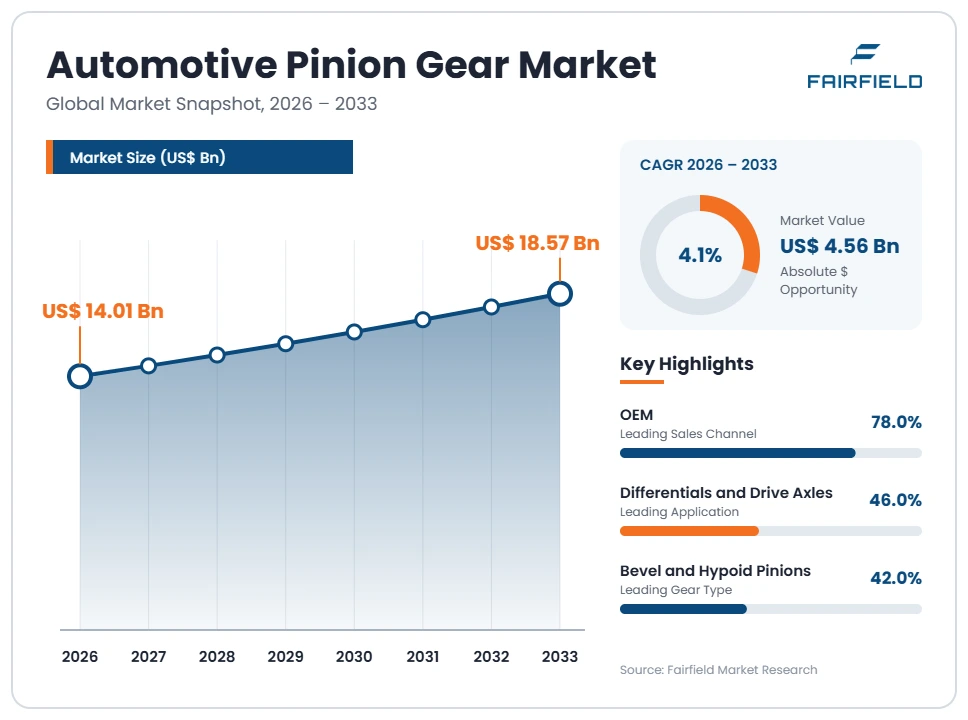
The global automotive pinion gear market size is expected to be valued at US$ 14.01 billion in 2026 and projected to reach US$ 18.57 billion by 2033, growing at a CAGR of 4.1% between 2026 and 2033.
Between 2020 and 2025, the market grew at a CAGR of about 4.1%, rising from roughly US$ 11.3 billion to about US$ 13.8 billion, as vehicle production recovered from pandemic shutdowns and chip shortages, demand for SUVs and pickup trucks with heavier drivetrains grew, and electric vehicle output rose sharply in China and Europe. The automotive pinion gear market covers small driving gears that mesh with larger gears or racks to transfer torque and change speed or direction. Pinions are used in differentials and drive axles, where they mesh with ring gears, in rack-and-pinion steering systems, in transmissions, and in electric drive units that reduce motor speed. Main types include bevel, hypoid, spiral bevel, helical, and spur pinions, mostly made from forged and heat-treated alloy steel. In February 2026, Dauch Corporation, formerly American Axle, completed its acquisition of GKN Automotive owner Dowlais Group.
Key Report Takeaways
- By Gear Type: Bevel and Hypoid Pinions held about 42% share in 2025, while Helical Pinions are projected to expand at a 4.8% CAGR through 2033, driven by quiet, efficient reduction gears in electric drive units and growing demand for low-noise drivetrains in vehicles.
- By Application: Differentials and Drive Axles held about 46% share in 2025, while Electric Drive Units are projected to expand at a 9.5% CAGR through 2033, driven by rising battery electric and hybrid vehicle production and the shift toward integrated e-axles worldwide.
- By Sales Channel: Original Equipment Manufacturers held about 78% share in 2025, while Aftermarket is projected to expand at a 4.6% CAGR through 2033, driven by an aging global vehicle fleet, longer vehicle ownership, and growing replacement of worn differential and steering gears.
- By Region: Asia Pacific held about 45% share in 2025, while India is projected to expand at a 5.6% CAGR through 2033, driven by rising vehicle production, growing exports of precision gears, and fast expansion of local driveline component suppliers.
Global Automotive Pinion Gear Market Trends and Insights
Drivers Impact Analysis
Two drivers carry the strongest influence on automotive pinion gear market demand during the forecast period.
| Driver | Impact on CAGR Forecast | Geographic Relevance | Impact Timeline |
| Steady global vehicle production and SUV growth | High | Global | Long term (≥4 years) |
| Electrification and new electric drive units | Medium | Asia Pacific, Europe, North America | Medium term (2-4 years) |
Vehicle Production Is Driving the Automotive Pinion Gear Market
Steady global vehicle production and SUV growth are the strongest driver of the automotive pinion gear market. Almost every vehicle uses several pinion gears.
The mechanism is that each passenger car, SUV, pickup truck, bus, and commercial truck needs pinion gears in its differential, steering system, and transmission or reduction gearbox. Global vehicle production is around 90 million units a year, led by China, the United States, Japan, India, Germany, and South Korea. Consumers continue to buy SUVs and pickup trucks, which often use all-wheel drive, larger axles, and heavier-duty gears with more value per vehicle. Commercial vehicles for logistics and construction also use large, high-strength pinions. Rising incomes in India, Indonesia, and Brazil are expanding new car markets. These trends create steady, high-volume demand for pinion gears across all regions.
Electrification Is Expanding the Automotive Pinion Gear Market
Electrification and new electric drive units are expanding the automotive pinion gear market. Electric vehicles still need precision gears.
The cause is that battery electric and hybrid vehicles use electric drive units that combine a motor, inverter, and reduction gearbox with a differential. Electric motors spin much faster than engines, so reduction gears and differential pinions must be very precise, quiet, and strong, since there is no engine noise to hide gear whine. This drives demand for high-quality helical pinions, advanced grinding and honing, and improved heat treatment. Many EVs with dual or tri-motor setups use more than one drive unit. Suppliers such as Sona Comstar report that a large share of new orders now come from EV programs. Hybrid vehicles also use complex gear sets. These trends raise the value of precision gear content.
Restraints Impact Analysis
Two restraints limit how quickly the automotive pinion gear market grows.
| Restraint | Impact on CAGR Forecast | Geographic Relevance | Impact Timeline |
| Simpler EV drivetrains with fewer gears | High | Global | Long term (≥4 years) |
| Raw material and energy cost volatility | Medium | Europe, Asia Pacific | Medium term (2-4 years) |
Simpler EV Drivetrains Slow the Automotive Pinion Gear Market
Simpler EV drivetrains with fewer gears slow the automotive pinion gear market. Electric vehicles need fewer gears than combustion vehicles.
The problem is that a typical automatic transmission in a combustion vehicle contains many gears and pinions, while most battery electric vehicles use a single-speed reduction gearbox with only a few gears. As EV sales grow, the total number of transmission gears per vehicle falls, which reduces volume for suppliers focused on multi-speed transmissions. Some automakers are bringing gear and e-axle production in-house, which takes business away from independent suppliers. Battery costs and fluctuating EV demand in Europe and North America have also led some automakers to delay programs, creating uncertainty for suppliers that invested in new capacity. Several European suppliers have faced financial distress. These shifts limit growth in some product lines.
Material Costs Restrict the Automotive Pinion Gear Market
Raw material and energy cost volatility restricts the automotive pinion gear market. Gear making uses large amounts of steel and energy.
The constraint is that pinion gears are made from alloy steels containing chromium, nickel, and molybdenum, and prices for these metals change with global supply and demand. Forging, machining, carburizing, and heat treatment use large amounts of electricity and natural gas, and energy prices in Europe rose sharply in recent years. Automakers often push suppliers for annual price cuts and resist passing on cost increases. Trade tariffs on steel and auto parts have raised costs and complicated supply chains between North America, Europe, and Asia Pacific. Skilled labor shortages in gear grinding and heat treatment add further pressure. These factors squeeze supplier margins and slow investment.
Market Opportunities
Precision EV Gears Open a Fast-Growth Revenue Pool
Precision EV gears open a fast-growth revenue pool. Electric drive units need the best gears.
The opportunity comes from fast growth in electric drive units, e-axles, and hybrid transmissions, which require pinions with very tight tolerances, low noise, high efficiency, and strength to handle instant motor torque. Gear makers can win business with advanced grinding, superfinishing, optimized tooth profiles, and simulation tools that reduce gear whine. Integrated differential assemblies and reduction gear sets offer higher value per vehicle than single gears. Sona Comstar estimates its global share in differential gears rose to 8.7% in 2025, helped by strong EV orders. Suppliers that offer complete, tested gear assemblies, local production near EV plants, and engineering support during vehicle development can win premium, long-term contracts with automakers around the world.
Aftermarket and Emerging Markets Create a Growth Revenue Pool
Aftermarket and emerging markets create a growth revenue pool. Older vehicles and new car buyers both need gears.
The opportunity reflects the aging global vehicle fleet, with the average car in the United States now more than 12 years old, and many vehicles in Europe and Latin America kept for long periods. Worn differential pinions, ring and pinion sets, and steering racks need replacement, supporting independent repair shops and performance upgrades for trucks and off-road vehicles. At the same time, vehicle ownership is rising fast in India, Indonesia, Vietnam, Brazil, Mexico, and Saudi Arabia. Suppliers in India and Mexico are also gaining export business from global automakers. Companies that offer quality aftermarket kits, strong distribution, and local manufacturing can capture strong growth in these expanding markets.
Segment Analysis
- By Gear Type: Bevel and Hypoid Pinions Lead While Helical Pinions Grow Fastest
Bevel and Hypoid Pinions held about 42% share in 2025. These pinions turn power at a right angle in rear and all-wheel-drive differentials and drive axles, meshing with ring gears to drive the wheels. Hypoid gears, with offset pinions, allow lower driveshafts and quieter operation, and are standard in many SUVs, pickup trucks, and commercial vehicles. Spiral bevel pinions are also widely used.
Helical Pinions are the fastest-growing gear type, expanding at a 4.8% CAGR through 2033. Their angled teeth mesh gradually, providing smooth, quiet operation and high load capacity, which makes them ideal for electric drive reduction gears and modern transmissions. Spur Pinions and Other Types, including planetary and worm pinions, form further segments. For the market, helical growth supports precision manufacturing investment.
- By Application: Differentials and Drive Axles Lead While Electric Drive Units Grow Fastest
Differentials and Drive Axles held about 46% share in 2025. Every vehicle needs a differential to let wheels turn at different speeds in corners, and pinions inside differentials and axles carry high torque loads. Trucks, SUVs, and all-wheel-drive vehicles often use more than one differential, which raises gear content per vehicle and supports steady demand from axle suppliers.
Electric Drive Units are the fastest-growing application, expanding at a 9.5% CAGR through 2033. These units combine a motor, reduction gears, and differential in a compact package, and demand rises with every new battery electric and hybrid vehicle. Steering Systems, including rack-and-pinion and electric power steering, and Transmissions form further segments. For the market, electric drive growth offsets lower transmission gear demand.
- By Sales Channel: Original Equipment Manufacturers Lead While Aftermarket Grows Fastest
Original Equipment Manufacturers held about 78% share in 2025. Most pinion gears are supplied directly to automakers and Tier 1 driveline and steering suppliers for new vehicles under long-term contracts with strict quality standards. Large volumes and engineering partnerships define this channel, and suppliers must meet strict delivery schedules, quality audits, and annual price reduction targets set by automakers.
Aftermarket is the fastest-growing channel, expanding at a 4.6% CAGR through 2033. Older vehicles need replacement ring and pinion sets, steering racks, and transmission gears, and off-road and performance enthusiasts upgrade gear ratios. Independent repair shops and online parts sellers support this channel. For the market, aftermarket growth provides steady replacement demand that is less affected by swings in new vehicle production and helps suppliers balance their revenue.
Geography Analysis
- Why Is North America Important to the Automotive Pinion Gear Market?
North America is important to the automotive pinion gear market because the United States market was about US$ 3.4 billion in 2023 and has very high demand for pickup trucks and SUVs with large axles and differentials. Dauch Corporation, Dana, Linamar Corporation, and Eaton are major driveline suppliers in the region, and Dauch completed its acquisition of GKN Automotive in 2026. Mexico is a fast-growing hub for gear and axle production, where Sona Comstar opened a plant in 2024. Key barriers include tariffs and shifting EV plans. One opportunity is local supply for new truck and EV programs.
- Europe Shapes the Automotive Pinion Gear Market Through Engineering Expertise
Europe is a major automotive pinion gear market. Germany, France, Italy, the United Kingdom, Spain, and the Czech Republic have large vehicle and driveline industries. ZF Friedrichshafen, Schaeffler, and Getrag, now part of Magna, are leading gear and transmission suppliers. Strict emissions rules and fast EV adoption are shifting demand toward electric drive gears and hybrid transmissions. Key barriers include high energy costs, weak vehicle demand, and supplier financial stress. One opportunity is high-precision gears for premium and electric vehicles, supported by strong engineering skills and many advanced research centers in the region.
- Which Region Is Leading the Automotive Pinion Gear Market?
Asia Pacific is leading the automotive pinion gear market with about 45% share in 2025. China is the world’s largest vehicle producer and the biggest market for electric vehicles, with large domestic gear and e-axle suppliers, and its market is forecast to grow at about 4.5% a year. Japan is home to Aisin Corporation, Musashi Seimitsu Industry, and JTEKT, and South Korea has large automotive and gear industries. Thailand and Indonesia add vehicle production. Key barriers include price competition and overcapacity. One change shaping the region is fast growth in EV drive units, which raises demand for precision helical gears.
- Latin America Grows the Automotive Pinion Gear Market Through Vehicle Production
Latin America is a growing automotive pinion gear market. Brazil and Argentina have large vehicle manufacturing industries, including pickup trucks and commercial vehicles that use heavy-duty axles and differentials. Many global automakers and Tier 1 suppliers run plants in the region. Colombia, Chile, and Peru add demand through large fleets of older vehicles that need replacement parts. Key barriers include economic swings and currency changes. One opportunity is aftermarket gear sets for aging truck fleets, supported by local distributors and repair networks. Rising vehicle production in Brazil, along with growing exports of vehicles and parts, adds demand for original equipment gears.
- Middle East & Africa Builds the Automotive Pinion Gear Market Through New Vehicle Plants
Middle East & Africa is an emerging automotive pinion gear market. South Africa and Morocco have growing vehicle manufacturing and export industries, and Saudi Arabia is investing in new car and EV plants. The region has large fleets of pickup trucks and SUVs that need replacement differential and steering gears, especially in harsh desert and off-road conditions. Egypt and Nigeria show rising vehicle demand. Key barriers include reliance on imports and limited local manufacturing. One opportunity is aftermarket distribution for heavy-use vehicles, supported by large fleets of pickup trucks, buses, and delivery vans that work in tough conditions across the region.
Competitive Landscape
The automotive pinion gear market is fragmented. ZF Friedrichshafen, Dauch Corporation, Aisin Corporation, Musashi Seimitsu Industry, and Linamar Corporation are leading players, while Sona Comstar, Schaeffler, JTEKT Corporation, Dana Incorporated, Eaton, Bharat Gears, and Nexteer Automotive compete strongly. Large Tier 1 suppliers make pinions as part of complete axles, differentials, steering systems, transmissions, and electric drive units, while specialist gear makers supply forged and machined gears to automakers and other suppliers. Many automakers also produce some gears in-house, and hundreds of smaller gear shops serve regional and aftermarket demand.
Companies compete on precision, noise performance, strength, durability, cost, production scale, forging and heat treatment capability, engineering support, and closeness to vehicle assembly plants. Winning a new vehicle program usually means years of steady volume, so suppliers invest heavily in testing and development with automakers. Low-cost producers in China and India are gaining share in global supply chains.
Strategic moves show how competition is changing. In April 2024, Sona Comstar opened a plant in Mexico to serve EV programs in North America. In February 2026, Dauch Corporation completed its acquisition of Dowlais Group, combining axle, driveline, and powder metal businesses. In April 2026, Sona Comstar reported an estimated 8.7% global share in differential gears.
Three themes shape vendor strategy. First, suppliers are consolidating to gain scale and broaden product ranges across combustion, hybrid, and electric vehicles. Second, they are investing in precision grinding, low-noise gear design, and complete electric drive assemblies. Third, they are expanding production in India, Mexico, and other lower-cost locations near growing vehicle markets.
Automotive Pinion Gear Market Industry Leaders
- ZF Friedrichshafen
- Dauch Corporation
- Aisin Corporation
- Musashi Seimitsu Industry
- Linamar Corporation
Recent Industry Developments
- April 2026: Sona Comstar announced it had produced 500 million differential gears and 10 million differential assemblies, with an estimated 8.7% global share in differential gears in 2025 - shows rising scale of EV-focused gear suppliers in the automotive pinion gear market.
- February 2026: Dauch Corporation, formerly American Axle, completed its roughly US$ 1.44 billion acquisition of Dowlais Group, owner of GKN Automotive and GKN Powder Metallurgy - creates a larger global driveline and metal forming supplier.
- April 2024: Sona Comstar opened a new manufacturing plant in Silao, Mexico - adds local driveline gear supply for electric vehicle programs in North America.
Companies Covered in the Report
- ZF Friedrichshafen
- Dauch Corporation
- Aisin Corporation
- Musashi Seimitsu Industry
- Linamar Corporation
- Sona Comstar
- Schaeffler
- JTEKT Corporation
- Dana Incorporated
- Eaton
- Bharat Gears
- Nexteer Automotive
Automotive Pinion Gear Market Report Scope
| Metric | Value |
| Study Period | 2020-2033 |
| Market Size 2026 | US$ 14.01 Billion |
| Market Size 2033 | US$ 18.57 Billion |
| CAGR 2026-2033 | 4.1% |
| Absolute Dollar Opportunity | US$ 4.56 Billion |
| Largest Market | Asia Pacific |
| Fastest-Growing Market | India |
| Market Concentration | Fragmented |
| Major Players | ZF Friedrichshafen, Dauch Corporation, Aisin Corporation, Musashi Seimitsu Industry, Linamar Corporation |
Automotive Pinion Gear Market Segmentation
- Executive Summary
- Automotive Pinion Gear Market Snapshot
- Future Projections
- Key Market Trends
- Regional Snapshot
- Market Overview
- Market Definition and Report Scope
- Historical Market Trends
- Market Dynamics
- Drivers
- Vehicle Production Is Driving the Automotive Pinion Gear Market
- Electrification Is Expanding the Automotive Pinion Gear Market
- Restraints
- Simpler EV Drivetrains Slow the Automotive Pinion Gear Market
- Material Costs Restrict the Automotive Pinion Gear Market
- Market Opportunities
- Precision EV Gears Open a Fast-Growth Revenue Pool
- Aftermarket and Emerging Markets Create a Growth Revenue Pool
- Drivers
- Global Automotive Pinion Gear Market Outlook, 2020–2033
- Global Automotive Pinion Gear Market Outlook, by Gear Type, Value (US$ Billion), 2020–2033
- Bevel and Hypoid Pinions
- Helical Pinions
- Spur Pinions
- Other Types
- Global Automotive Pinion Gear Market Outlook, by Application, Value (US$ Billion), 2020–2033
- Differentials and Drive Axles
- Electric Drive Units
- Steering Systems
- Transmissions
- Global Automotive Pinion Gear Market Outlook, by Sales Channel, Value (US$ Billion), 2020–2033
- Original Equipment Manufacturers
- Aftermarket
- Global Automotive Pinion Gear Market Outlook, by Region, Value (US$ Billion), 2020–2033
- North America
- Europe
- Asia Pacific
- Latin America
- Middle East & Africa
- Global Automotive Pinion Gear Market Outlook, by Gear Type, Value (US$ Billion), 2020–2033
- North America Automotive Pinion Gear Market Outlook, 2020–2033
- North America Automotive Pinion Gear Market Outlook, by Gear Type, Value (US$ Billion), 2020–2033
- Bevel and Hypoid Pinions
- Helical Pinions
- Spur Pinions
- Other Types
- North America Automotive Pinion Gear Market Outlook, by Application, Value (US$ Billion), 2020–2033
- Differentials and Drive Axles
- Electric Drive Units
- Steering Systems
- Transmissions
- North America Automotive Pinion Gear Market Outlook, by Sales Channel, Value (US$ Billion), 2020–2033
- Original Equipment Manufacturers
- Aftermarket
- North America Automotive Pinion Gear Market Outlook, by Country, Value (US$ Billion), 2020–2033
- United States Automotive Pinion Gear Market Outlook, by Gear Type, 2020–2033
- United States Automotive Pinion Gear Market Outlook, by Application, 2020–2033
- United States Automotive Pinion Gear Market Outlook, by Sales Channel, 2020–2033
- Mexico Automotive Pinion Gear Market Outlook, by Gear Type, 2020–2033
- Mexico Automotive Pinion Gear Market Outlook, by Application, 2020–2033
- Mexico Automotive Pinion Gear Market Outlook, by Sales Channel, 2020–2033
- North America Automotive Pinion Gear Market Outlook, by Gear Type, Value (US$ Billion), 2020–2033
- Europe Automotive Pinion Gear Market Outlook, 2020–2033
- Europe Automotive Pinion Gear Market Outlook, by Gear Type, Value (US$ Billion), 2020–2033
- Bevel and Hypoid Pinions
- Helical Pinions
- Spur Pinions
- Other Types
- Europe Automotive Pinion Gear Market Outlook, by Application, Value (US$ Billion), 2020–2033
- Differentials and Drive Axles
- Electric Drive Units
- Steering Systems
- Transmissions
- Europe Automotive Pinion Gear Market Outlook, by Sales Channel, Value (US$ Billion), 2020–2033
- Original Equipment Manufacturers
- Aftermarket
- Europe Automotive Pinion Gear Market Outlook, by Country, Value (US$ Billion), 2020–2033
- Germany Automotive Pinion Gear Market Outlook, by Gear Type, 2020–2033
- Germany Automotive Pinion Gear Market Outlook, by Application, 2020–2033
- Germany Automotive Pinion Gear Market Outlook, by Sales Channel, 2020–2033
- France Automotive Pinion Gear Market Outlook, by Gear Type, 2020–2033
- France Automotive Pinion Gear Market Outlook, by Application, 2020–2033
- France Automotive Pinion Gear Market Outlook, by Sales Channel, 2020–2033
- Italy Automotive Pinion Gear Market Outlook, by Gear Type, 2020–2033
- Italy Automotive Pinion Gear Market Outlook, by Application, 2020–2033
- Italy Automotive Pinion Gear Market Outlook, by Sales Channel, 2020–2033
- United Kingdom Automotive Pinion Gear Market Outlook, by Gear Type, 2020–2033
- United Kingdom Automotive Pinion Gear Market Outlook, by Application, 2020–2033
- United Kingdom Automotive Pinion Gear Market Outlook, by Sales Channel, 2020–2033
- Spain Automotive Pinion Gear Market Outlook, by Gear Type, 2020–2033
- Spain Automotive Pinion Gear Market Outlook, by Application, 2020–2033
- Spain Automotive Pinion Gear Market Outlook, by Sales Channel, 2020–2033
- Czech Republic Automotive Pinion Gear Market Outlook, by Gear Type, 2020–2033
- Czech Republic Automotive Pinion Gear Market Outlook, by Application, 2020–2033
- Czech Republic Automotive Pinion Gear Market Outlook, by Sales Channel, 2020–2033
- Europe Automotive Pinion Gear Market Outlook, by Gear Type, Value (US$ Billion), 2020–2033
- Asia Pacific Automotive Pinion Gear Market Outlook, 2020–2033
- Asia Pacific Automotive Pinion Gear Market Outlook, by Gear Type, Value (US$ Billion), 2020–2033
- Bevel and Hypoid Pinions
- Helical Pinions
- Spur Pinions
- Other Types
- Asia Pacific Automotive Pinion Gear Market Outlook, by Application, Value (US$ Billion), 2020–2033
- Differentials and Drive Axles
- Electric Drive Units
- Steering Systems
- Transmissions
- Asia Pacific Automotive Pinion Gear Market Outlook, by Sales Channel, Value (US$ Billion), 2020–2033
- Original Equipment Manufacturers
- Aftermarket
- Asia Pacific Automotive Pinion Gear Market Outlook, by Country, Value (US$ Billion), 2020–2033
- China Automotive Pinion Gear Market Outlook, by Gear Type, 2020–2033
- China Automotive Pinion Gear Market Outlook, by Application, 2020–2033
- China Automotive Pinion Gear Market Outlook, by Sales Channel, 2020–2033
- Japan Automotive Pinion Gear Market Outlook, by Gear Type, 2020–2033
- Japan Automotive Pinion Gear Market Outlook, by Application, 2020–2033
- Japan Automotive Pinion Gear Market Outlook, by Sales Channel, 2020–2033
- South Korea Automotive Pinion Gear Market Outlook, by Gear Type, 2020–2033
- South Korea Automotive Pinion Gear Market Outlook, by Application, 2020–2033
- South Korea Automotive Pinion Gear Market Outlook, by Sales Channel, 2020–2033
- Thailand Automotive Pinion Gear Market Outlook, by Gear Type, 2020–2033
- Thailand Automotive Pinion Gear Market Outlook, by Application, 2020–2033
- Thailand Automotive Pinion Gear Market Outlook, by Sales Channel, 2020–2033
- Indonesia Automotive Pinion Gear Market Outlook, by Gear Type, 2020–2033
- Indonesia Automotive Pinion Gear Market Outlook, by Application, 2020–2033
- Indonesia Automotive Pinion Gear Market Outlook, by Sales Channel, 2020–2033
- Asia Pacific Automotive Pinion Gear Market Outlook, by Gear Type, Value (US$ Billion), 2020–2033
- Latin America Automotive Pinion Gear Market Outlook, 2020–2033
- Latin America Automotive Pinion Gear Market Outlook, by Gear Type, Value (US$ Billion), 2020–2033
- Bevel and Hypoid Pinions
- Helical Pinions
- Spur Pinions
- Other Types
- Latin America Automotive Pinion Gear Market Outlook, by Application, Value (US$ Billion), 2020–2033
- Differentials and Drive Axles
- Electric Drive Units
- Steering Systems
- Transmissions
- Latin America Automotive Pinion Gear Market Outlook, by Sales Channel, Value (US$ Billion), 2020–2033
- Original Equipment Manufacturers
- Aftermarket
- Latin America Automotive Pinion Gear Market Outlook, by Country, Value (US$ Billion), 2020–2033
- Brazil Automotive Pinion Gear Market Outlook, by Gear Type, 2020–2033
- Brazil Automotive Pinion Gear Market Outlook, by Application, 2020–2033
- Brazil Automotive Pinion Gear Market Outlook, by Sales Channel, 2020–2033
- Argentina Automotive Pinion Gear Market Outlook, by Gear Type, 2020–2033
- Argentina Automotive Pinion Gear Market Outlook, by Application, 2020–2033
- Argentina Automotive Pinion Gear Market Outlook, by Sales Channel, 2020–2033
- Colombia Automotive Pinion Gear Market Outlook, by Gear Type, 2020–2033
- Colombia Automotive Pinion Gear Market Outlook, by Application, 2020–2033
- Colombia Automotive Pinion Gear Market Outlook, by Sales Channel, 2020–2033
- Chile Automotive Pinion Gear Market Outlook, by Gear Type, 2020–2033
- Chile Automotive Pinion Gear Market Outlook, by Application, 2020–2033
- Chile Automotive Pinion Gear Market Outlook, by Sales Channel, 2020–2033
- Peru Automotive Pinion Gear Market Outlook, by Gear Type, 2020–2033
- Peru Automotive Pinion Gear Market Outlook, by Application, 2020–2033
- Peru Automotive Pinion Gear Market Outlook, by Sales Channel, 2020–2033
- Latin America Automotive Pinion Gear Market Outlook, by Gear Type, Value (US$ Billion), 2020–2033
- Middle East & Africa Automotive Pinion Gear Market Outlook, 2020–2033
- Middle East & Africa Automotive Pinion Gear Market Outlook, by Gear Type, Value (US$ Billion), 2020–2033
- Bevel and Hypoid Pinions
- Helical Pinions
- Spur Pinions
- Other Types
- Middle East & Africa Automotive Pinion Gear Market Outlook, by Application, Value (US$ Billion), 2020–2033
- Differentials and Drive Axles
- Electric Drive Units
- Steering Systems
- Transmissions
- Middle East & Africa Automotive Pinion Gear Market Outlook, by Sales Channel, Value (US$ Billion), 2020–2033
- Original Equipment Manufacturers
- Aftermarket
- Middle East & Africa Automotive Pinion Gear Market Outlook, by Country, Value (US$ Billion), 2020–2033
- South Africa Automotive Pinion Gear Market Outlook, by Gear Type, 2020–2033
- South Africa Automotive Pinion Gear Market Outlook, by Application, 2020–2033
- South Africa Automotive Pinion Gear Market Outlook, by Sales Channel, 2020–2033
- Morocco Automotive Pinion Gear Market Outlook, by Gear Type, 2020–2033
- Morocco Automotive Pinion Gear Market Outlook, by Application, 2020–2033
- Morocco Automotive Pinion Gear Market Outlook, by Sales Channel, 2020–2033
- Saudi Arabia Automotive Pinion Gear Market Outlook, by Gear Type, 2020–2033
- Saudi Arabia Automotive Pinion Gear Market Outlook, by Application, 2020–2033
- Saudi Arabia Automotive Pinion Gear Market Outlook, by Sales Channel, 2020–2033
- Egypt Automotive Pinion Gear Market Outlook, by Gear Type, 2020–2033
- Egypt Automotive Pinion Gear Market Outlook, by Application, 2020–2033
- Egypt Automotive Pinion Gear Market Outlook, by Sales Channel, 2020–2033
- Nigeria Automotive Pinion Gear Market Outlook, by Gear Type, 2020–2033
- Nigeria Automotive Pinion Gear Market Outlook, by Application, 2020–2033
- Nigeria Automotive Pinion Gear Market Outlook, by Sales Channel, 2020–2033
- Middle East & Africa Automotive Pinion Gear Market Outlook, by Gear Type, Value (US$ Billion), 2020–2033
- Competitive Landscape
- Automotive Pinion Gear Market Industry Leaders
- Recent Industry Developments
- Company Profiles
- ZF Friedrichshafen
- Dauch Corporation
- Aisin Corporation
- Musashi Seimitsu Industry
- Linamar Corporation
- Sona Comstar
- Schaeffler
- JTEKT Corporation
- Dana Incorporated
- Eaton
- Bharat Gears
- Nexteer Automotive
- Appendix
- Research Methodology
- Report Assumptions
- Acronyms and Abbreviations
Gear Type
- Bevel and Hypoid Pinions
- Helical Pinions
- Spur Pinions
- Other Types
Application
- Differentials and Drive Axles
- Electric Drive Units
- Steering Systems
- Transmissions
Sales Channel
- Original Equipment Manufacturers
- Aftermarket
Regions
- North America
- Europe
- Asia Pacific
- Latin America
- Middle East & Africa
Our Research Methodology
Considering the volatility of business today, traditional approaches to strategizing a game plan can be unfruitful if not detrimental. True ambiguity is no way to determine a forecast. A myriad of predetermined factors must be accounted for such as the degree of risk involved, the magnitude of circumstances, as well as conditions or consequences that are not known or unpredictable. To circumvent binary views that cast uncertainty, the application of market research intelligence to strategically posture, move, and enable actionable outcomes is necessary.
View Methodology
Quality Assured
Rigorous Validation Process

Confidentiality Assured
End-to-end Data Security

Custom Research Services
Tailored To Your Objectives
FAQs
The market is valued at US$ 14.01 billion in 2026, led by bevel and hypoid pinions, differentials, and Asia Pacific.
The market is projected to reach US$ 18.57 billion by 2033, growing at a 4.1% CAGR and adding US$ 4.56 billion.
Electric Drive Units are growing fastest at a 9.5% CAGR through 2033, driven by rising battery electric and hybrid vehicle output.
India is growing fastest at a 5.6% CAGR through 2033, driven by rising vehicle production and growing precision gear exports.
Asia Pacific holds the largest share at about 45% in 2025, supported by China’s huge vehicle and EV production base.
Related Reports
Automotive CMOS Image Sensor Market Size, Share, Insights, Competitive Landscape, and Forecast 2026 to 2033
The global automotive CMOS image sensor market is valued at US$4.1 billion in 2026, reaching US$9.8 billion by 2033, growing at a 13.2% CAGR
Automotive Electric Vacuum Pump Market Size, Share, Insights, Competitive Landscape, and Forecast 2026 to 2033
Explore the automotive electric vacuum pump market outlook for 2026–2033, covering pump types, propulsion, vehicles, regions, and key companies.
EV Contactor Relay Market Size, Share, Insights, Competitive Landscape, and Forecast 2026 to 2033
The global EV contactor relay market is valued at US$2.4 billion in 2026, reaching US$6.3 billion by 2033, growing at a 14.8% CAGR
Locomotive Market Size, Share, Insights, Competitive Landscape, and Forecast 2026 to 2033
The locomotive market is projected to reach US$29.5 billion by 2033. Explore propulsion trends, freight and passenger demand, and regional growth.
Li-ion Battery Management Systems Market Size, Share, Insights, Competitive Landscape, and Forecast 2026 to 2033
The Li-ion battery management systems market is projected to reach US$30.2 billion by 2033. Explore trends by topology, pack voltage, and application.
In-Vehicle Payment Services Market Size, Share, Insights, Competitive Landscape, and Forecast 2026 to 2033
The in-vehicle payment services market is forecast to reach US$30.86 billion by 2033 at a 17.3% CAGR as connected cars expand access to in-car payments.