



Automotive CMOS Image Sensor Market
Automotive CMOS Image Sensor Market Size, Share, Insights, Competitive Landscape, and Forecast 2026 to 2033
Automotive CMOS Image Sensor Market Size and Trend Analysis
How Fast Will Automotive Camera Sensor Demand Grow?
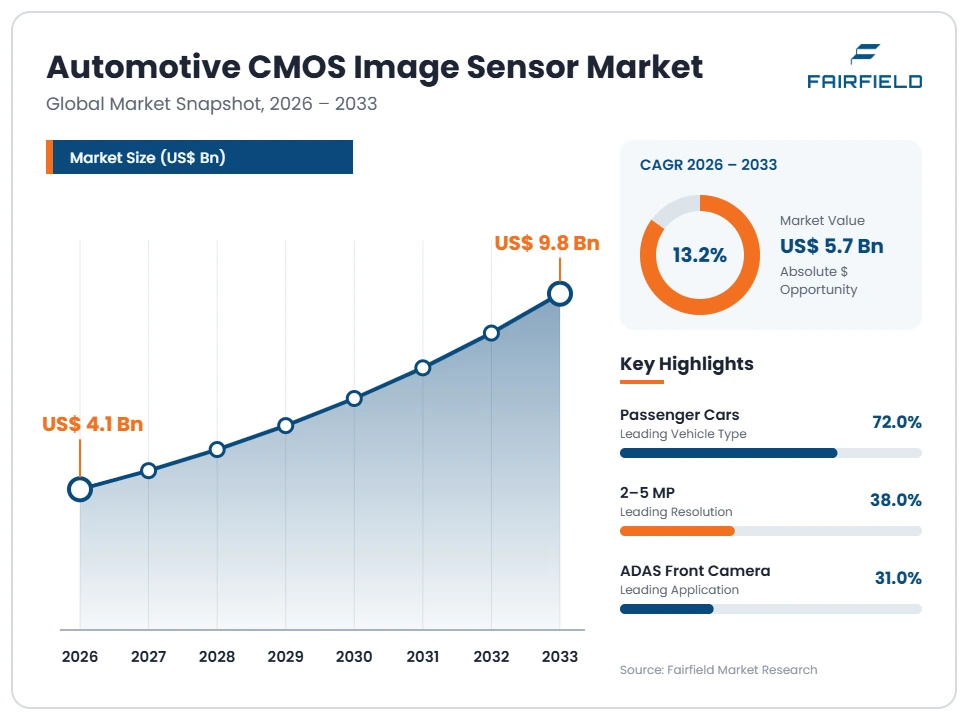
The global Automotive CMOS Image Sensor market size is expected to be valued at US$ 4.1 billion in 2026 and projected to reach US$ 9.8 billion by 2033, growing at a CAGR of 13.2% between 2026 and 2033. Growth reflects a rising camera count per vehicle, as rear view, surround view and forward-looking functions move into mainstream models. Safety assessment protocols, higher assisted-driving content and in-cabin monitoring rules lift both unit volumes and average resolution per sensor. Fairfield Market Research ties the absolute dollar opportunity of US$ 5.7 billion to suppliers holding automotive-qualified, high-dynamic-range sensor platforms, against a historical CAGR of 11.4% between 2020 and 2025.
Key Report Takeaways
- By Resolution: 2–5 MP sensors led with 38% share in 2026, while above 8 MP devices are projected to expand at an 18.9% CAGR through 2033, driven by long-range front-camera perception stacks.
- By Application: ADAS front cameras led with 31% share in 2026, while driver and occupant monitoring is projected to expand at a 19.6% CAGR through 2033, driven by cabin attention and child-presence detection rules.
- By Vehicle Type: passenger cars led with 72% share in 2026, while light commercial vehicles are projected to expand at a 15.4% CAGR through 2033, driven by last-mile delivery fleets adding multi-camera safety packages.
- By Region: across North America, Europe, Asia Pacific, Latin America and Middle East & Africa, Asia Pacific led with 44% share in 2026, while Latin America is projected to expand at a 15.1% CAGR through 2033, driven by rising safety content on Brazilian and Mexican assembly lines.
Global Automotive CMOS Image Sensor Market Trends and Insights
Market Growth Drivers
Safety Rating Protocols Are Pulling Cameras Into Mainstream Trims
Vehicle safety assessment programmes are the strongest single pull on automotive camera demand. Protocols operated by Euro NCAP and comparable regional bodies award credit for automatic emergency braking, lane keeping and blind-spot detection. Carmakers chasing a strong star rating fit camera-based perception as standard equipment rather than as a paid option. The clearest effect sits in entry and mid-priced trims, where a forward camera has become baseline content.
Each assisted-driving function the rating protocol rewards adds another viewing or sensing socket to the vehicle. Rear visibility rules in several markets already make a reversing camera mandatory on new light vehicles. Pedestrian and cyclist detection scenarios push carmakers toward wider fields of view and better low-light performance. That combination raises sensor count per platform and shifts the mix toward parts qualified under ISO 26262 functional safety practice.
Perception Software Is Rewarding Higher Resolution and Dynamic Range
Image quality now sets the ceiling on what a vehicle’s perception software can detect, so sensor specification has become a vehicle-level decision. Longer detection range lets automatic braking act earlier at highway speed, which directly affects rating scores and insurance classification. Higher dynamic range keeps tunnel exits, low sun and oncoming headlights from washing out the frame. Carmakers are buying resolution and dynamic range to unlock features they intend to sell later.
Behind that shift sits a change in vehicle computing. Centralised domain controllers and high-speed serial links can carry far more pixel data than earlier distributed architectures allowed. Sensor makers have responded with automotive pixel designs tuned for low-light sensitivity, LED flicker mitigation and wide operating temperature. The result is a steady migration of front and surround cameras toward higher resolution tiers across successive model generations.
Market Restraints
Long Automotive Qualification Cycles Delay Sensor Revenue
Automotive qualification acts as a brake on how quickly a new sensor converts into revenue. A part must pass reliability, temperature, vibration and electrical stress testing before a carmaker will design it into a platform. Functional safety documentation under ISO 26262 adds further engineering effort before the first shipment. Suppliers must carry development cost for several years ahead of volume production.
The commercial effect is a market that rewards incumbency and punishes late entrants. Once a sensor is locked into a camera module and validated with a specific image signal processor, switching costs become high for the tier-one supplier and the carmaker alike. Design cycles tied to vehicle programmes also mean demand responds slowly to new technology. Smaller sensor makers with limited qualification capacity find it difficult to win front-camera sockets.
In-Cabin Imaging Raises Privacy and Data Protection Hurdles
Driver and occupant monitoring points a camera at people, which makes privacy a genuine commercial constraint rather than a secondary concern. Buyers and works councils question what the cabin camera records, where images travel and who may review them. Data protection rules in several markets treat facial and biometric imagery as a sensitive category needing explicit justification. Uncertainty over compliance slows adoption decisions inside carmakers.
Suppliers are answering with architectures that process frames on the device and discard raw images instead of transmitting them. Near-infrared sensing, attention-state outputs rather than stored video, and clear driver notification are becoming expected design features. Each safeguard adds silicon area, validation work and cost to a sensor that already carries automotive qualification overhead. Until practice settles, in-cabin programmes advance more cautiously than exterior camera programmes.
Market Opportunities
Camera Monitor Systems Open a New High-Value Sensor Socket
Replacing mirrors with camera monitor systems creates a sensor socket that did not previously exist on the vehicle. Regulatory acceptance of mirror replacement in several regions has opened the door for series production rather than show-car demonstration. These systems carry strict latency, dynamic range and night performance requirements because the driver views the image directly. That specification floor supports higher average selling prices than legacy rear view parts.
Commercial vehicles make the strongest near-term case. Removing large exterior mirrors cuts aerodynamic drag on long-haul trucks and improves fuel economy over high annual mileage. Wide-angle cameras also address blind zones that cause low-speed collisions in urban delivery work. Sensor makers able to deliver automotive-grade latency and reliable low-light output gain access to a segment where operators judge equipment on measurable running cost.
Software-Defined Vehicles Favour Reusable Sensor Platforms
Software-defined vehicle programmes create an opening for sensor makers that sell a family rather than a single part. Carmakers want one camera interface and one calibration flow reused across front, surround, mirror replacement and cabin positions. A common pixel architecture scaled across resolution tiers lets a single validation effort serve several vehicle lines. Suppliers offering that consistency become harder to displace at the next programme.
The opportunity extends past silicon into tools and support. Carmakers increasingly ask for characterisation data, image quality models and simulation assets that let perception teams train algorithms before hardware exists. Over-the-air feature updates also mean a sensor must support functions that the vehicle will gain years after assembly. Sensor makers who package reference designs, safety documentation and tuning support convert a component sale into a longer platform relationship.
Segment Analysis
- Mid-Range 2–5 MP Sensors Hold the Volume Core of the Market
Mid-range sensors carry the volume of the market, with 2–5 MP devices holding 38% share in 2026. This tier matches the resolution that surround view, rear view and mainstream front cameras actually need, at a cost carmakers accept across high-volume platforms. Above 8 MP devices form the growth leader, expanding at an 18.9% CAGR through 2033 as long-range front cameras move toward reading signs and detecting pedestrians farther ahead.
The split reflects two buying decisions. Volume demand follows body-style rollouts and mandated rear visibility content, where cost per socket governs the choice. High-resolution demand follows perception capability, where detection distance decides which assisted-driving functions a carmaker can advertise. Wider bandwidth in automotive serial links removes the earlier barrier to moving large frames, lifting average selling price even where unit growth stays moderate.
- Which Application Is Adding Automotive Image Sensors Fastest?
Driver and occupant monitoring is the fastest-growing application, expanding at a 19.6% CAGR through 2033, while ADAS front cameras remain the largest with 31% share in 2026. Front cameras lead because almost every assisted-driving package begins with forward perception, making that socket close to universal on new vehicles. Cabin monitoring grows faster from a smaller base as attention detection and child-presence sensing move from premium models into volume programmes.
The two applications compete on different attributes. Front cameras are judged on detection range, dynamic range and functional safety evidence. Cabin sensors are judged on near-infrared sensitivity, eye tracking through eyewear, and privacy-preserving on-device processing. Surround view and rear view sockets sit between them, adding steady volume tied to parking automation. For sensor makers, one product family must now span very different optical requirements.
- Passenger Cars Anchor Demand While Delivery Fleets Accelerate
Passenger cars account for 72% share in 2026, anchoring demand through sheer build volume and the breadth of camera content fitted per vehicle. A mainstream car now commonly carries a front camera, a reversing camera and several surround view modules, with cabin sensing appearing on higher trims. Light commercial vehicles form the fastest-growing class at a 15.4% CAGR through 2033, as last-mile delivery operators adopt multi-camera safety packages.
Fleet economics explain the difference in pace. Delivery operators measure camera content against collision claims and insurance premiums, which makes payback explicit. Urban access rules in several cities reward direct vision and blind-spot detection on working vehicles. Heavy commercial and off-highway machines add smaller but steady demand where visibility around large bodies is limited. The effect is a demand base less tied to passenger vehicle cycles.
- OEM Channel Dominates as Retrofit Fleet Cameras Gain Ground
The OEM channel takes 86% share in 2026, since image sensors reach vehicles inside camera modules designed, validated and shipped by tier-one suppliers. Factory fitment is the only practical route for front cameras and mirror replacement, which must integrate with vehicle networks and functional safety architecture. The aftermarket grows faster at a 14.6% CAGR through 2033, carried by retrofit cameras and recording systems on commercial fleets.
The channels serve different buyers. OEM demand is won through multi-year design cycles, qualification evidence and supply continuity commitments. Aftermarket demand responds to insurance incentives and fleet policy, with shorter decision cycles and lower qualification thresholds. Retrofit systems for older trucks and vans extend camera coverage to vehicles that stay in service for years. For sensor makers, aftermarket volume offsets the slow rhythm of vehicle programme awards.
Geography Analysis
- North America Pairs Rear Visibility Rules With Advanced Perception Content
North America holds 23% share in 2026 and grows at a 12.0% CAGR through 2033, supported by the United States, Canada and Mexico. Rear visibility requirements on new light vehicles made reversing cameras standard years ago, giving the region a mature installed base. Growth now comes from higher-specification front cameras and from cabin monitoring linked to assisted-driving supervision. Pickup trucks and large sport utility vehicles add surround view content because body size creates significant blind zones. Mexican assembly plants supply domestic and export programmes, tying sensor demand to North American vehicle output. State-level privacy statutes shape how carmakers specify in-cabin imaging and push designs toward on-device processing.
- Europe Links Camera Content to Safety Assessment and Mirror Replacement
Europe holds 24% share in 2026 and grows at a 12.4% CAGR through 2033, led by Germany, France, Italy, Spain and the United Kingdom. General safety requirements across the region made driver drowsiness and attention warning, plus intelligent speed assistance, standard content on new vehicle types. Those rules convert directly into cabin sensor and front camera sockets. Europe also leads adoption of camera monitor systems on heavy trucks, where drag reduction improves fuel consumption on long routes. German premium carmakers specify high-resolution sensors to support supervised highway driving functions. Strong data protection practice across the region shapes in-cabin design toward local processing without image retention.
- Which Region Is Leading the Automotive CMOS Image Sensor Market?
Asia Pacific leads the Automotive CMOS Image Sensor market with 44% share in 2026 and grows at a 14.0% CAGR through 2033. China, Japan, South Korea and India combine the world’s largest vehicle assembly base with concentrated camera module manufacturing and semiconductor capacity. Chinese carmakers fit extensive camera arrays on electric models as a competitive feature rather than a regulatory minimum, lifting sensors per vehicle well above the global average. Indian passenger vehicle makers are adding rear view and surround view content as safety assessment ratings gain buyer attention. Regional proximity between sensor fabrication, module assembly and vehicle plants shortens development cycles and lowers landed cost.
- Which Region Is Growing Fastest in the Automotive CMOS Image Sensor Market?
Latin America is the fastest-growing region at a 15.1% CAGR through 2033, from 5% share in 2026. Brazil, Mexico and Argentina are raising safety content on locally assembled models, moving cameras from imported premium trims into domestic volume programmes. Regional safety assessment ratings now influence buyer choice, encouraging carmakers to standardise reversing and front cameras. Mexican plants building for export already run camera-equipped lines, and that engineering carries into vehicles sold locally. Commercial fleet operators in Brazil adopt recording and blind-spot cameras to control collision costs on long-distance routes. Growth is fast because the starting base is small and camera content per vehicle still sits below North American and European levels.
- Middle East & Africa Builds Camera Demand Around Fleets and Harsh Conditions
Middle East & Africa holds 4% share in 2026 and grows at a 13.6% CAGR through 2033, led by Saudi Arabia, the United Arab Emirates, Türkiye and South Africa. Gulf markets skew toward large sport utility vehicles and premium trims that arrive with full camera packages fitted. High ambient temperature and strong glare make dynamic range and thermal tolerance decisive specification points for this region. South African assembly plants building for export maintain demand for camera modules at international specification. Mining, construction and logistics operators across the region fit surround view and blind-spot cameras on working vehicles where visibility around large bodies is limited.
Competitive Landscape
The Automotive CMOS Image Sensor market is moderately concentrated. A small group of suppliers with automotive-qualified pixel processes and functional safety documentation holds most volume in front, surround and mirror replacement sockets. A wider set of specialists competes in rear view, cabin sensing and aftermarket applications, where qualification thresholds are lower and cost sensitivity is higher. Positions shift slowly because sensors are locked into camera module designs for the life of a vehicle programme. Regional suppliers in Asia have gained ground as domestic carmakers qualify local sources alongside established global vendors.
Competition runs on image performance under difficult light rather than on resolution alone. Vendors differentiate through high dynamic range, LED flicker mitigation, near-infrared sensitivity for cabin sensing, and stable behaviour across the automotive temperature range. Functional safety features such as fault detection and reporting consistent with ISO 26262 practice have become a qualifying condition rather than an advantage.
Strategic activity concentrates on capacity, co-development and tooling. Securing long-term wafer supply matters because automotive programmes demand availability for a decade, and carmakers ask suppliers to evidence that continuity. Joint development with tier-one camera module makers lets sensor vendors tune optical and electrical behaviour to a specific perception stack before a programme is awarded. Investment in characterisation data and simulation assets helps carmakers train algorithms early, which strengthens vendor positions ahead of sourcing decisions.
Competitive direction points toward platform families rather than individual parts. Vendors that scale a common architecture across resolution tiers, support exterior and in-cabin positions, and provide privacy-respecting processing options are shaping how carmakers approach sourcing for software-defined vehicles.
Industry Leaders
- Sony Group Corporation
- onsemi
- OMNIVISION Technologies, Inc.
- STMicroelectronics N.V.
- Samsung Electronics Co., Ltd.
Companies Covered in the Report
- Sony Group Corporation
- onsemi
- OMNIVISION Technologies, Inc.
- STMicroelectronics N.V.
- Samsung Electronics Co., Ltd.
- ams-OSRAM AG
- GalaxyCore Inc.
- SmartSens Technology Co., Ltd.
- Pixelplus Co., Ltd.
- Himax Technologies, Inc.
- Teledyne e2v
- Panasonic Holdings Corporation
- SK hynix Inc.
Automotive CMOS Image Sensor Market Report Scope
| Metric | Value |
| Study Period | 2020–2033 |
| Market Size 2026 | US$ 4.1 Billion |
| Market Size 2033 | US$ 9.8 Billion |
| CAGR 2026–2033 | 13.2% |
| Absolute Dollar Opportunity | US$ 5.7 Billion |
| Largest Market | Asia Pacific (44% share in 2026) |
| Fastest-Growing Market | Latin America (15.1% CAGR 2026–2033) |
| Market Concentration | Moderately Concentrated |
| Major Players | Sony Group Corporation, onsemi, OMNIVISION Technologies, Inc., STMicroelectronics N.V., Samsung Electronics Co., Ltd. |
Automotive CMOS Image Sensor Market Segmentation
- Executive Summary
- Automotive CMOS Image Sensor Market Snapshot
- Future Projections
- Key Market Trends
- Regional Snapshot
- Market Overview
- Market Definition and Report Scope
- Historical Market Trends
- Market Dynamics
- Drivers
- Safety Rating Protocols Are Pulling Cameras Into Mainstream Trims
- Perception Software Is Rewarding Higher Resolution and Dynamic Range
- Restraints
- Long Automotive Qualification Cycles Delay Sensor Revenue
- In-Cabin Imaging Raises Privacy and Data Protection Hurdles
- Market Opportunities
- Camera Monitor Systems Open a New High-Value Sensor Socket
- Software-Defined Vehicles Favour Reusable Sensor Platforms
- Drivers
- Global Automotive CMOS Image Sensor Market Outlook, 2026–2033
- Global Automotive CMOS Image Sensor Market Outlook, by Resolution, Value (US$ Billion), 2026–2033
- Below 2 MP
- 2–5 MP
- 5–8 MP
- Above 8 MP
- Global Automotive CMOS Image Sensor Market Outlook, by Application, Value (US$ Billion), 2026–2033
- ADAS Front Camera
- Surround View and Park Assist
- Rear View Camera
- Driver and Occupant Monitoring
- Camera Monitor Systems
- Global Automotive CMOS Image Sensor Market Outlook, by Vehicle Type, Value (US$ Billion), 2026–2033
- Passenger Cars
- Light Commercial Vehicles
- Heavy Commercial Vehicles
- Off-highway and Specialty Vehicles
- Global Automotive CMOS Image Sensor Market Outlook, by Sales Channel, Value (US$ Billion), 2026–2033
- OEM
- Aftermarket
- Global Automotive CMOS Image Sensor Market Outlook, by Region, Value (US$ Billion), 2026–2033
- North America
- Europe
- Asia Pacific
- Latin America
- Middle East & Africa
- Global Automotive CMOS Image Sensor Market Outlook, by Resolution, Value (US$ Billion), 2026–2033
- North America Automotive CMOS Image Sensor Market Outlook, 2026–2033
- North America Automotive CMOS Image Sensor Market Outlook, by Resolution, Value (US$ Billion), 2026–2033
- Below 2 MP
- 2–5 MP
- 5–8 MP
- Above 8 MP
- North America Automotive CMOS Image Sensor Market Outlook, by Application, Value (US$ Billion), 2026–2033
- ADAS Front Camera
- Surround View and Park Assist
- Rear View Camera
- Driver and Occupant Monitoring
- Camera Monitor Systems
- North America Automotive CMOS Image Sensor Market Outlook, by Vehicle Type, Value (US$ Billion), 2026–2033
- Passenger Cars
- Light Commercial Vehicles
- Heavy Commercial Vehicles
- Off-highway and Specialty Vehicles
- North America Automotive CMOS Image Sensor Market Outlook, by Sales Channel, Value (US$ Billion), 2026–2033
- OEM
- Aftermarket
- North America Automotive CMOS Image Sensor Market Outlook, by Country, Value (US$ Billion), 2026–2033
- United States Automotive CMOS Image Sensor Market Outlook, by Resolution, 2026–2033
- United States Automotive CMOS Image Sensor Market Outlook, by Application, 2026–2033
- United States Automotive CMOS Image Sensor Market Outlook, by Vehicle Type, 2026–2033
- United States Automotive CMOS Image Sensor Market Outlook, by Sales Channel, 2026–2033
- Canada Automotive CMOS Image Sensor Market Outlook, by Resolution, 2026–2033
- Canada Automotive CMOS Image Sensor Market Outlook, by Application, 2026–2033
- Canada Automotive CMOS Image Sensor Market Outlook, by Vehicle Type, 2026–2033
- Canada Automotive CMOS Image Sensor Market Outlook, by Sales Channel, 2026–2033
- Mexico Automotive CMOS Image Sensor Market Outlook, by Resolution, 2026–2033
- Mexico Automotive CMOS Image Sensor Market Outlook, by Application, 2026–2033
- Mexico Automotive CMOS Image Sensor Market Outlook, by Vehicle Type, 2026–2033
- Mexico Automotive CMOS Image Sensor Market Outlook, by Sales Channel, 2026–2033
- North America Automotive CMOS Image Sensor Market Outlook, by Resolution, Value (US$ Billion), 2026–2033
- Europe Automotive CMOS Image Sensor Market Outlook, 2026–2033
- Europe Automotive CMOS Image Sensor Market Outlook, by Resolution, Value (US$ Billion), 2026–2033
- Below 2 MP
- 2–5 MP
- 5–8 MP
- Above 8 MP
- Europe Automotive CMOS Image Sensor Market Outlook, by Application, Value (US$ Billion), 2026–2033
- ADAS Front Camera
- Surround View and Park Assist
- Rear View Camera
- Driver and Occupant Monitoring
- Camera Monitor Systems
- Europe Automotive CMOS Image Sensor Market Outlook, by Vehicle Type, Value (US$ Billion), 2026–2033
- Passenger Cars
- Light Commercial Vehicles
- Heavy Commercial Vehicles
- Off-highway and Specialty Vehicles
- Europe Automotive CMOS Image Sensor Market Outlook, by Sales Channel, Value (US$ Billion), 2026–2033
- OEM
- Aftermarket
- Europe Automotive CMOS Image Sensor Market Outlook, by Country, Value (US$ Billion), 2026–2033
- Germany Automotive CMOS Image Sensor Market Outlook, by Resolution, 2026–2033
- Germany Automotive CMOS Image Sensor Market Outlook, by Application, 2026–2033
- Germany Automotive CMOS Image Sensor Market Outlook, by Vehicle Type, 2026–2033
- Germany Automotive CMOS Image Sensor Market Outlook, by Sales Channel, 2026–2033
- France Automotive CMOS Image Sensor Market Outlook, by Resolution, 2026–2033
- France Automotive CMOS Image Sensor Market Outlook, by Application, 2026–2033
- France Automotive CMOS Image Sensor Market Outlook, by Vehicle Type, 2026–2033
- France Automotive CMOS Image Sensor Market Outlook, by Sales Channel, 2026–2033
- Italy Automotive CMOS Image Sensor Market Outlook, by Resolution, 2026–2033
- Italy Automotive CMOS Image Sensor Market Outlook, by Application, 2026–2033
- Italy Automotive CMOS Image Sensor Market Outlook, by Vehicle Type, 2026–2033
- Italy Automotive CMOS Image Sensor Market Outlook, by Sales Channel, 2026–2033
- Spain Automotive CMOS Image Sensor Market Outlook, by Resolution, 2026–2033
- Spain Automotive CMOS Image Sensor Market Outlook, by Application, 2026–2033
- Spain Automotive CMOS Image Sensor Market Outlook, by Vehicle Type, 2026–2033
- Spain Automotive CMOS Image Sensor Market Outlook, by Sales Channel, 2026–2033
- United Kingdom Automotive CMOS Image Sensor Market Outlook, by Resolution, 2026–2033
- United Kingdom Automotive CMOS Image Sensor Market Outlook, by Application, 2026–2033
- United Kingdom Automotive CMOS Image Sensor Market Outlook, by Vehicle Type, 2026–2033
- United Kingdom Automotive CMOS Image Sensor Market Outlook, by Sales Channel, 2026–2033
- Europe Automotive CMOS Image Sensor Market Outlook, by Resolution, Value (US$ Billion), 2026–2033
- Asia Pacific Automotive CMOS Image Sensor Market Outlook, 2026–2033
- Asia Pacific Automotive CMOS Image Sensor Market Outlook, by Resolution, Value (US$ Billion), 2026–2033
- Below 2 MP
- 2–5 MP
- 5–8 MP
- Above 8 MP
- Asia Pacific Automotive CMOS Image Sensor Market Outlook, by Application, Value (US$ Billion), 2026–2033
- ADAS Front Camera
- Surround View and Park Assist
- Rear View Camera
- Driver and Occupant Monitoring
- Camera Monitor Systems
- Asia Pacific Automotive CMOS Image Sensor Market Outlook, by Vehicle Type, Value (US$ Billion), 2026–2033
- Passenger Cars
- Light Commercial Vehicles
- Heavy Commercial Vehicles
- Off-highway and Specialty Vehicles
- Asia Pacific Automotive CMOS Image Sensor Market Outlook, by Sales Channel, Value (US$ Billion), 2026–2033
- OEM
- Aftermarket
- Asia Pacific Automotive CMOS Image Sensor Market Outlook, by Country, Value (US$ Billion), 2026–2033
- China Automotive CMOS Image Sensor Market Outlook, by Resolution, 2026–2033
- China Automotive CMOS Image Sensor Market Outlook, by Application, 2026–2033
- China Automotive CMOS Image Sensor Market Outlook, by Vehicle Type, 2026–2033
- China Automotive CMOS Image Sensor Market Outlook, by Sales Channel, 2026–2033
- Japan Automotive CMOS Image Sensor Market Outlook, by Resolution, 2026–2033
- Japan Automotive CMOS Image Sensor Market Outlook, by Application, 2026–2033
- Japan Automotive CMOS Image Sensor Market Outlook, by Vehicle Type, 2026–2033
- Japan Automotive CMOS Image Sensor Market Outlook, by Sales Channel, 2026–2033
- South Korea Automotive CMOS Image Sensor Market Outlook, by Resolution, 2026–2033
- South Korea Automotive CMOS Image Sensor Market Outlook, by Application, 2026–2033
- South Korea Automotive CMOS Image Sensor Market Outlook, by Vehicle Type, 2026–2033
- South Korea Automotive CMOS Image Sensor Market Outlook, by Sales Channel, 2026–2033
- India Automotive CMOS Image Sensor Market Outlook, by Resolution, 2026–2033
- India Automotive CMOS Image Sensor Market Outlook, by Application, 2026–2033
- India Automotive CMOS Image Sensor Market Outlook, by Vehicle Type, 2026–2033
- India Automotive CMOS Image Sensor Market Outlook, by Sales Channel, 2026–2033
- Asia Pacific Automotive CMOS Image Sensor Market Outlook, by Resolution, Value (US$ Billion), 2026–2033
- Latin America Automotive CMOS Image Sensor Market Outlook, 2026–2033
- Latin America Automotive CMOS Image Sensor Market Outlook, by Resolution, Value (US$ Billion), 2026–2033
- Below 2 MP
- 2–5 MP
- 5–8 MP
- Above 8 MP
- Latin America Automotive CMOS Image Sensor Market Outlook, by Application, Value (US$ Billion), 2026–2033
- ADAS Front Camera
- Surround View and Park Assist
- Rear View Camera
- Driver and Occupant Monitoring
- Camera Monitor Systems
- Latin America Automotive CMOS Image Sensor Market Outlook, by Vehicle Type, Value (US$ Billion), 2026–2033
- Passenger Cars
- Light Commercial Vehicles
- Heavy Commercial Vehicles
- Off-highway and Specialty Vehicles
- Latin America Automotive CMOS Image Sensor Market Outlook, by Sales Channel, Value (US$ Billion), 2026–2033
- OEM
- Aftermarket
- Latin America Automotive CMOS Image Sensor Market Outlook, by Country, Value (US$ Billion), 2026–2033
- Brazil Automotive CMOS Image Sensor Market Outlook, by Resolution, 2026–2033
- Brazil Automotive CMOS Image Sensor Market Outlook, by Application, 2026–2033
- Brazil Automotive CMOS Image Sensor Market Outlook, by Vehicle Type, 2026–2033
- Brazil Automotive CMOS Image Sensor Market Outlook, by Sales Channel, 2026–2033
- Mexico Automotive CMOS Image Sensor Market Outlook, by Resolution, 2026–2033
- Mexico Automotive CMOS Image Sensor Market Outlook, by Application, 2026–2033
- Mexico Automotive CMOS Image Sensor Market Outlook, by Vehicle Type, 2026–2033
- Mexico Automotive CMOS Image Sensor Market Outlook, by Sales Channel, 2026–2033
- Argentina Automotive CMOS Image Sensor Market Outlook, by Resolution, 2026–2033
- Argentina Automotive CMOS Image Sensor Market Outlook, by Application, 2026–2033
- Argentina Automotive CMOS Image Sensor Market Outlook, by Vehicle Type, 2026–2033
- Argentina Automotive CMOS Image Sensor Market Outlook, by Sales Channel, 2026–2033
- Latin America Automotive CMOS Image Sensor Market Outlook, by Resolution, Value (US$ Billion), 2026–2033
- Middle East & Africa Automotive CMOS Image Sensor Market Outlook, 2026–2033
- Middle East & Africa Automotive CMOS Image Sensor Market Outlook, by Resolution, Value (US$ Billion), 2026–2033
- Below 2 MP
- 2–5 MP
- 5–8 MP
- Above 8 MP
- Middle East & Africa Automotive CMOS Image Sensor Market Outlook, by Application, Value (US$ Billion), 2026–2033
- ADAS Front Camera
- Surround View and Park Assist
- Rear View Camera
- Driver and Occupant Monitoring
- Camera Monitor Systems
- Middle East & Africa Automotive CMOS Image Sensor Market Outlook, by Vehicle Type, Value (US$ Billion), 2026–2033
- Passenger Cars
- Light Commercial Vehicles
- Heavy Commercial Vehicles
- Off-highway and Specialty Vehicles
- Middle East & Africa Automotive CMOS Image Sensor Market Outlook, by Sales Channel, Value (US$ Billion), 2026–2033
- OEM
- Aftermarket
- Middle East & Africa Automotive CMOS Image Sensor Market Outlook, by Country, Value (US$ Billion), 2026–2033
- Saudi Arabia Automotive CMOS Image Sensor Market Outlook, by Resolution, 2026–2033
- Saudi Arabia Automotive CMOS Image Sensor Market Outlook, by Application, 2026–2033
- Saudi Arabia Automotive CMOS Image Sensor Market Outlook, by Vehicle Type, 2026–2033
- Saudi Arabia Automotive CMOS Image Sensor Market Outlook, by Sales Channel, 2026–2033
- United Arab Emirates Automotive CMOS Image Sensor Market Outlook, by Resolution, 2026–2033
- United Arab Emirates Automotive CMOS Image Sensor Market Outlook, by Application, 2026–2033
- United Arab Emirates Automotive CMOS Image Sensor Market Outlook, by Vehicle Type, 2026–2033
- United Arab Emirates Automotive CMOS Image Sensor Market Outlook, by Sales Channel, 2026–2033
- Türkiye Automotive CMOS Image Sensor Market Outlook, by Resolution, 2026–2033
- Türkiye Automotive CMOS Image Sensor Market Outlook, by Application, 2026–2033
- Türkiye Automotive CMOS Image Sensor Market Outlook, by Vehicle Type, 2026–2033
- Türkiye Automotive CMOS Image Sensor Market Outlook, by Sales Channel, 2026–2033
- South Africa Automotive CMOS Image Sensor Market Outlook, by Resolution, 2026–2033
- South Africa Automotive CMOS Image Sensor Market Outlook, by Application, 2026–2033
- South Africa Automotive CMOS Image Sensor Market Outlook, by Vehicle Type, 2026–2033
- South Africa Automotive CMOS Image Sensor Market Outlook, by Sales Channel, 2026–2033
- Middle East & Africa Automotive CMOS Image Sensor Market Outlook, by Resolution, Value (US$ Billion), 2026–2033
- Competitive Landscape
- Industry Leaders
- Company Profiles
- Sony Group Corporation
- onsemi
- OMNIVISION Technologies, Inc.
- STMicroelectronics N.V.
- Samsung Electronics Co., Ltd.
- ams-OSRAM AG
- GalaxyCore Inc.
- SmartSens Technology Co., Ltd.
- Pixelplus Co., Ltd.
- Himax Technologies, Inc.
- Teledyne e2v
- Panasonic Holdings Corporation
- SK hynix Inc.
- Appendix
- Research Methodology
- Report Assumptions
- Acronyms and Abbreviations
Resolution
- Below 2 MP
- 2–5 MP
- 5–8 MP
- Above 8 MP
Application
- ADAS Front Camera
- Surround View and Park Assist
- Rear View Camera
- Driver and Occupant Monitoring
- Camera Monitor Systems
Vehicle Type
- Passenger Cars
- Light Commercial Vehicles
- Heavy Commercial Vehicles
- Off-highway and Specialty Vehicles
Sales Channel
- OEM
- Aftermarket
Region
- North America
- Europe
- Asia Pacific
- Latin America
- Middle East & Africa
Our Research Methodology
Considering the volatility of business today, traditional approaches to strategizing a game plan can be unfruitful if not detrimental. True ambiguity is no way to determine a forecast. A myriad of predetermined factors must be accounted for such as the degree of risk involved, the magnitude of circumstances, as well as conditions or consequences that are not known or unpredictable. To circumvent binary views that cast uncertainty, the application of market research intelligence to strategically posture, move, and enable actionable outcomes is necessary.
View Methodology
Quality Assured
Rigorous Validation Process

Confidentiality Assured
End-to-end Data Security

Custom Research Services
Tailored To Your Objectives
FAQs
The market is valued at US$ 4.1 billion in 2026 and is projected to reach US$ 9.8 billion by 2033.
The market is expected to grow at a 13.2% CAGR between 2026 and 2033, supported by rising camera content in every vehicle class.
ADAS front cameras lead with 31% share in 2026, while driver and occupant monitoring is the fastest-growing application at a 19.6% CAGR.
Asia Pacific holds 44% share in 2026, supported by concentrated vehicle assembly, camera module manufacturing and semiconductor capacity across China, Japan and South Korea.
The market is moderately concentrated, with a few automotive-qualified sensor suppliers holding most volume while regional specialists compete in rear view and aftermarket sockets.
Related Reports
Automotive Pinion Gear Market Size, Share, Insights, Competitive Landscape, and Forecast 2026 to 2033
The global automotive pinion gear market is valued at US$14.01 billion in 2026, reaching US$18.57 billion by 2033, growing at a 4.1% CAGR
Automotive Electric Vacuum Pump Market Size, Share, Insights, Competitive Landscape, and Forecast 2026 to 2033
Explore the automotive electric vacuum pump market outlook for 2026–2033, covering pump types, propulsion, vehicles, regions, and key companies.
EV Contactor Relay Market Size, Share, Insights, Competitive Landscape, and Forecast 2026 to 2033
The global EV contactor relay market is valued at US$2.4 billion in 2026, reaching US$6.3 billion by 2033, growing at a 14.8% CAGR
Locomotive Market Size, Share, Insights, Competitive Landscape, and Forecast 2026 to 2033
The locomotive market is projected to reach US$29.5 billion by 2033. Explore propulsion trends, freight and passenger demand, and regional growth.
Li-ion Battery Management Systems Market Size, Share, Insights, Competitive Landscape, and Forecast 2026 to 2033
The Li-ion battery management systems market is projected to reach US$30.2 billion by 2033. Explore trends by topology, pack voltage, and application.
In-Vehicle Payment Services Market Size, Share, Insights, Competitive Landscape, and Forecast 2026 to 2033
The in-vehicle payment services market is forecast to reach US$30.86 billion by 2033 at a 17.3% CAGR as connected cars expand access to in-car payments.