



Compression Therapy Devices Market
Compression Therapy Devices Market Insights, Competitive Landscape, and Market Forecast - 2033
Global Compression Therapy Devices Market Forecast
- The compression therapy devices market size is poised to reach USD 6 Bn in 2033, up from USD 4.5 Bn projected in 2026
- Global compression therapy devices market revenue is likely to witness a CAGR of 4% during 2026-2033
Compression Therapy Devices Market Insights
A Look Back and a Look Forward - Comparative Analysis
The compression therapy devices market witnessed moderate yet consistent growth up to 2023. This growth was driven by the increasing prevalence of chronic conditions such as lymphedema, venous leg ulcers, and deep vein thrombosis, which heightened the demand for effective treatment options. Technological advancements led to the development of more comfortable and efficient compression garments and devices, enhancing patient compliance and outcomes.
Increased awareness and education about the benefits of compression therapy among healthcare professionals and patients further propelled market growth.
However, market penetration varied significantly across different regions, with developed markets like North America, and Europe showing higher adoption rates than emerging markets. Challenges such as reimbursement issues and the high cost of advanced devices posed limitations to market expansion.
Key Growth Determinants
- Technological Advancements
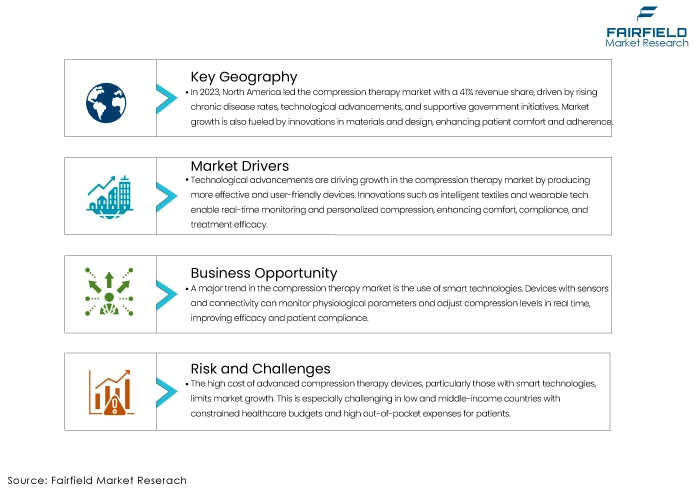
Technological advancements are a primary growth driver for the compression therapy devices market. Innovations in materials and design have led to the development of more effective and user-friendly compression garments and devices. For instance, integrating intelligent textiles and wearable technology has created compression products that monitor physiological parameters and provide real-time feedback to users and healthcare providers. These advancements improve patient compliance by offering greater comfort and ease of use and enhancing treatment efficacy through personalized and adaptive compression levels.
Additionally, digital health technologies that enable remote monitoring and telehealth services are becoming increasingly integrated with compression therapy, offering better management and follow-up care for patients with chronic conditions. As these technologies continue to evolve, they are expected to drive significant growth in the market by meeting the diverse needs of patients and healthcare systems globally.
- Increasing Prevalence of Chronic Conditions
The rising prevalence of chronic conditions such as lymphedema, venous leg ulcers, and deep vein thrombosis is another key growth driver for the compression therapy devices market. These conditions often require long-term management, making compression therapy an essential component of treatment.
The aging population, more susceptible to chronic venous diseases, further exacerbates the demand for effective compression solutions.
Moreover, increasing rates of obesity and sedentary lifestyles contribute to the incidence of venous disorders, driving the need for compression therapy. As awareness of these conditions grows among patients and healthcare providers, there is a greater emphasis on early diagnosis and intervention, including compression therapy. Public health initiatives and educational campaigns are also crucial in promoting compression therapy's benefits, thereby expanding the market.
This trend is expected to continue as the global burden of chronic conditions rises, fuelling sustained demand for compression therapy devices.
Key Growth Barriers
- High Cost of Advanced Devices
One of the primary restraints on the growth of the compression therapy devices market is the high cost of advanced devices. Compression therapy products, especially those incorporating the latest technologies like intelligent textiles and digital health integration, can be prohibitively expensive for many patients.
This is particularly challenging in low and middle-income countries, where healthcare budgets are limited and out-of-pocket expenses for patients are high.
The cost can be a barrier even in developed regions, mainly for uninsured or underinsured patients. This financial burden often leads to lower adoption rates and adherence to prescribed therapies, as patients may seek alternative, less costly treatments. The high cost of these devices also affects healthcare providers and systems, which may be reluctant to invest in expensive technologies without clear and immediate cost-benefit evidence. As a result, the market's growth is constrained by the economic limitations that consumers and healthcare systems face.
- Regulatory and Reimbursement Challenges
Regulatory and reimbursement challenges also significantly restrain the growth of the compression therapy devices market. Obtaining regulatory approval for new compression devices can be lengthy and complex, varying significantly across different regions. Stringent regulations ensure safety and efficacy but can delay the introduction of innovative products to the market. Additionally, the need for standardized regulations globally complicates manufacturers' entry into new markets.
Reimbursement policies are another critical issue; in many regions, insurance does not fully cover compression therapy devices, placing a financial burden on patients. Inconsistent reimbursement rates and policies can deter manufacturers and patients as the out-of-pocket costs become prohibitive. These challenges can limit market penetration and slow the adoption of new technologies. Addressing these regulatory and reimbursement hurdles is crucial for facilitating market growth and ensuring patients can access the latest and most effective compression therapy solutions.
Compression Therapy Devices Market Trends and Opportunities
- Integration of Smart Technologies
One of the most significant trends in the compression therapy devices market is the integration of smart technologies. This trend is revolutionizing how compression therapy is delivered and monitored, enhancing efficacy and patient compliance. Smart compression garments and devices with sensors and connectivity features can monitor a patient’s physiological parameters, such as blood flow, pressure, and movement. These devices can provide real-time feedback and adjust the compression levels accordingly, ensuring optimal therapeutic outcomes.
Additionally, the data collected can be transmitted to healthcare providers, allowing for remote monitoring and timely intervention if needed. The rise of wearable technology and the Internet of Things (IoT) has facilitated the development of these advanced compression devices. Patients can now benefit from personalized treatment plans that adapt to their specific needs and conditions. For instance, a smart compression device can alert a patient to adjust their activity levels or position to improve circulation, thereby preventing complications.
Moreover, these devices can track adherence to prescribed therapy, providing valuable insights to healthcare providers on patient compliance and the effectiveness of the treatment. This trend is not only improving patient outcomes but also enhancing the patient experience by making compression therapy more convenient and user-friendly. As technology continues to advance, the integration of artificial intelligence (AI) and machine learning (ML) into compression therapy devices is expected to further refine and personalize treatment protocols. This market trend is likely to drive significant growth in the market as patients and healthcare providers increasingly adopt these smart solutions to improve chronic condition management and overall quality of care.
- Opportunities in Developing Markets
The expansion into developing markets presents a substantial opportunity for the compression therapy devices market. Countries in regions such as Asia, Africa, and Latin America are experiencing rapid economic growth, improved healthcare infrastructure, and increasing healthcare expenditure. These factors create a fertile ground for the adoption of advanced medical technologies, including compression therapy devices.
Developing regional markets have a large and growing population with a significant burden of chronic conditions like diabetes, obesity, and venous diseases, which can benefit greatly from compression therapy. As awareness about these conditions and their management increases, so does the demand for effective treatment options. Manufacturers and healthcare providers can tap into this opportunity by developing and distributing cost-effective compression therapy solutions tailored to the needs of these populations.
- Alliances with Local Healthcare Providers
Strategic partnerships and collaborations with local healthcare providers, distributors, and governments can facilitate market entry and expansion. Initiatives aimed at educating healthcare professionals and patients about the benefits of compression therapy are crucial. Such educational programs can help dispel misconceptions and promote the adoption of these devices. Additionally, leveraging mobile health (mHealth) technologies can enhance the reach and impact of compression therapy, particularly in remote and underserved areas.
Furthermore, localized manufacturing and distribution can help reduce costs and make these devices more affordable for a broader segment of the population. By investing in research and development tailored to the specific needs and conditions prevalent in emerging markets, companies can create innovative solutions that are both effective and economically viable. This approach not only addresses the immediate healthcare needs but also establishes a strong market presence and brand loyalty in these rapidly growing regions. The expansion into emerging markets represents a significant growth opportunity, potentially leading to increased market share and revenue for companies in the compression therapy devices market.
How is Regulatory Scenario Shaping this Industry?
The compression therapy devices industry is significantly influenced by regulatory frameworks. Bodies like FDA in the U.S., EMA in Europe, and equivalent authorities in other regions set stringent standards for device safety, efficacy, and manufacturing processes. These regulations ensure product quality and patient safety. Compliance with these norms is essential for market entry and sustained growth.
On the other hand, regulatory hurdles can increase development costs and time-to-market. However, a clear understanding of these requirements can help companies innovate within regulatory boundaries. Moreover, strong regulatory oversight can boost consumer confidence, driving market growth. Overall, the growth trajectory of the compression therapy devices market is intertwined with the evolving regulatory landscape.
Segments Covered in Compression Therapy Devices Market Report
- Preference for Static Compression Therapy Accounts for over 68% Share
In 2023, the static compression therapy segment dominated the compression therapy devices market with a significant revenue share of 68%, primarily due to technological advancements. Static compression therapy entails the application of uniform pressure to afflicted regions to enhance blood circulation and diminish edema. This technique employs compression garments, such as stockings, bandages, or wraps, which are well-known for their convenience and efficacy in treating disorders such as varicose veins, deep vein thrombosis (DVT), and lymphedema.
The therapy is highly regarded for its user-friendly nature and convenience, making it a favorite option for patients and clinicians. It efficiently alleviates pressure and pain, causes rapid restoration of functionality, and decreases swelling, all essential for treating diverse sports injuries and disorders.
Static compression devices are not one-size-fits-all. They're adaptable, suitable for various medical ailments, and provide different degrees of compression, giving you confidence in their versatility. Static compression therapy is not only practical but also a smart financial choice. These devices are comparatively less expensive than dynamic compression devices, making them a cost-efficient choice for consumers and healthcare professionals, particularly in areas with constrained healthcare resources.
- Hospitals Register More than 32% of Total Demand Generation
Hospitals are favoured above other healthcare facilities because they can offer complete care to patients with intricate medical requirements. Hospitals possess the essential infrastructure, medical proficiency, and resources to oversee and supervise patients' circumstances efficiently, guaranteeing favourable treatment results. Furthermore, they benefit from offering prompt access to sophisticated medical treatment for any difficulties or crises.
Hospitals commonly utilize compression therapy devices to treat various medical ailments, such as venous diseases, lymphedema, and post-surgical rehabilitation. The utilization of these items in medical facilities has escalated due to their demonstrated effectiveness in treating ailments, minimizing problems, and enhancing patient results. This will keep the demand at hospitals afloat, in the compression therapy devices market.
-
Institutional Sales Dominate Other Distribution Channels
The institutional sales segment dominated the market with the highest revenue share of 60%, as determined by its distribution channel. In the global market, institutional sales involve the distribution of products through channels such as hospitals, clinics, and nursing homes. These sales offer numerous advantages over retail sales. These benefits include the potential to establish long-term business relationships with crucial institutional customers, reduced marketing costs, and the ability to sell products in larger quantities.
The growing demand for these products in healthcare settings is why institutional sales dominate the compression therapy devices market. The demand for compression therapy solutions to address conditions such as chronic venous insufficiency, lymphedema, and DVT is increasing as the global population ages. Institutional sales provide a reliable and efficient method of supplying these products to healthcare providers who require them.
Regional Analysis
- North America’s Prime Position Prevails
In 2025, North America held most of the compression therapy market, with a revenue share of 41%, owing to the combination of factors, including the increasing prevalence of chronic diseases, technological advancements, and government initiatives. The expansion of the compression therapy devices market is further supported by advancements in compression therapy technology, including the development of innovative materials and enhanced designs that improve patient comfort and compliance.
The market growth is considerably influenced by the rising prevalence of chronic diseases, such as diabetes and obesity, which frequently result in circulatory issues. Chronic venous disease (CVD) is a prevalent health condition, as over 25 million individuals in the US are affected by varicose veins, and over 6 million suffer from severe venous disease, according to the National Institutes of Health.
Fairfield’s Competitive Landscape Analysis
The compression therapy devices market is highly competitive, with several key players dominating the industry, and is also characterized by the presence of numerous regional and local players, particularly in emerging markets. Strategic collaborations, mergers, and acquisitions are common as companies seek to enhance their market presence and expand globally. Additionally, technological advancements and product differentiation are critical competitive strategies, with firms focusing on smart compression devices and personalized therapy solutions to gain a competitive edge.
Key Market Companies
- Essity Aktiebolag (publ)
- Cardinal Health
- Julius Zorn GmbH
- Hartmann AG
- Medi GmbH & Co.
- SIGVARIS
- BSN Medical GmbH
- ArjoHuntleigh
- 3M Health Care
- Spectrum Healthcare
- Bio Compression Systems, Inc.
- Stryker
- Gottfried Medical
- Tactile Medical
Global Compression Therapy Devices Market is Segmented as Below -
By Product
- Pneumatic Compression Therapy
- Static Compression Therapy
By End Use
- Hospitals
- Speciality Clinics
- Nursing Homes
By Distribution Channel
- Institutional Sales
- Retail Sales
By Region
- North America
- Europe
- Asia Pacific
- Latin America
- Middle East & Africa
- Executive Summary
- Global Compression Therapy Devices Market Snapshot
- Future Projections
- Key Market Trends
- Regional Snapshot, by Value, 2026
- Analyst Recommendations
- Market Overview
- Market Definitions and Segmentations
- Market Dynamics
- Drivers
- Restraints
- Market Opportunities
- Value Chain Analysis
- COVID-19 Impact Analysis
- Porter's Five Forces Analysis
- Impact of Russia-Ukraine Conflict
- PESTLE Analysis
- Regulatory Analysis
- Price Trend Analysis
- Current Prices and Future Projections, 2025-2033
- Price Impact Factors
- Global Compression Therapy Devices Market Outlook, 2020 - 2033
- Global Compression Therapy Devices Market Outlook, by Product, Value (US$ Mn), 2020-2033
- Pneumatic Compression Therapy
- Static Compression Therapy
- Global Compression Therapy Devices Market Outlook, by End Use, Value (US$ Mn), 2020-2033
- Hospitals
- Speciality Clinics
- Nursing Homes
- Global Compression Therapy Devices Market Outlook, by Distribution Channel, Value (US$ Mn), 2020-2033
- Institutional Sales
- Retail Sales
- Global Compression Therapy Devices Market Outlook, by Region, Value (US$ Mn), 2020-2033
- North America
- Europe
- Asia Pacific
- Latin America
- Middle East & Africa
- Global Compression Therapy Devices Market Outlook, by Product, Value (US$ Mn), 2020-2033
- North America Compression Therapy Devices Market Outlook, 2020 - 2033
- North America Compression Therapy Devices Market Outlook, by Product, Value (US$ Mn), 2020-2033
- Pneumatic Compression Therapy
- Static Compression Therapy
- North America Compression Therapy Devices Market Outlook, by End Use, Value (US$ Mn), 2020-2033
- Hospitals
- Speciality Clinics
- Nursing Homes
- North America Compression Therapy Devices Market Outlook, by Distribution Channel, Value (US$ Mn), 2020-2033
- Institutional Sales
- Retail Sales
- North America Compression Therapy Devices Market Outlook, by Country, Value (US$ Mn), 2020-2033
- S. Compression Therapy Devices Market Outlook, by Product, 2020-2033
- S. Compression Therapy Devices Market Outlook, by End Use, 2020-2033
- S. Compression Therapy Devices Market Outlook, by Distribution Channel, 2020-2033
- Canada Compression Therapy Devices Market Outlook, by Product, 2020-2033
- Canada Compression Therapy Devices Market Outlook, by End Use, 2020-2033
- Canada Compression Therapy Devices Market Outlook, by Distribution Channel, 2020-2033
- BPS Analysis/Market Attractiveness Analysis
- North America Compression Therapy Devices Market Outlook, by Product, Value (US$ Mn), 2020-2033
- Europe Compression Therapy Devices Market Outlook, 2020 - 2033
- Europe Compression Therapy Devices Market Outlook, by Product, Value (US$ Mn), 2020-2033
- Pneumatic Compression Therapy
- Static Compression Therapy
- Europe Compression Therapy Devices Market Outlook, by End Use, Value (US$ Mn), 2020-2033
- Hospitals
- Speciality Clinics
- Nursing Homes
- Europe Compression Therapy Devices Market Outlook, by Distribution Channel, Value (US$ Mn), 2020-2033
- Institutional Sales
- Retail Sales
- Europe Compression Therapy Devices Market Outlook, by Country, Value (US$ Mn), 2020-2033
- Germany Compression Therapy Devices Market Outlook, by Product, 2020-2033
- Germany Compression Therapy Devices Market Outlook, by End Use, 2020-2033
- Germany Compression Therapy Devices Market Outlook, by Distribution Channel, 2020-2033
- Italy Compression Therapy Devices Market Outlook, by Product, 2020-2033
- Italy Compression Therapy Devices Market Outlook, by End Use, 2020-2033
- Italy Compression Therapy Devices Market Outlook, by Distribution Channel, 2020-2033
- France Compression Therapy Devices Market Outlook, by Product, 2020-2033
- France Compression Therapy Devices Market Outlook, by End Use, 2020-2033
- France Compression Therapy Devices Market Outlook, by Distribution Channel, 2020-2033
- K. Compression Therapy Devices Market Outlook, by Product, 2020-2033
- K. Compression Therapy Devices Market Outlook, by End Use, 2020-2033
- K. Compression Therapy Devices Market Outlook, by Distribution Channel, 2020-2033
- Spain Compression Therapy Devices Market Outlook, by Product, 2020-2033
- Spain Compression Therapy Devices Market Outlook, by End Use, 2020-2033
- Spain Compression Therapy Devices Market Outlook, by Distribution Channel, 2020-2033
- Russia Compression Therapy Devices Market Outlook, by Product, 2020-2033
- Russia Compression Therapy Devices Market Outlook, by End Use, 2020-2033
- Russia Compression Therapy Devices Market Outlook, by Distribution Channel, 2020-2033
- Rest of Europe Compression Therapy Devices Market Outlook, by Product, 2020-2033
- Rest of Europe Compression Therapy Devices Market Outlook, by End Use, 2020-2033
- Rest of Europe Compression Therapy Devices Market Outlook, by Distribution Channel, 2020-2033
- BPS Analysis/Market Attractiveness Analysis
- Europe Compression Therapy Devices Market Outlook, by Product, Value (US$ Mn), 2020-2033
- Asia Pacific Compression Therapy Devices Market Outlook, 2020 - 2033
- Asia Pacific Compression Therapy Devices Market Outlook, by Product, Value (US$ Mn), 2020-2033
- Pneumatic Compression Therapy
- Static Compression Therapy
- Asia Pacific Compression Therapy Devices Market Outlook, by End Use, Value (US$ Mn), 2020-2033
- Hospitals
- Speciality Clinics
- Nursing Homes
- Asia Pacific Compression Therapy Devices Market Outlook, by Distribution Channel, Value (US$ Mn), 2020-2033
- Institutional Sales
- Retail Sales
- Asia Pacific Compression Therapy Devices Market Outlook, by Country, Value (US$ Mn), 2020-2033
- China Compression Therapy Devices Market Outlook, by Product, 2020-2033
- China Compression Therapy Devices Market Outlook, by End Use, 2020-2033
- China Compression Therapy Devices Market Outlook, by Distribution Channel, 2020-2033
- Japan Compression Therapy Devices Market Outlook, by Product, 2020-2033
- Japan Compression Therapy Devices Market Outlook, by End Use, 2020-2033
- Japan Compression Therapy Devices Market Outlook, by Distribution Channel, 2020-2033
- South Korea Compression Therapy Devices Market Outlook, by Product, 2020-2033
- South Korea Compression Therapy Devices Market Outlook, by End Use, 2020-2033
- South Korea Compression Therapy Devices Market Outlook, by Distribution Channel, 2020-2033
- India Compression Therapy Devices Market Outlook, by Product, 2020-2033
- India Compression Therapy Devices Market Outlook, by End Use, 2020-2033
- India Compression Therapy Devices Market Outlook, by Distribution Channel, 2020-2033
- Southeast Asia Compression Therapy Devices Market Outlook, by Product, 2020-2033
- Southeast Asia Compression Therapy Devices Market Outlook, by End Use, 2020-2033
- Southeast Asia Compression Therapy Devices Market Outlook, by Distribution Channel, 2020-2033
- Rest of SAO Compression Therapy Devices Market Outlook, by Product, 2020-2033
- Rest of SAO Compression Therapy Devices Market Outlook, by End Use, 2020-2033
- Rest of SAO Compression Therapy Devices Market Outlook, by Distribution Channel, 2020-2033
- BPS Analysis/Market Attractiveness Analysis
- Asia Pacific Compression Therapy Devices Market Outlook, by Product, Value (US$ Mn), 2020-2033
- Latin America Compression Therapy Devices Market Outlook, 2020 - 2033
- Latin America Compression Therapy Devices Market Outlook, by Product, Value (US$ Mn), 2020-2033
- Pneumatic Compression Therapy
- Static Compression Therapy
- Latin America Compression Therapy Devices Market Outlook, by End Use, Value (US$ Mn), 2020-2033
- Hospitals
- Speciality Clinics
- Nursing Homes
- Latin America Compression Therapy Devices Market Outlook, by Distribution Channel, Value (US$ Mn), 2020-2033
- Institutional Sales
- Retail Sales
- Latin America Compression Therapy Devices Market Outlook, by Country, Value (US$ Mn), 2020-2033
- Brazil Compression Therapy Devices Market Outlook, by Product, 2020-2033
- Brazil Compression Therapy Devices Market Outlook, by End Use, 2020-2033
- Brazil Compression Therapy Devices Market Outlook, by Distribution Channel, 2020-2033
- Mexico Compression Therapy Devices Market Outlook, by Product, 2020-2033
- Mexico Compression Therapy Devices Market Outlook, by End Use, 2020-2033
- Mexico Compression Therapy Devices Market Outlook, by Distribution Channel, 2020-2033
- Argentina Compression Therapy Devices Market Outlook, by Product, 2020-2033
- Argentina Compression Therapy Devices Market Outlook, by End Use, 2020-2033
- Argentina Compression Therapy Devices Market Outlook, by Distribution Channel, 2020-2033
- Rest of LATAM Compression Therapy Devices Market Outlook, by Product, 2020-2033
- Rest of LATAM Compression Therapy Devices Market Outlook, by End Use, 2020-2033
- Rest of LATAM Compression Therapy Devices Market Outlook, by Distribution Channel, 2020-2033
- BPS Analysis/Market Attractiveness Analysis
- Latin America Compression Therapy Devices Market Outlook, by Product, Value (US$ Mn), 2020-2033
- Middle East & Africa Compression Therapy Devices Market Outlook, 2020 - 2033
- Middle East & Africa Compression Therapy Devices Market Outlook, by Product, Value (US$ Mn), 2020-2033
- Pneumatic Compression Therapy
- Static Compression Therapy
- Middle East & Africa Compression Therapy Devices Market Outlook, by End Use, Value (US$ Mn), 2020-2033
- Hospitals
- Speciality Clinics
- Nursing Homes
- Middle East & Africa Compression Therapy Devices Market Outlook, by Distribution Channel, Value (US$ Mn), 2020-2033
- Institutional Sales
- Retail Sales
- Middle East & Africa Compression Therapy Devices Market Outlook, by Country, Value (US$ Mn), 2020-2033
- GCC Compression Therapy Devices Market Outlook, by Product, 2020-2033
- GCC Compression Therapy Devices Market Outlook, by End Use, 2020-2033
- GCC Compression Therapy Devices Market Outlook, by Distribution Channel, 2020-2033
- South Africa Compression Therapy Devices Market Outlook, by Product, 2020-2033
- South Africa Compression Therapy Devices Market Outlook, by End Use, 2020-2033
- South Africa Compression Therapy Devices Market Outlook, by Distribution Channel, 2020-2033
- Egypt Compression Therapy Devices Market Outlook, by Product, 2020-2033
- Egypt Compression Therapy Devices Market Outlook, by End Use, 2020-2033
- Egypt Compression Therapy Devices Market Outlook, by Distribution Channel, 2020-2033
- Nigeria Compression Therapy Devices Market Outlook, by Product, 2020-2033
- Nigeria Compression Therapy Devices Market Outlook, by End Use, 2020-2033
- Nigeria Compression Therapy Devices Market Outlook, by Distribution Channel, 2020-2033
- Rest of Middle East Compression Therapy Devices Market Outlook, by Product, 2020-2033
- Rest of Middle East Compression Therapy Devices Market Outlook, by End Use, 2020-2033
- Rest of Middle East Compression Therapy Devices Market Outlook, by Distribution Channel, 2020-2033
- BPS Analysis/Market Attractiveness Analysis
- Middle East & Africa Compression Therapy Devices Market Outlook, by Product, Value (US$ Mn), 2020-2033
- Competitive Landscape
- Company Vs Segment Heatmap
- Company Market Share Analysis, 2025
- Competitive Dashboard
- Company Profiles
- Essity Aktiebolag (publ)
- Company Overview
- Product Portfolio
- Financial Overview
- Business Strategies and Developments
- Cardinal Health
- Julius Zorn GmbH
- Hartmann AG
- Medi GmbH & Co.
- SIGVARIS
- BSN Medical GmbH
- ArjoHuntleigh
- 3M Health Care
- Spectrum Healthcare
- Essity Aktiebolag (publ)
- Appendix
- Research Methodology
- Report Assumptions
- Acronyms and Abbreviations
|
BASE YEAR |
HISTORICAL DATA |
FORECAST PERIOD |
UNITS |
|||
 |
2025 |
 |
2019 - 2024 |
 |
2026 - 2033 |
Value: US$ Billion |
|
REPORT FEATURES |
DETAILS |
|
Product Coverage |
|
|
End Use Coverage |
|
|
Distribution Channel Coverage |
|
|
Geographical Coverage |
|
|
Leading Companies |
|
|
Report Highlights |
Key Market Indicators, Macro-micro economic impact analysis, Technological Roadmap, Key Trends, Driver, Restraints, and Future Opportunities & Revenue Pockets, Porter’s 5 Forces Analysis, Historical Trend (2019-2024), Market Estimates and Forecast, Market Dynamics, Industry Trends, Competition Landscape, Category, Region, Country-wise Trends & Analysis, COVID-19 Impact Analysis (Demand and Supply Chain) |
Our Research Methodology
Considering the volatility of business today, traditional approaches to strategizing a game plan can be unfruitful if not detrimental. True ambiguity is no way to determine a forecast. A myriad of predetermined factors must be accounted for such as the degree of risk involved, the magnitude of circumstances, as well as conditions or consequences that are not known or unpredictable. To circumvent binary views that cast uncertainty, the application of market research intelligence to strategically posture, move, and enable actionable outcomes is necessary.
View Methodology
Quality Assured
Rigorous Validation Process

Confidentiality Assured
End-to-end Data Security

Custom Research Services
Tailored To Your Objectives
FAQs
It involves the production and sale of devices that apply controlled pressure to treat conditions like varicose veins, lymphedema, and deep vein thrombosis.
Growth is driven by the rising prevalence of vascular diseases, increasing awareness about the benefits of compression therapy, and advancements in product design.
North America and Europe dominate due to advanced healthcare infrastructure and high rates of chronic venous disorders.
Popular devices include compression garments, bandages, pumps, and wraps.
Challenges include ensuring patient compliance, managing costs, and addressing the need for personalized therapy solutions.
Related Reports
Ankle Boots Market Insights, Competitive Landscape, and Market Forecast 2033
The ankle boots market is valued at USD 18.50 Bn in 2026 and is projected to reach USD 27.45 Bn by 2033, expanding at a CAGR of 5.8% during 2026-2033
Foot And Ankle Devices Market Insights, Competitive Landscape, and Market Forecast 2033
The foot and ankle devices market will grow from USD 6.40 Bn in 2026 to USD 10.14 Bn by 2033 at a CAGR of 6.8%, driven by rising trauma & sports injuries.
Digital Therapeutics Delivery Devices Market Insights, Competitive Landscape, and Market Forecast 2033
The digital therapeutics delivery devices market will expand at a 15.5% CAGR from USD 2.10 Bn in 2026 to USD 5.76 Bn by 2033, led by wearable devices.
Global Infant Incubator Insights, Competitive Landscape, and Market Forecast 2033
Infant Incubator Market to reach US$1,306.72 Mn by 2033, growing at 5.3% CAGR, driven by preterm births, NICU expansion and transport incubators care.
Pulse Electromagnetic Field Therapy Devices Market Insights, Competitive Landscape, and Market Forecast 2026–2033
Pulse Electromagnetic Field Therapy Devices Market to reach US$930.86 Mn by 2033, driven by pain management and wearable devices.
Vaginal Rejuvenation Market Insights, Competitive Landscape, and Market Forecast 2026–2033
Vaginal Rejuvenation Market to Reach US$26.75 Billion by 2033, Driven by Rising Demand for Minimally Invasive Women's Health Solutions.