



Cubital Tunnel Syndrome Market
Cubital Tunnel Syndrome Market Size, Share, Insights, Competitive Landscape, and Forecast 2026 to 2033
Report Overview
Cubital Tunnel Syndrome Market Size and Trend Analysis
How Fast Is the Cubital Tunnel Syndrome Market Growing?
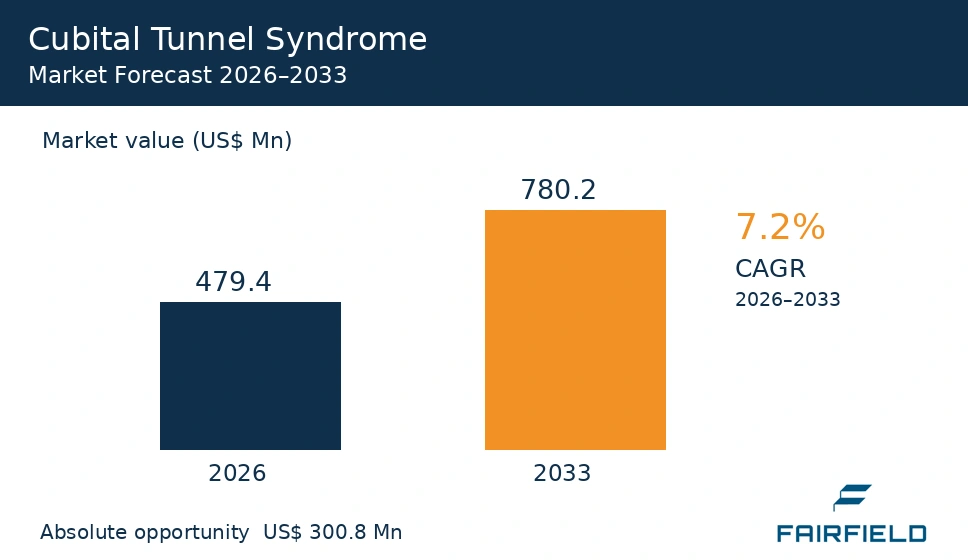
The global cubital tunnel syndrome market size is expected to be valued at US$ 479.4 million in 2026 and projected to reach US$ 780.2 million by 2033, growing at a CAGR of 7.2% between 2026 and 2033.
Between 2020 and 2025, the market grew at a CAGR of about 6.3%, rising from roughly US$ 330 million to about US$ 447 million, as elective hand and elbow surgeries delayed during the pandemic returned, more people worked long hours at computers and on phones with bent elbows, and minimally invasive release techniques spread. The cubital tunnel syndrome market covers diagnosis and treatment of compression of the ulnar nerve at the elbow, the second most common nerve compression condition in the arm after carpal tunnel syndrome. Treatment ranges from non-surgical care, such as night splints, elbow pads, activity changes, pain relievers, and physical therapy, to surgery, including in situ decompression, anterior transposition, medial epicondylectomy, and endoscopic and ultrasound-guided release. In December 2025, the FDA approved Axogen’s Avance nerve allograft as a biologic for peripheral nerve repair.
Key Report Takeaways
- By Treatment Type: Surgical Treatment held about 56% share in 2025, while Physical Therapy and Splinting are projected to expand at a 7.8% CAGR through 2033, driven by earlier diagnosis, conservative care guidelines, home exercise programs, and digital physical therapy services.
- By Diagnosis Method: Nerve Conduction Studies held about 45% share in 2025, while Ultrasound Imaging is projected to expand at a 9.0% CAGR through 2033, driven by portable high-resolution scanners, office-based diagnosis, and ultrasound-guided minimally invasive release procedures.
- By End User: Hospitals held about 50% share in 2025, while Ambulatory Surgical Centers are projected to expand at an 8.3% CAGR through 2033, driven by lower costs, same-day discharge, payer support, and growing hand surgery volumes in outpatient settings.
- By Region: North America held about 42% share in 2025, while Asia Pacific is projected to expand at an 8.5% CAGR through 2033, driven by aging populations, rising office work, better access to hand surgery, and expanding diagnostic services in China and India.
Global Cubital Tunnel Syndrome Market Trends and Insights
Drivers Impact Analysis
Two drivers carry the strongest influence on cubital tunnel syndrome market demand during the forecast period.
| Driver | Impact on CAGR Forecast | Geographic Relevance | Impact Timeline |
| Rising prevalence linked to lifestyle and aging | High | Global | Long term (≥4 years) |
| Adoption of minimally invasive surgery | Medium | North America, Europe, Asia Pacific | Medium term (2-4 years) |
Rising Prevalence Is Driving the Cubital Tunnel Syndrome Market
Rising prevalence linked to lifestyle and aging is the strongest driver of the cubital tunnel syndrome market. More people are developing ulnar nerve problems.
The mechanism is that keeping the elbow bent for long periods, leaning on the elbow, and repetitive arm movements increase pressure on the ulnar nerve. Office workers using computers, people holding phones for long periods, drivers, manual workers, and athletes such as baseball pitchers face higher risk. Obesity, diabetes, arthritis, and previous elbow fractures also raise risk, and these conditions are becoming more common. Aging populations in North America, Europe, Japan, and China add more patients, since nerve compression becomes more common with age. Workers’ compensation claims in the United States support treatment volumes. Greater awareness among doctors and patients also leads to more diagnoses. These trends create steady demand.
Minimally Invasive Surgery Is Expanding the Cubital Tunnel Syndrome Market
Adoption of minimally invasive surgery is expanding the cubital tunnel syndrome market. Patients want faster recovery and smaller scars.
The cause is that traditional open surgery for cubital tunnel syndrome can require larger incisions, longer recovery, and more scar pain. New endoscopic cubital tunnel release systems, such as those from Trice Medical and Integra LifeSciences, let surgeons view and release the nerve through small incisions. Ultrasound-guided percutaneous release, including thread and blade techniques, is emerging as a minimally invasive alternative that can take around 20 minutes. These procedures can often be done in outpatient centers or offices with local anesthesia, lowering costs and allowing patients to return to work sooner. Nerve wraps and protectors are used to reduce scarring in revision cases. These trends support adoption of new devices.
Restraints Impact Analysis
Two restraints limit how quickly the cubital tunnel syndrome market grows.
| Restraint | Impact on CAGR Forecast | Geographic Relevance | Impact Timeline |
| Underdiagnosis and preference for conservative care | High | Global | Medium term (2-4 years) |
| Surgical risks and limited evidence for new techniques | Medium | Europe, Asia Pacific | Long term (≥4 years) |
Underdiagnosis Slows the Cubital Tunnel Syndrome Market
Underdiagnosis and a preference for conservative care slow the cubital tunnel syndrome market. Many patients never receive formal treatment.
The problem is that early symptoms such as occasional numbness and tingling in the fingers are often mild and come and go, so many people ignore them or treat themselves with rest and over-the-counter products. Cubital tunnel syndrome can also be confused with carpal tunnel syndrome, neck problems, or other nerve conditions, delaying the correct diagnosis. Many mild and moderate cases improve with splinting, activity changes, and therapy, which cost far less than surgery. In many countries in Asia Pacific, Latin America, and Middle East & Africa, access to hand surgeons, nerve testing, and imaging is limited outside major cities. These factors reduce treatment volumes and limit revenue growth.
Surgical Risks Restrict the Cubital Tunnel Syndrome Market
Surgical risks and limited evidence for new techniques restrict the cubital tunnel syndrome market. Surgery does not always work.
The constraint is that cubital tunnel surgery can have less predictable results than carpal tunnel surgery, especially in severe cases with muscle wasting, and some patients continue to have symptoms or need revision surgery. Complications can include nerve injury, persistent pain, elbow instability, and scarring. Surgeons disagree about the best technique, such as simple decompression versus transposition, and newer endoscopic and ultrasound-guided methods have limited long-term data, which slows their adoption. Specialized training and equipment are needed. Reimbursement for newer procedures may be uncertain, and payers in Europe often limit access through waiting lists. These factors slow adoption of premium devices and new procedures in many hospitals and clinics.
Market Opportunities
Ultrasound-Guided and Office-Based Procedures Open a Fast-Growth Revenue Pool
Ultrasound-guided and office-based procedures open a fast-growth revenue pool. Treatment is moving out of the operating room.
The opportunity comes from high-resolution ultrasound, which can show the ulnar nerve and surrounding structures clearly, supporting both faster diagnosis and minimally invasive treatment. Office-based release procedures using ultrasound and small instruments can cut costs, avoid general anesthesia, and allow patients to return to normal activities within days. Companies that have built ultrasound-guided carpal tunnel and trigger finger release systems, such as Sonex Health, are positioned to extend these approaches. Portable ultrasound also supports diagnosis in primary care and sports medicine clinics. Companies that offer dedicated instruments, training programs, and clinical evidence can win strong adoption and premium pricing as payers look for lower-cost care settings.
Nerve Repair Biologics and Digital Therapy Create a Growth Revenue Pool
Nerve repair biologics and digital therapy create a growth revenue pool. New products support recovery after surgery.
The opportunity reflects growing use of nerve wraps, protectors, conduits, and allografts that help prevent scarring and support nerve healing in revision and complex cases. In December 2025, the FDA approved Axogen’s Avance acellular nerve allograft as a biologic, strengthening its position in peripheral nerve repair, with licensed product availability expected in the second quarter of 2026. Digital physical therapy apps, remote monitoring, and wearable devices also help patients follow exercise programs at home. Workplace ergonomics programs run by employers and insurers can also prevent symptoms and reduce lost workdays. Companies that combine surgical products, biologics, and digital rehabilitation can capture strong growth across the full patient journey, from diagnosis and conservative care to surgery and rehabilitation.
Segment Analysis
By Treatment Type: Surgical Treatment Leads While Physical Therapy and Splinting Grow Fastest
Surgical Treatment held about 56% share in 2025. Patients with moderate to severe symptoms, muscle weakness, or failed conservative care often need surgery, which includes in situ decompression, anterior transposition, medial epicondylectomy, and endoscopic release. Surgery costs much more per patient than other treatments, which gives this segment the largest revenue share, and revision surgeries add further value.
Physical Therapy and Splinting are the fastest-growing treatment type, expanding at a 7.8% CAGR through 2033. Night splints, elbow pads, nerve gliding exercises, and activity changes are first-line care for most patients, and digital therapy services are widening access. Medication, including pain relievers and anti-inflammatory drugs, forms another segment. For the market, conservative care growth expands the treated population and brings more patients into formal care pathways.
By Diagnosis Method: Nerve Conduction Studies Lead While Ultrasound Imaging Grows Fastest
Nerve Conduction Studies held about 45% share in 2025. These tests measure how fast signals travel along the ulnar nerve and help confirm the diagnosis, locate the compression, and assess severity before surgery. They are widely used by neurologists and physical medicine specialists, and many insurers require them before approving surgery.
Ultrasound Imaging is the fastest-growing diagnosis method, expanding at a 9.0% CAGR through 2033. High-resolution ultrasound shows nerve swelling and compression, is quick and painless, and can be done in the office. It also guides minimally invasive procedures and injections. Electromyography, Physical Examination, and Other Methods form further segments. For the market, ultrasound growth supports office-based care and creates demand for portable scanners and training.
By End User: Hospitals Lead While Ambulatory Surgical Centers Grow Fastest
Hospitals held about 50% share in 2025. Hospitals perform many cubital tunnel surgeries, especially complex cases, revisions, and transpositions, and they offer nerve testing and imaging. Large hospital systems treat many workers’ compensation and insured patients, and academic centers train new hand surgeons in both open and minimally invasive techniques.
Ambulatory Surgical Centers are the fastest-growing end user, expanding at an 8.3% CAGR through 2033. Most cubital tunnel releases can be performed as same-day procedures, and payers support outpatient care because of lower costs. Specialty Clinics and Physical Therapy Centers form further segments, with clinics handling diagnosis and follow-up. For the market, outpatient growth supports efficient, lower-cost devices and single-use instrument kits that reduce sterilization and setup time.
Geography Analysis
Which Region Is Leading the Cubital Tunnel Syndrome Market?
North America is leading the cubital tunnel syndrome market with about 42% share in 2025. The United States has a large number of hand surgeons, high rates of nerve testing, strong use of outpatient surgery centers, and workers’ compensation programs that support treatment of work-related nerve problems. Integra LifeSciences, Axogen, Stryker, Trice Medical, and Sonex Health are based in the region. Canada adds demand through public health coverage. Key barriers include high costs and uneven insurance coverage. One change shaping the region is growing use of ultrasound-guided procedures in offices and outpatient centers.
Europe Shapes the Cubital Tunnel Syndrome Market Through Advanced Hand Surgery
Europe is a major cubital tunnel syndrome market. Germany, the United Kingdom, France, Italy, Spain, and Austria have strong hand surgery and radiology programs, and researchers at the Medical University of Vienna have studied ultrasound-guided thread release as an alternative to surgery. Public health systems cover most diagnosis and surgery. Aging populations and rising diabetes rates add demand. Key barriers include waiting lists and cost controls. One opportunity is minimally invasive procedures that reduce hospital stays and waiting times for patients, supported by strong radiology and hand surgery research and active professional societies that promote new techniques.
Which Region Is Growing Fastest in the Cubital Tunnel Syndrome Market?
Asia Pacific is the fastest-growing cubital tunnel syndrome market, expanding at an 8.5% CAGR through 2033. China and India have large populations, rising office work, and growing numbers of hand and orthopedic surgeons, while Japan and South Korea have aging populations and advanced imaging. Several ultrasound-guided release techniques were first described by researchers in the region. Australia adds strong demand, and private hospitals in India and China are adding hand surgery units. Key barriers include limited access to specialists in rural areas. One change shaping the region is fast growth in diagnostic ultrasound use in hospitals and private clinics.
Latin America Grows the Cubital Tunnel Syndrome Market Through Expanding Specialist Care
Latin America is a growing cubital tunnel syndrome market. Brazil, Mexico, Argentina, Colombia, and Chile are expanding orthopedic and hand surgery services in private hospitals, and rising office work and manufacturing jobs add patients. Brazil has a large public health system. Key barriers include limited specialists, out-of-pocket costs, and long waits for surgery in public systems. One opportunity is affordable splints, physical therapy, and outpatient surgery programs, supported by growing private health insurance and specialist training. Rising awareness of work-related nerve problems among employers also supports earlier diagnosis and treatment across the region.
Middle East & Africa Builds the Cubital Tunnel Syndrome Market Through Healthcare Investment
Middle East & Africa is an emerging cubital tunnel syndrome market. Saudi Arabia, the United Arab Emirates, and Qatar are investing in orthopedic and specialty hospitals, while Israel has advanced hand surgery services. South Africa and Egypt have growing private healthcare sectors. Key barriers include limited specialists and low awareness of the condition. One opportunity is training programs for hand surgeons and diagnostic ultrasound services, supported by government health investment, growing medical tourism, and new private orthopedic hospitals. Rising office work and diabetes rates also increase the number of patients with nerve problems across the region’s large cities.
Competitive Landscape
The cubital tunnel syndrome market is fragmented. Integra LifeSciences, Axogen, Inc., Stryker Corporation, Pfizer Inc., and Enovis are leading players, while Trice Medical, Sonex Health, Zimmer Biomet, Össur, Bauerfeind, Natus Medical, and GE HealthCare compete strongly. Medical device companies supply surgical instruments, endoscopic release systems, nerve wraps, and nerve grafts, while orthopedic bracing companies sell elbow splints and pads. Diagnostic equipment makers supply nerve conduction and ultrasound systems, and drug makers sell pain relievers and anti-inflammatory medicines used in conservative care.
Companies compete on clinical outcomes, ease of use, procedure time, scar and recovery benefits, cost, surgeon training, and evidence from clinical studies. Relationships with hand surgeons, orthopedic surgeons, and neurologists strongly influence product choice. Outpatient surgery centers favor efficient, single-use systems that reduce setup time, while hospitals value full product portfolios for complex cases.
Strategic moves show how competition is changing. In September 2025, Sonex Health received a new FDA 510(k) clearance. In December 2025, Axogen won FDA approval of its Avance nerve allograft as a biologic, and a stepwise ultrasound-guided ulnar nerve release technique was published, supporting minimally invasive care.
Three themes shape vendor strategy. First, companies are developing endoscopic and ultrasound-guided release systems that move treatment to outpatient and office settings. Second, they are expanding nerve repair biologics and protection products for complex and revision cases. Third, they are building surgeon training and clinical evidence programs to support adoption in Europe and Asia Pacific.
Cubital Tunnel Syndrome Market Industry Leaders
Integra LifeSciences Axogen, Inc. Stryker Corporation Pfizer Inc. Enovis
Recent Industry Developments
- December 2025: Axogen received FDA approval of its Biologics License Application for Avance acellular nerve allograft for sensory, mixed, and motor peripheral nerve discontinuities - strengthens nerve repair options in the cubital tunnel syndrome market.
- December 2025: A stepwise technique for ultrasound-guided percutaneous ulnar nerve release at the elbow was published in Techniques in Hand and Upper Extremity Surgery - supports wider adoption of minimally invasive cubital tunnel release.
- September 2025: Sonex Health, developer of ultrasound-guided soft tissue release systems, received FDA 510(k) clearance for a new device - expands its portfolio for minimally invasive hand and upper limb procedures.
Companies Covered in the Report
- Integra LifeSciences
- Axogen, Inc.
- Stryker Corporation
- Pfizer Inc.
- Enovis
- Trice Medical
- Sonex Health
- Zimmer Biomet
- Össur
- Bauerfeind
- Natus Medical
- GE HealthCare
Cubital Tunnel Syndrome Market Report Scope
This report covers the cubital tunnel syndrome market, including surgical treatment, physical therapy and splinting, and medication, diagnosed by nerve conduction studies, ultrasound imaging, electromyography, physical examination, and other methods, in hospitals, ambulatory surgical centers, specialty clinics, and physical therapy centers. The base year is 2025, and the forecast period runs from 2026 to 2033. All values are expressed in US$ Million.
| Treatment Type | Surgical Treatment, Physical Therapy and Splinting, Medication |
| Diagnosis Method | Nerve Conduction Studies, Ultrasound Imaging, Electromyography, Physical Examination, Other Methods |
| End User | Hospitals, Ambulatory Surgical Centers, Specialty Clinics, Physical Therapy Centers |
| Regions | North America, Europe, Asia Pacific, Latin America, Middle East & Africa |
1. Executive Summary
1.1 Cubital Tunnel Syndrome Market Snapshot
1.2 Future Projections
1.3 Key Market Trends
1.4 Regional Snapshot
2. Market Overview
2.1 Market Definition and Report Scope
2.2 Historical Market Trends
2.3 Market Dynamics
2.3.1 Drivers
2.3.1.1 Rising Prevalence Is Driving the Cubital Tunnel Syndrome Market
2.3.1.2 Minimally Invasive Surgery Is Expanding the Cubital Tunnel Syndrome Market
2.3.2 Restraints
2.3.2.1 Underdiagnosis Slows the Cubital Tunnel Syndrome Market
2.3.2.2 Surgical Risks Restrict the Cubital Tunnel Syndrome Market
2.3.3 Market Opportunities
2.3.3.1 Ultrasound-Guided and Office-Based Procedures Open a Fast-Growth Revenue Pool
2.3.3.2 Nerve Repair Biologics and Digital Therapy Create a Growth Revenue Pool
3. Global Cubital Tunnel Syndrome Market Outlook, 2020–2033
3.1 Global Cubital Tunnel Syndrome Market Outlook, by Treatment Type, Value (US$ Million), 2020–2033
3.1.1 Surgical Treatment
3.1.2 Physical Therapy and Splinting
3.1.3 Medication
3.2 Global Cubital Tunnel Syndrome Market Outlook, by Diagnosis Method, Value (US$ Million), 2020–2033
3.2.1 Nerve Conduction Studies
3.2.2 Ultrasound Imaging
3.2.3 Electromyography
3.2.4 Physical Examination
3.2.5 Other Methods
3.3 Global Cubital Tunnel Syndrome Market Outlook, by End User, Value (US$ Million), 2020–2033
3.3.1 Hospitals
3.3.2 Ambulatory Surgical Centers
3.3.3 Specialty Clinics
3.3.4 Physical Therapy Centers
3.4 Global Cubital Tunnel Syndrome Market Outlook, by Region, Value (US$ Million), 2020–2033
3.4.1 North America
3.4.2 Europe
3.4.3 Asia Pacific
3.4.4 Latin America
3.4.5 Middle East & Africa
4. North America Cubital Tunnel Syndrome Market Outlook, 2020–2033
4.1 North America Cubital Tunnel Syndrome Market Outlook, by Treatment Type, Value (US$ Million), 2020–2033
4.1.1 Surgical Treatment
4.1.2 Physical Therapy and Splinting
4.1.3 Medication
4.2 North America Cubital Tunnel Syndrome Market Outlook, by Diagnosis Method, Value (US$ Million), 2020–2033
4.2.1 Nerve Conduction Studies
4.2.2 Ultrasound Imaging
4.2.3 Electromyography
4.2.4 Physical Examination
4.2.5 Other Methods
4.3 North America Cubital Tunnel Syndrome Market Outlook, by End User, Value (US$ Million), 2020–2033
4.3.1 Hospitals
4.3.2 Ambulatory Surgical Centers
4.3.3 Specialty Clinics
4.3.4 Physical Therapy Centers
4.4 North America Cubital Tunnel Syndrome Market Outlook, by Country, Value (US$ Million), 2020–2033
4.4.1 United States Cubital Tunnel Syndrome Market Outlook, by Treatment Type, 2020–2033
4.4.2 United States Cubital Tunnel Syndrome Market Outlook, by Diagnosis Method, 2020–2033
4.4.3 United States Cubital Tunnel Syndrome Market Outlook, by End User, 2020–2033
4.4.4 Canada Cubital Tunnel Syndrome Market Outlook, by Treatment Type, 2020–2033
4.4.5 Canada Cubital Tunnel Syndrome Market Outlook, by Diagnosis Method, 2020–2033
4.4.6 Canada Cubital Tunnel Syndrome Market Outlook, by End User, 2020–2033
5. Europe Cubital Tunnel Syndrome Market Outlook, 2020–2033
5.1 Europe Cubital Tunnel Syndrome Market Outlook, by Treatment Type, Value (US$ Million), 2020–2033
5.1.1 Surgical Treatment
5.1.2 Physical Therapy and Splinting
5.1.3 Medication
5.2 Europe Cubital Tunnel Syndrome Market Outlook, by Diagnosis Method, Value (US$ Million), 2020–2033
5.2.1 Nerve Conduction Studies
5.2.2 Ultrasound Imaging
5.2.3 Electromyography
5.2.4 Physical Examination
5.2.5 Other Methods
5.3 Europe Cubital Tunnel Syndrome Market Outlook, by End User, Value (US$ Million), 2020–2033
5.3.1 Hospitals
5.3.2 Ambulatory Surgical Centers
5.3.3 Specialty Clinics
5.3.4 Physical Therapy Centers
5.4 Europe Cubital Tunnel Syndrome Market Outlook, by Country, Value (US$ Million), 2020–2033
5.4.1 Germany Cubital Tunnel Syndrome Market Outlook, by Treatment Type, 2020–2033
5.4.2 Germany Cubital Tunnel Syndrome Market Outlook, by Diagnosis Method, 2020–2033
5.4.3 Germany Cubital Tunnel Syndrome Market Outlook, by End User, 2020–2033
5.4.4 United Kingdom Cubital Tunnel Syndrome Market Outlook, by Treatment Type, 2020–2033
5.4.5 United Kingdom Cubital Tunnel Syndrome Market Outlook, by Diagnosis Method, 2020–2033
5.4.6 United Kingdom Cubital Tunnel Syndrome Market Outlook, by End User, 2020–2033
5.4.7 France Cubital Tunnel Syndrome Market Outlook, by Treatment Type, 2020–2033
5.4.8 France Cubital Tunnel Syndrome Market Outlook, by Diagnosis Method, 2020–2033
5.4.9 France Cubital Tunnel Syndrome Market Outlook, by End User, 2020–2033
5.4.10 Italy Cubital Tunnel Syndrome Market Outlook, by Treatment Type, 2020–2033
5.4.11 Italy Cubital Tunnel Syndrome Market Outlook, by Diagnosis Method, 2020–2033
5.4.12 Italy Cubital Tunnel Syndrome Market Outlook, by End User, 2020–2033
5.4.13 Spain Cubital Tunnel Syndrome Market Outlook, by Treatment Type, 2020–2033
5.4.14 Spain Cubital Tunnel Syndrome Market Outlook, by Diagnosis Method, 2020–2033
5.4.15 Spain Cubital Tunnel Syndrome Market Outlook, by End User, 2020–2033
5.4.16 Austria Cubital Tunnel Syndrome Market Outlook, by Treatment Type, 2020–2033
5.4.17 Austria Cubital Tunnel Syndrome Market Outlook, by Diagnosis Method, 2020–2033
5.4.18 Austria Cubital Tunnel Syndrome Market Outlook, by End User, 2020–2033
6. Asia Pacific Cubital Tunnel Syndrome Market Outlook, 2020–2033
6.1 Asia Pacific Cubital Tunnel Syndrome Market Outlook, by Treatment Type, Value (US$ Million), 2020–2033
6.1.1 Surgical Treatment
6.1.2 Physical Therapy and Splinting
6.1.3 Medication
6.2 Asia Pacific Cubital Tunnel Syndrome Market Outlook, by Diagnosis Method, Value (US$ Million), 2020–2033
6.2.1 Nerve Conduction Studies
6.2.2 Ultrasound Imaging
6.2.3 Electromyography
6.2.4 Physical Examination
6.2.5 Other Methods
6.3 Asia Pacific Cubital Tunnel Syndrome Market Outlook, by End User, Value (US$ Million), 2020–2033
6.3.1 Hospitals
6.3.2 Ambulatory Surgical Centers
6.3.3 Specialty Clinics
6.3.4 Physical Therapy Centers
6.4 Asia Pacific Cubital Tunnel Syndrome Market Outlook, by Country, Value (US$ Million), 2020–2033
6.4.1 China Cubital Tunnel Syndrome Market Outlook, by Treatment Type, 2020–2033
6.4.2 China Cubital Tunnel Syndrome Market Outlook, by Diagnosis Method, 2020–2033
6.4.3 China Cubital Tunnel Syndrome Market Outlook, by End User, 2020–2033
6.4.4 India Cubital Tunnel Syndrome Market Outlook, by Treatment Type, 2020–2033
6.4.5 India Cubital Tunnel Syndrome Market Outlook, by Diagnosis Method, 2020–2033
6.4.6 India Cubital Tunnel Syndrome Market Outlook, by End User, 2020–2033
6.4.7 Japan Cubital Tunnel Syndrome Market Outlook, by Treatment Type, 2020–2033
6.4.8 Japan Cubital Tunnel Syndrome Market Outlook, by Diagnosis Method, 2020–2033
6.4.9 Japan Cubital Tunnel Syndrome Market Outlook, by End User, 2020–2033
6.4.10 South Korea Cubital Tunnel Syndrome Market Outlook, by Treatment Type, 2020–2033
6.4.11 South Korea Cubital Tunnel Syndrome Market Outlook, by Diagnosis Method, 2020–2033
6.4.12 South Korea Cubital Tunnel Syndrome Market Outlook, by End User, 2020–2033
6.4.13 Australia Cubital Tunnel Syndrome Market Outlook, by Treatment Type, 2020–2033
6.4.14 Australia Cubital Tunnel Syndrome Market Outlook, by Diagnosis Method, 2020–2033
6.4.15 Australia Cubital Tunnel Syndrome Market Outlook, by End User, 2020–2033
7. Latin America Cubital Tunnel Syndrome Market Outlook, 2020–2033
7.1 Latin America Cubital Tunnel Syndrome Market Outlook, by Treatment Type, Value (US$ Million), 2020–2033
7.1.1 Surgical Treatment
7.1.2 Physical Therapy and Splinting
7.1.3 Medication
7.2 Latin America Cubital Tunnel Syndrome Market Outlook, by Diagnosis Method, Value (US$ Million), 2020–2033
7.2.1 Nerve Conduction Studies
7.2.2 Ultrasound Imaging
7.2.3 Electromyography
7.2.4 Physical Examination
7.2.5 Other Methods
7.3 Latin America Cubital Tunnel Syndrome Market Outlook, by End User, Value (US$ Million), 2020–2033
7.3.1 Hospitals
7.3.2 Ambulatory Surgical Centers
7.3.3 Specialty Clinics
7.3.4 Physical Therapy Centers
7.4 Latin America Cubital Tunnel Syndrome Market Outlook, by Country, Value (US$ Million), 2020–2033
7.4.1 Brazil Cubital Tunnel Syndrome Market Outlook, by Treatment Type, 2020–2033
7.4.2 Brazil Cubital Tunnel Syndrome Market Outlook, by Diagnosis Method, 2020–2033
7.4.3 Brazil Cubital Tunnel Syndrome Market Outlook, by End User, 2020–2033
7.4.4 Mexico Cubital Tunnel Syndrome Market Outlook, by Treatment Type, 2020–2033
7.4.5 Mexico Cubital Tunnel Syndrome Market Outlook, by Diagnosis Method, 2020–2033
7.4.6 Mexico Cubital Tunnel Syndrome Market Outlook, by End User, 2020–2033
7.4.7 Argentina Cubital Tunnel Syndrome Market Outlook, by Treatment Type, 2020–2033
7.4.8 Argentina Cubital Tunnel Syndrome Market Outlook, by Diagnosis Method, 2020–2033
7.4.9 Argentina Cubital Tunnel Syndrome Market Outlook, by End User, 2020–2033
7.4.10 Colombia Cubital Tunnel Syndrome Market Outlook, by Treatment Type, 2020–2033
7.4.11 Colombia Cubital Tunnel Syndrome Market Outlook, by Diagnosis Method, 2020–2033
7.4.12 Colombia Cubital Tunnel Syndrome Market Outlook, by End User, 2020–2033
7.4.13 Chile Cubital Tunnel Syndrome Market Outlook, by Treatment Type, 2020–2033
7.4.14 Chile Cubital Tunnel Syndrome Market Outlook, by Diagnosis Method, 2020–2033
7.4.15 Chile Cubital Tunnel Syndrome Market Outlook, by End User, 2020–2033
8. Middle East & Africa Cubital Tunnel Syndrome Market Outlook, 2020–2033
8.1 Middle East & Africa Cubital Tunnel Syndrome Market Outlook, by Treatment Type, Value (US$ Million), 2020–2033
8.1.1 Surgical Treatment
8.1.2 Physical Therapy and Splinting
8.1.3 Medication
8.2 Middle East & Africa Cubital Tunnel Syndrome Market Outlook, by Diagnosis Method, Value (US$ Million), 2020–2033
8.2.1 Nerve Conduction Studies
8.2.2 Ultrasound Imaging
8.2.3 Electromyography
8.2.4 Physical Examination
8.2.5 Other Methods
8.3 Middle East & Africa Cubital Tunnel Syndrome Market Outlook, by End User, Value (US$ Million), 2020–2033
8.3.1 Hospitals
8.3.2 Ambulatory Surgical Centers
8.3.3 Specialty Clinics
8.3.4 Physical Therapy Centers
8.4 Middle East & Africa Cubital Tunnel Syndrome Market Outlook, by Country, Value (US$ Million), 2020–2033
8.4.1 Saudi Arabia Cubital Tunnel Syndrome Market Outlook, by Treatment Type, 2020–2033
8.4.2 Saudi Arabia Cubital Tunnel Syndrome Market Outlook, by Diagnosis Method, 2020–2033
8.4.3 Saudi Arabia Cubital Tunnel Syndrome Market Outlook, by End User, 2020–2033
8.4.4 United Arab Emirates Cubital Tunnel Syndrome Market Outlook, by Treatment Type, 2020–2033
8.4.5 United Arab Emirates Cubital Tunnel Syndrome Market Outlook, by Diagnosis Method, 2020–2033
8.4.6 United Arab Emirates Cubital Tunnel Syndrome Market Outlook, by End User, 2020–2033
8.4.7 Qatar Cubital Tunnel Syndrome Market Outlook, by Treatment Type, 2020–2033
8.4.8 Qatar Cubital Tunnel Syndrome Market Outlook, by Diagnosis Method, 2020–2033
8.4.9 Qatar Cubital Tunnel Syndrome Market Outlook, by End User, 2020–2033
8.4.10 Israel Cubital Tunnel Syndrome Market Outlook, by Treatment Type, 2020–2033
8.4.11 Israel Cubital Tunnel Syndrome Market Outlook, by Diagnosis Method, 2020–2033
8.4.12 Israel Cubital Tunnel Syndrome Market Outlook, by End User, 2020–2033
8.4.13 South Africa Cubital Tunnel Syndrome Market Outlook, by Treatment Type, 2020–2033
8.4.14 South Africa Cubital Tunnel Syndrome Market Outlook, by Diagnosis Method, 2020–2033
8.4.15 South Africa Cubital Tunnel Syndrome Market Outlook, by End User, 2020–2033
8.4.16 Egypt Cubital Tunnel Syndrome Market Outlook, by Treatment Type, 2020–2033
8.4.17 Egypt Cubital Tunnel Syndrome Market Outlook, by Diagnosis Method, 2020–2033
8.4.18 Egypt Cubital Tunnel Syndrome Market Outlook, by End User, 2020–2033
9. Competitive Landscape
9.1 Cubital Tunnel Syndrome Market Industry Leaders
9.2 Recent Industry Developments
9.3 Company Profiles
9.3.1 Integra LifeSciences
9.3.2 Axogen, Inc.
9.3.3 Stryker Corporation
9.3.4 Pfizer Inc.
9.3.5 Enovis
9.3.6 Trice Medical
9.3.7 Sonex Health
9.3.8 Zimmer Biomet
9.3.9 Össur
9.3.10 Bauerfeind
9.3.11 Natus Medical
9.3.12 GE HealthCare
10. Appendix
10.1 Research Methodology
10.2 Report Assumptions
10.3 Acronyms and Abbreviations
| Treatment Type | Surgical Treatment, Physical Therapy and Splinting, Medication |
| Diagnosis Method | Nerve Conduction Studies, Ultrasound Imaging, Electromyography, Physical Examination, Other Methods |
| End User | Hospitals, Ambulatory Surgical Centers, Specialty Clinics, Physical Therapy Centers |
| Regions | North America, Europe, Asia Pacific, Latin America, Middle East & Africa |
Our Research Methodology
Considering the volatility of business today, traditional approaches to strategizing a game plan can be unfruitful if not detrimental. True ambiguity is no way to determine a forecast. A myriad of predetermined factors must be accounted for such as the degree of risk involved, the magnitude of circumstances, as well as conditions or consequences that are not known or unpredictable. To circumvent binary views that cast uncertainty, the application of market research intelligence to strategically posture, move, and enable actionable outcomes is necessary.
View Methodology
Quality Assured
Rigorous Validation Process

Confidentiality Assured
End-to-end Data Security

Custom Research Services
Tailored To Your Objectives
FAQs
The market is valued at US$ 479.4 million in 2026, led by surgical treatment, nerve conduction studies, and North America.
The market is projected to reach US$ 780.2 million by 2033, growing at a 7.2% CAGR and adding US$ 300.8 million.
Ultrasound Imaging is growing fastest at a 9.0% CAGR through 2033, driven by portable scanners and office-based procedures.
Asia Pacific is growing fastest at an 8.5% CAGR through 2033, driven by aging populations and better specialist access.
North America holds the largest share at about 42% in 2025, supported by many hand surgeons and outpatient centers.
Related Reports
Disposable Medical Sensors Market Size, Share, Insights, Competitive Landscape, and Forecast 2026 to 2033
The disposable medical sensors market is projected to reach US$ 18.31 billion by 2033, growing at 6.4% CAGR from US$ 11.86 billion in 2026.
White Glove Services in Delivery Market Size, Share, Insights, Competitive Landscape, and Forecast 2026 to 2033
The global white glove services in delivery market is valued at US$15.60 billion in 2026, reaching US$29.08 billion by 2033, growing at a 9.3% CAGR
Centrifugation-Free Sperm Separation System Market Size, Share, Insights, Competitive Landscape, and Forecast 2026 to 2033
The centrifugation-free sperm separation system market is projected to reach US$ 223.8 million by 2033, growing at 5.3% CAGR from US$ 155.6 million in 2026.
Smart Fertility Trackers Market Size, Share, Insights, Competitive Landscape, and Forecast 2026 to 2033
Explore the smart fertility trackers market, forecast to reach US$3.10 billion by 2033 at 11.8% CAGR, with product, technology, channel, and regional insights.
Endodontic Instruments Market Size, Share, Insights, Competitive Landscape, and Forecast 2026 to 2033
Explore the endodontic instruments market, forecast to reach US$2.19 billion by 2033 at 6.4% CAGR, with product, application, and regional insights.
Blood Transfusion Diagnostics Market Size, Share, Insights, Competitive Landscape, and Forecast 2026 to 2033
Explore the blood transfusion diagnostics market, forecast to reach US$7.4 billion by 2033 at 6.4% CAGR, with insights on products, tests, and regions.