



Disposable Medical Sensors Market
Disposable Medical Sensors Market Size, Share, Insights, Competitive Landscape, and Forecast 2026 to 2033
Report Overview
Disposable Medical Sensors Market Size and Trend Analysis
How Fast Is the Disposable Medical Sensors Market Growing?
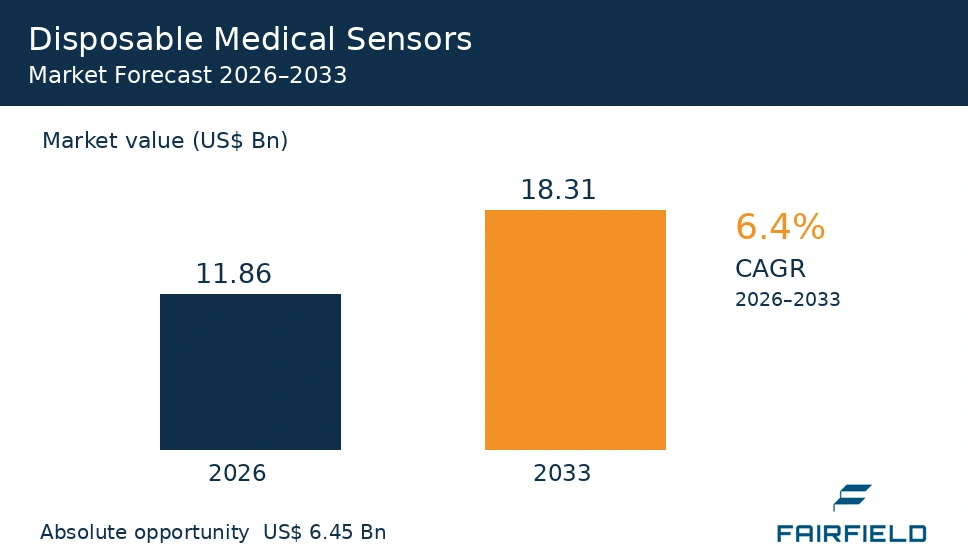
The global disposable medical sensors market size is expected to be valued at US$ 11.86 billion in 2026 and projected to reach US$ 18.31 billion by 2033, growing at a CAGR of 6.4% between 2026 and 2033.
Between 2020 and 2025, the market grew at a CAGR of about 6.2%, rising from roughly US$ 8.28 billion to about US$ 11.19 billion, as the pandemic boosted demand for single-use pulse oximetry, temperature, and ECG sensors, hospitals tightened infection control, and continuous glucose monitors moved into mainstream diabetes care. The disposable medical sensors market covers single-use sensors that measure body signals such as glucose, blood oxygen, heart rhythm, temperature, blood pressure, and respiration, and are thrown away after one patient or one wear period. Main products include biosensors, pressure sensors, temperature sensors, image sensors, and accelerometers, delivered as wearable patches, strip sensors, ingestible sensors, and invasive catheter-based sensors. These devices lower cross-infection risk and support remote monitoring at home. In August 2026, Abbott received FDA De Novo authorization for Libre Duo 10 Day, a dual glucose and ketone sensor.
Key Report Takeaways
- By Product: Biosensors held about 48% share in 2025, while Image Sensors are projected to expand at a 7.8% CAGR through 2033, driven by single-use endoscopes, capsule cameras, and the push to remove reprocessing steps that carry infection risk.
- By Application: Patient Monitoring held about 55% share in 2025, while Diagnostics is projected to expand at a 7.5% CAGR through 2033, driven by point-of-care testing, home test strips, and fast sensor-based results in clinics and pharmacies.
- By End User: Hospitals held about 60% share in 2025, while Home Healthcare is projected to expand at an 8.2% CAGR through 2033, driven by continuous glucose monitoring, remote patient monitoring programs, and reimbursement for monitoring patients outside hospitals.
- By Region: North America held about 40% share in 2025, while Asia Pacific is projected to expand at an 8.0% CAGR through 2033, driven by large diabetic populations, hospital expansion, and growing local sensor manufacturing in China, India, and Japan.
Global Disposable Medical Sensors Market Trends and Insights
Drivers Impact Analysis
Two drivers carry the strongest influence on disposable medical sensors market demand during the forecast period.
| Driver | Impact on CAGR Forecast | Geographic Relevance | Impact Timeline |
| Rising chronic disease and continuous monitoring | High | Global | Long term (≥4 years) |
| Infection control and single-use adoption | Medium | North America, Europe | Medium term (2-4 years) |
Chronic Disease Monitoring Is Driving the Disposable Medical Sensors Market
Rising chronic disease and continuous monitoring are the strongest driver of the disposable medical sensors market. More patients need ongoing measurement.
The mechanism is that hundreds of millions of people live with diabetes, heart disease, high blood pressure, and lung disease, and doctors increasingly track these conditions continuously instead of during occasional visits. Continuous glucose monitors from Abbott, Dexcom, and Medtronic use a new disposable sensor every ten to fifteen days, creating large recurring demand. Wearable ECG patches detect irregular heart rhythms over days or weeks, and single-use pulse oximetry sensors are used in surgery and intensive care. Ageing populations add more patients each year. Wider insurance coverage for glucose monitoring among people with type 2 diabetes is also expanding the user base. These trends create steady, repeat sales for sensor makers worldwide.
Infection Control Is Expanding the Disposable Medical Sensors Market
Infection control and single-use adoption are expanding the disposable medical sensors market. Hospitals want to reduce cross-contamination.
The cause is that reusable sensors, cables, and probes must be cleaned and checked between patients, and poor cleaning has been linked to hospital-acquired infections. Single-use temperature probes, pressure transducers, ECG electrodes, and pulse oximetry sensors remove this risk and save staff time spent on reprocessing. The pandemic made hospitals far more careful about shared equipment, and many kept single-use policies afterwards. Regulators in North America and Europe have issued safety warnings about reprocessed endoscopes, encouraging single-use designs with built-in image sensors. Hospital accreditation standards also focus on infection prevention. These factors are moving more sensor categories from reusable to disposable formats across hospitals and surgical centers.
Restraints Impact Analysis
Two restraints limit how quickly the disposable medical sensors market grows.
| Restraint | Impact on CAGR Forecast | Geographic Relevance | Impact Timeline |
| High recurring cost and reimbursement gaps | High | Global | Medium term (2-4 years) |
| Medical waste and environmental concerns | Medium | Europe, North America | Long term (≥4 years) |
Cost and Reimbursement Gaps Slow the Disposable Medical Sensors Market
High recurring cost and reimbursement gaps slow the disposable medical sensors market. Single-use devices must be bought again and again.
The problem is that a disposable sensor costs money every time it is used, so hospitals and patients face ongoing spending instead of a one-time purchase. Continuous glucose monitors can cost patients hundreds of dollars each month without insurance, and coverage for people with type 2 diabetes who do not use insulin remains limited in many countries. Hospitals in Asia Pacific, Latin America, and Middle East & Africa often reuse sensors or choose cheaper alternatives because budgets are tight. Price pressure from tenders and group purchasing organizations also squeezes margins. Clear evidence of cost savings is often needed before payers approve coverage. These factors slow adoption in price-sensitive markets.
Medical Waste Concerns Restrict the Disposable Medical Sensors Market
Medical waste and environmental concerns restrict the disposable medical sensors market. Single-use electronics add to waste.
The constraint is that disposable sensors often contain batteries, circuit boards, metals, and plastics that are hard to recycle, and billions of single-use devices are thrown away each year. Hospitals in Europe and North America face growing pressure to cut carbon emissions and waste, and some health systems now include sustainability in purchasing decisions. New rules on batteries, electronic waste, and plastics may raise compliance costs for manufacturers. Some hospitals are returning to validated reprocessing of certain sensors to save money and reduce waste. Cybersecurity and data privacy requirements for connected sensors also add costs and slow product approvals. These issues push companies to design longer-wear, recyclable, and lower-waste sensor products.
Market Opportunities
Multi-Analyte and Longer-Wear Sensors Open a Fast-Growth Revenue Pool
Multi-analyte and longer-wear sensors open a fast-growth revenue pool. Patients want more data from one device.
The opportunity comes from sensors that measure more than one signal, such as Abbott’s Libre Duo 10 Day, which tracks glucose and ketones together to warn of diabetic ketoacidosis. Longer wear times, such as Dexcom’s G7 15 Day, reduce sensor changes and improve convenience. Wearable patches that track heart rate, breathing, temperature, and activity support hospital-at-home programs and early warning of patient decline. Integration with insulin pumps, smartphones, smartwatches, and hospital records makes sensor data more useful for patients and doctors. Companies that combine accurate multi-signal sensing, comfortable wear, long battery life, and strong software platforms can win premium pricing, recurring revenue, and loyal users in every region.
Home Care and Emerging Markets Create a Growth Revenue Pool
Home care and emerging markets create a growth revenue pool. Care is moving outside hospitals.
The opportunity reflects strong growth in remote patient monitoring, telehealth, and home healthcare, where disposable wearable sensors let doctors track patients after discharge and avoid readmissions. Reimbursement codes for remote monitoring in the United States have encouraged health systems to launch programs at scale. In China, India, Indonesia, Brazil, and Mexico, large diabetic populations, rising incomes, and expanding hospitals are creating new demand. Local manufacturers are offering lower-cost glucose sensors and ECG patches, and pharmacies and online stores are making sensors easier to buy without a hospital visit. Companies that offer affordable sensors, local production, simple apps, and partnerships with insurers and clinics can capture fast growth in these large and underserved markets.
Segment Analysis
By Product: Biosensors Lead While Image Sensors Grow Fastest
Biosensors held about 48% share in 2025. Biosensors detect chemical signals such as glucose, lactate, ketones, and blood gases, and are the core technology inside continuous glucose monitors and test strips. The large global diabetic population and frequent sensor replacement make biosensors the largest product segment. Leading companies keep improving accuracy and wear time.
Image Sensors are the fastest-growing product, expanding at a 7.8% CAGR through 2033. Single-use endoscopes for bronchoscopy, urology, and gastroenterology, along with capsule cameras, contain small image sensors that are discarded after one procedure. Pressure Sensors, Temperature Sensors, and Accelerometers form other segments, used in catheters, infusion systems, and wearable patches. For the market, image sensor growth reflects the shift away from reusable scopes that are difficult to clean.
By Application: Patient Monitoring Leads While Diagnostics Grows Fastest
Patient Monitoring held about 55% share in 2025. Continuous glucose monitoring, pulse oximetry, ECG, temperature, and blood pressure monitoring in hospitals and homes use large volumes of single-use sensors every day. Intensive care units and operating rooms rely on disposable pressure transducers and oximetry probes. Remote monitoring programs add steady demand.
Diagnostics is the fastest-growing application, expanding at a 7.5% CAGR through 2033. Point-of-care tests, home test kits, and sensor-based diagnostic strips give fast results for infections, blood chemistry, and cardiac markers. Single-use endoscopes support diagnostic imaging. Therapeutics forms another segment, including sensors in insulin pumps and drug delivery systems. For the market, diagnostic growth supports earlier detection and decentralized testing in clinics and pharmacies.
By End User: Hospitals Lead While Home Healthcare Grows Fastest
Hospitals held about 60% share in 2025. Hospitals use disposable sensors in surgery, intensive care, emergency departments, and general wards, and strict infection control rules favor single-use devices. High patient volumes and complex procedures drive large purchases through group purchasing contracts. Wireless single-use patches are also replacing wired monitoring on general wards, helping nurses spot patient decline earlier.
Home Healthcare is the fastest-growing end user, expanding at an 8.2% CAGR through 2033. Continuous glucose monitors, wearable ECG patches, and remote monitoring kits let patients manage chronic conditions at home with data shared to doctors. Diagnostic Laboratories and Ambulatory Surgical Centers form other segments. For the market, home care growth creates large recurring sensor demand outside hospitals.
Geography Analysis
Which Region Is Leading the Disposable Medical Sensors Market?
North America is leading the disposable medical sensors market with about 40% share in 2025. The United States has high rates of diabetes and heart disease, wide insurance coverage for continuous glucose monitoring, reimbursement for remote patient monitoring, and strict infection control rules. Abbott, Dexcom, Medtronic, Masimo, TE Connectivity, and iRhythm Technologies are based in the region. Canada adds demand, and Health Canada authorized Dexcom’s G7 15 Day in July 2026. Key barriers include high costs and pricing pressure. One change shaping the region is fast growth of hospital-at-home programs.
Europe Shapes the Disposable Medical Sensors Market Through Public Health Systems
Europe is a major disposable medical sensors market. Germany, France, the United Kingdom, Italy, and Spain have large diabetic populations and public health systems that reimburse continuous glucose monitoring for many patients. Koninklijke Philips, Roche, Ambu, and Dräger are based in the region. The EU Medical Device Regulation raises clinical evidence requirements. Key barriers include tender-based pricing and sustainability rules. One opportunity is remote monitoring programs that reduce hospital stays, supported by national digital health strategies and growing reimbursement for digital care in several countries, including Germany. Single-use endoscope adoption is also rising across hospitals.
Which Region Is Growing Fastest in the Disposable Medical Sensors Market?
Asia Pacific is the fastest-growing disposable medical sensors market, expanding at an 8.0% CAGR through 2033. China and India have the world’s largest diabetic populations, while Japan and South Korea have ageing populations and advanced hospitals. Local makers such as Sinocare and MicroTech Medical are launching lower-cost glucose sensors, and governments are expanding hospital capacity and insurance coverage. Australia has strong continuous glucose monitoring subsidies. Hospitals in large cities are adopting single-use pulse oximetry and ECG sensors in intensive care units. Key barriers include price sensitivity and limited reimbursement. One change shaping the region is rapid growth of local sensor manufacturing.
Latin America Grows the Disposable Medical Sensors Market Through Hospital Investment
Latin America is a growing disposable medical sensors market. Brazil, Mexico, Argentina, Colombia, and Chile have rising rates of diabetes and heart disease and are investing in private hospitals and intensive care capacity. Brazil has a large medical device market and growing private health insurance. Key barriers include currency swings, import costs, and limited public coverage for continuous glucose monitors. One opportunity is affordable sensors and partnerships with private hospital chains and insurers, supported by telehealth services and growing awareness of diabetes care in large cities such as São Paulo and Mexico City. Single-use sensors in operating rooms are also gaining ground as infection control improves.
Middle East & Africa Builds the Disposable Medical Sensors Market Through Healthcare Expansion
Middle East & Africa is an emerging disposable medical sensors market. Saudi Arabia and the United Arab Emirates have some of the world’s highest diabetes rates and are building new hospitals under national health plans. Israel has a strong digital health and sensor startup sector. South Africa and Egypt have growing private hospital networks, and Qatar and Kuwait are investing in diabetes care centers. Key barriers include limited reimbursement, import dependence, and uneven access to specialist care outside large cities. One opportunity is continuous glucose monitoring programs for large diabetic populations, supported by government spending, smart hospital projects, and telehealth platforms in large cities.
Competitive Landscape
The disposable medical sensors market is moderately consolidated. Abbott Laboratories, Dexcom, Inc., Medtronic plc, TE Connectivity, and Koninklijke Philips N.V. are leading players, while Masimo Corporation, GE HealthCare, iRhythm Technologies, Ambu A/S, Senseonics Holdings, Smiths Medical, and Sensirion AG compete strongly. Abbott and Dexcom lead continuous glucose monitoring, which is the largest single category, while Medtronic, Masimo, and Philips are strong in pulse oximetry and hospital monitoring sensors. TE Connectivity and Sensirion supply sensor components to device makers, and Ambu leads single-use endoscopes.
Companies compete on accuracy, wear time, comfort, connectivity with phones and pumps, software platforms, price, reimbursement support, and supply reliability. Large hospital contracts and insurance coverage decide much of the market, so companies invest in clinical studies and payer relationships. Local makers in China are adding price competition in glucose sensors.
Strategic moves show how competition is changing. In April 2025, Dexcom won FDA clearance for its G7 15 Day sensor, and in July 2026, it gained Health Canada authorization. In August 2026, Abbott received FDA authorization for Libre Duo 10 Day, the first glucose and ketone sensor. MiniMed also completed its separation from Medtronic in 2026, creating a focused diabetes company.
Three themes shape vendor strategy. First, companies are extending wear time and adding new analytes to single sensors. Second, they are linking sensors with insulin pumps, apps, and remote monitoring platforms. Third, they are expanding into Asia Pacific, Latin America, and home care with lower-cost products.
Disposable Medical Sensors Market Industry Leaders
Abbott Laboratories Dexcom, Inc. Medtronic plc TE Connectivity Koninklijke Philips N.V.
Recent Industry Developments
- August 2026: Abbott received FDA De Novo authorization for Libre Duo 10 Day, the first sensor to continuously monitor both glucose and ketones, with a United States launch planned later in 2026 - creates a new multi-analyte category in the disposable medical sensors market.
- July 2026: Dexcom received Health Canada authorization for its G7 15 Day continuous glucose monitor for adults with diabetes, offering 15.5 days of wear - extends its longest-wear disposable sensor into a new market.
- April 2025: Dexcom received FDA clearance for the G7 15 Day continuous glucose monitor for adults with diabetes - intensifies competition on wear time with Abbott’s FreeStyle Libre sensors.
Companies Covered in the Report
- Abbott Laboratories
- Dexcom, Inc.
- Medtronic plc
- TE Connectivity
- Koninklijke Philips N.V.
- Masimo Corporation
- GE HealthCare
- iRhythm Technologies
- Ambu A/S
- Senseonics Holdings
- Smiths Medical
- Sensirion AG
Disposable Medical Sensors Market Report Scope
This report covers the disposable medical sensors market, including biosensors, image sensors, pressure sensors, temperature sensors, and accelerometers, used for patient monitoring, diagnostics, and therapeutics in hospitals, home healthcare, diagnostic laboratories, and ambulatory surgical centers. Segments cover product, application, and end user. The base year is 2025, and the forecast period runs from 2026 to 2033. All values are expressed in US$ Billion.
| Product | Biosensors, Image Sensors, Pressure Sensors, Temperature Sensors, Accelerometers |
| Application | Patient Monitoring, Diagnostics, Therapeutics |
| End User | Hospitals, Home Healthcare, Diagnostic Laboratories, Ambulatory Surgical Centers |
| Regions | North America, Europe, Asia Pacific, Latin America, Middle East & Africa |
1. Executive Summary
1.1 Disposable Medical Sensors Market Snapshot
1.2 Future Projections
1.3 Key Market Trends
1.4 Regional Snapshot
2. Market Overview
2.1 Market Definition and Report Scope
2.2 Historical Market Trends
2.3 Market Dynamics
2.3.1 Drivers
2.3.1.1 Chronic Disease Monitoring Is Driving the Disposable Medical Sensors Market
2.3.1.2 Infection Control Is Expanding the Disposable Medical Sensors Market
2.3.2 Restraints
2.3.2.1 Cost and Reimbursement Gaps Slow the Disposable Medical Sensors Market
2.3.2.2 Medical Waste Concerns Restrict the Disposable Medical Sensors Market
2.3.3 Market Opportunities
2.3.3.1 Multi-Analyte and Longer-Wear Sensors Open a Fast-Growth Revenue Pool
2.3.3.2 Home Care and Emerging Markets Create a Growth Revenue Pool
3. Global Disposable Medical Sensors Market Outlook, 2020–2033
3.1 Global Disposable Medical Sensors Market Outlook, by Product, Value (US$ Billion), 2020–2033
3.1.1 Biosensors
3.1.2 Image Sensors
3.1.3 Pressure Sensors
3.1.4 Temperature Sensors
3.1.5 Accelerometers
3.2 Global Disposable Medical Sensors Market Outlook, by Application, Value (US$ Billion), 2020–2033
3.2.1 Patient Monitoring
3.2.2 Diagnostics
3.2.3 Therapeutics
3.3 Global Disposable Medical Sensors Market Outlook, by End User, Value (US$ Billion), 2020–2033
3.3.1 Hospitals
3.3.2 Home Healthcare
3.3.3 Diagnostic Laboratories
3.3.4 Ambulatory Surgical Centers
3.4 Global Disposable Medical Sensors Market Outlook, by Region, Value (US$ Billion), 2020–2033
3.4.1 North America
3.4.2 Europe
3.4.3 Asia Pacific
3.4.4 Latin America
3.4.5 Middle East & Africa
4. North America Disposable Medical Sensors Market Outlook, 2020–2033
4.1 North America Disposable Medical Sensors Market Outlook, by Product, Value (US$ Billion), 2020–2033
4.1.1 Biosensors
4.1.2 Image Sensors
4.1.3 Pressure Sensors
4.1.4 Temperature Sensors
4.1.5 Accelerometers
4.2 North America Disposable Medical Sensors Market Outlook, by Application, Value (US$ Billion), 2020–2033
4.2.1 Patient Monitoring
4.2.2 Diagnostics
4.2.3 Therapeutics
4.3 North America Disposable Medical Sensors Market Outlook, by End User, Value (US$ Billion), 2020–2033
4.3.1 Hospitals
4.3.2 Home Healthcare
4.3.3 Diagnostic Laboratories
4.3.4 Ambulatory Surgical Centers
4.4 North America Disposable Medical Sensors Market Outlook, by Country, Value (US$ Billion), 2020–2033
4.4.1 United States Disposable Medical Sensors Market Outlook, by Product, 2020–2033
4.4.2 United States Disposable Medical Sensors Market Outlook, by Application, 2020–2033
4.4.3 United States Disposable Medical Sensors Market Outlook, by End User, 2020–2033
4.4.4 Canada Disposable Medical Sensors Market Outlook, by Product, 2020–2033
4.4.5 Canada Disposable Medical Sensors Market Outlook, by Application, 2020–2033
4.4.6 Canada Disposable Medical Sensors Market Outlook, by End User, 2020–2033
5. Europe Disposable Medical Sensors Market Outlook, 2020–2033
5.1 Europe Disposable Medical Sensors Market Outlook, by Product, Value (US$ Billion), 2020–2033
5.1.1 Biosensors
5.1.2 Image Sensors
5.1.3 Pressure Sensors
5.1.4 Temperature Sensors
5.1.5 Accelerometers
5.2 Europe Disposable Medical Sensors Market Outlook, by Application, Value (US$ Billion), 2020–2033
5.2.1 Patient Monitoring
5.2.2 Diagnostics
5.2.3 Therapeutics
5.3 Europe Disposable Medical Sensors Market Outlook, by End User, Value (US$ Billion), 2020–2033
5.3.1 Hospitals
5.3.2 Home Healthcare
5.3.3 Diagnostic Laboratories
5.3.4 Ambulatory Surgical Centers
5.4 Europe Disposable Medical Sensors Market Outlook, by Country, Value (US$ Billion), 2020–2033
5.4.1 Germany Disposable Medical Sensors Market Outlook, by Product, 2020–2033
5.4.2 Germany Disposable Medical Sensors Market Outlook, by Application, 2020–2033
5.4.3 Germany Disposable Medical Sensors Market Outlook, by End User, 2020–2033
5.4.4 France Disposable Medical Sensors Market Outlook, by Product, 2020–2033
5.4.5 France Disposable Medical Sensors Market Outlook, by Application, 2020–2033
5.4.6 France Disposable Medical Sensors Market Outlook, by End User, 2020–2033
5.4.7 United Kingdom Disposable Medical Sensors Market Outlook, by Product, 2020–2033
5.4.8 United Kingdom Disposable Medical Sensors Market Outlook, by Application, 2020–2033
5.4.9 United Kingdom Disposable Medical Sensors Market Outlook, by End User, 2020–2033
5.4.10 Italy Disposable Medical Sensors Market Outlook, by Product, 2020–2033
5.4.11 Italy Disposable Medical Sensors Market Outlook, by Application, 2020–2033
5.4.12 Italy Disposable Medical Sensors Market Outlook, by End User, 2020–2033
5.4.13 Spain Disposable Medical Sensors Market Outlook, by Product, 2020–2033
5.4.14 Spain Disposable Medical Sensors Market Outlook, by Application, 2020–2033
5.4.15 Spain Disposable Medical Sensors Market Outlook, by End User, 2020–2033
6. Asia Pacific Disposable Medical Sensors Market Outlook, 2020–2033
6.1 Asia Pacific Disposable Medical Sensors Market Outlook, by Product, Value (US$ Billion), 2020–2033
6.1.1 Biosensors
6.1.2 Image Sensors
6.1.3 Pressure Sensors
6.1.4 Temperature Sensors
6.1.5 Accelerometers
6.2 Asia Pacific Disposable Medical Sensors Market Outlook, by Application, Value (US$ Billion), 2020–2033
6.2.1 Patient Monitoring
6.2.2 Diagnostics
6.2.3 Therapeutics
6.3 Asia Pacific Disposable Medical Sensors Market Outlook, by End User, Value (US$ Billion), 2020–2033
6.3.1 Hospitals
6.3.2 Home Healthcare
6.3.3 Diagnostic Laboratories
6.3.4 Ambulatory Surgical Centers
6.4 Asia Pacific Disposable Medical Sensors Market Outlook, by Country, Value (US$ Billion), 2020–2033
6.4.1 China Disposable Medical Sensors Market Outlook, by Product, 2020–2033
6.4.2 China Disposable Medical Sensors Market Outlook, by Application, 2020–2033
6.4.3 China Disposable Medical Sensors Market Outlook, by End User, 2020–2033
6.4.4 India Disposable Medical Sensors Market Outlook, by Product, 2020–2033
6.4.5 India Disposable Medical Sensors Market Outlook, by Application, 2020–2033
6.4.6 India Disposable Medical Sensors Market Outlook, by End User, 2020–2033
6.4.7 Japan Disposable Medical Sensors Market Outlook, by Product, 2020–2033
6.4.8 Japan Disposable Medical Sensors Market Outlook, by Application, 2020–2033
6.4.9 Japan Disposable Medical Sensors Market Outlook, by End User, 2020–2033
6.4.10 South Korea Disposable Medical Sensors Market Outlook, by Product, 2020–2033
6.4.11 South Korea Disposable Medical Sensors Market Outlook, by Application, 2020–2033
6.4.12 South Korea Disposable Medical Sensors Market Outlook, by End User, 2020–2033
6.4.13 Australia Disposable Medical Sensors Market Outlook, by Product, 2020–2033
6.4.14 Australia Disposable Medical Sensors Market Outlook, by Application, 2020–2033
6.4.15 Australia Disposable Medical Sensors Market Outlook, by End User, 2020–2033
7. Latin America Disposable Medical Sensors Market Outlook, 2020–2033
7.1 Latin America Disposable Medical Sensors Market Outlook, by Product, Value (US$ Billion), 2020–2033
7.1.1 Biosensors
7.1.2 Image Sensors
7.1.3 Pressure Sensors
7.1.4 Temperature Sensors
7.1.5 Accelerometers
7.2 Latin America Disposable Medical Sensors Market Outlook, by Application, Value (US$ Billion), 2020–2033
7.2.1 Patient Monitoring
7.2.2 Diagnostics
7.2.3 Therapeutics
7.3 Latin America Disposable Medical Sensors Market Outlook, by End User, Value (US$ Billion), 2020–2033
7.3.1 Hospitals
7.3.2 Home Healthcare
7.3.3 Diagnostic Laboratories
7.3.4 Ambulatory Surgical Centers
7.4 Latin America Disposable Medical Sensors Market Outlook, by Country, Value (US$ Billion), 2020–2033
7.4.1 Brazil Disposable Medical Sensors Market Outlook, by Product, 2020–2033
7.4.2 Brazil Disposable Medical Sensors Market Outlook, by Application, 2020–2033
7.4.3 Brazil Disposable Medical Sensors Market Outlook, by End User, 2020–2033
7.4.4 Mexico Disposable Medical Sensors Market Outlook, by Product, 2020–2033
7.4.5 Mexico Disposable Medical Sensors Market Outlook, by Application, 2020–2033
7.4.6 Mexico Disposable Medical Sensors Market Outlook, by End User, 2020–2033
7.4.7 Argentina Disposable Medical Sensors Market Outlook, by Product, 2020–2033
7.4.8 Argentina Disposable Medical Sensors Market Outlook, by Application, 2020–2033
7.4.9 Argentina Disposable Medical Sensors Market Outlook, by End User, 2020–2033
7.4.10 Colombia Disposable Medical Sensors Market Outlook, by Product, 2020–2033
7.4.11 Colombia Disposable Medical Sensors Market Outlook, by Application, 2020–2033
7.4.12 Colombia Disposable Medical Sensors Market Outlook, by End User, 2020–2033
7.4.13 Chile Disposable Medical Sensors Market Outlook, by Product, 2020–2033
7.4.14 Chile Disposable Medical Sensors Market Outlook, by Application, 2020–2033
7.4.15 Chile Disposable Medical Sensors Market Outlook, by End User, 2020–2033
8. Middle East & Africa Disposable Medical Sensors Market Outlook, 2020–2033
8.1 Middle East & Africa Disposable Medical Sensors Market Outlook, by Product, Value (US$ Billion), 2020–2033
8.1.1 Biosensors
8.1.2 Image Sensors
8.1.3 Pressure Sensors
8.1.4 Temperature Sensors
8.1.5 Accelerometers
8.2 Middle East & Africa Disposable Medical Sensors Market Outlook, by Application, Value (US$ Billion), 2020–2033
8.2.1 Patient Monitoring
8.2.2 Diagnostics
8.2.3 Therapeutics
8.3 Middle East & Africa Disposable Medical Sensors Market Outlook, by End User, Value (US$ Billion), 2020–2033
8.3.1 Hospitals
8.3.2 Home Healthcare
8.3.3 Diagnostic Laboratories
8.3.4 Ambulatory Surgical Centers
8.4 Middle East & Africa Disposable Medical Sensors Market Outlook, by Country, Value (US$ Billion), 2020–2033
8.4.1 Saudi Arabia Disposable Medical Sensors Market Outlook, by Product, 2020–2033
8.4.2 Saudi Arabia Disposable Medical Sensors Market Outlook, by Application, 2020–2033
8.4.3 Saudi Arabia Disposable Medical Sensors Market Outlook, by End User, 2020–2033
8.4.4 United Arab Emirates Disposable Medical Sensors Market Outlook, by Product, 2020–2033
8.4.5 United Arab Emirates Disposable Medical Sensors Market Outlook, by Application, 2020–2033
8.4.6 United Arab Emirates Disposable Medical Sensors Market Outlook, by End User, 2020–2033
8.4.7 Israel Disposable Medical Sensors Market Outlook, by Product, 2020–2033
8.4.8 Israel Disposable Medical Sensors Market Outlook, by Application, 2020–2033
8.4.9 Israel Disposable Medical Sensors Market Outlook, by End User, 2020–2033
8.4.10 South Africa Disposable Medical Sensors Market Outlook, by Product, 2020–2033
8.4.11 South Africa Disposable Medical Sensors Market Outlook, by Application, 2020–2033
8.4.12 South Africa Disposable Medical Sensors Market Outlook, by End User, 2020–2033
8.4.13 Egypt Disposable Medical Sensors Market Outlook, by Product, 2020–2033
8.4.14 Egypt Disposable Medical Sensors Market Outlook, by Application, 2020–2033
8.4.15 Egypt Disposable Medical Sensors Market Outlook, by End User, 2020–2033
8.4.16 Qatar Disposable Medical Sensors Market Outlook, by Product, 2020–2033
8.4.17 Qatar Disposable Medical Sensors Market Outlook, by Application, 2020–2033
8.4.18 Qatar Disposable Medical Sensors Market Outlook, by End User, 2020–2033
8.4.19 Kuwait Disposable Medical Sensors Market Outlook, by Product, 2020–2033
8.4.20 Kuwait Disposable Medical Sensors Market Outlook, by Application, 2020–2033
8.4.21 Kuwait Disposable Medical Sensors Market Outlook, by End User, 2020–2033
9. Competitive Landscape
9.1 Disposable Medical Sensors Market Industry Leaders
9.2 Recent Industry Developments
9.3 Company Profiles
9.3.1 Abbott Laboratories
9.3.2 Dexcom, Inc.
9.3.3 Medtronic plc
9.3.4 TE Connectivity
9.3.5 Koninklijke Philips N.V.
9.3.6 Masimo Corporation
9.3.7 GE HealthCare
9.3.8 iRhythm Technologies
9.3.9 Ambu A/S
9.3.10 Senseonics Holdings
9.3.11 Smiths Medical
9.3.12 Sensirion AG
10. Appendix
10.1 Research Methodology
10.2 Report Assumptions
10.3 Acronyms and Abbreviations
| Product | Biosensors, Image Sensors, Pressure Sensors, Temperature Sensors, Accelerometers |
| Application | Patient Monitoring, Diagnostics, Therapeutics |
| End User | Hospitals, Home Healthcare, Diagnostic Laboratories, Ambulatory Surgical Centers |
| Regions | North America, Europe, Asia Pacific, Latin America, Middle East & Africa |
Our Research Methodology
Considering the volatility of business today, traditional approaches to strategizing a game plan can be unfruitful if not detrimental. True ambiguity is no way to determine a forecast. A myriad of predetermined factors must be accounted for such as the degree of risk involved, the magnitude of circumstances, as well as conditions or consequences that are not known or unpredictable. To circumvent binary views that cast uncertainty, the application of market research intelligence to strategically posture, move, and enable actionable outcomes is necessary.
View Methodology
Quality Assured
Rigorous Validation Process

Confidentiality Assured
End-to-end Data Security

Custom Research Services
Tailored To Your Objectives
FAQs
The global disposable medical sensors market is expected to be valued at US$ 11.86 billion in 2026, driven by glucose monitoring and infection control.
The market is projected to grow at a 6.4% CAGR from 2026 to 2033, reaching about US$ 18.31 billion by 2033.
North America leads the market with about 40% share, supported by high diabetes rates, strong reimbursement, and major sensor companies based in the region.
Biosensors dominate with about 48% share, because continuous glucose monitors and test strips use large volumes of single-use chemical sensors every year.
Key players include Abbott Laboratories, Dexcom, Medtronic, TE Connectivity, and Koninklijke Philips, competing on accuracy, wear time, and price.
Related Reports
Cubital Tunnel Syndrome Market Size, Share, Insights, Competitive Landscape, and Forecast 2026 to 2033
The cubital tunnel syndrome market is projected to reach US$ 780.2 million by 2033, growing at 7.2% CAGR from US$ 479.4 million in 2026.
White Glove Services in Delivery Market Size, Share, Insights, Competitive Landscape, and Forecast 2026 to 2033
The global white glove services in delivery market is valued at US$15.60 billion in 2026, reaching US$29.08 billion by 2033, growing at a 9.3% CAGR
Centrifugation-Free Sperm Separation System Market Size, Share, Insights, Competitive Landscape, and Forecast 2026 to 2033
The centrifugation-free sperm separation system market is projected to reach US$ 223.8 million by 2033, growing at 5.3% CAGR from US$ 155.6 million in 2026.
Smart Fertility Trackers Market Size, Share, Insights, Competitive Landscape, and Forecast 2026 to 2033
Explore the smart fertility trackers market, forecast to reach US$3.10 billion by 2033 at 11.8% CAGR, with product, technology, channel, and regional insights.
Endodontic Instruments Market Size, Share, Insights, Competitive Landscape, and Forecast 2026 to 2033
Explore the endodontic instruments market, forecast to reach US$2.19 billion by 2033 at 6.4% CAGR, with product, application, and regional insights.
Blood Transfusion Diagnostics Market Size, Share, Insights, Competitive Landscape, and Forecast 2026 to 2033
Explore the blood transfusion diagnostics market, forecast to reach US$7.4 billion by 2033 at 6.4% CAGR, with insights on products, tests, and regions.