



Digestive Health Drinks Market
Digestive Health Drinks Market Size, Share, Insights, Competitive Landscape, and Forecast 2026 to 2033
Digestive Health Drinks Market Size and Trend Analysis
How Fast Will Digestive Health Drinks Sales Grow?
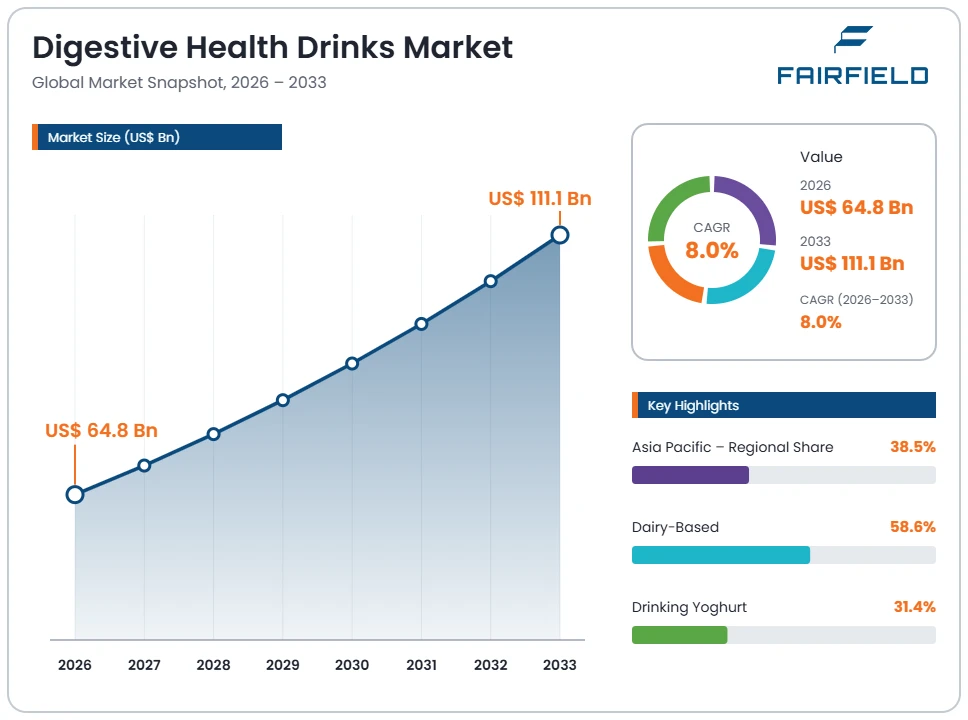
The global digestive health drinks market size is expected to be valued at US$ 64.8 billion in 2026 and projected to reach US$ 111.1 billion by 2033, growing at a CAGR of 8.0% between 2026 and 2033.
The category grew at close to a 7.2% CAGR between 2020 and 2025, when chilled fermented drinks moved from specialty aisles into mainstream grocery chillers. Three factors carry the forecast. Daily gut-comfort routines now sit inside normal grocery baskets rather than supplement budgets. Added-sugar declarations in the United States Nutrition Facts panel have pushed reformulation toward low-sugar fibre drinks and prebiotic sodas. Convenience retail in Japan, China, India and Mexico keeps single-serve probiotic shots in constant circulation. Direction of travel is steady volume growth with a slow mix shift from sweetened dairy drinks toward lower-sugar, fibre-forward and plant-based formats sold at higher unit prices.
Key Report Takeaways
- By Product Type: Drinking yoghurt held 31.4% share in 2026, while prebiotic soda is projected to expand at an 11.8% CAGR through 2033, driven by mainstream grocery listings for low-sugar carbonated fibre drinks in chilled and ambient sets.
- By Functional Ingredient: Probiotics held 44.2% share in 2026, while postbiotics are projected to expand at a 13.5% CAGR through 2033, helped by the ISAPP consensus definition that gave non-viable preparations a workable technical description.
- By Base Type: Dairy-based drinks held 58.6% share in 2026, while plant-based drinks are projected to expand at a 10.9% CAGR through 2033, as oat, coconut and soy bases widen reach among lactose-avoiding households.
- By Distribution Channel: Supermarkets and hypermarkets held 38.7% share in 2026, while online retail is projected to expand at a 12.4% CAGR through 2033, supported by subscription packs of shots and powdered fibre tonics.
- By Geography: Asia Pacific held 38.5% share in 2026, while North America is projected to expand at a 9.4% CAGR through 2033, on the back of rapid prebiotic soda distribution gains across national grocery and club chains.
Global Digestive Health Drinks Market Trends and Insights
Drivers Impact Analysis
Two demand forces account for most of the forecast growth in gut-health beverages.
| Driver | Impact on CAGR Forecast | Geographic Relevance | Impact Timeline |
| Everyday self-care routines move fermented drinks into mainstream grocery chillers | High | Asia Pacific, North America, Europe | Short term (≤2 years) |
| Added-sugar transparency pushes reformulation toward fibre-forward, low-sugar beverages | Medium | North America, Europe | Medium term (2–4 years) |
Daily Gut-Comfort Routines Move Digestive Health Drinks Out of the Supplement Aisle
Routine daily consumption is the single largest volume driver for digestive health drinks. Shoppers who once bought a probiotic course for a few weeks now keep kefir, drinking yoghurt or a 65 ml shot in the fridge all year. That shift converts an occasional purchase into a weekly replenishment item, which lifts household penetration and repeat rate at the same time.
The mechanism is distribution plus habit. Convenience chains in Japan, South Korea and China stock chilled shots at checkout, while grocery chillers in the United States and United Kingdom now carry fermented drinks beside juice rather than beside supplements. Smaller single-serve packs lower the trial price. Codex standards for fermented milks give manufacturers a settled compositional basis for drinking yoghurt and kefir, which simplifies export and private-label supply.
Added-Sugar Labelling Pushes Reformulation and Opens Shelf Space for Low-Sugar Digestive Beverages
Sugar visibility has become a formulation driver rather than a marketing footnote. The Nutrition Facts panel required by the US Food and Drug Administration declares added sugars in grams and as a percent daily value. Sweetened drinking yoghurts look weaker on that panel than fibre drinks, so retailers have made room for lower-sugar entries and brands have reformulated existing lines downward.
The causal chain runs from label to recipe to assortment. Chicory root fibre, inulin, resistant dextrin and agave inulin let formulators keep mouthfeel while cutting sucrose. Prebiotic sodas use those fibres with high-intensity sweeteners to land under common sugar thresholds. Retail buyers in Canada and the European Union, working against front-of-pack nutrition schemes, favour those entries, which pulls new shelf facings toward the low-sugar end of the category.
Restraints Impact Analysis
Two structural constraints hold back pricing power and claim-led marketing in this category.
| Restraint | Impact on CAGR Forecast | Geographic Relevance | Impact Timeline |
| Gap between consumer gut-health marketing and authorised health claims | High | Europe, North America | Long term (≥4 years) |
| Cold chain and live-culture stability costs compress distribution margins | Medium | Latin America, Middle East & Africa, Asia Pacific | Medium term (2–4 years) |
Authorised Claim Limits Separate Gut-Health Marketing From What Labels May Actually Say
Claim restrictions cap the premium that digestive health drinks can command in regulated markets. Under Regulation (EC) No 1924/2006, nutrition and health claims in the European Union must be authorised, and the European Food Safety Authority has not accepted general gut-health claims for most probiotic strains. The term “probiotic” has largely been treated as an unauthorised health claim at European Union level, although several member states now permit it on labels.
The underlying cause is evidentiary. Claim dossiers require a characterised strain, a measured physiological outcome and human trial evidence, which few single-strain beverage formulas carry. In the United States, conventional foods and dietary supplements may use structure or function claims, but those require the US Food and Drug Administration disclaimer and substantiation that satisfies Federal Trade Commission advertising rules. Marketing then leans on culture counts and lifestyle language rather than benefit statements.
Cold Chain Dependence and Live-Culture Stability Raise the Cost of Serving Distant Markets
Refrigerated logistics limit where digestive health drinks can profitably be sold. Chilled kefir, drinking yoghurt and probiotic shots need unbroken temperature control from filling line to shelf, which rules out large parts of traditional trade in warm climates. Distributors in those markets carry higher spoilage write-offs, and retailers demand deeper margins to accept the risk.
The specific cost sources are measurable. Refrigerated transport and chilled retail space cost more per case than ambient equivalents. Culture viability must be guaranteed to the end of shelf life, so manufacturers overdose cultures at filling and shorten dating. Kombucha adds a secondary fermentation risk, since continued yeast activity can lift alcohol above the 0.5% alcohol by volume threshold that separates a soft drink from an alcoholic beverage in the United States, forcing tighter process control and cold storage.
Market Opportunities
Two revenue pools sit outside the current chilled dairy core of the category.
Shelf-Stable Postbiotic and Ambient Fibre Drinks Unlock Warm-Climate Revenue Pools
Ambient formats open markets that chilled distribution cannot reach today. Postbiotic preparations and heat-treated fermented drinks do not depend on live-culture survival, so they tolerate ambient warehousing and long shipping routes without refrigerated vehicles. That removes the main barrier to selling gut-health beverages through traditional trade in hot regions and through e-commerce parcel networks. The addressable store count rises sharply once a chiller is no longer a condition of stocking the product.
Dairy processors, contract bottlers and fibre ingredient suppliers are positioned to capture this pool. Demand comes from urban shoppers in India, Indonesia, Brazil, Nigeria and Saudi Arabia who buy from small independent stores without reliable chilling. The ISAPP consensus definition of postbiotics gave the ingredient class a usable technical identity, which has made specification, supplier qualification and retailer onboarding far simpler than it was for live-culture ambient attempts.
Plant-Based and Fibre-Forward Formats Create a Second Shelf Beside Dairy Gut-Health Drinks
Plant bases build incremental revenue rather than cannibalising dairy. Oat, coconut, soy and almond fermented drinks reach lactose-avoiding and vegetarian households that skipped the chiller entirely. Retailers treat them as a separate set, so brands gain a second block of facings instead of competing for the same dairy space, and average selling prices sit above comparable dairy drinks.
Plant beverage specialists, oat processors and established dairy groups with plant divisions can take this pool. The buyer group is urban, younger and already purchasing plant milks, which shortens the education step. Supporting developments include the ISAPP consensus description of fermented foods, which clarified how non-dairy fermented drinks should be described, and wider availability of chicory inulin and resistant dextrin that let formulators add measurable fibre per serving without a chalky texture.
Segment Analysis
- By Product Type: Drinking Yoghurt Anchors Volume While Prebiotic Soda Scales Fastest
Drinking yoghurt leads the product mix with 31.4% share in 2026, because it sits in family grocery baskets across Asia Pacific, Europe and Latin America at everyday price points. Its position rests on established dairy processing capacity, familiar taste and compositional rules for fermented milks that make private-label supply straightforward. Prebiotic soda is the fastest-growing product type at an 11.8% CAGR to 2033, expanding from a small base as low-sugar carbonated fibre drinks win mainstream grocery and club listings in the United States and Canada. Kefir and probiotic shots occupy the middle, with shots strongest in convenience retail. The business implication is a widening price ladder: processors keep volume in dairy drinks while recruiting new buyers through carbonated fibre formats that need no dairy plant and carry higher gross margin per litre.
- By Functional Ingredient: Probiotic Cultures Hold the Base as Postbiotics Open New Formats
Probiotics hold 44.2% share of ingredient value in 2026, reflecting decades of consumer familiarity with live cultures in fermented milks and shots. Strain libraries, fermentation know-how and the ISAPP consensus definition of probiotics give suppliers a defensible technical position. Postbiotics are the fastest-growing ingredient class at a 13.5% CAGR through 2033, since heat-treated and non-viable preparations survive ambient distribution and pasteurisation steps that kill live cultures. Prebiotic fibres such as inulin and resistant dextrin sit between the two and support the fibre drink and prebiotic soda formats. Digestive enzymes remain a niche within tonics. For manufacturers, the practical consequence is that ingredient choice now decides the supply chain: live cultures commit a product to the chiller, while postbiotics and fibres free it for ambient shelves and export.
- By Base Type: Dairy Formats Dominate Shelf Space While Plant Bases Accelerate
Dairy-based drinks account for 58.6% of category value in 2026, supported by existing yoghurt and fermented milk capacity and by the taste expectations built over generations in Japan, China, Türkiye and Mexico. Scale in milk procurement keeps unit costs low and makes dairy the default for value tiers. Plant-based drinks are the fastest-growing base at a 10.9% CAGR to 2033, pulled by lactose avoidance, flexitarian eating and the spread of oat and coconut fermentation capability. Water-based and juice-based drinks cover kombucha and fibre tonics and provide the clean-label entry point. Supporting this shift are new culture blends validated on plant substrates and improved stabiliser systems that control separation. The implication for suppliers is dual-line capability, since a single dairy-only asset base now limits access to the fastest-moving part of the category.
- By Distribution Channel: Supermarkets Carry the Volume While Online Retail Compounds Quickest
Supermarkets and hypermarkets deliver 38.7% of sales in 2026, because chilled gut-health drinks are still largely a planned grocery purchase bought alongside milk and yoghurt. Large formats offer the chiller space, promotional mechanics and multipack economics that volume brands need. Online retail is the fastest-growing channel at a 12.4% CAGR to 2033, as subscription packs of probiotic shots, powdered fibre tonics and ambient prebiotic drinks ship economically without cold chain. Convenience stores remain central in Japan, South Korea and Thailand for single-serve shots, and specialty health retailers seed premium kombucha and kefir. Foodservice contributes through cafés and quick-service breakfast menus. The practical consequence is that ambient and powder formats now define online economics, so brands without a shippable format cede the fastest-growing channel.
Geography Analysis
- Which Region Is Growing Fastest in the Digestive Health Drinks Market?
North America is the fastest-growing geography, expanding at a 9.4% CAGR between 2026 and 2033 from a 26.4% share in 2026. Growth is led by the United States, where prebiotic soda moved from independent grocers into national supermarket, club and convenience distribution within a few years. Added-sugar declarations in the Nutrition Facts panel pushed shoppers toward lower-sugar options, and fibre-forward carbonated drinks answered that directly. Canada contributes through kefir and drinking yoghurt in mainstream chillers. Kombucha remains a sizeable sub-segment, with producers managing fermentation tightly to stay under the 0.5% alcohol by volume limit. The change shaping the region is retailer willingness to allocate ambient shelf space to gut-health beverages, which removes the chiller constraint that once capped distribution.
- Strict Claim Rules Keep Europe a Mature, Format-Led Fermented Drinks Market
Europe holds 22.8% of global value in 2026 and grows at a slower 6.9% CAGR, the most regulated major market in the category. Germany, France, the United Kingdom, Poland and Türkiye account for most consumption, with ayran, kefir and drinking yoghurt forming the base. Regulation (EC) No 1924/2006 and European Food Safety Authority opinions restrict health claims, so competition runs on format, sugar content and provenance rather than benefit messaging. Several member states now allow the word “probiotic” on labels, creating uneven national practice. Front-of-pack nutrition schemes push reformulation toward lower sugar. The opportunity reshaping the region is premium low-sugar kefir and plant-based fermented drinks, where brands can differentiate on composition without making a regulated health claim.
- Which Region Is Leading the Digestive Health Drinks Market?
Asia Pacific leads the market with 38.5% share in 2026 and grows at a 7.8% CAGR to 2033. Japan established the daily probiotic shot habit decades ago, and that routine now extends across China, South Korea, Viet Nam and Thailand through dense convenience retail and direct home delivery networks. China contributes the largest single volume pool, with chilled drinking yoghurt sold through supermarkets and online grocery platforms. India adds fast-rising demand for lassi-style and shelf-stable fermented drinks. Deep penetration rests on cultural familiarity with fermented dairy, small affordable pack sizes and daily purchase behaviour. The change shaping the region is premiumisation, as urban households trade from basic sweetened drinks to low-sugar and multi-strain products.
- Latin America Builds Scale Through Dairy Processors and Traditional Trade
Latin America accounts for 7.6% of global value in 2026 and grows at an 8.3% CAGR, ahead of the global average. Mexico and Brazil drive most of the demand, supported by large domestic dairy processors with established chilled yoghurt distribution and by widespread sales of single-serve drinkable yoghurt in small neighbourhood stores. Argentina, Chile and Colombia add steady secondary volume. The principal barriers are currency volatility that raises imported culture and fibre ingredient costs, uneven refrigeration in traditional trade, and price sensitivity that limits premium tiers. Sugar warning labels in Mexico and Chile have pressured sweetened drinkable yoghurts. The opportunity is reformulated lower-sugar and ambient fermented drinks that pass labelling thresholds and reach stores without reliable chilling.
- Middle East & Africa Demand Follows Traditional Fermented Dairy and Ambient Formats
Middle East & Africa represents 4.7% of global value in 2026 with a 7.5% CAGR, the smallest but a steadily building regional pool. Saudi Arabia, the United Arab Emirates, Egypt and South Africa lead consumption, built on established demand for laban, ayran and drinking yoghurt served with meals. Local dairy groups hold strong chilled distribution in Gulf cities. Barriers are substantial: high ambient temperatures, fragmented cold chain outside major urban centres, import dependence for cultures and fibres, and limited consumer familiarity with prebiotic or postbiotic positioning. Import tariffs and halal certification add administrative cost. The clearest opportunity is shelf-stable fermented and postbiotic drinks that reach secondary cities and rural trade without refrigerated transport.
Competitive Landscape
The digestive health drinks market shows medium concentration. A handful of large dairy groups control most chilled volume, while hundreds of regional fermenters, kombucha brewers and prebiotic soda start-ups share the rest. Danone S.A., Yakult Honsha Co., Ltd., Nestlé S.A. and Meiji Holdings Co., Ltd. hold entrenched positions in fermented dairy drinks through owned processing and chilled logistics. The newer low-sugar carbonated segment is far more fragmented, and acquisitions by beverage majors have begun pulling independent brands into national distribution systems, which steadily raises concentration at the top of the category.
Competition runs on a narrow set of factors. Chilled shelf access and distribution reach matter most, followed by sugar content per serving, strain or fibre credentials, price per serving and packaging format. Taste remains decisive, since repeat purchase collapses when a fibre load produces an unpleasant texture. New entrants have come from two directions: functional soda brands such as Olipop PBC and beverage start-ups building around chicory inulin and resistant dextrin, and kombucha producers including GT’s Living Foods, LLC and Health-Ade LLC that scaled from local brewing into national retail.
Strategic activity concentrates on capability rather than scale alone. Dairy groups have added plant-fermentation lines and ambient filling capacity to serve non-chilled channels. Ingredient suppliers have expanded postbiotic and prebiotic fibre production to meet reformulation demand. Beverage majors have used acquisitions and distribution agreements to place functional sodas into convenience and club channels where independent brands could not reach. Co-manufacturing partnerships let smaller brands scale without capital investment in fermentation plants.
Vendor strategy is converging on three themes: lower sugar per serving, formats that do not require refrigeration, and claim-safe communication that works under both European Union and United States rules. Companies are also investing in strain characterisation to support future dossiers.
Recent Industry Developments
- December 2006: The European Parliament and the Council of the European Union adopted Regulation (EC) No 1924/2006 on nutrition and health claims made on foods – it established the authorisation requirement that still governs what gut-health beverages may claim in the European Union.
- June 2014: The International Scientific Association for Probiotics and Prebiotics published its consensus statement on the scope and appropriate use of the term “probiotic” – it gave manufacturers and regulators a shared technical definition for live-culture beverage claims.
- May 2016: The US Food and Drug Administration issued the final rule updating the Nutrition Facts label, adding a mandatory added sugars declaration – it reset competitive positioning toward low-sugar fibre drinks and prebiotic sodas.
- May 2021: The International Scientific Association for Probiotics and Prebiotics published its consensus definition of postbiotics – it created a usable specification class for ambient, non-viable gut-health beverage ingredients.
- December 2022: The Federal Trade Commission issued its Health Products Compliance Guidance – it tightened substantiation expectations for digestive and immune advertising claims across food and supplement beverages.
Companies Covered in the Report
- Danone S.A.
- Nestlé S.A.
- Yakult Honsha Co., Ltd.
- Meiji Holdings Co., Ltd.
- Lifeway Foods, Inc.
- PepsiCo, Inc.
- Olipop PBC
- GT’s Living Foods, LLC
- Health-Ade LLC
- Chobani, LLC
- Arla Foods amba
- Bio-K Plus International Inc.
- Suja Life, LLC
- Grupo Lala, S.A.B. de C.V.
- Yeo Hiap Seng Limited
Digestive Health Drinks Market Report Scope
| Metric | Value |
| Study Period | 2020–2033 |
| Market Size 2026 | US$ 64.8 Billion |
| Market Size 2033 | US$ 111.1 Billion |
| CAGR 2026–2033 | 8.0% |
| Absolute Dollar Opportunity | US$ 46.3 Billion |
| Largest Market | Asia Pacific (38.5% share in 2026) |
| Fastest-Growing Market | North America (9.4% CAGR) |
| Market Concentration | Medium |
| Major Players | Danone S.A., Yakult Honsha Co., Ltd., Nestlé S.A., PepsiCo, Inc., Lifeway Foods, Inc. |
Digestive Health Drinks Market Segmentation
Product Type
- Drinking Yoghurt
- Kefir
- Kombucha
- Prebiotic Soda
- Probiotic Shots
- Fibre and Digestive Tonics
Functional Ingredient
- Probiotics
- Prebiotics
- Postbiotics
- Digestive Enzymes
- Dietary Fibre
Base Type
- Dairy-Based
- Plant-Based
- Water-Based and Juice-Based
Distribution Channel
- Supermarkets and Hypermarkets
- Convenience Stores
- Specialty and Health Stores
- Online Retail
- Foodservice
Regions
- North America
- Europe
- Asia Pacific
- Latin America
- Middle East & Africa
- Executive Summary
- Global Digestive Health Drinks Market Snapshot
- Market Size and Trend Analysis 2020–2033
- Historical Growth 2020–2025
- Base Year 2025
- Forecast Outlook 2026–2033
- Key Report Takeaways
- Market Overview
- Market Definition and Report Scope
- Market Dynamics
- Drivers
- Daily Gut-Comfort Routines Move Digestive Health Drinks Out of the Supplement Aisle
- Added-Sugar Labelling Pushes Reformulation and Opens Shelf Space for Low-Sugar Digestive Beverages
- Restraints
- Authorised Claim Limits Separate Gut-Health Marketing From What Labels May Actually Say
- Cold Chain Dependence and Live-Culture Stability Raise the Cost of Serving Distant Markets
- Market Opportunities
- Shelf-Stable Postbiotic and Ambient Fibre Drinks Unlock Warm-Climate Revenue Pools
- Plant-Based and Fibre-Forward Formats Create a Second Shelf Beside Dairy Gut-Health Drinks
- Drivers
- Segment Analysis
- By Product Type: Drinking Yoghurt Anchors Volume While Prebiotic Soda Scales Fastest
- By Functional Ingredient: Probiotic Cultures Hold the Base as Postbiotics Open New Formats
- By Base Type: Dairy Formats Dominate Shelf Space While Plant Bases Accelerate
- By Distribution Channel: Supermarkets Carry the Volume While Online Retail Compounds Quickest
- Global Digestive Health Drinks Market Outlook, 2020–2033
- Global Digestive Health Drinks Market Outlook, by Product Type, Value (US$ Billion), 2020–2033
- Drinking Yoghurt
- Kefir
- Kombucha
- Prebiotic Soda
- Probiotic Shots
- Fibre and Digestive Tonics
- Global Digestive Health Drinks Market Outlook, by Functional Ingredient, Value (US$ Billion), 2020–2033
- Probiotics
- Prebiotics
- Postbiotics
- Digestive Enzymes
- Dietary Fibre
- Global Digestive Health Drinks Market Outlook, by Base Type, Value (US$ Billion), 2020–2033
- Dairy-Based
- Plant-Based
- Water-Based and Juice-Based
- Global Digestive Health Drinks Market Outlook, by Distribution Channel, Value (US$ Billion), 2020–2033
- Supermarkets and Hypermarkets
- Convenience Stores
- Specialty and Health Stores
- Online Retail
- Foodservice
- Global Digestive Health Drinks Market Outlook, by Region, Value (US$ Billion), 2020–2033
- North America
- Europe
- Asia Pacific
- Latin America
- Middle East & Africa
- Global Digestive Health Drinks Market Outlook, by Product Type, Value (US$ Billion), 2020–2033
- North America Digestive Health Drinks Market Outlook, 2020–2033
- Regional Growth Outlook
- North America Digestive Health Drinks Market Outlook, by Product Type, Value (US$ Billion), 2020–2033
- Drinking Yoghurt
- Kefir
- Kombucha
- Prebiotic Soda
- Probiotic Shots
- Fibre and Digestive Tonics
- North America Digestive Health Drinks Market Outlook, by Functional Ingredient, Value (US$ Billion), 2020–2033
- Probiotics
- Prebiotics
- Postbiotics
- Digestive Enzymes
- Dietary Fibre
- North America Digestive Health Drinks Market Outlook, by Base Type, Value (US$ Billion), 2020–2033
- Dairy-Based
- Plant-Based
- Water-Based and Juice-Based
- North America Digestive Health Drinks Market Outlook, by Distribution Channel, Value (US$ Billion), 2020–2033
- Supermarkets and Hypermarkets
- Convenience Stores
- Specialty and Health Stores
- Online Retail
- Foodservice
- North America Digestive Health Drinks Market Outlook, by Country, Value (US$ Billion), 2020–2033
- United States Digestive Health Drinks Market Outlook, by Product Type, 2020–2033
- United States Digestive Health Drinks Market Outlook, by Functional Ingredient, 2020–2033
- United States Digestive Health Drinks Market Outlook, by Base Type, 2020–2033
- United States Digestive Health Drinks Market Outlook, by Distribution Channel, 2020–2033
- Canada Digestive Health Drinks Market Outlook, by Product Type, 2020–2033
- Canada Digestive Health Drinks Market Outlook, by Functional Ingredient, 2020–2033
- Canada Digestive Health Drinks Market Outlook, by Base Type, 2020–2033
- Canada Digestive Health Drinks Market Outlook, by Distribution Channel, 2020–2033
- Europe Digestive Health Drinks Market Outlook, 2020–2033
- Strict Claim Rules Keep Europe a Mature, Format-Led Fermented Drinks Market
- Europe Digestive Health Drinks Market Outlook, by Product Type, Value (US$ Billion), 2020–2033
- Drinking Yoghurt
- Kefir
- Kombucha
- Prebiotic Soda
- Probiotic Shots
- Fibre and Digestive Tonics
- Europe Digestive Health Drinks Market Outlook, by Functional Ingredient, Value (US$ Billion), 2020–2033
- Probiotics
- Prebiotics
- Postbiotics
- Digestive Enzymes
- Dietary Fibre
- Europe Digestive Health Drinks Market Outlook, by Base Type, Value (US$ Billion), 2020–2033
- Dairy-Based
- Plant-Based
- Water-Based and Juice-Based
- Europe Digestive Health Drinks Market Outlook, by Distribution Channel, Value (US$ Billion), 2020–2033
- Supermarkets and Hypermarkets
- Convenience Stores
- Specialty and Health Stores
- Online Retail
- Foodservice
- Europe Digestive Health Drinks Market Outlook, by Country, Value (US$ Billion), 2020–2033
- Germany Digestive Health Drinks Market Outlook, by Product Type, 2020–2033
- Germany Digestive Health Drinks Market Outlook, by Functional Ingredient, 2020–2033
- Germany Digestive Health Drinks Market Outlook, by Base Type, 2020–2033
- Germany Digestive Health Drinks Market Outlook, by Distribution Channel, 2020–2033
- France Digestive Health Drinks Market Outlook, by Product Type, 2020–2033
- France Digestive Health Drinks Market Outlook, by Functional Ingredient, 2020–2033
- France Digestive Health Drinks Market Outlook, by Base Type, 2020–2033
- France Digestive Health Drinks Market Outlook, by Distribution Channel, 2020–2033
- United Kingdom Digestive Health Drinks Market Outlook, by Product Type, 2020–2033
- United Kingdom Digestive Health Drinks Market Outlook, by Functional Ingredient, 2020–2033
- United Kingdom Digestive Health Drinks Market Outlook, by Base Type, 2020–2033
- United Kingdom Digestive Health Drinks Market Outlook, by Distribution Channel, 2020–2033
- Poland Digestive Health Drinks Market Outlook, by Product Type, 2020–2033
- Poland Digestive Health Drinks Market Outlook, by Functional Ingredient, 2020–2033
- Poland Digestive Health Drinks Market Outlook, by Base Type, 2020–2033
- Poland Digestive Health Drinks Market Outlook, by Distribution Channel, 2020–2033
- Türkiye Digestive Health Drinks Market Outlook, by Product Type, 2020–2033
- Türkiye Digestive Health Drinks Market Outlook, by Functional Ingredient, 2020–2033
- Türkiye Digestive Health Drinks Market Outlook, by Base Type, 2020–2033
- Türkiye Digestive Health Drinks Market Outlook, by Distribution Channel, 2020–2033
- Asia Pacific Digestive Health Drinks Market Outlook, 2020–2033
- Regional Market Leadership
- Asia Pacific Digestive Health Drinks Market Outlook, by Product Type, Value (US$ Billion), 2020–2033
- Drinking Yoghurt
- Kefir
- Kombucha
- Prebiotic Soda
- Probiotic Shots
- Fibre and Digestive Tonics
- Asia Pacific Digestive Health Drinks Market Outlook, by Functional Ingredient, Value (US$ Billion), 2020–2033
- Probiotics
- Prebiotics
- Postbiotics
- Digestive Enzymes
- Dietary Fibre
- Asia Pacific Digestive Health Drinks Market Outlook, by Base Type, Value (US$ Billion), 2020–2033
- Dairy-Based
- Plant-Based
- Water-Based and Juice-Based
- Asia Pacific Digestive Health Drinks Market Outlook, by Distribution Channel, Value (US$ Billion), 2020–2033
- Supermarkets and Hypermarkets
- Convenience Stores
- Specialty and Health Stores
- Online Retail
- Foodservice
- Asia Pacific Digestive Health Drinks Market Outlook, by Country, Value (US$ Billion), 2020–2033
- Japan Digestive Health Drinks Market Outlook, by Product Type, 2020–2033
- Japan Digestive Health Drinks Market Outlook, by Functional Ingredient, 2020–2033
- Japan Digestive Health Drinks Market Outlook, by Base Type, 2020–2033
- Japan Digestive Health Drinks Market Outlook, by Distribution Channel, 2020–2033
- China Digestive Health Drinks Market Outlook, by Product Type, 2020–2033
- China Digestive Health Drinks Market Outlook, by Functional Ingredient, 2020–2033
- China Digestive Health Drinks Market Outlook, by Base Type, 2020–2033
- China Digestive Health Drinks Market Outlook, by Distribution Channel, 2020–2033
- South Korea Digestive Health Drinks Market Outlook, by Product Type, 2020–2033
- South Korea Digestive Health Drinks Market Outlook, by Functional Ingredient, 2020–2033
- South Korea Digestive Health Drinks Market Outlook, by Base Type, 2020–2033
- South Korea Digestive Health Drinks Market Outlook, by Distribution Channel, 2020–2033
- Viet Nam Digestive Health Drinks Market Outlook, by Product Type, 2020–2033
- Viet Nam Digestive Health Drinks Market Outlook, by Functional Ingredient, 2020–2033
- Viet Nam Digestive Health Drinks Market Outlook, by Base Type, 2020–2033
- Viet Nam Digestive Health Drinks Market Outlook, by Distribution Channel, 2020–2033
- Thailand Digestive Health Drinks Market Outlook, by Product Type, 2020–2033
- Thailand Digestive Health Drinks Market Outlook, by Functional Ingredient, 2020–2033
- Thailand Digestive Health Drinks Market Outlook, by Base Type, 2020–2033
- Thailand Digestive Health Drinks Market Outlook, by Distribution Channel, 2020–2033
- India Digestive Health Drinks Market Outlook, by Product Type, 2020–2033
- India Digestive Health Drinks Market Outlook, by Functional Ingredient, 2020–2033
- India Digestive Health Drinks Market Outlook, by Base Type, 2020–2033
- India Digestive Health Drinks Market Outlook, by Distribution Channel, 2020–2033
- Latin America Digestive Health Drinks Market Outlook, 2020–2033
- Latin America Builds Scale Through Dairy Processors and Traditional Trade
- Latin America Digestive Health Drinks Market Outlook, by Product Type, Value (US$ Billion), 2020–2033
- Drinking Yoghurt
- Kefir
- Kombucha
- Prebiotic Soda
- Probiotic Shots
- Fibre and Digestive Tonics
- Latin America Digestive Health Drinks Market Outlook, by Functional Ingredient, Value (US$ Billion), 2020–2033
- Probiotics
- Prebiotics
- Postbiotics
- Digestive Enzymes
- Dietary Fibre
- Latin America Digestive Health Drinks Market Outlook, by Base Type, Value (US$ Billion), 2020–2033
- Dairy-Based
- Plant-Based
- Water-Based and Juice-Based
- Latin America Digestive Health Drinks Market Outlook, by Distribution Channel, Value (US$ Billion), 2020–2033
- Supermarkets and Hypermarkets
- Convenience Stores
- Specialty and Health Stores
- Online Retail
- Foodservice
- Latin America Digestive Health Drinks Market Outlook, by Country, Value (US$ Billion), 2020–2033
- Mexico Digestive Health Drinks Market Outlook, by Product Type, 2020–2033
- Mexico Digestive Health Drinks Market Outlook, by Functional Ingredient, 2020–2033
- Mexico Digestive Health Drinks Market Outlook, by Base Type, 2020–2033
- Mexico Digestive Health Drinks Market Outlook, by Distribution Channel, 2020–2033
- Brazil Digestive Health Drinks Market Outlook, by Product Type, 2020–2033
- Brazil Digestive Health Drinks Market Outlook, by Functional Ingredient, 2020–2033
- Brazil Digestive Health Drinks Market Outlook, by Base Type, 2020–2033
- Brazil Digestive Health Drinks Market Outlook, by Distribution Channel, 2020–2033
- Argentina Digestive Health Drinks Market Outlook, by Product Type, 2020–2033
- Argentina Digestive Health Drinks Market Outlook, by Functional Ingredient, 2020–2033
- Argentina Digestive Health Drinks Market Outlook, by Base Type, 2020–2033
- Argentina Digestive Health Drinks Market Outlook, by Distribution Channel, 2020–2033
- Chile Digestive Health Drinks Market Outlook, by Product Type, 2020–2033
- Chile Digestive Health Drinks Market Outlook, by Functional Ingredient, 2020–2033
- Chile Digestive Health Drinks Market Outlook, by Base Type, 2020–2033
- Chile Digestive Health Drinks Market Outlook, by Distribution Channel, 2020–2033
- Colombia Digestive Health Drinks Market Outlook, by Product Type, 2020–2033
- Colombia Digestive Health Drinks Market Outlook, by Functional Ingredient, 2020–2033
- Colombia Digestive Health Drinks Market Outlook, by Base Type, 2020–2033
- Colombia Digestive Health Drinks Market Outlook, by Distribution Channel, 2020–2033
- Middle East & Africa Digestive Health Drinks Market Outlook, 2020–2033
- Middle East & Africa Demand Follows Traditional Fermented Dairy and Ambient Formats
- Middle East & Africa Digestive Health Drinks Market Outlook, by Product Type, Value (US$ Billion), 2020–2033
- Drinking Yoghurt
- Kefir
- Kombucha
- Prebiotic Soda
- Probiotic Shots
- Fibre and Digestive Tonics
- Middle East & Africa Digestive Health Drinks Market Outlook, by Functional Ingredient, Value (US$ Billion), 2020–2033
- Probiotics
- Prebiotics
- Postbiotics
- Digestive Enzymes
- Dietary Fibre
- Middle East & Africa Digestive Health Drinks Market Outlook, by Base Type, Value (US$ Billion), 2020–2033
- Dairy-Based
- Plant-Based
- Water-Based and Juice-Based
- Middle East & Africa Digestive Health Drinks Market Outlook, by Distribution Channel, Value (US$ Billion), 2020–2033
- Supermarkets and Hypermarkets
- Convenience Stores
- Specialty and Health Stores
- Online Retail
- Foodservice
- Middle East & Africa Digestive Health Drinks Market Outlook, by Country, Value (US$ Billion), 2020–2033
- Saudi Arabia Digestive Health Drinks Market Outlook, by Product Type, 2020–2033
- Saudi Arabia Digestive Health Drinks Market Outlook, by Functional Ingredient, 2020–2033
- Saudi Arabia Digestive Health Drinks Market Outlook, by Base Type, 2020–2033
- Saudi Arabia Digestive Health Drinks Market Outlook, by Distribution Channel, 2020–2033
- United Arab Emirates Digestive Health Drinks Market Outlook, by Product Type, 2020–2033
- United Arab Emirates Digestive Health Drinks Market Outlook, by Functional Ingredient, 2020–2033
- United Arab Emirates Digestive Health Drinks Market Outlook, by Base Type, 2020–2033
- United Arab Emirates Digestive Health Drinks Market Outlook, by Distribution Channel, 2020–2033
- Egypt Digestive Health Drinks Market Outlook, by Product Type, 2020–2033
- Egypt Digestive Health Drinks Market Outlook, by Functional Ingredient, 2020–2033
- Egypt Digestive Health Drinks Market Outlook, by Base Type, 2020–2033
- Egypt Digestive Health Drinks Market Outlook, by Distribution Channel, 2020–2033
- South Africa Digestive Health Drinks Market Outlook, by Product Type, 2020–2033
- South Africa Digestive Health Drinks Market Outlook, by Functional Ingredient, 2020–2033
- South Africa Digestive Health Drinks Market Outlook, by Base Type, 2020–2033
- South Africa Digestive Health Drinks Market Outlook, by Distribution Channel, 2020–2033
- Competitive Landscape
- Market Concentration and Supplier Participation
- Competitive Factors and Strategic Direction
- Recent Industry Developments
- EU Nutrition and Health Claims Regulation December 2006
- ISAPP Probiotic Consensus Statement June 2014
- FDA Nutrition Facts Added Sugars Final Rule May 2016
- ISAPP Postbiotic Consensus Definition May 2021
- FTC Health Products Compliance Guidance December 2022
- Company Profiles
- Danone S.A.
- Nestlé S.A.
- Yakult Honsha Co., Ltd.
- Meiji Holdings Co., Ltd.
- Lifeway Foods, Inc.
- PepsiCo, Inc.
- Olipop PBC
- GT's Living Foods, LLC
- Health-Ade LLC
- Chobani, LLC
- Arla Foods amba
- Bio-K Plus International Inc.
- Suja Life, LLC
- Grupo Lala, S.A.B. de C.V.
- Yeo Hiap Seng Limited
- Appendix
- Research Methodology
- Report Assumptions
- Acronyms and Abbreviations
Product Type
- Drinking Yoghurt
- Kefir
- Kombucha
- Prebiotic Soda
- Probiotic Shots
- Fibre and Digestive Tonics
Functional Ingredient
- Probiotics
- Prebiotics
- Postbiotics
- Digestive Enzymes
- Dietary Fibre
Base Type
- Dairy-Based
- Plant-Based
- Water-Based and Juice-Based
Distribution Channel
- Supermarkets and Hypermarkets
- Convenience Stores
- Specialty and Health Stores
- Online Retail
- Foodservice
Regions
- North America
- Europe
- Asia Pacific
- Latin America
- Middle East & Africa
Our Research Methodology
Considering the volatility of business today, traditional approaches to strategizing a game plan can be unfruitful if not detrimental. True ambiguity is no way to determine a forecast. A myriad of predetermined factors must be accounted for such as the degree of risk involved, the magnitude of circumstances, as well as conditions or consequences that are not known or unpredictable. To circumvent binary views that cast uncertainty, the application of market research intelligence to strategically posture, move, and enable actionable outcomes is necessary.
View Methodology
Quality Assured
Rigorous Validation Process

Confidentiality Assured
End-to-end Data Security

Custom Research Services
Tailored To Your Objectives
FAQs
The global market is valued at US$ 64.8 billion in 2026, covering drinking yoghurt, kefir, kombucha, prebiotic soda, fibre tonics and probiotic shots.
The market is projected to reach US$ 111.1 billion by 2033, growing at an 8.0% CAGR and adding US$ 46.3 billion in absolute value.
Drinking yoghurt leads with 31.4% share in 2026, supported by established dairy processing capacity, familiar taste profiles and everyday grocery pricing worldwide.
North America grows fastest at a 9.4% CAGR through 2033, driven by rapid national distribution gains for low-sugar prebiotic sodas.
Asia Pacific holds the largest share at 38.5% in 2026, built on daily probiotic shot routines and deep fermented dairy consumption.
Related Reports
Plant Based Meals Market Size, Share, Insights, Competitive Landscape, and Forecast 2026 to 2033
The plant-based meals market is valued at US$19.4 billion in 2026 and is projected to reach US$29.2 billion by 2033, growing at 6.02% CAGR
Grain Alcohol Market Size, Share, Insights, Competitive Landscape, and Forecast 2026 to 2033
The global grain alcohol market is valued at US$13.2 billion in 2026 and is projected to reach US$20.1 billion by 2033, growing at 6.2% CAGR
Nixtamalized Corn Flour Market Size, Share, Insights, Competitive Landscape, and Forecast 2026 to 2033
The nixtamalized corn flour market is projected to grow from US$6.2 billion in 2026 to US$9.1 billion by 2033, at a 5.63% CAGR
Fruit-flavour Drink Compounds Market Size, Share, Insights, Competitive Landscape, and Forecast 2026 to 2033
The fruit-flavour drink compounds market is projected to grow from US$7.4 billion in 2026 to US$11.9 billion by 2033, at a 7.0% CAGR
Protein Fat-Mimic Systems Market Size, Share, Insights, Competitive Landscape, and Forecast 2026 to 2033
The protein fat-mimic systems market, valued at US$ 2.2 billion in 2026 and projected to reach US$ 4.48 billion by 2033, growing at a 10.7% CAGR
Additive-Free Dairy Powders Market Size, Share, Insights, Competitive Landscape, and Forecast 2026 to 2033
The additive-Free Dairy Powders Market is valued at US$ 1.50 billion in 2026 and projected to reach US$ 2.83 billion by 2033, growing at a 9.5% CAGR