



Edible Oils Market
Edible Oils Market Insights, Competitive Landscape, and Market Forecast - 2033
Global Edible Oils Market Forecast
The Edible Oils Market is valued at USD 266.2 Bn in 2026 and is projected to reach USD 437.3 Bn, growing at a CAGR of 5% by 2033.
Edible Oils Market Insights
A Look Back and a Look Forward - Comparative Analysis
The edible oil market growth during the historical period ranging between 2019 and 2025, was significantly impacted by the increasing demand for vegetable oils, notably palm oil, soybean oil, and sunflower oil. Expansion in the market was also propelled by the increasing vegan population worldwide along with evolving dietary trends.
The growing preference for economical cooking oils and the escalating demand in emerging markets like India and China propelled growth. Demand in the food processing sector, encompassing ready-to-eat meals and packaged foods, has also led to growth in the use of edible oils.
Over the forecast period, consumer demand for healthier, organic, and sustainable oils is expected to rise. Increasing emphasis on oils abundant in omega-3 fatty acids, like flaxseed and avocado oils is anticipated to propel growth.
The emergence of plant-based and clean-label trends and advancements in healthy oil compositions will continue to transform the market. Growing inclination towards environmentally sustainable production techniques and responsible sourcing is likely to bolster market growth over the forecast period.
Key Growth Determinants
- Growing Trends among Consumers for Health-Conscious Diets
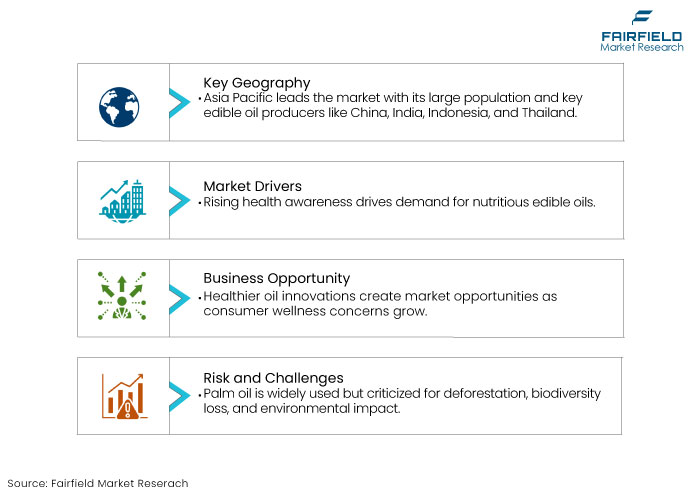
A key growth factor for the edible oils market is the rising consumer awareness of health and nutrition. As individuals increasingly prioritize health, there is a notable transition towards healthier oil alternatives with superior nutritional characteristics.
Oils characterized by reduced saturated fat content, elevated unsaturated fat levels, and vital elements like omega-3 fatty acids are increasingly favoured. Such oils tend to be especially pronounced in the desire for olive, avocado, and flaxseed, which are recognized for their cardiovascular health advantages.
As consumers increasingly reject oils rich in trans fats and detrimental saturated fats, the demand for plant-based and organic oils is anticipated to increase. It prompts food producers to develop healthier oil formulations, stimulating growth.
- Rising Demand for Organic and Non-GMO Oils
A prominent market driver is the increasing preference for organic and non-GMO (genetically modified organism) products. Consumers are becoming selective about the quality and sourcing of their food, including oils.
Organic edible oils, produced without synthetic fertilizers or pesticides, are gaining traction owing to their perceived health benefits and environmental sustainability. Non-GMO oils, made from crops that have not been genetically modified, are also highly sought after by consumers who prioritize natural and unprocessed products.
Growing demand for organic and non-GMO oils prompts manufacturers to shift toward sustainable production practices, further accelerating growth. The demand is particularly notable in regions like Europe and North America, where regulatory standards for GMOs are stricter, and consumers are more inclined to choose products with labels like non-GMO or organic.
Key Growth Barriers
- Environmental and Sustainability Concerns Over Palm Oil Production
Palm oil is one of the most widely used edible oils globally. Its production, however, faces significant criticism owing to environmental concerns. Widespread deforestation and destruction of natural habitats to cultivate palm oil plantations have raised concerns about biodiversity loss, greenhouse gas emissions, and negative impacts on local communities.
Growing awareness about these environmental issues has led governments and non-governmental organizations across the globe to push for stringent regulations around palm oil production. There is a shift in consumer demand toward sustainable oil alternatives, like olive oil or coconut oil, as they are considered more environmentally friendly.
Companies in the market for edible oils may be forced to invest in sustainable sourcing and certifications like RSPO (Roundtable on Sustainable Palm Oil) to address consumer and regulatory demands. While this benefits the environment, it could increase production costs and limit the scalability of palm oil, thereby restraining its growth in the edible oils sector.
Edible Oils Market Trends and Opportunities
- Innovation in Healthier Oils
Innovation of healthier alternatives to traditional oils presents transformative opportunities in the market. Brands have an opportunity to develop oils that offer superior nutritional benefits owing to the growing consumer concerns over health and wellness.
Oils like avocado, flaxseed, and walnut are gaining traction for their heart-healthy properties. A growing interest in oils with functional health benefits, like those promoting cognitive function, weight management, or skin health, bolsters market prospects.
Brands can innovate by creating blends of oils that balance healthy fats while maintaining flavour, versatility, and affordability, meeting the demand for healthier dietary options. It also opens new market opportunities, especially in developed economies where consumers are becoming more conscious of the oils they use in their daily cooking.
- Sustainable and Eco-Friendly Sourcing
Sustainability is a key area of growth owing to the increase in environmental awareness. Consumers are becoming selective about their products, with a strong preference for sustainably sourced products.
Companies have a growing opportunity to focus on sustainable sourcing practices, particularly for oils that have been historically linked to deforestation and environmental degradation. Obtaining certifications like RSPO (Roundtable on Sustainable Palm Oil) or creating traceable supply chains that ensure ethical practices can give companies a competitive edge.
Exploring new sources of plant-based oils, like algae or camelina oil, which have lower environmental impact than traditional oil crops, can further enhance the market appeal. Sustainable practices address consumer concerns and comply with global regulations, which are becoming stricter around environmental impact. This presents a long-term opportunity for growth.
How is Regulatory Scenario Shaping this Industry?
The regulatory scenario significantly shapes the edible oils market by influencing production practices, labelling standards, and consumer preferences. Governments worldwide are introducing stringent regulations on food safety, sustainability, and health labelling, impacting the edible oils industry.
In regions like Europe and North America, regulatory bodies enforce stringent labelling requirements, compelling manufacturers to disclose detailed nutritional information on their products. This includes mentioning the levels of trans fats, saturated fats, and omega-3 fatty acids.
Environmental regulations also play a significant role, particularly in the palm oil sector, where concerns over deforestation and biodiversity loss have established sustainable sourcing standards like the Roundtable on Sustainable Palm Oil (RSPO). Such regulations push companies to adopt eco-friendly production practices, thereby impacting costs and market dynamics.
Governments around the world are promoting organic and non-GMO oils by incentivizing farmers and manufacturers to adopt these practices. The regulatory landscape is driving the growth of cleaner, sustainable, and health-conscious oil products, thereby reshaping the market.
Segment Covered in the Report
- Soybean Oil is Preferred for its High Nutritional Advantages
Based on product type, the soybean oil segment is anticipated to account for a share of 35% in 2025. It is considered as one of the healthiest cooking oils owing to its elevated polyunsaturated and monounsaturated fatty acids. It is devoid of cholesterol and has a low saturated fat content, thereby increasing its use.
- According to reports, the market share of soybean oil in terms of volume is estimated to reach 72.3 million tons by 2032 and is predicted to grow at a CAGR of 1.7% over the forecast period.
Soybean oil's Omega-3 and Omega-6 fatty acids contribute to cardiovascular and cognitive health when included in a balanced diet. Dietitians and nutritionists frequently advocate that consumers progressively pursue oil products that offer nutritional advantages rather than just flavour.
Research consistently supports the inclusion of soybean oil in a heart-healthy diet. From an agricultural perspective, soybeans are among the most versatile crops extensively produced globally.
- Rising Demand for Bakery Products Foster Growth in Food Service
Rising demand for edible oils in baking, frying, and processed food manufacturing underpins growth, as most edible oils improve the texture, flavour, and shelf life of these items. This is essential for mass production and product consistency.
Germany, France, and the U.K., where breads and pastries are primary foods, lead in the production and consumption of bakery products. Robust demand for baked goods necessitates the use of edible oils, such as palm oil and sunflower oil, which are vital components in bakery processes.
As bakeries expand their operations to satisfy domestic and export requirements, the industry is anticipated to have a growing need for a reliable edible oil supply chain. This indicates that the food processing industry plays a crucial role in propelling the market, thereby ensuring a viable basis for continued growth.
Regional Analysis
- Rising Awareness of Nutrition Propels the Need for Edible Oils in Asia Pacific
Large population and the presence of emerging economies is likely to foster the dominance of Asia Pacific in the market. China, India, Indonesia, and Thailand are significant consumers and producers of edible oils, utilizing a diverse range of oils for cooking, frying, and food processing.
The region exhibits the highest palm oil usage, predominantly generated in Southeast Asian nations like Indonesia and Malaysia. The expanding middle-class section in these countries is progressively pursuing superior-quality oils, such as soybean, sunflower, and rapeseed, in alignment with a transition towards healthier dietary practices.
Increasing awareness of health and nutrition propels the need for oils with superior nutritional profiles, particularly those high in Omega-3 fatty acids and low in saturated fats. The region's agricultural foundation, characterized by vast oilseed production in nations like India and China, guarantees a consistent supply of raw materials for oil extraction.
Rising urbanization and modernization of food services in the Asia Pacific, coupled with expansion of the packaged food and ready-to-eat meals, enhances the demand for edible oils. This further solidifies Asia-Pacific's status as the largest and most influential region in this market.
- Europe Ranks as the Second-largest Region in the Edible Oils Market.
Demand for edible oils in Europe is influenced by evolving customer preferences for healthier oils, like olive oil and rapeseed oil. Increasing trend in plant-based diets further augments growth. Consumption of olive oil is notably elevated in Southern European nations like Spain, Italy and Greece, where it serves as a fundamental component of everyday cuisine.
Increasing demand for organic and non-GMO oils coupled with a transition towards sustainable food production positions Europe as a significant participant in this industry. Regulatory restrictions concerning food quality and labelling along with a pronounced emphasis on nutrition assists in fostering innovation and expansion in the region.
Rising awareness regarding the benefits of cooking with oils that support heart health contribute to continuous growth. Increasing adoption of low-fat and plant-based diets augment expansion in Europe. The region’s mature market and strong focus on wellness and sustainability position it as a key player in the global market.
Fairfield’s Competitive Landscape Analysis
The edible oils market is highly competitive, with a mix of global and regional players. Key companies in the industry include Cargill, Bunge Limited, and ADM. These brands dominate the market with their extensive product portfolios and large-scale production capabilities.
Regional players like Wilmar International and Marico hold a strong position in key markets, leveraging local expertise and distribution networks. Competitive strategies include product innovation, sustainability efforts, and acquisitions to expand market presence.
Rising consumer preferences for organic, non-GMO, and clean-label oils has led companies to invest in research and development to offer differentiated products and capitalize on the growing demand for healthier and environmentally sustainable options.
Key Market Companies
- Cargill, Incorporated
- Archer Daniels Midland Company
- Fuji Vegetable Oil, Inc.
- Bunge Limited
- Conagra Brands, Inc.
- Marico
- The Adams Group Inc.
- American Vegetable Oils, Inc.
- COFCO
- The Nisshin OilliO Group, Ltd.
- Associated British Foods plc
- Borges International Group S.L.
An Expert’s Eye
- Increasing consumer awareness about the health risks of certain oils is driving the demand for healthier alternatives, like olive, avocado, and flaxseed oils.
- Organic and non-GMO oils are gaining traction as consumers seek cleaner and natural products.
- Experts foresee strong growth in oils with added health benefits, like those fortified with omega-3 fatty acids or antioxidants, to cater to the evolving wellness-driven market.
- Prominent companies are diversifying their portfolios and focusing on clean-label and healthier oils to stay competitive in an increasingly crowded market.
Global Edible Oils Market is Segmented as-
By Product Type
- Palm Oil
- Soybean Oil
- Sunflower Oil
- Olive Oil
- Rapeseeds Oil
- Others
By Nature
- Organic
- Conventional
By End Use
- Industrial
- Food Service
- Household Retail
By Distribution Channel
- B2B
- B2C
- Hypermarkets/Supermarkets
- Traditional Grocery Stores
- Convenience Stores
- Online Retail
- Others
By Region
- North America
- Europe
- Asia Pacific
- Latin America
- Middle East & Africa
- Executive Summary
- Global Edible Oils Market Snapshot
- Future Projections
- Key Market Trends
- Regional Snapshot, by Value, 2026
- Analyst Recommendations
- Market Overview
- Market Definitions and Segmentations
- Market Dynamics
- Drivers
- Restraints
- Market Opportunities
- Value Chain Analysis
- COVID-19 Impact Analysis
- Porter's Five Forces Analysis
- Impact of Russia-Ukraine Conflict
- PESTLE Analysis
- Regulatory Analysis
- Price Trend Analysis
- Current Prices and Future Projections, 2025-2033
- Price Impact Factors
- Global Edible Oils Market Outlook, 2020 - 2033
- Global Edible Oils Market Outlook, by Product Type, Value (US$ Mn), 2020-2033
- Palm Oil
- Soybean Oil
- Sunflower Oil
- Olive Oil
- Rapeseeds Oil
- Others
- Global Edible Oils Market Outlook, by Nature, Value (US$ Mn), 2020-2033
- Organic
- Conventional
- Global Edible Oils Market Outlook, by End Use, Value (US$ Mn), 2020-2033
- Industrial
- Food Service
- Household Retail
- Global Edible Oils Market Outlook, by Distribution Channel, Value (US$ Mn), 2020-2033
- B2B
- B2C
- Global Edible Oils Market Outlook, by Region, Value (US$ Mn), 2020-2033
- North America
- Europe
- Asia Pacific
- Latin America
- Middle East & Africa
- Global Edible Oils Market Outlook, by Product Type, Value (US$ Mn), 2020-2033
- North America Edible Oils Market Outlook, 2020 - 2033
- North America Edible Oils Market Outlook, by Product Type, Value (US$ Mn), 2020-2033
- Palm Oil
- Soybean Oil
- Sunflower Oil
- Olive Oil
- Rapeseeds Oil
- Others
- North America Edible Oils Market Outlook, by Nature, Value (US$ Mn), 2020-2033
- Organic
- Conventional
- North America Edible Oils Market Outlook, by End Use, Value (US$ Mn), 2020-2033
- Industrial
- Food Service
- Household Retail
- North America Edible Oils Market Outlook, by Distribution Channel, Value (US$ Mn), 2020-2033
- B2B
- B2C
- North America Edible Oils Market Outlook, by Country, Value (US$ Mn), 2020-2033
- U.S. Edible Oils Market Outlook, by Product Type, 2020-2033
- U.S. Edible Oils Market Outlook, by Nature, 2020-2033
- U.S. Edible Oils Market Outlook, by End Use, 2020-2033
- U.S. Edible Oils Market Outlook, by Distribution Channel, 2020-2033
- Canada Edible Oils Market Outlook, by Product Type, 2020-2033
- Canada Edible Oils Market Outlook, by Nature, 2020-2033
- Canada Edible Oils Market Outlook, by End Use, 2020-2033
- Canada Edible Oils Market Outlook, by Distribution Channel, 2020-2033
- BPS Analysis/Market Attractiveness Analysis
- North America Edible Oils Market Outlook, by Product Type, Value (US$ Mn), 2020-2033
- Europe Edible Oils Market Outlook, 2020 - 2033
- Europe Edible Oils Market Outlook, by Product Type, Value (US$ Mn), 2020-2033
- Palm Oil
- Soybean Oil
- Sunflower Oil
- Olive Oil
- Rapeseeds Oil
- Others
- Europe Edible Oils Market Outlook, by Nature, Value (US$ Mn), 2020-2033
- Organic
- Conventional
- Europe Edible Oils Market Outlook, by End Use, Value (US$ Mn), 2020-2033
- Industrial
- Food Service
- Household Retail
- Europe Edible Oils Market Outlook, by Distribution Channel, Value (US$ Mn), 2020-2033
- B2B
- B2C
- Europe Edible Oils Market Outlook, by Country, Value (US$ Mn), 2020-2033
- Germany Edible Oils Market Outlook, by Product Type, 2020-2033
- Germany Edible Oils Market Outlook, by Nature, 2020-2033
- Germany Edible Oils Market Outlook, by End Use, 2020-2033
- Germany Edible Oils Market Outlook, by Distribution Channel, 2020-2033
- Italy Edible Oils Market Outlook, by Product Type, 2020-2033
- Italy Edible Oils Market Outlook, by Nature, 2020-2033
- Italy Edible Oils Market Outlook, by End Use, 2020-2033
- Italy Edible Oils Market Outlook, by Distribution Channel, 2020-2033
- France Edible Oils Market Outlook, by Product Type, 2020-2033
- France Edible Oils Market Outlook, by Nature, 2020-2033
- France Edible Oils Market Outlook, by End Use, 2020-2033
- France Edible Oils Market Outlook, by Distribution Channel, 2020-2033
- U.K. Edible Oils Market Outlook, by Product Type, 2020-2033
- U.K. Edible Oils Market Outlook, by Nature, 2020-2033
- U.K. Edible Oils Market Outlook, by End Use, 2020-2033
- U.K. Edible Oils Market Outlook, by Distribution Channel, 2020-2033
- Spain Edible Oils Market Outlook, by Product Type, 2020-2033
- Spain Edible Oils Market Outlook, by Nature, 2020-2033
- Spain Edible Oils Market Outlook, by End Use, 2020-2033
- Spain Edible Oils Market Outlook, by Distribution Channel, 2020-2033
- Russia Edible Oils Market Outlook, by Product Type, 2020-2033
- Russia Edible Oils Market Outlook, by Nature, 2020-2033
- Russia Edible Oils Market Outlook, by End Use, 2020-2033
- Russia Edible Oils Market Outlook, by Distribution Channel, 2020-2033
- Rest of Europe Edible Oils Market Outlook, by Product Type, 2020-2033
- Rest of Europe Edible Oils Market Outlook, by Nature, 2020-2033
- Rest of Europe Edible Oils Market Outlook, by End Use, 2020-2033
- Rest of Europe Edible Oils Market Outlook, by Distribution Channel, 2020-2033
- BPS Analysis/Market Attractiveness Analysis
- Europe Edible Oils Market Outlook, by Product Type, Value (US$ Mn), 2020-2033
- Asia Pacific Edible Oils Market Outlook, 2020 - 2033
- Asia Pacific Edible Oils Market Outlook, by Product Type, Value (US$ Mn), 2020-2033
- Palm Oil
- Soybean Oil
- Sunflower Oil
- Olive Oil
- Rapeseeds Oil
- Others
- Asia Pacific Edible Oils Market Outlook, by Nature, Value (US$ Mn), 2020-2033
- Organic
- Conventional
- Asia Pacific Edible Oils Market Outlook, by End Use, Value (US$ Mn), 2020-2033
- Industrial
- Food Service
- Household Retail
- Asia Pacific Edible Oils Market Outlook, by Distribution Channel, Value (US$ Mn), 2020-2033
- B2B
- B2C
- Asia Pacific Edible Oils Market Outlook, by Country, Value (US$ Mn), 2020-2033
- China Edible Oils Market Outlook, by Product Type, 2020-2033
- China Edible Oils Market Outlook, by Nature, 2020-2033
- China Edible Oils Market Outlook, by End Use, 2020-2033
- China Edible Oils Market Outlook, by Distribution Channel, 2020-2033
- Japan Edible Oils Market Outlook, by Product Type, 2020-2033
- Japan Edible Oils Market Outlook, by Nature, 2020-2033
- Japan Edible Oils Market Outlook, by End Use, 2020-2033
- Japan Edible Oils Market Outlook, by Distribution Channel, 2020-2033
- South Korea Edible Oils Market Outlook, by Product Type, 2020-2033
- South Korea Edible Oils Market Outlook, by Nature, 2020-2033
- South Korea Edible Oils Market Outlook, by End Use, 2020-2033
- South Korea Edible Oils Market Outlook, by Distribution Channel, 2020-2033
- India Edible Oils Market Outlook, by Product Type, 2020-2033
- India Edible Oils Market Outlook, by Nature, 2020-2033
- India Edible Oils Market Outlook, by End Use, 2020-2033
- India Edible Oils Market Outlook, by Distribution Channel, 2020-2033
- Southeast Asia Edible Oils Market Outlook, by Product Type, 2020-2033
- Southeast Asia Edible Oils Market Outlook, by Nature, 2020-2033
- Southeast Asia Edible Oils Market Outlook, by End Use, 2020-2033
- Southeast Asia Edible Oils Market Outlook, by Distribution Channel, 2020-2033
- Rest of SAO Edible Oils Market Outlook, by Product Type, 2020-2033
- Rest of SAO Edible Oils Market Outlook, by Nature, 2020-2033
- Rest of SAO Edible Oils Market Outlook, by End Use, 2020-2033
- Rest of SAO Edible Oils Market Outlook, by Distribution Channel, 2020-2033
- BPS Analysis/Market Attractiveness Analysis
- Asia Pacific Edible Oils Market Outlook, by Product Type, Value (US$ Mn), 2020-2033
- Latin America Edible Oils Market Outlook, 2020 - 2033
- Latin America Edible Oils Market Outlook, by Product Type, Value (US$ Mn), 2020-2033
- Palm Oil
- Soybean Oil
- Sunflower Oil
- Olive Oil
- Rapeseeds Oil
- Others
- Latin America Edible Oils Market Outlook, by Nature, Value (US$ Mn), 2020-2033
- Organic
- Conventional
- Latin America Edible Oils Market Outlook, by End Use, Value (US$ Mn), 2020-2033
- Industrial
- Food Service
- Household Retail
- Latin America Edible Oils Market Outlook, by Distribution Channel, Value (US$ Mn), 2020-2033
- B2B
- B2C
- Latin America Edible Oils Market Outlook, by Country, Value (US$ Mn), 2020-2033
- Brazil Edible Oils Market Outlook, by Product Type, 2020-2033
- Brazil Edible Oils Market Outlook, by Nature, 2020-2033
- Brazil Edible Oils Market Outlook, by End Use, 2020-2033
- Brazil Edible Oils Market Outlook, by Distribution Channel, 2020-2033
- Mexico Edible Oils Market Outlook, by Product Type, 2020-2033
- Mexico Edible Oils Market Outlook, by Nature, 2020-2033
- Mexico Edible Oils Market Outlook, by End Use, 2020-2033
- Mexico Edible Oils Market Outlook, by Distribution Channel, 2020-2033
- Argentina Edible Oils Market Outlook, by Product Type, 2020-2033
- Argentina Edible Oils Market Outlook, by Nature, 2020-2033
- Argentina Edible Oils Market Outlook, by End Use, 2020-2033
- Argentina Edible Oils Market Outlook, by Distribution Channel, 2020-2033
- Rest of LATAM Edible Oils Market Outlook, by Product Type, 2020-2033
- Rest of LATAM Edible Oils Market Outlook, by Nature, 2020-2033
- Rest of LATAM Edible Oils Market Outlook, by End Use, 2020-2033
- Rest of LATAM Edible Oils Market Outlook, by Distribution Channel, 2020-2033
- BPS Analysis/Market Attractiveness Analysis
- Latin America Edible Oils Market Outlook, by Product Type, Value (US$ Mn), 2020-2033
- Middle East & Africa Edible Oils Market Outlook, 2020 - 2033
- Middle East & Africa Edible Oils Market Outlook, by Product Type, Value (US$ Mn), 2020-2033
- Palm Oil
- Soybean Oil
- Sunflower Oil
- Olive Oil
- Rapeseeds Oil
- Others
- Middle East & Africa Edible Oils Market Outlook, by Nature, Value (US$ Mn), 2020-2033
- Organic
- Conventional
- Middle East & Africa Edible Oils Market Outlook, by End Use, Value (US$ Mn), 2020-2033
- Industrial
- Food Service
- Household Retail
- Middle East & Africa Edible Oils Market Outlook, by Distribution Channel, Value (US$ Mn), 2020-2033
- B2B
- B2C
- Middle East & Africa Edible Oils Market Outlook, by Country, Value (US$ Mn), 2020-2033
- GCC Edible Oils Market Outlook, by Product Type, 2020-2033
- GCC Edible Oils Market Outlook, by Nature, 2020-2033
- GCC Edible Oils Market Outlook, by End Use, 2020-2033
- GCC Edible Oils Market Outlook, by Distribution Channel, 2020-2033
- South Africa Edible Oils Market Outlook, by Product Type, 2020-2033
- South Africa Edible Oils Market Outlook, by Nature, 2020-2033
- South Africa Edible Oils Market Outlook, by End Use, 2020-2033
- South Africa Edible Oils Market Outlook, by Distribution Channel, 2020-2033
- Egypt Edible Oils Market Outlook, by Product Type, 2020-2033
- Egypt Edible Oils Market Outlook, by Nature, 2020-2033
- Egypt Edible Oils Market Outlook, by End Use, 2020-2033
- Egypt Edible Oils Market Outlook, by Distribution Channel, 2020-2033
- Nigeria Edible Oils Market Outlook, by Product Type, 2020-2033
- Nigeria Edible Oils Market Outlook, by Nature, 2020-2033
- Nigeria Edible Oils Market Outlook, by End Use, 2020-2033
- Nigeria Edible Oils Market Outlook, by Distribution Channel, 2020-2033
- Rest of Middle East Edible Oils Market Outlook, by Product Type, 2020-2033
- Rest of Middle East Edible Oils Market Outlook, by Nature, 2020-2033
- Rest of Middle East Edible Oils Market Outlook, by End Use, 2020-2033
- Rest of Middle East Edible Oils Market Outlook, by Distribution Channel, 2020-2033
- BPS Analysis/Market Attractiveness Analysis
- Middle East & Africa Edible Oils Market Outlook, by Product Type, Value (US$ Mn), 2020-2033
- Competitive Landscape
- Company Vs Segment Heatmap
- Company Market Share Analysis, 2025
- Competitive Dashboard
- Company Profiles
- Cargill, Incorporated
- Company Overview
- Product Portfolio
- Financial Overview
- Business Strategies and Developments
- Archer Daniels Midland Company
- Fuji Vegetable Oil, Inc.
- Bunge Limited
- Conagra Brands, Inc.
- Marico
- The Adams Group Inc.
- American Vegetable Oils, Inc.
- COFCO
- The Nisshin OilliO Group, Ltd.
- Cargill, Incorporated
- Appendix
- Research Methodology
- Report Assumptions
- Acronyms and Abbreviations
|
BASE YEAR |
HISTORICAL DATA |
FORECAST PERIOD |
UNITS |
|||
 |
2025 |
 |
2019 - 2025 |
 |
2026 - 2033 |
Value: US$ Billion |
|
REPORT FEATURES |
DETAILS |
|
Product Type Coverage |
|
|
Nature Coverage |
|
|
End Use Coverage |
|
|
Distribution Channel Coverage |
|
|
Geographical Coverage |
|
|
Leading Companies |
|
|
Report Highlights |
Key Market Indicators, Macro-micro economic impact analysis, Technological Roadmap, Key Trends, Driver, Restraints, and Future Opportunities & Revenue Pockets, Porter’s 5 Forces Analysis, Historical Trend (2019-2021), Market Estimates and Forecast, Market Dynamics, Industry Trends, Competition Landscape, Category, Region, Country-wise Trends & Analysis, COVID-19 Impact Analysis (Demand and Supply Chain) |
Our Research Methodology
Considering the volatility of business today, traditional approaches to strategizing a game plan can be unfruitful if not detrimental. True ambiguity is no way to determine a forecast. A myriad of predetermined factors must be accounted for such as the degree of risk involved, the magnitude of circumstances, as well as conditions or consequences that are not known or unpredictable. To circumvent binary views that cast uncertainty, the application of market research intelligence to strategically posture, move, and enable actionable outcomes is necessary.
View Methodology
Quality Assured
Rigorous Validation Process

Confidentiality Assured
End-to-end Data Security

Custom Research Services
Tailored To Your Objectives
FAQs
The edible oils market is estimated to be valued at UUSD 266.2 Bn in 2026.
Asia Pacific is projected to account for the largest market share in 2025.
The edible oils market is estimated to grow at a CAGR of 5% from 2026 to 2033.
Palm Oil, Soybean Oil and Rapeseed Oil are the three most consumed edible oils.
Cargill, Incorporated, Archer Daniels Midland Company, and Fuji Vegetable Oil, Inc., are the leading companies in the edible oils industry.
Related Reports
Dietary Supplements Market Insights, Competitive Landscape, and Market Forecast 2026–2033
Dietary Supplements Market to reach US$435.78 billion by 2033, growing at 9.6% CAGR, driven by health awareness, and personalized nutrition.
Decaffeinated Coffee Market Insights, Competitive Landscape, and Market Forecast 2033
Decaffeinated Coffee Market is projected to reach US$5.20 billion by 2033, driven by health trends, premiumization, specialty retail, and better technology.
Coffee Substitute Market Insights, Competitive Landscape, and Market Forecast 2026–2033
The coffee substitute market is expected to grow from US$18.20 billion in 2026 to US$23.95 billion by 2033 at a 4.0% CAGR, driven by beverage innovation.
Protein Crisps Market Insights, Competitive Landscape, and Market Forecast 2033
The protein crisps market will grow from US$9.0 Bn in 2026 to US$15.83 Bn by 2033 at an 8.4% CAGR, driven by sports nutrition and healthy snacking trends.
Beet Sugar Market Insights, Competitive Landscape, and Market Forecast 2026–2033
The beet sugar market is expected to grow from US$15.70 billion in 2026 to US$25.71 billion by 2033, registering a 7.3% CAGR over the forecast period.
Carbonated Soft Drink Market Insights, Competitive Landscape, and Market Forecast 2033
Carbonated Soft Drink Market is projected to reach US$349.36 billion by 2033, driven by zero-sugar demand, and expanding Asia Pacific consumption.