



Facade Market
Facade Market Size, Share, Insights, Competitive Landscape, and Forecast 2026 to 2033
Facade Market Size and Trend Analysis
What Is Driving Facade Market Growth Through 2033?
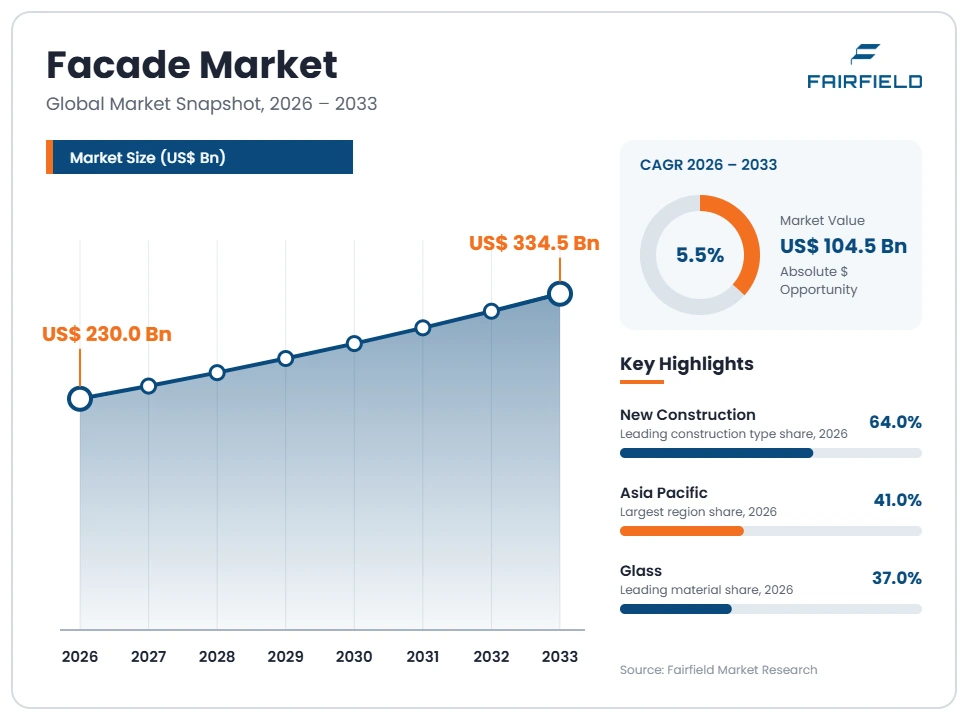
The global facade market size is expected to be valued at US$ 230.0 billion in 2026 and projected to reach US$ 334.5 billion by 2033, growing at a CAGR of 5.5% between 2026 and 2033.
Between 2020 and 2025 the market grew at an estimated 4.6% CAGR, held back by pandemic-era construction stoppages and later by high interest rates in commercial real estate. Three forces shape the 2026–2033 outlook. First, fire safety regulation has forced wholesale specification change in external wall construction across several countries. Second, energy performance rules are turning building envelope upgrades into a mandatory renovation activity rather than a discretionary one. Third, urban high-rise pipelines in Asia Pacific and the Gulf continue to absorb large volumes of curtain wall systems. Figures count facade materials, fabricated systems and their installation.
Key Report Takeaways
- By System Type: Curtain Wall held 34% share in 2026, while Double-Skin and Adaptive Facades are projected to expand at a 7.9% CAGR through 2033, driven by zero-emission building targets in commercial towers.
- By Material: Glass held 37% share in 2026, while Concrete and Fibre Cement is projected to expand at a 6.9% CAGR through 2033, as non-combustible classifications displace composite panels on tall residential buildings.
- By Construction Type: New Construction held 64% share in 2026, while Renovation and Retrofit is projected to expand at a 6.8% CAGR through 2033, supported by European renovation mandates and remediation programmes.
- By Application: Commercial held 41% share in 2026, while Residential is projected to expand at a 6.4% CAGR through 2033, reflecting high-rise housing delivery and external wall replacement work.
- By Geography: Asia Pacific held 41% share in 2026, while Middle East & Africa is projected to expand at a 7.1% CAGR through 2033, led by Gulf megaproject and tourism construction.
Global Facade Market Trends and Insights
Drivers Impact Analysis
Two regulatory forces account for most of the forecast growth in building envelope demand.
| Driver | Impact on CAGR Forecast | Geographic Relevance | Impact Timeline |
| Fire safety rules reshaping external wall specification and remediation | High | Europe, North America, Asia Pacific | Short term (≤2 years) |
| Energy performance mandates converting facade retrofit into required work | High | Europe, North America | Medium term (2–4 years) |
Post-Grenfell Fire Safety Rules Rewrite External Wall Specification and Create Remediation Demand
Fire safety regulation is now the strongest single demand driver in several facade markets. In the United Kingdom, combustible materials are banned in the external walls of relevant residential buildings above 18 metres, and the resulting remediation programme covers thousands of existing buildings. Similar scrutiny has spread across Europe, Australia and parts of Asia Pacific, generating both compliant new-build specification and a large replacement workload.
The mechanism is classification-driven. EN 13501-1 reaction-to-fire classes determine which products may be used, so specifiers have moved toward A1 and A2-s1,d0 rated mineral wool, fibre cement and solid metal rainscreen cladding. In North America, NFPA 285 assembly testing and ASTM E2307 two-storey apparatus testing perform a comparable gatekeeping role. Each change forces full assembly retesting rather than simple component substitution, which lifts the value of the delivered system.
Energy Performance Mandates Turn Facade Retrofit Into Required Rather Than Optional Work
Energy regulation has converted envelope upgrades into compulsory construction activity across much of Europe. The recast Energy Performance of Buildings Directive sets national renovation trajectories for the worst-performing stock and defines a zero-emission building standard for new construction. Because the facade governs thermal transmittance, airtightness and solar gain, compliance work usually starts with the external wall rather than with building services.
The causal chain runs through mandatory performance metrics. Member states must publish renovation plans, and national building codes tighten U-value and airtightness thresholds in step. That pushes specification toward thermally broken aluminium framing, triple glazing, continuous insulation behind ventilated facade systems and tested thermal bridging details. Public funding instruments and minimum energy efficiency standards for rented property add commercial pressure, so owners act on timetables set by regulation rather than by asset strategy.
Restraints Impact Analysis
Two cost and capability constraints hold the market below its regulation-implied potential.
| Restraint | Impact on CAGR Forecast | Geographic Relevance | Impact Timeline |
| High capital cost and financing sensitivity of engineered facade packages | High | Europe, North America, Latin America | Medium term (2–4 years) |
| Shortage of qualified facade installers, testing capacity and competent designers | Medium | Europe, North America, Middle East & Africa | Long term (≥4 years) |
Engineered Facade Packages Carry Capital Costs That Stall Projects When Financing Tightens
Facade cost is a frequent reason projects are redesigned or shelved. The envelope commonly represents a substantial share of a tall building’s construction budget, so when financing costs rise, developers either downgrade the specification or postpone the scheme entirely. Retrofit faces the same problem, because owners must fund envelope works without the rental uplift that a new building generates.
The cost sources are specific rather than general. Unitised curtain wall requires factory fabrication, project-specific tooling, structural silicone glazing and full-scale performance mock-up testing before production starts. Aluminium extrusion and flat glass are energy-intensive, so their prices track electricity and natural gas markets closely. Site installation needs cranes, mast climbers and certified labour. Each element is largely fixed, which leaves little scope for value engineering once the design is set.
Installer, Designer and Testing Capacity Shortages Delay Facade Delivery and Remediation
Capacity, not demand, limits output in several markets. Remediation programmes and new high-rise pipelines compete for the same specialist contractors, and waiting times for accredited fire and weather performance testing extend programme durations. Projects slip, revenue recognition shifts between years and smaller contractors decline work they cannot resource safely.
The cause is structural and regulatory at once. Facade engineering is a narrow discipline, and an ageing installer workforce has not been replaced at the required rate. The Building Safety Act 2022 in the United Kingdom introduced a higher-risk building regime with gateway approvals and competence requirements, which lengthened approval timelines and raised the evidence burden on designers. Accredited testing laboratories capable of large-scale assembly tests remain few, so their schedules effectively set the pace for new product launches across the whole supply chain.
Market Opportunities
Facade Retrofit of Ageing Commercial Stock Opens a Durable Replacement Revenue Pool
Re-cladding and over-cladding existing buildings is the largest emerging revenue pool in the building envelope sector. A substantial share of commercial and institutional stock in Europe and North America was built before modern thermal and fire standards, and much of it is reaching the end of serviceable facade life. Owners facing minimum energy efficiency rules and tenant demand for certified buildings must act on that stock rather than replace it.
Specialist contractors, system houses with retrofit-specific details and insulation manufacturers are best placed to capture the work. Demand originates from institutional landlords, universities, hospitals and social housing providers that hold long-term assets. Over-cladding systems that can be installed without decanting occupants, combined with digital laser surveys and off-site panel fabrication, make the work commercially practical at scale across large property portfolios.
Adaptive and Building-Integrated Photovoltaic Facades Create a Premium System Revenue Tier
Facades that generate energy or respond to conditions represent a high-value tier above conventional cladding. Building-integrated photovoltaic spandrel and glazing units, automated external shading and double-skin cavities with controlled ventilation all command premium pricing, because they contribute directly to the energy balance that zero-emission building definitions require.
Capture favours system houses and glass processors that can integrate electrical and control components into a tested, warrantied assembly. Demand comes mainly from corporate headquarters, public buildings with carbon targets and developers pursuing green certification, where the envelope is also a visible sustainability statement. Falling photovoltaic module costs and improving coloured and semi-transparent module options have narrowed the price gap against high-specification conventional glazing, making these systems easier to justify on a whole-life basis. Tightening national energy codes give the business case a further regulatory push.
Segment Analysis
- By System Type: Curtain Wall Dominates While Double-Skin and Adaptive Facades Accelerate
Curtain Wall held 34% of facade revenue in 2026, the largest system share, because unitised and stick-built aluminium framing remains the default solution for commercial towers worldwide. Unitised construction in particular shortens site programmes, improves quality control and suits the high-rise pipelines of Asia Pacific and the Gulf. Rainscreen Cladding follows closely, boosted by fire-driven replacement work, while Structural Glazing, Ventilated Facades and Precast Concrete and Metal Panel Systems serve defined architectural and budget niches.
Double-Skin and Adaptive Facades form the fastest-growing system type at a 7.9% CAGR through 2033. Their cavity ventilation, automated shading and integrated controls help buildings meet tightening energy targets that single-skin envelopes struggle to satisfy. Volumes remain modest because of cost and maintenance complexity.
The implication is a widening value gap. Standard cladding competes largely on price, while engineered systems compete on tested performance data and warranty depth.
- By Material: Glass Leads as Non-Combustible Concrete and Fibre Cement Grows Fastest
Glass accounted for 37% of 2026 facade material value, reflecting the continued dominance of transparent envelopes in offices, hotels and premium residential towers. Coated, laminated and insulating glass units carry high value per square metre, which lifts the segment’s revenue share above its area share. Metal, chiefly aluminium with steel, zinc and copper, holds the second position through framing, solid panels and rainscreen cassettes.
Concrete and Fibre Cement is the fastest-growing material at a 6.9% CAGR through 2033. Demand follows directly from reaction-to-fire classification, as specifiers replace combustible composite panels with A1 and A2 rated boards on tall residential buildings. Stone and Ceramic, Composite Panels and Timber occupy smaller positions, with timber constrained by fire rules on tall buildings.
Material substitution is now a compliance decision first and an aesthetic one second, which has permanently changed procurement behaviour.
- By Construction Type: New Construction Holds the Majority While Retrofit Expands Faster
New Construction held 64% share in 2026, supported by sustained high-rise delivery in Asia Pacific, Gulf megaprojects and continued data centre, logistics and institutional building activity in North America. New schemes also specify higher-value engineered systems, because performance requirements are set at design stage rather than retrofitted onto an existing structure.
Renovation and Retrofit is the faster-growing segment at a 6.8% CAGR through 2033. European renovation obligations, minimum energy efficiency standards for rented property and large-scale external wall remediation programmes generate work that is largely independent of new development cycles.
That independence matters commercially. Retrofit demand is driven by regulation and asset compliance deadlines rather than by interest rates, so it provides a counter-cyclical revenue stream for contractors and system suppliers whose new-build order books contract when financing conditions tighten.
- By Application: Commercial Buildings Lead While Residential Facade Work Grows Fastest
Commercial buildings held 41% share in 2026, the leading application, covering offices, retail and mixed-use towers that use the most glazing per square metre and specify the most engineered systems. Corporate occupiers also fund premium envelopes to meet certification and workplace comfort expectations.
Residential is the fastest-growing application at a 6.4% CAGR through 2033. Two distinct flows drive it: continued high-rise apartment delivery in Asia Pacific and the Gulf, and external wall replacement on existing mid-rise and high-rise housing in Europe and Australia. Institutional and Public, Industrial and Hospitality applications fill the remainder, with hospitals and schools increasingly tied to public decarbonisation budgets.
For suppliers, the residential shift means higher volumes at lower unit value, and a much stronger emphasis on documented fire classification evidence.
Geography Analysis
- North America Pairs High-Rise Construction With Assembly-Level Fire Testing Requirements
North America held 23% of global facade revenue in 2026, the third largest position. The United States supplies most of that value through office, institutional, hospitality and high-rise residential construction, with Canada adding steady demand concentrated in Toronto and Vancouver.
Regulation shapes specification heavily. NFPA 285 assembly testing governs exterior wall systems containing combustible components in buildings of Type I to IV construction, and ASTM E2307 provides the intermediate-scale multi-storey apparatus test for perimeter fire barriers. Together they make tested assemblies, not individual products, the unit of compliance.
The region’s main opportunity is the ageing commercial estate. Owners of 1970s and 1980s office towers face poor thermal performance, failing sealants and tenant demand for certified space, which supports a sustained re-cladding workload.
- Europe Converts Energy and Construction Product Regulation Into Steady Facade Demand
Europe accounted for 27% of 2026 revenue, the second largest regional pool, with Germany, France, the United Kingdom, Italy, Spain and the Nordics leading. Activity is weighted toward renovation rather than new build, which is unusual among regions and makes demand less sensitive to development cycles.
Two regulatory frameworks dominate. The Construction Products Regulation governs CE marking and declarations of performance, with EN 13830 serving as the harmonised product standard for curtain walling and EN 13501-1 setting reaction-to-fire classes. The recast Energy Performance of Buildings Directive then drives the renovation workload itself.
In the United Kingdom, the external wall remediation programme remains the defining feature of the market, absorbing specialist contractor capacity that would otherwise serve new construction.
- Which Region Is Leading the Facade Market?
Asia Pacific leads the facade market with 41% share in 2026, because it builds more high-rise floor area than the rest of the world combined. China remains the largest single source of demand despite a weaker residential development cycle, supported by commercial, infrastructure and public building work. India is the most dynamic large national market, with office and residential towers rising across Mumbai, Bengaluru, Hyderabad and the National Capital Region.
Japan, South Korea, Singapore and Australia contribute high-specification demand, with seismic performance, typhoon wind loading and energy codes shaping system design. Australia also runs a substantial combustible cladding rectification programme.
Regional aluminium extrusion and glass processing capacity keeps system costs competitive, and local unitised fabrication now serves export projects across the Gulf as well.
- Latin America Builds Facade Demand Around Urban Office and Mixed-Use Towers
Latin America represented 3.5% of 2026 facade revenue, the smallest regional share. Brazil and Mexico account for most activity, concentrated in São Paulo, Rio de Janeiro, Mexico City and Monterrey, with Chile, Colombia and Peru adding smaller commercial pipelines.
Barriers are mainly economic and technical. Currency volatility raises the cost of imported glass, framing systems and high-performance sealants, while financing costs restrict speculative tower development. Facade engineering and testing capability is thinner than in other regions, so complex unitised schemes often rely on imported design and supervision.
The clearest change is nearshoring-related industrial and logistics construction in Mexico, which creates steady demand for metal panel and precast envelope systems even when office markets stay soft.
- Which Region Is Growing Fastest in the Facade Market?
Middle East & Africa is growing fastest in the facade market, at a 7.1% CAGR between 2026 and 2033, from a 5.5% share in 2026. Saudi Arabia is the primary driver, with giga-projects, tourism developments and new urban districts requiring large volumes of unitised curtain wall and high-performance solar control glass. The United Arab Emirates and Qatar sustain substantial tower and hospitality pipelines.
Climate conditions set the technical agenda. Extreme solar gain, high ambient temperatures, sand abrasion and coastal corrosion push specification toward double-silver and triple-silver coated glass, thermally broken framing and marine-grade finishes.
Barriers remain real: installer capacity is largely imported, and across much of Africa outside Egypt, Morocco and South Africa, engineered facade demand is limited to a few commercial centres.
Competitive Landscape
The facade market is fragmented. Thousands of fabricators, installers and material suppliers compete, and no company holds more than a low single-digit share of global value. Fragmentation is structural: facades are project-specific, locally installed and governed by national codes, so regional contractors with code familiarity and site capability compete effectively against international groups. Consolidation is slowly advancing, with material groups such as Saint-Gobain, Kingspan Group and Etex Group acquiring insulation, board and panel businesses to assemble complete, tested wall build-ups rather than selling individual components.
Competition rests on four factors. The first is certified performance evidence, since reaction-to-fire classification, assembly test reports and declarations of performance determine eligibility before price is discussed. The second is delivery certainty, because facade installation sits on the critical path of every tall building programme. The third is engineering support, as contractors increasingly expect system houses such as Schüco International, Reynaers Aluminium and Aluprof to supply calculations, details and warranty backing. The fourth is price, which dominates in commodity rainscreen and panel work. New entrants come mainly from off-site manufacturing and from photovoltaic integration, where glass processors and module makers meet in the same assembly.
Strategic activity concentrates on vertical integration and capacity. Glass groups such as AGC and Guardian Glass invest in coating and processing lines near demand centres, while specialist contractors including Permasteelisa Group and Lindner Group extend unitised fabrication capacity to shorten lead times. Insulation producers such as ROCKWOOL benefit directly from non-combustible substitution.
Strategic direction points toward tested complete systems, documented embodied carbon, digital fabrication from building information models, and services built around remediation and retrofit rather than new construction alone.
Recent Industry Developments
- December 2018: England brought into force a ban on combustible materials in the external walls of relevant residential buildings above 18 metres, permanently redirecting specification toward non-combustible cladding and insulation.
- April 2022: The Building Safety Act 2022 received Royal Assent in the United Kingdom, establishing a higher-risk building regime with gateway approvals, duty-holder roles and competence requirements for facade design and installation.
- May 2024: The recast Energy Performance of Buildings Directive was published in the Official Journal of the European Union, setting national renovation trajectories and a zero-emission building definition that make envelope upgrades mandatory.
- December 2024: Regulation (EU) 2024/3110 on construction products was published, replacing the 2011 framework over a transition period and updating CE marking, digital product passport and declaration of performance obligations.
Companies Covered in the Report
- Saint-Gobain
- Kingspan Group
- AGC
- Permasteelisa Group
- Schüco International
- Reynaers Aluminium
- YKK AP
- Etex Group
- ROCKWOOL
- Lindner Group
- Aluprof
- Guardian Glass
Facade Market Report Scope
| Metric | Value |
| Study Period | 2020–2033 |
| Market Size 2026 | US$ 230.0 Billion |
| Market Size 2033 | US$ 334.5 Billion |
| CAGR 2026–2033 | 5.5% |
| Absolute Dollar Opportunity | US$ 104.5 Billion |
| Largest Market | Asia Pacific, 41% share in 2026 |
| Fastest-Growing Market | Middle East & Africa, 7.1% CAGR 2026–2033 |
| Market Concentration | Low |
| Major Players | Saint-Gobain, Kingspan Group, AGC, Permasteelisa Group, Schüco International |
Facade Market Segmentation
System Type
- Curtain Wall
- Rainscreen Cladding
- Structural Glazing
- Ventilated Facades
- Precast Concrete and Metal Panel Systems
- Double-Skin and Adaptive Facades
Material
- Glass
- Metal
- Concrete and Fibre Cement
- Stone and Ceramic
- Composite Panels
- Timber
Construction Type
- New Construction
- Renovation and Retrofit
Application
- Commercial
- Residential
- Institutional and Public
- Industrial
- Hospitality and Mixed-Use
Regions
- North America
- Europe
- Asia Pacific
- Latin America
- Middle East & Africa
- Executive Summary
- Global Facade Market Snapshot
- Future Projections
- Key Report Takeaways
- Regional Snapshot
- Market Overview
- Market Definition and Report Scope
- Historical Trends 2020–2025
- Market Dynamics
- Drivers
- Post-Grenfell Fire Safety Rules Rewrite External Wall Specification and Create Remediation Demand
- Energy Performance Mandates Turn Facade Retrofit Into Required Rather Than Optional Work
- Restraints
- Engineered Facade Packages Carry Capital Costs That Stall Projects When Financing Tightens
- Installer, Designer and Testing Capacity Shortages Delay Facade Delivery and Remediation
- Market Opportunities
- Facade Retrofit of Ageing Commercial Stock Opens a Durable Replacement Revenue Pool
- Adaptive and Building-Integrated Photovoltaic Facades Create a Premium System Revenue Tier
- Drivers
- Global Facade Market Outlook, 2020–2033
- Global Facade Market Outlook, by System Type, Value (US$ Billion), 2020–2033
- Curtain Wall
- Rainscreen Cladding
- Structural Glazing
- Ventilated Facades
- Precast Concrete and Metal Panel Systems
- Double-Skin and Adaptive Facades
- Global Facade Market Outlook, by Material, Value (US$ Billion), 2020–2033
- Glass
- Metal
- Concrete and Fibre Cement
- Stone and Ceramic
- Composite Panels
- Timber
- Global Facade Market Outlook, by Construction Type, Value (US$ Billion), 2020–2033
- New Construction
- Renovation and Retrofit
- Global Facade Market Outlook, by Application, Value (US$ Billion), 2020–2033
- Commercial
- Residential
- Institutional and Public
- Industrial
- Hospitality and Mixed-Use
- Global Facade Market Outlook, by Region, Value (US$ Billion), 2020–2033
- North America
- Europe
- Asia Pacific
- Latin America
- Middle East & Africa
- Global Facade Market Outlook, by System Type, Value (US$ Billion), 2020–2033
- North America Facade Market Outlook, 2020–2033
- North America Facade Market Outlook, by System Type, Value (US$ Billion), 2020–2033
- Curtain Wall
- Rainscreen Cladding
- Structural Glazing
- Ventilated Facades
- Precast Concrete and Metal Panel Systems
- Double-Skin and Adaptive Facades
- North America Facade Market Outlook, by Material, Value (US$ Billion), 2020–2033
- Glass
- Metal
- Concrete and Fibre Cement
- Stone and Ceramic
- Composite Panels
- Timber
- North America Facade Market Outlook, by Construction Type, Value (US$ Billion), 2020–2033
- New Construction
- Renovation and Retrofit
- North America Facade Market Outlook, by Application, Value (US$ Billion), 2020–2033
- Commercial
- Residential
- Institutional and Public
- Industrial
- Hospitality and Mixed-Use
- North America Facade Market Outlook, by Country, Value (US$ Billion), 2020–2033
- United States Facade Market Outlook, by System Type, 2020–2033
- United States Facade Market Outlook, by Material, 2020–2033
- United States Facade Market Outlook, by Construction Type, 2020–2033
- United States Facade Market Outlook, by Application, 2020–2033
- Canada Facade Market Outlook, by System Type, 2020–2033
- Canada Facade Market Outlook, by Material, 2020–2033
- Canada Facade Market Outlook, by Construction Type, 2020–2033
- Canada Facade Market Outlook, by Application, 2020–2033
- North America Facade Market Outlook, by System Type, Value (US$ Billion), 2020–2033
- Europe Facade Market Outlook, 2020–2033
- Europe Facade Market Outlook, by System Type, Value (US$ Billion), 2020–2033
- Curtain Wall
- Rainscreen Cladding
- Structural Glazing
- Ventilated Facades
- Precast Concrete and Metal Panel Systems
- Double-Skin and Adaptive Facades
- Europe Facade Market Outlook, by Material, Value (US$ Billion), 2020–2033
- Glass
- Metal
- Concrete and Fibre Cement
- Stone and Ceramic
- Composite Panels
- Timber
- Europe Facade Market Outlook, by Construction Type, Value (US$ Billion), 2020–2033
- New Construction
- Renovation and Retrofit
- Europe Facade Market Outlook, by Application, Value (US$ Billion), 2020–2033
- Commercial
- Residential
- Institutional and Public
- Industrial
- Hospitality and Mixed-Use
- Europe Facade Market Outlook, by Country, Value (US$ Billion), 2020–2033
- Germany Facade Market Outlook, by System Type, 2020–2033
- Germany Facade Market Outlook, by Material, 2020–2033
- Germany Facade Market Outlook, by Construction Type, 2020–2033
- Germany Facade Market Outlook, by Application, 2020–2033
- France Facade Market Outlook, by System Type, 2020–2033
- France Facade Market Outlook, by Material, 2020–2033
- France Facade Market Outlook, by Construction Type, 2020–2033
- France Facade Market Outlook, by Application, 2020–2033
- United Kingdom Facade Market Outlook, by System Type, 2020–2033
- United Kingdom Facade Market Outlook, by Material, 2020–2033
- United Kingdom Facade Market Outlook, by Construction Type, 2020–2033
- United Kingdom Facade Market Outlook, by Application, 2020–2033
- Italy Facade Market Outlook, by System Type, 2020–2033
- Italy Facade Market Outlook, by Material, 2020–2033
- Italy Facade Market Outlook, by Construction Type, 2020–2033
- Italy Facade Market Outlook, by Application, 2020–2033
- Spain Facade Market Outlook, by System Type, 2020–2033
- Spain Facade Market Outlook, by Material, 2020–2033
- Spain Facade Market Outlook, by Construction Type, 2020–2033
- Spain Facade Market Outlook, by Application, 2020–2033
- Europe Facade Market Outlook, by System Type, Value (US$ Billion), 2020–2033
- Asia Pacific Facade Market Outlook, 2020–2033
- Asia Pacific Facade Market Outlook, by System Type, Value (US$ Billion), 2020–2033
- Curtain Wall
- Rainscreen Cladding
- Structural Glazing
- Ventilated Facades
- Precast Concrete and Metal Panel Systems
- Double-Skin and Adaptive Facades
- Asia Pacific Facade Market Outlook, by Material, Value (US$ Billion), 2020–2033
- Glass
- Metal
- Concrete and Fibre Cement
- Stone and Ceramic
- Composite Panels
- Timber
- Asia Pacific Facade Market Outlook, by Construction Type, Value (US$ Billion), 2020–2033
- New Construction
- Renovation and Retrofit
- Asia Pacific Facade Market Outlook, by Application, Value (US$ Billion), 2020–2033
- Commercial
- Residential
- Institutional and Public
- Industrial
- Hospitality and Mixed-Use
- Asia Pacific Facade Market Outlook, by Country, Value (US$ Billion), 2020–2033
- China Facade Market Outlook, by System Type, 2020–2033
- China Facade Market Outlook, by Material, 2020–2033
- China Facade Market Outlook, by Construction Type, 2020–2033
- China Facade Market Outlook, by Application, 2020–2033
- India Facade Market Outlook, by System Type, 2020–2033
- India Facade Market Outlook, by Material, 2020–2033
- India Facade Market Outlook, by Construction Type, 2020–2033
- India Facade Market Outlook, by Application, 2020–2033
- Japan Facade Market Outlook, by System Type, 2020–2033
- Japan Facade Market Outlook, by Material, 2020–2033
- Japan Facade Market Outlook, by Construction Type, 2020–2033
- Japan Facade Market Outlook, by Application, 2020–2033
- South Korea Facade Market Outlook, by System Type, 2020–2033
- South Korea Facade Market Outlook, by Material, 2020–2033
- South Korea Facade Market Outlook, by Construction Type, 2020–2033
- South Korea Facade Market Outlook, by Application, 2020–2033
- Singapore Facade Market Outlook, by System Type, 2020–2033
- Singapore Facade Market Outlook, by Material, 2020–2033
- Singapore Facade Market Outlook, by Construction Type, 2020–2033
- Singapore Facade Market Outlook, by Application, 2020–2033
- Australia Facade Market Outlook, by System Type, 2020–2033
- Australia Facade Market Outlook, by Material, 2020–2033
- Australia Facade Market Outlook, by Construction Type, 2020–2033
- Australia Facade Market Outlook, by Application, 2020–2033
- Asia Pacific Facade Market Outlook, by System Type, Value (US$ Billion), 2020–2033
- Latin America Facade Market Outlook, 2020–2033
- Latin America Facade Market Outlook, by System Type, Value (US$ Billion), 2020–2033
- Curtain Wall
- Rainscreen Cladding
- Structural Glazing
- Ventilated Facades
- Precast Concrete and Metal Panel Systems
- Double-Skin and Adaptive Facades
- Latin America Facade Market Outlook, by Material, Value (US$ Billion), 2020–2033
- Glass
- Metal
- Concrete and Fibre Cement
- Stone and Ceramic
- Composite Panels
- Timber
- Latin America Facade Market Outlook, by Construction Type, Value (US$ Billion), 2020–2033
- New Construction
- Renovation and Retrofit
- Latin America Facade Market Outlook, by Application, Value (US$ Billion), 2020–2033
- Commercial
- Residential
- Institutional and Public
- Industrial
- Hospitality and Mixed-Use
- Latin America Facade Market Outlook, by Country, Value (US$ Billion), 2020–2033
- Brazil Facade Market Outlook, by System Type, 2020–2033
- Brazil Facade Market Outlook, by Material, 2020–2033
- Brazil Facade Market Outlook, by Construction Type, 2020–2033
- Brazil Facade Market Outlook, by Application, 2020–2033
- Mexico Facade Market Outlook, by System Type, 2020–2033
- Mexico Facade Market Outlook, by Material, 2020–2033
- Mexico Facade Market Outlook, by Construction Type, 2020–2033
- Mexico Facade Market Outlook, by Application, 2020–2033
- Chile Facade Market Outlook, by System Type, 2020–2033
- Chile Facade Market Outlook, by Material, 2020–2033
- Chile Facade Market Outlook, by Construction Type, 2020–2033
- Chile Facade Market Outlook, by Application, 2020–2033
- Colombia Facade Market Outlook, by System Type, 2020–2033
- Colombia Facade Market Outlook, by Material, 2020–2033
- Colombia Facade Market Outlook, by Construction Type, 2020–2033
- Colombia Facade Market Outlook, by Application, 2020–2033
- Peru Facade Market Outlook, by System Type, 2020–2033
- Peru Facade Market Outlook, by Material, 2020–2033
- Peru Facade Market Outlook, by Construction Type, 2020–2033
- Peru Facade Market Outlook, by Application, 2020–2033
- Latin America Facade Market Outlook, by System Type, Value (US$ Billion), 2020–2033
- Middle East & Africa Facade Market Outlook, 2020–2033
- Middle East & Africa Facade Market Outlook, by System Type, Value (US$ Billion), 2020–2033
- Curtain Wall
- Rainscreen Cladding
- Structural Glazing
- Ventilated Facades
- Precast Concrete and Metal Panel Systems
- Double-Skin and Adaptive Facades
- Middle East & Africa Facade Market Outlook, by Material, Value (US$ Billion), 2020–2033
- Glass
- Metal
- Concrete and Fibre Cement
- Stone and Ceramic
- Composite Panels
- Timber
- Middle East & Africa Facade Market Outlook, by Construction Type, Value (US$ Billion), 2020–2033
- New Construction
- Renovation and Retrofit
- Middle East & Africa Facade Market Outlook, by Application, Value (US$ Billion), 2020–2033
- Commercial
- Residential
- Institutional and Public
- Industrial
- Hospitality and Mixed-Use
- Middle East & Africa Facade Market Outlook, by Country, Value (US$ Billion), 2020–2033
- Saudi Arabia Facade Market Outlook, by System Type, 2020–2033
- Saudi Arabia Facade Market Outlook, by Material, 2020–2033
- Saudi Arabia Facade Market Outlook, by Construction Type, 2020–2033
- Saudi Arabia Facade Market Outlook, by Application, 2020–2033
- United Arab Emirates Facade Market Outlook, by System Type, 2020–2033
- United Arab Emirates Facade Market Outlook, by Material, 2020–2033
- United Arab Emirates Facade Market Outlook, by Construction Type, 2020–2033
- United Arab Emirates Facade Market Outlook, by Application, 2020–2033
- Qatar Facade Market Outlook, by System Type, 2020–2033
- Qatar Facade Market Outlook, by Material, 2020–2033
- Qatar Facade Market Outlook, by Construction Type, 2020–2033
- Qatar Facade Market Outlook, by Application, 2020–2033
- Egypt Facade Market Outlook, by System Type, 2020–2033
- Egypt Facade Market Outlook, by Material, 2020–2033
- Egypt Facade Market Outlook, by Construction Type, 2020–2033
- Egypt Facade Market Outlook, by Application, 2020–2033
- Morocco Facade Market Outlook, by System Type, 2020–2033
- Morocco Facade Market Outlook, by Material, 2020–2033
- Morocco Facade Market Outlook, by Construction Type, 2020–2033
- Morocco Facade Market Outlook, by Application, 2020–2033
- South Africa Facade Market Outlook, by System Type, 2020–2033
- South Africa Facade Market Outlook, by Material, 2020–2033
- South Africa Facade Market Outlook, by Construction Type, 2020–2033
- South Africa Facade Market Outlook, by Application, 2020–2033
- Middle East & Africa Facade Market Outlook, by System Type, Value (US$ Billion), 2020–2033
- Competitive Landscape
- Market Concentration and Industry Leaders
- Competitive Differentiation
- Strategic Moves and Market Direction
- Recent Industry Developments
- Company Profiles
- Saint-Gobain
- Kingspan Group
- AGC
- Permasteelisa Group
- Schüco International
- Reynaers Aluminium
- YKK AP
- Etex Group
- ROCKWOOL
- Lindner Group
- Aluprof
- Guardian Glass
- Appendix
- Research Methodology
- Report Assumptions
- Acronyms and Abbreviations
System Type
- Curtain Wall
- Rainscreen Cladding
- Structural Glazing
- Ventilated Facades
- Precast Concrete and Metal Panel Systems
- Double-Skin and Adaptive Facades
Material
- Glass
- Metal
- Concrete and Fibre Cement
- Stone and Ceramic
- Composite Panels
- Timber
Construction Type
- New Construction
- Renovation and Retrofit
Application
- Commercial
- Residential
- Institutional and Public
- Industrial
- Hospitality and Mixed-Use
Regions
- North America
- Europe
- Asia Pacific
- Latin America
- Middle East & Africa
Our Research Methodology
Considering the volatility of business today, traditional approaches to strategizing a game plan can be unfruitful if not detrimental. True ambiguity is no way to determine a forecast. A myriad of predetermined factors must be accounted for such as the degree of risk involved, the magnitude of circumstances, as well as conditions or consequences that are not known or unpredictable. To circumvent binary views that cast uncertainty, the application of market research intelligence to strategically posture, move, and enable actionable outcomes is necessary.
View Methodology
Quality Assured
Rigorous Validation Process

Confidentiality Assured
End-to-end Data Security

Custom Research Services
Tailored To Your Objectives
FAQs
The global facade market is valued at US$ 230.0 billion in 2026, counting envelope materials, fabricated systems and their installation at contractor level.
The market is projected to reach US$ 334.5 billion by 2033 at a 5.5% CAGR, an absolute opportunity of US$ 104.5 billion.
Curtain Wall leads with 34% share in 2026, because unitised and stick-built aluminium framing remains the default solution for commercial towers.
Double-Skin and Adaptive Facades grow fastest at 7.9% CAGR, while Middle East & Africa leads regional growth at 7.1% CAGR through 2033.
Asia Pacific leads with 41% share in 2026, because it delivers more high-rise floor area than all other regions combined.
Related Reports
Fluorosurfactant Market Size, Share, Insights, Competitive Landscape, and Forecast 2026 to 2033
The global fluorosurfactant market is valued at US$0.9 billion in 2026, reaching US$1.0 billion by 2033, growing at a 1.5% CAGR
Fluoropolymer Films Market Size, Share, Insights, Competitive Landscape, and Forecast 2026 to 2033
The global fluoropolymer films market is valued at US$3.4 billion in 2026, reaching US$5.4 billion by 2033, growing at a 6.8% CAGR
Fluoroalkyl-based Coatings Market Size, Share, Insights, Competitive Landscape, and Forecast 2026 to 2033
The global fluoroalkyl-based coatings market is valued at US$1.5 billion in 2026, reaching US$1.6 billion by 2033, growing at a 0.9% CAGR
Plastic Lumber Market Size, Share, Insights, Competitive Landscape, and Forecast 2026 to 2033
The global plastic lumber market is valued at US$6.50 billion in 2026, reaching US$12.80 billion by 2033, growing at a 10.16% CAGR
Nickel Market Size, Share, Insights, Competitive Landscape, and Forecast 2026 to 2033
The global nickel market is valued at US$48.5 billion in 2026, reaching US$76.0 billion by 2033, growing at a 6.6% CAGR
Lead Market Size, Share, Insights, Competitive Landscape, and Forecast 2026 to 2033
The global lead market is valued at US$25.6 billion in 2026, reaching US$34.8 billion by 2033, growing at a 4.5% CAGR