



Fluoropolymer Films Market
Fluoropolymer Films Market Size, Share, Insights, Competitive Landscape, and Forecast 2026 to 2033
Fluoropolymer Films Market Size and Trend Analysis
What Is Driving Fluoropolymer Films Market Growth?
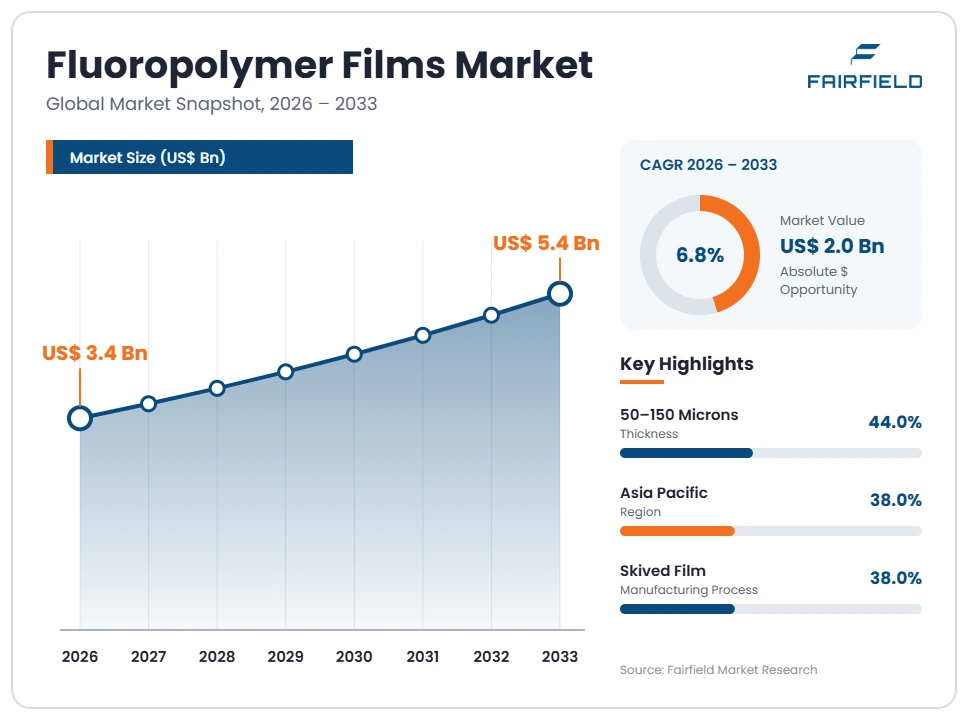
The global fluoropolymer films market size is expected to be valued at US$ 3.4 billion in 2026 and projected to reach US$ 5.4 billion by 2033, growing at a CAGR of 6.8% between 2026 and 2033.
The market grew at about 5.6% annually between 2020 and 2025, and the pace is accelerating. Three demand engines explain the step up. Semiconductor fabrication needs chemically inert films for wet-process equipment, wafer handling and high-purity fluid systems. Energy applications are scaling fast, covering lithium-ion battery separators and pouch layers, photovoltaic backsheets and hydrogen electrolyser components. Aerospace wiring insulation and ETFE architectural membranes add steady volume. Working against this, regulatory uncertainty over how fluoropolymers will be treated under a European restriction is slowing qualification decisions. The direction is firmly upward, but with a widening gap between confident buyers and hesitant ones.
Key Report Takeaways
- By Product Type: PTFE Films held 34% share in 2026, while PVDF Films are projected to expand at an 8.9% CAGR through 2033, driven by lithium-ion battery binders, separator coatings and photovoltaic backsheet layers.
- By Manufacturing Process: Skived Film held 38% share in 2026, while Melt-Extruded Cast Film is projected to expand at a 7.9% CAGR through 2033, because melt-processable grades allow continuous production at wider webs and lower unit cost.
- By Thickness: 50–150 Microns held 44% share in 2026, while Below 50 Microns is projected to expand at an 8.4% CAGR through 2033, as electronics and battery designs push toward thinner dielectric and barrier layers.
- By End Use Industry: Electrical and Electronics held 27% share in 2026, while Energy and Power is projected to expand at a 9.5% CAGR through 2033, supported by electrolyser, fuel cell and solar module build-out.
- By Geography: Asia Pacific held 38% share in 2026, while Middle East & Africa is projected to expand at a 9.1% CAGR through 2033, led by green hydrogen and solar manufacturing investment.
Global Fluoropolymer Films Market Trends and Insights
Drivers Impact Analysis
Two structural demand shifts are lifting film consumption faster than the wider plastics industry.
| Driver | Impact on CAGR Forecast | Geographic Relevance | Impact Timeline |
| Semiconductor fabrication capacity additions requiring high-purity inert films | High | Asia Pacific, North America | Medium term 2–4 years |
| Energy transition hardware: batteries, photovoltaics and hydrogen electrolysers | High | Asia Pacific, Europe | Long term ≥4 years |
Semiconductor Fab Build-Out Lifts High-Purity Fluoropolymer Film Consumption
New wafer fabrication capacity is the most immediate growth engine for fluoropolymer films. Each fab consumes PTFE, PFA and ETFE film in wet bench linings, chemical delivery components, wafer carrier surfaces, valve diaphragms and cleanroom ducting. These films must resist hot acids, solvents and plasma without shedding particles or leaching ions, and they are replaced on maintenance cycles, so demand is both installed and recurring.
The mechanism is contamination control. At advanced nodes, defect budgets are measured in particles per wafer pass, and metal ion contamination is specified in parts per trillion. Only perfluorinated films combine chemical inertness with extremely low extractables at these levels. Government-supported fab programmes in the United States, Japan, Korea, Taiwan and the European Union are adding capacity simultaneously, and every new line specifies these materials at the design stage rather than choosing them later.
Battery, Solar and Hydrogen Hardware Expand the Fluoropolymer Film Base
Energy transition manufacturing is broadening the customer base well beyond traditional industrial buyers. PVDF film and coated layers go into lithium-ion separators and pouch cell laminates, fluoropolymer backsheets protect photovoltaic modules through decades of ultraviolet and moisture exposure, and reinforced perfluorinated films serve as membranes and gaskets in water electrolysers and fuel cells. These are high-volume assemblies, which changes the scale of orders film producers receive.
The causal link is service life under electrochemical stress. A photovoltaic module is warranted for 25 years in outdoor conditions, and an electrolyser stack runs in hot, acidic, oxidising conditions that destroy hydrocarbon polymers. Fluoropolymers survive both. As electrolyser and gigafactory projects move from pilot to commercial scale, material selection locks in early, because requalifying a membrane or backsheet mid-programme means repeating years of accelerated ageing tests.
Restraints Impact Analysis
Two restraints temper the outlook without reversing it.
| Restraint | Impact on CAGR Forecast | Geographic Relevance | Impact Timeline |
| Unresolved scope and derogations under the proposed European universal PFAS restriction | High | Europe | Medium term 2–4 years |
| Fluorspar and hydrogen fluoride feedstock concentration plus polymerisation emissions control costs | Medium | Global | Long term ≥4 years |
Unresolved Restriction Scope Delays Long-Cycle Fluoropolymer Film Qualification
Regulatory uncertainty is deferring design decisions rather than cancelling them. The universal restriction proposal submitted to the European Chemicals Agency in January 2023 by five national authorities covers fluoropolymers as submitted, with derogations for specific uses still under evaluation. Engineers designing aerospace, medical or infrastructure hardware with service lives measured in decades are reluctant to specify a material whose legal status in 2030 is unknown, so some projects hold at prototype stage.
The dispute itself is technical and openly contested. Industry bodies, including the fluoropolymer groups within PlasticsEurope and the American Chemistry Council, argue that PTFE, FEP, PFA, ETFE and PVDF satisfy the OECD criteria for polymers of low concern, being insoluble, non-mobile and not bioavailable. The dossier submitters and organisations such as the European Environmental Bureau reject treating them separately, pointing to emissions during manufacture and at end of life. Until that is settled, procurement carries a risk premium.
Feedstock Concentration and Emissions Control Raise Fluoropolymer Film Costs
Input costs and capital intensity limit how quickly supply can answer demand. Film producers cannot pass through every increase, because battery and solar customers negotiate on cents per square metre, and margins compress when resin prices move faster than contracts reset.
The cost chain begins underground. Acid-grade fluorspar supply is concentrated in a small number of countries, led by China and Mexico, and converting it to hydrogen fluoride and then to monomer is energy-intensive and tightly permitted. Producers are also replacing legacy fluorinated polymerisation aids with alternative processes and installing thermal oxidisers and abatement systems to cut process emissions, which adds capital cost per tonne without adding capacity. New polymerisation lines take several years to permit and commission, so near-term supply responses come from debottlenecking existing assets rather than greenfield plants.
Market Opportunities
Two emerging revenue pools sit outside the traditional industrial film business.
Hydrogen Electrolyser Membranes Open a New Fluoropolymer Film Revenue Pool
Water electrolysis hardware represents the largest genuinely new revenue pool for perfluorinated films. Proton exchange membrane stacks need reinforced perfluorosulfonic acid membranes, sealing films and gas diffusion layer components, and each gigawatt of installed capacity consumes a substantial membrane area. Unlike mature industrial uses, this demand did not exist at scale a decade ago, and stack replacement cycles will create recurring volume once installed fleets mature.
Film producers with reinforced membrane capability and electrochemical testing resources are positioned to capture it. Demand comes from electrolyser manufacturers and the industrial gas companies and energy utilities funding projects, who qualify suppliers on durability data measured in thousands of operating hours. National hydrogen strategies in the European Union, Japan, Korea, India and the Gulf states underpin the order pipeline. Early qualification matters disproportionately, because membrane choice is effectively frozen once a stack design is certified.
ETFE Architectural Membranes Create a Construction-Scale Film Opportunity
Architectural membrane roofing turns a specialty film into a construction material sold by the thousands of square metres. ETFE cushions and single-layer membranes replace glass in stadium roofs, airport concourses, atria, horticultural glasshouses and transport canopies, weighing a fraction of glazing, transmitting more light and lasting decades with minimal cleaning. Project sizes are large, so a single award can equal a year of industrial film orders.
Film extruders partnered with tensile structure fabricators and facade engineers are best placed to win this work. Demand originates with architects, stadium authorities, airport operators and protected-cropping developers, especially where long spans and daylight matter. Energy codes help, since the light transmission reduces artificial lighting load and lighter roofs cut structural steel. Growth concentrates where major sporting events, airport expansions and controlled-environment agriculture projects are funded, which puts the near-term pipeline in hot and rapidly urbanising markets.
Segment Analysis
- By Product Type: PTFE Films Hold the Base While PVDF Films Grow Fastest
PTFE Films led product type with 34% share in 2026, reflecting the widest application range: gaskets and sealing tapes, chemical equipment liners, release films for composite curing, and printed circuit substrates where its dielectric constant is unmatched. Skiving from moulded billet also gives converters flexibility in small lots. PVDF Films are the fastest-growing type at an 8.9% CAGR to 2033, because battery and photovoltaic programmes consume them in volumes that dwarf traditional industrial uses, and PVDF is melt-processable at lower temperatures than perfluorinated grades. FEP and PFA Films serve semiconductor and wire applications, ETFE Films serve architecture and aerospace wiring, and PCTFE Films hold pharmaceutical blister barrier work. The implication is a revenue mix tilting from chemical processing toward electrified energy hardware.
- By Manufacturing Process: Skiving Leads Volume as Melt Extrusion Scales Faster
Skived Film accounted for 38% of output value in 2026, because PTFE, the largest resin by volume, is not melt-processable and must be skived from compression-moulded billet. The process suits thicker gauges, small runs and the wide product variety that industrial distributors require. Melt-Extruded Cast Film is growing fastest at a 7.9% CAGR, driven by FEP, PFA, ETFE and PVDF grades that can be extruded continuously into wide, uniform webs with tighter thickness tolerance and lower scrap. Blown Film and Solution-Cast Film occupy specialised positions, the latter in ultra-thin membranes and coatings. Continuous processes favour producers with the capital for wide-web lines and inline inspection, which gradually shifts share toward larger integrated converters and away from the job-shop skiving operations that have historically served local industrial distributors.
- By Thickness: Mid-Gauge Films Dominate While Sub-50 Micron Grades Accelerate
The 50–150 Microns band held 44% share in 2026, the workhorse gauge for liners, release films, cable wrap, laminates and architectural layers where handling strength and pinhole resistance both matter. Below 50 Microns is the fastest-growing band at an 8.4% CAGR through 2033, pushed by flexible printed circuits, high-frequency antenna substrates, battery cell components and capacitor dielectrics that demand thinner insulation without losing breakdown strength. Above 150 Microns remains important in chemical tank lining and heavy sealing. Thin-gauge production is technically harder, requiring tight melt control, low-gel resin and continuous optical defect inspection, so it carries better margins and far fewer qualified suppliers per application. That gives producers who master sub-50-micron extrusion a defensible position in the fastest-expanding part of the market.
- By End Use Industry: Electronics Leads Today While Energy and Power Advances Quickest
Electrical and Electronics led end use industries with 27% share in 2026, spanning semiconductor fabrication consumables, high-frequency circuit substrates, wire and cable insulation and display assembly films. Energy and Power is the fastest-growing end use at a 9.5% CAGR to 2033, covering lithium-ion battery components, photovoltaic module backsheets, electrolyser membranes and fuel cell hardware. Chemical Processing remains a stable base through linings and gaskets, Aerospace and Defense contributes high-value wiring and composite release film, Building and Construction grows with architectural membranes, and Medical and Healthcare adds barrier and device applications. The commercial implication is a change of customer type: energy buyers purchase against cost per watt or per kilowatt-hour, imposing cost discipline that traditional industrial accounts never required.
Geography Analysis
- North America Converts Fab and Battery Investment Into Film Demand
North America held 28% of revenue in 2026 and is forecast to grow at a 5.8% CAGR to 2033. The United States drives it, through semiconductor fabrication projects supported by federal incentives, battery plant construction across the southeast and midwest, aerospace wiring demand and a large installed chemical processing base that replaces linings and gaskets on turnaround cycles. Domestic resin and film production capacity means shorter supply chains than most regions enjoy. Regulatory pressure is real but targeted differently than in Europe: the US Environmental Protection Agency reporting rule under the Toxic Substances Control Act imposes disclosure obligations on importers and processors, and several states regulate specific product categories. The regional opportunity is reshoring, as fabs and gigafactories prefer qualified suppliers inside the same customs territory.
- Europe Balances Advanced Manufacturing Against Restriction Uncertainty
Europe accounted for 24% of the market in 2026 and grows more slowly, at a 5.0% CAGR through 2033. Germany, France, Italy and the Netherlands host strong chemical processing, automotive, semiconductor equipment and electrolyser manufacturing clusters that consume high-specification film. The restraint is policy risk: the universal restriction proposal under assessment at the European Chemicals Agency leaves the legal status of fluoropolymer articles unsettled, and some multinationals have paused regional qualification work until derogation decisions are clearer. Hydrogen and defence programmes pull the other way, creating firm demand that is difficult to serve with substitutes. The change to watch is whether use-specific derogations for industrial and energy applications emerge, which would unlock projects currently held in design review.
- Which Region Is Leading the Fluoropolymer Films Market?
Asia Pacific leads the fluoropolymer films market with 38% share in 2026 and grows at an 8.4% CAGR to 2033, the strongest combination of scale and momentum. China, Japan, Korea, Taiwan and India concentrate the manufacturing that consumes these films: semiconductor and display fabrication, lithium-ion cell production, photovoltaic module assembly, printed circuit fabrication and electronics final assembly. China also holds substantial fluorspar reserves and domestic fluoropolymer resin capacity, giving regional converters feedstock access that others lack. Japan and Korea supply the highest-purity grades for advanced semiconductor use. Rapid capacity additions in India for electronics and solar manufacturing add a second growth pole. Because regional restriction regimes are less advanced, qualification decisions proceed without the policy hesitation seen elsewhere.
- Latin America Builds Film Demand Through Chemicals and Mining Infrastructure
Latin America represented 5% of revenue in 2026, expanding at a 6.4% CAGR to 2033. Brazil, Mexico and Chile lead consumption, drawn by chemical processing plants, mining and metal refining operations that line tanks and ducts with inert film, oil and gas facilities, and an automotive and appliance manufacturing base in Mexico that uses wire insulation and release films. Utility-scale solar construction in Chile and Brazil adds module-related demand. The barriers are structural: almost all film is imported, lead times are long, local technical service is limited, and currency volatility complicates pricing on multi-year contracts. The regional opportunity is nearshoring, as Mexican electronics and automotive suppliers take on work previously placed in other continents.
- Which Region Is Growing Fastest in the Fluoropolymer Films Market?
Middle East & Africa is the fastest-growing geography, expanding at a 9.1% CAGR between 2026 and 2033 from a 5% share. Saudi Arabia, the United Arab Emirates, Qatar, Egypt and South Africa drive this through green hydrogen projects that need electrolyser membranes, large solar programmes that need module backsheets, petrochemical and desalination plants that need chemically resistant linings, and landmark construction that uses ETFE roofing to shade large spans. Sovereign investment programmes fund these projects on timelines that commercial markets rarely match. Barriers include total import dependence for film, scarce local conversion and testing capability, and a skilled installation base that is still forming. The decisive change is industrial diversification policy, which is moving the region from buying finished equipment toward assembling it locally.
Competitive Landscape
The fluoropolymer films market is moderately concentrated, with the degree of concentration varying sharply by layer. A small group of integrated producers makes the base resins, since fluoromonomer production demands fluorspar access, hydrogen fluoride handling and heavy permitting. Downstream, the converter tier is fragmented, with dozens of regional skivers, extruders and laminators serving industrial distributors and local accounts. Vertically integrated suppliers that run both resin and film operations hold the strongest position in semiconductor and energy applications, where customers want traceability from monomer to finished web.
Competition is based on purity, consistency and qualification history rather than price in the high-value segments. Semiconductor buyers evaluate extractable metal content, particle counts and lot-to-lot variation; energy customers evaluate accelerated ageing data, dielectric performance and cost per square metre; aerospace customers evaluate flammability and smoke performance against airframe standards. Supply security has become a competitive factor in its own right, as buyers ask where resin originates and whether a producer has transitioned away from legacy polymerisation aids. New entrants are concentrated in Asia Pacific, where resin producers are moving downstream into film to capture conversion margin.
Strategic activity centres on capability rather than scale alone. Producers are debottlenecking existing polymerisation assets, adding wide-web and thin-gauge extrusion lines, installing emissions abatement to pre-empt tighter permits, and forming development agreements with electrolyser, battery and module manufacturers to lock in designed-in positions early.
The prevailing strategic direction combines growth investment with regulatory engagement. Vendors are funding capacity for energy and electronics demand while arguing the polymer of low concern case through industry associations, and simultaneously documenting manufacturing emissions reductions to answer the criticism that matters most.
Recent Industry Developments
- June 2022: The Stockholm Convention Conference of the Parties listed PFHxS, its salts and related compounds in Annex A – extending global persistent organic pollutant controls across the perfluoroalkyl sulfonate class.
- January 2023: National authorities from Denmark, Germany, the Netherlands, Norway and Sweden submitted a universal PFAS restriction proposal to the European Chemicals Agency – covering fluoropolymers as submitted, with use-specific derogations still under assessment.
- March 2023: The European Chemicals Agency opened the six-month Annex XV consultation on that proposal – drawing thousands of submissions, many arguing fluoropolymers meet the OECD polymer of low concern criteria.
- October 2023: The US Environmental Protection Agency finalised the PFAS reporting rule under section 8(a)(7) of the Toxic Substances Control Act – extending one-time reporting obligations to manufacturers and importers of fluoropolymer articles.
Companies Covered in the Report
- The Chemours Company
- Daikin Industries, Ltd.
- AGC Inc.
- Arkema S.A.
- Saint-Gobain Performance Plastics
- 3M Company
- Syensqo
- Nitto Denko Corporation
- Rogers Corporation
- W. L. Gore & Associates, Inc.
- Shanghai 3F New Materials Company Limited
- Guarniflon S.p.A.
- Zeus Company LLC
- Textiles Coated International
Fluoropolymer Films Market Report Scope
| Metric | Value |
| Study Period | 2020–2033 |
| Market Size 2026 | US$ 3.4 Billion |
| Market Size 2033 | US$ 5.4 Billion |
| CAGR 2026–2033 | 6.8% |
| Absolute Dollar Opportunity | US$ 2.0 Billion |
| Largest Market | Asia Pacific |
| Fastest-Growing Market | Middle East & Africa |
| Market Concentration | Medium |
| Major Players | The Chemours Company, Daikin Industries, Ltd., AGC Inc., Arkema S.A., Saint-Gobain Performance Plastics |
Fluoropolymer Films Market Segmentation
Product Type
- PTFE Films
- FEP Films
- PFA Films
- ETFE Films
- PVDF Films
- PCTFE Films
Manufacturing Process
- Skived Film
- Melt-Extruded Cast Film
- Blown Film
- Solution-Cast Film
Thickness
- Below 50 Microns
- 50–150 Microns
- Above 150 Microns
End Use Industry
- Electrical and Electronics
- Energy and Power
- Chemical Processing
- Aerospace and Defense
- Building and Construction
- Automotive
- Medical and Healthcare
Regions
- North America
- Europe
- Asia Pacific
- Latin America
- Middle East & Africa
- Executive Summary
- Global Fluoropolymer Films Market Snapshot
- Future Projections
- Key Report Takeaways
- Regional Snapshot
- Market Overview
- Market Definition and Report Scope
- Historical Trends 2020–2025
- Market Dynamics
- Drivers
- Semiconductor Fab Build-Out Lifts High-Purity Fluoropolymer Film Consumption
- Battery, Solar and Hydrogen Hardware Expand the Fluoropolymer Film Base
- Restraints
- Unresolved Restriction Scope Delays Long-Cycle Fluoropolymer Film Qualification
- Feedstock Concentration and Emissions Control Raise Fluoropolymer Film Costs
- Market Opportunities
- Hydrogen Electrolyser Membranes Open a New Fluoropolymer Film Revenue Pool
- ETFE Architectural Membranes Create a Construction-Scale Film Opportunity
- Drivers
- Global Fluoropolymer Films Market Outlook, 2020–2033
- Global Fluoropolymer Films Market Outlook, by Product Type, Value (US$ Billion), 2020–2033
- PTFE Films
- FEP Films
- PFA Films
- ETFE Films
- PVDF Films
- PCTFE Films
- Global Fluoropolymer Films Market Outlook, by Manufacturing Process, Value (US$ Billion), 2020–2033
- Skived Film
- Melt-Extruded Cast Film
- Blown Film
- Solution-Cast Film
- Global Fluoropolymer Films Market Outlook, by Thickness, Value (US$ Billion), 2020–2033
- Below 50 Microns
- 50–150 Microns
- Above 150 Microns
- Global Fluoropolymer Films Market Outlook, by End Use Industry, Value (US$ Billion), 2020–2033
- Electrical and Electronics
- Energy and Power
- Chemical Processing
- Aerospace and Defense
- Building and Construction
- Automotive
- Medical and Healthcare
- Global Fluoropolymer Films Market Outlook, by Region, Value (US$ Billion), 2020–2033
- North America
- Europe
- Asia Pacific
- Latin America
- Middle East & Africa
- Global Fluoropolymer Films Market Outlook, by Product Type, Value (US$ Billion), 2020–2033
- North America Fluoropolymer Films Market Outlook, 2020–2033
- North America Fluoropolymer Films Market Outlook, by Product Type, Value (US$ Billion), 2020–2033
- PTFE Films
- FEP Films
- PFA Films
- ETFE Films
- PVDF Films
- PCTFE Films
- North America Fluoropolymer Films Market Outlook, by Manufacturing Process, Value (US$ Billion), 2020–2033
- Skived Film
- Melt-Extruded Cast Film
- Blown Film
- Solution-Cast Film
- North America Fluoropolymer Films Market Outlook, by Thickness, Value (US$ Billion), 2020–2033
- Below 50 Microns
- 50–150 Microns
- Above 150 Microns
- North America Fluoropolymer Films Market Outlook, by End Use Industry, Value (US$ Billion), 2020–2033
- Electrical and Electronics
- Energy and Power
- Chemical Processing
- Aerospace and Defense
- Building and Construction
- Automotive
- Medical and Healthcare
- North America Fluoropolymer Films Market Outlook, by Country, Value (US$ Billion), 2020–2033
- United States Fluoropolymer Films Market Outlook, by Product Type, 2020–2033
- United States Fluoropolymer Films Market Outlook, by Manufacturing Process, 2020–2033
- United States Fluoropolymer Films Market Outlook, by Thickness, 2020–2033
- United States Fluoropolymer Films Market Outlook, by End Use Industry, 2020–2033
- North America Fluoropolymer Films Market Outlook, by Product Type, Value (US$ Billion), 2020–2033
- Europe Fluoropolymer Films Market Outlook, 2020–2033
- Europe Fluoropolymer Films Market Outlook, by Product Type, Value (US$ Billion), 2020–2033
- PTFE Films
- FEP Films
- PFA Films
- ETFE Films
- PVDF Films
- PCTFE Films
- Europe Fluoropolymer Films Market Outlook, by Manufacturing Process, Value (US$ Billion), 2020–2033
- Skived Film
- Melt-Extruded Cast Film
- Blown Film
- Solution-Cast Film
- Europe Fluoropolymer Films Market Outlook, by Thickness, Value (US$ Billion), 2020–2033
- Below 50 Microns
- 50–150 Microns
- Above 150 Microns
- Europe Fluoropolymer Films Market Outlook, by End Use Industry, Value (US$ Billion), 2020–2033
- Electrical and Electronics
- Energy and Power
- Chemical Processing
- Aerospace and Defense
- Building and Construction
- Automotive
- Medical and Healthcare
- Europe Fluoropolymer Films Market Outlook, by Country, Value (US$ Billion), 2020–2033
- Germany Fluoropolymer Films Market Outlook, by Product Type, 2020–2033
- Germany Fluoropolymer Films Market Outlook, by Manufacturing Process, 2020–2033
- Germany Fluoropolymer Films Market Outlook, by Thickness, 2020–2033
- Germany Fluoropolymer Films Market Outlook, by End Use Industry, 2020–2033
- France Fluoropolymer Films Market Outlook, by Product Type, 2020–2033
- France Fluoropolymer Films Market Outlook, by Manufacturing Process, 2020–2033
- France Fluoropolymer Films Market Outlook, by Thickness, 2020–2033
- France Fluoropolymer Films Market Outlook, by End Use Industry, 2020–2033
- Italy Fluoropolymer Films Market Outlook, by Product Type, 2020–2033
- Italy Fluoropolymer Films Market Outlook, by Manufacturing Process, 2020–2033
- Italy Fluoropolymer Films Market Outlook, by Thickness, 2020–2033
- Italy Fluoropolymer Films Market Outlook, by End Use Industry, 2020–2033
- Netherlands Fluoropolymer Films Market Outlook, by Product Type, 2020–2033
- Netherlands Fluoropolymer Films Market Outlook, by Manufacturing Process, 2020–2033
- Netherlands Fluoropolymer Films Market Outlook, by Thickness, 2020–2033
- Netherlands Fluoropolymer Films Market Outlook, by End Use Industry, 2020–2033
- Europe Fluoropolymer Films Market Outlook, by Product Type, Value (US$ Billion), 2020–2033
- Asia Pacific Fluoropolymer Films Market Outlook, 2020–2033
- Asia Pacific Fluoropolymer Films Market Outlook, by Product Type, Value (US$ Billion), 2020–2033
- PTFE Films
- FEP Films
- PFA Films
- ETFE Films
- PVDF Films
- PCTFE Films
- Asia Pacific Fluoropolymer Films Market Outlook, by Manufacturing Process, Value (US$ Billion), 2020–2033
- Skived Film
- Melt-Extruded Cast Film
- Blown Film
- Solution-Cast Film
- Asia Pacific Fluoropolymer Films Market Outlook, by Thickness, Value (US$ Billion), 2020–2033
- Below 50 Microns
- 50–150 Microns
- Above 150 Microns
- Asia Pacific Fluoropolymer Films Market Outlook, by End Use Industry, Value (US$ Billion), 2020–2033
- Electrical and Electronics
- Energy and Power
- Chemical Processing
- Aerospace and Defense
- Building and Construction
- Automotive
- Medical and Healthcare
- Asia Pacific Fluoropolymer Films Market Outlook, by Country, Value (US$ Billion), 2020–2033
- China Fluoropolymer Films Market Outlook, by Product Type, 2020–2033
- China Fluoropolymer Films Market Outlook, by Manufacturing Process, 2020–2033
- China Fluoropolymer Films Market Outlook, by Thickness, 2020–2033
- China Fluoropolymer Films Market Outlook, by End Use Industry, 2020–2033
- Japan Fluoropolymer Films Market Outlook, by Product Type, 2020–2033
- Japan Fluoropolymer Films Market Outlook, by Manufacturing Process, 2020–2033
- Japan Fluoropolymer Films Market Outlook, by Thickness, 2020–2033
- Japan Fluoropolymer Films Market Outlook, by End Use Industry, 2020–2033
- Korea Fluoropolymer Films Market Outlook, by Product Type, 2020–2033
- Korea Fluoropolymer Films Market Outlook, by Manufacturing Process, 2020–2033
- Korea Fluoropolymer Films Market Outlook, by Thickness, 2020–2033
- Korea Fluoropolymer Films Market Outlook, by End Use Industry, 2020–2033
- Taiwan Fluoropolymer Films Market Outlook, by Product Type, 2020–2033
- Taiwan Fluoropolymer Films Market Outlook, by Manufacturing Process, 2020–2033
- Taiwan Fluoropolymer Films Market Outlook, by Thickness, 2020–2033
- Taiwan Fluoropolymer Films Market Outlook, by End Use Industry, 2020–2033
- India Fluoropolymer Films Market Outlook, by Product Type, 2020–2033
- India Fluoropolymer Films Market Outlook, by Manufacturing Process, 2020–2033
- India Fluoropolymer Films Market Outlook, by Thickness, 2020–2033
- India Fluoropolymer Films Market Outlook, by End Use Industry, 2020–2033
- Asia Pacific Fluoropolymer Films Market Outlook, by Product Type, Value (US$ Billion), 2020–2033
- Latin America Fluoropolymer Films Market Outlook, 2020–2033
- Latin America Fluoropolymer Films Market Outlook, by Product Type, Value (US$ Billion), 2020–2033
- PTFE Films
- FEP Films
- PFA Films
- ETFE Films
- PVDF Films
- PCTFE Films
- Latin America Fluoropolymer Films Market Outlook, by Manufacturing Process, Value (US$ Billion), 2020–2033
- Skived Film
- Melt-Extruded Cast Film
- Blown Film
- Solution-Cast Film
- Latin America Fluoropolymer Films Market Outlook, by Thickness, Value (US$ Billion), 2020–2033
- Below 50 Microns
- 50–150 Microns
- Above 150 Microns
- Latin America Fluoropolymer Films Market Outlook, by End Use Industry, Value (US$ Billion), 2020–2033
- Electrical and Electronics
- Energy and Power
- Chemical Processing
- Aerospace and Defense
- Building and Construction
- Automotive
- Medical and Healthcare
- Latin America Fluoropolymer Films Market Outlook, by Country, Value (US$ Billion), 2020–2033
- Brazil Fluoropolymer Films Market Outlook, by Product Type, 2020–2033
- Brazil Fluoropolymer Films Market Outlook, by Manufacturing Process, 2020–2033
- Brazil Fluoropolymer Films Market Outlook, by Thickness, 2020–2033
- Brazil Fluoropolymer Films Market Outlook, by End Use Industry, 2020–2033
- Mexico Fluoropolymer Films Market Outlook, by Product Type, 2020–2033
- Mexico Fluoropolymer Films Market Outlook, by Manufacturing Process, 2020–2033
- Mexico Fluoropolymer Films Market Outlook, by Thickness, 2020–2033
- Mexico Fluoropolymer Films Market Outlook, by End Use Industry, 2020–2033
- Chile Fluoropolymer Films Market Outlook, by Product Type, 2020–2033
- Chile Fluoropolymer Films Market Outlook, by Manufacturing Process, 2020–2033
- Chile Fluoropolymer Films Market Outlook, by Thickness, 2020–2033
- Chile Fluoropolymer Films Market Outlook, by End Use Industry, 2020–2033
- Latin America Fluoropolymer Films Market Outlook, by Product Type, Value (US$ Billion), 2020–2033
- Middle East & Africa Fluoropolymer Films Market Outlook, 2020–2033
- Middle East & Africa Fluoropolymer Films Market Outlook, by Product Type, Value (US$ Billion), 2020–2033
- PTFE Films
- FEP Films
- PFA Films
- ETFE Films
- PVDF Films
- PCTFE Films
- Middle East & Africa Fluoropolymer Films Market Outlook, by Manufacturing Process, Value (US$ Billion), 2020–2033
- Skived Film
- Melt-Extruded Cast Film
- Blown Film
- Solution-Cast Film
- Middle East & Africa Fluoropolymer Films Market Outlook, by Thickness, Value (US$ Billion), 2020–2033
- Below 50 Microns
- 50–150 Microns
- Above 150 Microns
- Middle East & Africa Fluoropolymer Films Market Outlook, by End Use Industry, Value (US$ Billion), 2020–2033
- Electrical and Electronics
- Energy and Power
- Chemical Processing
- Aerospace and Defense
- Building and Construction
- Automotive
- Medical and Healthcare
- Middle East & Africa Fluoropolymer Films Market Outlook, by Country, Value (US$ Billion), 2020–2033
- Saudi Arabia Fluoropolymer Films Market Outlook, by Product Type, 2020–2033
- Saudi Arabia Fluoropolymer Films Market Outlook, by Manufacturing Process, 2020–2033
- Saudi Arabia Fluoropolymer Films Market Outlook, by Thickness, 2020–2033
- Saudi Arabia Fluoropolymer Films Market Outlook, by End Use Industry, 2020–2033
- United Arab Emirates Fluoropolymer Films Market Outlook, by Product Type, 2020–2033
- United Arab Emirates Fluoropolymer Films Market Outlook, by Manufacturing Process, 2020–2033
- United Arab Emirates Fluoropolymer Films Market Outlook, by Thickness, 2020–2033
- United Arab Emirates Fluoropolymer Films Market Outlook, by End Use Industry, 2020–2033
- Qatar Fluoropolymer Films Market Outlook, by Product Type, 2020–2033
- Qatar Fluoropolymer Films Market Outlook, by Manufacturing Process, 2020–2033
- Qatar Fluoropolymer Films Market Outlook, by Thickness, 2020–2033
- Qatar Fluoropolymer Films Market Outlook, by End Use Industry, 2020–2033
- Egypt Fluoropolymer Films Market Outlook, by Product Type, 2020–2033
- Egypt Fluoropolymer Films Market Outlook, by Manufacturing Process, 2020–2033
- Egypt Fluoropolymer Films Market Outlook, by Thickness, 2020–2033
- Egypt Fluoropolymer Films Market Outlook, by End Use Industry, 2020–2033
- South Africa Fluoropolymer Films Market Outlook, by Product Type, 2020–2033
- South Africa Fluoropolymer Films Market Outlook, by Manufacturing Process, 2020–2033
- South Africa Fluoropolymer Films Market Outlook, by Thickness, 2020–2033
- South Africa Fluoropolymer Films Market Outlook, by End Use Industry, 2020–2033
- Middle East & Africa Fluoropolymer Films Market Outlook, by Product Type, Value (US$ Billion), 2020–2033
- Competitive Landscape
- Market Concentration and Industry Leaders
- Competitive Differentiation
- Strategic Moves and Market Direction
- Recent Industry Developments
- Company Profiles
- The Chemours Company
- Daikin Industries, Ltd.
- AGC Inc.
- Arkema S.A.
- Saint-Gobain Performance Plastics
- 3M Company
- Syensqo
- Nitto Denko Corporation
- Rogers Corporation
- W. L. Gore & Associates, Inc.
- Shanghai 3F New Materials Company Limited
- Guarniflon S.p.A.
- Zeus Company LLC
- Textiles Coated International
- Appendix
- Research Methodology
- Report Assumptions
- Acronyms and Abbreviations
Product Type
- PTFE Films
- FEP Films
- PFA Films
- ETFE Films
- PVDF Films
- PCTFE Films
Manufacturing Process
- Skived Film
- Melt-Extruded Cast Film
- Blown Film
- Solution-Cast Film
Thickness
- Below 50 Microns
- 50–150 Microns
- Above 150 Microns
End Use Industry
- Electrical and Electronics
- Energy and Power
- Chemical Processing
- Aerospace and Defense
- Building and Construction
- Automotive
- Medical and Healthcare
Regions
- North America
- Europe
- Asia Pacific
- Latin America
- Middle East & Africa
Our Research Methodology
Considering the volatility of business today, traditional approaches to strategizing a game plan can be unfruitful if not detrimental. True ambiguity is no way to determine a forecast. A myriad of predetermined factors must be accounted for such as the degree of risk involved, the magnitude of circumstances, as well as conditions or consequences that are not known or unpredictable. To circumvent binary views that cast uncertainty, the application of market research intelligence to strategically posture, move, and enable actionable outcomes is necessary.
View Methodology
Quality Assured
Rigorous Validation Process

Confidentiality Assured
End-to-end Data Security

Custom Research Services
Tailored To Your Objectives
FAQs
The market is valued at US$ 3.4 billion in 2026, equal to roughly US$ 3,415 million in global fluoropolymer film revenue at manufacturer level.
Revenue reaches US$ 5.4 billion by 2033, a 6.8% CAGR and an absolute dollar opportunity of about US$ 2,017 million across seven years.
PTFE Films lead with 34% share in 2026, supported by the widest application range across sealing, lining, release and circuit substrate uses.
Energy and Power grows fastest at a 9.5% CAGR through 2033, driven by battery components, photovoltaic backsheets and hydrogen electrolyser membranes.
Asia Pacific holds 38% share in 2026, because semiconductor, battery, solar and electronics manufacturing capacity is concentrated across China, Japan, Korea and Taiwan.
Related Reports
Fluorosurfactant Market Size, Share, Insights, Competitive Landscape, and Forecast 2026 to 2033
The global fluorosurfactant market is valued at US$0.9 billion in 2026, reaching US$1.0 billion by 2033, growing at a 1.5% CAGR
Fluoroalkyl-based Coatings Market Size, Share, Insights, Competitive Landscape, and Forecast 2026 to 2033
The global fluoroalkyl-based coatings market is valued at US$1.5 billion in 2026, reaching US$1.6 billion by 2033, growing at a 0.9% CAGR
Facade Market Size, Share, Insights, Competitive Landscape, and Forecast 2026 to 2033
The global facade market is valued at US$230.0 billion in 2026, reaching US$334.5 billion by 2033, growing at a 5.5% CAGR
Plastic Lumber Market Size, Share, Insights, Competitive Landscape, and Forecast 2026 to 2033
The global plastic lumber market is valued at US$6.50 billion in 2026, reaching US$12.80 billion by 2033, growing at a 10.16% CAGR
Nickel Market Size, Share, Insights, Competitive Landscape, and Forecast 2026 to 2033
The global nickel market is valued at US$48.5 billion in 2026, reaching US$76.0 billion by 2033, growing at a 6.6% CAGR
Lead Market Size, Share, Insights, Competitive Landscape, and Forecast 2026 to 2033
The global lead market is valued at US$25.6 billion in 2026, reaching US$34.8 billion by 2033, growing at a 4.5% CAGR