



Fluoroalkyl-based Coatings Market
Fluoroalkyl-based Coatings Market Size, Share, Insights, Competitive Landscape, and Forecast 2026 to 2033
Fluoroalkyl-based Coatings Market Size and Trend Analysis
Is the Fluoroalkyl-based Coatings Market Still Growing?
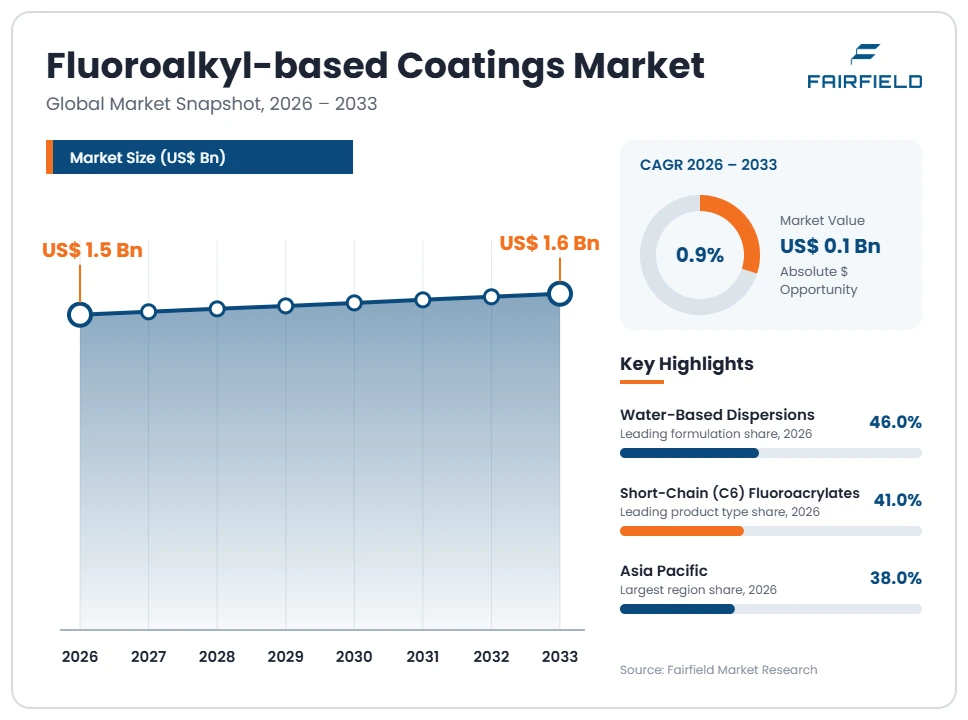
The global fluoroalkyl-based coatings market size is expected to be valued at US$ 1.5 billion in 2026 and projected to reach US$ 1.6 billion by 2033, growing at a CAGR of 0.9% between 2026 and 2033.
Growth has slowed from the 2.1% CAGR recorded between 2020 and 2025, when producers completed the shift from long-chain to short-chain C6 fluorotelomer chemistry. Three forces now set direction. Regulated consumer uses, led by textile durable water repellent finishes and food-contact paper, are contracting as product bans take effect. Technical uses in semiconductors, medical devices, optics and industrial release hold firm, because no alternative matches the oil repellency of these low surface energy coatings. Price per kilogram is rising as volumes fall and intermediate supply tightens. The result is a category that is flat in value, smaller in tonnage, and steadily more concentrated in high-specification industrial work.
Key Report Takeaways
- By Product Type: Short-Chain (C6) Fluoroacrylate Polymers held 41% share in 2026, while Perfluoropolyether Coatings are projected to expand at a 4.8% CAGR through 2033, driven by display and optical surfaces that need durable anti-fingerprint performance.
- By Formulation Technology: Water-Based Dispersions held 46% share in 2026, while Vapor-Deposited and Plasma-Applied Coatings are projected to expand at a 5.6% CAGR through 2033, because gram-scale deposition cuts both emissions and reportable chemical inventory.
- By Application: Textile Durable Water Repellency held 33% share in 2026, while Electronics Anti-Fingerprint and Conformal Coatings are projected to expand at a 5.9% CAGR through 2033, supported by rising ingress-protection ratings on handsets and wearables.
- By End Use Industry: Apparel and Outdoor Textiles held 28% share in 2026, while Automotive and Transportation is projected to expand at a 5.2% CAGR through 2033, as camera, radar and LiDAR housings require anti-soiling surfaces.
- By Geography: Asia Pacific held 38% share in 2026, while Latin America is projected to expand at a 2.3% CAGR through 2033, reflecting textile finishing capacity that faces fewer product-level restrictions.
Global Fluoroalkyl-based Coatings Market Trends and Insights
Drivers Impact Analysis
Two demand pools continue to justify fluoroalkyl chemistry despite the regulatory pressure on consumer uses.
| Driver | Impact on CAGR Forecast | Geographic Relevance | Impact Timeline |
| Semiconductor, optics and medical surface protection with no qualified substitute | High | Asia Pacific, North America | Long term ≥4 years |
| Protective and defense textiles requiring combined oil, water and soil repellency | Medium | North America, Europe | Medium term 2–4 years |
Semiconductor and Optical Surfaces Anchor Fluoroalkyl Coating Demand
Precision electronics manufacturing is now the firmest demand pool for fluoroalkyl-based surface treatments. Wafer carriers, photomask frames, lens assemblies and display cover glass need surfaces that reject both water and oils at contact angles no silicone or wax chemistry reaches. Volumes are small, measured in grams per unit, but the value per kilogram is many times that of textile finishing, which keeps the segment profitable even as tonnage elsewhere falls.
The mechanism is specification, not preference. Device makers qualify a surface treatment against fingerprint resistance, abrasion cycles and optical clarity targets written into their own standards, and requalification can take 18 months. Fluorinated silane treatments and perfluoropolyether films deposited by vapor phase meet those targets with deposits only nanometres thick. Because the coating is bonded, cured and enclosed inside a finished device, exposure arguments that drive consumer restrictions apply far more weakly here.
Defense and Industrial Protective Textiles Keep C6 Repellent Finishes in Service
Protective workwear and defense textiles remain a committed buyer of oil and water repellent coatings. Flame-resistant garments, chemical-protective layers, military shelters and marine covers must shed fuels, hydraulic fluids and blood, not only rain. Non-fluorinated finishes handle water well but fail oil-repellency grades, so procurement specifications in this segment still name fluorinated surface treatments explicitly and renew annually.
The cause is the physics of surface energy. Hydrocarbon oils wet almost any surface above roughly 20 millinewtons per metre, and only fluoroalkyl groups push surface energy below that threshold. Silicone and paraffin systems sit well above it. Military and industrial standards that test oil repellency on an eight-point scale therefore cannot be met by current alternatives. Until a non-fluorinated chemistry clears those tests, this demand is defended by specification rather than by cost or habit.
Restraints Impact Analysis
Two restraints explain why value growth is close to zero despite resilient technical demand.
| Restraint | Impact on CAGR Forecast | Geographic Relevance | Impact Timeline |
| Brand elimination pledges and state product bans in textiles and food packaging | High | North America, Europe | Short term ≤2 years |
| Requalification cost and contracting C6 intermediate supply | Medium | Global | Medium term 2–4 years |
Apparel Pledges and State Product Bans Erase the Largest Coating Volume
Consumer-facing bans are removing the single largest historical outlet for these coatings. Several large apparel and outdoor brands have committed to eliminating intentionally added PFAS from their products, and those commitments pass straight through to mills as purchasing specifications. Food-service packaging converters have moved the same way. Because durable water repellency and grease-proofing together accounted for most tonnage, their withdrawal reduces volume faster than technical applications can replace it.
The driving instruments are product bans rather than substance registrations. California, Minnesota, New York, Washington and Maine have enacted restrictions on intentionally added PFAS in textiles, apparel or food packaging, and in the European Union Regulation (EU) 2019/1021 on persistent organic pollutants already limits long-chain residues. A mill supplying several of these jurisdictions cannot economically maintain two finishing lines, so it converts the whole line to a non-fluorinated recipe.
Requalification Costs and Contracting C6 Intermediate Supply Squeeze Formulators
Reformulation economics are squeezing margins on the business that remains. Every change of repellent chemistry forces re-testing of spray rating, wash durability, hand feel, seam strength and colour fastness, and apparel customers typically require 20 to 50 wash cycles of evidence. Formulators absorb much of that laboratory cost to retain accounts, while the revenue being defended is shrinking.
The underlying cost source is the fluorotelomer intermediate chain. Short-chain C6 acrylates depend on telomerization capacity that few producers operate, and several have narrowed their catalogues rather than carry PFAS compliance and liability costs. Thinner supply raises intermediate prices, lengthens lead times and forces formulators to hold more inventory. Add emissions abatement, wastewater monitoring and reporting obligations at the finishing plant, and the delivered cost of a fluorinated finish rises against alternatives that face none of these obligations.
Market Opportunities
Two revenue pools are opening as the category narrows toward applications where repellency is a functional requirement.
Perfluoropolyether Treatments Open a High-Value Display and Optics Pool
Perfluoropolyether surface treatments represent the most attractive new revenue pool in this category. Sold by the gram for anti-fingerprint layers on cover glass, camera lenses, sensor windows and head-up display optics, they carry gross margins far above textile finishing. The addressable units expand with every additional camera and touch surface per device, and with automotive glazing that now carries optical sensors behind it.
Specialty formulators and vapor-deposition equipment suppliers are positioned to capture this pool. Demand originates with handset, display panel and automotive tier-one manufacturers who buy coating performance as part of a qualified process rather than as a commodity drum. Deposition equipment that applies monolayers under vacuum supports the shift, because it cuts consumption per part and keeps the chemistry inside a closed tool. That combination of tiny dose, enclosed handling and measurable optical benefit makes the application defensible under current restriction proposals.
Medical Filtration and Device Surfaces Create a Defensible Repellency Pool
Medical devices and filtration media offer a second pool where repellency is clinically functional. Sterile barrier fabrics, vent filters on infusion sets, lateral-flow diagnostic membranes and implant handling surfaces rely on controlled wetting to work at all. These are low-tonnage, high-value applications, validated under device approvals that make substitution slow and deliberate rather than driven by brand marketing.
Coating houses with regulated-industry quality systems are best placed to serve it. Demand comes from device manufacturers and membrane converters who need documented biocompatibility, lot traceability and change control, not the lowest price per litre. Rising single-use device volumes and the growth of home-administered therapies enlarge the base. Because every change requires regulatory notification, incumbents who already hold validated coating processes with these customers enjoy switching costs that the textile business never had.
Segment Analysis
- By Product Type: C6 Fluoroacrylates Hold Scale While Perfluoropolyethers Gain Value
Short-Chain (C6) Fluoroacrylate Polymers led product type with 41% share in 2026, because they remain the workhorse chemistry for textile, leather and paper treatment and are compatible with existing pad-bath and size-press equipment. Mills can run them without capital change, which keeps them in place wherever a jurisdiction still permits their use. Perfluoropolyether Coatings are the fastest-growing product type at a 4.8% CAGR to 2033, driven by anti-fingerprint and anti-smudge layers on glass and optics. Fluorinated Silane Surface Treatments hold a smaller but stable position in electronics assembly, while Fluorinated Urethane and Hybrid Systems serve architectural and industrial release work. The practical implication is a shift in the revenue mix from kilograms sold to performance sold, which favours suppliers with application engineering capability over commodity blenders competing on price.
- By Formulation Technology: Water-Based Systems Dominate as Vapor Deposition Accelerates
Water-Based Dispersions accounted for 46% of formulation technology revenue in 2026, reflecting two decades of solvent reduction under volatile organic compound rules and the dominance of aqueous textile and paper processing. Converting a finishing line away from water-based delivery is costly, so incumbency is strong. Vapor-Deposited and Plasma-Applied Coatings are expanding fastest at a 5.6% CAGR, because applying nanometre layers inside a vacuum chamber cuts chemical consumption by orders of magnitude and confines emissions to a controllable point source. That matters directly for reporting obligations and worker exposure limits. Solvent-Based Systems continue to decline, and Powder and High-Solids Systems remain niche. For suppliers, the message is that delivery method, not only molecular design, is becoming a compliance argument that customers are willing to pay for.
- By Application: Textile Repellency Still Leads While Electronics Coatings Grow Fastest
Textile Durable Water Repellency remained the largest application at 33% share in 2026, a position inherited from decades of outdoor apparel, upholstery and technical fabric treatment rather than from current momentum. Its share is falling every year as brand pledges and state bans bite. Electronics Anti-Fingerprint and Conformal Coatings are growing fastest at a 5.9% CAGR to 2033, pushed by ingress-protection ratings on handsets, wearables and hearables that now specify splash and sweat resistance. Paper and Board Grease Resistance is contracting sharply under food-contact restrictions, while Architectural and Glass Surfaces and Industrial Release and Anti-Stick Coatings hold steady. Suppliers that still depend on apparel finishing for most revenue face a structurally declining base, and the credible response is reallocating technical service resources toward electronics and industrial accounts.
- By End Use Industry: Apparel Leads Today While Automotive Surfaces Expand Quickest
Apparel and Outdoor Textiles led end use industries with 28% share in 2026, concentrated in performance outerwear, workwear and technical fabrics produced in China, Viet Nam and Bangladesh. Automotive and Transportation is the fastest-growing end use at a 5.2% CAGR through 2033, because driver-assistance systems place cameras, radar covers and LiDAR windows on vehicle exteriors where water beading, mud shedding and ice release affect sensor reliability. Food Packaging is in open decline, Building and Construction is stable through glass and facade treatments, and Medical Devices grows quietly behind device approvals. The business implication is a buyer shift from brand merchandisers who respond to consumer campaigns toward engineering buyers who qualify a surface against measurable function, which lengthens sales cycles but improves revenue durability.
Geography Analysis
- North America Converts From Volume Consumer to Compliance-Led Technical Buyer
North America accounted for 25% of revenue in 2026 and is close to flat, at a 0.3% CAGR to 2033. The United States and Canada still host substantial demand from semiconductor fabrication, aerospace release coatings, defense textiles and medical device manufacturing. Consumer demand, however, is being legislated away: state statutes restricting intentionally added PFAS in apparel, textiles and food packaging now cover a large share of the national retail market, and the US Environmental Protection Agency reporting rule under the Toxic Substances Control Act raises the administrative cost of keeping marginal products listed. The barrier for suppliers is litigation and disclosure exposure rather than technology. The regional opportunity lies in defense and semiconductor specifications, where qualification files are long-lived and buyers accept premium pricing for documented performance.
- Europe Leads Restriction Policy and Pushes Formulators Toward Substitution
Europe held 24% of the market in 2026 and is the only region expected to lose value, contracting by roughly 0.3% a year through 2033. Germany, Italy and France retain strong technical textile, automotive and industrial coating bases, but the policy environment is the most restrictive anywhere. Regulation (EU) 2019/1021 on persistent organic pollutants already removes long-chain chemistry, and Regulation (EU) 2024/2462 narrows the compliant space further for textiles, footwear and food-contact paper. Brand owners headquartered in the region have moved earliest on elimination pledges. Suppliers respond by building dual portfolios, selling non-fluorinated repellents alongside a shrinking fluoroalkyl range. The regional opportunity is reformulation services and application support, where mills need help matching spray ratings without fluorochemistry.
- Which Region Is Leading the Fluoroalkyl-based Coatings Market?
Asia Pacific leads the fluoroalkyl-based coatings market with 38% share in 2026 and is forecast to grow at a 1.5% CAGR to 2033. The position rests on manufacturing location: China, Viet Nam, Bangladesh, India, Taiwan, Japan and Korea host most of the world’s textile finishing, consumer electronics assembly and display panel capacity, so coatings are applied here even when the finished goods are sold elsewhere. That also makes the region the transmission point for foreign product bans, because export-oriented mills adopt the strictest customer specification they face. Domestic consumption, particularly in China and India, is less restricted and partially offsets export-driven substitution. Electronics coating demand in Taiwan, Japan and Korea adds high-value volume that is insulated from consumer campaigns, keeping regional growth marginally positive.
- Which Region Is Growing Fastest in the Fluoroalkyl-based Coatings Market?
Latin America is the fastest-growing geography, expanding at a 2.3% CAGR between 2026 and 2033 from an 8% share. Brazil and Mexico drive this, through domestic textile finishing, footwear production, packaging converting and a growing automotive supply base around Mexican assembly plants. Product-level restrictions on intentionally added fluorinated substances are limited here, so domestic brands continue to specify conventional repellent finishes that retailers elsewhere have abandoned. Barriers are real: import dependence for fluorotelomer intermediates exposes formulators to currency swings and long lead times, and technical service coverage is thin outside the main industrial clusters. The change to watch is export alignment, as Mexican suppliers to United States retailers adopt their customers’ elimination pledges ahead of any local regulation.
- Middle East & Africa Builds Industrial Demand Around Construction and Oilfield Surfaces
Middle East & Africa held 5% of revenue in 2026 and is forecast to grow at 2.0% annually to 2033, the second-fastest trajectory from the smallest base. Demand concentrates in Saudi Arabia, the United Arab Emirates, Türkiye, Egypt and South Africa, where architectural glass and facade treatments, oilfield equipment release coatings and technical textiles for shade structures and tenting dominate consumption. Harsh sun, sand abrasion and dust loading make anti-soiling surfaces genuinely valuable on buildings. Barriers include almost complete import dependence, limited local formulation and testing capability, and uneven enforcement that makes product specification inconsistent between projects. The shaping change is Türkiye’s textile export sector, which is aligning with European customer requirements faster than the rest of the region.
Competitive Landscape
The fluoroalkyl-based coatings market is moderately concentrated. A small group of integrated fluorochemical producers controls the fluorotelomer intermediates, while a wider tier of specialty formulators blends and sells finished treatments for textiles, paper, glass and electronics. That split gives upstream producers pricing leverage, because a formulator cannot substitute a C6 acrylate intermediate quickly. Concentration is increasing for an unusual reason: consolidation here comes from portfolio withdrawal rather than acquisition, as diversified chemical companies narrow or exit fluorochemical lines to limit compliance and liability exposure, leaving the committed specialists with higher shares of a smaller market.
Competition now turns on regulatory credibility as much as performance. Buyers assess a supplier’s substance disclosure quality, analytical capability for trace testing, emissions controls at the manufacturing site, and the ability to supply both a fluorinated and a non-fluorinated option for the same fabric or substrate. Application engineering support matters more than list price, because mills need help hitting spray ratings and wash durability after reformulation. New entrants are mostly arriving from the other direction, offering silicone, paraffin wax, dendrimer and hyperbranched polymer repellents, and several textile chemical houses now market these alongside their legacy fluorinated ranges.
Strategic activity concentrates on repositioning rather than expansion. Vendors are reallocating technical service and development spending from apparel finishing toward electronics, medical and industrial release applications, qualifying vapor-deposition and low-dose delivery methods, and acquiring or licensing non-fluorinated technologies to hold accounts through the transition. Supply agreements increasingly include traceability and testing commitments.
The prevailing strategic direction is managed decline with selective defence. Vendors are shrinking the regulated consumer business deliberately, protecting technical niches where specifications still require fluoroalkyl performance, and competing to own the substitution conversation with customers before a rival does.
Recent Industry Developments
- May 2019: The Stockholm Convention Conference of the Parties listed PFOA, its salts and related compounds in Annex A – closing the long-chain fluorotelomer route worldwide and forcing the industry onto short-chain chemistry.
- January 2023: California’s Assembly Bill 1200 ban on intentionally added PFAS in paper and plant-fibre food packaging took effect – removing fluoroalkyl grease-proofing from the largest single state market.
- October 2024: The European Commission adopted Regulation (EU) 2024/2462 restricting PFHxA and related substances under REACH Annex XVII, covering textiles, footwear and food-contact paper – narrowing the compliant formulation space in Europe.
- January 2025: California’s Assembly Bill 1817 and Minnesota’s Amara’s Law took effect, banning intentionally added PFAS in textile articles and several consumer product categories – accelerating substitution across apparel supply chains.
Companies Covered in the Report
- AGC Inc.
- Daikin Industries, Ltd.
- The Chemours Company
- Archroma
- Rudolf GmbH
- Huntsman Corporation
- Nicca Chemical Co., Ltd.
- 3M Company
- Dow Inc.
- Shin-Etsu Chemical Co., Ltd.
- Asahi Kasei Corporation
- Tanatex Chemicals B.V.
- Pulcra Chemicals GmbH
Fluoroalkyl-based Coatings Market Report Scope
| Metric | Value |
| Study Period | 2020–2033 |
| Market Size 2026 | US$ 1.5 Billion |
| Market Size 2033 | US$ 1.6 Billion |
| CAGR 2026–2033 | 0.9% |
| Absolute Dollar Opportunity | US$ 0.1 Billion |
| Largest Market | Asia Pacific |
| Fastest-Growing Market | Latin America |
| Market Concentration | Medium |
| Major Players | AGC Inc., Daikin Industries, Ltd., The Chemours Company, Archroma, Rudolf GmbH |
Fluoroalkyl-based Coatings Market Segmentation
Product Type
- Short-Chain (C6) Fluoroacrylate Polymers
- Perfluoropolyether Coatings
- Fluorinated Silane Surface Treatments
- Fluorinated Urethane and Hybrid Systems
Formulation Technology
- Water-Based Dispersions
- Solvent-Based Systems
- Powder and High-Solids Systems
- Vapor-Deposited and Plasma-Applied Coatings
Application
- Textile Durable Water Repellency
- Paper and Board Grease Resistance
- Electronics Anti-Fingerprint and Conformal Coatings
- Architectural and Glass Surfaces
- Industrial Release and Anti-Stick Coatings
End Use Industry
- Apparel and Outdoor Textiles
- Electronics and Semiconductors
- Food Packaging
- Automotive and Transportation
- Building and Construction
- Medical Devices
Regions
- North America
- Europe
- Asia Pacific
- Latin America
- Middle East & Africa
- Executive Summary
- Global Fluoroalkyl-based Coatings Market Snapshot
- Future Projections
- Key Report Takeaways
- Regional Snapshot
- Market Overview
- Market Definition and Report Scope
- Historical Trends 2020–2025
- Market Dynamics
- Drivers
- Semiconductor and Optical Surfaces Anchor Fluoroalkyl Coating Demand
- Defense and Industrial Protective Textiles Keep C6 Repellent Finishes in Service
- Restraints
- Apparel Pledges and State Product Bans Erase the Largest Coating Volume
- Requalification Costs and Contracting C6 Intermediate Supply Squeeze Formulators
- Market Opportunities
- Perfluoropolyether Treatments Open a High-Value Display and Optics Pool
- Medical Filtration and Device Surfaces Create a Defensible Repellency Pool
- Drivers
- Global Fluoroalkyl-based Coatings Market Outlook, 2020–2033
- Global Fluoroalkyl-based Coatings Market Outlook, by Product Type, Value (US$ Billion), 2020–2033
- Short-Chain (C6) Fluoroacrylate Polymers
- Perfluoropolyether Coatings
- Fluorinated Silane Surface Treatments
- Fluorinated Urethane and Hybrid Systems
- Global Fluoroalkyl-based Coatings Market Outlook, by Formulation Technology, Value (US$ Billion), 2020–2033
- Water-Based Dispersions
- Solvent-Based Systems
- Powder and High-Solids Systems
- Vapor-Deposited and Plasma-Applied Coatings
- Global Fluoroalkyl-based Coatings Market Outlook, by Application, Value (US$ Billion), 2020–2033
- Textile Durable Water Repellency
- Paper and Board Grease Resistance
- Electronics Anti-Fingerprint and Conformal Coatings
- Architectural and Glass Surfaces
- Industrial Release and Anti-Stick Coatings
- Global Fluoroalkyl-based Coatings Market Outlook, by End Use Industry, Value (US$ Billion), 2020–2033
- Apparel and Outdoor Textiles
- Electronics and Semiconductors
- Food Packaging
- Automotive and Transportation
- Building and Construction
- Medical Devices
- Global Fluoroalkyl-based Coatings Market Outlook, by Region, Value (US$ Billion), 2020–2033
- North America
- Europe
- Asia Pacific
- Latin America
- Middle East & Africa
- Global Fluoroalkyl-based Coatings Market Outlook, by Product Type, Value (US$ Billion), 2020–2033
- North America Fluoroalkyl-based Coatings Market Outlook, 2020–2033
- North America Fluoroalkyl-based Coatings Market Outlook, by Product Type, Value (US$ Billion), 2020–2033
- Short-Chain (C6) Fluoroacrylate Polymers
- Perfluoropolyether Coatings
- Fluorinated Silane Surface Treatments
- Fluorinated Urethane and Hybrid Systems
- North America Fluoroalkyl-based Coatings Market Outlook, by Formulation Technology, Value (US$ Billion), 2020–2033
- Water-Based Dispersions
- Solvent-Based Systems
- Powder and High-Solids Systems
- Vapor-Deposited and Plasma-Applied Coatings
- North America Fluoroalkyl-based Coatings Market Outlook, by Application, Value (US$ Billion), 2020–2033
- Textile Durable Water Repellency
- Paper and Board Grease Resistance
- Electronics Anti-Fingerprint and Conformal Coatings
- Architectural and Glass Surfaces
- Industrial Release and Anti-Stick Coatings
- North America Fluoroalkyl-based Coatings Market Outlook, by End Use Industry, Value (US$ Billion), 2020–2033
- Apparel and Outdoor Textiles
- Electronics and Semiconductors
- Food Packaging
- Automotive and Transportation
- Building and Construction
- Medical Devices
- North America Fluoroalkyl-based Coatings Market Outlook, by Country, Value (US$ Billion), 2020–2033
- United States Fluoroalkyl-based Coatings Market Outlook, by Product Type, 2020–2033
- United States Fluoroalkyl-based Coatings Market Outlook, by Formulation Technology, 2020–2033
- United States Fluoroalkyl-based Coatings Market Outlook, by Application, 2020–2033
- United States Fluoroalkyl-based Coatings Market Outlook, by End Use Industry, 2020–2033
- Canada Fluoroalkyl-based Coatings Market Outlook, by Product Type, 2020–2033
- Canada Fluoroalkyl-based Coatings Market Outlook, by Formulation Technology, 2020–2033
- Canada Fluoroalkyl-based Coatings Market Outlook, by Application, 2020–2033
- Canada Fluoroalkyl-based Coatings Market Outlook, by End Use Industry, 2020–2033
- North America Fluoroalkyl-based Coatings Market Outlook, by Product Type, Value (US$ Billion), 2020–2033
- Europe Fluoroalkyl-based Coatings Market Outlook, 2020–2033
- Europe Fluoroalkyl-based Coatings Market Outlook, by Product Type, Value (US$ Billion), 2020–2033
- Short-Chain (C6) Fluoroacrylate Polymers
- Perfluoropolyether Coatings
- Fluorinated Silane Surface Treatments
- Fluorinated Urethane and Hybrid Systems
- Europe Fluoroalkyl-based Coatings Market Outlook, by Formulation Technology, Value (US$ Billion), 2020–2033
- Water-Based Dispersions
- Solvent-Based Systems
- Powder and High-Solids Systems
- Vapor-Deposited and Plasma-Applied Coatings
- Europe Fluoroalkyl-based Coatings Market Outlook, by Application, Value (US$ Billion), 2020–2033
- Textile Durable Water Repellency
- Paper and Board Grease Resistance
- Electronics Anti-Fingerprint and Conformal Coatings
- Architectural and Glass Surfaces
- Industrial Release and Anti-Stick Coatings
- Europe Fluoroalkyl-based Coatings Market Outlook, by End Use Industry, Value (US$ Billion), 2020–2033
- Apparel and Outdoor Textiles
- Electronics and Semiconductors
- Food Packaging
- Automotive and Transportation
- Building and Construction
- Medical Devices
- Europe Fluoroalkyl-based Coatings Market Outlook, by Country, Value (US$ Billion), 2020–2033
- Germany Fluoroalkyl-based Coatings Market Outlook, by Product Type, 2020–2033
- Germany Fluoroalkyl-based Coatings Market Outlook, by Formulation Technology, 2020–2033
- Germany Fluoroalkyl-based Coatings Market Outlook, by Application, 2020–2033
- Germany Fluoroalkyl-based Coatings Market Outlook, by End Use Industry, 2020–2033
- Italy Fluoroalkyl-based Coatings Market Outlook, by Product Type, 2020–2033
- Italy Fluoroalkyl-based Coatings Market Outlook, by Formulation Technology, 2020–2033
- Italy Fluoroalkyl-based Coatings Market Outlook, by Application, 2020–2033
- Italy Fluoroalkyl-based Coatings Market Outlook, by End Use Industry, 2020–2033
- France Fluoroalkyl-based Coatings Market Outlook, by Product Type, 2020–2033
- France Fluoroalkyl-based Coatings Market Outlook, by Formulation Technology, 2020–2033
- France Fluoroalkyl-based Coatings Market Outlook, by Application, 2020–2033
- France Fluoroalkyl-based Coatings Market Outlook, by End Use Industry, 2020–2033
- Europe Fluoroalkyl-based Coatings Market Outlook, by Product Type, Value (US$ Billion), 2020–2033
- Asia Pacific Fluoroalkyl-based Coatings Market Outlook, 2020–2033
- Asia Pacific Fluoroalkyl-based Coatings Market Outlook, by Product Type, Value (US$ Billion), 2020–2033
- Short-Chain (C6) Fluoroacrylate Polymers
- Perfluoropolyether Coatings
- Fluorinated Silane Surface Treatments
- Fluorinated Urethane and Hybrid Systems
- Asia Pacific Fluoroalkyl-based Coatings Market Outlook, by Formulation Technology, Value (US$ Billion), 2020–2033
- Water-Based Dispersions
- Solvent-Based Systems
- Powder and High-Solids Systems
- Vapor-Deposited and Plasma-Applied Coatings
- Asia Pacific Fluoroalkyl-based Coatings Market Outlook, by Application, Value (US$ Billion), 2020–2033
- Textile Durable Water Repellency
- Paper and Board Grease Resistance
- Electronics Anti-Fingerprint and Conformal Coatings
- Architectural and Glass Surfaces
- Industrial Release and Anti-Stick Coatings
- Asia Pacific Fluoroalkyl-based Coatings Market Outlook, by End Use Industry, Value (US$ Billion), 2020–2033
- Apparel and Outdoor Textiles
- Electronics and Semiconductors
- Food Packaging
- Automotive and Transportation
- Building and Construction
- Medical Devices
- Asia Pacific Fluoroalkyl-based Coatings Market Outlook, by Country, Value (US$ Billion), 2020–2033
- China Fluoroalkyl-based Coatings Market Outlook, by Product Type, 2020–2033
- China Fluoroalkyl-based Coatings Market Outlook, by Formulation Technology, 2020–2033
- China Fluoroalkyl-based Coatings Market Outlook, by Application, 2020–2033
- China Fluoroalkyl-based Coatings Market Outlook, by End Use Industry, 2020–2033
- Bangladesh Fluoroalkyl-based Coatings Market Outlook, by Product Type, 2020–2033
- Bangladesh Fluoroalkyl-based Coatings Market Outlook, by Formulation Technology, 2020–2033
- Bangladesh Fluoroalkyl-based Coatings Market Outlook, by Application, 2020–2033
- Bangladesh Fluoroalkyl-based Coatings Market Outlook, by End Use Industry, 2020–2033
- India Fluoroalkyl-based Coatings Market Outlook, by Product Type, 2020–2033
- India Fluoroalkyl-based Coatings Market Outlook, by Formulation Technology, 2020–2033
- India Fluoroalkyl-based Coatings Market Outlook, by Application, 2020–2033
- India Fluoroalkyl-based Coatings Market Outlook, by End Use Industry, 2020–2033
- Taiwan Fluoroalkyl-based Coatings Market Outlook, by Product Type, 2020–2033
- Taiwan Fluoroalkyl-based Coatings Market Outlook, by Formulation Technology, 2020–2033
- Taiwan Fluoroalkyl-based Coatings Market Outlook, by Application, 2020–2033
- Taiwan Fluoroalkyl-based Coatings Market Outlook, by End Use Industry, 2020–2033
- Japan Fluoroalkyl-based Coatings Market Outlook, by Product Type, 2020–2033
- Japan Fluoroalkyl-based Coatings Market Outlook, by Formulation Technology, 2020–2033
- Japan Fluoroalkyl-based Coatings Market Outlook, by Application, 2020–2033
- Japan Fluoroalkyl-based Coatings Market Outlook, by End Use Industry, 2020–2033
- Korea Fluoroalkyl-based Coatings Market Outlook, by Product Type, 2020–2033
- Korea Fluoroalkyl-based Coatings Market Outlook, by Formulation Technology, 2020–2033
- Korea Fluoroalkyl-based Coatings Market Outlook, by Application, 2020–2033
- Korea Fluoroalkyl-based Coatings Market Outlook, by End Use Industry, 2020–2033
- Asia Pacific Fluoroalkyl-based Coatings Market Outlook, by Product Type, Value (US$ Billion), 2020–2033
- Latin America Fluoroalkyl-based Coatings Market Outlook, 2020–2033
- Latin America Fluoroalkyl-based Coatings Market Outlook, by Product Type, Value (US$ Billion), 2020–2033
- Short-Chain (C6) Fluoroacrylate Polymers
- Perfluoropolyether Coatings
- Fluorinated Silane Surface Treatments
- Fluorinated Urethane and Hybrid Systems
- Latin America Fluoroalkyl-based Coatings Market Outlook, by Formulation Technology, Value (US$ Billion), 2020–2033
- Water-Based Dispersions
- Solvent-Based Systems
- Powder and High-Solids Systems
- Vapor-Deposited and Plasma-Applied Coatings
- Latin America Fluoroalkyl-based Coatings Market Outlook, by Application, Value (US$ Billion), 2020–2033
- Textile Durable Water Repellency
- Paper and Board Grease Resistance
- Electronics Anti-Fingerprint and Conformal Coatings
- Architectural and Glass Surfaces
- Industrial Release and Anti-Stick Coatings
- Latin America Fluoroalkyl-based Coatings Market Outlook, by End Use Industry, Value (US$ Billion), 2020–2033
- Apparel and Outdoor Textiles
- Electronics and Semiconductors
- Food Packaging
- Automotive and Transportation
- Building and Construction
- Medical Devices
- Latin America Fluoroalkyl-based Coatings Market Outlook, by Country, Value (US$ Billion), 2020–2033
- Brazil Fluoroalkyl-based Coatings Market Outlook, by Product Type, 2020–2033
- Brazil Fluoroalkyl-based Coatings Market Outlook, by Formulation Technology, 2020–2033
- Brazil Fluoroalkyl-based Coatings Market Outlook, by Application, 2020–2033
- Brazil Fluoroalkyl-based Coatings Market Outlook, by End Use Industry, 2020–2033
- Mexico Fluoroalkyl-based Coatings Market Outlook, by Product Type, 2020–2033
- Mexico Fluoroalkyl-based Coatings Market Outlook, by Formulation Technology, 2020–2033
- Mexico Fluoroalkyl-based Coatings Market Outlook, by Application, 2020–2033
- Mexico Fluoroalkyl-based Coatings Market Outlook, by End Use Industry, 2020–2033
- Latin America Fluoroalkyl-based Coatings Market Outlook, by Product Type, Value (US$ Billion), 2020–2033
- Middle East & Africa Fluoroalkyl-based Coatings Market Outlook, 2020–2033
- Middle East & Africa Fluoroalkyl-based Coatings Market Outlook, by Product Type, Value (US$ Billion), 2020–2033
- Short-Chain (C6) Fluoroacrylate Polymers
- Perfluoropolyether Coatings
- Fluorinated Silane Surface Treatments
- Fluorinated Urethane and Hybrid Systems
- Middle East & Africa Fluoroalkyl-based Coatings Market Outlook, by Formulation Technology, Value (US$ Billion), 2020–2033
- Water-Based Dispersions
- Solvent-Based Systems
- Powder and High-Solids Systems
- Vapor-Deposited and Plasma-Applied Coatings
- Middle East & Africa Fluoroalkyl-based Coatings Market Outlook, by Application, Value (US$ Billion), 2020–2033
- Textile Durable Water Repellency
- Paper and Board Grease Resistance
- Electronics Anti-Fingerprint and Conformal Coatings
- Architectural and Glass Surfaces
- Industrial Release and Anti-Stick Coatings
- Middle East & Africa Fluoroalkyl-based Coatings Market Outlook, by End Use Industry, Value (US$ Billion), 2020–2033
- Apparel and Outdoor Textiles
- Electronics and Semiconductors
- Food Packaging
- Automotive and Transportation
- Building and Construction
- Medical Devices
- Middle East & Africa Fluoroalkyl-based Coatings Market Outlook, by Country, Value (US$ Billion), 2020–2033
- Saudi Arabia Fluoroalkyl-based Coatings Market Outlook, by Product Type, 2020–2033
- Saudi Arabia Fluoroalkyl-based Coatings Market Outlook, by Formulation Technology, 2020–2033
- Saudi Arabia Fluoroalkyl-based Coatings Market Outlook, by Application, 2020–2033
- Saudi Arabia Fluoroalkyl-based Coatings Market Outlook, by End Use Industry, 2020–2033
- United Arab Emirates Fluoroalkyl-based Coatings Market Outlook, by Product Type, 2020–2033
- United Arab Emirates Fluoroalkyl-based Coatings Market Outlook, by Formulation Technology, 2020–2033
- United Arab Emirates Fluoroalkyl-based Coatings Market Outlook, by Application, 2020–2033
- United Arab Emirates Fluoroalkyl-based Coatings Market Outlook, by End Use Industry, 2020–2033
- Türkiye Fluoroalkyl-based Coatings Market Outlook, by Product Type, 2020–2033
- Türkiye Fluoroalkyl-based Coatings Market Outlook, by Formulation Technology, 2020–2033
- Türkiye Fluoroalkyl-based Coatings Market Outlook, by Application, 2020–2033
- Türkiye Fluoroalkyl-based Coatings Market Outlook, by End Use Industry, 2020–2033
- Egypt Fluoroalkyl-based Coatings Market Outlook, by Product Type, 2020–2033
- Egypt Fluoroalkyl-based Coatings Market Outlook, by Formulation Technology, 2020–2033
- Egypt Fluoroalkyl-based Coatings Market Outlook, by Application, 2020–2033
- Egypt Fluoroalkyl-based Coatings Market Outlook, by End Use Industry, 2020–2033
- South Africa Fluoroalkyl-based Coatings Market Outlook, by Product Type, 2020–2033
- South Africa Fluoroalkyl-based Coatings Market Outlook, by Formulation Technology, 2020–2033
- South Africa Fluoroalkyl-based Coatings Market Outlook, by Application, 2020–2033
- South Africa Fluoroalkyl-based Coatings Market Outlook, by End Use Industry, 2020–2033
- Middle East & Africa Fluoroalkyl-based Coatings Market Outlook, by Product Type, Value (US$ Billion), 2020–2033
- Competitive Landscape
- Market Concentration and Industry Leaders
- Competitive Differentiation
- Strategic Moves and Market Direction
- Recent Industry Developments
- Company Profiles
- AGC Inc.
- Daikin Industries, Ltd.
- The Chemours Company
- Archroma
- Rudolf GmbH
- Huntsman Corporation
- Nicca Chemical Co., Ltd.
- 3M Company
- Dow Inc.
- Shin-Etsu Chemical Co., Ltd.
- Asahi Kasei Corporation
- Tanatex Chemicals B.V.
- Pulcra Chemicals GmbH
- Appendix
- Research Methodology
- Report Assumptions
- Acronyms and Abbreviations
Product Type
- Short-Chain (C6) Fluoroacrylate Polymers
- Perfluoropolyether Coatings
- Fluorinated Silane Surface Treatments
- Fluorinated Urethane and Hybrid Systems
Formulation Technology
- Water-Based Dispersions
- Solvent-Based Systems
- Powder and High-Solids Systems
- Vapor-Deposited and Plasma-Applied Coatings
Application
- Textile Durable Water Repellency
- Paper and Board Grease Resistance
- Electronics Anti-Fingerprint and Conformal Coatings
- Architectural and Glass Surfaces
- Industrial Release and Anti-Stick Coatings
End Use Industry
- Apparel and Outdoor Textiles
- Electronics and Semiconductors
- Food Packaging
- Automotive and Transportation
- Building and Construction
- Medical Devices
Regions
- North America
- Europe
- Asia Pacific
- Latin America
- Middle East & Africa
Our Research Methodology
Considering the volatility of business today, traditional approaches to strategizing a game plan can be unfruitful if not detrimental. True ambiguity is no way to determine a forecast. A myriad of predetermined factors must be accounted for such as the degree of risk involved, the magnitude of circumstances, as well as conditions or consequences that are not known or unpredictable. To circumvent binary views that cast uncertainty, the application of market research intelligence to strategically posture, move, and enable actionable outcomes is necessary.
View Methodology
Quality Assured
Rigorous Validation Process

Confidentiality Assured
End-to-end Data Security

Custom Research Services
Tailored To Your Objectives
FAQs
The market is valued at US$ 1.5 billion in 2026, equal to about US$ 1,512 million in fluoroalkyl coating and surface treatment revenue worldwide.
Revenue reaches US$ 1.6 billion by 2033, a 0.9% CAGR and an absolute dollar opportunity of roughly US$ 101 million over seven years.
Textile Durable Water Repellency leads with 33% share in 2026, although product bans and brand pledges are steadily reducing that position each year.
Latin America grows fastest at a 2.3% CAGR to 2033, helped by Brazil and Mexico and comparatively limited product-level restrictions on fluorinated finishes.
Concentration is medium: a few integrated producers control fluorotelomer intermediates, while specialty formulators compete on application support and regulatory credibility.
Related Reports
Fluorosurfactant Market Size, Share, Insights, Competitive Landscape, and Forecast 2026 to 2033
The global fluorosurfactant market is valued at US$0.9 billion in 2026, reaching US$1.0 billion by 2033, growing at a 1.5% CAGR
Fluoropolymer Films Market Size, Share, Insights, Competitive Landscape, and Forecast 2026 to 2033
The global fluoropolymer films market is valued at US$3.4 billion in 2026, reaching US$5.4 billion by 2033, growing at a 6.8% CAGR
Facade Market Size, Share, Insights, Competitive Landscape, and Forecast 2026 to 2033
The global facade market is valued at US$230.0 billion in 2026, reaching US$334.5 billion by 2033, growing at a 5.5% CAGR
Plastic Lumber Market Size, Share, Insights, Competitive Landscape, and Forecast 2026 to 2033
The global plastic lumber market is valued at US$6.50 billion in 2026, reaching US$12.80 billion by 2033, growing at a 10.16% CAGR
Nickel Market Size, Share, Insights, Competitive Landscape, and Forecast 2026 to 2033
The global nickel market is valued at US$48.5 billion in 2026, reaching US$76.0 billion by 2033, growing at a 6.6% CAGR
Lead Market Size, Share, Insights, Competitive Landscape, and Forecast 2026 to 2033
The global lead market is valued at US$25.6 billion in 2026, reaching US$34.8 billion by 2033, growing at a 4.5% CAGR