



Fluorosurfactant Market
Fluorosurfactant Market Size, Share, Insights, Competitive Landscape, and Forecast 2026 to 2033
Fluorosurfactant Market Size and Trend Analysis
How Fast Will the Fluorosurfactant Market Grow?
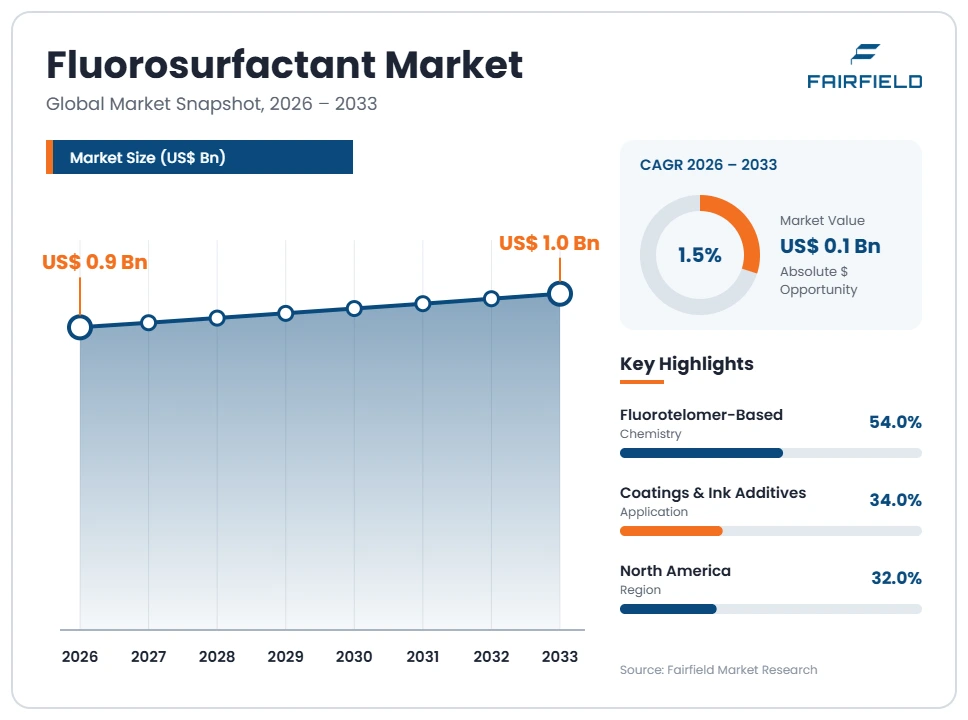
The global fluorosurfactant market size is expected to be valued at US$ 0.9 billion in 2026 and projected to reach US$ 1.0 billion by 2033, growing at a CAGR of 1.5% between 2026 and 2033.
Value contracted by roughly 1.2% a year between 2020 and 2025, as firefighting foam concentrates, once the largest volume outlet for fluorinated surfactants, began a managed phase-out. The composition of demand has changed more than the headline. Growth now comes from applications dosed in parts per million: photolithography and semiconductor wet chemistry, levelling and wetting additives in waterborne coatings and inks, electroplating mist suppression and specialised cleaning. Average selling prices per kilogram are rising as the mix shifts from bulk foam concentrate to purified, application-specific grades. The market is therefore smaller in tonnes but slowly recovering in value.
Key Report Takeaways
- By Product Type: Anionic Fluorosurfactants held 36% share in 2026, while Nonionic Fluorosurfactants are projected to expand at a 3.6% CAGR through 2033, because they tolerate waterborne resin systems and electrolytes without destabilising formulations.
- By Chemistry: Fluorotelomer-Based grades held 54% share in 2026, while Perfluoropolyether-Based grades are projected to expand at a 4.6% CAGR through 2033, driven by thermal stability demands in electronic and high-temperature fluids.
- By Application: Coatings, Inks and Adhesive Additives held 34% share in 2026, while Electronics and Photolithography is projected to expand at a 5.2% CAGR through 2033, as finer resist features demand tighter surface tension control.
- By End Use Industry: Paints and Coatings held 31% share in 2026, while Semiconductors and Electronics is projected to expand at a 5.4% CAGR through 2033, supported by new fabrication capacity and advanced packaging lines.
- By Geography: North America held 32% share in 2026, while Asia Pacific is projected to expand at a 3.8% CAGR through 2033, led by semiconductor, display and coatings production growth.
Global Fluorosurfactant Market Trends and Insights
Drivers Impact Analysis
Two applications keep buying fluorinated surfactants because the dose is tiny and the function has no equal.
| Driver | Impact on CAGR Forecast | Geographic Relevance | Impact Timeline |
| Semiconductor photolithography and advanced packaging wet chemistry | High | Asia Pacific, North America | Medium term 2–4 years |
| Conversion of industrial coatings and inks to waterborne systems | Medium | Europe, Asia Pacific | Long term ≥4 years |
Photolithography Chemistry Sustains High-Value Fluorosurfactant Demand
Semiconductor wet processing is now the most reliable source of fluorosurfactant demand growth. Photoresist formulations, developers, rinse chemistries, etchants and cleaning solutions all rely on additives that lower surface tension far enough to wet high-aspect-ratio features without leaving residue. Consumption per wafer is measured in milligrams, yet the chemistry sells at specialty prices because purity specifications are extreme and qualification is slow.
The mechanism is feature geometry. As pattern dimensions shrink, capillary forces can collapse resist structures during rinse and dry, and incomplete wetting leaves defects that scrap entire lots. Fluorinated surfactants reduce surface tension below roughly 20 millinewtons per metre, a level hydrocarbon and silicone surfactants cannot reach at comparable dose. Fabrication capacity is expanding simultaneously in Taiwan, Korea, Japan, the United States and the European Union, and advanced packaging lines add further wet-chemistry steps per device.
Waterborne Coating Conversion Expands Demand for Levelling Additives
The move from solvent-borne to waterborne industrial coatings is pulling fluorinated wetting agents into formulations that never needed them before. Water has high surface tension, so coatings applied to oily metal, plastic or recycled substrates resist spreading and form craters, fisheyes and edge pull-back. Dosing a fluorosurfactant at a few hundred parts per million solves this at a fraction of the cost of reworking rejected parts.
The driver behind the conversion is air quality regulation. Volatile organic compound limits on industrial coatings in North America, the European Union and China have forced coil, can, automotive refinish, wood and architectural formulators to reformulate in water. Each reformulation reopens the additive package, and dynamic surface tension performance during high-speed application becomes the deciding criterion. Because the additive is a tiny fraction of formulation cost but determines first-pass yield, demand is relatively insensitive to price.
Restraints Impact Analysis
Two restraints explain why value growth remains low despite healthy niche demand.
| Restraint | Impact on CAGR Forecast | Geographic Relevance | Impact Timeline |
| Phase-out of aqueous film-forming foam and conversion to fluorine-free foam | High | North America, Europe | Short term ≤2 years |
| Remediation liability and procurement screens that de-list fluorinated additives | Medium | North America, Europe | Medium term 2–4 years |
Fluorine-Free Foam Conversion Removes the Largest Historical Volume Pool
The firefighting foam transition has taken away the single biggest tonnage outlet this industry ever had. Aqueous film-forming foam used fluorinated surfactants at percentage-level concentrations to create the aqueous film that smothers hydrocarbon fuel fires, and military bases, airports, refineries and tank farms held large inventories. Fluorine-free foam has replaced it in most new procurement, and legacy stock is being collected and destroyed rather than resold.
The decisive change was specification, not persuasion. The US Department of Defense issued a performance specification for fluorine-free firefighting foam and set a transition away from PFAS-containing foam, and civil aviation authorities followed with guidance permitting the switch at certificated airports. In Europe, a restriction proposal on PFAS in firefighting foams has been under assessment at the European Chemicals Agency. Once a national specification exists, procurement follows automatically, and the volume does not return.
Remediation Liability and Procurement Screens Shrink the Addressable Catalogue
Liability exposure is removing fluorosurfactants from applications where they remain technically permitted. The US Environmental Protection Agency has designated PFOA and PFOS as hazardous substances under CERCLA and set enforceable drinking water limits, creating cleanup cost recovery risk that extends to sites and users, not only manufacturers. Industrial customers increasingly refuse to introduce any fluorinated additive into a plant that discharges to water.
The cost is more commercial than technical. Insurers price PFAS liability into general policies, legal review of a single new application can take months, and corporate procurement teams now apply blanket fluorine-free screening rules that do not distinguish a percentage-level foam from a 200 parts per million levelling additive. Suppliers also carry analytical, wastewater monitoring and product stewardship costs across a shrinking volume base. The result is de-listing by policy rather than by performance.
Market Opportunities
Two niches offer genuine new revenue where dose rates are minimal and substitution is hardest.
Advanced Packaging Chemistry Opens a Premium Fluorosurfactant Niche
Advanced semiconductor packaging is creating a revenue pool that did not exist at scale a few years ago. Fan-out wafer-level packaging, hybrid bonding, through-silicon via plating and panel-level redistribution each add wet-chemistry steps where uniform wetting and controlled foam behaviour determine yield. These chemistries sell per litre at prices far above industrial surfactant norms, and volumes scale with artificial intelligence accelerator and high-bandwidth memory production.
Suppliers with electronic-grade purification, trace metals analysis and cleanroom packaging capability can capture this. Demand comes from electronic chemicals formulators and plating chemistry houses who blend additives into proprietary baths, and ultimately from foundries and outsourced assembly and test providers. Because a bath additive is qualified alongside the process and audited for lot consistency, incumbency is durable. Early participation in a customer’s process development programme is effectively the only entry route.
Functional Inkjet and Digital Printing Fluids Create a Growing Additive Pool
Industrial inkjet is a second pool where fluorinated surfactants earn their place. High-speed digital printing on corrugated board, films, textiles, ceramics and printed electronics substrates depends on controlling dynamic surface tension within milliseconds, so droplets spread correctly without coalescing or flooding. Hydrocarbon surfactants migrate to the interface too slowly at these timescales, which makes the fluorinated option difficult to displace.
Ink formulators and printhead fluid developers are the buyers, serving packaging converters, label printers, textile printers and printed electronics manufacturers. The shift of short-run packaging from analogue plates to digital presses enlarges the base each year, and functional printing of conductive and dielectric layers adds demanding new fluids. Because additive content is well below 1% of ink mass and defect avoidance is the economic argument, this application supports premium pricing and low price elasticity.
Segment Analysis
- By Product Type: Anionic Grades Retain Scale While Nonionic Grades Gain Share
Anionic Fluorosurfactants led product type with 36% share in 2026, a position built on decades of use in foam concentrates, electroplating mist suppression and alkaline cleaning, where charged head groups give strong interfacial activity at low concentration. The base is eroding as foam demand disappears, but plating and cleaning uses continue. Nonionic Fluorosurfactants are the fastest-growing type at a 3.6% CAGR to 2033, because they remain stable in electrolyte-rich plating baths, hard water and resin emulsions, and they are the default choice for coatings, inks and photoresist additives. Amphoteric grades decline with foam, while Cationic grades hold small antistatic and surface-modification niches. For suppliers, the practical implication is that catalogue value is migrating toward purified nonionic chemistries sold in drums rather than bulk anionic concentrates sold in tankers.
- By Chemistry: Fluorotelomer Grades Dominate as Perfluoropolyether Chemistry Accelerates
Fluorotelomer-Based chemistry accounted for 54% of revenue in 2026, the industry standard since the move to short-chain structures, and the most cost-effective route to low surface tension across coatings, cleaning and plating applications. Manufacturing infrastructure and customer qualifications both favour it. Perfluoropolyether-Based grades grow fastest at a 4.6% CAGR through 2033, because their ether backbone survives high temperatures, strong oxidisers and aggressive solvents that degrade telomer structures, which suits electronic fluids, vacuum systems and specialty lubricant formulations. Perfluoroalkane Sulfonamide-Based products continue to shrink under persistent organic pollutant controls, and Fluorinated Polymeric Surfactants serve dispersion stabilisation. The business implication is a slow premiumisation of the chemistry mix, with suppliers that can synthesise and purify perfluoropolyether structures earning materially better margins than telomer blenders.
- By Application: Coating and Ink Additives Lead While Electronics Chemistry Grows Fastest
Coatings, Inks and Adhesive Additives formed the largest application at 34% share in 2026, reflecting the breadth of waterborne formulations that need levelling, wetting and defoaming control across architectural, industrial, packaging and automotive coatings. Volumes are modest but the customer count is large and stable. Electronics and Photolithography is the fastest-growing application at a 5.2% CAGR to 2033, driven by resist, developer and cleaning chemistries at advanced nodes. Firefighting Foam Concentrates continue to fall away as fluorine-free foam replaces aqueous film-forming foam in military, aviation and petrochemical service. Metal Plating and Mist Suppression holds steady where chromium and nickel baths require it, and Specialty Cleaning and Oilfield Chemicals is stable. The implication is a market where technical service intensity per revenue dollar keeps rising.
- By End Use Industry: Paints and Coatings Lead While Semiconductors Advance Quickest
Paints and Coatings led end use industries with 31% share in 2026, because surfactant additives are consumed across thousands of formulations by a large base of regional and global coating manufacturers. Demand tracks construction, industrial production and vehicle output rather than any single technology cycle. Semiconductors and Electronics is the fastest-growing end use at a 5.4% CAGR through 2033, benefiting from new fabrication plants, advanced packaging capacity and display manufacturing. Fire Safety declines sharply, Metal Finishing is stable but exposed to plating chemistry restrictions, Oil and Gas is cyclical, and Household and Industrial Cleaning is small and steady. The strategic implication is clear: suppliers whose revenue still leans on fire safety face structural decline, while those qualified in electronic chemicals supply chains hold the more defensible position.
Geography Analysis
- Which Region Is Leading the Fluorosurfactant Market?
North America leads the fluorosurfactant market with 32% share in 2026, though it grows only 0.2% annually to 2033. The United States holds the position through its coatings and inks industry, electroplating and metal finishing base, oilfield chemicals sector and a rapidly expanding semiconductor manufacturing footprint supported by federal incentives. The region also carried the world’s largest firefighting foam inventory, which is why its growth rate is nearly flat: electronics gains are offsetting, not exceeding, the loss of foam volume. Regulatory and liability pressure is more intense here than anywhere else, with enforceable drinking water limits and hazardous substance designations under CERCLA shaping buyer behaviour. The opportunity lies in electronic chemicals, where new fabrication plants qualify domestic additive suppliers to shorten supply chains.
- Europe Applies the Strictest Controls and Pushes Suppliers Toward Niche Grades
Europe held 24% of revenue in 2026 and grows at 0.4% a year through 2033. Germany, France, Italy, the Netherlands and Belgium anchor demand through coatings, printing inks, automotive, chemical processing and semiconductor equipment manufacturing. Policy is the defining feature: Regulation (EU) 2019/1021 on persistent organic pollutants removes legacy chemistries, the Drinking Water Directive sets PFAS parameters that drive utility monitoring and catchment pressure, and a restriction proposal on PFAS in firefighting foams has been under assessment. Suppliers respond by narrowing portfolios to grades with clear technical justification and documented stewardship. The regional change to watch is the outcome of derogation decisions for industrial process uses, which will determine whether plating and photoresist applications retain legal headroom.
- Which Region Is Growing Fastest in the Fluorosurfactant Market?
Asia Pacific is the fastest-growing geography, expanding at a 3.8% CAGR between 2026 and 2033 from a 31% share. China, Taiwan, Korea, Japan and India drive this through semiconductor and display fabrication, printed circuit manufacturing, electroplating, and the world’s largest coatings and inks production base. Domestic producers in China and Japan supply much of the regional requirement, which keeps lead times short and prices competitive. Restriction regimes exist but are generally narrower than Western equivalents, so formulators retain more freedom to specify fluorinated additives where they improve yield. Capacity additions in India for electronics assembly and specialty chemicals add a second demand pole. The region is also where fluorine-free foam adoption is slowest, which cushions the volume decline.
- Latin America Grows Steadily on Coatings, Plating and Industrial Cleaning
Latin America accounted for 7% of the market in 2026 and grows at a 1.6% CAGR to 2033. Brazil and Mexico dominate consumption through architectural and industrial coatings production, automotive component plating, packaging printing and oilfield chemicals used in offshore and onshore operations. Product-level restrictions on fluorinated additives are limited, so formulators continue to specify them where they solve wetting defects. The barriers are supply-side: almost all fluorosurfactant is imported in small lot sizes, customs lead times are long, and local technical service for formulation troubleshooting is scarce outside major industrial centres. The change shaping the region is export alignment, as suppliers to United States and European brand owners adopt their customers’ screening rules ahead of domestic rules.
- Middle East & Africa Demand Centres on Petrochemicals and Metal Finishing
Middle East & Africa held 6% of revenue in 2026 and grows at 1.9% annually to 2033. Saudi Arabia, the United Arab Emirates, Qatar, Egypt and South Africa account for most consumption, concentrated in refinery and petrochemical operations, oilfield stimulation chemistry, metal finishing for construction hardware, and protective coatings formulated for extreme heat and salt exposure. Large fuel storage infrastructure also means a slower foam transition than elsewhere, which sustains legacy demand longer. The barriers are complete import dependence, thin local formulation expertise and inconsistent chemical regulation between countries, which makes product registration unpredictable. The opportunity is downstream diversification, as new petrochemical and manufacturing complexes create local formulation demand that was previously served by finished imports.
Competitive Landscape
The fluorosurfactant market is moderately concentrated, and becoming more so as participants leave. A small number of integrated fluorochemical manufacturers produce the telomer and perfluoropolyether intermediates, and a second tier of specialty blenders converts them into application-specific grades for coatings, electronics and plating customers. Concentration is rising through withdrawal rather than acquisition: diversified chemical companies have narrowed or ended fluorochemical participation to limit liability, and the collapse of foam demand has stranded capacity that will not be rebuilt. The surviving suppliers hold larger shares of a smaller and more technical business.
Competition turns on purity, documentation and application support. Electronic chemicals customers audit trace metals, particle counts and lot-to-lot consistency; coatings formulators want dynamic surface tension data, compatibility screening and defect troubleshooting on their own lines; plating customers need bath stability over long operating cycles. Regulatory documentation has become a competitive asset, since buyers require substance identity disclosure, residual monomer analysis and evidence of emissions control before approving a supplier. The most visible new entrants are not fluorochemical producers at all, but fluorine-free foam formulators and silicone and hydrocarbon surfactant suppliers offering substitutes in the applications where performance gaps are narrowest.
Strategic activity focuses on repositioning the portfolio. Suppliers are discontinuing bulk foam grades, investing in purification and analytical capability for electronic applications, consolidating production into fewer permitted sites with abatement, and signing development agreements with electronic chemicals formulators to secure designed-in positions.
Strategic direction across the industry is consistent: retreat from high-volume dispersive uses, defend low-dose applications where function is irreplaceable, and compete on stewardship evidence as much as on performance data.
Recent Industry Developments
- February 2022: The European Chemicals Agency published an Annex XV restriction proposal targeting PFAS in firefighting foams – setting out a phased European withdrawal of fluorosurfactant-based foam across sectors.
- January 2023: The US Department of Defense issued military specification MIL-PRF-32725 for fluorine-free firefighting foam – creating a qualified alternative and a procurement route away from aqueous film-forming foam.
- April 2024: The US Environmental Protection Agency finalised the national primary drinking water regulation for six PFAS – setting enforceable limits that raise monitoring and remediation costs wherever these substances reach water.
- April 2024: The US Environmental Protection Agency designated PFOA and PFOS as hazardous substances under CERCLA – exposing historic foam users and industrial sites to cleanup cost recovery actions.
- October 2024: The deadline set under the fiscal 2020 National Defense Authorization Act for the US Department of Defense to end AFFF use at land-based installations took effect – confirming the loss of the largest single demand pool.
Companies Covered in the Report
- The Chemours Company
- AGC Inc.
- Daikin Industries, Ltd.
- Merck KGaA
- Dynax Corporation
- 3M Company
- Syensqo
- Maflon S.p.A.
- Innovative Chemical Technologies, Inc.
- Advanced Polymer, Inc.
- Pilot Chemical Company
- Synthomer plc
Fluorosurfactant Market Report Scope
| Metric | Value |
| Study Period | 2020–2033 |
| Market Size 2026 | US$ 0.9 Billion |
| Market Size 2033 | US$ 1.0 Billion |
| CAGR 2026–2033 | 1.5% |
| Absolute Dollar Opportunity | US$ 0.1 Billion |
| Largest Market | North America |
| Fastest-Growing Market | Asia Pacific |
| Market Concentration | Medium |
| Major Players | The Chemours Company, AGC Inc., Daikin Industries, Ltd., Merck KGaA, Dynax Corporation |
Fluorosurfactant Market Segmentation
Product Type
- Anionic Fluorosurfactants
- Nonionic Fluorosurfactants
- Cationic Fluorosurfactants
- Amphoteric Fluorosurfactants
Chemistry
- Fluorotelomer-Based
- Perfluoropolyether-Based
- Perfluoroalkane Sulfonamide-Based
- Fluorinated Polymeric Surfactants
Application
- Coatings, Inks and Adhesive Additives
- Firefighting Foam Concentrates
- Electronics and Photolithography
- Metal Plating and Mist Suppression
- Specialty Cleaning and Oilfield Chemicals
End Use Industry
- Paints and Coatings
- Semiconductors and Electronics
- Fire Safety
- Metal Finishing
- Oil and Gas
- Household and Industrial Cleaning
Regions
- North America
- Europe
- Asia Pacific
- Latin America
- Middle East & Africa
- Executive Summary
- Global Fluorosurfactant Market Snapshot
- Future Projections
- Key Report Takeaways
- Regional Snapshot
- Market Overview
- Market Definition and Report Scope
- Historical Trends 2020–2025
- Market Dynamics
- Drivers
- Photolithography Chemistry Sustains High-Value Fluorosurfactant Demand
- Waterborne Coating Conversion Expands Demand for Levelling Additives
- Restraints
- Fluorine-Free Foam Conversion Removes the Largest Historical Volume Pool
- Remediation Liability and Procurement Screens Shrink the Addressable Catalogue
- Market Opportunities
- Advanced Packaging Chemistry Opens a Premium Fluorosurfactant Niche
- Functional Inkjet and Digital Printing Fluids Create a Growing Additive Pool
- Drivers
- Global Fluorosurfactant Market Outlook, 2020–2033
- Global Fluorosurfactant Market Outlook, by Product Type, Value (US$ Billion), 2020–2033
- Anionic Fluorosurfactants
- Nonionic Fluorosurfactants
- Cationic Fluorosurfactants
- Amphoteric Fluorosurfactants
- Global Fluorosurfactant Market Outlook, by Chemistry, Value (US$ Billion), 2020–2033
- Fluorotelomer-Based
- Perfluoropolyether-Based
- Perfluoroalkane Sulfonamide-Based
- Fluorinated Polymeric Surfactants
- Global Fluorosurfactant Market Outlook, by Application, Value (US$ Billion), 2020–2033
- Coatings, Inks and Adhesive Additives
- Firefighting Foam Concentrates
- Electronics and Photolithography
- Metal Plating and Mist Suppression
- Specialty Cleaning and Oilfield Chemicals
- Global Fluorosurfactant Market Outlook, by End Use Industry, Value (US$ Billion), 2020–2033
- Paints and Coatings
- Semiconductors and Electronics
- Fire Safety
- Metal Finishing
- Oil and Gas
- Household and Industrial Cleaning
- Global Fluorosurfactant Market Outlook, by Region, Value (US$ Billion), 2020–2033
- North America
- Europe
- Asia Pacific
- Latin America
- Middle East & Africa
- Global Fluorosurfactant Market Outlook, by Product Type, Value (US$ Billion), 2020–2033
- North America Fluorosurfactant Market Outlook, 2020–2033
- North America Fluorosurfactant Market Outlook, by Product Type, Value (US$ Billion), 2020–2033
- Anionic Fluorosurfactants
- Nonionic Fluorosurfactants
- Cationic Fluorosurfactants
- Amphoteric Fluorosurfactants
- North America Fluorosurfactant Market Outlook, by Chemistry, Value (US$ Billion), 2020–2033
- Fluorotelomer-Based
- Perfluoropolyether-Based
- Perfluoroalkane Sulfonamide-Based
- Fluorinated Polymeric Surfactants
- North America Fluorosurfactant Market Outlook, by Application, Value (US$ Billion), 2020–2033
- Coatings, Inks and Adhesive Additives
- Firefighting Foam Concentrates
- Electronics and Photolithography
- Metal Plating and Mist Suppression
- Specialty Cleaning and Oilfield Chemicals
- North America Fluorosurfactant Market Outlook, by End Use Industry, Value (US$ Billion), 2020–2033
- Paints and Coatings
- Semiconductors and Electronics
- Fire Safety
- Metal Finishing
- Oil and Gas
- Household and Industrial Cleaning
- North America Fluorosurfactant Market Outlook, by Country, Value (US$ Billion), 2020–2033
- United States Fluorosurfactant Market Outlook, by Product Type, 2020–2033
- United States Fluorosurfactant Market Outlook, by Chemistry, 2020–2033
- United States Fluorosurfactant Market Outlook, by Application, 2020–2033
- United States Fluorosurfactant Market Outlook, by End Use Industry, 2020–2033
- North America Fluorosurfactant Market Outlook, by Product Type, Value (US$ Billion), 2020–2033
- Europe Fluorosurfactant Market Outlook, 2020–2033
- Europe Fluorosurfactant Market Outlook, by Product Type, Value (US$ Billion), 2020–2033
- Anionic Fluorosurfactants
- Nonionic Fluorosurfactants
- Cationic Fluorosurfactants
- Amphoteric Fluorosurfactants
- Europe Fluorosurfactant Market Outlook, by Chemistry, Value (US$ Billion), 2020–2033
- Fluorotelomer-Based
- Perfluoropolyether-Based
- Perfluoroalkane Sulfonamide-Based
- Fluorinated Polymeric Surfactants
- Europe Fluorosurfactant Market Outlook, by Application, Value (US$ Billion), 2020–2033
- Coatings, Inks and Adhesive Additives
- Firefighting Foam Concentrates
- Electronics and Photolithography
- Metal Plating and Mist Suppression
- Specialty Cleaning and Oilfield Chemicals
- Europe Fluorosurfactant Market Outlook, by End Use Industry, Value (US$ Billion), 2020–2033
- Paints and Coatings
- Semiconductors and Electronics
- Fire Safety
- Metal Finishing
- Oil and Gas
- Household and Industrial Cleaning
- Europe Fluorosurfactant Market Outlook, by Country, Value (US$ Billion), 2020–2033
- Germany Fluorosurfactant Market Outlook, by Product Type, 2020–2033
- Germany Fluorosurfactant Market Outlook, by Chemistry, 2020–2033
- Germany Fluorosurfactant Market Outlook, by Application, 2020–2033
- Germany Fluorosurfactant Market Outlook, by End Use Industry, 2020–2033
- France Fluorosurfactant Market Outlook, by Product Type, 2020–2033
- France Fluorosurfactant Market Outlook, by Chemistry, 2020–2033
- France Fluorosurfactant Market Outlook, by Application, 2020–2033
- France Fluorosurfactant Market Outlook, by End Use Industry, 2020–2033
- Italy Fluorosurfactant Market Outlook, by Product Type, 2020–2033
- Italy Fluorosurfactant Market Outlook, by Chemistry, 2020–2033
- Italy Fluorosurfactant Market Outlook, by Application, 2020–2033
- Italy Fluorosurfactant Market Outlook, by End Use Industry, 2020–2033
- Netherlands Fluorosurfactant Market Outlook, by Product Type, 2020–2033
- Netherlands Fluorosurfactant Market Outlook, by Chemistry, 2020–2033
- Netherlands Fluorosurfactant Market Outlook, by Application, 2020–2033
- Netherlands Fluorosurfactant Market Outlook, by End Use Industry, 2020–2033
- Belgium Fluorosurfactant Market Outlook, by Product Type, 2020–2033
- Belgium Fluorosurfactant Market Outlook, by Chemistry, 2020–2033
- Belgium Fluorosurfactant Market Outlook, by Application, 2020–2033
- Belgium Fluorosurfactant Market Outlook, by End Use Industry, 2020–2033
- Europe Fluorosurfactant Market Outlook, by Product Type, Value (US$ Billion), 2020–2033
- Asia Pacific Fluorosurfactant Market Outlook, 2020–2033
- Asia Pacific Fluorosurfactant Market Outlook, by Product Type, Value (US$ Billion), 2020–2033
- Anionic Fluorosurfactants
- Nonionic Fluorosurfactants
- Cationic Fluorosurfactants
- Amphoteric Fluorosurfactants
- Asia Pacific Fluorosurfactant Market Outlook, by Chemistry, Value (US$ Billion), 2020–2033
- Fluorotelomer-Based
- Perfluoropolyether-Based
- Perfluoroalkane Sulfonamide-Based
- Fluorinated Polymeric Surfactants
- Asia Pacific Fluorosurfactant Market Outlook, by Application, Value (US$ Billion), 2020–2033
- Coatings, Inks and Adhesive Additives
- Firefighting Foam Concentrates
- Electronics and Photolithography
- Metal Plating and Mist Suppression
- Specialty Cleaning and Oilfield Chemicals
- Asia Pacific Fluorosurfactant Market Outlook, by End Use Industry, Value (US$ Billion), 2020–2033
- Paints and Coatings
- Semiconductors and Electronics
- Fire Safety
- Metal Finishing
- Oil and Gas
- Household and Industrial Cleaning
- Asia Pacific Fluorosurfactant Market Outlook, by Country, Value (US$ Billion), 2020–2033
- China Fluorosurfactant Market Outlook, by Product Type, 2020–2033
- China Fluorosurfactant Market Outlook, by Chemistry, 2020–2033
- China Fluorosurfactant Market Outlook, by Application, 2020–2033
- China Fluorosurfactant Market Outlook, by End Use Industry, 2020–2033
- Taiwan Fluorosurfactant Market Outlook, by Product Type, 2020–2033
- Taiwan Fluorosurfactant Market Outlook, by Chemistry, 2020–2033
- Taiwan Fluorosurfactant Market Outlook, by Application, 2020–2033
- Taiwan Fluorosurfactant Market Outlook, by End Use Industry, 2020–2033
- Korea Fluorosurfactant Market Outlook, by Product Type, 2020–2033
- Korea Fluorosurfactant Market Outlook, by Chemistry, 2020–2033
- Korea Fluorosurfactant Market Outlook, by Application, 2020–2033
- Korea Fluorosurfactant Market Outlook, by End Use Industry, 2020–2033
- Japan Fluorosurfactant Market Outlook, by Product Type, 2020–2033
- Japan Fluorosurfactant Market Outlook, by Chemistry, 2020–2033
- Japan Fluorosurfactant Market Outlook, by Application, 2020–2033
- Japan Fluorosurfactant Market Outlook, by End Use Industry, 2020–2033
- India Fluorosurfactant Market Outlook, by Product Type, 2020–2033
- India Fluorosurfactant Market Outlook, by Chemistry, 2020–2033
- India Fluorosurfactant Market Outlook, by Application, 2020–2033
- India Fluorosurfactant Market Outlook, by End Use Industry, 2020–2033
- Asia Pacific Fluorosurfactant Market Outlook, by Product Type, Value (US$ Billion), 2020–2033
- Latin America Fluorosurfactant Market Outlook, 2020–2033
- Latin America Fluorosurfactant Market Outlook, by Product Type, Value (US$ Billion), 2020–2033
- Anionic Fluorosurfactants
- Nonionic Fluorosurfactants
- Cationic Fluorosurfactants
- Amphoteric Fluorosurfactants
- Latin America Fluorosurfactant Market Outlook, by Chemistry, Value (US$ Billion), 2020–2033
- Fluorotelomer-Based
- Perfluoropolyether-Based
- Perfluoroalkane Sulfonamide-Based
- Fluorinated Polymeric Surfactants
- Latin America Fluorosurfactant Market Outlook, by Application, Value (US$ Billion), 2020–2033
- Coatings, Inks and Adhesive Additives
- Firefighting Foam Concentrates
- Electronics and Photolithography
- Metal Plating and Mist Suppression
- Specialty Cleaning and Oilfield Chemicals
- Latin America Fluorosurfactant Market Outlook, by End Use Industry, Value (US$ Billion), 2020–2033
- Paints and Coatings
- Semiconductors and Electronics
- Fire Safety
- Metal Finishing
- Oil and Gas
- Household and Industrial Cleaning
- Latin America Fluorosurfactant Market Outlook, by Country, Value (US$ Billion), 2020–2033
- Brazil Fluorosurfactant Market Outlook, by Product Type, 2020–2033
- Brazil Fluorosurfactant Market Outlook, by Chemistry, 2020–2033
- Brazil Fluorosurfactant Market Outlook, by Application, 2020–2033
- Brazil Fluorosurfactant Market Outlook, by End Use Industry, 2020–2033
- Mexico Fluorosurfactant Market Outlook, by Product Type, 2020–2033
- Mexico Fluorosurfactant Market Outlook, by Chemistry, 2020–2033
- Mexico Fluorosurfactant Market Outlook, by Application, 2020–2033
- Mexico Fluorosurfactant Market Outlook, by End Use Industry, 2020–2033
- Latin America Fluorosurfactant Market Outlook, by Product Type, Value (US$ Billion), 2020–2033
- Middle East & Africa Fluorosurfactant Market Outlook, 2020–2033
- Middle East & Africa Fluorosurfactant Market Outlook, by Product Type, Value (US$ Billion), 2020–2033
- Anionic Fluorosurfactants
- Nonionic Fluorosurfactants
- Cationic Fluorosurfactants
- Amphoteric Fluorosurfactants
- Middle East & Africa Fluorosurfactant Market Outlook, by Chemistry, Value (US$ Billion), 2020–2033
- Fluorotelomer-Based
- Perfluoropolyether-Based
- Perfluoroalkane Sulfonamide-Based
- Fluorinated Polymeric Surfactants
- Middle East & Africa Fluorosurfactant Market Outlook, by Application, Value (US$ Billion), 2020–2033
- Coatings, Inks and Adhesive Additives
- Firefighting Foam Concentrates
- Electronics and Photolithography
- Metal Plating and Mist Suppression
- Specialty Cleaning and Oilfield Chemicals
- Middle East & Africa Fluorosurfactant Market Outlook, by End Use Industry, Value (US$ Billion), 2020–2033
- Paints and Coatings
- Semiconductors and Electronics
- Fire Safety
- Metal Finishing
- Oil and Gas
- Household and Industrial Cleaning
- Middle East & Africa Fluorosurfactant Market Outlook, by Country, Value (US$ Billion), 2020–2033
- Saudi Arabia Fluorosurfactant Market Outlook, by Product Type, 2020–2033
- Saudi Arabia Fluorosurfactant Market Outlook, by Chemistry, 2020–2033
- Saudi Arabia Fluorosurfactant Market Outlook, by Application, 2020–2033
- Saudi Arabia Fluorosurfactant Market Outlook, by End Use Industry, 2020–2033
- United Arab Emirates Fluorosurfactant Market Outlook, by Product Type, 2020–2033
- United Arab Emirates Fluorosurfactant Market Outlook, by Chemistry, 2020–2033
- United Arab Emirates Fluorosurfactant Market Outlook, by Application, 2020–2033
- United Arab Emirates Fluorosurfactant Market Outlook, by End Use Industry, 2020–2033
- Qatar Fluorosurfactant Market Outlook, by Product Type, 2020–2033
- Qatar Fluorosurfactant Market Outlook, by Chemistry, 2020–2033
- Qatar Fluorosurfactant Market Outlook, by Application, 2020–2033
- Qatar Fluorosurfactant Market Outlook, by End Use Industry, 2020–2033
- Egypt Fluorosurfactant Market Outlook, by Product Type, 2020–2033
- Egypt Fluorosurfactant Market Outlook, by Chemistry, 2020–2033
- Egypt Fluorosurfactant Market Outlook, by Application, 2020–2033
- Egypt Fluorosurfactant Market Outlook, by End Use Industry, 2020–2033
- South Africa Fluorosurfactant Market Outlook, by Product Type, 2020–2033
- South Africa Fluorosurfactant Market Outlook, by Chemistry, 2020–2033
- South Africa Fluorosurfactant Market Outlook, by Application, 2020–2033
- South Africa Fluorosurfactant Market Outlook, by End Use Industry, 2020–2033
- Middle East & Africa Fluorosurfactant Market Outlook, by Product Type, Value (US$ Billion), 2020–2033
- Competitive Landscape
- Market Concentration and Industry Leaders
- Competitive Differentiation
- Strategic Moves and Market Direction
- Recent Industry Developments
- Company Profiles
- The Chemours Company
- AGC Inc.
- Daikin Industries, Ltd.
- Merck KGaA
- Dynax Corporation
- 3M Company
- Syensqo
- Maflon S.p.A.
- Innovative Chemical Technologies, Inc.
- Advanced Polymer, Inc.
- Pilot Chemical Company
- Synthomer plc
- Appendix
- Research Methodology
- Report Assumptions
- Acronyms and Abbreviations
Product Type
- Anionic Fluorosurfactants
- Nonionic Fluorosurfactants
- Cationic Fluorosurfactants
- Amphoteric Fluorosurfactants
Chemistry
- Fluorotelomer-Based
- Perfluoropolyether-Based
- Perfluoroalkane Sulfonamide-Based
- Fluorinated Polymeric Surfactants
Application
- Coatings, Inks and Adhesive Additives
- Firefighting Foam Concentrates
- Electronics and Photolithography
- Metal Plating and Mist Suppression
- Specialty Cleaning and Oilfield Chemicals
End Use Industry
- Paints and Coatings
- Semiconductors and Electronics
- Fire Safety
- Metal Finishing
- Oil and Gas
- Household and Industrial Cleaning
Regions
- North America
- Europe
- Asia Pacific
- Latin America
- Middle East & Africa
Our Research Methodology
Considering the volatility of business today, traditional approaches to strategizing a game plan can be unfruitful if not detrimental. True ambiguity is no way to determine a forecast. A myriad of predetermined factors must be accounted for such as the degree of risk involved, the magnitude of circumstances, as well as conditions or consequences that are not known or unpredictable. To circumvent binary views that cast uncertainty, the application of market research intelligence to strategically posture, move, and enable actionable outcomes is necessary.
View Methodology
Quality Assured
Rigorous Validation Process

Confidentiality Assured
End-to-end Data Security

Custom Research Services
Tailored To Your Objectives
FAQs
The market is valued at US$ 0.9 billion in 2026, equal to about US$ 902 million of fluorinated surfactant content sold worldwide.
Revenue reaches US$ 1.0 billion by 2033, a 1.5% CAGR and an absolute dollar opportunity of roughly US$ 101 million over seven years.
Coatings, Inks and Adhesive Additives lead with 34% share in 2026, reflecting broad use of levelling and wetting agents in waterborne formulations.
Asia Pacific grows fastest at a 3.8% CAGR to 2033, driven by semiconductor, display, printed circuit and coatings manufacturing across China, Taiwan and Korea.
Concentration is medium and rising, as integrated producers narrow portfolios and surviving suppliers compete on purity, documentation and application support.
Related Reports
Fluoropolymer Films Market Size, Share, Insights, Competitive Landscape, and Forecast 2026 to 2033
The global fluoropolymer films market is valued at US$3.4 billion in 2026, reaching US$5.4 billion by 2033, growing at a 6.8% CAGR
Fluoroalkyl-based Coatings Market Size, Share, Insights, Competitive Landscape, and Forecast 2026 to 2033
The global fluoroalkyl-based coatings market is valued at US$1.5 billion in 2026, reaching US$1.6 billion by 2033, growing at a 0.9% CAGR
Facade Market Size, Share, Insights, Competitive Landscape, and Forecast 2026 to 2033
The global facade market is valued at US$230.0 billion in 2026, reaching US$334.5 billion by 2033, growing at a 5.5% CAGR
Plastic Lumber Market Size, Share, Insights, Competitive Landscape, and Forecast 2026 to 2033
The global plastic lumber market is valued at US$6.50 billion in 2026, reaching US$12.80 billion by 2033, growing at a 10.16% CAGR
Nickel Market Size, Share, Insights, Competitive Landscape, and Forecast 2026 to 2033
The global nickel market is valued at US$48.5 billion in 2026, reaching US$76.0 billion by 2033, growing at a 6.6% CAGR
Lead Market Size, Share, Insights, Competitive Landscape, and Forecast 2026 to 2033
The global lead market is valued at US$25.6 billion in 2026, reaching US$34.8 billion by 2033, growing at a 4.5% CAGR