



Form Fill Seal Machines Market
Form Fill Seal Machines Market Size, Share, Insights, Competitive Landscape, and Forecast 2026 to 2033
Form Fill Seal Machines Market
Form-Fill-Seal Machines Market Size and Trend Analysis
What Is Driving Form-Fill-Seal Machine Demand Through 2033?
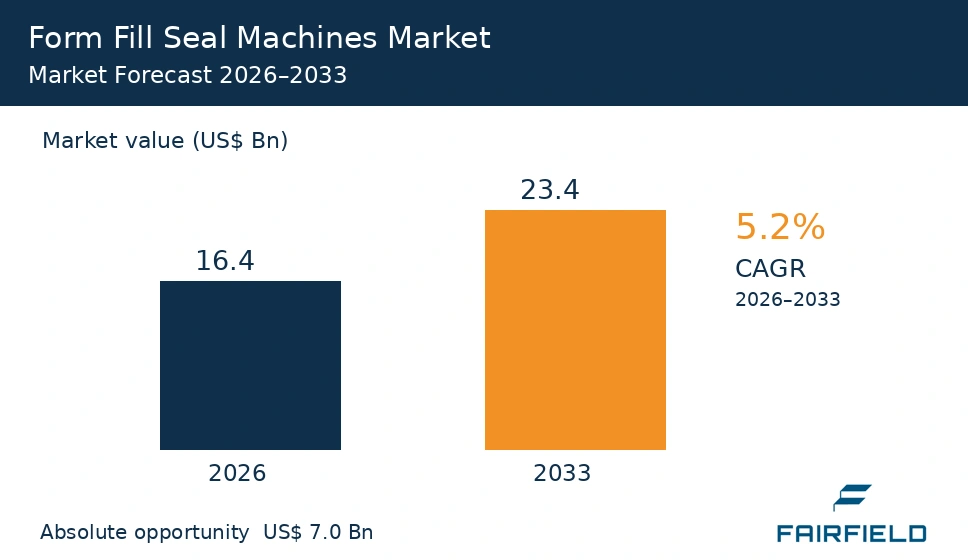
The global Form-Fill-Seal Machines market size is expected to be valued at US$ 16.4 billion in 2026 and projected to reach US$ 23.4 billion by 2033, growing at a CAGR of 5.2% between 2026 and 2033. Growth rests on the steady move from rigid containers to flexible pouches, sachets and stickpacks across food, beverage and healthcare plants. Packers are replacing ageing lines to gain faster changeovers and tighter material control. Recyclable mono-material and paper-based films are the second force, because older sealing platforms cannot run them reliably. The market expanded at a 4.1% CAGR between 2020 and 2025, and the absolute dollar opportunity between 2026 and 2033 stands at US$ 7.0 billion.
Key Report Takeaways
- By Machine Type: Vertical form-fill-seal machines led with 41% share in 2026, while blow-fill-seal systems are projected to expand at a 7.0% CAGR through 2033, driven by sterile liquid dosing in respiratory and ophthalmic products.
- By Automation Level: Fully automatic systems led with 61% share in 2026 and also post the quickest gain at a 5.9% CAGR through 2033, driven by scarce skilled operators and plant-wide data reporting duties.
- By Packaging Material: Multilayer plastic laminates led with 54% share in 2026, while paper-based and fibre films are projected to expand at a 9.4% CAGR through 2033, driven by extended producer responsibility fees on mixed-plastic packs.
- By End-use Industry: Food led with 46% share in 2026, while pharmaceutical and healthcare lines are projected to expand at a 7.2% CAGR through 2033, driven by unit-dose dispensing and serialisation duties on small packs.
- By Region: Across North America, Europe, Asia Pacific, Latin America and Middle East & Africa, Asia Pacific led with 36% share in 2026, while Middle East & Africa is projected to expand at a 6.9% CAGR through 2033, driven by local food and medicine manufacturing policy.
Market Trends and Insights
Market Growth Drivers
Flexible Pouch Conversion Keeps Replacing Rigid Filling Lines
Flexible pouches keep pulling volume away from jars, cans and cartons, and that shift lands directly on form-fill-seal equipment. A packer moving to stand-up pouches, stickpacks or sachets must buy a new vertical or horizontal machine rather than adapt an existing rigid filler. The purchase is a line decision, not a component upgrade, so each conversion carries a full capital ticket. Demand compounds across food, beverage, personal care and household chemical plants at the same time.
Retail and e-commerce patterns sit behind the shift. Single-serve portions, resealable spouts and light shipping weights suit convenience formats, quick commerce and subscription boxes. Brand owners also run shorter batches and change artwork more often, which rewards machines that hold many formats on one frame. Contract packers, who absorb much of this short-run work, keep investing to widen the format range they can quote.
Operator Scarcity Pushes Plants Toward Integrated Sealing Lines
Skilled packaging operators are hard to recruit and keep, so plants buy machines that need fewer hands per shift. Integrated form-fill-seal systems combine dosing, forming, sealing and cutting in one controlled frame, removing manual transfer steps between stations. That design lowers labour cost per pack and cuts the training burden when staff turnover is high. It also narrows the gap between a skilled shift and an average one, which steadies output quality across a working week.
Recipe-driven controls underpin the trend. Stored format settings, guided changeover prompts and automated reject handling reduce the judgement a line asks of its operator. Plants can then redeploy people to quality checks and maintenance, where experience earns more. Rising wage floors in processing regions sharpen the arithmetic, shortening payback on automation projects that once looked optional for mid-sized producers.
Restraints Impact Analysis of Market
High Capital Cost Slows Adoption Among Smaller Processors
Capital cost keeps many small and mid-sized processors on older or semi-automatic equipment. A complete form-fill-seal line carries machine, integration, utilities, guarding and validation costs that reach well beyond the quoted machine price. Smaller producers with uneven order books struggle to justify the outlay when utilisation sits low for part of the year. The result is a slower replacement cycle in fragmented food and personal care segments than headline packaging growth would suggest.
Financing conditions make the gap wider. Interest costs, currency moves and long machine lead times push payback beyond the horizon many owner-run firms accept. Buyers also weigh the cost of a line standing idle during commissioning and operator training. Leasing, refurbished machines and pay-per-pack arrangements ease the problem, yet they remain thinly offered outside mature markets with established service networks.
Recyclable Mono-Material Films Strain Existing Sealing Platforms
Recyclable mono-material films create a genuine engineering constraint on installed machines. Single-polymer polyethylene and polypropylene structures have a narrower processing window than the multilayer laminates they replace, because the sealing layer and the structural layer are now the same polymer. Older machines built around wide-tolerance laminates lose output stability or seal integrity when fed these films. Packers then face reduced line speed, higher scrap or an unplanned equipment upgrade, each of which deters the switch.
Paper-based structures raise a separate set of problems, including fibre dust, web tension control and different barrier coatings. Film suppliers and machine builders are working through the gap together, since neither can solve it alone. Until a wider range of qualified film and machine pairings exists, packaging teams move cautiously, and conversion timetables set by brand owners slip more often than planned.
Market Opportunities
Mono-Material and Paper Film Conversion Opens a Replacement Cycle
The same material shift that constrains old machines creates the strongest replacement opportunity in a decade. Packers switching to recyclable mono-material or fibre-based films often need newer sealing technology, tighter web handling and better temperature control than installed equipment offers. That turns a packaging decision into an equipment decision across thousands of lines. Machine builders able to qualify a wide film range and prove it on a customer product gain first claim on those projects.
Extended producer responsibility fees and recycled-content rules give the conversion a commercial deadline rather than an aspiration. Brand owners with public packaging targets need validated lines well before reporting dates arrive. Machinery suppliers are responding with film trial centres, joint development work with converters and format libraries that shorten qualification. Those capabilities are becoming a selling point in their own right, separate from machine speed.
Service, Retrofit and Spare Parts Build Durable Aftermarket Revenue
Aftermarket work gives machine builders revenue that holds steady when capital spending pauses. An installed form-fill-seal line runs for many years and needs sealing jaws, forming shoulders, belts, controls and format parts throughout that life. Service contracts, condition monitoring and remote diagnostics convert those needs into recurring income with better margins than new machine sales. They also keep suppliers close to the customer when the next line purchase comes up for decision.
Retrofit packages extend the same logic. Upgrading drives, controls, sealing systems or inspection on an existing frame lets a packer run new film types without replacing the whole machine. For buyers facing capital limits, that is often the only workable route to compliance. For suppliers, retrofits protect the installed base from competitors and create a measured path toward a full replacement later.
Category-wise Insights
Vertical Machines Anchor Volume While Blow-Fill-Seal Sets the Growth Pace
Vertical form-fill-seal machines held 41% share in 2026, the largest position by machine type. They dominate because dry and free-flowing products such as snacks, powders, grains, coffee and frozen foods suit a vertical bagger, and the machines carry a lower installed cost than horizontal alternatives. Blow-fill-seal systems are the fastest-growing type at a 7.0% CAGR through 2033, since they form, fill and seal a sterile plastic container in one enclosed cycle. That contained sequence suits respiratory solutions, eye drops and small-volume parenterals, where aseptic assurance matters more than unit cost. Horizontal machines hold a solid middle position in thermoformed and pre-made pouch work. The split shows a market where volume growth follows food packaging, while value growth follows regulated healthcare work that carries higher machine prices and longer validation cycles.
Fully Automatic Lines Absorb the Larger Share of Capital Budgets
Fully automatic systems held 61% share in 2026 and remain the quickest-growing tier at a 5.9% CAGR through 2033, a rare case where scale and momentum sit together. High-volume food, beverage and pharmaceutical plants buy them because labour cost per pack, data capture and traceability all improve when the full cycle runs under one controller. Semi-automatic machines keep a real place in small-batch, high-mix production, regional brands and contract work with uncertain volumes. Manual and benchtop units serve pilot plants, start-ups and specialty producers. The pattern matters for suppliers because the automatic tier carries integration, software and service revenue well beyond the base machine, while the semi-automatic tier competes mainly on price. Portfolio breadth across both tiers is becoming a condition for serving emerging markets properly.
Which Packaging Materials Are Reshaping Machine Design?
Multilayer plastic laminates still carry the most volume, holding 54% share in 2026, because they deliver barrier performance and sealing reliability that packers trust. Their position is eroding as recyclability rules tighten. Paper-based and fibre films are the fastest-growing material at a 9.4% CAGR through 2033, with mono-material polyethylene and polypropylene structures close behind. Both demand different handling from the machines that run them: narrower sealing windows, closer web tension control and attention to dust and coating behaviour. Machine builders are redesigning sealing systems, drives and inspection to suit. For buyers, material choice now sets equipment choice rather than following it, which lifts the value of suppliers that can qualify films quickly and prove results on the customer's own product.
Food Sustains Scale While Pharmaceutical Work Drives Value Growth
Food held 46% share in 2026, the largest end-use position, supported by snacks, dairy, bakery, confectionery and frozen categories that pack in very high unit counts. Pharmaceutical and healthcare applications are growing fastest at a 7.2% CAGR through 2033, lifted by unit-dose formats, sterile liquid containers and serialisation duties that favour enclosed, well-documented machines. Beverage work centres on pouches, sachets and single-serve liquid formats. Personal care uses sachets for samples and travel packs, while chemical producers rely on sealed packs for powders and agricultural inputs. The contrast is strategic for machine builders: food keeps unit volumes high and pricing sharply competitive across tenders, whereas healthcare brings validation, documentation and service requirements that raise machine value and tie customers to a single supplier for far longer periods.
Geography Analysis
North America Rebuilds Capacity Around Flexible Pouch Lines
North America held 25% share in 2026 and is set to grow at a 4.3% CAGR through 2033. The United States contributes most demand, with Canada and Mexico adding food processing and contract packing capacity. Spending is led by replacement rather than first-time installation, as processors retire ageing baggers for machines with faster changeover and better data reporting. Snack, pet food, coffee and nutraceutical producers are the most active buyers. State-level packaging rules and retailer recyclability commitments are starting to shape film choices, which pulls equipment decisions forward. Reshoring of pharmaceutical and personal care production adds a second stream of demand for enclosed, well-documented lines.
Europe Converts Regulatory Pressure Into Machine Replacement Demand
Europe held 27% share in 2026, growing at a 4.0% CAGR through 2033. Germany and Italy anchor both manufacture and consumption of this equipment, with France, Spain, Poland and the Netherlands adding strong packer demand. Packaging waste rules and producer responsibility fees are the main spur, pushing brand owners toward recyclable mono-material and fibre structures well ahead of other regions. That translates into equipment projects, because installed machines often cannot run the new films at full rate. European builders also compete on energy use per pack, since electricity costs weigh on plant economics. Growth is moderate in percentage terms but valuable, as the region buys technically demanding machines.
Which Region Is Leading the Form-Fill-Seal Machines Market?
Asia Pacific leads the form-fill-seal machines market with 36% share in 2026, growing at a 6.3% CAGR through 2033. China and India supply most of the demand, with Japan, South Korea, Indonesia, Thailand and Vietnam adding steady volume. Leadership rests on sheer packaged food output, a large generic pharmaceutical base and continuing expansion of organised retail and quick commerce. Domestic machine builders in China and India serve price-sensitive buyers, while imported systems cover regulated healthcare work. Rising wages are pushing processors from manual filling toward automatic lines faster than earlier cycles suggested. Growing export of packaged food and medicines also raises the standard of equipment that local plants need.
Latin America Expands Food Processing Capacity at a Measured Pace
Latin America held 7% share in 2026, with a 5.5% CAGR through 2033. Brazil and Mexico account for most installations, supported by Argentina, Chile and Colombia. Demand comes from processed food, dairy, coffee and agricultural chemical packing, along with contract packers serving regional brand owners. Capital access, import duties and currency movement restrain the pace of line replacement, so semi-automatic machines keep a larger share here than in mature markets. Mexican plants supplying North American customers invest ahead of local averages, because buyer audits set the equipment standard. Spare parts availability and local service coverage weigh heavily in supplier selection across the region.
Which Region Is Growing Fastest in the Form-Fill-Seal Machines Market?
Middle East & Africa is growing fastest at a 6.9% CAGR through 2033, from a 5% share in 2026. Saudi Arabia, the United Arab Emirates, Egypt, South Africa, Morocco and Nigeria lead the activity. Industrial policy across the Gulf is pushing local manufacture of food and medicines, which converts directly into packaging line orders. New pharmaceutical plants favour enclosed sterile systems, while food processors install vertical baggers for staples, dates, spices and dairy powders. African demand follows urban population growth and the spread of modern retail. Growth comes off a small base, so percentage gains look strong while absolute volumes stay modest against Asia Pacific.
Competitive Landscape
The form-fill-seal machines market is moderately concentrated at the top and fragmented beneath it. A group of European, Japanese and North American builders holds the regulated pharmaceutical and high-speed food work, while hundreds of regional firms serve standard bagging duties in Asia, Latin America and Eastern Europe. Larger groups have grown by assembling complementary brands, so a single owner can offer vertical, horizontal and pouch machines along with upstream weighing and downstream case packing. That structure reflects a buyer preference for one accountable supplier across a whole line rather than several specialists.
Competition turns on throughput stability, changeover time and format flexibility more than headline speed. Buyers judge machines on how quickly a line moves between pack sizes, how much film it wastes during a restart and how reliably it seals difficult structures. Material compatibility has become a decisive test, as recyclable mono-material and paper-based films narrow processing windows. Suppliers that can qualify new films quickly, and prove it on a customer's own product, win projects that once turned on price. Hygienic design, inspection integration and energy use per pack carry weight in food and pharmaceutical tenders.
Strategic activity concentrates on capability rather than scale alone. Builders are opening film trial and application centres, working jointly with converters on sustainable structures, and extending service networks into growth regions where parts availability decides purchases. Digital tools for remote diagnostics and condition monitoring are being folded into machine offerings, because they protect uptime and create recurring revenue. Retrofit programmes for installed machines serve the same purpose while easing the capital burden on buyers.
The broader direction is a shift from selling machines toward supporting packaging programmes. Vendors increasingly compete on how well they help a customer move to new materials, hold output through that transition and keep lines serviced across a long asset life.
Industry Leaders
- Syntegon Technology GmbH
- IMA Group
- Rommelag Group
- GEA Group
- MULTIVAC Sepp Haggenmüller SE & Co. KG
- Coesia S.p.A.
- ULMA Packaging
- Krones AG
Companies Covered in the Report
- Syntegon Technology GmbH
- IMA Group
- Rommelag Group
- GEA Group
- MULTIVAC Sepp Haggenmüller SE & Co. KG
- Coesia S.p.A.
- ULMA Packaging
- Krones AG
- Ishida Co., Ltd.
- ProMach, Inc.
- Duravant LLC
- PFM Packaging Machinery S.p.A.
- Nichrome India Ltd.
- Weiler Engineering, Inc.
- Bossar Packaging S.A.
Form Fill Seal Machines Market Report Scope
The market is analysed across machine type, automation level, packaging material, end-use industry and region.
| By Machine Type | Vertical Form-Fill-Seal, Horizontal Form-Fill-Seal, Blow-Fill-Seal, Other Fill-Seal Systems |
| By Automation Level | Fully Automatic, Semi-Automatic, Manual and Benchtop |
| By Packaging Material | Multilayer Plastic Laminates, Mono-Material Polyethylene and Polypropylene Films, Paper-Based and Fibre Films, Aluminium Foil Laminates, Compostable and Bio-Based Films |
| By End-use Industry | Food, Beverage, Pharmaceutical and Healthcare, Personal Care and Cosmetics, Chemicals and Others |
| By Region | North America, Europe, Asia Pacific, Latin America, Middle East & Africa |
1. Executive Summary
1.1 Form-Fill-Seal Machines Market Snapshot
1.2 Future Projections
1.3 Key Market Trends
1.4 Regional Snapshot
2. Market Overview
2.1 Market Definition and Report Scope
2.2 Historical Market Trends
2.3 Market Dynamics
2.3.1 Drivers
2.3.1.1 Flexible Pouch Conversion Keeps Replacing Rigid Filling Lines
2.3.1.2 Operator Scarcity Pushes Plants Toward Integrated Sealing Lines
2.3.2 Restraints
2.3.2.1 High Capital Cost Slows Adoption Among Smaller Processors
2.3.2.2 Recyclable Mono-Material Films Strain Existing Sealing Platforms
2.3.3 Market Opportunities
2.3.3.1 Mono-Material and Paper Film Conversion Opens a Replacement Cycle
2.3.3.2 Service, Retrofit and Spare Parts Build Durable Aftermarket Revenue
3. Global Form-Fill-Seal Machines Market Outlook, 2026–2033
3.1 Global Form-Fill-Seal Machines Market Outlook, by Machine Type, Value (US$ Billion), 2026–2033
3.1.1 Vertical Form-Fill-Seal
3.1.2 Horizontal Form-Fill-Seal
3.1.3 Blow-Fill-Seal
3.1.4 Other Fill-Seal Systems
3.2 Global Form-Fill-Seal Machines Market Outlook, by Automation Level, Value (US$ Billion), 2026–2033
3.2.1 Fully Automatic
3.2.2 Semi-Automatic
3.2.3 Manual and Benchtop
3.3 Global Form-Fill-Seal Machines Market Outlook, by Packaging Material, Value (US$ Billion), 2026–2033
3.3.1 Multilayer Plastic Laminates
3.3.2 Mono-Material Polyethylene and Polypropylene Films
3.3.3 Paper-Based and Fibre Films
3.3.4 Aluminium Foil Laminates
3.3.5 Compostable and Bio-Based Films
3.4 Global Form-Fill-Seal Machines Market Outlook, by End-use Industry, Value (US$ Billion), 2026–2033
3.4.1 Food
3.4.2 Beverage
3.4.3 Pharmaceutical and Healthcare
3.4.4 Personal Care and Cosmetics
3.4.5 Chemicals and Others
3.5 Global Form-Fill-Seal Machines Market Outlook, by Region, Value (US$ Billion), 2026–2033
3.5.1 North America
3.5.2 Europe
3.5.3 Asia Pacific
3.5.4 Latin America
3.5.5 Middle East & Africa
4. North America Form-Fill-Seal Machines Market Outlook, 2026–2033
4.1 North America Form-Fill-Seal Machines Market Outlook, by Machine Type, Value (US$ Billion), 2026–2033
4.1.1 Vertical Form-Fill-Seal
4.1.2 Horizontal Form-Fill-Seal
4.1.3 Blow-Fill-Seal
4.1.4 Other Fill-Seal Systems
4.2 North America Form-Fill-Seal Machines Market Outlook, by Automation Level, Value (US$ Billion), 2026–2033
4.2.1 Fully Automatic
4.2.2 Semi-Automatic
4.2.3 Manual and Benchtop
4.3 North America Form-Fill-Seal Machines Market Outlook, by Packaging Material, Value (US$ Billion), 2026–2033
4.3.1 Multilayer Plastic Laminates
4.3.2 Mono-Material Polyethylene and Polypropylene Films
4.3.3 Paper-Based and Fibre Films
4.3.4 Aluminium Foil Laminates
4.3.5 Compostable and Bio-Based Films
4.4 North America Form-Fill-Seal Machines Market Outlook, by End-use Industry, Value (US$ Billion), 2026–2033
4.4.1 Food
4.4.2 Beverage
4.4.3 Pharmaceutical and Healthcare
4.4.4 Personal Care and Cosmetics
4.4.5 Chemicals and Others
4.5 North America Form-Fill-Seal Machines Market Outlook, by Country, Value (US$ Billion), 2026–2033
4.5.1 United States Form-Fill-Seal Machines Market Outlook, by Machine Type, 2026–2033
4.5.2 United States Form-Fill-Seal Machines Market Outlook, by Automation Level, 2026–2033
4.5.3 United States Form-Fill-Seal Machines Market Outlook, by Packaging Material, 2026–2033
4.5.4 United States Form-Fill-Seal Machines Market Outlook, by End-use Industry, 2026–2033
4.5.5 Canada Form-Fill-Seal Machines Market Outlook, by Machine Type, 2026–2033
4.5.6 Canada Form-Fill-Seal Machines Market Outlook, by Automation Level, 2026–2033
4.5.7 Canada Form-Fill-Seal Machines Market Outlook, by Packaging Material, 2026–2033
4.5.8 Canada Form-Fill-Seal Machines Market Outlook, by End-use Industry, 2026–2033
4.5.9 Mexico Form-Fill-Seal Machines Market Outlook, by Machine Type, 2026–2033
4.5.10 Mexico Form-Fill-Seal Machines Market Outlook, by Automation Level, 2026–2033
4.5.11 Mexico Form-Fill-Seal Machines Market Outlook, by Packaging Material, 2026–2033
4.5.12 Mexico Form-Fill-Seal Machines Market Outlook, by End-use Industry, 2026–2033
5. Europe Form-Fill-Seal Machines Market Outlook, 2026–2033
5.1 Europe Form-Fill-Seal Machines Market Outlook, by Machine Type, Value (US$ Billion), 2026–2033
5.1.1 Vertical Form-Fill-Seal
5.1.2 Horizontal Form-Fill-Seal
5.1.3 Blow-Fill-Seal
5.1.4 Other Fill-Seal Systems
5.2 Europe Form-Fill-Seal Machines Market Outlook, by Automation Level, Value (US$ Billion), 2026–2033
5.2.1 Fully Automatic
5.2.2 Semi-Automatic
5.2.3 Manual and Benchtop
5.3 Europe Form-Fill-Seal Machines Market Outlook, by Packaging Material, Value (US$ Billion), 2026–2033
5.3.1 Multilayer Plastic Laminates
5.3.2 Mono-Material Polyethylene and Polypropylene Films
5.3.3 Paper-Based and Fibre Films
5.3.4 Aluminium Foil Laminates
5.3.5 Compostable and Bio-Based Films
5.4 Europe Form-Fill-Seal Machines Market Outlook, by End-use Industry, Value (US$ Billion), 2026–2033
5.4.1 Food
5.4.2 Beverage
5.4.3 Pharmaceutical and Healthcare
5.4.4 Personal Care and Cosmetics
5.4.5 Chemicals and Others
5.5 Europe Form-Fill-Seal Machines Market Outlook, by Country, Value (US$ Billion), 2026–2033
5.5.1 Germany Form-Fill-Seal Machines Market Outlook, by Machine Type, 2026–2033
5.5.2 Germany Form-Fill-Seal Machines Market Outlook, by Automation Level, 2026–2033
5.5.3 Germany Form-Fill-Seal Machines Market Outlook, by Packaging Material, 2026–2033
5.5.4 Germany Form-Fill-Seal Machines Market Outlook, by End-use Industry, 2026–2033
5.5.5 Italy Form-Fill-Seal Machines Market Outlook, by Machine Type, 2026–2033
5.5.6 Italy Form-Fill-Seal Machines Market Outlook, by Automation Level, 2026–2033
5.5.7 Italy Form-Fill-Seal Machines Market Outlook, by Packaging Material, 2026–2033
5.5.8 Italy Form-Fill-Seal Machines Market Outlook, by End-use Industry, 2026–2033
5.5.9 France Form-Fill-Seal Machines Market Outlook, by Machine Type, 2026–2033
5.5.10 France Form-Fill-Seal Machines Market Outlook, by Automation Level, 2026–2033
5.5.11 France Form-Fill-Seal Machines Market Outlook, by Packaging Material, 2026–2033
5.5.12 France Form-Fill-Seal Machines Market Outlook, by End-use Industry, 2026–2033
5.5.13 Spain Form-Fill-Seal Machines Market Outlook, by Machine Type, 2026–2033
5.5.14 Spain Form-Fill-Seal Machines Market Outlook, by Automation Level, 2026–2033
5.5.15 Spain Form-Fill-Seal Machines Market Outlook, by Packaging Material, 2026–2033
5.5.16 Spain Form-Fill-Seal Machines Market Outlook, by End-use Industry, 2026–2033
5.5.17 Poland Form-Fill-Seal Machines Market Outlook, by Machine Type, 2026–2033
5.5.18 Poland Form-Fill-Seal Machines Market Outlook, by Automation Level, 2026–2033
5.5.19 Poland Form-Fill-Seal Machines Market Outlook, by Packaging Material, 2026–2033
5.5.20 Poland Form-Fill-Seal Machines Market Outlook, by End-use Industry, 2026–2033
5.5.21 Netherlands Form-Fill-Seal Machines Market Outlook, by Machine Type, 2026–2033
5.5.22 Netherlands Form-Fill-Seal Machines Market Outlook, by Automation Level, 2026–2033
5.5.23 Netherlands Form-Fill-Seal Machines Market Outlook, by Packaging Material, 2026–2033
5.5.24 Netherlands Form-Fill-Seal Machines Market Outlook, by End-use Industry, 2026–2033
6. Asia Pacific Form-Fill-Seal Machines Market Outlook, 2026–2033
6.1 Asia Pacific Form-Fill-Seal Machines Market Outlook, by Machine Type, Value (US$ Billion), 2026–2033
6.1.1 Vertical Form-Fill-Seal
6.1.2 Horizontal Form-Fill-Seal
6.1.3 Blow-Fill-Seal
6.1.4 Other Fill-Seal Systems
6.2 Asia Pacific Form-Fill-Seal Machines Market Outlook, by Automation Level, Value (US$ Billion), 2026–2033
6.2.1 Fully Automatic
6.2.2 Semi-Automatic
6.2.3 Manual and Benchtop
6.3 Asia Pacific Form-Fill-Seal Machines Market Outlook, by Packaging Material, Value (US$ Billion), 2026–2033
6.3.1 Multilayer Plastic Laminates
6.3.2 Mono-Material Polyethylene and Polypropylene Films
6.3.3 Paper-Based and Fibre Films
6.3.4 Aluminium Foil Laminates
6.3.5 Compostable and Bio-Based Films
6.4 Asia Pacific Form-Fill-Seal Machines Market Outlook, by End-use Industry, Value (US$ Billion), 2026–2033
6.4.1 Food
6.4.2 Beverage
6.4.3 Pharmaceutical and Healthcare
6.4.4 Personal Care and Cosmetics
6.4.5 Chemicals and Others
6.5 Asia Pacific Form-Fill-Seal Machines Market Outlook, by Country, Value (US$ Billion), 2026–2033
6.5.1 China Form-Fill-Seal Machines Market Outlook, by Machine Type, 2026–2033
6.5.2 China Form-Fill-Seal Machines Market Outlook, by Automation Level, 2026–2033
6.5.3 China Form-Fill-Seal Machines Market Outlook, by Packaging Material, 2026–2033
6.5.4 China Form-Fill-Seal Machines Market Outlook, by End-use Industry, 2026–2033
6.5.5 India Form-Fill-Seal Machines Market Outlook, by Machine Type, 2026–2033
6.5.6 India Form-Fill-Seal Machines Market Outlook, by Automation Level, 2026–2033
6.5.7 India Form-Fill-Seal Machines Market Outlook, by Packaging Material, 2026–2033
6.5.8 India Form-Fill-Seal Machines Market Outlook, by End-use Industry, 2026–2033
6.5.9 Japan Form-Fill-Seal Machines Market Outlook, by Machine Type, 2026–2033
6.5.10 Japan Form-Fill-Seal Machines Market Outlook, by Automation Level, 2026–2033
6.5.11 Japan Form-Fill-Seal Machines Market Outlook, by Packaging Material, 2026–2033
6.5.12 Japan Form-Fill-Seal Machines Market Outlook, by End-use Industry, 2026–2033
6.5.13 South Korea Form-Fill-Seal Machines Market Outlook, by Machine Type, 2026–2033
6.5.14 South Korea Form-Fill-Seal Machines Market Outlook, by Automation Level, 2026–2033
6.5.15 South Korea Form-Fill-Seal Machines Market Outlook, by Packaging Material, 2026–2033
6.5.16 South Korea Form-Fill-Seal Machines Market Outlook, by End-use Industry, 2026–2033
6.5.17 Indonesia Form-Fill-Seal Machines Market Outlook, by Machine Type, 2026–2033
6.5.18 Indonesia Form-Fill-Seal Machines Market Outlook, by Automation Level, 2026–2033
6.5.19 Indonesia Form-Fill-Seal Machines Market Outlook, by Packaging Material, 2026–2033
6.5.20 Indonesia Form-Fill-Seal Machines Market Outlook, by End-use Industry, 2026–2033
6.5.21 Thailand Form-Fill-Seal Machines Market Outlook, by Machine Type, 2026–2033
6.5.22 Thailand Form-Fill-Seal Machines Market Outlook, by Automation Level, 2026–2033
6.5.23 Thailand Form-Fill-Seal Machines Market Outlook, by Packaging Material, 2026–2033
6.5.24 Thailand Form-Fill-Seal Machines Market Outlook, by End-use Industry, 2026–2033
6.5.25 Vietnam Form-Fill-Seal Machines Market Outlook, by Machine Type, 2026–2033
6.5.26 Vietnam Form-Fill-Seal Machines Market Outlook, by Automation Level, 2026–2033
6.5.27 Vietnam Form-Fill-Seal Machines Market Outlook, by Packaging Material, 2026–2033
6.5.28 Vietnam Form-Fill-Seal Machines Market Outlook, by End-use Industry, 2026–2033
7. Latin America Form-Fill-Seal Machines Market Outlook, 2026–2033
7.1 Latin America Form-Fill-Seal Machines Market Outlook, by Machine Type, Value (US$ Billion), 2026–2033
7.1.1 Vertical Form-Fill-Seal
7.1.2 Horizontal Form-Fill-Seal
7.1.3 Blow-Fill-Seal
7.1.4 Other Fill-Seal Systems
7.2 Latin America Form-Fill-Seal Machines Market Outlook, by Automation Level, Value (US$ Billion), 2026–2033
7.2.1 Fully Automatic
7.2.2 Semi-Automatic
7.2.3 Manual and Benchtop
7.3 Latin America Form-Fill-Seal Machines Market Outlook, by Packaging Material, Value (US$ Billion), 2026–2033
7.3.1 Multilayer Plastic Laminates
7.3.2 Mono-Material Polyethylene and Polypropylene Films
7.3.3 Paper-Based and Fibre Films
7.3.4 Aluminium Foil Laminates
7.3.5 Compostable and Bio-Based Films
7.4 Latin America Form-Fill-Seal Machines Market Outlook, by End-use Industry, Value (US$ Billion), 2026–2033
7.4.1 Food
7.4.2 Beverage
7.4.3 Pharmaceutical and Healthcare
7.4.4 Personal Care and Cosmetics
7.4.5 Chemicals and Others
7.5 Latin America Form-Fill-Seal Machines Market Outlook, by Country, Value (US$ Billion), 2026–2033
7.5.1 Brazil Form-Fill-Seal Machines Market Outlook, by Machine Type, 2026–2033
7.5.2 Brazil Form-Fill-Seal Machines Market Outlook, by Automation Level, 2026–2033
7.5.3 Brazil Form-Fill-Seal Machines Market Outlook, by Packaging Material, 2026–2033
7.5.4 Brazil Form-Fill-Seal Machines Market Outlook, by End-use Industry, 2026–2033
7.5.5 Mexico Form-Fill-Seal Machines Market Outlook, by Machine Type, 2026–2033
7.5.6 Mexico Form-Fill-Seal Machines Market Outlook, by Automation Level, 2026–2033
7.5.7 Mexico Form-Fill-Seal Machines Market Outlook, by Packaging Material, 2026–2033
7.5.8 Mexico Form-Fill-Seal Machines Market Outlook, by End-use Industry, 2026–2033
7.5.9 Argentina Form-Fill-Seal Machines Market Outlook, by Machine Type, 2026–2033
7.5.10 Argentina Form-Fill-Seal Machines Market Outlook, by Automation Level, 2026–2033
7.5.11 Argentina Form-Fill-Seal Machines Market Outlook, by Packaging Material, 2026–2033
7.5.12 Argentina Form-Fill-Seal Machines Market Outlook, by End-use Industry, 2026–2033
7.5.13 Chile Form-Fill-Seal Machines Market Outlook, by Machine Type, 2026–2033
7.5.14 Chile Form-Fill-Seal Machines Market Outlook, by Automation Level, 2026–2033
7.5.15 Chile Form-Fill-Seal Machines Market Outlook, by Packaging Material, 2026–2033
7.5.16 Chile Form-Fill-Seal Machines Market Outlook, by End-use Industry, 2026–2033
7.5.17 Colombia Form-Fill-Seal Machines Market Outlook, by Machine Type, 2026–2033
7.5.18 Colombia Form-Fill-Seal Machines Market Outlook, by Automation Level, 2026–2033
7.5.19 Colombia Form-Fill-Seal Machines Market Outlook, by Packaging Material, 2026–2033
7.5.20 Colombia Form-Fill-Seal Machines Market Outlook, by End-use Industry, 2026–2033
8. Middle East & Africa Form-Fill-Seal Machines Market Outlook, 2026–2033
8.1 Middle East & Africa Form-Fill-Seal Machines Market Outlook, by Machine Type, Value (US$ Billion), 2026–2033
8.1.1 Vertical Form-Fill-Seal
8.1.2 Horizontal Form-Fill-Seal
8.1.3 Blow-Fill-Seal
8.1.4 Other Fill-Seal Systems
8.2 Middle East & Africa Form-Fill-Seal Machines Market Outlook, by Automation Level, Value (US$ Billion), 2026–2033
8.2.1 Fully Automatic
8.2.2 Semi-Automatic
8.2.3 Manual and Benchtop
8.3 Middle East & Africa Form-Fill-Seal Machines Market Outlook, by Packaging Material, Value (US$ Billion), 2026–2033
8.3.1 Multilayer Plastic Laminates
8.3.2 Mono-Material Polyethylene and Polypropylene Films
8.3.3 Paper-Based and Fibre Films
8.3.4 Aluminium Foil Laminates
8.3.5 Compostable and Bio-Based Films
8.4 Middle East & Africa Form-Fill-Seal Machines Market Outlook, by End-use Industry, Value (US$ Billion), 2026–2033
8.4.1 Food
8.4.2 Beverage
8.4.3 Pharmaceutical and Healthcare
8.4.4 Personal Care and Cosmetics
8.4.5 Chemicals and Others
8.5 Middle East & Africa Form-Fill-Seal Machines Market Outlook, by Country, Value (US$ Billion), 2026–2033
8.5.1 Saudi Arabia Form-Fill-Seal Machines Market Outlook, by Machine Type, 2026–2033
8.5.2 Saudi Arabia Form-Fill-Seal Machines Market Outlook, by Automation Level, 2026–2033
8.5.3 Saudi Arabia Form-Fill-Seal Machines Market Outlook, by Packaging Material, 2026–2033
8.5.4 Saudi Arabia Form-Fill-Seal Machines Market Outlook, by End-use Industry, 2026–2033
8.5.5 United Arab Emirates Form-Fill-Seal Machines Market Outlook, by Machine Type, 2026–2033
8.5.6 United Arab Emirates Form-Fill-Seal Machines Market Outlook, by Automation Level, 2026–2033
8.5.7 United Arab Emirates Form-Fill-Seal Machines Market Outlook, by Packaging Material, 2026–2033
8.5.8 United Arab Emirates Form-Fill-Seal Machines Market Outlook, by End-use Industry, 2026–2033
8.5.9 Egypt Form-Fill-Seal Machines Market Outlook, by Machine Type, 2026–2033
8.5.10 Egypt Form-Fill-Seal Machines Market Outlook, by Automation Level, 2026–2033
8.5.11 Egypt Form-Fill-Seal Machines Market Outlook, by Packaging Material, 2026–2033
8.5.12 Egypt Form-Fill-Seal Machines Market Outlook, by End-use Industry, 2026–2033
8.5.13 South Africa Form-Fill-Seal Machines Market Outlook, by Machine Type, 2026–2033
8.5.14 South Africa Form-Fill-Seal Machines Market Outlook, by Automation Level, 2026–2033
8.5.15 South Africa Form-Fill-Seal Machines Market Outlook, by Packaging Material, 2026–2033
8.5.16 South Africa Form-Fill-Seal Machines Market Outlook, by End-use Industry, 2026–2033
8.5.17 Morocco Form-Fill-Seal Machines Market Outlook, by Machine Type, 2026–2033
8.5.18 Morocco Form-Fill-Seal Machines Market Outlook, by Automation Level, 2026–2033
8.5.19 Morocco Form-Fill-Seal Machines Market Outlook, by Packaging Material, 2026–2033
8.5.20 Morocco Form-Fill-Seal Machines Market Outlook, by End-use Industry, 2026–2033
8.5.21 Nigeria Form-Fill-Seal Machines Market Outlook, by Machine Type, 2026–2033
8.5.22 Nigeria Form-Fill-Seal Machines Market Outlook, by Automation Level, 2026–2033
8.5.23 Nigeria Form-Fill-Seal Machines Market Outlook, by Packaging Material, 2026–2033
8.5.24 Nigeria Form-Fill-Seal Machines Market Outlook, by End-use Industry, 2026–2033
9. Competitive Landscape
9.1 Industry Leaders
9.2 Company Profiles
9.2.1 Syntegon Technology GmbH
9.2.2 IMA Group
9.2.3 Rommelag Group
9.2.4 GEA Group
9.2.5 MULTIVAC Sepp Haggenmüller SE & Co. KG
9.2.6 Coesia S.p.A.
9.2.7 ULMA Packaging
9.2.8 Krones AG
9.2.9 Ishida Co., Ltd.
9.2.10 ProMach, Inc.
9.2.11 Duravant LLC
9.2.12 PFM Packaging Machinery S.p.A.
9.2.13 Nichrome India Ltd.
9.2.14 Weiler Engineering, Inc.
9.2.15 Bossar Packaging S.A.
10. Appendix
10.1 Research Methodology
10.2 Report Assumptions
10.3 Acronyms and Abbreviations
| By Machine Type | Vertical Form-Fill-Seal, Horizontal Form-Fill-Seal, Blow-Fill-Seal, Other Fill-Seal Systems |
| By Automation Level | Fully Automatic, Semi-Automatic, Manual and Benchtop |
| By Packaging Material | Multilayer Plastic Laminates, Mono-Material Polyethylene and Polypropylene Films, Paper-Based and Fibre Films, Aluminium Foil Laminates, Compostable and Bio-Based Films |
| By End-use Industry | Food, Beverage, Pharmaceutical and Healthcare, Personal Care and Cosmetics, Chemicals and Others |
| By Region | North America, Europe, Asia Pacific, Latin America, Middle East & Africa |
Our Research Methodology
Considering the volatility of business today, traditional approaches to strategizing a game plan can be unfruitful if not detrimental. True ambiguity is no way to determine a forecast. A myriad of predetermined factors must be accounted for such as the degree of risk involved, the magnitude of circumstances, as well as conditions or consequences that are not known or unpredictable. To circumvent binary views that cast uncertainty, the application of market research intelligence to strategically posture, move, and enable actionable outcomes is necessary.
View Methodology
Quality Assured
Rigorous Validation Process

Confidentiality Assured
End-to-end Data Security

Custom Research Services
Tailored To Your Objectives
FAQs
The market is valued at US$ 16.4 billion in 2026, supported by flexible pouch conversion across food, beverage, pharmaceutical and personal care packaging plants worldwide.
It is projected to reach US$ 23.4 billion by 2033, growing at a 5.2% CAGR and creating an absolute opportunity of US$ 7.0 billion.
Vertical form-fill-seal machines lead with 41% share in 2026, because dry and free-flowing foods suit vertical bagging at lower installed cost.
Asia Pacific holds 36% share in 2026, supported by large packaged food output, generic medicine manufacturing and rapid retail expansion across the region.
The market is moderately concentrated at the top and fragmented below, with vendors competing on changeover speed, format flexibility and film compatibility.
Related Reports
Micro Excavator Market Size, Share, Insights, Competitive Landscape, and Forecast 2026 to 2033
Explore the Micro Excavator Market, valued at US$1.80 billion in 2026 and forecast to reach US$2.80 billion by 2033, growing at a 6.5% CAGR.
Hand Control Valve Market Size, Share, Insights, Competitive Landscape, and Forecast 2026 to 2033
Hand control valve market is projected to grow from US$947.2 million in 2026 to US$1,233.5 million by 2033, expanding at a CAGR of 3.8%.
Graders for Construction Market Size, Share, Insights, Competitive Landscape, and Forecast 2026 to 2033
Graders for construction market is projected to grow from US$4.62 billion in 2026 to US$7.32 billion by 2033, expanding at a CAGR of 6.8%.
Geared Motors Market Size, Share, Insights, Competitive Landscape, and Forecast 2026 to 2033
Geared motors market is projected to grow from US$8.76 billion in 2026 to US$12.21 billion by 2033, expanding at a CAGR of 4.9%.
Geared Elevator Market Size, Share, Insights, Competitive Landscape, and Forecast 2026 to 2033
The global geared elevator market is valued at US$17.57 billion in 2026, reaching US$24.17 billion by 2033, growing at a 4.7% CAGR
Gas Mixers Market Size, Share, Insights, Competitive Landscape, and Forecast 2026 to 2033
The global gas mixers market is valued at US$3.01 billion in 2026, reaching US$4.04 billion by 2033, growing at a 4.3% CAGR