



Hand Control Valve Market
Hand Control Valve Market Size, Share, Insights, Competitive Landscape, and Forecast 2026 to 2033
Report Overview
Hand Control Valve Market Size and Trend Analysis
How Fast Is the Hand Control Valve Market Growing?
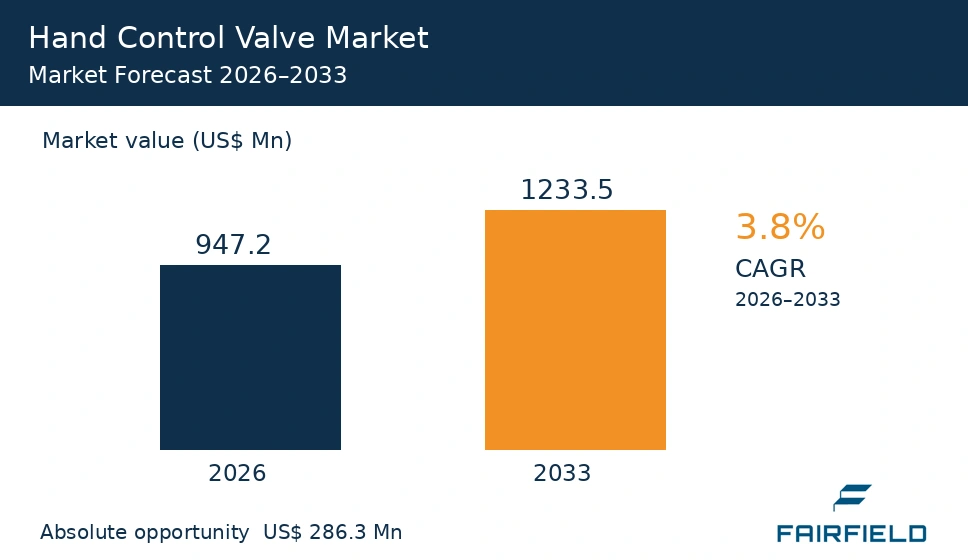
The global hand control valve market size is expected to be valued at US$ 947.2 million in 2026 and projected to reach US$ 1,233.5 million by 2033, growing at a CAGR of 3.8% between 2026 and 2033.
Between 2020 and 2025, the market grew at a CAGR of about 4.1%, rising from roughly US$ 741.0 million to about US$ 906.4 million, as oil and gas, chemical, water, and power plants resumed maintenance and expansion projects, and construction, agricultural, and material handling machinery production recovered. The hand control valve market covers manually operated valves that allow an operator to start, stop, direct, or adjust the flow of liquids and gases by turning a handwheel or moving a lever, knob, or push button, without electric or pneumatic actuators. Products include manual lever valves, handwheel and flywheel valves, manual directional control valves for hydraulic and pneumatic systems. They serve process plants, power stations, water utilities, and mobile machinery. In August 2026, Bosch Rexroth and HydraForce showcased compact hydraulic valves at iVT Expo USA.
Key Report Takeaways
-
By Type: Manual Lever held about 55% share in 2025, while Handwheel and Flywheel is projected to expand at a 4.4% CAGR through 2033, driven by precise throttling needs in power stations, water networks, chemical plants, and pipelines where gradual flow adjustment is essential.
-
By Medium: Hydraulic held about 40% share in 2025, while Pneumatic is projected to expand at a 4.5% CAGR through 2033, driven by factory automation, packaging lines, food processing equipment, and simple, low-cost air control circuits in small machines.
-
By Application: Oil and Gas held about 30% share in 2025, while Food and Beverage is projected to expand at a 4.8% CAGR through 2033, driven by hygienic manual valves for processing lines, cleaning systems, and utilities in growing food and beverage plants worldwide.
-
By Region: Asia Pacific held about 40% share in 2025, while India is projected to expand at a 5.5% CAGR through 2033, driven by refinery and petrochemical expansion, water supply programs, power plant construction, and rising machinery and equipment manufacturing.
Global Hand Control Valve Market Trends and Insights
Drivers Impact Analysis
Two drivers carry the strongest influence on hand control valve market demand during the forecast period.
| Driver | Impact on CAGR Forecast | Geographic Relevance | Impact Timeline |
| Growth of process industries and infrastructure | High | Global | Long term (≥4 years) |
| Demand from mobile machinery and industrial equipment | Medium | Asia Pacific, North America, Europe | Medium term (2-4 years) |
Process Industry Growth Is Driving the Hand Control Valve Market
Growth of process industries and infrastructure is the strongest driver of the hand control valve market. Plants need simple, reliable manual valves.
The mechanism is that oil and gas facilities, refineries, chemical plants, power stations, water treatment plants, and pipelines use large numbers of manual valves for isolation, bypass, sampling, drainage, and fine flow adjustment, even when main process valves are automated. Manual valves are low cost, work without power, and are easy to operate and maintain, making them essential for safety backups and maintenance tasks. New refinery and petrochemical projects in India, China, and Middle East & Africa, along with water supply and wastewater programs worldwide, create steady demand. Hydroelectric and thermal power stations use handwheel valves for cooling and auxiliary systems. Regular replacement of worn valves adds recurring demand across all regions.
Machinery and Equipment Demand Is Expanding the Hand Control Valve Market
Demand from mobile machinery and industrial equipment is expanding the hand control valve market. Many machines still use manual controls.
The cause is that tractors, loaders, log splitters, small cranes, aerial platforms, forklifts, snow plows, and agricultural implements use lever-operated hydraulic directional control valves because they are simple, robust, and affordable, and operators can feel and control the machine directly. Industrial presses, test benches, machine tools, and packaging machines use manual pneumatic and hydraulic valves for setup and maintenance. Many valve makers now offer manual lever options alongside electro-hydraulic actuation, highlighted by Parker's VA130 mobile valve, which supports optional manual lever control. Growth in construction, agriculture, and material handling equipment in Asia Pacific, North America, and Europe supports steady demand for hand-operated valves, especially in compact and lower-cost machines.
Restraints Impact Analysis
Two restraints limit how quickly the hand control valve market grows.
| Restraint | Impact on CAGR Forecast | Geographic Relevance | Impact Timeline |
| Shift to automated and electro-hydraulic valves | High | North America, Europe, Asia Pacific | Long term (≥4 years) |
| Price competition and raw material volatility | Medium | Global | Medium term (2-4 years) |
Automation Slows the Hand Control Valve Market
The shift to automated and electro-hydraulic valves slows the hand control valve market. Many users want remote and automatic control.
The problem is that process plants are adopting digital control systems, smart actuators, and remote monitoring to improve efficiency, safety, and labor productivity, replacing some manual valves with motorized, pneumatic, or solenoid-operated valves. Mobile machinery makers are moving toward joystick and electro-hydraulic controls that support automation, operator assist, and telematics, reducing demand for lever valves in larger machines. Labor shortages and safety rules discourage tasks that require workers to operate valves in hazardous areas. Industry 4.0 and digital twin strategies favor connected valves. These trends limit growth for purely manual valves, especially in advanced economies and high-end equipment, even as they remain common in simpler applications.
Price Competition and Material Costs Restrict the Hand Control Valve Market
Price competition and raw material volatility restrict the hand control valve market. Margins are under pressure.
The constraint is that hand control valves are relatively simple products, and many small manufacturers in China, India, and other countries produce low-cost versions, creating strong price competition. Large buyers often choose suppliers based mainly on price for standard valves. Raw materials such as stainless steel, brass, carbon steel, cast iron, and ductile iron fluctuate in price with metal markets, and tariffs on steel and imported components raise costs in some regions. Certification requirements for oil and gas, food, and pressure equipment add testing costs. Counterfeit and low-quality valves damage trust. These factors squeeze margins and limit average selling prices across the market, pushing established suppliers to focus on certified and specialized products.
Market Opportunities
High-Performance, Certified, and Hygienic Manual Valves Open a Premium Revenue Pool
High-performance, certified, and hygienic manual valves open a premium revenue pool. Demanding users need quality and compliance.
The opportunity comes from rising demand for manual valves made from stainless steel and special alloys for corrosive chemicals, high-pressure hydrogen, LNG, and cryogenic service, along with hygienic designs for food, beverage, dairy, and pharmaceutical processing. Low-emission valve stems and fire-safe designs help oil and gas users meet methane and safety rules. Instrumentation valves for analyzers and sampling systems require precision and leak-tight performance. Valves with position indicators, lockout features, and optional limit switches add safety and monitoring without full automation. Suppliers with strong certifications, application expertise, and global distribution can earn higher margins and long-term supply agreements with engineering contractors, plant owners, and equipment makers that value proven reliability.
Infrastructure, Energy Transition, and Emerging Markets Create a Growth Revenue Pool
Infrastructure, energy transition, and emerging markets create a growth revenue pool. New projects need large numbers of valves.
The opportunity reflects heavy investment in water supply, wastewater treatment, irrigation, district heating, hydropower, and renewable energy in India, Indonesia, Vietnam, Saudi Arabia, Egypt, and Brazil. Hydrogen production, carbon capture, and biogas plants need specialized manual valves for isolation and control. Agricultural mechanization in emerging markets increases demand for tractors and implements with manual hydraulic valves. In November 2025, Bosch Rexroth and HydraForce presented compact directional control valves with manual actuation options for agricultural machinery at Agritechnica. Companies with local manufacturing, competitive pricing, and strong distributor networks can capture this growth and build strong positions with engineering contractors and machinery makers in these fast-growing markets.
Segment Analysis
By Type: Manual Lever Leads While Handwheel and Flywheel Grows Fastest
Manual Lever held about 55% share in 2025. Lever-operated valves provide quick on-off or directional control with a short movement, making them popular for hydraulic directional control valves on tractors, loaders, and industrial machines, as well as quarter-turn ball and plug valves in process plants. They are simple, rugged, easy to understand, and give operators clear visual indication of valve position, supporting their wide use across many industries and price points.
Handwheel and Flywheel is the fastest-growing type, expanding at a 4.4% CAGR through 2033. Handwheel and flywheel valves allow gradual, precise throttling of flow and are used in power stations, water networks, chemical plants, pipelines, and large process systems, where sudden flow changes can cause pressure surges. Growth in water and energy infrastructure supports demand. Knob, Push Button, and Others form other segments. For the market, handwheel growth reflects infrastructure and process investment.
By Medium: Hydraulic Leads While Pneumatic Grows Fastest
Hydraulic held about 40% share in 2025. Manual hydraulic directional and flow control valves are used in mobile machinery, presses, lifting equipment, and industrial hydraulics. Large volumes of agricultural, construction, and material handling equipment, along with industrial hydraulic systems in steel mills, presses, and test benches, give this medium the largest share.
Pneumatic is the fastest-growing medium, expanding at a 4.5% CAGR through 2033. Manual pneumatic valves control compressed air in factories, packaging lines, food processing, and small machines, and they are low cost and easy to install. Liquids and Process Fluids and Gas form other segments. Liquids and process fluids include water, chemicals, and oil in process plants, where manual valves are used for isolation and throttling. For the market, pneumatic growth adds steady factory demand.
By Application: Oil and Gas Leads While Food and Beverage Grows Fastest
Oil and Gas held about 30% share in 2025. Refineries, pipelines, wellheads, and petrochemical plants use many manual valves for isolation, bypass, and sampling. Large installed bases, strict safety requirements, and frequent maintenance and replacement give this application the largest share, and new LNG and petrochemical projects add demand.
Food and Beverage is the fastest-growing application, expanding at a 4.8% CAGR through 2033. Processing plants need hygienic manual valves for product lines and utilities. Chemical Plants, Power Stations, Water and Wastewater, Mobile Machinery, and Others form other segments. Chemical plants and power stations use manual valves for isolation and bypass, while water utilities use handwheel valves throughout distribution networks. For the market, food growth adds steady demand.
Geography Analysis
Why Is North America Important to the Hand Control Valve Market?
North America is a major hand control valve market. The United States has large oil and gas, chemical, power, water, food processing, and agricultural and construction machinery industries, and Parker Hannifin, Emerson, Swagelok, and Flowserve are based in the region. Shale oil and gas production, LNG export projects, and pipeline networks use large numbers of manual valves. Aging water infrastructure is being upgraded with federal funding. Canada and Mexico add demand from oil sands, mining, and manufacturing. Key barriers include automation trends. One change shaping the region is demand for low-emission valves to meet methane rules.
Europe Shapes the Hand Control Valve Market Through Quality and Standards
Europe is a major hand control valve market. Germany, Italy, France, the United Kingdom, and the Netherlands have strong chemical, food, pharmaceutical, machinery, and water industries, and Bosch Rexroth, Danfoss, Festo, Walvoil, and Bucher Hydraulics are based in the region. Strict pressure equipment, hygiene, and emission rules drive demand for certified valves. Key barriers include weak industrial growth, high energy costs, and competition from lower-priced imports. One opportunity is manual valves for hydrogen, biogas, and district heating projects, supported by European climate targets and investment in renewable gas and heat networks.
Which Region Is Leading the Hand Control Valve Market?
Asia Pacific is leading the hand control valve market with about 40% share in 2025, while India is the fastest-growing country, expanding at a 5.5% CAGR through 2033. China has huge chemical, power, water, and machinery industries and many local valve makers. Japan is home to SMC and KITZ, and South Korea hosts Hy-Lok. India's refinery, water, and power investments drive demand. Key barriers include intense price competition from local producers. One change shaping the region is rising demand for certified, higher-quality valves as refineries, chemical plants, and food processors adopt international standards.
Latin America Grows the Hand Control Valve Market Through Energy and Agriculture
Latin America is a growing hand control valve market with steady demand from energy, mining, and agriculture. Brazil, Mexico, Argentina, Chile, and Colombia have oil and gas, mining, agriculture, food processing, and water industries that use manual valves. Brazil has large offshore oil and agricultural machinery sectors, and Mexico benefits from nearshoring of manufacturing. Key barriers include currency swings, economic cycles, and reliance on imported high-specification valves. One opportunity is valves for oil, mining, and water projects, supported by infrastructure investment and growing food processing industries. Chile and Peru also use manual valves in mining and water treatment systems.
Middle East & Africa Builds the Hand Control Valve Market Through Oil, Gas, and Water
Middle East & Africa is a growing hand control valve market with large demand from energy and water projects. Saudi Arabia, the United Arab Emirates, and Qatar have some of the world's largest oil, gas, petrochemical, and desalination industries, while Egypt, Nigeria, and South Africa are investing in energy, water, and industrial projects. Large refinery, petrochemical, and gas processing projects in the region require thousands of manual valves for isolation and maintenance. Key barriers include project delays, price competition, and reliance on imports. One opportunity is valves for desalination, refineries, and water networks, supported by national industrial localization programs.
Competitive Landscape
The hand control valve market is fragmented. Parker Hannifin, Emerson, Danfoss, Bosch Rexroth, and Swagelok are leading players, while Flowserve, Walvoil, Bucher Hydraulics, SMC, Festo, Hy-Lok, and KITZ compete strongly. The market includes two main groups: process valve makers that supply manual ball, globe, needle, and gate valves to oil and gas, chemical, water, and power plants, and fluid power companies that supply manual hydraulic and pneumatic directional control valves for machinery. Thousands of small manufacturers in China, India, and Italy serve local customers with low-cost standard valves.
Companies compete on valve quality, pressure and temperature ratings, leak-tightness, materials, certifications, ease of operation, product range, delivery speed, distributor coverage, technical support, and price. Large global suppliers win projects that require certified products and documentation, while local makers compete on price and fast delivery for standard valves.
Strategic moves show how competition is changing. In September 2025, Parker launched its VA130 mobile valve with optional manual lever control. In November 2025, Bosch Rexroth and HydraForce showed compact directional valves with manual actuation options at Agritechnica, and in August 2026, they presented an integrated compact hydraulics portfolio at iVT Expo USA.
Three themes shape vendor strategy. First, suppliers are combining manual and electro-hydraulic options. Second, they are offering certified, high-performance valves for demanding process applications. Third, they are expanding distribution and local assembly in emerging markets to compete with regional producers.
Hand Control Valve Market Industry Leaders
Parker Hannifin Corporation
Emerson Electric Co.
Danfoss A/S
Bosch Rexroth AG
Swagelok Company
Recent Industry Developments
-
August 2026: Bosch Rexroth and HydraForce showcased an integrated compact hydraulics portfolio, including directional control and cartridge valves, at iVT Expo USA 2026 in Chicago - expands valve options for off-highway equipment makers.
-
November 2025: Bosch Rexroth and HydraForce presented compact directional control valves that can be tailored with manual actuation, anti-shock, and anti-cavitation options at Agritechnica 2025 - supports manual and hydraulic control in agricultural machinery.
-
September 2025: Parker Hannifin launched its VA130 mobile directional control valve, offering hydraulic or electrohydraulic actuation with optional manual lever control in any combination - completes its VA Series for mobile machinery.
Companies Covered in the Report
-
Parker Hannifin Corporation
-
Emerson Electric Co.
-
Danfoss A/S
-
Bosch Rexroth AG
-
Swagelok Company
-
Flowserve Corporation
-
Walvoil S.p.A. (Interpump Group)
-
Bucher Hydraulics
-
SMC Corporation
-
Festo SE & Co. KG
-
Hy-Lok Corporation
-
KITZ Corporation
Hand Control Valve Market Report Scope
This report covers the hand control valve market, including manual lever, handwheel and flywheel, knob, push button, and other types, for hydraulic, pneumatic, liquids and process fluids, and gas media, used in oil and gas, food and beverage, chemical plants, power stations, water and wastewater, mobile machinery, and other applications. The base year is 2025, and the forecast period runs from 2026 to 2033. All values are expressed in US$ Million.
| Type | Manual Lever, Handwheel and Flywheel, Knob, Push Button, Others |
| Medium | Hydraulic, Pneumatic, Liquids and Process Fluids, Gas |
| Application | Oil and Gas, Food and Beverage, Chemical Plants, Power Stations, Water and Wastewater, Mobile Machinery, Others |
| Regions | North America, Europe, Asia Pacific, Latin America, Middle East & Africa |
1. Executive Summary
1.1 Hand Control Valve Market Snapshot
1.2 Future Projections
1.3 Key Market Trends
1.4 Regional Snapshot
2. Market Overview
2.1 Market Definition and Report Scope
2.2 Historical Market Trends
2.3 Market Dynamics
2.3.1 Drivers
2.3.1.1 Process Industry Growth Is Driving the Hand Control Valve Market
2.3.1.2 Machinery and Equipment Demand Is Expanding the Hand Control Valve Market
2.3.2 Restraints
2.3.2.1 Automation Slows the Hand Control Valve Market
2.3.2.2 Price Competition and Material Costs Restrict the Hand Control Valve Market
2.3.3 Market Opportunities
2.3.3.1 High-Performance, Certified, and Hygienic Manual Valves Open a Premium Revenue Pool
2.3.3.2 Infrastructure, Energy Transition, and Emerging Markets Create a Growth Revenue Pool
3. Global Hand Control Valve Market Outlook, 2020–2033
3.1 Global Hand Control Valve Market Outlook, by Type, Value (US$ Million), 2020–2033
3.1.1 Manual Lever
3.1.2 Handwheel and Flywheel
3.1.3 Knob
3.1.4 Push Button
3.1.5 Others
3.2 Global Hand Control Valve Market Outlook, by Medium, Value (US$ Million), 2020–2033
3.2.1 Hydraulic
3.2.2 Pneumatic
3.2.3 Liquids and Process Fluids
3.2.4 Gas
3.3 Global Hand Control Valve Market Outlook, by Application, Value (US$ Million), 2020–2033
3.3.1 Oil and Gas
3.3.2 Food and Beverage
3.3.3 Chemical Plants
3.3.4 Power Stations
3.3.5 Water and Wastewater
3.3.6 Mobile Machinery
3.3.7 Others
3.4 Global Hand Control Valve Market Outlook, by Region, Value (US$ Million), 2020–2033
3.4.1 North America
3.4.2 Europe
3.4.3 Asia Pacific
3.4.4 Latin America
3.4.5 Middle East & Africa
4. North America Hand Control Valve Market Outlook, 2020–2033
4.1 North America Hand Control Valve Market Outlook, by Type, Value (US$ Million), 2020–2033
4.1.1 Manual Lever
4.1.2 Handwheel and Flywheel
4.1.3 Knob
4.1.4 Push Button
4.1.5 Others
4.2 North America Hand Control Valve Market Outlook, by Medium, Value (US$ Million), 2020–2033
4.2.1 Hydraulic
4.2.2 Pneumatic
4.2.3 Liquids and Process Fluids
4.2.4 Gas
4.3 North America Hand Control Valve Market Outlook, by Application, Value (US$ Million), 2020–2033
4.3.1 Oil and Gas
4.3.2 Food and Beverage
4.3.3 Chemical Plants
4.3.4 Power Stations
4.3.5 Water and Wastewater
4.3.6 Mobile Machinery
4.3.7 Others
4.4 North America Hand Control Valve Market Outlook, by Country, Value (US$ Million), 2020–2033
4.4.1 United States Hand Control Valve Market Outlook, by Type, 2020–2033
4.4.2 United States Hand Control Valve Market Outlook, by Medium, 2020–2033
4.4.3 United States Hand Control Valve Market Outlook, by Application, 2020–2033
4.4.4 Canada Hand Control Valve Market Outlook, by Type, 2020–2033
4.4.5 Canada Hand Control Valve Market Outlook, by Medium, 2020–2033
4.4.6 Canada Hand Control Valve Market Outlook, by Application, 2020–2033
4.4.7 Mexico Hand Control Valve Market Outlook, by Type, 2020–2033
4.4.8 Mexico Hand Control Valve Market Outlook, by Medium, 2020–2033
4.4.9 Mexico Hand Control Valve Market Outlook, by Application, 2020–2033
5. Europe Hand Control Valve Market Outlook, 2020–2033
5.1 Europe Hand Control Valve Market Outlook, by Type, Value (US$ Million), 2020–2033
5.1.1 Manual Lever
5.1.2 Handwheel and Flywheel
5.1.3 Knob
5.1.4 Push Button
5.1.5 Others
5.2 Europe Hand Control Valve Market Outlook, by Medium, Value (US$ Million), 2020–2033
5.2.1 Hydraulic
5.2.2 Pneumatic
5.2.3 Liquids and Process Fluids
5.2.4 Gas
5.3 Europe Hand Control Valve Market Outlook, by Application, Value (US$ Million), 2020–2033
5.3.1 Oil and Gas
5.3.2 Food and Beverage
5.3.3 Chemical Plants
5.3.4 Power Stations
5.3.5 Water and Wastewater
5.3.6 Mobile Machinery
5.3.7 Others
5.4 Europe Hand Control Valve Market Outlook, by Country, Value (US$ Million), 2020–2033
5.4.1 Germany Hand Control Valve Market Outlook, by Type, 2020–2033
5.4.2 Germany Hand Control Valve Market Outlook, by Medium, 2020–2033
5.4.3 Germany Hand Control Valve Market Outlook, by Application, 2020–2033
5.4.4 Italy Hand Control Valve Market Outlook, by Type, 2020–2033
5.4.5 Italy Hand Control Valve Market Outlook, by Medium, 2020–2033
5.4.6 Italy Hand Control Valve Market Outlook, by Application, 2020–2033
5.4.7 France Hand Control Valve Market Outlook, by Type, 2020–2033
5.4.8 France Hand Control Valve Market Outlook, by Medium, 2020–2033
5.4.9 France Hand Control Valve Market Outlook, by Application, 2020–2033
5.4.10 United Kingdom Hand Control Valve Market Outlook, by Type, 2020–2033
5.4.11 United Kingdom Hand Control Valve Market Outlook, by Medium, 2020–2033
5.4.12 United Kingdom Hand Control Valve Market Outlook, by Application, 2020–2033
5.4.13 Netherlands Hand Control Valve Market Outlook, by Type, 2020–2033
5.4.14 Netherlands Hand Control Valve Market Outlook, by Medium, 2020–2033
5.4.15 Netherlands Hand Control Valve Market Outlook, by Application, 2020–2033
6. Asia Pacific Hand Control Valve Market Outlook, 2020–2033
6.1 Asia Pacific Hand Control Valve Market Outlook, by Type, Value (US$ Million), 2020–2033
6.1.1 Manual Lever
6.1.2 Handwheel and Flywheel
6.1.3 Knob
6.1.4 Push Button
6.1.5 Others
6.2 Asia Pacific Hand Control Valve Market Outlook, by Medium, Value (US$ Million), 2020–2033
6.2.1 Hydraulic
6.2.2 Pneumatic
6.2.3 Liquids and Process Fluids
6.2.4 Gas
6.3 Asia Pacific Hand Control Valve Market Outlook, by Application, Value (US$ Million), 2020–2033
6.3.1 Oil and Gas
6.3.2 Food and Beverage
6.3.3 Chemical Plants
6.3.4 Power Stations
6.3.5 Water and Wastewater
6.3.6 Mobile Machinery
6.3.7 Others
6.4 Asia Pacific Hand Control Valve Market Outlook, by Country, Value (US$ Million), 2020–2033
6.4.1 India Hand Control Valve Market Outlook, by Type, 2020–2033
6.4.2 India Hand Control Valve Market Outlook, by Medium, 2020–2033
6.4.3 India Hand Control Valve Market Outlook, by Application, 2020–2033
6.4.4 China Hand Control Valve Market Outlook, by Type, 2020–2033
6.4.5 China Hand Control Valve Market Outlook, by Medium, 2020–2033
6.4.6 China Hand Control Valve Market Outlook, by Application, 2020–2033
6.4.7 Japan Hand Control Valve Market Outlook, by Type, 2020–2033
6.4.8 Japan Hand Control Valve Market Outlook, by Medium, 2020–2033
6.4.9 Japan Hand Control Valve Market Outlook, by Application, 2020–2033
6.4.10 South Korea Hand Control Valve Market Outlook, by Type, 2020–2033
6.4.11 South Korea Hand Control Valve Market Outlook, by Medium, 2020–2033
6.4.12 South Korea Hand Control Valve Market Outlook, by Application, 2020–2033
7. Latin America Hand Control Valve Market Outlook, 2020–2033
7.1 Latin America Hand Control Valve Market Outlook, by Type, Value (US$ Million), 2020–2033
7.1.1 Manual Lever
7.1.2 Handwheel and Flywheel
7.1.3 Knob
7.1.4 Push Button
7.1.5 Others
7.2 Latin America Hand Control Valve Market Outlook, by Medium, Value (US$ Million), 2020–2033
7.2.1 Hydraulic
7.2.2 Pneumatic
7.2.3 Liquids and Process Fluids
7.2.4 Gas
7.3 Latin America Hand Control Valve Market Outlook, by Application, Value (US$ Million), 2020–2033
7.3.1 Oil and Gas
7.3.2 Food and Beverage
7.3.3 Chemical Plants
7.3.4 Power Stations
7.3.5 Water and Wastewater
7.3.6 Mobile Machinery
7.3.7 Others
7.4 Latin America Hand Control Valve Market Outlook, by Country, Value (US$ Million), 2020–2033
7.4.1 Brazil Hand Control Valve Market Outlook, by Type, 2020–2033
7.4.2 Brazil Hand Control Valve Market Outlook, by Medium, 2020–2033
7.4.3 Brazil Hand Control Valve Market Outlook, by Application, 2020–2033
7.4.4 Mexico Hand Control Valve Market Outlook, by Type, 2020–2033
7.4.5 Mexico Hand Control Valve Market Outlook, by Medium, 2020–2033
7.4.6 Mexico Hand Control Valve Market Outlook, by Application, 2020–2033
7.4.7 Argentina Hand Control Valve Market Outlook, by Type, 2020–2033
7.4.8 Argentina Hand Control Valve Market Outlook, by Medium, 2020–2033
7.4.9 Argentina Hand Control Valve Market Outlook, by Application, 2020–2033
7.4.10 Chile Hand Control Valve Market Outlook, by Type, 2020–2033
7.4.11 Chile Hand Control Valve Market Outlook, by Medium, 2020–2033
7.4.12 Chile Hand Control Valve Market Outlook, by Application, 2020–2033
7.4.13 Colombia Hand Control Valve Market Outlook, by Type, 2020–2033
7.4.14 Colombia Hand Control Valve Market Outlook, by Medium, 2020–2033
7.4.15 Colombia Hand Control Valve Market Outlook, by Application, 2020–2033
7.4.16 Peru Hand Control Valve Market Outlook, by Type, 2020–2033
7.4.17 Peru Hand Control Valve Market Outlook, by Medium, 2020–2033
7.4.18 Peru Hand Control Valve Market Outlook, by Application, 2020–2033
8. Middle East & Africa Hand Control Valve Market Outlook, 2020–2033
8.1 Middle East & Africa Hand Control Valve Market Outlook, by Type, Value (US$ Million), 2020–2033
8.1.1 Manual Lever
8.1.2 Handwheel and Flywheel
8.1.3 Knob
8.1.4 Push Button
8.1.5 Others
8.2 Middle East & Africa Hand Control Valve Market Outlook, by Medium, Value (US$ Million), 2020–2033
8.2.1 Hydraulic
8.2.2 Pneumatic
8.2.3 Liquids and Process Fluids
8.2.4 Gas
8.3 Middle East & Africa Hand Control Valve Market Outlook, by Application, Value (US$ Million), 2020–2033
8.3.1 Oil and Gas
8.3.2 Food and Beverage
8.3.3 Chemical Plants
8.3.4 Power Stations
8.3.5 Water and Wastewater
8.3.6 Mobile Machinery
8.3.7 Others
8.4 Middle East & Africa Hand Control Valve Market Outlook, by Country, Value (US$ Million), 2020–2033
8.4.1 Saudi Arabia Hand Control Valve Market Outlook, by Type, 2020–2033
8.4.2 Saudi Arabia Hand Control Valve Market Outlook, by Medium, 2020–2033
8.4.3 Saudi Arabia Hand Control Valve Market Outlook, by Application, 2020–2033
8.4.4 United Arab Emirates Hand Control Valve Market Outlook, by Type, 2020–2033
8.4.5 United Arab Emirates Hand Control Valve Market Outlook, by Medium, 2020–2033
8.4.6 United Arab Emirates Hand Control Valve Market Outlook, by Application, 2020–2033
8.4.7 Qatar Hand Control Valve Market Outlook, by Type, 2020–2033
8.4.8 Qatar Hand Control Valve Market Outlook, by Medium, 2020–2033
8.4.9 Qatar Hand Control Valve Market Outlook, by Application, 2020–2033
8.4.10 Egypt Hand Control Valve Market Outlook, by Type, 2020–2033
8.4.11 Egypt Hand Control Valve Market Outlook, by Medium, 2020–2033
8.4.12 Egypt Hand Control Valve Market Outlook, by Application, 2020–2033
8.4.13 Nigeria Hand Control Valve Market Outlook, by Type, 2020–2033
8.4.14 Nigeria Hand Control Valve Market Outlook, by Medium, 2020–2033
8.4.15 Nigeria Hand Control Valve Market Outlook, by Application, 2020–2033
8.4.16 South Africa Hand Control Valve Market Outlook, by Type, 2020–2033
8.4.17 South Africa Hand Control Valve Market Outlook, by Medium, 2020–2033
8.4.18 South Africa Hand Control Valve Market Outlook, by Application, 2020–2033
9. Competitive Landscape
9.1 Hand Control Valve Market Industry Leaders
9.2 Recent Industry Developments
9.3 Company Profiles
9.3.1 Parker Hannifin Corporation
9.3.2 Emerson Electric Co.
9.3.3 Danfoss A/S
9.3.4 Bosch Rexroth AG
9.3.5 Swagelok Company
9.3.6 Flowserve Corporation
9.3.7 Walvoil S.p.A. (Interpump Group)
9.3.8 Bucher Hydraulics
9.3.9 SMC Corporation
9.3.10 Festo SE & Co. KG
9.3.11 Hy-Lok Corporation
9.3.12 KITZ Corporation
10. Appendix
10.1 Research Methodology
10.2 Report Assumptions
10.3 Acronyms and Abbreviations
| Type | Manual Lever, Handwheel and Flywheel, Knob, Push Button, Others |
| Medium | Hydraulic, Pneumatic, Liquids and Process Fluids, Gas |
| Application | Oil and Gas, Food and Beverage, Chemical Plants, Power Stations, Water and Wastewater, Mobile Machinery, Others |
| Regions | North America, Europe, Asia Pacific, Latin America, Middle East & Africa |
Our Research Methodology
Considering the volatility of business today, traditional approaches to strategizing a game plan can be unfruitful if not detrimental. True ambiguity is no way to determine a forecast. A myriad of predetermined factors must be accounted for such as the degree of risk involved, the magnitude of circumstances, as well as conditions or consequences that are not known or unpredictable. To circumvent binary views that cast uncertainty, the application of market research intelligence to strategically posture, move, and enable actionable outcomes is necessary.
View Methodology
Quality Assured
Rigorous Validation Process

Confidentiality Assured
End-to-end Data Security

Custom Research Services
Tailored To Your Objectives
FAQs
The global hand control valve market is expected to be valued at US$ 947.2 million in 2026, driven by process industry and machinery demand.
The market is projected to grow at a 3.8% CAGR from 2026 to 2033, reaching about US$ 1,233.5 million by 2033.
Asia Pacific leads with about 40% share, supported by large chemical, power, water, and machinery industries in China, India, and Japan.
India is growing fastest at a 5.5% CAGR, driven by refinery expansion, water supply programs, and steady power plant construction.
Key players include Parker Hannifin, Emerson, Danfoss, Bosch Rexroth, and Swagelok, competing on quality, certification, distribution, and price.
Related Reports
Micro Excavator Market Size, Share, Insights, Competitive Landscape, and Forecast 2026 to 2033
Explore the Micro Excavator Market, valued at US$1.80 billion in 2026 and forecast to reach US$2.80 billion by 2033, growing at a 6.5% CAGR.
Graders for Construction Market Size, Share, Insights, Competitive Landscape, and Forecast 2026 to 2033
Graders for construction market is projected to grow from US$4.62 billion in 2026 to US$7.32 billion by 2033, expanding at a CAGR of 6.8%.
Geared Motors Market Size, Share, Insights, Competitive Landscape, and Forecast 2026 to 2033
Geared motors market is projected to grow from US$8.76 billion in 2026 to US$12.21 billion by 2033, expanding at a CAGR of 4.9%.
Geared Elevator Market Size, Share, Insights, Competitive Landscape, and Forecast 2026 to 2033
The global geared elevator market is valued at US$17.57 billion in 2026, reaching US$24.17 billion by 2033, growing at a 4.7% CAGR
Gas Mixers Market Size, Share, Insights, Competitive Landscape, and Forecast 2026 to 2033
The global gas mixers market is valued at US$3.01 billion in 2026, reaching US$4.04 billion by 2033, growing at a 4.3% CAGR
Gas Liquefiers Market Size, Share, Insights, Competitive Landscape, and Forecast 2026 to 2033
The global gas liquefiers market is valued at US$7.88 billion in 2026, reaching US$11.75 billion by 2033, growing at a 5.9% CAGR