



Geared Elevator Market
Geared Elevator Market Size, Share, Insights, Competitive Landscape, and Forecast 2026 to 2033
Geared Elevator Market Size and Trend Analysis
How Fast Is the Geared Elevator Market Growing?
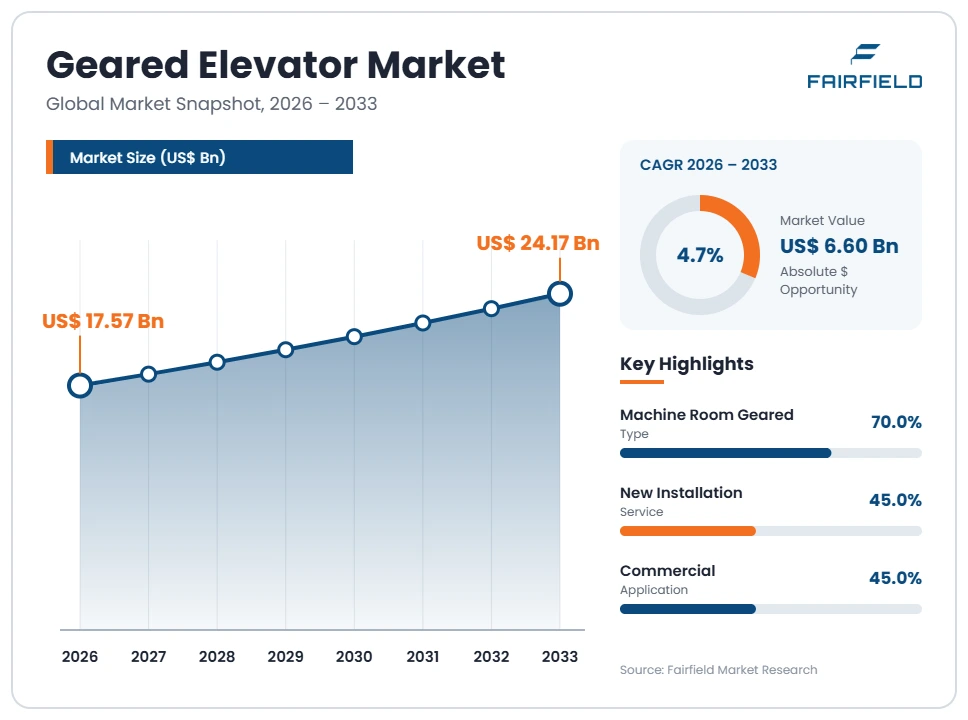
The global geared elevator market size is expected to be valued at US$ 17.57 billion in 2026 and projected to reach US$ 24.17 billion by 2033, growing at a CAGR of 4.7% between 2026 and 2033.
Between 2020 and 2025, the market grew at a CAGR of about 4.6%, rising from roughly US$ 13.40 billion to about US$ 16.79 billion, as mid-rise residential and commercial construction recovered, aging elevators in developed markets were modernized, and urbanization increased demand in Asia Pacific and Middle East & Africa. The geared elevator market covers traction elevators in which an electric motor drives the hoisting sheave through a gearbox, usually a worm or helical gear, which reduces speed and increases torque. Geared elevators typically serve low-rise and mid-rise buildings at speeds of about 0.5 to 2.5 meters per second, offering a lower initial cost than gearless systems and more speed and travel height than hydraulic elevators. They serve apartments, offices, hotels, hospitals, and factories. In April 2026, KONE agreed to acquire TK Elevator for about €29.4 billion.
Key Report Takeaways
- By Type: Machine Room Geared held about 70% share in 2025, while Machine Room-Less Geared is projected to expand at a 6.0% CAGR through 2033, driven by compact geared machines that save building space, lower construction costs, and suit mid-rise apartments and commercial buildings.
- By Service: New Installation held about 45% share in 2025, while Modernization is projected to expand at a 6.5% CAGR through 2033, driven by aging elevator fleets in North America, Europe, and Japan that need upgraded drives, controls, and safety systems.
- By Application: Commercial held about 45% share in 2025, while Residential is projected to expand at a 5.5% CAGR through 2033, driven by urban apartment construction, affordable housing programs, and rising demand for accessible homes for aging populations worldwide.
- By Region: Asia Pacific held about 38% share in 2025, while India is projected to expand at a 6.8% CAGR through 2033, driven by rapid urbanization, mid-rise housing construction, metro rail and commercial projects, and government programs for affordable housing.
Global Geared Elevator Market Trends and Insights
Drivers Impact Analysis
Two drivers carry the strongest influence on geared elevator market demand during the forecast period.
| Driver | Impact on CAGR Forecast | Geographic Relevance | Impact Timeline |
| Urbanization and mid-rise building construction | High | Asia Pacific, Middle East & Africa, Latin America | Long term (≥4 years) |
| Modernization of aging elevator fleets | High | North America, Europe, Asia Pacific | Medium term (2-4 years) |
Urbanization and Mid-Rise Construction Are Driving the Geared Elevator Market
Urbanization and mid-rise building construction are the strongest drivers of the geared elevator market. Growing cities need more elevators.
The mechanism is that millions of people move to cities each year, creating demand for apartments, offices, hotels, hospitals, schools, and shopping centers, many of which are mid-rise buildings of about 5 to 20 floors where geared traction elevators offer a good balance of cost, speed, and capacity. India, China, Indonesia, Vietnam, Saudi Arabia, and Egypt are building large numbers of such buildings. Building codes increasingly require elevators in multi-story buildings to support accessibility for older people and people with disabilities. Geared elevators also serve freight, hospital, and industrial uses that need high load capacity. These trends create strong, long-term demand for new geared elevator installations across emerging markets.
Modernization of Aging Fleets Is Expanding the Geared Elevator Market
Modernization of aging elevator fleets is expanding the geared elevator market. Many existing elevators are old and inefficient.
The cause is that a large share of elevators in North America, Europe, and Japan were installed decades ago, and many older geared units use outdated controllers, relay logic, and inefficient motors. Building owners modernize these elevators to improve safety, reliability, energy efficiency, ride comfort, and compliance with updated codes. Modernization often replaces controllers, drives, door systems, and sometimes the geared machine itself with more efficient designs. Regular maintenance of the large installed base also generates steady service revenue. In April 2026, KONE highlighted the large US backlog of outdated elevators as one reason for its planned acquisition of TK Elevator. These factors create recurring, higher-margin demand for geared elevator services.
Restraints Impact Analysis
Two restraints limit how quickly the geared elevator market grows.
| Restraint | Impact on CAGR Forecast | Geographic Relevance | Impact Timeline |
| Shift to gearless and machine room-less technology | High | Global | Long term (≥4 years) |
| Construction market cycles and high costs | Medium | China, Europe, North America | Medium term (2-4 years) |
The Shift to Gearless Technology Slows the Geared Elevator Market
The shift to gearless and machine room-less technology slows the geared elevator market. Newer designs are taking share.
The problem is that permanent magnet gearless traction machines have become smaller, more efficient, quieter, and more affordable, and many manufacturers now offer gearless machine room-less elevators as their standard product for low-rise and mid-rise buildings. Gearless machines avoid gear oil, gear wear, and energy losses from the gearbox, and they reduce maintenance needs. Building developers prefer machine room-less designs to save space. Energy efficiency rules and green building certifications also favor gearless systems with regenerative drives. As a result, geared elevators are losing share in new installations, especially in Europe, China, and North America, limiting market growth even as overall elevator demand rises.
Construction Cycles Restrict the Geared Elevator Market
Construction market cycles and high costs restrict the geared elevator market. New installations depend on building activity.
The constraint is that new elevator orders follow real estate construction, which slows when interest rates rise, property prices fall, or developers face financing problems. The property downturn in China, the world's largest elevator market, has reduced new equipment orders in recent years. High interest rates have also slowed residential and commercial construction in Europe and North America. Rising costs for steel, copper, electronic components, and labor squeeze manufacturer margins. Skilled elevator technician shortages delay installation and modernization projects. Price competition among large manufacturers and local companies is intense. These factors restrict new installation growth and create uneven demand across regions, pushing manufacturers to rely more on service and modernization revenue.
Market Opportunities
Modernization and Service Contracts Open a Recurring Revenue Pool
Modernization and service contracts open a recurring revenue pool. The installed base needs ongoing care.
The opportunity comes from the huge global installed base of geared elevators, many of which are more than 20 years old and need modernization, replacement parts, and regular maintenance. Service and modernization contracts provide stable, higher-margin revenue than new equipment sales. Digital remote monitoring, predictive maintenance, and cloud-connected controllers help service providers reduce breakdowns and improve efficiency. Retrofitting regenerative drives and LED lighting cuts energy use. Smart building integration, including links with robots and access systems, adds value, highlighted by Otis connecting elevators with cleaning robots at Ritsumeikan University in October 2026. Companies with large service networks, trained technicians, and digital monitoring platforms can capture long-term revenue and protect customer relationships.
Emerging Markets and Industry Consolidation Create a Growth Revenue Pool
Emerging markets and industry consolidation create a growth revenue pool. Demand and industry structure are both changing.
The opportunity reflects fast growth of mid-rise housing, commercial buildings, hospitals, and infrastructure in India, Indonesia, Vietnam, Saudi Arabia, Egypt, and Nigeria, where affordable and reliable geared elevators remain attractive. Freight and heavy-duty elevators for factories, warehouses, and logistics centers also offer opportunities. At the same time, consolidation is reshaping the industry: in April 2026, KONE agreed to acquire TK Elevator in a deal valued at about €29.4 billion, and KONE shareholders approved it in June 2026. Regulators may require asset sales, creating openings for other companies to buy service portfolios and regional businesses. Firms with local manufacturing, strong dealer networks, and competitive pricing can capture this growth.
Segment Analysis
- By Type: Machine Room Geared Leads While Machine Room-Less Geared Grows Fastest
Machine Room Geared held about 70% share in 2025. Traditional geared traction elevators place the motor, gearbox, and controller in a machine room above the shaft, allowing easy access for maintenance and supporting heavy loads and higher travel heights than hydraulic systems. They are widely installed in older buildings, hospitals, freight applications, and many emerging markets, and the large installed base drives strong modernization and service demand.
Machine Room-Less Geared is the fastest-growing type, expanding at a 6.0% CAGR through 2033. Compact geared machines mounted inside the hoistway eliminate the need for a separate machine room, saving building space and construction costs while keeping the lower purchase price of geared technology. They are popular for mid-rise apartments, small offices, and commercial buildings. For the market, machine room-less growth helps geared elevators compete with gearless designs.
- By Service: New Installation Leads While Modernization Grows Fastest
New Installation held about 45% share in 2025. New buildings in Asia Pacific, Middle East & Africa, and Latin America account for most new geared elevator installations, with strong demand from residential and commercial projects. Large construction volumes and strong demand from developers of mid-rise housing and offices give this service the largest share.
Modernization is the fastest-growing service, expanding at a 6.5% CAGR through 2033. Building owners upgrade controllers, drives, doors, and machines to improve safety, efficiency, and reliability. Maintenance forms another segment, providing steady recurring revenue from regular inspections, repairs, and parts replacement under multi-year contracts. For the market, modernization growth increases higher-margin service revenue and keeps older geared elevators in operation for many more years.
- By Application: Commercial Leads While Residential Grows Fastest
Commercial held about 45% share in 2025. Offices, hotels, shopping centers, hospitals, and public buildings use geared elevators for passenger and freight service. Heavy daily usage, larger elevator banks, strict safety and uptime requirements, and frequent modernization in office towers, hotels, and hospitals give this application the largest share.
Residential is the fastest-growing application, expanding at a 5.5% CAGR through 2033. Mid-rise apartments and affordable housing projects need reliable elevators. Industrial and Others form other segments. Residential demand is also supported by aging populations that need accessible homes and by building codes requiring elevators in multi-story housing. Industrial and Others form other segments, including freight elevators in factories and warehouses. For the market, residential growth adds volume.
Geography Analysis
- Why Is North America Important to the Geared Elevator Market?
North America is a major geared elevator market with about 32% share in 2025. The United States has one of the world's largest installed bases of elevators, many of them older geared traction units in offices, apartments, hospitals, and public buildings that need modernization. Otis is based in the region, and KONE, Schindler, and TK Elevator have large service networks. Strict safety codes and accessibility requirements drive upgrades. Canada and Mexico add demand from construction and modernization. Key barriers include technician shortages. One change shaping the region is consolidation, highlighted by the planned KONE and TK Elevator combination.
- Europe Shapes the Geared Elevator Market Through Modernization
Europe is a major geared elevator market. Germany, France, Italy, Spain, and the United Kingdom have large, aging elevator fleets, and KONE, Schindler, and TK Elevator are based in the region. Safety rules and energy efficiency targets encourage modernization of older geared elevators. Many historic and older apartment buildings rely on geared units that are difficult to replace with other technologies. Key barriers include slow new construction and the shift to gearless technology. One opportunity is modernization of older apartment and office elevators across the region, supported by building renovation programs, accessibility rules, and energy efficiency targets.
- Which Region Is Leading the Geared Elevator Market?
Asia Pacific is leading the geared elevator market with about 38% share in 2025, while India is the fastest-growing country, expanding at a 6.8% CAGR through 2033. China has the world's largest elevator market, though its property downturn has slowed new orders. Japan is home to Mitsubishi Electric, Hitachi, Toshiba Elevator, and Fujitec, and South Korea hosts Hyundai Elevator. India's housing and infrastructure growth drives demand, supported by Johnson Lifts. Key barriers include price competition. One change shaping the region is rising modernization demand in China as its huge installed base ages.
- Latin America Grows the Geared Elevator Market Through Urban Construction
Latin America is a growing geared elevator market with steady demand from urban construction and modernization. Brazil, Mexico, Colombia, Chile, and Argentina are building mid-rise apartments, offices, hospitals, and shopping centers in growing cities. Brazil has a large installed base of older elevators needing modernization, and Mexico benefits from commercial and industrial construction linked to nearshoring. Key barriers include economic cycles, currency swings, high financing costs, and price competition from local installers. One opportunity is affordable geared elevators for residential projects, supported by government housing programs and urban growth. Hospitals and shopping centers also add steady demand across the region.
- Middle East & Africa Builds the Geared Elevator Market Through Megaprojects
Middle East & Africa is a growing geared elevator market with strong long-term potential for manufacturers. Saudi Arabia, the United Arab Emirates, and Qatar are building new cities, housing, hotels, hospitals, and commercial projects, while Egypt is developing its New Administrative Capital and other urban projects. Nigeria, Kenya, and South Africa have growing urban populations and rising mid-rise construction. Hot climates and dusty conditions require durable, well-maintained equipment. Key barriers include project delays, financing challenges, and limited technician availability. One opportunity is elevators for affordable housing, hospitals, and mid-rise commercial buildings in fast-growing cities.
Competitive Landscape
The geared elevator market is consolidated. Otis, KONE, Schindler, TK Elevator, and Mitsubishi Electric are leading players, while Hitachi, Fujitec, Hyundai Elevator, Toshiba Elevator, Sigma Elevator, Johnson Lifts, and Canny Elevator compete strongly. The largest companies earn a major share of their revenue from maintenance and modernization of their installed base, which creates strong customer relationships and recurring income. Many regional and independent elevator companies install and service geared elevators in local markets, especially in Asia Pacific, Latin America, and Middle East & Africa, often competing on price.
Companies compete on reliability, safety, ride quality, energy efficiency, installation speed, service network coverage, technician availability, digital monitoring, modernization offerings, and price. Proprietary controllers and service contracts make it costly for customers to switch providers, while independent service firms compete by offering lower prices and open-protocol modernization.
Strategic moves show how competition is changing. In April 2026, KONE agreed to acquire TK Elevator for about €29.4 billion, and in June 2026, its shareholders approved the deal, which now faces antitrust review into 2027. Schindler has criticized the deal but sees possible gains from divestitures. In October 2026, Otis connected elevators with cleaning robots at a university in Japan.
Three themes shape vendor strategy. First, companies are growing service and modernization revenue. Second, they are adding digital monitoring and smart building features to elevators. Third, consolidation is reshaping the industry and its competitive balance.
Geared Elevator Market Industry Leaders
- Otis Worldwide Corporation
- KONE Corporation
- Schindler Group
- TK Elevator GmbH
- Mitsubishi Electric Corporation
Recent Industry Developments
- October 2026: Otis connected its elevators with cleaning robots at Ritsumeikan University in Japan, allowing automated and coordinated cleaning across floors - demonstrates smart building integration for elevator systems.
- June 2026: KONE shareholders approved the acquisition of TK Elevator at an Extraordinary General Meeting, moving the deal into antitrust review in the European Union, United States, and United Kingdom - advances the largest consolidation in the industry's history.
- April 2026: KONE agreed to acquire TK Elevator from a consortium led by Advent and Cinven in a cash-and-share deal valued at about €29.4 billion - would create the world's largest elevator company with about 3.2 million units under maintenance.
Companies Covered in the Report
- Otis Worldwide Corporation
- KONE Corporation
- Schindler Group
- TK Elevator GmbH
- Mitsubishi Electric Corporation
- Hitachi, Ltd.
- Fujitec Co., Ltd.
- Hyundai Elevator Co., Ltd.
- Toshiba Elevator and Building Systems Corporation
- Sigma Elevator Company
- Johnson Lifts Private Limited
- Canny Elevator Co., Ltd.
Geared Elevator Market Report Scope
| Metric | Value |
| Study Period | 2020-2033 |
| Market Size 2026 | US$ 17.57 Billion |
| Market Size 2033 | US$ 24.17 Billion |
| CAGR 2026-2033 | 4.7% |
| Absolute Dollar Opportunity | US$ 6.60 Billion |
| Largest Market | Asia Pacific |
| Fastest-Growing Market | India |
| Market Concentration | Consolidated |
| Major Players | Otis Worldwide Corporation, KONE Corporation, Schindler Group, TK Elevator GmbH, Mitsubishi Electric Corporation |
Geared Elevator Market Segmentation
- Executive Summary
- Geared Elevator Market Snapshot
- Future Projections
- Key Market Trends
- Regional Snapshot
- Market Overview
- Market Definition and Report Scope
- Historical Market Trends
- Market Dynamics
- Drivers
- Urbanization and Mid-Rise Construction Are Driving the Geared Elevator Market
- Modernization of Aging Fleets Is Expanding the Geared Elevator Market
- Restraints
- The Shift to Gearless Technology Slows the Geared Elevator Market
- Construction Cycles Restrict the Geared Elevator Market
- Market Opportunities
- Modernization and Service Contracts Open a Recurring Revenue Pool
- Emerging Markets and Industry Consolidation Create a Growth Revenue Pool
- Drivers
- Global Geared Elevator Market Outlook, 2020–2033
- Global Geared Elevator Market Outlook, by Type, Value (US$ Billion), 2020–2033
- Machine Room Geared
- Machine Room-Less Geared
- Global Geared Elevator Market Outlook, by Service, Value (US$ Billion), 2020–2033
- New Installation
- Modernization
- Maintenance
- Global Geared Elevator Market Outlook, by Application, Value (US$ Billion), 2020–2033
- Commercial
- Residential
- Industrial
- Others
- Global Geared Elevator Market Outlook, by Region, Value (US$ Billion), 2020–2033
- North America
- Europe
- Asia Pacific
- Latin America
- Middle East & Africa
- Global Geared Elevator Market Outlook, by Type, Value (US$ Billion), 2020–2033
- North America Geared Elevator Market Outlook, 2020–2033
- North America Geared Elevator Market Outlook, by Type, Value (US$ Billion), 2020–2033
- Machine Room Geared
- Machine Room-Less Geared
- North America Geared Elevator Market Outlook, by Service, Value (US$ Billion), 2020–2033
- New Installation
- Modernization
- Maintenance
- North America Geared Elevator Market Outlook, by Application, Value (US$ Billion), 2020–2033
- Commercial
- Residential
- Industrial
- Others
- North America Geared Elevator Market Outlook, by Country, Value (US$ Billion), 2020–2033
- United States Geared Elevator Market Outlook, by Type, 2020–2033
- United States Geared Elevator Market Outlook, by Service, 2020–2033
- United States Geared Elevator Market Outlook, by Application, 2020–2033
- Canada Geared Elevator Market Outlook, by Type, 2020–2033
- Canada Geared Elevator Market Outlook, by Service, 2020–2033
- Canada Geared Elevator Market Outlook, by Application, 2020–2033
- Mexico Geared Elevator Market Outlook, by Type, 2020–2033
- Mexico Geared Elevator Market Outlook, by Service, 2020–2033
- Mexico Geared Elevator Market Outlook, by Application, 2020–2033
- North America Geared Elevator Market Outlook, by Type, Value (US$ Billion), 2020–2033
- Europe Geared Elevator Market Outlook, 2020–2033
- Europe Geared Elevator Market Outlook, by Type, Value (US$ Billion), 2020–2033
- Machine Room Geared
- Machine Room-Less Geared
- Europe Geared Elevator Market Outlook, by Service, Value (US$ Billion), 2020–2033
- New Installation
- Modernization
- Maintenance
- Europe Geared Elevator Market Outlook, by Application, Value (US$ Billion), 2020–2033
- Commercial
- Residential
- Industrial
- Others
- Europe Geared Elevator Market Outlook, by Country, Value (US$ Billion), 2020–2033
- Germany Geared Elevator Market Outlook, by Type, 2020–2033
- Germany Geared Elevator Market Outlook, by Service, 2020–2033
- Germany Geared Elevator Market Outlook, by Application, 2020–2033
- France Geared Elevator Market Outlook, by Type, 2020–2033
- France Geared Elevator Market Outlook, by Service, 2020–2033
- France Geared Elevator Market Outlook, by Application, 2020–2033
- Italy Geared Elevator Market Outlook, by Type, 2020–2033
- Italy Geared Elevator Market Outlook, by Service, 2020–2033
- Italy Geared Elevator Market Outlook, by Application, 2020–2033
- Spain Geared Elevator Market Outlook, by Type, 2020–2033
- Spain Geared Elevator Market Outlook, by Service, 2020–2033
- Spain Geared Elevator Market Outlook, by Application, 2020–2033
- United Kingdom Geared Elevator Market Outlook, by Type, 2020–2033
- United Kingdom Geared Elevator Market Outlook, by Service, 2020–2033
- United Kingdom Geared Elevator Market Outlook, by Application, 2020–2033
- Europe Geared Elevator Market Outlook, by Type, Value (US$ Billion), 2020–2033
- Asia Pacific Geared Elevator Market Outlook, 2020–2033
- Asia Pacific Geared Elevator Market Outlook, by Type, Value (US$ Billion), 2020–2033
- Machine Room Geared
- Machine Room-Less Geared
- Asia Pacific Geared Elevator Market Outlook, by Service, Value (US$ Billion), 2020–2033
- New Installation
- Modernization
- Maintenance
- Asia Pacific Geared Elevator Market Outlook, by Application, Value (US$ Billion), 2020–2033
- Commercial
- Residential
- Industrial
- Others
- Asia Pacific Geared Elevator Market Outlook, by Country, Value (US$ Billion), 2020–2033
- India Geared Elevator Market Outlook, by Type, 2020–2033
- India Geared Elevator Market Outlook, by Service, 2020–2033
- India Geared Elevator Market Outlook, by Application, 2020–2033
- China Geared Elevator Market Outlook, by Type, 2020–2033
- China Geared Elevator Market Outlook, by Service, 2020–2033
- China Geared Elevator Market Outlook, by Application, 2020–2033
- Japan Geared Elevator Market Outlook, by Type, 2020–2033
- Japan Geared Elevator Market Outlook, by Service, 2020–2033
- Japan Geared Elevator Market Outlook, by Application, 2020–2033
- South Korea Geared Elevator Market Outlook, by Type, 2020–2033
- South Korea Geared Elevator Market Outlook, by Service, 2020–2033
- South Korea Geared Elevator Market Outlook, by Application, 2020–2033
- Asia Pacific Geared Elevator Market Outlook, by Type, Value (US$ Billion), 2020–2033
- Latin America Geared Elevator Market Outlook, 2020–2033
- Latin America Geared Elevator Market Outlook, by Type, Value (US$ Billion), 2020–2033
- Machine Room Geared
- Machine Room-Less Geared
- Latin America Geared Elevator Market Outlook, by Service, Value (US$ Billion), 2020–2033
- New Installation
- Modernization
- Maintenance
- Latin America Geared Elevator Market Outlook, by Application, Value (US$ Billion), 2020–2033
- Commercial
- Residential
- Industrial
- Others
- Latin America Geared Elevator Market Outlook, by Country, Value (US$ Billion), 2020–2033
- Brazil Geared Elevator Market Outlook, by Type, 2020–2033
- Brazil Geared Elevator Market Outlook, by Service, 2020–2033
- Brazil Geared Elevator Market Outlook, by Application, 2020–2033
- Mexico Geared Elevator Market Outlook, by Type, 2020–2033
- Mexico Geared Elevator Market Outlook, by Service, 2020–2033
- Mexico Geared Elevator Market Outlook, by Application, 2020–2033
- Colombia Geared Elevator Market Outlook, by Type, 2020–2033
- Colombia Geared Elevator Market Outlook, by Service, 2020–2033
- Colombia Geared Elevator Market Outlook, by Application, 2020–2033
- Chile Geared Elevator Market Outlook, by Type, 2020–2033
- Chile Geared Elevator Market Outlook, by Service, 2020–2033
- Chile Geared Elevator Market Outlook, by Application, 2020–2033
- Argentina Geared Elevator Market Outlook, by Type, 2020–2033
- Argentina Geared Elevator Market Outlook, by Service, 2020–2033
- Argentina Geared Elevator Market Outlook, by Application, 2020–2033
- Latin America Geared Elevator Market Outlook, by Type, Value (US$ Billion), 2020–2033
- Middle East & Africa Geared Elevator Market Outlook, 2020–2033
- Middle East & Africa Geared Elevator Market Outlook, by Type, Value (US$ Billion), 2020–2033
- Machine Room Geared
- Machine Room-Less Geared
- Middle East & Africa Geared Elevator Market Outlook, by Service, Value (US$ Billion), 2020–2033
- New Installation
- Modernization
- Maintenance
- Middle East & Africa Geared Elevator Market Outlook, by Application, Value (US$ Billion), 2020–2033
- Commercial
- Residential
- Industrial
- Others
- Middle East & Africa Geared Elevator Market Outlook, by Country, Value (US$ Billion), 2020–2033
- Saudi Arabia Geared Elevator Market Outlook, by Type, 2020–2033
- Saudi Arabia Geared Elevator Market Outlook, by Service, 2020–2033
- Saudi Arabia Geared Elevator Market Outlook, by Application, 2020–2033
- United Arab Emirates Geared Elevator Market Outlook, by Type, 2020–2033
- United Arab Emirates Geared Elevator Market Outlook, by Service, 2020–2033
- United Arab Emirates Geared Elevator Market Outlook, by Application, 2020–2033
- Qatar Geared Elevator Market Outlook, by Type, 2020–2033
- Qatar Geared Elevator Market Outlook, by Service, 2020–2033
- Qatar Geared Elevator Market Outlook, by Application, 2020–2033
- Egypt Geared Elevator Market Outlook, by Type, 2020–2033
- Egypt Geared Elevator Market Outlook, by Service, 2020–2033
- Egypt Geared Elevator Market Outlook, by Application, 2020–2033
- Nigeria Geared Elevator Market Outlook, by Type, 2020–2033
- Nigeria Geared Elevator Market Outlook, by Service, 2020–2033
- Nigeria Geared Elevator Market Outlook, by Application, 2020–2033
- Kenya Geared Elevator Market Outlook, by Type, 2020–2033
- Kenya Geared Elevator Market Outlook, by Service, 2020–2033
- Kenya Geared Elevator Market Outlook, by Application, 2020–2033
- South Africa Geared Elevator Market Outlook, by Type, 2020–2033
- South Africa Geared Elevator Market Outlook, by Service, 2020–2033
- South Africa Geared Elevator Market Outlook, by Application, 2020–2033
- Middle East & Africa Geared Elevator Market Outlook, by Type, Value (US$ Billion), 2020–2033
- Competitive Landscape
- Geared Elevator Market Industry Leaders
- Recent Industry Developments
- Company Profiles
- Otis Worldwide Corporation
- KONE Corporation
- Schindler Group
- TK Elevator GmbH
- Mitsubishi Electric Corporation
- Hitachi, Ltd.
- Fujitec Co., Ltd.
- Hyundai Elevator Co., Ltd.
- Toshiba Elevator and Building Systems Corporation
- Sigma Elevator Company
- Johnson Lifts Private Limited
- Canny Elevator Co., Ltd.
- Appendix
- Research Methodology
- Report Assumptions
- Acronyms and Abbreviations
Type
- Machine Room Geared
- Machine Room-Less Geared
Service
- New Installation
- Modernization
- Maintenance
Application
- Commercial
- Residential
- Industrial
- Others
Regions
- North America
- Europe
- Asia Pacific
- Latin America
- Middle East & Africa
Our Research Methodology
Considering the volatility of business today, traditional approaches to strategizing a game plan can be unfruitful if not detrimental. True ambiguity is no way to determine a forecast. A myriad of predetermined factors must be accounted for such as the degree of risk involved, the magnitude of circumstances, as well as conditions or consequences that are not known or unpredictable. To circumvent binary views that cast uncertainty, the application of market research intelligence to strategically posture, move, and enable actionable outcomes is necessary.
View Methodology
Quality Assured
Rigorous Validation Process

Confidentiality Assured
End-to-end Data Security

Custom Research Services
Tailored To Your Objectives
FAQs
The global geared elevator market is expected to be valued at US$ 17.57 billion in 2026, driven by mid-rise construction and modernization.
The market is projected to grow at a 4.7% CAGR from 2026 to 2033, reaching about US$ 24.17 billion by 2033.
Asia Pacific leads with about 38% share, supported by large elevator markets and construction activity in China, India, and Japan.
India is growing fastest at a 6.8% CAGR, driven by rapid urbanization, mid-rise housing, and commercial and infrastructure projects.
Key players include Otis, KONE, Schindler, TK Elevator, and Mitsubishi Electric, competing on reliability, service, technology, and price.
Related Reports
Micro Excavator Market Size, Share, Insights, Competitive Landscape, and Forecast 2026 to 2033
Explore the Micro Excavator Market, valued at US$1.80 billion in 2026 and forecast to reach US$2.80 billion by 2033, growing at a 6.5% CAGR.
Hand Control Valve Market Size, Share, Insights, Competitive Landscape, and Forecast 2026 to 2033
Hand control valve market is projected to grow from US$947.2 million in 2026 to US$1,233.5 million by 2033, expanding at a CAGR of 3.8%.
Graders for Construction Market Size, Share, Insights, Competitive Landscape, and Forecast 2026 to 2033
Graders for construction market is projected to grow from US$4.62 billion in 2026 to US$7.32 billion by 2033, expanding at a CAGR of 6.8%.
Geared Motors Market Size, Share, Insights, Competitive Landscape, and Forecast 2026 to 2033
Geared motors market is projected to grow from US$8.76 billion in 2026 to US$12.21 billion by 2033, expanding at a CAGR of 4.9%.
Gas Mixers Market Size, Share, Insights, Competitive Landscape, and Forecast 2026 to 2033
The global gas mixers market is valued at US$3.01 billion in 2026, reaching US$4.04 billion by 2033, growing at a 4.3% CAGR
Gas Liquefiers Market Size, Share, Insights, Competitive Landscape, and Forecast 2026 to 2033
The global gas liquefiers market is valued at US$7.88 billion in 2026, reaching US$11.75 billion by 2033, growing at a 5.9% CAGR