



Gas Liquefiers Market
Gas Liquefiers Market Size, Share, Insights, Competitive Landscape, and Forecast 2026 to 2033
Gas Liquefiers Market Size and Trend Analysis
How Fast Is the Gas Liquefiers Market Growing?
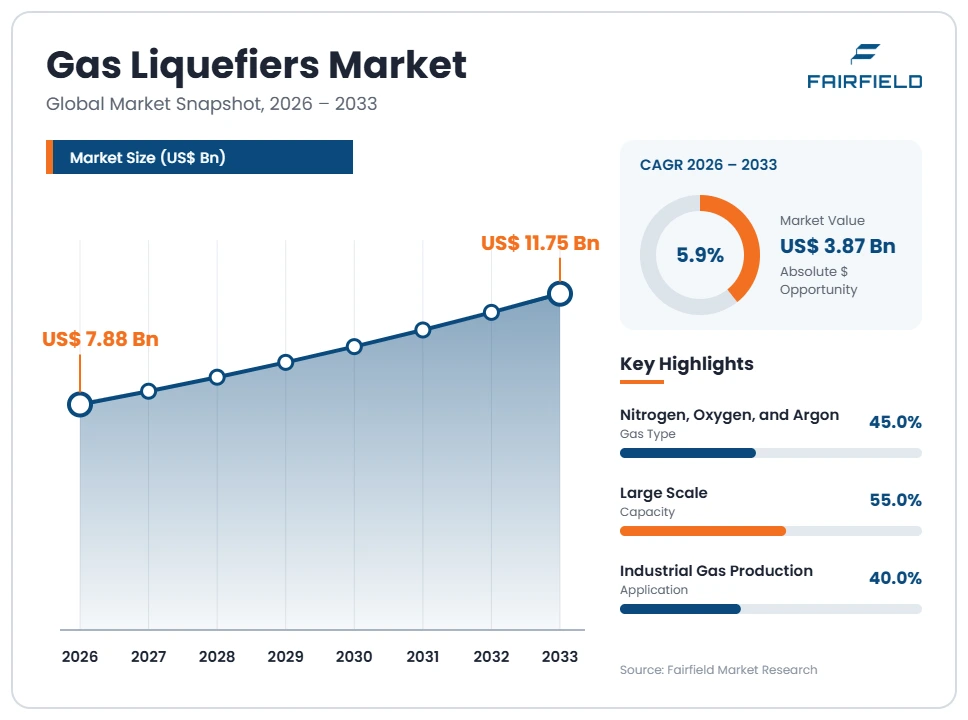
The global gas liquefiers market size is expected to be valued at US$ 7.88 billion in 2026 and projected to reach US$ 11.75 billion by 2033, growing at a CAGR of 5.9% between 2026 and 2033.
Between 2020 and 2025, the market grew at a CAGR of about 5.8%, rising from roughly US$ 5.62 billion to about US$ 7.45 billion, as demand for liquid nitrogen, oxygen, and argon rose in healthcare, electronics, and steel, small-scale LNG projects expanded, and early hydrogen liquefaction plants were built. The gas liquefiers market covers machines and plants that cool gases to very low temperatures until they become liquids, making them easier and cheaper to store and transport. Main products include nitrogen, oxygen, and argon liquefiers, helium liquefiers, hydrogen liquefiers, and natural gas liquefiers. Systems use compressors, heat exchangers, turboexpanders, cold boxes, and refrigeration cycles. They serve industrial gas producers, healthcare and hospitals, electronics and semiconductors, energy and LNG, research laboratories, and aerospace and space launch facilities. In July 2026, Baker Hughes completed its acquisition of Chart Industries.
Key Report Takeaways
- By Gas Type: Nitrogen, Oxygen, and Argon held about 45% share in 2025, while Hydrogen is projected to expand at a 14.0% CAGR through 2033, driven by clean hydrogen projects, liquid hydrogen supply chains for mobility and industry, and space launch propellant demand.
- By Capacity: Large Scale held about 55% share in 2025, while Small Scale is projected to expand at a 7.5% CAGR through 2033, driven by modular liquefiers for hospitals, research labs, biogas plants, remote gas fields, and on-site liquefaction at launch facilities.
- By Application: Industrial Gas Production held about 40% share in 2025, while Aerospace and Space is projected to expand at a 9.5% CAGR through 2033, driven by rising launch cadence, on-site liquefaction of LNG, oxygen, and hydrogen propellants, and new space programs worldwide.
- By Region: Asia Pacific held about 38% share in 2025, while India is projected to expand at a 7.5% CAGR through 2033, driven by steel, healthcare, and electronics growth, new air separation plants, the National Green Hydrogen Mission, and expanding LNG infrastructure.
Global Gas Liquefiers Market Trends and Insights
Drivers Impact Analysis
Two drivers carry the strongest influence on gas liquefiers market demand during the forecast period.
| Driver | Impact on CAGR Forecast | Geographic Relevance | Impact Timeline |
| Rising demand for liquefied industrial and medical gases | High | Global | Long term (≥4 years) |
| Growth of LNG, hydrogen, and clean energy supply chains | High | North America, Asia Pacific, Europe | Medium term (2-4 years) |
Industrial and Medical Gas Demand Is Driving the Gas Liquefiers Market
Rising demand for liquefied industrial and medical gases is the strongest driver of the gas liquefiers market. Many industries rely on liquid gases.
The mechanism is that steel, chemicals, glass, electronics, food processing, and healthcare use large amounts of oxygen, nitrogen, and argon, and liquid form allows these gases to be shipped by truck and stored in tanks at customer sites. Semiconductor and battery factories need very pure liquid nitrogen and argon, and new chip plants in the United States, Japan, South Korea, India, and China are adding demand. Hospitals need reliable liquid oxygen supply, a need highlighted during the pandemic. Food companies use liquid nitrogen for freezing. Helium liquefiers support MRI scanners, research labs, and quantum computing. Industrial gas companies build new air separation and liquefaction plants to serve these growing markets.
Clean Energy Supply Chains Are Expanding the Gas Liquefiers Market
Growth of LNG, hydrogen, and clean energy supply chains is expanding the gas liquefiers market. Energy transition projects need liquefaction.
The cause is that small-scale and mid-scale LNG plants are being built to supply trucking, shipping, remote power, peak shaving, and bio-LNG from biogas, while large LNG export projects in North America and Middle East & Africa drive demand for liquefaction technology. Hydrogen liquefiers allow hydrogen to be stored and transported in large quantities for fuel cell trucks, industrial users, and export, and governments in the United States, Europe, Japan, South Korea, and India support hydrogen projects. Space launch companies need on-site liquefaction of methane, oxygen, and hydrogen propellants. Carbon capture projects use liquefaction to transport CO2. These trends create new, high-value demand for advanced liquefiers.
Restraints Impact Analysis
Two restraints limit how quickly the gas liquefiers market grows.
| Restraint | Impact on CAGR Forecast | Geographic Relevance | Impact Timeline |
| High capital costs and energy consumption | High | Global | Medium term (2-4 years) |
| Uncertain hydrogen demand and project delays | Medium | Europe, North America, Asia Pacific | Long term (≥4 years) |
High Costs and Energy Use Slow the Gas Liquefiers Market
High capital costs and energy consumption slow the gas liquefiers market. Liquefaction is expensive.
The problem is that gas liquefiers require costly compressors, turboexpanders, brazed aluminum heat exchangers, vacuum-insulated cold boxes, and control systems, and large plants can cost tens or hundreds of millions of dollars. Liquefaction also uses large amounts of electricity, especially for hydrogen and helium, which must be cooled to extremely low temperatures. Hydrogen liquefaction can consume about a third of the energy contained in the hydrogen itself. High power prices in Europe and other regions raise operating costs. Long engineering and delivery times delay projects. Smaller users may choose gas cylinders or on-site gas generators instead. These factors slow investment, particularly for new and less proven applications where customers are unsure about long-term demand and utilization rates.
Hydrogen Uncertainty Restricts the Gas Liquefiers Market
Uncertain hydrogen demand and project delays restrict the gas liquefiers market. Many hydrogen projects are behind schedule.
The constraint is that clean hydrogen production costs remain high, and many announced projects in Europe, North America, and Asia Pacific have been delayed, scaled back, or cancelled because of weak offtake demand, rising costs, and policy uncertainty. Changes to tax credits and subsidy programs have made project economics less certain in some countries. Fuel cell truck adoption has been slower than expected. Competing hydrogen carriers, such as ammonia and liquid organic hydrogen carriers, may replace liquid hydrogen for long-distance shipping. These uncertainties make customers cautious about ordering large hydrogen liquefiers, slowing the fastest-growing part of the market even as long-term interest remains strong among governments, energy companies, and industrial users.
Market Opportunities
Hydrogen, Space, and Small-Scale LNG Open a High-Growth Revenue Pool
Hydrogen, space, and small-scale LNG open a high-growth revenue pool. New applications need specialized liquefaction.
The opportunity comes from rising demand for hydrogen liquefiers for mobility, industry, and space launch, along with modular LNG liquefiers for bio-LNG, virtual pipelines, and remote sites. Space launch activity is accelerating, and in August 2026, Nikkiso CE&IG reported that its aerospace cryogenic equipment orders had quadrupled year over year, including orders for multiple LNG liquefiers at US launch facilities. Air Liquide offers hydrogen liquefiers from small scale to large trains of up to 150 tonnes per day. Companies that offer efficient, modular, and reliable liquefiers with fast delivery can win early contracts in these fast-growing segments and build long-term service relationships with customers that will need upgrades, spare parts, and maintenance for decades.
Efficiency, Electronics, and Lifecycle Services Create a Premium Revenue Pool
Efficiency, electronics, and lifecycle services create a premium revenue pool. Customers want lower energy use and reliable operation.
The opportunity reflects demand for more efficient liquefaction cycles, advanced turboexpanders, better heat exchangers, and digital monitoring that cut power use and downtime. New semiconductor, battery, and data center projects need high-purity liquid nitrogen and argon, while helium recovery and liquefaction systems help research labs and hospitals cope with helium shortages. Quantum computing requires large cryogenic cooling plants. Aftermarket services, spare parts, upgrades, and long-term maintenance contracts provide recurring revenue. In July 2026, Baker Hughes completed its US$ 13.6 billion acquisition of Chart, citing aftermarket services as a key benefit. Suppliers that combine efficient technology, global service networks, and digital monitoring can earn higher margins and more predictable recurring revenue.
Segment Analysis
- By Gas Type: Nitrogen, Oxygen, and Argon Lead While Hydrogen Grows Fastest
Nitrogen, Oxygen, and Argon held about 45% share in 2025. Air separation units and associated liquefiers produce liquid nitrogen, oxygen, and argon for steel, chemicals, electronics, healthcare, food, and metal fabrication. These gases are used in very large volumes worldwide, and industrial gas companies continuously build new plants to serve growing regional demand, giving this segment the largest share.
Hydrogen is the fastest-growing gas type, expanding at a 14.0% CAGR through 2033. Hydrogen liquefiers cool hydrogen to about minus 253°C, allowing storage and transport for fuel cell vehicles, industry, electronics, and space launch. New plants are being developed in North America, Europe, Japan, South Korea, and India. Natural Gas, Helium, and Others form other segments, with helium serving MRI and research. For the market, hydrogen growth adds high-value, technically demanding projects.
- By Capacity: Large Scale Leads While Small Scale Grows Fastest
Large Scale held about 55% share in 2025. Large liquefiers operated by industrial gas companies and LNG producers serve regional distribution networks and export terminals. Their high output and long service life give this segment the largest share, and they require advanced turbomachinery and heat exchangers.
Small Scale is the fastest-growing capacity, expanding at a 7.5% CAGR through 2033. Compact and modular liquefiers serve hospitals, research labs, biogas plants, remote gas fields, fueling stations, and launch facilities, reducing transport costs and supply risks. Medium Scale forms another segment. For the market, small-scale growth broadens the customer base beyond large gas companies, and standardized modular designs help suppliers shorten delivery times and lower costs for smaller buyers.
- By Application: Industrial Gas Production Leads While Aerospace and Space Grows Fastest
Industrial Gas Production held about 40% share in 2025. Industrial gas companies use liquefiers to produce liquid nitrogen, oxygen, argon, and hydrogen for distribution to customers. Large, ongoing investment in new air separation units and hydrogen plants gives this application the largest share, as companies such as Linde, Air Liquide, and Air Products expand regional networks.
Aerospace and Space is the fastest-growing application, expanding at a 9.5% CAGR through 2033. Launch sites need liquid oxygen, methane, and hydrogen propellants on site. Energy and LNG, Healthcare, Electronics and Semiconductors, Research, and Others form other segments. Energy and LNG uses liquefiers for export, peak shaving, and bio-LNG, while healthcare relies on liquid oxygen and helium for MRI scanners. For the market, space growth adds premium demand.
Geography Analysis
- Why Is North America Important to the Gas Liquefiers Market?
North America is a major gas liquefiers market. The United States is the world's largest LNG exporter, with many new liquefaction projects, and it has large industrial gas, semiconductor, healthcare, and space launch industries. Air Products and Chart, now part of Baker Hughes, are based in the region, and Linde has major US operations. Hydrogen liquefaction plants serve fuel cell vehicles and space programs. Canada adds LNG and hydrogen projects, while Mexico has industrial gas demand. Key barriers include policy uncertainty for hydrogen. One change shaping the region is fast growth of on-site propellant liquefaction at commercial launch sites.
- Europe Shapes the Gas Liquefiers Market Through Engineering Leadership
Europe is a major gas liquefiers market. Germany, France, the United Kingdom, Italy, and the Netherlands have strong industrial gas, chemicals, healthcare, and research sectors, and Linde, Air Liquide, Messer, and Cryostar are based in the region. Bio-LNG projects and hydrogen strategies drive demand for small-scale liquefiers, and research centers and particle physics laboratories use large helium liquefiers and refrigerators. Key barriers include high power prices, slow permitting, and hydrogen project delays. One opportunity is bio-LNG and efficient liquefaction systems that support European climate goals, along with helium recovery systems for research centers and hospitals.
- Which Region Is Leading the Gas Liquefiers Market?
Asia Pacific is leading the gas liquefiers market with about 38% share in 2025, while India is the fastest-growing country, expanding at a 7.5% CAGR through 2033. China has huge steel, chemical, and electronics industries and major liquefier makers such as Hangzhou Hangyang. Japan is home to Nippon Sanso, Kawasaki Heavy Industries, and Nikkiso, and leads in liquid hydrogen technology. South Korea has large semiconductor demand. India's steel, healthcare, and green hydrogen programs drive demand. Key barriers include price competition. One change shaping the region is new liquid hydrogen supply chains between Japan, South Korea, and Australia.
- Latin America Grows the Gas Liquefiers Market Through Industrial and Healthcare Demand
Latin America is a growing gas liquefiers market. Brazil, Mexico, Chile, Argentina, and Colombia use liquid gases in steel, mining, food processing, healthcare, and chemicals. Brazil is developing bio-LNG from agricultural waste, and Chile has major green hydrogen ambitions for export supported by strong solar and wind resources. Key barriers include high equipment costs, currency swings, limited local manufacturing, and long delivery times. One opportunity is small-scale LNG and medical oxygen liquefiers, supported by gas infrastructure expansion and hospital investment. Mining operations in Chile and Brazil also use liquid oxygen and nitrogen in processing.
- Middle East & Africa Builds the Gas Liquefiers Market Through Energy Projects
Middle East & Africa is a growing gas liquefiers market. Qatar is expanding LNG export capacity, and Saudi Arabia, the United Arab Emirates, and Oman are developing hydrogen and ammonia export projects. Qatar is also one of the world's largest helium producers and exporters. Egypt and South Africa use industrial gases in steel, chemicals, and healthcare. Rising healthcare investment increases demand for medical oxygen across the region. Key barriers include project financing, harsh operating conditions, and reliance on imported technology. One opportunity is liquefaction for energy export projects, helium production, and new industrial gas plants serving growing manufacturing zones.
Competitive Landscape
The gas liquefiers market is consolidated. Linde, Air Liquide, Air Products, Chart Industries, now part of Baker Hughes, and Nikkiso CE&IG are leading players, while Kawasaki Heavy Industries, Nippon Sanso, Messer, Hangzhou Hangyang, Sumitomo Heavy Industries, Cryostar, and Quantum Design compete strongly. Large industrial gas companies both build liquefiers for their own plants and sell engineering and equipment to other customers, while equipment specialists supply cold boxes, heat exchangers, turboexpanders, and complete modular systems. Small helium and nitrogen liquefiers for laboratories form a separate, specialized niche.
Companies compete on energy efficiency, reliability, plant capacity range, delivery time, project execution experience, proprietary process technology, turbomachinery and heat exchanger capabilities, aftermarket service, and total lifecycle cost. Long project histories and references are important for winning large orders, because customers want proven designs for plants that will run for decades.
Strategic moves show how competition is changing. In July 2025, Baker Hughes agreed to acquire Chart, and in July 2026, it completed the US$ 13.6 billion deal, making Chart its third operating segment. In August 2026, Nikkiso CE&IG reported strong growth in aerospace orders, including LNG liquefiers for US launch sites, while Air Liquide continues to expand its hydrogen liquefier range.
Partnerships with engineering contractors are also common on large projects. Three themes shape vendor strategy. First, companies are consolidating to offer complete cryogenic solutions. Second, they are developing more efficient hydrogen liquefaction. Third, they are expanding aftermarket and lifecycle services to secure steady, recurring revenue.
Gas Liquefiers Market Industry Leaders
- Linde plc
- Air Liquide S.A.
- Air Products and Chemicals, Inc.
- Chart Industries (Baker Hughes)
- Nikkiso Clean Energy & Industrial Gases Group
Recent Industry Developments
- August 2026: Nikkiso CE&IG reported that its aerospace cryogenic equipment orders had quadrupled year over year, including recent orders for multiple natural gas liquefiers for launch facilities across the United States - supports on-site propellant supply as launch schedules tighten.
- July 2026: Baker Hughes completed its US$ 13.6 billion acquisition of Chart Industries, establishing Chart as its third operating segment covering thermal management, air and gas handling, and lifecycle services - creates a larger supplier of liquefaction and cryogenic technology.
- July 2025: Baker Hughes announced its agreement to acquire Chart Industries - signaled strong strategic interest in LNG, hydrogen, and industrial gas liquefaction technology.
Companies Covered in the Report
- Linde plc
- Air Liquide S.A.
- Air Products and Chemicals, Inc.
- Chart Industries (Baker Hughes)
- Nikkiso Clean Energy & Industrial Gases Group
- Kawasaki Heavy Industries, Ltd.
- Nippon Sanso Holdings Corporation
- Messer Group
- Hangzhou Hangyang Co., Ltd.
- Sumitomo Heavy Industries, Ltd.
- Cryostar SAS
- Quantum Design, Inc.
Gas Liquefiers Market Report Scope
| Metric | Value |
| Study Period | 2020-2033 |
| Market Size 2026 | US$ 7.88 Billion |
| Market Size 2033 | US$ 11.75 Billion |
| CAGR 2026-2033 | 5.9% |
| Absolute Dollar Opportunity | US$ 3.87 Billion |
| Largest Market | Asia Pacific |
| Fastest-Growing Market | India |
| Market Concentration | Consolidated |
| Major Players | Linde plc, Air Liquide S.A., Air Products and Chemicals, Inc., Chart Industries (Baker Hughes), Nikkiso Clean Energy & Industrial Gases Group |
Gas Liquefiers Market Segmentation
- Executive Summary
- Gas Liquefiers Market Snapshot
- Future Projections
- Key Market Trends
- Regional Snapshot
- Market Overview
- Market Definition and Report Scope
- Historical Market Trends
- Market Dynamics
- Drivers
- Industrial and Medical Gas Demand Is Driving the Gas Liquefiers Market
- Clean Energy Supply Chains Are Expanding the Gas Liquefiers Market
- Restraints
- High Costs and Energy Use Slow the Gas Liquefiers Market
- Hydrogen Uncertainty Restricts the Gas Liquefiers Market
- Market Opportunities
- Hydrogen, Space, and Small-Scale LNG Open a High-Growth Revenue Pool
- Efficiency, Electronics, and Lifecycle Services Create a Premium Revenue Pool
- Drivers
- Global Gas Liquefiers Market Outlook, 2020–2033
- Global Gas Liquefiers Market Outlook, by Gas Type, Value (US$ Billion), 2020–2033
- Nitrogen, Oxygen, and Argon
- Natural Gas
- Hydrogen
- Helium
- Others
- Global Gas Liquefiers Market Outlook, by Capacity, Value (US$ Billion), 2020–2033
- Small Scale
- Medium Scale
- Large Scale
- Global Gas Liquefiers Market Outlook, by Application, Value (US$ Billion), 2020–2033
- Industrial Gas Production
- Aerospace and Space
- Energy and LNG
- Healthcare
- Electronics and Semiconductors
- Research
- Others
- Global Gas Liquefiers Market Outlook, by Region, Value (US$ Billion), 2020–2033
- North America
- Europe
- Asia Pacific
- Latin America
- Middle East & Africa
- Global Gas Liquefiers Market Outlook, by Gas Type, Value (US$ Billion), 2020–2033
- North America Gas Liquefiers Market Outlook, 2020–2033
- North America Gas Liquefiers Market Outlook, by Gas Type, Value (US$ Billion), 2020–2033
- Nitrogen, Oxygen, and Argon
- Natural Gas
- Hydrogen
- Helium
- Others
- North America Gas Liquefiers Market Outlook, by Capacity, Value (US$ Billion), 2020–2033
- Small Scale
- Medium Scale
- Large Scale
- North America Gas Liquefiers Market Outlook, by Application, Value (US$ Billion), 2020–2033
- Industrial Gas Production
- Aerospace and Space
- Energy and LNG
- Healthcare
- Electronics and Semiconductors
- Research
- Others
- North America Gas Liquefiers Market Outlook, by Country, Value (US$ Billion), 2020–2033
- United States Gas Liquefiers Market Outlook, by Gas Type, 2020–2033
- United States Gas Liquefiers Market Outlook, by Capacity, 2020–2033
- United States Gas Liquefiers Market Outlook, by Application, 2020–2033
- Canada Gas Liquefiers Market Outlook, by Gas Type, 2020–2033
- Canada Gas Liquefiers Market Outlook, by Capacity, 2020–2033
- Canada Gas Liquefiers Market Outlook, by Application, 2020–2033
- Mexico Gas Liquefiers Market Outlook, by Gas Type, 2020–2033
- Mexico Gas Liquefiers Market Outlook, by Capacity, 2020–2033
- Mexico Gas Liquefiers Market Outlook, by Application, 2020–2033
- North America Gas Liquefiers Market Outlook, by Gas Type, Value (US$ Billion), 2020–2033
- Europe Gas Liquefiers Market Outlook, 2020–2033
- Europe Gas Liquefiers Market Outlook, by Gas Type, Value (US$ Billion), 2020–2033
- Nitrogen, Oxygen, and Argon
- Natural Gas
- Hydrogen
- Helium
- Others
- Europe Gas Liquefiers Market Outlook, by Capacity, Value (US$ Billion), 2020–2033
- Small Scale
- Medium Scale
- Large Scale
- Europe Gas Liquefiers Market Outlook, by Application, Value (US$ Billion), 2020–2033
- Industrial Gas Production
- Aerospace and Space
- Energy and LNG
- Healthcare
- Electronics and Semiconductors
- Research
- Others
- Europe Gas Liquefiers Market Outlook, by Country, Value (US$ Billion), 2020–2033
- Germany Gas Liquefiers Market Outlook, by Gas Type, 2020–2033
- Germany Gas Liquefiers Market Outlook, by Capacity, 2020–2033
- Germany Gas Liquefiers Market Outlook, by Application, 2020–2033
- France Gas Liquefiers Market Outlook, by Gas Type, 2020–2033
- France Gas Liquefiers Market Outlook, by Capacity, 2020–2033
- France Gas Liquefiers Market Outlook, by Application, 2020–2033
- United Kingdom Gas Liquefiers Market Outlook, by Gas Type, 2020–2033
- United Kingdom Gas Liquefiers Market Outlook, by Capacity, 2020–2033
- United Kingdom Gas Liquefiers Market Outlook, by Application, 2020–2033
- Italy Gas Liquefiers Market Outlook, by Gas Type, 2020–2033
- Italy Gas Liquefiers Market Outlook, by Capacity, 2020–2033
- Italy Gas Liquefiers Market Outlook, by Application, 2020–2033
- Netherlands Gas Liquefiers Market Outlook, by Gas Type, 2020–2033
- Netherlands Gas Liquefiers Market Outlook, by Capacity, 2020–2033
- Netherlands Gas Liquefiers Market Outlook, by Application, 2020–2033
- Europe Gas Liquefiers Market Outlook, by Gas Type, Value (US$ Billion), 2020–2033
- Asia Pacific Gas Liquefiers Market Outlook, 2020–2033
- Asia Pacific Gas Liquefiers Market Outlook, by Gas Type, Value (US$ Billion), 2020–2033
- Nitrogen, Oxygen, and Argon
- Natural Gas
- Hydrogen
- Helium
- Others
- Asia Pacific Gas Liquefiers Market Outlook, by Capacity, Value (US$ Billion), 2020–2033
- Small Scale
- Medium Scale
- Large Scale
- Asia Pacific Gas Liquefiers Market Outlook, by Application, Value (US$ Billion), 2020–2033
- Industrial Gas Production
- Aerospace and Space
- Energy and LNG
- Healthcare
- Electronics and Semiconductors
- Research
- Others
- Asia Pacific Gas Liquefiers Market Outlook, by Country, Value (US$ Billion), 2020–2033
- India Gas Liquefiers Market Outlook, by Gas Type, 2020–2033
- India Gas Liquefiers Market Outlook, by Capacity, 2020–2033
- India Gas Liquefiers Market Outlook, by Application, 2020–2033
- China Gas Liquefiers Market Outlook, by Gas Type, 2020–2033
- China Gas Liquefiers Market Outlook, by Capacity, 2020–2033
- China Gas Liquefiers Market Outlook, by Application, 2020–2033
- Japan Gas Liquefiers Market Outlook, by Gas Type, 2020–2033
- Japan Gas Liquefiers Market Outlook, by Capacity, 2020–2033
- Japan Gas Liquefiers Market Outlook, by Application, 2020–2033
- South Korea Gas Liquefiers Market Outlook, by Gas Type, 2020–2033
- South Korea Gas Liquefiers Market Outlook, by Capacity, 2020–2033
- South Korea Gas Liquefiers Market Outlook, by Application, 2020–2033
- Australia Gas Liquefiers Market Outlook, by Gas Type, 2020–2033
- Australia Gas Liquefiers Market Outlook, by Capacity, 2020–2033
- Australia Gas Liquefiers Market Outlook, by Application, 2020–2033
- Asia Pacific Gas Liquefiers Market Outlook, by Gas Type, Value (US$ Billion), 2020–2033
- Latin America Gas Liquefiers Market Outlook, 2020–2033
- Latin America Gas Liquefiers Market Outlook, by Gas Type, Value (US$ Billion), 2020–2033
- Nitrogen, Oxygen, and Argon
- Natural Gas
- Hydrogen
- Helium
- Others
- Latin America Gas Liquefiers Market Outlook, by Capacity, Value (US$ Billion), 2020–2033
- Small Scale
- Medium Scale
- Large Scale
- Latin America Gas Liquefiers Market Outlook, by Application, Value (US$ Billion), 2020–2033
- Industrial Gas Production
- Aerospace and Space
- Energy and LNG
- Healthcare
- Electronics and Semiconductors
- Research
- Others
- Latin America Gas Liquefiers Market Outlook, by Country, Value (US$ Billion), 2020–2033
- Brazil Gas Liquefiers Market Outlook, by Gas Type, 2020–2033
- Brazil Gas Liquefiers Market Outlook, by Capacity, 2020–2033
- Brazil Gas Liquefiers Market Outlook, by Application, 2020–2033
- Mexico Gas Liquefiers Market Outlook, by Gas Type, 2020–2033
- Mexico Gas Liquefiers Market Outlook, by Capacity, 2020–2033
- Mexico Gas Liquefiers Market Outlook, by Application, 2020–2033
- Chile Gas Liquefiers Market Outlook, by Gas Type, 2020–2033
- Chile Gas Liquefiers Market Outlook, by Capacity, 2020–2033
- Chile Gas Liquefiers Market Outlook, by Application, 2020–2033
- Argentina Gas Liquefiers Market Outlook, by Gas Type, 2020–2033
- Argentina Gas Liquefiers Market Outlook, by Capacity, 2020–2033
- Argentina Gas Liquefiers Market Outlook, by Application, 2020–2033
- Colombia Gas Liquefiers Market Outlook, by Gas Type, 2020–2033
- Colombia Gas Liquefiers Market Outlook, by Capacity, 2020–2033
- Colombia Gas Liquefiers Market Outlook, by Application, 2020–2033
- Latin America Gas Liquefiers Market Outlook, by Gas Type, Value (US$ Billion), 2020–2033
- Middle East & Africa Gas Liquefiers Market Outlook, 2020–2033
- Middle East & Africa Gas Liquefiers Market Outlook, by Gas Type, Value (US$ Billion), 2020–2033
- Nitrogen, Oxygen, and Argon
- Natural Gas
- Hydrogen
- Helium
- Others
- Middle East & Africa Gas Liquefiers Market Outlook, by Capacity, Value (US$ Billion), 2020–2033
- Small Scale
- Medium Scale
- Large Scale
- Middle East & Africa Gas Liquefiers Market Outlook, by Application, Value (US$ Billion), 2020–2033
- Industrial Gas Production
- Aerospace and Space
- Energy and LNG
- Healthcare
- Electronics and Semiconductors
- Research
- Others
- Middle East & Africa Gas Liquefiers Market Outlook, by Country, Value (US$ Billion), 2020–2033
- Qatar Gas Liquefiers Market Outlook, by Gas Type, 2020–2033
- Qatar Gas Liquefiers Market Outlook, by Capacity, 2020–2033
- Qatar Gas Liquefiers Market Outlook, by Application, 2020–2033
- Saudi Arabia Gas Liquefiers Market Outlook, by Gas Type, 2020–2033
- Saudi Arabia Gas Liquefiers Market Outlook, by Capacity, 2020–2033
- Saudi Arabia Gas Liquefiers Market Outlook, by Application, 2020–2033
- United Arab Emirates Gas Liquefiers Market Outlook, by Gas Type, 2020–2033
- United Arab Emirates Gas Liquefiers Market Outlook, by Capacity, 2020–2033
- United Arab Emirates Gas Liquefiers Market Outlook, by Application, 2020–2033
- Oman Gas Liquefiers Market Outlook, by Gas Type, 2020–2033
- Oman Gas Liquefiers Market Outlook, by Capacity, 2020–2033
- Oman Gas Liquefiers Market Outlook, by Application, 2020–2033
- Egypt Gas Liquefiers Market Outlook, by Gas Type, 2020–2033
- Egypt Gas Liquefiers Market Outlook, by Capacity, 2020–2033
- Egypt Gas Liquefiers Market Outlook, by Application, 2020–2033
- South Africa Gas Liquefiers Market Outlook, by Gas Type, 2020–2033
- South Africa Gas Liquefiers Market Outlook, by Capacity, 2020–2033
- South Africa Gas Liquefiers Market Outlook, by Application, 2020–2033
- Middle East & Africa Gas Liquefiers Market Outlook, by Gas Type, Value (US$ Billion), 2020–2033
- Competitive Landscape
- Gas Liquefiers Market Industry Leaders
- Recent Industry Developments
- Company Profiles
- Linde plc
- Air Liquide S.A.
- Air Products and Chemicals, Inc.
- Chart Industries (Baker Hughes)
- Nikkiso Clean Energy & Industrial Gases Group
- Kawasaki Heavy Industries, Ltd.
- Nippon Sanso Holdings Corporation
- Messer Group
- Hangzhou Hangyang Co., Ltd.
- Sumitomo Heavy Industries, Ltd.
- Cryostar SAS
- Quantum Design, Inc.
- Appendix
- Research Methodology
- Report Assumptions
- Acronyms and Abbreviations
Gas Type
- Nitrogen, Oxygen, and Argon
- Natural Gas
- Hydrogen
- Helium
- Others
Capacity
- Small Scale
- Medium Scale
- Large Scale
Application
- Industrial Gas Production
- Aerospace and Space
- Energy and LNG
- Healthcare
- Electronics and Semiconductors
- Research
- Others
Regions
- North America
- Europe
- Asia Pacific
- Latin America
- Middle East & Africa
Our Research Methodology
Considering the volatility of business today, traditional approaches to strategizing a game plan can be unfruitful if not detrimental. True ambiguity is no way to determine a forecast. A myriad of predetermined factors must be accounted for such as the degree of risk involved, the magnitude of circumstances, as well as conditions or consequences that are not known or unpredictable. To circumvent binary views that cast uncertainty, the application of market research intelligence to strategically posture, move, and enable actionable outcomes is necessary.
View Methodology
Quality Assured
Rigorous Validation Process

Confidentiality Assured
End-to-end Data Security

Custom Research Services
Tailored To Your Objectives
FAQs
The global gas liquefiers market is expected to be valued at US$ 7.88 billion in 2026, driven by industrial gas and clean energy demand.
The market is projected to grow at a 5.9% CAGR from 2026 to 2033, reaching about US$ 11.75 billion by 2033.
Asia Pacific leads with about 38% share, supported by large steel, chemical, and electronics industries in China, Japan, and South Korea.
India is growing fastest at a 7.5% CAGR, driven by steel, healthcare, and electronics growth and national green hydrogen programs.
Key players include Linde, Air Liquide, Air Products, Chart, and Nikkiso, competing on efficiency, reliability, project experience, and service.
Related Reports
Micro Excavator Market Size, Share, Insights, Competitive Landscape, and Forecast 2026 to 2033
Explore the Micro Excavator Market, valued at US$1.80 billion in 2026 and forecast to reach US$2.80 billion by 2033, growing at a 6.5% CAGR.
Hand Control Valve Market Size, Share, Insights, Competitive Landscape, and Forecast 2026 to 2033
Hand control valve market is projected to grow from US$947.2 million in 2026 to US$1,233.5 million by 2033, expanding at a CAGR of 3.8%.
Graders for Construction Market Size, Share, Insights, Competitive Landscape, and Forecast 2026 to 2033
Graders for construction market is projected to grow from US$4.62 billion in 2026 to US$7.32 billion by 2033, expanding at a CAGR of 6.8%.
Geared Motors Market Size, Share, Insights, Competitive Landscape, and Forecast 2026 to 2033
Geared motors market is projected to grow from US$8.76 billion in 2026 to US$12.21 billion by 2033, expanding at a CAGR of 4.9%.
Geared Elevator Market Size, Share, Insights, Competitive Landscape, and Forecast 2026 to 2033
The global geared elevator market is valued at US$17.57 billion in 2026, reaching US$24.17 billion by 2033, growing at a 4.7% CAGR
Gas Mixers Market Size, Share, Insights, Competitive Landscape, and Forecast 2026 to 2033
The global gas mixers market is valued at US$3.01 billion in 2026, reaching US$4.04 billion by 2033, growing at a 4.3% CAGR