



Micro Excavator Market
Micro Excavator Market Size, Share, Insights, Competitive Landscape, and Forecast 2026 to 2033
Micro Excavator Market
Micro Excavator Market Size and Trend Analysis
How Fast Is the Micro Excavator Market Growing?
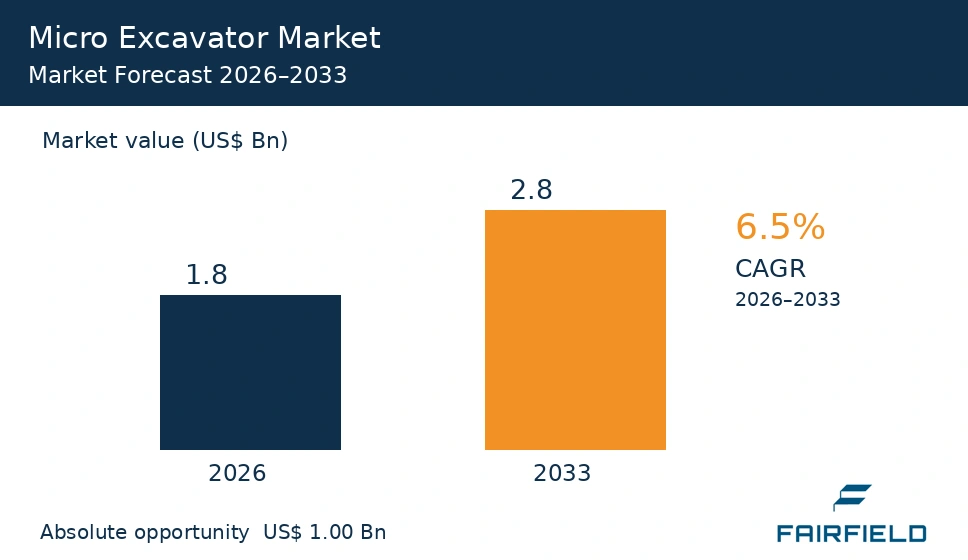
The global micro excavator market size is expected to be valued at US$ 1.80 billion in 2026 and projected to reach US$ 2.80 billion by 2033, growing at a CAGR of 6.5% between 2026 and 2033.
Between 2020 and 2025, the market grew at a CAGR of about 5.4%, rising from roughly US$ 1.30 billion to about US$ 1.69 billion, as home renovation, landscaping, and utility work increased, rental companies expanded compact equipment fleets, and contractors replaced manual digging with small machines to cope with labor shortages. The micro excavator market covers the smallest class of hydraulic excavators, generally weighing up to about 2 tonnes, designed to work in very tight spaces such as backyards, gardens, building interiors, basements, narrow city streets, and utility trenches. Many models have retractable undercarriages that can pass through standard doorways, zero or reduced tail swing, folding canopies, and light weight for towing behind small vehicles. Micro excavators are used for landscaping, utility installation, renovation and demolition, plumbing and drainage, foundation work, and agriculture. In March 2026, Caterpillar launched its smallest excavator yet, the 1-ton 301 CR.
Key Report Takeaways
-
By Operating Weight: 1-2 Tonnes held about 60% share in 2025, while Below 1 Tonne is projected to expand at a 7.2% CAGR through 2033, driven by indoor demolition, garden landscaping, and renovation work where machines must pass through doorways and work on delicate surfaces.
-
By Power Source: Diesel held about 85% share in 2025, while Electric is projected to expand at an 18.0% CAGR through 2033, driven by zero-emission city zones, indoor work requirements, lower noise, and falling battery costs in compact equipment.
-
By End Use: Construction and Utilities held about 45% share in 2025, while Landscaping and Gardening is projected to expand at a 7.4% CAGR through 2033, driven by residential landscaping, garden design, tree planting, and homeowner and small contractor rentals.
-
By Region: Europe held about 35% share in 2025, while Asia Pacific is projected to expand at a 7.5% CAGR through 2033, driven by dense urban construction, a shrinking construction workforce in Japan and South Korea, and rising use of compact machines in China and India.
Global Micro Excavator Market Trends and Insights
Drivers Impact Analysis
Two drivers carry the strongest influence on micro excavator market demand during the forecast period.
| Driver | Impact on CAGR Forecast | Geographic Relevance | Impact Timeline |
| Urban construction, renovation, and utility work | High | Europe, North America, Asia Pacific | Long term (≥4 years) |
| Labor shortages and growth of equipment rental | High | Global | Medium term (2-4 years) |
Urban Construction and Renovation Are Driving the Micro Excavator Market
Urban construction, renovation, and utility work are the strongest drivers of the micro excavator market. Small machines fit where larger ones cannot.
The mechanism is that dense cities, older buildings, and residential neighborhoods leave little space for equipment, so contractors need machines that can enter backyards, pass through gates and doorways, work beside walls, and avoid damaging lawns and paving. Micro excavators handle trenching for water, gas, electric, and fiber optic lines, foundation and footing work, drainage, pool installation, and interior demolition. Governments in Europe and North America are investing in water pipe replacement, fiber broadband, EV charging, and district heating, all requiring small-scale digging in built-up areas. Home renovation and landscaping spending also supports demand. These trends create strong, steady demand for micro excavators in every developed region.
Labor Shortages and Rental Growth Are Expanding the Micro Excavator Market
Labor shortages and growth of equipment rental are expanding the micro excavator market. Contractors need productivity without extra workers.
The cause is that construction, landscaping, and utility companies in Europe, North America, Japan, and Australia struggle to find workers for manual digging, which is slow, tiring, and physically demanding. A micro excavator can do the work of several laborers with shovels, improving productivity and reducing injury risk. Rental companies have built large fleets of micro and mini excavators, making them available to small contractors, landscapers, and homeowners for short jobs without buying equipment. Yanmar reports that the 0-2 tonne segment accounts for a large share of compact equipment sales in Europe, driven by construction and rental professionals. Easy controls and towable designs further widen the user base. These factors expand demand across many customer types.
Restraints Impact Analysis
Two restraints limit how quickly the micro excavator market grows.
| Restraint | Impact on CAGR Forecast | Geographic Relevance | Impact Timeline |
| High prices and price competition | Medium | Global | Medium term (2-4 years) |
| Construction cycles and limited capability of small machines | Medium | Europe, North America, China | Long term (≥4 years) |
Price Pressure Slows the Micro Excavator Market
High prices and price competition slow the micro excavator market. Small buyers are cost-sensitive.
The problem is that many buyers of micro excavators are small contractors, landscapers, farmers, and homeowners with limited budgets, and a new branded machine plus a trailer and attachments can be a large investment. Electric models cost significantly more than diesel versions because of battery costs. At the same time, low-cost micro excavators from Chinese manufacturers sold online and through small dealers are taking share in the entry segment, creating strong price pressure for established brands. Some low-cost machines raise concerns about safety, emissions compliance, durability, and parts availability. Higher interest rates have also raised financing costs. These factors slow purchases of premium models and squeeze margins for established manufacturers, pushing them to stress reliability, service, and resale value.
Construction Cycles and Machine Limits Restrict the Micro Excavator Market
Construction cycles and limited capability of small machines restrict the micro excavator market. Demand depends on building activity.
The constraint is that micro excavator sales follow residential construction, renovation, and landscaping spending, which falls when interest rates rise, house prices weaken, or consumer confidence drops, as seen in parts of Europe and North America recently. Rental fleets slow purchases when utilization falls. Micro excavators have limited digging depth, reach, and lifting capacity, so many jobs still need larger mini excavators, backhoes, or skid steers, and some contractors prefer one larger machine for flexibility. Battery-electric micro excavators offer limited run time, which can restrict full-day use. These factors restrict growth and create uneven demand across regions and years, making manufacturers rely on new models and rental demand to sustain sales.
Market Opportunities
Electric Micro Excavators Open a Fast-Growth Revenue Pool
Electric micro excavators open a fast-growth revenue pool. Cities and contractors want zero-emission, quiet machines.
The opportunity comes from rising demand for battery-electric micro excavators that produce no exhaust emissions and very little noise, allowing work indoors, in hospitals, schools, and historic buildings, and at night in residential areas. Several European cities are introducing zero-emission construction sites, and public sector clients increasingly require low-emission equipment. Battery prices are falling, and charging options are improving. Takeuchi showed a TB10e electric prototype at Bauma 2025, and other makers are expanding electric compact ranges. Rental companies are adding electric machines to meet customer sustainability targets. Suppliers that offer reliable batteries, fast charging, and competitive pricing can capture premium demand and win public projects with strict emission requirements.
New Ultra-Compact Models and Asia Pacific Growth Create a Growth Revenue Pool
New ultra-compact models and Asia Pacific growth create a growth revenue pool. Manufacturers are refreshing their smallest machines.
The opportunity reflects a wave of new models in the 0-2 tonne class with better visibility, easier controls, retractable undercarriages, and improved digging force. In March 2026, Caterpillar launched the 1-ton 301 CR, and in April 2026, Yanmar introduced the new SV10 in Europe, followed by a launch across other regions in June 2026. At the same time, urban construction and labor shortages in Japan, South Korea, China, Australia, and India are increasing demand for compact equipment. Companies that offer reliable machines, attachments, dealer support, and financing can capture growth across these markets and build loyalty among small contractors and rental companies.
Segment Analysis
By Operating Weight: 1-2 Tonnes Lead While Below 1 Tonne Grows Fastest
1-2 Tonnes held about 60% share in 2025. Micro excavators in this class offer a good balance of size, digging depth, and stability, making them popular for utility trenching, landscaping, foundation work, and general construction. They can be towed behind a pickup or van and often have expandable tracks for stability. Rental companies buy large numbers of these machines because they suit a wide range of customers and jobs, supporting their leading share.
Below 1 Tonne is the fastest-growing weight class, expanding at a 7.2% CAGR through 2033. These ultra-compact machines can pass through standard doorways and garden gates, work on delicate surfaces, and operate inside buildings, making them ideal for interior demolition, basement work, and garden landscaping. Their low weight allows easy transport and lifting into confined areas. Electric versions are especially common in this class. For the market, below 1 tonne growth reaches new customers and indoor applications.
By Power Source: Diesel Leads While Electric Grows Fastest
Diesel held about 85% share in 2025. Diesel micro excavators offer long run times, easy refueling, strong power, and lower purchase prices, making them the standard choice for contractors and rental fleets. Small diesel engines from Kubota and Yanmar power most models, and many are designed to avoid complex after-treatment systems, keeping prices and maintenance costs low for rental fleets and small contractors.
Electric is the fastest-growing power source, expanding at an 18.0% CAGR through 2033. Battery-electric and plug-in micro excavators provide zero emissions and low noise for indoor and urban work. Their share is growing fastest in Europe, where cities and public clients increasingly require zero-emission equipment, and rental companies are adding electric models to meet customer sustainability goals. For the market, electric growth raises value per unit.
By End Use: Construction and Utilities Lead While Landscaping and Gardening Grows Fastest
Construction and Utilities held about 45% share in 2025. Contractors use micro excavators for trenching, foundations, utilities, and small demolition jobs. Broad use across residential, commercial, and public works, along with large utility upgrade programs for water, gas, electricity, and fiber broadband networks, gives this end use the largest share.
Landscaping and Gardening is the fastest-growing end use, expanding at a 7.4% CAGR through 2033. Landscapers and homeowners use micro excavators for garden design, planting, ponds, patios, and drainage. Agriculture, Rental, and Others form other segments, covering farms, nurseries, and hire fleets. Agricultural users dig drainage, fence posts, and small irrigation channels, while rental companies buy large fleets for short-term hire. For the market, landscaping growth widens the customer base.
Geography Analysis
North America Expands the Micro Excavator Market Through Rental and Residential Demand
North America is a major micro excavator market. The United States has large residential construction, landscaping, utility, and home improvement sectors, and rental companies offer micro excavators widely to contractors and homeowners. Bobcat, Caterpillar, John Deere, and CNH are active in compact equipment, and Kubota, Takeuchi, Yanmar, and JCB have strong US dealer networks. Fiber broadband and water pipe replacement programs drive trenching demand. Canada adds residential and utility demand. Key barriers include high interest rates and low-cost imports. One change shaping the region is the launch of new 1-ton models, such as the Cat 301 CR in 2026.
Which Region Is Leading the Micro Excavator Market?
Europe is leading the micro excavator market with about 35% share in 2025. The United Kingdom, Germany, France, the Netherlands, and Italy have dense cities, older buildings, small gardens, and strong rental markets that favor very small excavators, and JCB, Wacker Neuson, and Volvo are based in the region. Many European cities are introducing zero-emission construction zones, driving demand for electric micro excavators. Utility upgrades, fiber rollout, and renovation programs add demand. Key barriers include weak construction activity. One change shaping the region is fast adoption of electric models in Norway, the Netherlands, and other countries.
Which Region Is Growing Fastest in the Micro Excavator Market?
Asia Pacific is the fastest-growing micro excavator market, expanding at a 7.5% CAGR through 2033. Japan is the birthplace of the mini excavator and home to Kubota, Yanmar, Takeuchi, Komatsu, Hitachi, and Kobelco, with strong demand for small machines in tight urban sites. China is a large and growing producer and user of micro excavators, while Australia, South Korea, and India are expanding compact equipment use. Key barriers include price competition from local brands. One change shaping the region is rising exports of low-cost micro excavators from China to markets worldwide.
Latin America Grows the Micro Excavator Market Through Urban and Agricultural Demand
Latin America is a growing micro excavator market with rising interest from contractors and farmers. Brazil, Mexico, Chile, Colombia, and Argentina are adopting compact equipment for urban construction, utilities, landscaping, and agriculture as labor costs rise, rental availability improves, and contractors look for faster ways to complete small jobs. Brazil and Mexico have growing rental sectors serving small contractors in large cities. Key barriers include high import costs, currency swings, and limited dealer networks outside major cities. One opportunity is micro excavators for urban utility and farm work, supported by growing rental fleets and dealer expansion by Japanese and Chinese brands.
Middle East & Africa Builds the Micro Excavator Market Through Urban Development
Middle East & Africa is an emerging micro excavator market with early but rising demand from contractors. Saudi Arabia, the United Arab Emirates, and Qatar are building new cities, large landscaped public spaces, and utility networks, while South Africa, Egypt, and Morocco use compact equipment for urban, housing, and utility work. Hot climates and sandy soil require durable machines with good cooling. Key barriers include low awareness, limited rental availability, and reliance on manual labor for small jobs. One opportunity is micro excavators for landscaping, utilities, and residential projects in fast-growing cities across the region.
Competitive Landscape
The micro excavator market is moderately consolidated. Kubota, Yanmar, Takeuchi, Bobcat, and JCB are leading players, while Caterpillar, Volvo Construction Equipment, Komatsu, Hitachi Construction Machinery, Wacker Neuson, Kobelco, and CNH through New Holland compete strongly. Japanese manufacturers have long been strong in the smallest excavator classes, and many other brands use Japanese engines or sourced machines. A growing number of Chinese manufacturers sell low-cost micro excavators through dealers and online platforms, especially in Europe, North America, and Asia Pacific, increasing competition in the entry segment.
Companies compete on compact dimensions, digging performance, stability, ease of operation, reliability, electric options, attachments, dealer and service networks, rental partnerships, resale value, and price. Strong relationships with large rental companies are important because rental fleets account for a major share of purchases, and rental customers value easy operation and low maintenance.
Strategic moves show how competition is changing. In April 2025, Takeuchi showed its TB10e electric prototype at Bauma. In March 2026, Caterpillar launched the 1-ton 301 CR, and in April 2026, Yanmar introduced the SV10 in Europe, extending it to other regions in June 2026.
Four themes shape vendor strategy. First, manufacturers are launching new ultra-compact models. Second, they are expanding electric ranges. Third, they are deepening rental partnerships and dealer networks to reach small contractors and homeowners. Fourth, they are adding telematics and quick-change attachments to increase machine versatility.
Micro Excavator Market Industry Leaders
- Kubota Corporation
- Yanmar Holdings Co., Ltd.
- Takeuchi Mfg. Co., Ltd.
- Doosan Bobcat Inc.
- J.C. Bamford Excavators Ltd. (JCB)
Recent Industry Developments
-
June 2026: Yanmar Compact Equipment launched its new SV10 ultra-compact excavator across additional regions, focusing on precise control, ease of operation, and dependable performance in the 0-2 tonne segment - extends its micro excavator offering globally.
-
April 2026: Yanmar Compact Equipment EMEA introduced the SV10 mini excavator, powered by a 9.2 kW engine with a maximum digging depth of 1,800 mm, for the fast-growing 0-2 tonne segment - targets construction and rental professionals in Europe.
-
March 2026: Caterpillar debuted its smallest mini excavator yet, the 1-ton 301 CR, with zero tail swing, a retractable undercarriage from 44 to 29 inches, a foldable blade, and folding ROPS - enters the ultra-compact class.
-
April 2025: Takeuchi showed a prototype of its TB10e electric micro excavator at Bauma 2025, offering up to two hours of work in standard mode and four hours in eco mode - expands electric options in the smallest class.
Companies Covered in the Report
-
Kubota Corporation
-
Yanmar Holdings Co., Ltd.
-
Takeuchi Mfg. Co., Ltd.
-
Doosan Bobcat Inc.
-
J.C. Bamford Excavators Ltd. (JCB)
-
Caterpillar Inc.
-
Volvo Construction Equipment
-
Komatsu Ltd.
-
Hitachi Construction Machinery Co., Ltd.
-
Wacker Neuson SE
-
Kobelco Construction Machinery Co., Ltd.
-
CNH Industrial N.V. (New Holland)
Micro Excavator Market Report Scope
This report covers the micro excavator market, including machines below 1 tonne and 1-2 tonnes, powered by diesel, electric, and other sources, used in construction and utilities, landscaping and gardening, agriculture, rental, and other end uses. The base year is 2025, and the forecast period runs from 2026 to 2033. All values are expressed in US$ Billion.
| Operating Weight | Below 1 Tonne, 1-2 Tonnes |
| Power Source | Diesel, Electric, Others |
| End Use | Construction and Utilities, Landscaping and Gardening, Agriculture, Rental, Others |
| Regions | North America, Europe, Asia Pacific, Latin America, Middle East & Africa |
1. Executive Summary
1.1 Micro Excavator Market Snapshot
1.2 Future Projections
1.3 Key Market Trends
1.4 Regional Snapshot
2. Market Overview
2.1 Market Definition and Report Scope
2.2 Historical Market Trends
2.3 Market Dynamics
2.3.1 Drivers
2.3.1.1 Urban Construction and Renovation Are Driving the Micro Excavator Market
2.3.1.2 Labor Shortages and Rental Growth Are Expanding the Micro Excavator Market
2.3.2 Restraints
2.3.2.1 Price Pressure Slows the Micro Excavator Market
2.3.2.2 Construction Cycles and Machine Limits Restrict the Micro Excavator Market
2.3.3 Market Opportunities
2.3.3.1 Electric Micro Excavators Open a Fast-Growth Revenue Pool
2.3.3.2 New Ultra-Compact Models and Asia Pacific Growth Create a Growth Revenue Pool
3. Global Micro Excavator Market Outlook, 2020–2033
3.1 Global Micro Excavator Market Outlook, by Operating Weight, Value (US$ Billion), 2020–2033
3.1.1 Below 1 Tonne
3.1.2 1-2 Tonnes
3.2 Global Micro Excavator Market Outlook, by Power Source, Value (US$ Billion), 2020–2033
3.2.1 Diesel
3.2.2 Electric
3.2.3 Others
3.3 Global Micro Excavator Market Outlook, by End Use, Value (US$ Billion), 2020–2033
3.3.1 Construction and Utilities
3.3.2 Landscaping and Gardening
3.3.3 Agriculture
3.3.4 Rental
3.3.5 Others
3.4 Global Micro Excavator Market Outlook, by Region, Value (US$ Billion), 2020–2033
3.4.1 North America
3.4.2 Europe
3.4.3 Asia Pacific
3.4.4 Latin America
3.4.5 Middle East & Africa
4. North America Micro Excavator Market Outlook, 2020–2033
4.1 North America Micro Excavator Market Outlook, by Operating Weight, Value (US$ Billion), 2020–2033
4.1.1 Below 1 Tonne
4.1.2 1-2 Tonnes
4.2 North America Micro Excavator Market Outlook, by Power Source, Value (US$ Billion), 2020–2033
4.2.1 Diesel
4.2.2 Electric
4.2.3 Others
4.3 North America Micro Excavator Market Outlook, by End Use, Value (US$ Billion), 2020–2033
4.3.1 Construction and Utilities
4.3.2 Landscaping and Gardening
4.3.3 Agriculture
4.3.4 Rental
4.3.5 Others
4.4 North America Micro Excavator Market Outlook, by Country, Value (US$ Billion), 2020–2033
4.4.1 United States Micro Excavator Market Outlook, by Operating Weight, 2020–2033
4.4.2 United States Micro Excavator Market Outlook, by Power Source, 2020–2033
4.4.3 United States Micro Excavator Market Outlook, by End Use, 2020–2033
4.4.4 Canada Micro Excavator Market Outlook, by Operating Weight, 2020–2033
4.4.5 Canada Micro Excavator Market Outlook, by Power Source, 2020–2033
4.4.6 Canada Micro Excavator Market Outlook, by End Use, 2020–2033
5. Europe Micro Excavator Market Outlook, 2020–2033
5.1 Europe Micro Excavator Market Outlook, by Operating Weight, Value (US$ Billion), 2020–2033
5.1.1 Below 1 Tonne
5.1.2 1-2 Tonnes
5.2 Europe Micro Excavator Market Outlook, by Power Source, Value (US$ Billion), 2020–2033
5.2.1 Diesel
5.2.2 Electric
5.2.3 Others
5.3 Europe Micro Excavator Market Outlook, by End Use, Value (US$ Billion), 2020–2033
5.3.1 Construction and Utilities
5.3.2 Landscaping and Gardening
5.3.3 Agriculture
5.3.4 Rental
5.3.5 Others
5.4 Europe Micro Excavator Market Outlook, by Country, Value (US$ Billion), 2020–2033
5.4.1 United Kingdom Micro Excavator Market Outlook, by Operating Weight, 2020–2033
5.4.2 United Kingdom Micro Excavator Market Outlook, by Power Source, 2020–2033
5.4.3 United Kingdom Micro Excavator Market Outlook, by End Use, 2020–2033
5.4.4 Germany Micro Excavator Market Outlook, by Operating Weight, 2020–2033
5.4.5 Germany Micro Excavator Market Outlook, by Power Source, 2020–2033
5.4.6 Germany Micro Excavator Market Outlook, by End Use, 2020–2033
5.4.7 France Micro Excavator Market Outlook, by Operating Weight, 2020–2033
5.4.8 France Micro Excavator Market Outlook, by Power Source, 2020–2033
5.4.9 France Micro Excavator Market Outlook, by End Use, 2020–2033
5.4.10 Netherlands Micro Excavator Market Outlook, by Operating Weight, 2020–2033
5.4.11 Netherlands Micro Excavator Market Outlook, by Power Source, 2020–2033
5.4.12 Netherlands Micro Excavator Market Outlook, by End Use, 2020–2033
5.4.13 Italy Micro Excavator Market Outlook, by Operating Weight, 2020–2033
5.4.14 Italy Micro Excavator Market Outlook, by Power Source, 2020–2033
5.4.15 Italy Micro Excavator Market Outlook, by End Use, 2020–2033
5.4.16 Norway Micro Excavator Market Outlook, by Operating Weight, 2020–2033
5.4.17 Norway Micro Excavator Market Outlook, by Power Source, 2020–2033
5.4.18 Norway Micro Excavator Market Outlook, by End Use, 2020–2033
6. Asia Pacific Micro Excavator Market Outlook, 2020–2033
6.1 Asia Pacific Micro Excavator Market Outlook, by Operating Weight, Value (US$ Billion), 2020–2033
6.1.1 Below 1 Tonne
6.1.2 1-2 Tonnes
6.2 Asia Pacific Micro Excavator Market Outlook, by Power Source, Value (US$ Billion), 2020–2033
6.2.1 Diesel
6.2.2 Electric
6.2.3 Others
6.3 Asia Pacific Micro Excavator Market Outlook, by End Use, Value (US$ Billion), 2020–2033
6.3.1 Construction and Utilities
6.3.2 Landscaping and Gardening
6.3.3 Agriculture
6.3.4 Rental
6.3.5 Others
6.4 Asia Pacific Micro Excavator Market Outlook, by Country, Value (US$ Billion), 2020–2033
6.4.1 Japan Micro Excavator Market Outlook, by Operating Weight, 2020–2033
6.4.2 Japan Micro Excavator Market Outlook, by Power Source, 2020–2033
6.4.3 Japan Micro Excavator Market Outlook, by End Use, 2020–2033
6.4.4 China Micro Excavator Market Outlook, by Operating Weight, 2020–2033
6.4.5 China Micro Excavator Market Outlook, by Power Source, 2020–2033
6.4.6 China Micro Excavator Market Outlook, by End Use, 2020–2033
6.4.7 Australia Micro Excavator Market Outlook, by Operating Weight, 2020–2033
6.4.8 Australia Micro Excavator Market Outlook, by Power Source, 2020–2033
6.4.9 Australia Micro Excavator Market Outlook, by End Use, 2020–2033
6.4.10 South Korea Micro Excavator Market Outlook, by Operating Weight, 2020–2033
6.4.11 South Korea Micro Excavator Market Outlook, by Power Source, 2020–2033
6.4.12 South Korea Micro Excavator Market Outlook, by End Use, 2020–2033
6.4.13 India Micro Excavator Market Outlook, by Operating Weight, 2020–2033
6.4.14 India Micro Excavator Market Outlook, by Power Source, 2020–2033
6.4.15 India Micro Excavator Market Outlook, by End Use, 2020–2033
7. Latin America Micro Excavator Market Outlook, 2020–2033
7.1 Latin America Micro Excavator Market Outlook, by Operating Weight, Value (US$ Billion), 2020–2033
7.1.1 Below 1 Tonne
7.1.2 1-2 Tonnes
7.2 Latin America Micro Excavator Market Outlook, by Power Source, Value (US$ Billion), 2020–2033
7.2.1 Diesel
7.2.2 Electric
7.2.3 Others
7.3 Latin America Micro Excavator Market Outlook, by End Use, Value (US$ Billion), 2020–2033
7.3.1 Construction and Utilities
7.3.2 Landscaping and Gardening
7.3.3 Agriculture
7.3.4 Rental
7.3.5 Others
7.4 Latin America Micro Excavator Market Outlook, by Country, Value (US$ Billion), 2020–2033
7.4.1 Brazil Micro Excavator Market Outlook, by Operating Weight, 2020–2033
7.4.2 Brazil Micro Excavator Market Outlook, by Power Source, 2020–2033
7.4.3 Brazil Micro Excavator Market Outlook, by End Use, 2020–2033
7.4.4 Mexico Micro Excavator Market Outlook, by Operating Weight, 2020–2033
7.4.5 Mexico Micro Excavator Market Outlook, by Power Source, 2020–2033
7.4.6 Mexico Micro Excavator Market Outlook, by End Use, 2020–2033
7.4.7 Chile Micro Excavator Market Outlook, by Operating Weight, 2020–2033
7.4.8 Chile Micro Excavator Market Outlook, by Power Source, 2020–2033
7.4.9 Chile Micro Excavator Market Outlook, by End Use, 2020–2033
7.4.10 Colombia Micro Excavator Market Outlook, by Operating Weight, 2020–2033
7.4.11 Colombia Micro Excavator Market Outlook, by Power Source, 2020–2033
7.4.12 Colombia Micro Excavator Market Outlook, by End Use, 2020–2033
7.4.13 Argentina Micro Excavator Market Outlook, by Operating Weight, 2020–2033
7.4.14 Argentina Micro Excavator Market Outlook, by Power Source, 2020–2033
7.4.15 Argentina Micro Excavator Market Outlook, by End Use, 2020–2033
8. Middle East & Africa Micro Excavator Market Outlook, 2020–2033
8.1 Middle East & Africa Micro Excavator Market Outlook, by Operating Weight, Value (US$ Billion), 2020–2033
8.1.1 Below 1 Tonne
8.1.2 1-2 Tonnes
8.2 Middle East & Africa Micro Excavator Market Outlook, by Power Source, Value (US$ Billion), 2020–2033
8.2.1 Diesel
8.2.2 Electric
8.2.3 Others
8.3 Middle East & Africa Micro Excavator Market Outlook, by End Use, Value (US$ Billion), 2020–2033
8.3.1 Construction and Utilities
8.3.2 Landscaping and Gardening
8.3.3 Agriculture
8.3.4 Rental
8.3.5 Others
8.4 Middle East & Africa Micro Excavator Market Outlook, by Country, Value (US$ Billion), 2020–2033
8.4.1 Saudi Arabia Micro Excavator Market Outlook, by Operating Weight, 2020–2033
8.4.2 Saudi Arabia Micro Excavator Market Outlook, by Power Source, 2020–2033
8.4.3 Saudi Arabia Micro Excavator Market Outlook, by End Use, 2020–2033
8.4.4 United Arab Emirates Micro Excavator Market Outlook, by Operating Weight, 2020–2033
8.4.5 United Arab Emirates Micro Excavator Market Outlook, by Power Source, 2020–2033
8.4.6 United Arab Emirates Micro Excavator Market Outlook, by End Use, 2020–2033
8.4.7 Qatar Micro Excavator Market Outlook, by Operating Weight, 2020–2033
8.4.8 Qatar Micro Excavator Market Outlook, by Power Source, 2020–2033
8.4.9 Qatar Micro Excavator Market Outlook, by End Use, 2020–2033
8.4.10 South Africa Micro Excavator Market Outlook, by Operating Weight, 2020–2033
8.4.11 South Africa Micro Excavator Market Outlook, by Power Source, 2020–2033
8.4.12 South Africa Micro Excavator Market Outlook, by End Use, 2020–2033
8.4.13 Egypt Micro Excavator Market Outlook, by Operating Weight, 2020–2033
8.4.14 Egypt Micro Excavator Market Outlook, by Power Source, 2020–2033
8.4.15 Egypt Micro Excavator Market Outlook, by End Use, 2020–2033
8.4.16 Morocco Micro Excavator Market Outlook, by Operating Weight, 2020–2033
8.4.17 Morocco Micro Excavator Market Outlook, by Power Source, 2020–2033
8.4.18 Morocco Micro Excavator Market Outlook, by End Use, 2020–2033
9. Competitive Landscape
9.1 Micro Excavator Market Industry Leaders
9.2 Recent Industry Developments
9.3 Company Profiles
9.3.1 Kubota Corporation
9.3.2 Yanmar Holdings Co., Ltd.
9.3.3 Takeuchi Mfg. Co., Ltd.
9.3.4 Doosan Bobcat Inc.
9.3.5 J.C. Bamford Excavators Ltd. (JCB)
9.3.6 Caterpillar Inc.
9.3.7 Volvo Construction Equipment
9.3.8 Komatsu Ltd.
9.3.9 Hitachi Construction Machinery Co., Ltd.
9.3.10 Wacker Neuson SE
9.3.11 Kobelco Construction Machinery Co., Ltd.
9.3.12 CNH Industrial N.V. (New Holland)
10. Appendix
10.1 Research Methodology
10.2 Report Assumptions
10.3 Acronyms and Abbreviations
| Operating Weight | Below 1 Tonne, 1-2 Tonnes |
| Power Source | Diesel, Electric, Others |
| End Use | Construction and Utilities, Landscaping and Gardening, Agriculture, Rental, Others |
| Regions | North America, Europe, Asia Pacific, Latin America, Middle East & Africa |
Our Research Methodology
Considering the volatility of business today, traditional approaches to strategizing a game plan can be unfruitful if not detrimental. True ambiguity is no way to determine a forecast. A myriad of predetermined factors must be accounted for such as the degree of risk involved, the magnitude of circumstances, as well as conditions or consequences that are not known or unpredictable. To circumvent binary views that cast uncertainty, the application of market research intelligence to strategically posture, move, and enable actionable outcomes is necessary.
View Methodology
Quality Assured
Rigorous Validation Process

Confidentiality Assured
End-to-end Data Security

Custom Research Services
Tailored To Your Objectives
FAQs
The global micro excavator market is expected to be valued at US$ 1.80 billion in 2026, driven by urban construction, renovation, and landscaping.
The market is projected to grow at a 6.5% CAGR from 2026 to 2033, reaching about US$ 2.80 billion by 2033.
Europe leads with about 35% share, supported by dense cities, strong rental markets, and zero-emission construction rules in many countries.
Asia Pacific is growing fastest at a 7.5% CAGR, driven by urban construction, labor shortages, and compact equipment growth in China.
Key players include Kubota, Yanmar, Takeuchi, Bobcat, and JCB, competing on compactness, reliability, dealer support, and price.
Related Reports
Hand Control Valve Market Size, Share, Insights, Competitive Landscape, and Forecast 2026 to 2033
Hand control valve market is projected to grow from US$947.2 million in 2026 to US$1,233.5 million by 2033, expanding at a CAGR of 3.8%.
Graders for Construction Market Size, Share, Insights, Competitive Landscape, and Forecast 2026 to 2033
Graders for construction market is projected to grow from US$4.62 billion in 2026 to US$7.32 billion by 2033, expanding at a CAGR of 6.8%.
Geared Motors Market Size, Share, Insights, Competitive Landscape, and Forecast 2026 to 2033
Geared motors market is projected to grow from US$8.76 billion in 2026 to US$12.21 billion by 2033, expanding at a CAGR of 4.9%.
Geared Elevator Market Size, Share, Insights, Competitive Landscape, and Forecast 2026 to 2033
The global geared elevator market is valued at US$17.57 billion in 2026, reaching US$24.17 billion by 2033, growing at a 4.7% CAGR
Gas Mixers Market Size, Share, Insights, Competitive Landscape, and Forecast 2026 to 2033
The global gas mixers market is valued at US$3.01 billion in 2026, reaching US$4.04 billion by 2033, growing at a 4.3% CAGR
Gas Liquefiers Market Size, Share, Insights, Competitive Landscape, and Forecast 2026 to 2033
The global gas liquefiers market is valued at US$7.88 billion in 2026, reaching US$11.75 billion by 2033, growing at a 5.9% CAGR