



Gas Mixers Market
Gas Mixers Market Size, Share, Insights, Competitive Landscape, and Forecast 2026 to 2033
Gas Mixers Market Size and Trend Analysis
How Fast Is the Gas Mixers Market Growing?
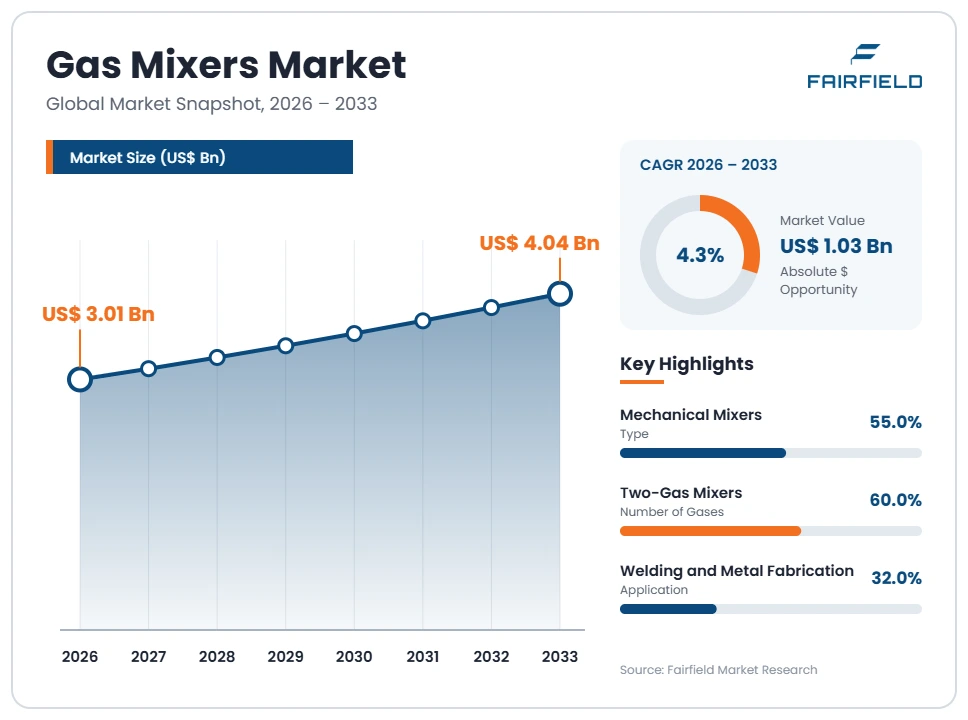
The global gas mixers market size is expected to be valued at US$ 3.01 billion in 2026 and projected to reach US$ 4.04 billion by 2033, growing at a CAGR of 4.3% between 2026 and 2033.
Between 2020 and 2025, the market grew at a CAGR of about 3.9%, rising from roughly US$ 2.39 billion to about US$ 2.89 billion, as food producers adopted modified atmosphere packaging, welding and laser cutting shops sought exact shielding gas blends, and hospitals, laboratories, and semiconductor plants increased use of precisely controlled gas mixtures. The gas mixers market covers equipment that blends two or more gases in exact proportions on site. Products range from simple mechanical proportional mixers to electronic and digital mixers using mass flow controllers. Common blends include argon and carbon dioxide for welding, nitrogen and carbon dioxide for food packaging and beverages, oxygen and air for medical use, and hydrogen and nitrogen for heat treatment. In September 2026, WITT highlighted connected MEM+ gas mixers for welding and laser cutting.
Key Report Takeaways
- By Type: Mechanical Mixers held about 55% share in 2025, while Electronic and Digital Mixers are projected to expand at a 5.8% CAGR through 2033, driven by demand for touchscreen control, data logging, remote monitoring, and automatic adjustment that improve accuracy and traceability in regulated industries.
- By Number of Gases: Two-Gas Mixers held about 60% share in 2025, while Multi-Gas Mixers are projected to expand at a 5.5% CAGR through 2033, driven by laboratory, semiconductor, and specialty welding processes that need custom blends of three or more gases.
- By Application: Welding and Metal Fabrication held about 32% share in 2025, while Food and Beverage is projected to expand at a 5.5% CAGR through 2033, driven by modified atmosphere packaging for meat, cheese, bakery, and ready meals, along with beverage carbonation and nitrogen dispensing.
- By Region: North America held about 33% share in 2025, while Asia Pacific is projected to expand at a 5.8% CAGR through 2033, driven by fast growth in metal fabrication, packaged food production, electronics manufacturing, and healthcare infrastructure in China, India, and Indonesia.
Global Gas Mixers Market Trends and Insights
Drivers Impact Analysis
Two drivers carry the strongest influence on gas mixers market demand during the forecast period.
| Driver | Impact on CAGR Forecast | Geographic Relevance | Impact Timeline |
| Growth of welding, metal fabrication, and laser cutting | High | Global | Long term (≥4 years) |
| Expansion of modified atmosphere packaging and food processing | High | North America, Europe, Asia Pacific | Medium term (2-4 years) |
Welding and Fabrication Growth Is Driving the Gas Mixers Market
Growth of welding, metal fabrication, and laser cutting is the strongest driver of the gas mixers market. These processes need exact shielding and assist gas blends.
The mechanism is that MIG, MAG, and TIG welding use mixtures of argon, carbon dioxide, oxygen, helium, and hydrogen to protect the weld pool, and the right blend improves weld quality, speed, and appearance for each material and thickness. On-site gas mixers let fabricators produce the exact blend they need from bulk gas supplies, reducing cylinder handling, rental fees, and inventory of many pre-mixed gases. Automotive, shipbuilding, construction, energy, and heavy equipment manufacturing all use large volumes of welding gases. Laser cutting uses nitrogen and oxygen mixtures to improve cut quality. As robotic welding and high-speed laser cutting spread, demand for reliable, accurate gas mixers continues to rise in every region.
Food Packaging Growth Is Expanding the Gas Mixers Market
Expansion of modified atmosphere packaging and food processing is expanding the gas mixers market. Food companies use gas blends to extend shelf life.
The cause is that modified atmosphere packaging replaces air inside food packs with carefully controlled blends of nitrogen, carbon dioxide, and sometimes oxygen, slowing spoilage and keeping meat, poultry, fish, cheese, bakery products, salads, and ready meals fresh for longer without preservatives. Rising demand for packaged and convenience foods, retail growth, and efforts to reduce food waste increase use of MAP. Beverage companies use gas mixers for carbonation, nitrogen-infused coffee and beer, and dispensing. Food safety rules require consistent gas composition, so many processors use mixers with gas analyzers. Growth in packaged food production in North America, Europe, and Asia Pacific creates steady demand for food-grade gas mixers.
Restraints Impact Analysis
Two restraints limit how quickly the gas mixers market grows.
| Restraint | Impact on CAGR Forecast | Geographic Relevance | Impact Timeline |
| Availability of pre-mixed cylinder gases | Medium | Global | Long term (≥4 years) |
| High cost of advanced digital mixers for small users | Medium | Asia Pacific, Latin America, Middle East & Africa | Medium term (2-4 years) |
Pre-Mixed Cylinder Gases Slow the Gas Mixers Market
Availability of pre-mixed cylinder gases slows the gas mixers market. Many users prefer to buy ready-made blends.
The problem is that industrial gas suppliers sell a wide range of pre-mixed gases in cylinders and cylinder bundles, and small welding shops, laboratories, and food producers with low gas consumption often find this simpler than installing a mixer. Pre-mixed cylinders come with certified composition and require no equipment investment, training, or maintenance. Some gas suppliers bundle cylinder rental and delivery services with attractive contracts. For users that need only one or two standard blends in small volumes, on-site mixing may not offer enough savings to justify the cost. These factors limit gas mixer adoption among smaller customers, keeping a large part of the potential market served by cylinder gases rather than on-site mixing equipment.
Cost Barriers Restrict the Gas Mixers Market
The high cost of advanced digital mixers for small users restricts the gas mixers market. Price-sensitive buyers often choose simpler options.
The constraint is that electronic mixers with mass flow controllers, analyzers, touchscreens, data logging, and remote connectivity cost much more than basic mechanical mixers, and they may require calibration, software updates, and trained staff. Small and mid-sized fabricators and food processors in emerging markets often lack the budget or technical skills to use these systems. Safety requirements for mixing flammable gases such as hydrogen add costs for explosion-proof designs and certifications. Currency swings raise import prices for European and American equipment in Asia Pacific, Latin America, and Middle East & Africa. Low-cost local products compete on price. These factors slow the shift to premium mixers and limit average selling prices in many markets.
Market Opportunities
Digital, Connected, and Smart Gas Mixers Open a Premium Revenue Pool
Digital, connected, and smart gas mixers open a premium revenue pool. Users want precise control and data.
The opportunity comes from rising demand for gas mixers with electronic control, built-in gas analyzers, touchscreen interfaces, data storage, alarm functions, and connection to PLCs, factory networks, and remote monitoring systems. These features help food, pharmaceutical, and electronics users document gas composition for quality and regulatory audits, and they help welding shops optimize blends for robotic lines. In September 2026, WITT highlighted enhanced connectivity in its latest MEM+ gas mixers, and Alicat offers FusionFlow mixers that can blend up to ten gas sources using multi-gas mass flow controllers. Suppliers that combine accuracy, connectivity, and service can win higher-value contracts and build long-term relationships through calibration, software updates, and maintenance agreements.
Hydrogen, Electronics, and Healthcare Create a Growth Revenue Pool
Hydrogen, electronics, and healthcare create a growth revenue pool. New applications need specialized gas blending.
The opportunity reflects growing use of hydrogen and natural gas blends for industrial heating, fuel cell testing, and energy research, along with semiconductor, solar, and battery manufacturing that need ultra-pure, precisely mixed process gases. Laboratories use multi-gas mixers for calibration, emissions testing, and research. Hospitals and medical device makers use oxygen and air blenders for respiratory care, and the pandemic highlighted the importance of reliable medical gas systems. Greenhouses and controlled-environment agriculture use carbon dioxide blending to boost plant growth. Suppliers that develop explosion-proof, high-purity, and medically certified mixers can open new, faster-growing markets beyond welding and food, where customers value safety, purity, and documented performance more than low prices.
Segment Analysis
- By Type: Mechanical Mixers Lead While Electronic and Digital Mixers Grow Fastest
Mechanical Mixers held about 55% share in 2025. Mechanical proportional gas mixers use precision valves and pressure regulators to blend gases in fixed or adjustable ratios without electronic controls. They are rugged, reliable, simple to operate, and relatively low cost, making them popular in welding shops, food packaging lines, and beverage plants. Their long service life and low maintenance needs keep demand strong, especially in price-sensitive markets.
Electronic and Digital Mixers are the fastest-growing type, expanding at a 5.8% CAGR through 2033. These mixers use mass flow controllers or motor-operated valves with processor control, offering high accuracy, fast adjustment, data logging, and remote operation through PC, PLC, or machine controls. They are increasingly used in laboratories, electronics, pharmaceuticals, and automated food and welding lines. For the market, digital growth raises value per unit and supports Industry 4.0 integration.
- By Number of Gases: Two-Gas Mixers Lead While Multi-Gas Mixers Grow Fastest
Two-Gas Mixers held about 60% share in 2025. Most welding, food packaging, and beverage applications use binary blends such as argon and carbon dioxide or nitrogen and carbon dioxide. Their simplicity, low cost, and wide use across welding, packaging, and beverage plants give two-gas mixers the largest share.
Multi-Gas Mixers are the fastest-growing segment, expanding at a 5.5% CAGR through 2033. Three-gas and multi-source mixers serve specialty welding, laboratories, calibration, semiconductor processing, and research that need complex blends. They often use digital controls. For the market, multi-gas growth adds technically advanced, higher-value demand, and suppliers with flexible mass flow controller platforms can serve many different customer recipes with one product line.
- By Application: Welding and Metal Fabrication Leads While Food and Beverage Grows Fastest
Welding and Metal Fabrication held about 32% share in 2025. Fabricators use gas mixers to produce shielding gas blends for MIG, MAG, and TIG welding and assist gases for laser cutting. Large welding gas volumes, widespread use of bulk argon and carbon dioxide supply, and growing robotic welding lines in automotive, shipbuilding, and heavy equipment manufacturing give this application the largest share.
Food and Beverage is the fastest-growing application, expanding at a 5.5% CAGR through 2033. Modified atmosphere packaging, beverage carbonation, and nitrogen dispensing drive demand. Healthcare, Laboratories and Research, Electronics, Heat Treatment, and Others form other segments. Healthcare uses oxygen and air blenders for respiratory care, while laboratories and electronics need precise multi-gas blends. For the market, food growth adds steady demand.
Geography Analysis
- Which Region Is Leading the Gas Mixers Market?
North America is leading the gas mixers market with about 33% share in 2025. The United States has large welding and metal fabrication, automotive, aerospace, packaged food, beverage, healthcare, and semiconductor industries, along with widespread use of bulk industrial gas supply that favors on-site mixing. Alicat Scientific, Thermco Products, Environics, and Sierra Instruments are based in the region, and Linde and Air Products have major gas businesses there. Canada and Mexico add demand from manufacturing and food processing. Key barriers include competition from pre-mixed cylinders. One change shaping the region is growing demand for connected mixers in automated welding and food lines.
- Europe Shapes the Gas Mixers Market Through Engineering Expertise
Europe is a major gas mixers market. Germany, France, Italy, the United Kingdom, and Denmark have strong welding, food packaging, beverage, pharmaceutical, and laboratory industries. WITT-Gasetechnik, Bronkhorst, Messer, Air Liquide, and Dansensor are based in the region, and many leading gas mixer designs originate there. Strict food safety and workplace rules support accurate, certified equipment. Key barriers include slower industrial growth and high energy costs. One opportunity is digital mixers for food packaging and laboratories, supported by strong demand for traceable, documented gas composition in regulated industries and growing hydrogen research programs.
- Which Region Is Growing Fastest in the Gas Mixers Market?
Asia Pacific is the fastest-growing gas mixers market, expanding at a 5.8% CAGR through 2033. China has the world's largest metal fabrication, shipbuilding, electronics, and food processing industries. India is expanding manufacturing, packaged food, and healthcare infrastructure, while Japan and South Korea have advanced semiconductor and automotive industries that need precise gas blends. Indonesia, Vietnam, and Thailand are growing quickly. Key barriers include price competition from local suppliers. One change shaping the region is rising use of modified atmosphere packaging as supermarkets and packaged meat, dairy, and bakery products spread, along with fast growth of robotic welding in automotive and electronics plants.
- Latin America Grows the Gas Mixers Market Through Food and Manufacturing Demand
Latin America is a growing gas mixers market with rising demand from food exporters and manufacturers. Brazil, Mexico, Argentina, Chile, and Colombia have large meat, poultry, dairy, beverage, and metal fabrication industries. Brazil is a major meat exporter that uses modified atmosphere packaging, and Mexico benefits from nearshoring of automotive and equipment manufacturing for North America. Key barriers include currency swings, import costs, limited service networks, and reliance on pre-mixed cylinders. One opportunity is gas mixers for food export and welding applications, supported by growing manufacturing investment. Chile and Argentina also use gas mixers in wine, beverage, and food processing.
- Middle East & Africa Builds the Gas Mixers Market Through Industrial Growth
Middle East & Africa is an emerging gas mixers market with steady long-term potential for equipment suppliers. Saudi Arabia and the United Arab Emirates are building manufacturing, food processing, healthcare, and energy facilities under national diversification plans, while South Africa, Egypt, and Nigeria have welding, metal fabrication, and food processing industries that are expanding steadily. Large energy and construction projects require extensive welding and fabrication. Key barriers include limited local suppliers, reliance on imports, and price sensitivity among small users. One opportunity is mixers for new food processing, healthcare, and welding operations built under national industrial diversification programs.
Competitive Landscape
The gas mixers market is fragmented. WITT-Gasetechnik, Linde, Air Liquide, AMETEK MOCON through its Dansensor brand, and Alicat Scientific are leading players, while Air Products, Messer, Bronkhorst, Brooks Instrument, Thermco Products, Environics, and Sierra Instruments compete strongly. Specialist equipment makers design and manufacture mixers, while large industrial gas companies often supply mixers to customers together with bulk gas contracts, installation, and service. Mass flow controller makers serve laboratory and electronics users, and many regional suppliers offer low-cost mechanical mixers for welding and food applications.
Companies compete on mixing accuracy, stability under changing flow and pressure, flow range, safety certification for flammable gases, digital control and connectivity, integration with gas analyzers, reliability, service support, and price. Bundling mixers with long-term gas supply agreements is a common strategy for industrial gas companies, because it secures recurring gas sales and makes it harder for customers to switch suppliers.
Strategic moves show how competition is changing. In February 2025, Alicat Scientific launched its FusionFlow gas mixer line after bringing Fusion Flow Technologies products into its own brand. In December 2025, WITT introduced next-generation MEM+ mixers for thermal processing, and in September 2026, it highlighted enhanced connectivity for welding and laser cutting.
Three themes shape vendor strategy. First, suppliers are adding digital control and connectivity. Second, they are expanding multi-gas and high-flow ranges. Third, they are targeting food, laboratory, healthcare, and hydrogen applications with specialized, certified products.
Gas Mixers Market Industry Leaders
- WITT-Gasetechnik GmbH & Co KG
- Linde plc
- Air Liquide S.A.
- AMETEK MOCON (Dansensor)
- Alicat Scientific, Inc.
Recent Industry Developments
- September 2026: WITT Gas highlighted the latest generation of its MEM+ gas mixer series, which now features enhanced connectivity for popular gases used in welding and laser cutting - supports automated and connected fabrication.
- December 2025: WITT Gas introduced its next-generation MEM+ gas mixers for precise and reliable mixing of non-flammable gases in thermal processing environments - improves accuracy for heat treatment and industrial users.
- February 2025: Alicat Scientific released its FusionFlow gas mixer product line for high-accuracy custom blends from two to ten gas sources, covering laboratory and industrial mixing - expands digital, multi-gas mixing options.
Companies Covered in the Report
- WITT-Gasetechnik GmbH & Co KG
- Linde plc
- Air Liquide S.A.
- AMETEK MOCON (Dansensor)
- Alicat Scientific, Inc.
- Air Products and Chemicals, Inc.
- Messer Group
- Bronkhorst High-Tech B.V.
- Brooks Instrument
- Thermco Products, Inc.
- Environics, Inc.
- Sierra Instruments, Inc.
Gas Mixers Market Report Scope
| Metric | Value |
| Study Period | 2020-2033 |
| Market Size 2026 | US$ 3.01 Billion |
| Market Size 2033 | US$ 4.04 Billion |
| CAGR 2026-2033 | 4.3% |
| Absolute Dollar Opportunity | US$ 1.03 Billion |
| Largest Market | North America |
| Fastest-Growing Market | Asia Pacific |
| Market Concentration | Fragmented |
| Major Players | WITT-Gasetechnik GmbH & Co KG, Linde plc, Air Liquide S.A., AMETEK MOCON (Dansensor), Alicat Scientific, Inc. |
Gas Mixers Market Segmentation
- Executive Summary
- Gas Mixers Market Snapshot
- Future Projections
- Key Market Trends
- Regional Snapshot
- Market Overview
- Market Definition and Report Scope
- Historical Market Trends
- Market Dynamics
- Drivers
- Welding and Fabrication Growth Is Driving the Gas Mixers Market
- Food Packaging Growth Is Expanding the Gas Mixers Market
- Restraints
- Pre-Mixed Cylinder Gases Slow the Gas Mixers Market
- Cost Barriers Restrict the Gas Mixers Market
- Market Opportunities
- Digital, Connected, and Smart Gas Mixers Open a Premium Revenue Pool
- Hydrogen, Electronics, and Healthcare Create a Growth Revenue Pool
- Drivers
- Global Gas Mixers Market Outlook, 2020–2033
- Global Gas Mixers Market Outlook, by Type, Value (US$ Billion), 2020–2033
- Mechanical Mixers
- Electronic and Digital Mixers
- Global Gas Mixers Market Outlook, by Number of Gases, Value (US$ Billion), 2020–2033
- Two-Gas Mixers
- Multi-Gas Mixers
- Global Gas Mixers Market Outlook, by Application, Value (US$ Billion), 2020–2033
- Welding and Metal Fabrication
- Food and Beverage
- Healthcare
- Laboratories and Research
- Electronics
- Heat Treatment
- Others
- Global Gas Mixers Market Outlook, by Region, Value (US$ Billion), 2020–2033
- North America
- Europe
- Asia Pacific
- Latin America
- Middle East & Africa
- Global Gas Mixers Market Outlook, by Type, Value (US$ Billion), 2020–2033
- North America Gas Mixers Market Outlook, 2020–2033
- North America Gas Mixers Market Outlook, by Type, Value (US$ Billion), 2020–2033
- Mechanical Mixers
- Electronic and Digital Mixers
- North America Gas Mixers Market Outlook, by Number of Gases, Value (US$ Billion), 2020–2033
- Two-Gas Mixers
- Multi-Gas Mixers
- North America Gas Mixers Market Outlook, by Application, Value (US$ Billion), 2020–2033
- Welding and Metal Fabrication
- Food and Beverage
- Healthcare
- Laboratories and Research
- Electronics
- Heat Treatment
- Others
- North America Gas Mixers Market Outlook, by Country, Value (US$ Billion), 2020–2033
- United States Gas Mixers Market Outlook, by Type, 2020–2033
- United States Gas Mixers Market Outlook, by Number of Gases, 2020–2033
- United States Gas Mixers Market Outlook, by Application, 2020–2033
- Canada Gas Mixers Market Outlook, by Type, 2020–2033
- Canada Gas Mixers Market Outlook, by Number of Gases, 2020–2033
- Canada Gas Mixers Market Outlook, by Application, 2020–2033
- Mexico Gas Mixers Market Outlook, by Type, 2020–2033
- Mexico Gas Mixers Market Outlook, by Number of Gases, 2020–2033
- Mexico Gas Mixers Market Outlook, by Application, 2020–2033
- North America Gas Mixers Market Outlook, by Type, Value (US$ Billion), 2020–2033
- Europe Gas Mixers Market Outlook, 2020–2033
- Europe Gas Mixers Market Outlook, by Type, Value (US$ Billion), 2020–2033
- Mechanical Mixers
- Electronic and Digital Mixers
- Europe Gas Mixers Market Outlook, by Number of Gases, Value (US$ Billion), 2020–2033
- Two-Gas Mixers
- Multi-Gas Mixers
- Europe Gas Mixers Market Outlook, by Application, Value (US$ Billion), 2020–2033
- Welding and Metal Fabrication
- Food and Beverage
- Healthcare
- Laboratories and Research
- Electronics
- Heat Treatment
- Others
- Europe Gas Mixers Market Outlook, by Country, Value (US$ Billion), 2020–2033
- Germany Gas Mixers Market Outlook, by Type, 2020–2033
- Germany Gas Mixers Market Outlook, by Number of Gases, 2020–2033
- Germany Gas Mixers Market Outlook, by Application, 2020–2033
- France Gas Mixers Market Outlook, by Type, 2020–2033
- France Gas Mixers Market Outlook, by Number of Gases, 2020–2033
- France Gas Mixers Market Outlook, by Application, 2020–2033
- Italy Gas Mixers Market Outlook, by Type, 2020–2033
- Italy Gas Mixers Market Outlook, by Number of Gases, 2020–2033
- Italy Gas Mixers Market Outlook, by Application, 2020–2033
- United Kingdom Gas Mixers Market Outlook, by Type, 2020–2033
- United Kingdom Gas Mixers Market Outlook, by Number of Gases, 2020–2033
- United Kingdom Gas Mixers Market Outlook, by Application, 2020–2033
- Denmark Gas Mixers Market Outlook, by Type, 2020–2033
- Denmark Gas Mixers Market Outlook, by Number of Gases, 2020–2033
- Denmark Gas Mixers Market Outlook, by Application, 2020–2033
- Europe Gas Mixers Market Outlook, by Type, Value (US$ Billion), 2020–2033
- Asia Pacific Gas Mixers Market Outlook, 2020–2033
- Asia Pacific Gas Mixers Market Outlook, by Type, Value (US$ Billion), 2020–2033
- Mechanical Mixers
- Electronic and Digital Mixers
- Asia Pacific Gas Mixers Market Outlook, by Number of Gases, Value (US$ Billion), 2020–2033
- Two-Gas Mixers
- Multi-Gas Mixers
- Asia Pacific Gas Mixers Market Outlook, by Application, Value (US$ Billion), 2020–2033
- Welding and Metal Fabrication
- Food and Beverage
- Healthcare
- Laboratories and Research
- Electronics
- Heat Treatment
- Others
- Asia Pacific Gas Mixers Market Outlook, by Country, Value (US$ Billion), 2020–2033
- China Gas Mixers Market Outlook, by Type, 2020–2033
- China Gas Mixers Market Outlook, by Number of Gases, 2020–2033
- China Gas Mixers Market Outlook, by Application, 2020–2033
- India Gas Mixers Market Outlook, by Type, 2020–2033
- India Gas Mixers Market Outlook, by Number of Gases, 2020–2033
- India Gas Mixers Market Outlook, by Application, 2020–2033
- Japan Gas Mixers Market Outlook, by Type, 2020–2033
- Japan Gas Mixers Market Outlook, by Number of Gases, 2020–2033
- Japan Gas Mixers Market Outlook, by Application, 2020–2033
- South Korea Gas Mixers Market Outlook, by Type, 2020–2033
- South Korea Gas Mixers Market Outlook, by Number of Gases, 2020–2033
- South Korea Gas Mixers Market Outlook, by Application, 2020–2033
- Indonesia Gas Mixers Market Outlook, by Type, 2020–2033
- Indonesia Gas Mixers Market Outlook, by Number of Gases, 2020–2033
- Indonesia Gas Mixers Market Outlook, by Application, 2020–2033
- Vietnam Gas Mixers Market Outlook, by Type, 2020–2033
- Vietnam Gas Mixers Market Outlook, by Number of Gases, 2020–2033
- Vietnam Gas Mixers Market Outlook, by Application, 2020–2033
- Thailand Gas Mixers Market Outlook, by Type, 2020–2033
- Thailand Gas Mixers Market Outlook, by Number of Gases, 2020–2033
- Thailand Gas Mixers Market Outlook, by Application, 2020–2033
- Asia Pacific Gas Mixers Market Outlook, by Type, Value (US$ Billion), 2020–2033
- Latin America Gas Mixers Market Outlook, 2020–2033
- Latin America Gas Mixers Market Outlook, by Type, Value (US$ Billion), 2020–2033
- Mechanical Mixers
- Electronic and Digital Mixers
- Latin America Gas Mixers Market Outlook, by Number of Gases, Value (US$ Billion), 2020–2033
- Two-Gas Mixers
- Multi-Gas Mixers
- Latin America Gas Mixers Market Outlook, by Application, Value (US$ Billion), 2020–2033
- Welding and Metal Fabrication
- Food and Beverage
- Healthcare
- Laboratories and Research
- Electronics
- Heat Treatment
- Others
- Latin America Gas Mixers Market Outlook, by Country, Value (US$ Billion), 2020–2033
- Brazil Gas Mixers Market Outlook, by Type, 2020–2033
- Brazil Gas Mixers Market Outlook, by Number of Gases, 2020–2033
- Brazil Gas Mixers Market Outlook, by Application, 2020–2033
- Mexico Gas Mixers Market Outlook, by Type, 2020–2033
- Mexico Gas Mixers Market Outlook, by Number of Gases, 2020–2033
- Mexico Gas Mixers Market Outlook, by Application, 2020–2033
- Argentina Gas Mixers Market Outlook, by Type, 2020–2033
- Argentina Gas Mixers Market Outlook, by Number of Gases, 2020–2033
- Argentina Gas Mixers Market Outlook, by Application, 2020–2033
- Chile Gas Mixers Market Outlook, by Type, 2020–2033
- Chile Gas Mixers Market Outlook, by Number of Gases, 2020–2033
- Chile Gas Mixers Market Outlook, by Application, 2020–2033
- Colombia Gas Mixers Market Outlook, by Type, 2020–2033
- Colombia Gas Mixers Market Outlook, by Number of Gases, 2020–2033
- Colombia Gas Mixers Market Outlook, by Application, 2020–2033
- Latin America Gas Mixers Market Outlook, by Type, Value (US$ Billion), 2020–2033
- Middle East & Africa Gas Mixers Market Outlook, 2020–2033
- Middle East & Africa Gas Mixers Market Outlook, by Type, Value (US$ Billion), 2020–2033
- Mechanical Mixers
- Electronic and Digital Mixers
- Middle East & Africa Gas Mixers Market Outlook, by Number of Gases, Value (US$ Billion), 2020–2033
- Two-Gas Mixers
- Multi-Gas Mixers
- Middle East & Africa Gas Mixers Market Outlook, by Application, Value (US$ Billion), 2020–2033
- Welding and Metal Fabrication
- Food and Beverage
- Healthcare
- Laboratories and Research
- Electronics
- Heat Treatment
- Others
- Middle East & Africa Gas Mixers Market Outlook, by Country, Value (US$ Billion), 2020–2033
- Saudi Arabia Gas Mixers Market Outlook, by Type, 2020–2033
- Saudi Arabia Gas Mixers Market Outlook, by Number of Gases, 2020–2033
- Saudi Arabia Gas Mixers Market Outlook, by Application, 2020–2033
- United Arab Emirates Gas Mixers Market Outlook, by Type, 2020–2033
- United Arab Emirates Gas Mixers Market Outlook, by Number of Gases, 2020–2033
- United Arab Emirates Gas Mixers Market Outlook, by Application, 2020–2033
- South Africa Gas Mixers Market Outlook, by Type, 2020–2033
- South Africa Gas Mixers Market Outlook, by Number of Gases, 2020–2033
- South Africa Gas Mixers Market Outlook, by Application, 2020–2033
- Egypt Gas Mixers Market Outlook, by Type, 2020–2033
- Egypt Gas Mixers Market Outlook, by Number of Gases, 2020–2033
- Egypt Gas Mixers Market Outlook, by Application, 2020–2033
- Nigeria Gas Mixers Market Outlook, by Type, 2020–2033
- Nigeria Gas Mixers Market Outlook, by Number of Gases, 2020–2033
- Nigeria Gas Mixers Market Outlook, by Application, 2020–2033
- Middle East & Africa Gas Mixers Market Outlook, by Type, Value (US$ Billion), 2020–2033
- Competitive Landscape
- Gas Mixers Market Industry Leaders
- Recent Industry Developments
- Company Profiles
- WITT-Gasetechnik GmbH & Co KG
- Linde plc
- Air Liquide S.A.
- AMETEK MOCON (Dansensor)
- Alicat Scientific, Inc.
- Air Products and Chemicals, Inc.
- Messer Group
- Bronkhorst High-Tech B.V.
- Brooks Instrument
- Thermco Products, Inc.
- Environics, Inc.
- Sierra Instruments, Inc.
- Appendix
- Research Methodology
- Report Assumptions
- Acronyms and Abbreviations
Type
- Mechanical Mixers
- Electronic and Digital Mixers
Number of Gases
- Two-Gas Mixers
- Multi-Gas Mixers
Application
- Welding and Metal Fabrication
- Food and Beverage
- Healthcare
- Laboratories and Research
- Electronics
- Heat Treatment
- Others
Regions
- North America
- Europe
- Asia Pacific
- Latin America
- Middle East & Africa
Our Research Methodology
Considering the volatility of business today, traditional approaches to strategizing a game plan can be unfruitful if not detrimental. True ambiguity is no way to determine a forecast. A myriad of predetermined factors must be accounted for such as the degree of risk involved, the magnitude of circumstances, as well as conditions or consequences that are not known or unpredictable. To circumvent binary views that cast uncertainty, the application of market research intelligence to strategically posture, move, and enable actionable outcomes is necessary.
View Methodology
Quality Assured
Rigorous Validation Process

Confidentiality Assured
End-to-end Data Security

Custom Research Services
Tailored To Your Objectives
FAQs
The global gas mixers market is expected to be valued at US$ 3.01 billion in 2026, driven by welding, food packaging, and laboratory demand.
The market is projected to grow at a 4.3% CAGR from 2026 to 2033, reaching about US$ 4.04 billion by 2033.
North America leads with about 33% share, supported by large welding, food, healthcare, and semiconductor industries in the United States.
Asia Pacific is growing fastest at a 5.8% CAGR, driven by metal fabrication, packaged food, and electronics growth in China and India.
Key players include WITT, Linde, Air Liquide, AMETEK MOCON, and Alicat, competing on accuracy, reliability, connectivity, and price.
Related Reports
Micro Excavator Market Size, Share, Insights, Competitive Landscape, and Forecast 2026 to 2033
Explore the Micro Excavator Market, valued at US$1.80 billion in 2026 and forecast to reach US$2.80 billion by 2033, growing at a 6.5% CAGR.
Hand Control Valve Market Size, Share, Insights, Competitive Landscape, and Forecast 2026 to 2033
Hand control valve market is projected to grow from US$947.2 million in 2026 to US$1,233.5 million by 2033, expanding at a CAGR of 3.8%.
Graders for Construction Market Size, Share, Insights, Competitive Landscape, and Forecast 2026 to 2033
Graders for construction market is projected to grow from US$4.62 billion in 2026 to US$7.32 billion by 2033, expanding at a CAGR of 6.8%.
Geared Motors Market Size, Share, Insights, Competitive Landscape, and Forecast 2026 to 2033
Geared motors market is projected to grow from US$8.76 billion in 2026 to US$12.21 billion by 2033, expanding at a CAGR of 4.9%.
Geared Elevator Market Size, Share, Insights, Competitive Landscape, and Forecast 2026 to 2033
The global geared elevator market is valued at US$17.57 billion in 2026, reaching US$24.17 billion by 2033, growing at a 4.7% CAGR
Gas Liquefiers Market Size, Share, Insights, Competitive Landscape, and Forecast 2026 to 2033
The global gas liquefiers market is valued at US$7.88 billion in 2026, reaching US$11.75 billion by 2033, growing at a 5.9% CAGR