



Gensets Market
Gensets Market Size, Share, Insights, Competitive Landscape, and Forecast 2026 to 2033
Report Overview
Gensets Market Size and Trend Analysis
How Fast Is the Gensets Market Growing?
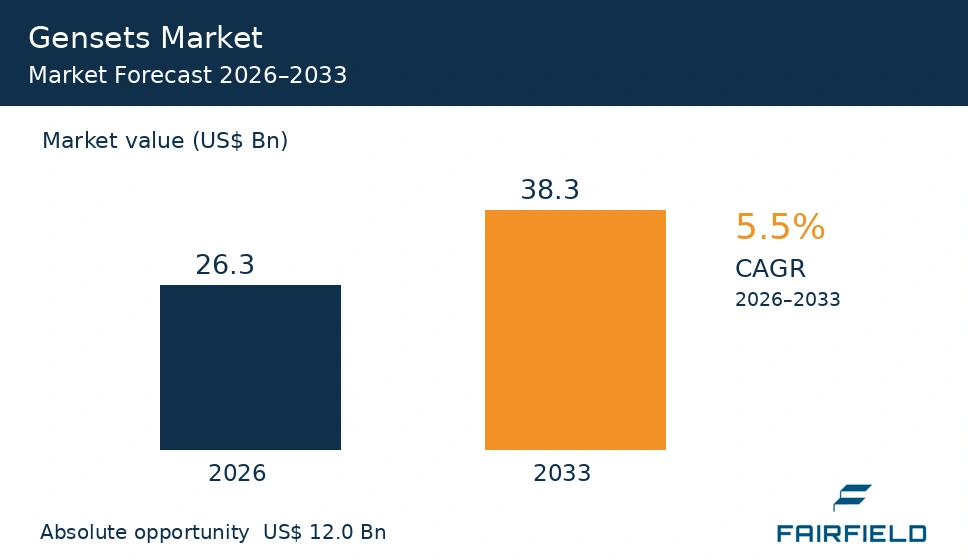
The global gensets market size is expected to be valued at US$ 26.3 billion in 2026 and projected to reach US$ 38.3 billion by 2033, growing at a CAGR of 5.5% between 2026 and 2033.
Between 2020 and 2025, the market grew at a CAGR of about 4.1%, rising from roughly US$ 20.4 billion to about US$ 24.9 billion, as data center construction surged, extreme weather and grid outages increased demand for backup power, and construction, mining, and telecom projects expanded in emerging markets. The gensets market covers generator sets that combine an engine, usually running on diesel, natural gas, gasoline, or biofuels, with an alternator to produce electricity. Gensets range from small portable units for homes and job sites to large stationary systems of several megawatts for hospitals, factories, and data centers. They provide standby power during outages, prime and continuous power where grids are weak or unavailable, and peak shaving to reduce electricity costs. In February 2026, AIP ordered 2 GW of Caterpillar natural gas gensets for a data center campus.
Key Report Takeaways
-
By Fuel: Diesel held about 58% share in 2025, while Gas is projected to expand at a 7.5% CAGR through 2033, driven by behind-the-meter prime power for data centers, lower emissions than diesel, abundant natural gas supply, and growing use of fast-start gas engines.
-
By Power Rating: 75-375 kVA held about 40% share in 2025, while Above 750 kVA is projected to expand at a 7.8% CAGR through 2033, driven by hyperscale and AI data centers, large hospitals, industrial plants, and utility-scale backup and peaking power projects.
-
By End Use: Industrial held about 36% share in 2025, while Data Centers is projected to expand at a 9.5% CAGR through 2033, driven by explosive AI computing demand, strict uptime requirements, grid connection delays, and multi-gigawatt on-site power orders.
-
By Region: Asia Pacific held about 31.7% share in 2025, while India is projected to expand at a 7.0% CAGR through 2033, driven by unreliable grid supply in many areas, rapid construction and industrial growth, telecom expansion, and fast-growing data center capacity.
Global Gensets Market Trends and Insights
Drivers Impact Analysis
Two drivers carry the strongest influence on gensets market demand during the forecast period.
| Driver | Impact on CAGR Forecast | Geographic Relevance | Impact Timeline |
| Data center expansion and on-site power needs | High | North America, Asia Pacific, Europe | Medium term (2-4 years) |
| Grid unreliability, extreme weather, and infrastructure growth | High | Global | Long term (≥4 years) |
Data Center Growth Is Driving the Gensets Market
Data center expansion and on-site power needs are the strongest drivers of the gensets market. Data centers need reliable power at all times.
The mechanism is that every data center installs large diesel or gas gensets to provide backup power during grid outages, and AI and cloud computing are driving construction of hyperscale campuses that each need hundreds of megawatts of capacity. In many regions, utility grid connections for new data centers take years, so developers are turning to behind-the-meter natural gas gensets as prime power. In February 2026, AIP ordered 2 GW of Caterpillar G3516 fast-response natural gas gensets for its Monarch Compute Campus, and in June 2026, Cummins agreed to supply natural gas gensets for a data center microgrid in Texas. These orders show how data centers are reshaping the genset industry.
Grid Unreliability and Infrastructure Growth Are Expanding the Gensets Market
Grid unreliability, extreme weather, and infrastructure growth are expanding the gensets market. Many users need backup or off-grid power.
The cause is that hurricanes, wildfires, heat waves, winter storms, and aging grid infrastructure are causing more frequent and longer power outages in North America, Europe, and Asia Pacific, driving demand for standby gensets in homes, hospitals, and businesses. In many parts of Asia Pacific, Middle East & Africa, and Latin America, grids are weak or unavailable, so factories, mines, telecom towers, and commercial buildings rely on gensets for daily power. Construction sites, events, and disaster relief need portable and rental gensets. Healthcare rules require backup power for hospitals. These factors create steady, broad demand for gensets of all sizes across every region, from small portable units to multi-megawatt installations.
Restraints Impact Analysis
Two restraints limit how quickly the gensets market grows.
| Restraint | Impact on CAGR Forecast | Geographic Relevance | Impact Timeline |
| Emission regulations and decarbonization pressure | High | Europe, North America, Asia Pacific | Long term (≥4 years) |
| Competition from batteries and renewable hybrid systems | Medium | Global | Medium term (2-4 years) |
Emission Rules Slow the Gensets Market
Emission regulations and decarbonization pressure slow the gensets market. Diesel engines face strict limits.
The problem is that diesel gensets emit nitrogen oxides, particulate matter, and carbon dioxide, and regulators are tightening emission standards such as US EPA Tier 4, EU Stage V, and India's CPCB IV+ rules. Meeting these standards requires costly after-treatment systems such as selective catalytic reduction and diesel particulate filters, raising product prices. Many cities restrict genset operating hours and noise levels. Companies with net-zero targets want to reduce diesel use, and some data center operators face permit challenges for large diesel fleets. These rules increase costs, slow approvals for some projects, and push buyers toward cleaner technologies, limiting growth for traditional diesel gensets in some markets, especially in dense cities with strict air quality rules.
Batteries and Hybrid Systems Restrict the Gensets Market
Competition from batteries and renewable hybrid systems restricts the gensets market. Users have more backup power options.
The constraint is that falling battery prices are making battery energy storage systems and uninterruptible power supplies more competitive for short-duration backup, while home solar and battery systems compete with residential standby gensets. Telecom operators are replacing some diesel gensets at towers with solar-battery hybrid systems to cut fuel and maintenance costs. Fuel cells are being tested for data center backup. Grid improvements in some emerging markets reduce the need for daily genset use. Hybrid systems combining gensets with batteries and solar reduce genset running hours and fuel use. These alternatives restrict genset volume growth in some applications, even as overall power demand rises, and push genset makers to design products that work alongside batteries and solar.
Market Opportunities
Gas, Hybrid, and Low-Carbon Gensets Open a Premium Revenue Pool
Gas, hybrid, and low-carbon gensets open a premium revenue pool. Customers want reliable power with lower emissions.
The opportunity comes from rising demand for natural gas gensets with fast-start and load-following capability for data center prime power, along with gensets that run on hydrotreated vegetable oil, biogas, and hydrogen blends. Hybrid systems combining gensets, batteries, and solar with smart controllers cut fuel use and emissions. Cummins reports record demand for its diesel, natural gas, and renewable diesel gensets. In November 2026, Caterpillar announced plans to expand large engine and turbine production, including restarting its 10 MW MaK gas engine, as its order backlog reached a record US$ 78 billion. Suppliers that offer clean fuels, advanced controls, and lifecycle services can earn premium prices and long-term customer relationships.
Rental, Services, and Emerging Markets Create a Growth Revenue Pool
Rental, services, and emerging markets create a growth revenue pool. Many customers need flexible power solutions.
The opportunity reflects strong demand for rental gensets for construction, events, mining, utilities, and disaster recovery, as well as long-term maintenance, remote monitoring, and power-as-a-service contracts. Digital monitoring helps users track fuel, performance, and maintenance needs, reducing downtime. At the same time, fast growth of industry, construction, telecom, and data centers in India, Indonesia, Vietnam, Nigeria, Saudi Arabia, and Brazil creates demand for gensets where grid power is unreliable. Companies with local assembly, strong dealer networks, financing options, and service capabilities can capture growth across these markets. Power-as-a-service models also let customers pay for electricity output rather than buying equipment, lowering upfront costs for mines, factories, and remote sites.
Segment Analysis
By Fuel: Diesel Leads While Gas Grows Fastest
Diesel held about 58% share in 2025. Diesel gensets are reliable, start quickly, deliver high power density, and are easy to refuel with widely available fuel, making them the standard choice for standby power in data centers, hospitals, commercial buildings, and industrial sites, and for prime power in remote locations. Their proven performance, long service life, and large installed base support continued demand, especially for emergency backup.
Gas is the fastest-growing fuel, expanding at a 7.5% CAGR through 2033. Natural gas gensets produce lower emissions, can run continuously using pipeline gas, and are increasingly used for behind-the-meter data center power, combined heat and power, and peak shaving. Fast-response gas engines from Caterpillar, Cummins, Rolls-Royce, and INNIO support data center needs. Gasoline, Biofuels, and Others form other segments. For the market, gas growth supports cleaner, higher-value continuous power.
By Power Rating: 75-375 kVA Leads While Above 750 kVA Grows Fastest
75-375 kVA held about 40% share in 2025. Mid-range gensets power commercial buildings, small factories, telecom sites, construction projects, hospitals, and retail centers. Their wide use, moderate prices, easy transport and installation, and suitability for both standby and prime power give this segment the largest share, especially in Asia Pacific and Middle East & Africa.
Above 750 kVA is the fastest-growing power rating, expanding at a 7.8% CAGR through 2033. Large gensets serve data centers, large hospitals, industrial plants, mines, and utility-scale projects, often in multi-unit installations. Below 75 kVA and 375-750 kVA form other segments, with small units serving homes and job sites. For the market, large genset growth raises average order value and supports high-value data center projects.
By End Use: Industrial Leads While Data Centers Grows Fastest
Industrial held about 36% share in 2025. Factories, mines, oil and gas sites, and process plants use gensets for backup and prime power. Broad demand from manufacturing, mining, oil and gas, and process industries, many of which operate in areas with weak grids, gives this end use the largest share.
Data Centers is the fastest-growing end use, expanding at a 9.5% CAGR through 2033. AI and cloud campuses need large backup and on-site prime power systems, often hundreds of units per site. Commercial, Residential, Healthcare, Telecom, and Others form other segments. Commercial buildings, hospitals, and telecom towers rely on gensets for backup, while residential standby generators grow with extreme weather events. For the market, data center growth adds very large orders.
Geography Analysis
Why Is North America Important to the Gensets Market?
North America is a major gensets market. The United States is the world's largest data center market, and grid connection delays are driving large orders for behind-the-meter natural gas gensets, while hurricanes, wildfires, and winter storms drive demand for home and commercial standby generators. Caterpillar, Cummins, Generac, and Rehlko are based in the region, and Rolls-Royce's mtu subsidiary is expanding its plant in South Carolina. Canada and Mexico add demand from mining, oil and gas, and industry. Key barriers include emission permits. One change shaping the region is multi-gigawatt data center genset orders.
Europe Shapes the Gensets Market Through Clean Power Standards
Europe is a major gensets market. Germany, the United Kingdom, France, Ireland, and the Netherlands have large data center clusters, healthcare, and industrial sectors that rely on backup power, and Rolls-Royce Power Systems, INNIO, Wärtsilä, and Atlas Copco are based in the region. EU Stage V emission rules drive demand for cleaner engines and alternative fuels. Key barriers include strict emission limits and grid connection constraints for data centers. One opportunity is HVO-ready and gas gensets for data centers and hospitals, supported by sustainability goals, cleaner fuel availability, and rapid data center growth in Ireland, Germany, and the Netherlands.
Which Region Is Leading the Gensets Market?
Asia Pacific is leading the gensets market with about 31.7% share in 2025, while India is the fastest-growing country, expanding at a 7.0% CAGR through 2033. China has huge construction, manufacturing, and data center industries. Japan is home to Mitsubishi Heavy Industries and Yanmar, while South Korea is building large data centers. India's grid gaps, construction growth, and data center boom drive demand, supported by Kirloskar Oil Engines and Cummins India. Key barriers include emission rules. One change shaping the region is rapid data center growth in India, Japan, Singapore, and South Korea.
Latin America Grows the Gensets Market Through Industrial and Mining Demand
Latin America is a growing gensets market. Brazil, Mexico, Chile, Argentina, and Colombia use gensets in mining, oil and gas, agriculture, construction, telecom, and commercial buildings, especially where grid supply is unreliable or remote. Chile and Peru have large mining operations, and Brazil and Mexico are attracting data center investment. Key barriers include currency swings, economic cycles, and high import duties on equipment. One opportunity is gensets for data centers, mining, and remote power, supported by industrial investment and frequent power shortages in some countries. Telecom tower growth across the region also supports small genset demand.
Middle East & Africa Builds the Gensets Market Through Off-Grid and Project Power
Middle East & Africa is a growing gensets market with strong demand for both backup and prime power. Saudi Arabia, the United Arab Emirates, and Qatar are building megaprojects, data centers, and industrial facilities, while Nigeria, South Africa, Kenya, and Egypt face frequent power shortages and load shedding that make gensets essential for homes, businesses, and hospitals. Large oil and gas operations and remote mining sites also need prime power. Key barriers include fuel costs, fuel supply disruptions, and price sensitivity. One opportunity is hybrid gensets combining engines, batteries, and solar for off-grid power, telecom towers, and mining sites.
Competitive Landscape
The gensets market is moderately consolidated. Caterpillar, Cummins, Rolls-Royce Power Systems through its mtu brand, Rehlko, formerly Kohler Energy, and Generac are leading players, while Mitsubishi Heavy Industries, Wärtsilä, INNIO, Atlas Copco, Kirloskar Oil Engines, Yanmar through HIMOINSA, and Aggreko compete strongly. Large engine makers dominate high-power gensets for data centers, hospitals, and industry, while many regional assemblers in Asia Pacific, Middle East & Africa, and Latin America package engines from major suppliers into lower-cost gensets. Generac leads residential standby generators in North America.
Companies compete on reliability, fast-start performance, fuel efficiency, emissions compliance, power range, fuel flexibility, digital controls and monitoring, delivery lead times, dealer and service networks, and total cost of ownership. Production capacity for large engines has become a key competitive factor as data center demand outpaces supply, and long lead times are pushing buyers to sign multi-year agreements.
Strategic moves show how competition is changing. In February 2026, Caterpillar secured a 2 GW natural gas genset order from AIP, and in June 2026, Cummins agreed to supply gas gensets for a Texas data center microgrid. In November 2026, Caterpillar announced plans to expand large engine and turbine output, while Rolls-Royce and INNIO are expanding US plants.
Three themes shape vendor strategy. First, companies are adding large engine capacity. Second, they are shifting toward gas and low-carbon fuels. Third, they are offering integrated microgrid and service solutions.
Gensets Market Industry Leaders
Caterpillar Inc.
Cummins Inc.
Rolls-Royce Power Systems (mtu)
Rehlko
Generac Holdings Inc.
Recent Industry Developments
-
November 2026: Caterpillar announced plans to expand production of large reciprocating engines and turbines as data center orders extend into 2029, with its order backlog reaching a record US$ 78 billion and the first units of its restarted 10 MW MaK gas engine shipping in the fourth quarter - expands capacity for large genset demand.
-
June 2026: Cummins agreed with Circe Energy to supply HSK78 and QSK60 natural gas generator sets for a behind-the-meter prime power microgrid at a high-performance computing data center in Texas, with deliveries from 2026 through 2030 - supports off-grid data center power.
-
February 2026: American Intelligence and Power ordered 2 GW of Caterpillar G3516 fast-response natural gas generator sets for its Monarch Compute Campus, with deliveries from September 2026 through August 2027 - one of the largest genset orders for AI infrastructure.
-
February 2025: Rolls-Royce launched upgraded mtu Series 1600 diesel generator sets for the 50 Hz market - strengthens its offering for standby and prime power.
Companies Covered in the Report
-
Caterpillar Inc.
-
Cummins Inc.
-
Rolls-Royce Power Systems (mtu)
-
Rehlko
-
Generac Holdings Inc.
-
Mitsubishi Heavy Industries, Ltd.
-
Wärtsilä Corporation
-
INNIO Group
-
Atlas Copco AB
-
Kirloskar Oil Engines Limited
-
Yanmar Holdings (HIMOINSA)
-
Aggreko
Gensets Market Report Scope
This report covers the gensets market, including diesel, gas, gasoline, biofuels, and other fuel gensets in below 75 kVA, 75-375 kVA, 375-750 kVA, and above 750 kVA power ratings, used in industrial, data centers, commercial, residential, healthcare, telecom, and other end uses. The base year is 2025, and the forecast period runs from 2026 to 2033. All values are expressed in US$ Billion.
| Fuel | Diesel, Gas, Gasoline, Biofuels, Others |
| Power Rating | Below 75 kVA, 75-375 kVA, 375-750 kVA, Above 750 kVA |
| End Use | Industrial, Data Centers, Commercial, Residential, Healthcare, Telecom, Others |
| Regions | North America, Europe, Asia Pacific, Latin America, Middle East & Africa |
1. Executive Summary
1.1 Gensets Market Snapshot
1.2 Future Projections
1.3 Key Market Trends
1.4 Regional Snapshot
2. Market Overview
2.1 Market Definition and Report Scope
2.2 Historical Market Trends
2.3 Market Dynamics
2.3.1 Drivers
2.3.1.1 Data Center Growth Is Driving the Gensets Market
2.3.1.2 Grid Unreliability and Infrastructure Growth Are Expanding the Gensets Market
2.3.2 Restraints
2.3.2.1 Emission Rules Slow the Gensets Market
2.3.2.2 Batteries and Hybrid Systems Restrict the Gensets Market
2.3.3 Market Opportunities
2.3.3.1 Gas, Hybrid, and Low-Carbon Gensets Open a Premium Revenue Pool
2.3.3.2 Rental, Services, and Emerging Markets Create a Growth Revenue Pool
3. Global Gensets Market Outlook, 2020–2033
3.1 Global Gensets Market Outlook, by Fuel, Value (US$ Billion), 2020–2033
3.1.1 Diesel
3.1.2 Gas
3.1.3 Gasoline
3.1.4 Biofuels
3.1.5 Others
3.2 Global Gensets Market Outlook, by Power Rating, Value (US$ Billion), 2020–2033
3.2.1 Below 75 kVA
3.2.2 75-375 kVA
3.2.3 375-750 kVA
3.2.4 Above 750 kVA
3.3 Global Gensets Market Outlook, by End Use, Value (US$ Billion), 2020–2033
3.3.1 Industrial
3.3.2 Data Centers
3.3.3 Commercial
3.3.4 Residential
3.3.5 Healthcare
3.3.6 Telecom
3.3.7 Others
3.4 Global Gensets Market Outlook, by Region, Value (US$ Billion), 2020–2033
3.4.1 North America
3.4.2 Europe
3.4.3 Asia Pacific
3.4.4 Latin America
3.4.5 Middle East & Africa
4. North America Gensets Market Outlook, 2020–2033
4.1 North America Gensets Market Outlook, by Fuel, Value (US$ Billion), 2020–2033
4.1.1 Diesel
4.1.2 Gas
4.1.3 Gasoline
4.1.4 Biofuels
4.1.5 Others
4.2 North America Gensets Market Outlook, by Power Rating, Value (US$ Billion), 2020–2033
4.2.1 Below 75 kVA
4.2.2 75-375 kVA
4.2.3 375-750 kVA
4.2.4 Above 750 kVA
4.3 North America Gensets Market Outlook, by End Use, Value (US$ Billion), 2020–2033
4.3.1 Industrial
4.3.2 Data Centers
4.3.3 Commercial
4.3.4 Residential
4.3.5 Healthcare
4.3.6 Telecom
4.3.7 Others
4.4 North America Gensets Market Outlook, by Country, Value (US$ Billion), 2020–2033
4.4.1 United States Gensets Market Outlook, by Fuel, 2020–2033
4.4.2 United States Gensets Market Outlook, by Power Rating, 2020–2033
4.4.3 United States Gensets Market Outlook, by End Use, 2020–2033
4.4.4 Canada Gensets Market Outlook, by Fuel, 2020–2033
4.4.5 Canada Gensets Market Outlook, by Power Rating, 2020–2033
4.4.6 Canada Gensets Market Outlook, by End Use, 2020–2033
4.4.7 Mexico Gensets Market Outlook, by Fuel, 2020–2033
4.4.8 Mexico Gensets Market Outlook, by Power Rating, 2020–2033
4.4.9 Mexico Gensets Market Outlook, by End Use, 2020–2033
5. Europe Gensets Market Outlook, 2020–2033
5.1 Europe Gensets Market Outlook, by Fuel, Value (US$ Billion), 2020–2033
5.1.1 Diesel
5.1.2 Gas
5.1.3 Gasoline
5.1.4 Biofuels
5.1.5 Others
5.2 Europe Gensets Market Outlook, by Power Rating, Value (US$ Billion), 2020–2033
5.2.1 Below 75 kVA
5.2.2 75-375 kVA
5.2.3 375-750 kVA
5.2.4 Above 750 kVA
5.3 Europe Gensets Market Outlook, by End Use, Value (US$ Billion), 2020–2033
5.3.1 Industrial
5.3.2 Data Centers
5.3.3 Commercial
5.3.4 Residential
5.3.5 Healthcare
5.3.6 Telecom
5.3.7 Others
5.4 Europe Gensets Market Outlook, by Country, Value (US$ Billion), 2020–2033
5.4.1 Germany Gensets Market Outlook, by Fuel, 2020–2033
5.4.2 Germany Gensets Market Outlook, by Power Rating, 2020–2033
5.4.3 Germany Gensets Market Outlook, by End Use, 2020–2033
5.4.4 United Kingdom Gensets Market Outlook, by Fuel, 2020–2033
5.4.5 United Kingdom Gensets Market Outlook, by Power Rating, 2020–2033
5.4.6 United Kingdom Gensets Market Outlook, by End Use, 2020–2033
5.4.7 France Gensets Market Outlook, by Fuel, 2020–2033
5.4.8 France Gensets Market Outlook, by Power Rating, 2020–2033
5.4.9 France Gensets Market Outlook, by End Use, 2020–2033
5.4.10 Ireland Gensets Market Outlook, by Fuel, 2020–2033
5.4.11 Ireland Gensets Market Outlook, by Power Rating, 2020–2033
5.4.12 Ireland Gensets Market Outlook, by End Use, 2020–2033
5.4.13 Netherlands Gensets Market Outlook, by Fuel, 2020–2033
5.4.14 Netherlands Gensets Market Outlook, by Power Rating, 2020–2033
5.4.15 Netherlands Gensets Market Outlook, by End Use, 2020–2033
6. Asia Pacific Gensets Market Outlook, 2020–2033
6.1 Asia Pacific Gensets Market Outlook, by Fuel, Value (US$ Billion), 2020–2033
6.1.1 Diesel
6.1.2 Gas
6.1.3 Gasoline
6.1.4 Biofuels
6.1.5 Others
6.2 Asia Pacific Gensets Market Outlook, by Power Rating, Value (US$ Billion), 2020–2033
6.2.1 Below 75 kVA
6.2.2 75-375 kVA
6.2.3 375-750 kVA
6.2.4 Above 750 kVA
6.3 Asia Pacific Gensets Market Outlook, by End Use, Value (US$ Billion), 2020–2033
6.3.1 Industrial
6.3.2 Data Centers
6.3.3 Commercial
6.3.4 Residential
6.3.5 Healthcare
6.3.6 Telecom
6.3.7 Others
6.4 Asia Pacific Gensets Market Outlook, by Country, Value (US$ Billion), 2020–2033
6.4.1 India Gensets Market Outlook, by Fuel, 2020–2033
6.4.2 India Gensets Market Outlook, by Power Rating, 2020–2033
6.4.3 India Gensets Market Outlook, by End Use, 2020–2033
6.4.4 China Gensets Market Outlook, by Fuel, 2020–2033
6.4.5 China Gensets Market Outlook, by Power Rating, 2020–2033
6.4.6 China Gensets Market Outlook, by End Use, 2020–2033
6.4.7 Japan Gensets Market Outlook, by Fuel, 2020–2033
6.4.8 Japan Gensets Market Outlook, by Power Rating, 2020–2033
6.4.9 Japan Gensets Market Outlook, by End Use, 2020–2033
6.4.10 South Korea Gensets Market Outlook, by Fuel, 2020–2033
6.4.11 South Korea Gensets Market Outlook, by Power Rating, 2020–2033
6.4.12 South Korea Gensets Market Outlook, by End Use, 2020–2033
6.4.13 Singapore Gensets Market Outlook, by Fuel, 2020–2033
6.4.14 Singapore Gensets Market Outlook, by Power Rating, 2020–2033
6.4.15 Singapore Gensets Market Outlook, by End Use, 2020–2033
7. Latin America Gensets Market Outlook, 2020–2033
7.1 Latin America Gensets Market Outlook, by Fuel, Value (US$ Billion), 2020–2033
7.1.1 Diesel
7.1.2 Gas
7.1.3 Gasoline
7.1.4 Biofuels
7.1.5 Others
7.2 Latin America Gensets Market Outlook, by Power Rating, Value (US$ Billion), 2020–2033
7.2.1 Below 75 kVA
7.2.2 75-375 kVA
7.2.3 375-750 kVA
7.2.4 Above 750 kVA
7.3 Latin America Gensets Market Outlook, by End Use, Value (US$ Billion), 2020–2033
7.3.1 Industrial
7.3.2 Data Centers
7.3.3 Commercial
7.3.4 Residential
7.3.5 Healthcare
7.3.6 Telecom
7.3.7 Others
7.4 Latin America Gensets Market Outlook, by Country, Value (US$ Billion), 2020–2033
7.4.1 Brazil Gensets Market Outlook, by Fuel, 2020–2033
7.4.2 Brazil Gensets Market Outlook, by Power Rating, 2020–2033
7.4.3 Brazil Gensets Market Outlook, by End Use, 2020–2033
7.4.4 Mexico Gensets Market Outlook, by Fuel, 2020–2033
7.4.5 Mexico Gensets Market Outlook, by Power Rating, 2020–2033
7.4.6 Mexico Gensets Market Outlook, by End Use, 2020–2033
7.4.7 Chile Gensets Market Outlook, by Fuel, 2020–2033
7.4.8 Chile Gensets Market Outlook, by Power Rating, 2020–2033
7.4.9 Chile Gensets Market Outlook, by End Use, 2020–2033
7.4.10 Argentina Gensets Market Outlook, by Fuel, 2020–2033
7.4.11 Argentina Gensets Market Outlook, by Power Rating, 2020–2033
7.4.12 Argentina Gensets Market Outlook, by End Use, 2020–2033
7.4.13 Colombia Gensets Market Outlook, by Fuel, 2020–2033
7.4.14 Colombia Gensets Market Outlook, by Power Rating, 2020–2033
7.4.15 Colombia Gensets Market Outlook, by End Use, 2020–2033
7.4.16 Peru Gensets Market Outlook, by Fuel, 2020–2033
7.4.17 Peru Gensets Market Outlook, by Power Rating, 2020–2033
7.4.18 Peru Gensets Market Outlook, by End Use, 2020–2033
8. Middle East & Africa Gensets Market Outlook, 2020–2033
8.1 Middle East & Africa Gensets Market Outlook, by Fuel, Value (US$ Billion), 2020–2033
8.1.1 Diesel
8.1.2 Gas
8.1.3 Gasoline
8.1.4 Biofuels
8.1.5 Others
8.2 Middle East & Africa Gensets Market Outlook, by Power Rating, Value (US$ Billion), 2020–2033
8.2.1 Below 75 kVA
8.2.2 75-375 kVA
8.2.3 375-750 kVA
8.2.4 Above 750 kVA
8.3 Middle East & Africa Gensets Market Outlook, by End Use, Value (US$ Billion), 2020–2033
8.3.1 Industrial
8.3.2 Data Centers
8.3.3 Commercial
8.3.4 Residential
8.3.5 Healthcare
8.3.6 Telecom
8.3.7 Others
8.4 Middle East & Africa Gensets Market Outlook, by Country, Value (US$ Billion), 2020–2033
8.4.1 Saudi Arabia Gensets Market Outlook, by Fuel, 2020–2033
8.4.2 Saudi Arabia Gensets Market Outlook, by Power Rating, 2020–2033
8.4.3 Saudi Arabia Gensets Market Outlook, by End Use, 2020–2033
8.4.4 United Arab Emirates Gensets Market Outlook, by Fuel, 2020–2033
8.4.5 United Arab Emirates Gensets Market Outlook, by Power Rating, 2020–2033
8.4.6 United Arab Emirates Gensets Market Outlook, by End Use, 2020–2033
8.4.7 Qatar Gensets Market Outlook, by Fuel, 2020–2033
8.4.8 Qatar Gensets Market Outlook, by Power Rating, 2020–2033
8.4.9 Qatar Gensets Market Outlook, by End Use, 2020–2033
8.4.10 Nigeria Gensets Market Outlook, by Fuel, 2020–2033
8.4.11 Nigeria Gensets Market Outlook, by Power Rating, 2020–2033
8.4.12 Nigeria Gensets Market Outlook, by End Use, 2020–2033
8.4.13 South Africa Gensets Market Outlook, by Fuel, 2020–2033
8.4.14 South Africa Gensets Market Outlook, by Power Rating, 2020–2033
8.4.15 South Africa Gensets Market Outlook, by End Use, 2020–2033
8.4.16 Kenya Gensets Market Outlook, by Fuel, 2020–2033
8.4.17 Kenya Gensets Market Outlook, by Power Rating, 2020–2033
8.4.18 Kenya Gensets Market Outlook, by End Use, 2020–2033
8.4.19 Egypt Gensets Market Outlook, by Fuel, 2020–2033
8.4.20 Egypt Gensets Market Outlook, by Power Rating, 2020–2033
8.4.21 Egypt Gensets Market Outlook, by End Use, 2020–2033
9. Competitive Landscape
9.1 Gensets Market Industry Leaders
9.2 Recent Industry Developments
9.3 Company Profiles
9.3.1 Caterpillar Inc.
9.3.2 Cummins Inc.
9.3.3 Rolls-Royce Power Systems (mtu)
9.3.4 Rehlko
9.3.5 Generac Holdings Inc.
9.3.6 Mitsubishi Heavy Industries, Ltd.
9.3.7 Wärtsilä Corporation
9.3.8 INNIO Group
9.3.9 Atlas Copco AB
9.3.10 Kirloskar Oil Engines Limited
9.3.11 Yanmar Holdings (HIMOINSA)
9.3.12 Aggreko
10. Appendix
10.1 Research Methodology
10.2 Report Assumptions
10.3 Acronyms and Abbreviations
| Fuel | Diesel, Gas, Gasoline, Biofuels, Others |
| Power Rating | Below 75 kVA, 75-375 kVA, 375-750 kVA, Above 750 kVA |
| End Use | Industrial, Data Centers, Commercial, Residential, Healthcare, Telecom, Others |
| Regions | North America, Europe, Asia Pacific, Latin America, Middle East & Africa |
Our Research Methodology
Considering the volatility of business today, traditional approaches to strategizing a game plan can be unfruitful if not detrimental. True ambiguity is no way to determine a forecast. A myriad of predetermined factors must be accounted for such as the degree of risk involved, the magnitude of circumstances, as well as conditions or consequences that are not known or unpredictable. To circumvent binary views that cast uncertainty, the application of market research intelligence to strategically posture, move, and enable actionable outcomes is necessary.
View Methodology
Quality Assured
Rigorous Validation Process

Confidentiality Assured
End-to-end Data Security

Custom Research Services
Tailored To Your Objectives
FAQs
The global gensets market is expected to be valued at US$ 26.3 billion in 2026, driven by data center and backup power demand.
The market is projected to grow at a 5.5% CAGR from 2026 to 2033, reaching about US$ 38.3 billion by 2033.
Asia Pacific leads with about 31.7% share, supported by large construction, industrial, and data center demand in China, India, and Japan.
India is growing fastest at a 7.0% CAGR, driven by grid gaps, construction and industrial growth, and a data center boom.
Key players include Caterpillar, Cummins, Rolls-Royce, Rehlko, and Generac, competing on reliability, emissions, power range, service, and price.
Related Reports
Electronics Recycling Market Size, Share, Insights, Competitive Landscape, and Forecast 2026 to 2033
The electronics recycling market is projected to reach US$ 91.50 billion by 2033, growing at 9.8% CAGR from US$ 47.50 billion in 2026.
Bunker Fuel Market Size, Share, Insights, Competitive Landscape, and Forecast 2026 to 2033
Explore the bunker fuel market outlook for 2026–2033, covering fuel types, vessels, sellers, regional trends, and leading companies.
Shale Gas Market Size, Share, Insights, Competitive Landscape, and Forecast 2026 to 2033
Explore the shale gas market outlook for 2026–2033, covering technologies, applications, gas types, regional trends, and leading companies.
Bus HVAC Systems Market Size, Share, Insights, Competitive Landscape, and Forecast 2026 to 2033
Explore the bus HVAC systems market outlook for 2026–2033, covering bus types, propulsion, cooling capacity, regional trends, and leading companies.
Frameless Solar Panels Market Size, Share, Insights, Competitive Landscape, and Forecast 2026 to 2033
Explore the frameless solar panels market outlook for 2026–2033, with cell technologies, mounting trends, regional demand, and competitive insights.
Building Energy Management Systems Market Size, Share, Insights, Competitive Landscape, and Forecast 2026 to 2033
Explore the building energy management systems market outlook for 2026–2033, with component trends, deployment insights, regions, and key suppliers.