



Graphite Market
Graphite Market Insights, Competitive Landscape, and Market Forecast - 2033
Global Graphite Market Forecast
- Global Graphite Market is expected to grow from USD 12.5 Bn in 2026 to USD 18.5 Bn by 2033. The market is projected to witness a CAGR of 6% during this period.
- Rising demand for lithium-ion batteries in electric vehicles and energy storage systems is identified as the key demand driver for the graphite market.
Graphite Market Insights
- Natural graphite powder with high purity (≥99.9%) is witnessing growing demand from refractories and foundries, fueled by rising steel and iron production in Asia Pacific and the Middle East.
- Synthetic graphite blocks with medium purity (95%–99.9%) are increasingly used in energy storage applications, as battery manufacturers prioritize consistency and stability in anode materials for electric vehicles.
- Low-purity synthetic graphite granules are in high demand for electrode production, supported by the rising use of electric arc furnaces in global steel recycling and decarbonisation initiatives.
- Synthetic graphite in other forms is gaining traction in lubricants and industrial additives, especially for high-temperature machinery and aerospace components requiring low friction and thermal stability.
- The demand for high-conductivity synthetic graphite materials is rapidly growing in electronics, driven by the global push for miniaturized, high-efficiency semiconductors and fuel cell technologies.
Key Growth Determinants
Rising steel and iron production worldwide is fuelling the demand for graphite in refractories and foundry applications
The surging global steel and iron production is significantly boosting demand for graphite in refractories and foundry applications. Refractories and foundries account for approximately 56–58% of natural graphite consumption, underscoring graphite’s critical role in high-temperature steelmaking processes. In 2024, U.S. natural graphite imports reached around 60,000 tons, with a substantial share directed toward refractory uses in furnaces and casting. As blast furnace and basic oxygen furnace operations expand, particularly in Asia, natural graphite demand in these applications continues to grow.
Beyond production volume, advanced refractory formulations used in electric arc furnaces (EAFs) and clean steel technologies are further driving the need for high-purity graphite. The shift toward low-carbon steelmaking through EAFs has increased the demand for carbon-containing refractories. Additionally, the growing use of sustainable and bio-based carbon additives in metallurgical processes is enhancing the value proposition of graphite. These trends strongly support its sustained growth in global refractories and foundry segments.
Key Growth Barriers
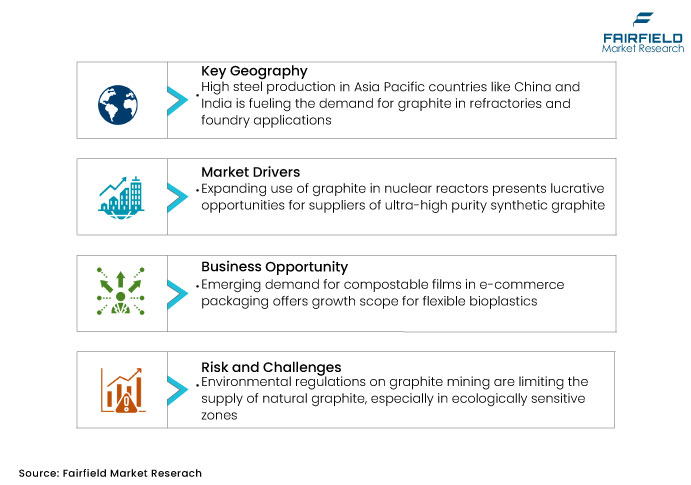
Environmental regulations on graphite mining are limiting the supply of natural graphite, especially in ecologically sensitive zones
Stringent environmental regulations targeting graphite mining, especially in ecologically sensitive areas like Madagascar and China, are choking the natural graphite supply. Leading producers have reduced mining activities to comply with stricter water-use and tailings disposal laws. For example, China cut natural graphite output in recent years to protect ecosystems and simultaneously boosted synthetic graphite production in response to stricter environmental controls.
Moreover, processing natural graphite requires harsh chemicals such as hydrofluoric acid and sodium hydroxide, and heightened emissions control adds cost and complexity. A comprehensive study shows that purification waste and acid runoff pose serious threats to water quality, prompting new restrictions on tailings management. These increasingly rigid compliance requirements elevate operational expenses and elongate approval timelines, subsequently hindering new mine development and tightening global graphite supplies.
Graphite Market Opportunities
Expanding use of graphite in nuclear reactors presents lucrative opportunities for suppliers of ultra-high-purity synthetic graphite
The accelerating global revival of nuclear energy is driving demand for ultra-high-purity synthetic graphite as reactor-grade moderators and reflectors. In 2025, the nuclear graphite sector saw substantial momentum, driven by advanced reactor projects across Europe, Asia, and North America. Suppliers capable of delivering 99.99%+ purity graphite stand to gain significantly from this expanding energy infrastructure.
Companies like Focus Graphite have achieved breakthrough 5N (99.999%) purity levels, unlocking entry into nuclear-grade markets historically dominated by synthetic producers. Additionally, strategic partnerships, such as those supporting domestic nuclear-grade graphite production, are reinforcing supply chains aligned with emerging micro-reactor deployments. These developments are creating lucrative, long-term opportunities for suppliers of ultra-high-purity synthetic graphite.
Segment-wise Overview
- Energy storage applications, especially lithium-ion batteries, are witnessing rapid growth due to global EV and grid storage expansion
The energy storage boom, driven by EV production and grid systems, is dramatically increasing graphite demand. Roughly 95% of lithium-ion battery anode material is graphite, with each electric vehicle battery containing about 50–100 kg of graphite. Grid storage also contributes to the growing demand for graphite in energy storage applications. For instance, China added 62 GW/141 GWh in 2024, while the U.S. installed 12.3 GW/37.1 GWh storage capacities, intensifying demand for battery-grade graphite.
Major industry moves also reinforce this trend. For example, GM’s multi-billion-dollar supply deal with Norway’s Vianode secures synthetic anode graphite to support 3 million EVs annually by 2030, marking a significant shift toward localized, strategic sourcing. Companies like Mitsubishi Chemical and CarbonScape are scaling anode production and securing patents to meet soaring EV battery needs. This signals that energy storage is the leading application fuelling global graphite market expansion.
- Synthetic graphite continues to dominate global supply due to its consistent quality, customizable properties, and technological flexibility
Synthetic graphite dominates the global supply due to its consistent quality and customizable properties. In 2024, synthetic production reached approximately 3 million tonnes, which is over double the natural graphite production of 1.3 million tonnes. This significant production of synthetic graphite ensures a reliable supply of graphite for the critical industries such as steelmaking, EV batteries, and electronics, where precision, high purity, and uniformity are essential performance parameters.
Investment and innovation are accelerating synthetic graphite's dominance. Reports indicate a strong presence in Asia-Pacific, which accounts for over 55% of global production. Meanwhile, North America is scaling up rapidly. For example, companies like Novonix secured US$1.2 billion in funding to build domestic synthetic anode plants, highlighting synthetic graphite's superior technological flexibility and growing preference across diverse end-use applications.
Regional Analysis
- Growing investments in domestic battery manufacturing in the U.S. are accelerating demand for locally sourced synthetic graphite
North America is rapidly expanding its battery manufacturing infrastructure, boosting demand for locally sourced synthetic graphite. The U.S. saw quarter-on-quarter battery investment peak at US$11 billion in 2024, driven by the Inflation Reduction Act’s tax credits for domestic production. Simultaneously, U.S.–China tensions and planned tariffs create urgency to secure homegrown supply chains, making synthetic graphite a top priority for regional battery anode makers.
Several companies are helping to grow the synthetic graphite market in North America. Anovion Battery Materials has started building a synthetic graphite plant in Georgia, which is expected to produce 35,000 tons of graphite every year. This project received US$117 million in funding from the United States government.
In another major development, POSCO Future M from South Korea announced a partnership with General Motors to set up a graphite processing facility in the United States. This new plant will help supply graphite for electric vehicle batteries and reduce dependence on foreign sources. These efforts show that North America is becoming more focused on building a strong and local graphite supply chain.
- High steel production in Asia Pacific countries like China and India is fuelling the demand for graphite in refractories and foundry applications
Asia Pacific remains the powerhouse of steel production, significantly fuelling graphite demand in refractories and foundries. China produced over 1 billion tonnes of crude steel in 2022, representing nearly 53% of global output, while India’s steel output surged 33% between 2019 and 2024, making it the fastest-growing producer. High-performance graphite refractories are essential to maintain durable linings in blast and electric arc furnaces operating under extreme temperatures.
The scale of steelmaking is driving innovation in South Asia’s refractory sector as well. China leads with annual refractory material production of around 25 million tonnes, essential for maintaining high-temperature furnace efficiency. In parallel, India, with over 900 steel plants and a capacity of 154 million tonnes, is increasing the use of graphite-based refractories to improve energy efficiency and extend furnace life. This trend highlights Asia Pacific’s vital role in driving natural graphite demand through refractories and foundry applications.
Europe's push for sustainable technologies is increasing graphite demand in conductive materials for fuel cells and green electronics
Europe’s transition toward sustainable technologies are significantly driving demand for graphite in conductive materials. The European Commission’s hydrogen strategy includes a
€1 billion Clean Hydrogen Partnership under Horizon Europe, aimed at scaling fuel cell innovation and infrastructure. High-purity graphite is essential in fuel cell bipolar plates, gas diffusion layers, and catalyst substrates, which directly support clean mobility, heating, and industrial energy systems in Europe.
Major European manufacturers are responding by securing sustainable graphite supply chains. Nordic Bio-Graphite and Talga Group are securing jumbo flake graphite to produce thin-format graphite foil used in smartphones, fuel cells, and electric vehicle heat management. Meanwhile, SGL Carbon reported over one billion euros in revenue in 2024, with increased demand for graphite products in semiconductors, batteries, and fuel cells, demonstrating Europe’s commitment to localized, high-performance conductive graphite innovation.
Competitive Landscape
The global graphite market is highly competitive largely dominated by vertically integrated players focusing on synthetic graphite. Shanshan Corporation leads the anode materials segment with a 21 percent market share and over 465 battery-related patents, reinforcing its strength through research and development and strong customer relationships. Their large-scale production capacity for synthetic graphite used in lithium-ion batteries highlights how innovation and scale define market leadership.
Western competitors are rapidly gaining ground through government support and strategic investment. Novonix secured up to 1.2 billion U.S. dollars in funding from the Department of Energy to build North America's first large-scale synthetic graphite plant in Chattanooga, Tennessee. At the same time, U.S. authorities are imposing steep tariffs on Chinese battery graphite to encourage domestic production and reduce import dependence. Meanwhile, natural graphite producers in Mozambique, Madagascar, and the United States are expanding output to diversify supply chains and reduce geopolitical risk. This shows that supply chain control, resource localization, and trade protection policies are becoming key competitive tools in the global graphite market.
Key Companies
- Imerys S.A.
- Grafitbergbau Kaisersberg GmbH
- GrafTech International
- BTR New Material Group Co., Ltd.
- Northern Graphite
- Yixiang Graphite
- Qingdao Black Dragon
- Dongyang Graphite
- Mineral Commodities Ltd.
- Asbury Carbons.
- Graphit Kropfmühl GmbH
- SGL Carbon
- Mason Resources Inc.
- NOVONIX Limited
- Nacional de Grafite
- Tirupati Carbons & Chemicals Pvt Ltd
- Graphite India Limited
- Baofeng Carbon
Expert Opinion
- Graphite is no longer just a refractory material; its strategic importance has grown with the rise of lithium-ion batteries, positioning synthetic graphite as a critical mineral in the energy transition.
- Increasing environmental regulations and dependency on China for both natural and synthetic graphite are prompting governments and OEMs to localize and diversify their graphite supply chains globally.
- Innovations in battery chemistries may shift material demand, but graphite remains indispensable due to its unmatched performance in anodes, especially as EV adoption and grid storage scale aggressively.
- Future market growth will be shaped by advancements in purification technology, strategic mining in Africa and North America, and aggressive capacity expansions in synthetic graphite by leading Asian players.
Global Graphite Market Segmentation-
By Product Type
- Natural Graphite
- Synthetic Graphite
By Form
- Powder
- Block
- Granule
- Others
By Purity Level
- High Purity (≥99.9%)
- Medium Purity (95%–99.9%)
- Low Purity (<95%)
By Application
- Refractories & Foundries
- Energy Storage (Batteries)
- Electrodes
- Lubricants & Additives
- Electronics (Conductive Materials)
- Nuclear Reactors
- Other Industrial Applications
By Region
- North America
- Europe
- Asia Pacific
- Latin America
- Middle East & Africa
- Executive Summary
- Global Graphite Market Snapshot
- Future Projections
- Key Market Trends
- Regional Snapshot, by Value, 2026
- Analyst Recommendations
- Market Overview
- Market Definitions and Segmentations
- Market Dynamics
- Drivers
- Restraints
- Market Opportunities
- Value Chain Analysis
- COVID-19 Impact Analysis
- Porter's Five Forces Analysis
- Impact of Russia-Ukraine Conflict
- PESTLE Analysis
- Regulatory Analysis
- Price Trend Analysis
- Current Prices and Future Projections, 2025-2033
- Price Impact Factors
- Global Graphite Market Outlook, 2020 - 2033
- Global Graphite Market Outlook, by Product Type, Value (US$ Mn), 2020-2033
- Natural Graphite
- Synthetic Graphite
- Global Graphite Market Outlook, by Form, Value (US$ Mn), 2020-2033
- Powder
- Block
- Granule
- Others
- Global Graphite Market Outlook, by Purity Level, Value (US$ Mn), 2020-2033
- High Purity (≥99.9%)
- Medium Purity (95%–99.9%)
- Low Purity (<95%)
- Global Graphite Market Outlook, by Application, Value (US$ Mn), 2020-2033
- Refractories & Foundries
- Energy Storage (Batteries)
- Electrodes
- Lubricants & Additives
- Electronics (Conductive Materials)
- Nuclear Reactors
- Other Industrial Applications
- Global Graphite Market Outlook, by Region, Value (US$ Mn), 2020-2033
- North America
- Europe
- Asia Pacific
- Latin America
- Middle East & Africa
- Global Graphite Market Outlook, by Product Type, Value (US$ Mn), 2020-2033
- North America Graphite Market Outlook, 2020 - 2033
- North America Graphite Market Outlook, by Product Type, Value (US$ Mn), 2020-2033
- Natural Graphite
- Synthetic Graphite
- North America Graphite Market Outlook, by Form, Value (US$ Mn), 2020-2033
- Powder
- Block
- Granule
- Others
- North America Graphite Market Outlook, by Purity Level, Value (US$ Mn), 2020-2033
- High Purity (≥99.9%)
- Medium Purity (95%–99.9%)
- Low Purity (<95%)
- North America Graphite Market Outlook, by Application, Value (US$ Mn), 2020-2033
- Refractories & Foundries
- Energy Storage (Batteries)
- Electrodes
- Lubricants & Additives
- Electronics (Conductive Materials)
- Nuclear Reactors
- Other Industrial Applications
- North America Graphite Market Outlook, by Country, Value (US$ Mn), 2020-2033
- U.S. Graphite Market Outlook, by Product Type, 2020-2033
- U.S. Graphite Market Outlook, by Form, 2020-2033
- U.S. Graphite Market Outlook, by Purity Level, 2020-2033
- U.S. Graphite Market Outlook, by Application, 2020-2033
- Canada Graphite Market Outlook, by Product Type, 2020-2033
- Canada Graphite Market Outlook, by Form, 2020-2033
- Canada Graphite Market Outlook, by Purity Level, 2020-2033
- Canada Graphite Market Outlook, by Application, 2020-2033
- BPS Analysis/Market Attractiveness Analysis
- North America Graphite Market Outlook, by Product Type, Value (US$ Mn), 2020-2033
- Europe Graphite Market Outlook, 2020 - 2033
- Europe Graphite Market Outlook, by Product Type, Value (US$ Mn), 2020-2033
- Natural Graphite
- Synthetic Graphite
- Europe Graphite Market Outlook, by Form, Value (US$ Mn), 2020-2033
- Powder
- Block
- Granule
- Others
- Europe Graphite Market Outlook, by Purity Level, Value (US$ Mn), 2020-2033
- High Purity (≥99.9%)
- Medium Purity (95%–99.9%)
- Low Purity (<95%)
- Europe Graphite Market Outlook, by Application, Value (US$ Mn), 2020-2033
- Refractories & Foundries
- Energy Storage (Batteries)
- Electrodes
- Lubricants & Additives
- Electronics (Conductive Materials)
- Nuclear Reactors
- Other Industrial Applications
- Europe Graphite Market Outlook, by Country, Value (US$ Mn), 2020-2033
- Germany Graphite Market Outlook, by Product Type, 2020-2033
- Germany Graphite Market Outlook, by Form, 2020-2033
- Germany Graphite Market Outlook, by Purity Level, 2020-2033
- Germany Graphite Market Outlook, by Application, 2020-2033
- Italy Graphite Market Outlook, by Product Type, 2020-2033
- Italy Graphite Market Outlook, by Form, 2020-2033
- Italy Graphite Market Outlook, by Purity Level, 2020-2033
- Italy Graphite Market Outlook, by Application, 2020-2033
- France Graphite Market Outlook, by Product Type, 2020-2033
- France Graphite Market Outlook, by Form, 2020-2033
- France Graphite Market Outlook, by Purity Level, 2020-2033
- France Graphite Market Outlook, by Application, 2020-2033
- U.K. Graphite Market Outlook, by Product Type, 2020-2033
- U.K. Graphite Market Outlook, by Form, 2020-2033
- U.K. Graphite Market Outlook, by Purity Level, 2020-2033
- U.K. Graphite Market Outlook, by Application, 2020-2033
- Spain Graphite Market Outlook, by Product Type, 2020-2033
- Spain Graphite Market Outlook, by Form, 2020-2033
- Spain Graphite Market Outlook, by Purity Level, 2020-2033
- Spain Graphite Market Outlook, by Application, 2020-2033
- Russia Graphite Market Outlook, by Product Type, 2020-2033
- Russia Graphite Market Outlook, by Form, 2020-2033
- Russia Graphite Market Outlook, by Purity Level, 2020-2033
- Russia Graphite Market Outlook, by Application, 2020-2033
- Rest of Europe Graphite Market Outlook, by Product Type, 2020-2033
- Rest of Europe Graphite Market Outlook, by Form, 2020-2033
- Rest of Europe Graphite Market Outlook, by Purity Level, 2020-2033
- Rest of Europe Graphite Market Outlook, by Application, 2020-2033
- BPS Analysis/Market Attractiveness Analysis
- Europe Graphite Market Outlook, by Product Type, Value (US$ Mn), 2020-2033
- Asia Pacific Graphite Market Outlook, 2020 - 2033
- Asia Pacific Graphite Market Outlook, by Product Type, Value (US$ Mn), 2020-2033
- Natural Graphite
- Synthetic Graphite
- Asia Pacific Graphite Market Outlook, by Form, Value (US$ Mn), 2020-2033
- Powder
- Block
- Granule
- Others
- Asia Pacific Graphite Market Outlook, by Purity Level, Value (US$ Mn), 2020-2033
- High Purity (≥99.9%)
- Medium Purity (95%–99.9%)
- Low Purity (<95%)
- Asia Pacific Graphite Market Outlook, by Application, Value (US$ Mn), 2020-2033
- Refractories & Foundries
- Energy Storage (Batteries)
- Electrodes
- Lubricants & Additives
- Electronics (Conductive Materials)
- Nuclear Reactors
- Other Industrial Applications
- Asia Pacific Graphite Market Outlook, by Country, Value (US$ Mn), 2020-2033
- China Graphite Market Outlook, by Product Type, 2020-2033
- China Graphite Market Outlook, by Form, 2020-2033
- China Graphite Market Outlook, by Purity Level, 2020-2033
- China Graphite Market Outlook, by Application, 2020-2033
- Japan Graphite Market Outlook, by Product Type, 2020-2033
- Japan Graphite Market Outlook, by Form, 2020-2033
- Japan Graphite Market Outlook, by Purity Level, 2020-2033
- Japan Graphite Market Outlook, by Application, 2020-2033
- South Korea Graphite Market Outlook, by Product Type, 2020-2033
- South Korea Graphite Market Outlook, by Form, 2020-2033
- South Korea Graphite Market Outlook, by Purity Level, 2020-2033
- South Korea Graphite Market Outlook, by Application, 2020-2033
- India Graphite Market Outlook, by Product Type, 2020-2033
- India Graphite Market Outlook, by Form, 2020-2033
- India Graphite Market Outlook, by Purity Level, 2020-2033
- India Graphite Market Outlook, by Application, 2020-2033
- Southeast Asia Graphite Market Outlook, by Product Type, 2020-2033
- Southeast Asia Graphite Market Outlook, by Form, 2020-2033
- Southeast Asia Graphite Market Outlook, by Purity Level, 2020-2033
- Southeast Asia Graphite Market Outlook, by Application, 2020-2033
- Rest of SAO Graphite Market Outlook, by Product Type, 2020-2033
- Rest of SAO Graphite Market Outlook, by Form, 2020-2033
- Rest of SAO Graphite Market Outlook, by Purity Level, 2020-2033
- Rest of SAO Graphite Market Outlook, by Application, 2020-2033
- BPS Analysis/Market Attractiveness Analysis
- Asia Pacific Graphite Market Outlook, by Product Type, Value (US$ Mn), 2020-2033
- Latin America Graphite Market Outlook, 2020 - 2033
- Latin America Graphite Market Outlook, by Product Type, Value (US$ Mn), 2020-2033
- Natural Graphite
- Synthetic Graphite
- Latin America Graphite Market Outlook, by Form, Value (US$ Mn), 2020-2033
- Powder
- Block
- Granule
- Others
- Latin America Graphite Market Outlook, by Purity Level, Value (US$ Mn), 2020-2033
- High Purity (≥99.9%)
- Medium Purity (95%–99.9%)
- Low Purity (<95%)
- Latin America Graphite Market Outlook, by Application, Value (US$ Mn), 2020-2033
- Refractories & Foundries
- Energy Storage (Batteries)
- Electrodes
- Lubricants & Additives
- Electronics (Conductive Materials)
- Nuclear Reactors
- Other Industrial Applications
- Latin America Graphite Market Outlook, by Country, Value (US$ Mn), 2020-2033
- Brazil Graphite Market Outlook, by Product Type, 2020-2033
- Brazil Graphite Market Outlook, by Form, 2020-2033
- Brazil Graphite Market Outlook, by Purity Level, 2020-2033
- Brazil Graphite Market Outlook, by Application, 2020-2033
- Mexico Graphite Market Outlook, by Product Type, 2020-2033
- Mexico Graphite Market Outlook, by Form, 2020-2033
- Mexico Graphite Market Outlook, by Purity Level, 2020-2033
- Mexico Graphite Market Outlook, by Application, 2020-2033
- Argentina Graphite Market Outlook, by Product Type, 2020-2033
- Argentina Graphite Market Outlook, by Form, 2020-2033
- Argentina Graphite Market Outlook, by Purity Level, 2020-2033
- Argentina Graphite Market Outlook, by Application, 2020-2033
- Rest of LATAM Graphite Market Outlook, by Product Type, 2020-2033
- Rest of LATAM Graphite Market Outlook, by Form, 2020-2033
- Rest of LATAM Graphite Market Outlook, by Purity Level, 2020-2033
- Rest of LATAM Graphite Market Outlook, by Application, 2020-2033
- BPS Analysis/Market Attractiveness Analysis
- Latin America Graphite Market Outlook, by Product Type, Value (US$ Mn), 2020-2033
- Middle East & Africa Graphite Market Outlook, 2020 - 2033
- Middle East & Africa Graphite Market Outlook, by Product Type, Value (US$ Mn), 2020-2033
- Natural Graphite
- Synthetic Graphite
- Middle East & Africa Graphite Market Outlook, by Form, Value (US$ Mn), 2020-2033
- Powder
- Block
- Granule
- Others
- Middle East & Africa Graphite Market Outlook, by Purity Level, Value (US$ Mn), 2020-2033
- High Purity (≥99.9%)
- Medium Purity (95%–99.9%)
- Low Purity (<95%)
- Middle East & Africa Graphite Market Outlook, by Application, Value (US$ Mn), 2020-2033
- Refractories & Foundries
- Energy Storage (Batteries)
- Electrodes
- Lubricants & Additives
- Electronics (Conductive Materials)
- Nuclear Reactors
- Other Industrial Applications
- Middle East & Africa Graphite Market Outlook, by Country, Value (US$ Mn), 2020-2033
- GCC Graphite Market Outlook, by Product Type, 2020-2033
- GCC Graphite Market Outlook, by Form, 2020-2033
- GCC Graphite Market Outlook, by Purity Level, 2020-2033
- GCC Graphite Market Outlook, by Application, 2020-2033
- South Africa Graphite Market Outlook, by Product Type, 2020-2033
- South Africa Graphite Market Outlook, by Form, 2020-2033
- South Africa Graphite Market Outlook, by Purity Level, 2020-2033
- South Africa Graphite Market Outlook, by Application, 2020-2033
- Egypt Graphite Market Outlook, by Product Type, 2020-2033
- Egypt Graphite Market Outlook, by Form, 2020-2033
- Egypt Graphite Market Outlook, by Purity Level, 2020-2033
- Egypt Graphite Market Outlook, by Application, 2020-2033
- Nigeria Graphite Market Outlook, by Product Type, 2020-2033
- Nigeria Graphite Market Outlook, by Form, 2020-2033
- Nigeria Graphite Market Outlook, by Purity Level, 2020-2033
- Nigeria Graphite Market Outlook, by Application, 2020-2033
- Rest of Middle East Graphite Market Outlook, by Product Type, 2020-2033
- Rest of Middle East Graphite Market Outlook, by Form, 2020-2033
- Rest of Middle East Graphite Market Outlook, by Purity Level, 2020-2033
- Rest of Middle East Graphite Market Outlook, by Application, 2020-2033
- BPS Analysis/Market Attractiveness Analysis
- Middle East & Africa Graphite Market Outlook, by Product Type, Value (US$ Mn), 2020-2033
- Competitive Landscape
- Company Vs Segment Heatmap
- Company Market Share Analysis, 2025
- Competitive Dashboard
- Company Profiles
- Imerys S.A.
- Company Overview
- Product Portfolio
- Financial Overview
- Business Strategies and Developments
- Grafitbergbau Kaisersberg GmbH
- GrafTech International
- BTR New Material Group Co., Ltd.
- Northern Graphite
- Yixiang Graphite
- Qingdao Black Dragon
- Dongyang Graphite
- Mineral Commodities Ltd.
- Asbury Carbons.
- Imerys S.A.
- Appendix
- Research Methodology
- Report Assumptions
- Acronyms and Abbreviations
|
BASE YEAR |
HISTORICAL DATA |
FORECAST PERIOD |
UNITS |
|||
 |
2025 |
 |
2019 - 2024 |
 |
2026 - 2033 |
Value: US$ Billion |
|
REPORT FEATURES |
DETAILS |
|
Product Type Coverage |
|
|
Form Coverage |
|
|
Purity Level Coverage |
|
|
Application Coverage |
|
|
Geographical Coverage |
|
|
Leading Companies |
|
|
Report Highlights |
Key Market Indicators, Macro-micro economic impact analysis, Technological Roadmap, Key Trends, Driver, Restraints, and Future Opportunities & Revenue Pockets, Porter’s 5 Forces Analysis, Historical Trend (2019-2024), Market Estimates and Forecast, Market Dynamics, Industry Trends, Competition Landscape, Category, Region, Country-wise Trends & Analysis, COVID-19 Impact Analysis (Demand and Supply Chain) |
Our Research Methodology
Considering the volatility of business today, traditional approaches to strategizing a game plan can be unfruitful if not detrimental. True ambiguity is no way to determine a forecast. A myriad of predetermined factors must be accounted for such as the degree of risk involved, the magnitude of circumstances, as well as conditions or consequences that are not known or unpredictable. To circumvent binary views that cast uncertainty, the application of market research intelligence to strategically posture, move, and enable actionable outcomes is necessary.
View Methodology
Quality Assured
Rigorous Validation Process

Confidentiality Assured
End-to-end Data Security

Custom Research Services
Tailored To Your Objectives
FAQs
Graphite Market is valued at USD 12.5 Bn in 2026.
Rising demand for lithium-ion batteries in electric vehicles and energy storage systems is propelling the growth of the Graphite market.
Imerys S.A., Grafitbergbau Kaisersberg GmbH, GrafTech International, BTR New Material Group Co., Ltd., and Northern Graphite are some leading industry players.
The market is projected to record a CAGR of 6.0% during the forecast period from 2026 to 2033.
Expanding use of graphite in nuclear reactors offers significant market opportunities.
Related Reports
Expanded Metal Foils Market Size, Share, Insights, Competitive Landscape, and Forecast 2026 to 2033
The global expanded metal foils market is valued at US$0.5 billion in 2026, reaching US$0.9 billion by 2033, growing at an 8.8% CAGR
Zirconium Market Size, Share, Insights, Competitive Landscape, and Forecast 2026 to 2033
The global zirconium market is valued at US$4.5 billion in 2026, reaching US$6.5 billion by 2033, growing at a 5.4% CAGR
Precision Stainless Steel Market Size, Share, Insights, Competitive Landscape, and Forecast 2026 to 2033
The global precision stainless steel market is valued at US$9.8 billion in 2026, reaching US$15.7 billion by 2033, growing at a 6.96% CAGR
Multi-mode Receiver Market Insights, Competitive Landscape, and Market Forecast 2033
Multi-Mode Receiver Market is projected to reach US$2.18 billion by 2033, driven by aircraft modernization, navigation mandates and fleet expansion
Finished Lubricants Market Insights, Competitive Landscape, and Market Forecast 2026–2033
Finished Lubricants Market is projected to reach US$253.02 billion by 2033, driven by automotive growth, industrialization and stricter emissions standards
Discrete Capacitor Market Insights, Competitive Landscape, and Market Forecast 2026–2033
Discrete Capacitor Market is projected to reach US$32.51 billion by 2033, driven by EV production, AI infrastructure, semiconductor manufacturing