



Group Life Insurance Market
Group Life Insurance Market Size, Share, Insights, Competitive Landscape, and Forecast 2026 to 2033
Group Life Insurance Market Size and Trend Analysis
Is the Group Life Insurance Market Still Growing?
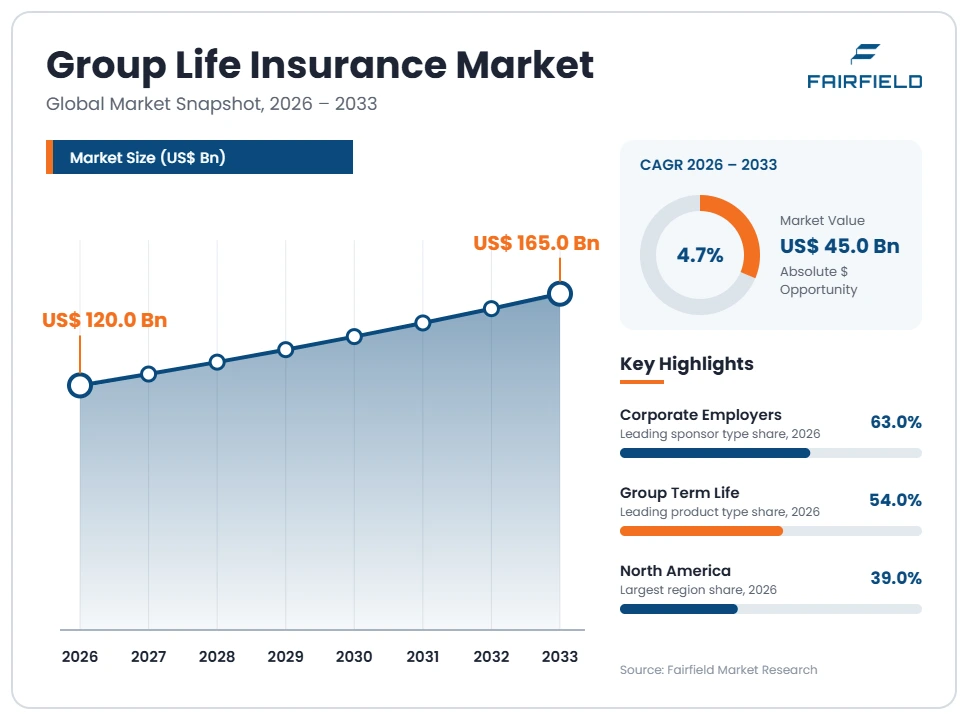
The global group life insurance market size is expected to be valued at US$ 120.0 billion in 2026 and projected to reach US$ 165.0 billion by 2033, growing at a CAGR of 4.7% between 2026 and 2033.
All values measure direct written premium for employer, association and affinity group cover. Between 2020 and 2025 the market grew at a 3.9% CAGR, a modest rate that reflects a mature, commoditised product line rather than weak demand. Three factors now carry growth. Employee-paid supplemental elections are rising where employers already provide basic cover, lifting premium per covered life. Wage inflation increases benefit amounts automatically, because most schemes set cover as a multiple of salary. Formal employment growth outside mature markets is widening the covered population. Volume growth in established markets is close to flat, so value growth depends largely on richer elections and higher insured salaries.
Key Report Takeaways
- By Product Type: Group Term Life held 54% share in 2026, while Supplemental and Voluntary Life is projected to expand at a 7.1% CAGR through 2033, as employees elect additional cover above the employer-funded base amount.
- By Sponsor Type: Corporate Employers held 63% share in 2026, while Associations and Affinity Groups are projected to expand at a 6.3% CAGR through 2033, supported by professional bodies adding member schemes with guaranteed issue limits.
- By Enterprise Size: Large Employers held 61% share in 2026, while Small Employers are projected to expand at a 6.9% CAGR through 2033, because simplified underwriting has made schemes viable below fifty lives.
- By Distribution Channel: Brokers and Employee Benefit Consultants held 57% share in 2026, while Worksite Enrolment Platforms are projected to expand at an 8.4% CAGR through 2033, driven by active-choice enrolment replacing passive renewal.
- By Geography: North America held 39% share in 2026, while Asia Pacific is projected to expand at a 6.8% CAGR through 2033, led by expanding formal payrolls and employer benefit mandates.
Global Group Life Insurance Market Trends and Insights
Drivers Impact Analysis
Two forces explain most of the premium growth available in this mature benefit line.
| Driver | Impact on CAGR Forecast | Geographic Relevance | Impact Timeline |
| Rising supplemental and voluntary election rates above the employer-funded base | High | North America, Europe | Medium term (2–4 years) |
| Formal payroll expansion and employer death benefit obligations | High | Asia Pacific, Middle East & Africa, Latin America | Long term (≥4 years) |
Voluntary Election Rates Lift Group Life Premium Above the Employer-Funded Base
Employee-paid supplemental cover is the main source of premium growth in developed markets. Basic employer-paid life is close to universal among large firms, so additional revenue comes from persuading employees to buy cover above the standard one-times-salary benefit. Each incremental election raises premium per covered life without requiring a new employer relationship, which makes it the most efficient growth lever available to insurers in this line.
The causal mechanism is behavioural and tax-related. Under Internal Revenue Code Section 79, employer-paid group term life above US$ 50,000 of cover creates imputed income for the employee, which caps how much employers are willing to fund directly. Employees therefore buy the difference themselves with after-tax payroll deductions. Decision-support tools presented during annual enrolment, together with guaranteed issue limits that waive medical evidence, have measurably raised participation.
Expanding Formal Payrolls and Death Benefit Rules Widen the Insured Population
Growth outside mature markets comes from enrolment rather than richer benefits. As employment shifts from informal to formal arrangements, employers register workers for payroll and statutory benefits, and group life cover is frequently added at that point because it is inexpensive per head and simple to administer. This adds covered lives at low average premium, which explains why developing markets grow faster in volume than in value.
The specific instruments vary by country. Several jurisdictions require employers to provide a death-in-service benefit or an end-of-service gratuity that insurers can fund through a group policy. Elsewhere, public pension systems provide only a minimal death benefit, leaving an acknowledged gap that employer schemes fill. Multinational employers standardising benefit floors across subsidiaries also extend cover into markets where it was not previously offered.
Restraints Impact Analysis
Two structural constraints keep growth in this line below that of most other insurance products.
| Restraint | Impact on CAGR Forecast | Geographic Relevance | Impact Timeline |
| Commoditised pricing and persistent rate competition at renewal | High | Global | Short term (≤2 years) |
| Saturation of employer-paid basic cover among large employers | High | North America, Europe | Long term (≥4 years) |
Commoditised Pricing and Renewal Rate Competition Compress Group Life Margins
Group life is sold largely on price, and that compresses the margin available to fund growth. Benefit definitions are near-identical across carriers, claims are objective and rarely disputed, and brokers market accounts competitively at each renewal. Insurers consequently win business by shaving rates, which limits the earnings that can be reinvested in distribution technology or underwriting capability, and makes the line a scale business rather than a differentiated one.
Two cost sources sit behind the pressure. Mortality assumptions required revision after the pandemic period, when group life claims experience deviated sharply from prior tables, particularly among working-age insured populations; rebuilding credible improvement assumptions carries real actuarial and reserving cost. Separately, capital held against mortality and catastrophe risk under Solvency II and the NAIC risk-based capital regime must be remunerated from thin margins.
Saturation of Employer-Paid Basic Cover Caps Volume Growth in Large Employers
The large-employer segment is effectively saturated, which removes the simplest growth route. Most sizeable firms in mature markets already provide basic group term life as a standard benefit, usually at one or two times annual salary. There is no new employer to acquire, only an incumbent to displace, so competitive activity is a transfer of existing premium between carriers rather than an addition to the market.
The underlying cause is the nature of the benefit itself. Basic life is inexpensive, uncontroversial and expected by employees, so it was adopted decades ago and has remained in place. Benefit amounts are tied to salary, meaning premium grows only with payroll. Where employers have reviewed their benefit spend, they have generally redirected incremental budget toward medical, mental health and retirement provision rather than increasing death cover.
Market Opportunities
Worksite Enrolment Technology Opens an Underused Voluntary Premium Pool
Enrolment technology is the clearest untapped pool in group life, because participation rates in voluntary cover remain far below eligibility. Worksite Enrolment Platforms are projected to grow at an 8.4% CAGR through 2033. Moving from passive renewal to active-choice enrolment, with personalised benefit modelling and payroll-integrated deductions, measurably raises election rates and average cover amounts, and it does so without any change to the underlying product or price.
Carriers with strong benefits administration integrations, platform vendors and enrolment specialists can all capture this pool. Demand comes from employers who want higher benefit engagement without higher employer cost, since voluntary life insurance is employee-funded. Guaranteed issue limits and simplified underwriting rules, applied at the point of enrolment, remove the medical evidence step that historically caused employees to abandon applications midway.
Small and Mid-Size Employer Schemes Form an Underpenetrated Premium Pool
Small employers represent the largest block of uninsured working lives in mature markets and an expanding revenue pool. Schemes below one hundred lives have historically been uneconomic because acquisition and administration costs outweighed premium. Simplified underwriting, standardised plan designs and digital quote-to-bind processes have lowered that cost base enough to make the segment viable, and Small Employers are projected to grow at a 6.9% CAGR through 2033.
Insurers with low-cost administration, payroll providers and professional employer organisations are best positioned. Demand is created by small firms competing for staff against larger employers that already offer death cover, and by associations and affinity groups assembling members into pooled schemes. Packaging group term life with accidental death and dismemberment and disability cover in a single quote further reduces distribution cost per policy.
Segment Analysis
- By Product Type: Basic Term Cover Leads While Supplemental Elections Grow Fastest
Group Term Life held 54% share in 2026, the core of the market. It is simple, annually renewable, inexpensive per thousand dollars of cover and provided by most medium and large employers as a standard benefit. Because employers fund it directly, participation is automatic and persistency is high, which gives insurers a stable, predictable premium base.
Supplemental and Voluntary Life is the fastest-growing product at a 7.1% CAGR through 2033, as employees purchase cover above the employer-funded amount. Group Accidental Death and Dismemberment remains a common low-cost attachment, while Group Universal and Whole Life serves executives and employees who want portable, cash-value cover. Dependent life stays a small addition. The business implication is that product profitability increasingly depends on election rates rather than on winning new employer accounts.
- By Sponsor Type: Corporate Schemes Dominate as Association Programmes Gain Share
Corporate Employers sponsored 63% of group life premium in 2026. Private-sector employers hold the largest insured payrolls, renew annually through brokers, and typically bundle death cover with disability and other employee benefits in a single carrier relationship, which concentrates premium with a limited number of underwriters.
Associations and Affinity Groups form the fastest-growing sponsor type at a 6.3% CAGR through 2033. Professional bodies, trade associations and alumni organisations offer member schemes that reach self-employed and small-firm workers who have no workplace cover, often with guaranteed issue limits that make enrolment straightforward. Public Sector and Government Employers hold a substantial, highly stable share, while Unions and Multi-Employer Trusts remain important in construction, transport and healthcare. The implication is that distribution economics, not underwriting, determine which sponsor types an insurer can serve profitably.
- By Enterprise Size: Large Employers Hold the Premium Base While Small Firms Grow Fastest
Large Employers accounted for 61% of premium in 2026. Firms with substantial headcount insure large aggregate salary bases, negotiate experience-rated terms, and frequently add supplemental, dependent and accidental death and dismemberment layers. Their schemes are administratively efficient for carriers because one contract covers thousands of lives with a single data feed.
Small Employers are the fastest-growing size band at a 6.9% CAGR through 2033, from a low base. Digital quote-and-bind processes, standardised plan designs and simplified underwriting have cut the cost of serving schemes under one hundred lives to a workable level. Mid-Size Employers sit between the two, increasingly buying through benefits platforms rather than traditional placement. The broader implication is that growth in this line now depends on administrative cost per policy rather than on underwriting sophistication or pricing skill.
- By Distribution Channel: Broker Placement Leads While Enrolment Platforms Accelerate
Brokers and Employee Benefit Consultants placed 57% of group life premium in 2026. Employers rely on intermediaries to market schemes at renewal, compare carrier terms and coordinate death cover with disability and medical lines. Because the product is commoditised, broker relationships and service reputation often matter more than price differences of a few cents per thousand dollars of cover.
Worksite Enrolment Platforms are the fastest-growing channel at an 8.4% CAGR through 2033. Benefits administration systems that handle eligibility, elections, evidence of insurability and payroll deduction have become the practical point of sale for employee-paid cover. Direct and Group Sales Teams retain the largest national accounts, while Affinity and Association Partnerships serve niche populations. For carriers, platform integration quality is becoming a precondition for competing in the voluntary benefits enrolment market.
Geography Analysis
- Which Region Is Leading the Group Life Insurance Market?
North America leads the group life insurance market with 39% share in 2026, reflecting the depth of the United States employee benefits system. Employer-provided death cover is a long-established component of compensation, and most medium and large firms offer a basic amount with supplemental elections available. The Employee Retirement Income Security Act governs these welfare benefit plans and provides a consistent federal framework for multi-state employers, while Internal Revenue Code Section 79 shapes how much cover employers fund directly before imputed income applies. State insurance regulation and NAIC model acts set solvency and policy form standards. Canada adds a smaller but structurally similar market. Growth is modest at 3.7% annually because basic cover is saturated. The defining change is the shift of voluntary elections onto benefits administration platforms.
- Europe Combines Pension-Linked Death Benefits with Standalone Employer Schemes
Europe holds 24% share in 2026 and is structured differently from other mature markets. In the United Kingdom, Ireland and the Netherlands, death-in-service benefits are frequently attached to occupational pension arrangements rather than sold as standalone contracts, which changes how premium is recorded and who administers the scheme. Germany, France and the Nordic countries blend collective agreements, mandatory supplementary schemes and voluntary employer top-ups. Capital requirements under Solvency II shape pricing discipline, and IFRS 17 has altered how insurers present the profitability of these short-duration contracts. Growth of 3.4% annually is the slowest in this study, reflecting saturation and flat workforce numbers. The main regional change is consolidation of scheme administration onto shared platforms to reduce per-member cost.
- Which Region Is Growing Fastest in the Group Life Insurance Market?
Asia Pacific is growing fastest in the group life insurance market, at a 6.8% CAGR between 2026 and 2033, from 27% share in 2026. Japan, China, India, South Korea and Australia supply most of the premium, with Japan contributing a large established base of corporate schemes. Growth is driven by the formalisation of employment, rising insured salaries and employers adding death cover to compete for skilled staff. India has seen particularly rapid expansion in corporate group term schemes, helped by low per-head cost and straightforward payroll administration. Australia channels substantial death cover through superannuation funds on a group basis. Barriers include thin mortality data in some markets and limited employee awareness of supplemental options. The key change is digital enrolment reaching mid-size employers.
- Latin America Expands Group Life Through Payroll and Affinity Distribution
Latin America accounts for 5% of premium in 2026 and is growing at a 5.1% CAGR. Brazil and Mexico dominate, with Colombia, Chile and Peru contributing smaller volumes. Employer-paid death cover is a common component of formal compensation packages, and payroll-deducted affinity schemes distributed through employers, retailers and financial institutions reach workers who would not otherwise buy protection. Average benefit amounts are low, so premium per life is modest even where participation is high. The principal barriers are a large informal workforce outside payroll systems, currency volatility affecting multinational programme pricing, and limited consumer familiarity with supplemental elections. The notable regional development is the use of mobile enrolment and payroll integration to add voluntary life insurance to existing employer schemes at minimal distribution cost.
- Middle East & Africa Builds Group Cover Around End-of-Service and Payroll Schemes
Middle East & Africa holds 5% share in 2026 with a 5.4% CAGR. Gulf markets, led by the United Arab Emirates and Saudi Arabia, generate most premium, where large expatriate workforces and employer obligations to provide end-of-service or death-in-service benefits create steady demand that insurers fund through group contracts. South Africa has the region’s most developed market, with substantial group schemes attached to retirement funds and union arrangements. Elsewhere on the continent, cover is concentrated among multinational employers and the formal banking and resources sectors. Barriers include low insurance penetration, incomplete mortality statistics that complicate pricing, and administrative capacity limits at smaller insurers. The significant change is the move to insure end-of-service liabilities rather than hold them on employer balance sheets.
Competitive Landscape
The group life insurance market is moderately concentrated. In the United States a group of established benefits carriers writes the large majority of employer schemes, and scale matters because the economics depend on administrative cost per covered life rather than on underwriting margin. Outside that market the picture is more dispersed, with large composites, domestic life insurers and bancassurance operations competing in their home territories and only a handful of carriers able to serve multinational employers across regions. Consolidation has been persistent, as subscale blocks are sold or reinsured and acquirers pursue the administrative scale that makes thin margins workable.
Competition rests on a narrow set of factors because the product itself is standardised. Carriers compete on rate, on the quality and speed of claims payment to beneficiaries, on the breadth of guaranteed issue limits they will offer without medical evidence, and increasingly on how cleanly their systems connect to benefits administration and payroll platforms. The ability to bundle group term life with disability, accidental death and dismemberment and absence management in a single contract is a meaningful advantage, because it raises switching costs for employers. New approaches come from technology-led benefits platforms and from payroll providers that embed cover into their own offering rather than underwriting it themselves.
Strategic activity in the sector has centred on platform integrations, investment in enrolment and claims automation, reinsurance of legacy mortality exposure, and the development of simplified products aimed at smaller employers.
Strategic direction is consistent: carriers are competing on cost of administration and distribution reach rather than product features, and treating group life as an anchor for a wider employee benefits relationship.
Recent Industry Developments
- January 2023: IFRS 17 became effective for annual reporting periods beginning on or after this date, replacing IFRS 4 for insurance contracts – changing how group life insurers measure, present and disclose the profitability of short-duration protection business.
- December 2024: The United Kingdom completed its transition from Solvency II to the domestic Solvency UK regime, with revised capital, reporting and matching adjustment rules taking effect – altering the capital framework for insurers writing group protection business in that market.
- January 2025: The directive amending Solvency II was published in the Official Journal of the European Union, setting proportionality, reporting and long-term guarantee changes for transposition by member states – reshaping the capital and disclosure requirements that apply to European group life underwriters.
Companies Covered in the Report
- MetLife, Inc.
- Prudential Financial, Inc.
- Unum Group
- Securian Financial
- The Hartford
- Lincoln National Corporation
- Sun Life Financial Inc.
- Manulife Financial Corporation
- Legal & General Group Plc
- Dai-ichi Life Holdings, Inc.
- Zurich Insurance Group
- Voya Financial, Inc.
Group Life Insurance Market Report Scope
| Metric | Value |
| Study Period | 2020–2033 |
| Market Size 2026 | US$ 120.0 Billion |
| Market Size 2033 | US$ 165.0 Billion |
| CAGR 2026–2033 | 4.7% |
| Absolute Dollar Opportunity | US$ 45.0 Billion |
| Largest Market | North America (39% share in 2026) |
| Fastest-Growing Market | Asia Pacific (6.8% CAGR) |
| Market Concentration | Medium |
| Major Players | MetLife, Inc., Prudential Financial, Inc., Unum Group, Securian Financial, The Hartford |
Group Life Insurance Market Segmentation
Product Type
- Group Term Life
- Supplemental and Voluntary Life
- Group Accidental Death and Dismemberment
- Group Universal and Whole Life
- Dependent Life
Sponsor Type
- Corporate Employers
- Public Sector and Government Employers
- Associations and Affinity Groups
- Unions and Multi-Employer Trusts
Enterprise Size
- Large Employers
- Mid-Size Employers
- Small Employers
Distribution Channel
- Brokers and Employee Benefit Consultants
- Worksite Enrolment Platforms
- Direct and Group Sales Teams
- Affinity and Association Partnerships
Regions
- North America
- Europe
- Asia Pacific
- Latin America
- Middle East & Africa
- Executive Summary
- Global Group Life Insurance Market Snapshot
- Future Projections
- Key Report Takeaways
- Regional Snapshot
- Market Overview
- Market Definition and Report Scope
- Historical Trends 2020–2025
- Market Dynamics
- Drivers
- Voluntary Election Rates Lift Group Life Premium Above the Employer-Funded Base
- Expanding Formal Payrolls and Death Benefit Rules Widen the Insured Population
- Restraints
- Commoditised Pricing and Renewal Rate Competition Compress Group Life Margins
- Saturation of Employer-Paid Basic Cover Caps Volume Growth in Large Employers
- Market Opportunities
- Worksite Enrolment Technology Opens an Underused Voluntary Premium Pool
- Small and Mid-Size Employer Schemes Form an Underpenetrated Premium Pool
- Drivers
- Global Group Life Insurance Market Outlook, 2020–2033
- Global Group Life Insurance Market Outlook, by Product Type, Value (US$ Billion), 2020–2033
- Group Term Life
- Supplemental and Voluntary Life
- Group Accidental Death and Dismemberment
- Group Universal and Whole Life
- Dependent Life
- Global Group Life Insurance Market Outlook, by Sponsor Type, Value (US$ Billion), 2020–2033
- Corporate Employers
- Public Sector and Government Employers
- Associations and Affinity Groups
- Unions and Multi-Employer Trusts
- Global Group Life Insurance Market Outlook, by Enterprise Size, Value (US$ Billion), 2020–2033
- Large Employers
- Mid-Size Employers
- Small Employers
- Global Group Life Insurance Market Outlook, by Distribution Channel, Value (US$ Billion), 2020–2033
- Brokers and Employee Benefit Consultants
- Worksite Enrolment Platforms
- Direct and Group Sales Teams
- Affinity and Association Partnerships
- Global Group Life Insurance Market Outlook, by Region, Value (US$ Billion), 2020–2033
- North America
- Europe
- Asia Pacific
- Latin America
- Middle East & Africa
- Global Group Life Insurance Market Outlook, by Product Type, Value (US$ Billion), 2020–2033
- North America Group Life Insurance Market Outlook, 2020–2033
- North America Group Life Insurance Market Outlook, by Product Type, Value (US$ Billion), 2020–2033
- Group Term Life
- Supplemental and Voluntary Life
- Group Accidental Death and Dismemberment
- Group Universal and Whole Life
- Dependent Life
- North America Group Life Insurance Market Outlook, by Sponsor Type, Value (US$ Billion), 2020–2033
- Corporate Employers
- Public Sector and Government Employers
- Associations and Affinity Groups
- Unions and Multi-Employer Trusts
- North America Group Life Insurance Market Outlook, by Enterprise Size, Value (US$ Billion), 2020–2033
- Large Employers
- Mid-Size Employers
- Small Employers
- North America Group Life Insurance Market Outlook, by Distribution Channel, Value (US$ Billion), 2020–2033
- Brokers and Employee Benefit Consultants
- Worksite Enrolment Platforms
- Direct and Group Sales Teams
- Affinity and Association Partnerships
- North America Group Life Insurance Market Outlook, by Country, Value (US$ Billion), 2020–2033
- United States Group Life Insurance Market Outlook, by Product Type, 2020–2033
- United States Group Life Insurance Market Outlook, by Sponsor Type, 2020–2033
- United States Group Life Insurance Market Outlook, by Enterprise Size, 2020–2033
- United States Group Life Insurance Market Outlook, by Distribution Channel, 2020–2033
- Canada Group Life Insurance Market Outlook, by Product Type, 2020–2033
- Canada Group Life Insurance Market Outlook, by Sponsor Type, 2020–2033
- Canada Group Life Insurance Market Outlook, by Enterprise Size, 2020–2033
- Canada Group Life Insurance Market Outlook, by Distribution Channel, 2020–2033
- North America Group Life Insurance Market Outlook, by Product Type, Value (US$ Billion), 2020–2033
- Europe Group Life Insurance Market Outlook, 2020–2033
- Europe Group Life Insurance Market Outlook, by Product Type, Value (US$ Billion), 2020–2033
- Group Term Life
- Supplemental and Voluntary Life
- Group Accidental Death and Dismemberment
- Group Universal and Whole Life
- Dependent Life
- Europe Group Life Insurance Market Outlook, by Sponsor Type, Value (US$ Billion), 2020–2033
- Corporate Employers
- Public Sector and Government Employers
- Associations and Affinity Groups
- Unions and Multi-Employer Trusts
- Europe Group Life Insurance Market Outlook, by Enterprise Size, Value (US$ Billion), 2020–2033
- Large Employers
- Mid-Size Employers
- Small Employers
- Europe Group Life Insurance Market Outlook, by Distribution Channel, Value (US$ Billion), 2020–2033
- Brokers and Employee Benefit Consultants
- Worksite Enrolment Platforms
- Direct and Group Sales Teams
- Affinity and Association Partnerships
- Europe Group Life Insurance Market Outlook, by Country, Value (US$ Billion), 2020–2033
- United Kingdom Group Life Insurance Market Outlook, by Product Type, 2020–2033
- United Kingdom Group Life Insurance Market Outlook, by Sponsor Type, 2020–2033
- United Kingdom Group Life Insurance Market Outlook, by Enterprise Size, 2020–2033
- United Kingdom Group Life Insurance Market Outlook, by Distribution Channel, 2020–2033
- Ireland Group Life Insurance Market Outlook, by Product Type, 2020–2033
- Ireland Group Life Insurance Market Outlook, by Sponsor Type, 2020–2033
- Ireland Group Life Insurance Market Outlook, by Enterprise Size, 2020–2033
- Ireland Group Life Insurance Market Outlook, by Distribution Channel, 2020–2033
- Netherlands Group Life Insurance Market Outlook, by Product Type, 2020–2033
- Netherlands Group Life Insurance Market Outlook, by Sponsor Type, 2020–2033
- Netherlands Group Life Insurance Market Outlook, by Enterprise Size, 2020–2033
- Netherlands Group Life Insurance Market Outlook, by Distribution Channel, 2020–2033
- Germany Group Life Insurance Market Outlook, by Product Type, 2020–2033
- Germany Group Life Insurance Market Outlook, by Sponsor Type, 2020–2033
- Germany Group Life Insurance Market Outlook, by Enterprise Size, 2020–2033
- Germany Group Life Insurance Market Outlook, by Distribution Channel, 2020–2033
- France Group Life Insurance Market Outlook, by Product Type, 2020–2033
- France Group Life Insurance Market Outlook, by Sponsor Type, 2020–2033
- France Group Life Insurance Market Outlook, by Enterprise Size, 2020–2033
- France Group Life Insurance Market Outlook, by Distribution Channel, 2020–2033
- Nordic countries Group Life Insurance Market Outlook, by Product Type, 2020–2033
- Nordic countries Group Life Insurance Market Outlook, by Sponsor Type, 2020–2033
- Nordic countries Group Life Insurance Market Outlook, by Enterprise Size, 2020–2033
- Nordic countries Group Life Insurance Market Outlook, by Distribution Channel, 2020–2033
- Europe Group Life Insurance Market Outlook, by Product Type, Value (US$ Billion), 2020–2033
- Asia Pacific Group Life Insurance Market Outlook, 2020–2033
- Asia Pacific Group Life Insurance Market Outlook, by Product Type, Value (US$ Billion), 2020–2033
- Group Term Life
- Supplemental and Voluntary Life
- Group Accidental Death and Dismemberment
- Group Universal and Whole Life
- Dependent Life
- Asia Pacific Group Life Insurance Market Outlook, by Sponsor Type, Value (US$ Billion), 2020–2033
- Corporate Employers
- Public Sector and Government Employers
- Associations and Affinity Groups
- Unions and Multi-Employer Trusts
- Asia Pacific Group Life Insurance Market Outlook, by Enterprise Size, Value (US$ Billion), 2020–2033
- Large Employers
- Mid-Size Employers
- Small Employers
- Asia Pacific Group Life Insurance Market Outlook, by Distribution Channel, Value (US$ Billion), 2020–2033
- Brokers and Employee Benefit Consultants
- Worksite Enrolment Platforms
- Direct and Group Sales Teams
- Affinity and Association Partnerships
- Asia Pacific Group Life Insurance Market Outlook, by Country, Value (US$ Billion), 2020–2033
- Japan Group Life Insurance Market Outlook, by Product Type, 2020–2033
- Japan Group Life Insurance Market Outlook, by Sponsor Type, 2020–2033
- Japan Group Life Insurance Market Outlook, by Enterprise Size, 2020–2033
- Japan Group Life Insurance Market Outlook, by Distribution Channel, 2020–2033
- China Group Life Insurance Market Outlook, by Product Type, 2020–2033
- China Group Life Insurance Market Outlook, by Sponsor Type, 2020–2033
- China Group Life Insurance Market Outlook, by Enterprise Size, 2020–2033
- China Group Life Insurance Market Outlook, by Distribution Channel, 2020–2033
- India Group Life Insurance Market Outlook, by Product Type, 2020–2033
- India Group Life Insurance Market Outlook, by Sponsor Type, 2020–2033
- India Group Life Insurance Market Outlook, by Enterprise Size, 2020–2033
- India Group Life Insurance Market Outlook, by Distribution Channel, 2020–2033
- South Korea Group Life Insurance Market Outlook, by Product Type, 2020–2033
- South Korea Group Life Insurance Market Outlook, by Sponsor Type, 2020–2033
- South Korea Group Life Insurance Market Outlook, by Enterprise Size, 2020–2033
- South Korea Group Life Insurance Market Outlook, by Distribution Channel, 2020–2033
- Australia Group Life Insurance Market Outlook, by Product Type, 2020–2033
- Australia Group Life Insurance Market Outlook, by Sponsor Type, 2020–2033
- Australia Group Life Insurance Market Outlook, by Enterprise Size, 2020–2033
- Australia Group Life Insurance Market Outlook, by Distribution Channel, 2020–2033
- Asia Pacific Group Life Insurance Market Outlook, by Product Type, Value (US$ Billion), 2020–2033
- Latin America Group Life Insurance Market Outlook, 2020–2033
- Latin America Group Life Insurance Market Outlook, by Product Type, Value (US$ Billion), 2020–2033
- Group Term Life
- Supplemental and Voluntary Life
- Group Accidental Death and Dismemberment
- Group Universal and Whole Life
- Dependent Life
- Latin America Group Life Insurance Market Outlook, by Sponsor Type, Value (US$ Billion), 2020–2033
- Corporate Employers
- Public Sector and Government Employers
- Associations and Affinity Groups
- Unions and Multi-Employer Trusts
- Latin America Group Life Insurance Market Outlook, by Enterprise Size, Value (US$ Billion), 2020–2033
- Large Employers
- Mid-Size Employers
- Small Employers
- Latin America Group Life Insurance Market Outlook, by Distribution Channel, Value (US$ Billion), 2020–2033
- Brokers and Employee Benefit Consultants
- Worksite Enrolment Platforms
- Direct and Group Sales Teams
- Affinity and Association Partnerships
- Latin America Group Life Insurance Market Outlook, by Country, Value (US$ Billion), 2020–2033
- Brazil Group Life Insurance Market Outlook, by Product Type, 2020–2033
- Brazil Group Life Insurance Market Outlook, by Sponsor Type, 2020–2033
- Brazil Group Life Insurance Market Outlook, by Enterprise Size, 2020–2033
- Brazil Group Life Insurance Market Outlook, by Distribution Channel, 2020–2033
- Mexico Group Life Insurance Market Outlook, by Product Type, 2020–2033
- Mexico Group Life Insurance Market Outlook, by Sponsor Type, 2020–2033
- Mexico Group Life Insurance Market Outlook, by Enterprise Size, 2020–2033
- Mexico Group Life Insurance Market Outlook, by Distribution Channel, 2020–2033
- Colombia Group Life Insurance Market Outlook, by Product Type, 2020–2033
- Colombia Group Life Insurance Market Outlook, by Sponsor Type, 2020–2033
- Colombia Group Life Insurance Market Outlook, by Enterprise Size, 2020–2033
- Colombia Group Life Insurance Market Outlook, by Distribution Channel, 2020–2033
- Chile Group Life Insurance Market Outlook, by Product Type, 2020–2033
- Chile Group Life Insurance Market Outlook, by Sponsor Type, 2020–2033
- Chile Group Life Insurance Market Outlook, by Enterprise Size, 2020–2033
- Chile Group Life Insurance Market Outlook, by Distribution Channel, 2020–2033
- Peru Group Life Insurance Market Outlook, by Product Type, 2020–2033
- Peru Group Life Insurance Market Outlook, by Sponsor Type, 2020–2033
- Peru Group Life Insurance Market Outlook, by Enterprise Size, 2020–2033
- Peru Group Life Insurance Market Outlook, by Distribution Channel, 2020–2033
- Latin America Group Life Insurance Market Outlook, by Product Type, Value (US$ Billion), 2020–2033
- Middle East & Africa Group Life Insurance Market Outlook, 2020–2033
- Middle East & Africa Group Life Insurance Market Outlook, by Product Type, Value (US$ Billion), 2020–2033
- Group Term Life
- Supplemental and Voluntary Life
- Group Accidental Death and Dismemberment
- Group Universal and Whole Life
- Dependent Life
- Middle East & Africa Group Life Insurance Market Outlook, by Sponsor Type, Value (US$ Billion), 2020–2033
- Corporate Employers
- Public Sector and Government Employers
- Associations and Affinity Groups
- Unions and Multi-Employer Trusts
- Middle East & Africa Group Life Insurance Market Outlook, by Enterprise Size, Value (US$ Billion), 2020–2033
- Large Employers
- Mid-Size Employers
- Small Employers
- Middle East & Africa Group Life Insurance Market Outlook, by Distribution Channel, Value (US$ Billion), 2020–2033
- Brokers and Employee Benefit Consultants
- Worksite Enrolment Platforms
- Direct and Group Sales Teams
- Affinity and Association Partnerships
- Middle East & Africa Group Life Insurance Market Outlook, by Country, Value (US$ Billion), 2020–2033
- United Arab Emirates Group Life Insurance Market Outlook, by Product Type, 2020–2033
- United Arab Emirates Group Life Insurance Market Outlook, by Sponsor Type, 2020–2033
- United Arab Emirates Group Life Insurance Market Outlook, by Enterprise Size, 2020–2033
- United Arab Emirates Group Life Insurance Market Outlook, by Distribution Channel, 2020–2033
- Saudi Arabia Group Life Insurance Market Outlook, by Product Type, 2020–2033
- Saudi Arabia Group Life Insurance Market Outlook, by Sponsor Type, 2020–2033
- Saudi Arabia Group Life Insurance Market Outlook, by Enterprise Size, 2020–2033
- Saudi Arabia Group Life Insurance Market Outlook, by Distribution Channel, 2020–2033
- South Africa Group Life Insurance Market Outlook, by Product Type, 2020–2033
- South Africa Group Life Insurance Market Outlook, by Sponsor Type, 2020–2033
- South Africa Group Life Insurance Market Outlook, by Enterprise Size, 2020–2033
- South Africa Group Life Insurance Market Outlook, by Distribution Channel, 2020–2033
- Middle East & Africa Group Life Insurance Market Outlook, by Product Type, Value (US$ Billion), 2020–2033
- Competitive Landscape
- Market Concentration and Industry Leaders
- Competitive Differentiation
- Strategic Moves and Market Direction
- Recent Industry Developments
- Company Profiles
- MetLife, Inc.
- Prudential Financial, Inc.
- Unum Group
- Securian Financial
- The Hartford
- Lincoln National Corporation
- Sun Life Financial Inc.
- Manulife Financial Corporation
- Legal & General Group Plc
- Dai-ichi Life Holdings, Inc.
- Zurich Insurance Group
- Voya Financial, Inc.
- Appendix
- Research Methodology
- Report Assumptions
- Acronyms and Abbreviations
Product Type
- Group Term Life
- Supplemental and Voluntary Life
- Group Accidental Death and Dismemberment
- Group Universal and Whole Life
- Dependent Life
Sponsor Type
- Corporate Employers
- Public Sector and Government Employers
- Associations and Affinity Groups
- Unions and Multi-Employer Trusts
Enterprise Size
- Large Employers
- Mid-Size Employers
- Small Employers
Distribution Channel
- Brokers and Employee Benefit Consultants
- Worksite Enrolment Platforms
- Direct and Group Sales Teams
- Affinity and Association Partnerships
Regions
- North America
- Europe
- Asia Pacific
- Latin America
- Middle East & Africa
Our Research Methodology
Considering the volatility of business today, traditional approaches to strategizing a game plan can be unfruitful if not detrimental. True ambiguity is no way to determine a forecast. A myriad of predetermined factors must be accounted for such as the degree of risk involved, the magnitude of circumstances, as well as conditions or consequences that are not known or unpredictable. To circumvent binary views that cast uncertainty, the application of market research intelligence to strategically posture, move, and enable actionable outcomes is necessary.
View Methodology
Quality Assured
Rigorous Validation Process

Confidentiality Assured
End-to-end Data Security

Custom Research Services
Tailored To Your Objectives
FAQs
The global group life insurance market is valued at US$ 120.0 billion in 2026, measured as direct written premium for employer, association and affinity schemes.
The market is projected to reach US$ 165.0 billion by 2033, growing at a 4.7% CAGR and adding an absolute dollar opportunity of US$ 45.0 billion.
Group Term Life leads with 54% share in 2026, because employers provide basic death cover as a standard, low-cost component of compensation.
Worksite Enrolment Platforms grow fastest at an 8.4% CAGR, while Asia Pacific is the quickest-expanding region at a 6.8% CAGR through 2033.
North America holds the largest share at 39% in 2026, supported by the depth and maturity of the United States employee benefits system.
Related Reports
Group Health Insurance Market Size, Share, Insights, Competitive Landscape, and Forecast 2026 to 2033
The global group health insurance market is valued at US$625.0 billion in 2026, reaching US$1,060.0 billion by 2033, growing at a 7.8% CAGR
5G in Healthcare Market Size, Share, Insights, Competitive Landscape, and Forecast 2026 to 2033
The global 5G in healthcare market is valued at US$3.6 billion in 2026, reaching US$19.5 billion by 2033, growing at a 27.3% CAGR
Wearable Skin Adhesives Market Size, Share, Insights, Competitive Landscape, and Forecast 2026 to 2033
The global wearable skin adhesives market is valued at US$1.2 billion in 2026, reaching US$2.1 billion by 2033, growing at an 8.3% CAGR
Healthcare Reimbursement Market Size, Share, Insights, Competitive Landscape, and Forecast 2026 to 2033
The global healthcare reimbursement market is valued at US$65.0 billion in 2026, reaching US$135.0 billion by 2033, growing at an 11.0% CAGR
3D Bioprinted Human Tissue Market Size, Share, Insights, Competitive Landscape, and Forecast 2026 to 2033
The global 3D bioprinted human tissue market is valued at US$2.92 billion in 2026, reaching US$10.37 billion by 2033, growing at a 19.8% CAGR
Diagnostic Imaging Services Market Size, Share, Insights, Competitive Landscape, and Forecast 2026 to 2033
The diagnostic imaging services market is valued at US$600.05 billion in 2026 and is projected to reach US$908.23 billion by 2033, growing at a 6.1% CAGR.