



Hemoglobin A1c Testing Devices Market
Hemoglobin A1c Testing Devices Market Size, Share, Insights, Competitive Landscape, and Forecast 2026 to 2033
Hemoglobin A1c Testing Devices Market Size and Trend Analysis
What Is the Outlook for Hemoglobin A1c Testing Devices?
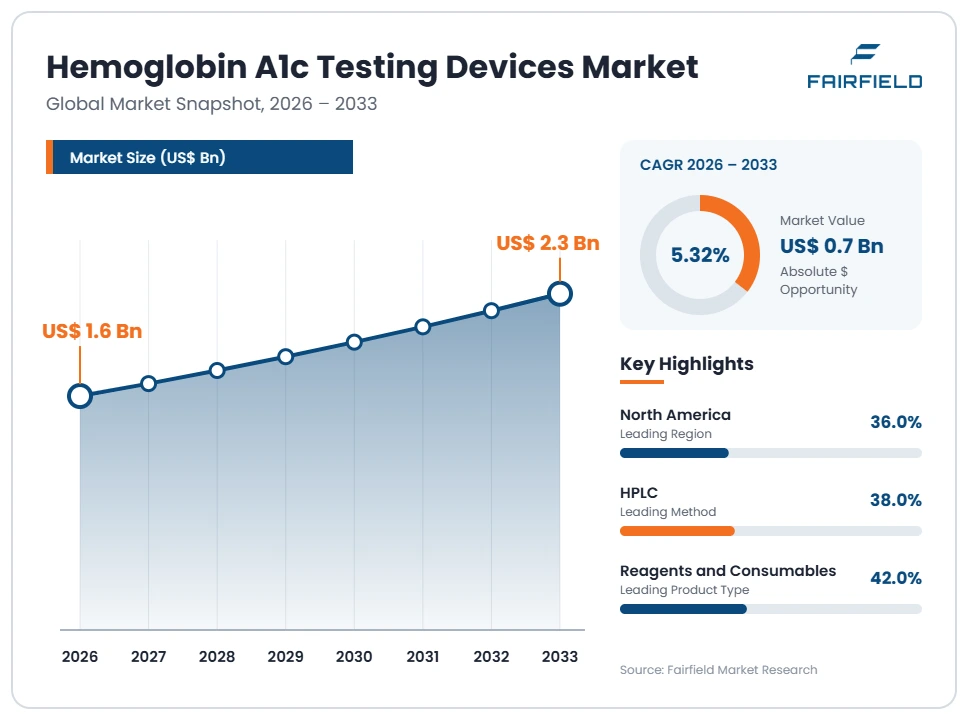
The global Hemoglobin A1c Testing Devices market size is expected to be valued at US$ 1.6 billion in 2026 and projected to reach US$ 2.3 billion by 2033, growing at a CAGR of 5.32% between 2026 and 2033.
Between 2020 and 2025 the category grew at an estimated 4.6% CAGR, recovering from a pandemic period when routine laboratory testing volumes fell sharply. This is a modest, annuity-driven analyser business rather than a consumer market. Growth comes from three places: rising test volumes in primary care across middle-income countries, migration of the assay onto general chemistry platforms already installed in laboratories, and tighter proficiency testing rules that enlarge the market for calibrators and control materials. Instrument placements grow slowly because laboratories consolidate, but each placement carries a long reagent tail. The direction of travel is a small market with high switching costs, decided on method traceability and accreditation rather than on price.
Key Report Takeaways
- By Product Type: Reagents and Consumables held 42.0% share in 2026, while Point-of-Care Analysers and Cartridges are projected to expand at a 7.4% CAGR through 2033, as primary care and pharmacy sites adopt near-patient testing.
- By Method: High-Performance Liquid Chromatography held 38.0% share in 2026, while Enzymatic Assay is projected to expand at a 7.1% CAGR through 2033, because the assay consolidates onto general chemistry analysers already installed.
- By End User: Hospital Laboratories held 38.0% share in 2026, while Pharmacies and Retail Clinics are projected to expand at an 8.2% CAGR through 2033, following the widening of permitted testing sites in several health systems.
- By Distribution Channel: Direct Sales and Service Agreements held 46.0% share in 2026, while Group Purchasing Organisations and Public Tenders are projected to expand at a 6.8% CAGR through 2033, as laboratory networks centralise procurement.
- By Region: North America held 36.0% share in 2026, while Asia Pacific is projected to expand at a 7.6% CAGR through 2033, supported by laboratory build-out and accreditation programmes across the region.
Global Hemoglobin A1c Testing Devices Market Trends and Insights
Drivers Impact Analysis
Two forces shape this market, and the first is a standardisation programme rather than a commercial trend.
| Driver | Impact on CAGR Forecast | Geographic Relevance | Impact Timeline |
| Method traceability and certification requirements governing what laboratories may buy | High | North America, Europe | Long term (≥4 years) |
| Proficiency testing rules expanding demand for calibrators and control materials | Medium | North America, Europe | Short term (≤2 years) |
Traceability Certification Acts as the Licence to Sell Into Accredited Laboratories
This market exists in its current form because of a standardisation programme. Results produced by different measurement methods once disagreed enough that values could not be compared between laboratories. An international reference measurement procedure and a certification programme reconciled them, and the consequence is commercial: an analyser that cannot demonstrate traceability to the reference procedure cannot be sold into an accredited laboratory at any price.
The mechanism runs through documentation. The International Federation of Clinical Chemistry reference measurement procedure defines the anchor, the National Glycohemoglobin Standardization Program certifies manufacturers and laboratories against it, and ISO 17511 sets out how values are assigned to calibrators and controls with metrological traceability. Procurement teams in accredited laboratories treat certification as a pass or fail gate during tender evaluation. Suppliers therefore maintain continuous certification programmes as a cost of participation, not as a marketing claim.
Proficiency Testing Obligations Enlarge the Market for Calibrators and Control Materials
Proficiency testing requirements create recurring consumable demand that is independent of patient test volume. Every accredited laboratory must enrol in external quality assessment, run supplied specimens on schedule, and document corrective action when results fall outside acceptable limits. That obligation converts quality assurance from an internal practice into a purchased product with a predictable annual cycle.
The causal mechanism is regulatory. In the United States, CLIA regulations define regulated analytes and acceptable performance limits, and the College of American Pathologists operates the proficiency testing programmes most large laboratories use. ISO 15189 imposes comparable external quality assessment duties on accredited laboratories elsewhere, and CLSI documents describe how glycated haemoglobin measurement should be verified and monitored. Each requirement generates demand for calibrators, third-party controls and survey materials sold alongside the analyser and reagents.
Restraints Impact Analysis
Two constraints keep growth modest despite a large and rising test volume worldwide.
| Restraint | Impact on CAGR Forecast | Geographic Relevance | Impact Timeline |
| Laboratory consolidation concentrating purchasing power and suppressing instrument pricing | High | North America, Europe | Long term (≥4 years) |
| Analytical interference from haemoglobin variants limiting method and site choice | Medium | Asia Pacific, Middle East & Africa | Long term (≥4 years) |
Laboratory Consolidation and Capped Test Reimbursement Compress Instrument and Reagent Pricing
Buying power has moved decisively to the customer. Hospital networks, national laboratory chains and integrated delivery systems now purchase for dozens or hundreds of sites at once, so a single tender can decide an installed base for a decade. Those buyers negotiate reagent pricing alongside instrument placement, and they expect analysers supplied at low or zero capital cost against committed consumable volume.
The specific cost source is the gap between fixed supply costs and capped revenue per result. Reimbursement schedules set a fixed payment per glycated haemoglobin test, and that payment has been flat or falling in several systems, which caps what a laboratory will pay per reagent pack. Suppliers still carry the cost of instrument placement, field service engineers, certification maintenance, lot-to-lot validation and regulatory documentation. Recovering that fixed base across contracts priced at tender levels is the structural margin problem in this category.
Haemoglobin Variants and Red Cell Turnover Narrow Method Choice and Point-of-Care Acceptance
Analytical interference limits where products can be sold. Haemoglobin variants and conditions that alter red cell turnover affect some measurement principles and not others, and the pattern of interference differs between chromatographic, immunoassay, enzymatic and boronate affinity methods. Laboratories serving populations with high variant prevalence therefore select methods on interference characteristics first, which removes part of the addressable base from competing platforms.
The underlying cause is analytical rather than commercial. Separation-based methods can display variant peaks and flag affected specimens, while methods that measure a single fraction may not. Manufacturers must document interference behaviour, publish variant handling data and maintain software that identifies abnormal patterns. Point-of-care systems face an additional obstacle: near-patient analysers are held to demanding accuracy and precision expectations, and several health systems have restricted their permitted uses, which limits how far testing can move out of the laboratory.
Market Opportunities
Primary Care and Pharmacy Testing Sites Open a New Analyser Placement Pool
Decentralised testing sites represent the clearest untapped placement pool. Primary care practices, community clinics, pharmacy health bays and retail clinics operate outside the consolidated laboratory network, buy in small quantities, and pay list prices rather than tender prices. Each site is a low-volume account, but the installed base is large and the cartridge attach rate is high, so aggregate consumable revenue can exceed that of a single laboratory contract.
Capturing it requires a different commercial model. Suppliers with waived or simplified regulatory classifications, distributor networks reaching non-laboratory customers, and training programmes for non-laboratory staff are best placed. Demand comes from health systems moving chronic disease reviews into primary care and from pharmacy chains adding paid screening services. Expansion of permitted testing categories and external quality assessment schemes designed for small sites support the shift and give buyers a compliance route.
Emerging-Market Laboratory Accreditation Programmes Create a First-Time Instrument Cycle
National accreditation drives in middle-income countries open a first-time equipment cycle. Ministries of health and development agencies in India, Indonesia, Viet Nam, Nigeria, Kenya and Brazil are funding laboratory strengthening programmes that require documented quality systems, traceable calibration and participation in external quality assessment. Laboratories meeting those conditions must replace uncertified or unsupported instruments, which creates first-time placements in facilities where no compliant analyser existed before.
Suppliers able to offer mid-tier analysers with full certification documentation, local service coverage and affordable reagent packs can capture this pool. The buyers are public hospital networks, national reference laboratories and fast-growing private laboratory chains serving urban middle-income patients. Supporting developments include ISO 15189 accreditation programmes expanding across the region, regional regulatory harmonisation, and donor-funded quality improvement schemes that now include non-communicable disease testing alongside infectious disease work.
Segment Analysis
- By Product Type: Reagents Carry the Revenue While Near-Patient Cartridges Grow Quickest
Reagents and Consumables held 42.0% of 2026 revenue. This is an annuity business: instruments are frequently placed at low capital cost against multi-year reagent commitments, so the recurring stream rather than the hardware sale carries the economics. Switching cost is high, because changing supplier means revalidation, staff retraining and a new traceability record.
Point-of-Care Analysers and Cartridges are the fastest-growing product type at a 7.4% CAGR, as testing moves into primary care practices, community clinics and pharmacy settings.
Laboratory Analysers hold 34.0%, point-of-care systems 14.0%, and Calibrators, Controls and Proficiency Testing Materials 10.0%. The quality materials line is small but defensible, because proficiency testing participation is mandatory for accredited laboratories and buyers prefer third-party controls. The business implication is that placement strategy, not product differentiation, determines a supplier’s revenue over a ten-year horizon.
- By Method: Chromatography Leads as Enzymatic Assays Consolidate Onto Chemistry Analysers
High-Performance Liquid Chromatography accounted for 38.0% of 2026 revenue. Ion-exchange chromatography leads because it separates haemoglobin fractions and displays chromatograms that let laboratories identify variant patterns, and because it has the longest certification history among available methods.
Enzymatic Assay is the fastest-growing method at a 7.1% CAGR, because it runs as an additional channel on general chemistry analysers that laboratories already own, which avoids buying and validating a dedicated instrument.
Immunoassay holds 27.0%, Capillary Electrophoresis 12.0% and Boronate Affinity Chromatography 8.0%, with enzymatic methods at 15.0%. Capillary electrophoresis has gained ground in laboratories wanting separation without chromatographic consumables. For suppliers, the implication is a slow erosion of dedicated-instrument economics, as the assay becomes one test among hundreds on a consolidated chemistry platform.
- By End User: Hospital Laboratories Hold the Base While Pharmacy Testing Expands Fastest
Hospital Laboratories held 38.0% share in 2026. Hospital testing combines inpatient, outpatient and referred work on a single accredited platform, and procurement sits inside larger analyser contracts that cover many assays at once, which secures the position.
Pharmacies and Retail Clinics form the fastest-growing end user at an 8.2% CAGR, following the widening of permitted testing categories and the growth of paid screening services in community settings.
Clinical Reference Laboratories account for 34.0%, Physician Offices and Primary Care Clinics 22.0%, and pharmacy and retail sites 6.0%. Reference laboratories compete on cost per result and run very high throughput platforms. The business implication is a two-tier market: high-volume accounts decided by tender economics, and a long tail of small accounts decided by ease of operation, service coverage and regulatory classification.
- By Distribution Channel: Direct Contracts Dominate While Group Purchasing Grows Faster
Direct Sales and Service Agreements held 46.0% of 2026 revenue. Analyser businesses sell directly wherever they can, because the contract bundles instrument placement, reagent commitment, service response times and application support, and because field service capability is itself a competitive asset.
Group Purchasing Organisations and Public Tenders form the fastest-growing channel at a 6.8% CAGR, as hospital networks and national health systems centralise diagnostics procurement into fewer, larger awards.
Distributors and Dealers hold 33.0%, group purchasing and tenders 16.0%, and Online and Third-Party Resellers 5.0%. Distributors remain essential in markets where direct service coverage is uneconomic, particularly across Latin America and Middle East & Africa. The implication is margin transfer: as awards consolidate, more value is negotiated away at the contract stage and less is recovered through the reagent stream.
Geography Analysis
- Which Region Is Leading the Hemoglobin A1c Testing Devices Market?
North America leads with 36.0% of global revenue in 2026, driven almost entirely by the United States, with Canada adding a smaller provincially funded stream. The position reflects test volume, a dense accredited laboratory network, and reimbursement that pays for the test as a distinct billable item rather than bundling it into a consultation fee.
Regulation reinforces the lead. CLIA certification governs who may perform the test and under what quality system, College of American Pathologists proficiency testing is the practical standard for accredited laboratories, and certification against the national standardisation programme is effectively required for an analyser to be specified. The change to watch is the expansion of waived point-of-care testing into primary care and pharmacy sites, which adds placements while lowering average revenue per account.
- Europe Buys on Accreditation Standards and Centralised Procurement Frameworks
Europe holds 28.0% of the 2026 market. Germany, France, the United Kingdom, Italy and Spain account for most revenue, with the Nordic countries notable for early laboratory consolidation. Public payers and statutory insurers fund the test broadly, so volume is stable and predictable, while procurement is highly centralised.
Two frameworks shape purchasing. ISO 15189 accreditation is the operating licence for medical laboratories across most of the region, and the EU In Vitro Diagnostic Regulation reclassified many of these devices into higher risk classes requiring notified body conformity assessment. That raised compliance costs and withdrew some legacy products from the market. The opportunity is replacement demand: laboratories retiring non-compliant or unsupported analysers are running competitive tenders earlier than planned equipment cycles would have required.
- Which Region Is Growing Fastest in the Hemoglobin A1c Testing Devices Market?
Asia Pacific is the fastest-growing geography at a 7.6% CAGR between 2026 and 2033, from 25.0% share in 2026. China, India, Japan, South Korea, Indonesia and Viet Nam drive it, though Japan behaves as a mature market with very high analyser density while the others are building capacity.
Growth comes from infrastructure rather than price. Private laboratory chains are expanding rapidly in India and Indonesia, public hospital upgrade programmes are funding chemistry platforms in China, and accreditation schemes are spreading across the region. Domestic manufacturers in China, Japan and South Korea supply mid-tier analysers at prices that open smaller laboratories. The constraint is variant prevalence in parts of the region, which narrows acceptable method choice and favours separation-based platforms in affected populations.
- Latin America Instrument Demand Follows Public Laboratory Budget Cycles
Latin America represents 6.5% of 2026 revenue. Brazil and Mexico supply most of it, followed by Argentina, Colombia and Chile. Public laboratory networks buy through multi-year tenders, so instrument demand arrives in cycles tied to budget approvals rather than in a steady annual flow, and private laboratory chains fill the gaps between them.
Barriers are economic and operational. Currency movements raise the landed cost of imported reagents, national registration adds months to launch timelines, and field service coverage outside major cities is thin, which pushes buyers toward distributors with established engineer networks. The clearest opportunity is accreditation: as more laboratories pursue international quality standards to serve private insurers and clinical research work, certified platforms and external quality assessment materials gain a defensible position.
- Middle East & Africa Demand Splits Between Gulf Investment and Thin Laboratory Coverage
Middle East & Africa accounts for 4.5% of the 2026 market, the smallest share. The Gulf Cooperation Council states, particularly Saudi Arabia and the United Arab Emirates, are building large accredited hospital laboratories and buy high-specification platforms at developed-market prices. Israel, South Africa, Egypt and Kenya supply most of the remaining revenue.
Constraints across much of the continent are structural. Laboratory density is low, reliable power and cold chain are not universal, trained biomedical scientists are scarce, and reagent import logistics are slow and costly. Donor funding has historically prioritised communicable disease testing. The main opportunity is the inclusion of chronic disease assays in national essential diagnostics lists and in donor-funded laboratory strengthening programmes, which would create predictable public procurement for certified analysers and quality materials.
Competitive Landscape
The hemoglobin A1c testing devices market is moderately concentrated. A limited group of specialist manufacturers supplies most dedicated analysers, while the large diagnostics platform companies reach the market by offering the assay as one channel among many on general chemistry and immunoassay systems. That split defines the competitive structure: specialists defend method-specific strengths and chromatographic installed bases, while platform companies compete on consolidation, arguing that one fewer instrument on the bench is worth more than a dedicated analyser. A separate group of smaller firms supplies point-of-care systems, calibrators, controls and proficiency testing materials. Consolidation has been steady but unspectacular, mostly involving diagnostics groups acquiring niche analyser or quality-materials businesses to complete portfolios.
Competition rests on documented performance rather than on brand. Buyers compare certification status against the recognised standardisation programme, imprecision and bias data, throughput and walk-away time, sample volume, documented interference behaviour with haemoglobin variants, reagent stability and onboard shelf life, connectivity with laboratory information systems, and guaranteed service response times. Tender scoring in public systems makes these explicit and weighted, which leaves little room for commercial persuasion. New entrants come mainly from Asia Pacific manufacturers moving up from domestic markets, and from point-of-care specialists approaching the category through non-laboratory channels rather than through hospital tenders.
Strategic activity has focused on portfolio completion and installed base defence. Participants have extended certification coverage across product ranges, added capillary electrophoresis and enzymatic options alongside chromatography, invested in middleware and remote diagnostics to cut service costs, and expanded reagent manufacturing to improve lot consistency. Several have built dedicated commercial teams for non-laboratory accounts, which require different training and support models.
Strategic direction is converging on three themes: protecting reagent annuities through long placement contracts, following testing into primary care and pharmacy settings where regulation permits, and treating certification and quality materials as a defensible position rather than a compliance cost.
Recent Industry Developments
- May 2007: The American Diabetes Association, the European Association for the Study of Diabetes, the International Diabetes Federation and the International Federation of Clinical Chemistry issued a consensus statement on worldwide standardisation of glycated haemoglobin measurement – it fixed the reference anchor that every commercial method must now trace to.
- May 2022: The EU In Vitro Diagnostic Regulation became applicable, moving many of these devices into higher risk classes requiring notified body conformity assessment – it raised fixed compliance costs and removed some legacy analysers and reagents from the European market.
- December 2022: ISO 15189:2022 was published in revised form, restating requirements for quality and competence in medical laboratories – it reinforced traceability and external quality assessment obligations that determine which analysers accredited laboratories may specify.
- January 2024: Updated CLIA proficiency testing regulations took effect in the United States, adding glycated haemoglobin to the regulated analyte list with defined acceptable performance limits – it created obligatory recurring demand for survey materials and third-party controls.
Companies Covered in the Report
- Bio-Rad Laboratories, Inc.
- Tosoh Corporation
- ARKRAY, Inc.
- Trinity Biotech plc
- Siemens Healthineers AG
- Abbott Laboratories
- F. Hoffmann-La Roche AG
- Sebia SA
- EKF Diagnostics Holdings plc
- Beckman Coulter, Inc.
- Sysmex Corporation
- Mindray Bio-Medical Electronics Co., Ltd.
- PTS Diagnostics
Hemoglobin A1c Testing Devices Market Report Scope
| Metric | Value |
| Study Period | 2020–2033 |
| Market Size 2026 | US$ 1.6 Billion |
| Market Size 2033 | US$ 2.3 Billion |
| CAGR 2026–2033 | 5.32% |
| Absolute Dollar Opportunity | US$ 0.7 Billion |
| Largest Market | North America (36.0% share in 2026) |
| Fastest-Growing Market | Asia Pacific (7.6% CAGR 2026–2033) |
| Market Concentration | Medium |
| Major Players | Bio-Rad Laboratories, Inc., Tosoh Corporation, ARKRAY, Inc., Trinity Biotech plc, Siemens Healthineers AG |
Hemoglobin A1c Testing Devices Market Segmentation
Product Type
- Laboratory Analysers
- Point-of-Care Analysers and Cartridges
- Reagents and Consumables
- Calibrators, Controls and Proficiency Testing Materials
Method
- High-Performance Liquid Chromatography
- Immunoassay
- Enzymatic Assay
- Boronate Affinity Chromatography
- Capillary Electrophoresis
End User
- Clinical Reference Laboratories
- Hospital Laboratories
- Physician Offices and Primary Care Clinics
- Pharmacies and Retail Clinics
Distribution Channel
- Direct Sales and Service Agreements
- Distributors and Dealers
- Group Purchasing Organisations and Public Tenders
- Online and Third-Party Resellers
Regions
- North America
- Europe
- Asia Pacific
- Latin America
- Middle East & Africa
- Executive Summary
- Global Hemoglobin A1c Testing Devices Market Snapshot
- Future Projections, 2026-2033
- Key Market Trends
- Regional Snapshot
- Market Overview
- Market Definition and Report Scope
- Historical Market Trends, 2020-2025
- Market Dynamics
- Drivers Impact Analysis
- Traceability Certification Acts as the Licence to Sell Into Accredited Laboratories
- Proficiency Testing Obligations Enlarge the Market for Calibrators and Control Materials
- Restraints Impact Analysis
- Laboratory Consolidation and Capped Test Reimbursement Compress Instrument and Reagent Pricing
- Haemoglobin Variants and Red Cell Turnover Narrow Method Choice and Point-of-Care Acceptance
- Market Opportunities
- Primary Care and Pharmacy Testing Sites Open a New Analyser Placement Pool
- Emerging-Market Laboratory Accreditation Programmes Create a First-Time Instrument Cycle
- Drivers Impact Analysis
- Global Hemoglobin A1c Testing Devices Market Outlook, 2020-2033
- Global Hemoglobin A1c Testing Devices Market Outlook, by Product Type, Value (US$ Billion), 2020-2033
- Laboratory Analysers
- Point-of-Care Analysers and Cartridges
- Reagents and Consumables
- Calibrators, Controls and Proficiency Testing Materials
- Global Hemoglobin A1c Testing Devices Market Outlook, by Method, Value (US$ Billion), 2020-2033
- High-Performance Liquid Chromatography
- Immunoassay
- Enzymatic Assay
- Boronate Affinity Chromatography
- Capillary Electrophoresis
- Global Hemoglobin A1c Testing Devices Market Outlook, by End User, Value (US$ Billion), 2020-2033
- Clinical Reference Laboratories
- Hospital Laboratories
- Physician Offices and Primary Care Clinics
- Pharmacies and Retail Clinics
- Global Hemoglobin A1c Testing Devices Market Outlook, by Distribution Channel, Value (US$ Billion), 2020-2033
- Direct Sales and Service Agreements
- Distributors and Dealers
- Group Purchasing Organisations and Public Tenders
- Online and Third-Party Resellers
- Global Hemoglobin A1c Testing Devices Market Outlook, by Region, Value (US$ Billion), 2020-2033
- North America
- Europe
- Asia Pacific
- Latin America
- Middle East & Africa
- Global Hemoglobin A1c Testing Devices Market Outlook, by Product Type, Value (US$ Billion), 2020-2033
- North America Hemoglobin A1c Testing Devices Market Outlook, 2020-2033
- North America Hemoglobin A1c Testing Devices Market Outlook, by Product Type, Value (US$ Billion), 2020-2033
- Laboratory Analysers
- Point-of-Care Analysers and Cartridges
- Reagents and Consumables
- Calibrators, Controls and Proficiency Testing Materials
- North America Hemoglobin A1c Testing Devices Market Outlook, by Method, Value (US$ Billion), 2020-2033
- High-Performance Liquid Chromatography
- Immunoassay
- Enzymatic Assay
- Boronate Affinity Chromatography
- Capillary Electrophoresis
- North America Hemoglobin A1c Testing Devices Market Outlook, by End User, Value (US$ Billion), 2020-2033
- Clinical Reference Laboratories
- Hospital Laboratories
- Physician Offices and Primary Care Clinics
- Pharmacies and Retail Clinics
- North America Hemoglobin A1c Testing Devices Market Outlook, by Distribution Channel, Value (US$ Billion), 2020-2033
- Direct Sales and Service Agreements
- Distributors and Dealers
- Group Purchasing Organisations and Public Tenders
- Online and Third-Party Resellers
- North America Hemoglobin A1c Testing Devices Market Outlook, by Country, Value (US$ Billion), 2020-2033
- United States Hemoglobin A1c Testing Devices Market Outlook, by Product Type, 2020-2033
- United States Hemoglobin A1c Testing Devices Market Outlook, by Method, 2020-2033
- United States Hemoglobin A1c Testing Devices Market Outlook, by End User, 2020-2033
- United States Hemoglobin A1c Testing Devices Market Outlook, by Distribution Channel, 2020-2033
- Canada Hemoglobin A1c Testing Devices Market Outlook, by Product Type, 2020-2033
- Canada Hemoglobin A1c Testing Devices Market Outlook, by Method, 2020-2033
- Canada Hemoglobin A1c Testing Devices Market Outlook, by End User, 2020-2033
- Canada Hemoglobin A1c Testing Devices Market Outlook, by Distribution Channel, 2020-2033
- North America Hemoglobin A1c Testing Devices Market Outlook, by Product Type, Value (US$ Billion), 2020-2033
- Europe Hemoglobin A1c Testing Devices Market Outlook, 2020-2033
- Europe Hemoglobin A1c Testing Devices Market Outlook, by Product Type, Value (US$ Billion), 2020-2033
- Laboratory Analysers
- Point-of-Care Analysers and Cartridges
- Reagents and Consumables
- Calibrators, Controls and Proficiency Testing Materials
- Europe Hemoglobin A1c Testing Devices Market Outlook, by Method, Value (US$ Billion), 2020-2033
- High-Performance Liquid Chromatography
- Immunoassay
- Enzymatic Assay
- Boronate Affinity Chromatography
- Capillary Electrophoresis
- Europe Hemoglobin A1c Testing Devices Market Outlook, by End User, Value (US$ Billion), 2020-2033
- Clinical Reference Laboratories
- Hospital Laboratories
- Physician Offices and Primary Care Clinics
- Pharmacies and Retail Clinics
- Europe Hemoglobin A1c Testing Devices Market Outlook, by Distribution Channel, Value (US$ Billion), 2020-2033
- Direct Sales and Service Agreements
- Distributors and Dealers
- Group Purchasing Organisations and Public Tenders
- Online and Third-Party Resellers
- Europe Hemoglobin A1c Testing Devices Market Outlook, by Country and Subregion, Value (US$ Billion), 2020-2033
- Germany Hemoglobin A1c Testing Devices Market Outlook, by Product Type, 2020-2033
- Germany Hemoglobin A1c Testing Devices Market Outlook, by Method, 2020-2033
- Germany Hemoglobin A1c Testing Devices Market Outlook, by End User, 2020-2033
- Germany Hemoglobin A1c Testing Devices Market Outlook, by Distribution Channel, 2020-2033
- France Hemoglobin A1c Testing Devices Market Outlook, by Product Type, 2020-2033
- France Hemoglobin A1c Testing Devices Market Outlook, by Method, 2020-2033
- France Hemoglobin A1c Testing Devices Market Outlook, by End User, 2020-2033
- France Hemoglobin A1c Testing Devices Market Outlook, by Distribution Channel, 2020-2033
- United Kingdom Hemoglobin A1c Testing Devices Market Outlook, by Product Type, 2020-2033
- United Kingdom Hemoglobin A1c Testing Devices Market Outlook, by Method, 2020-2033
- United Kingdom Hemoglobin A1c Testing Devices Market Outlook, by End User, 2020-2033
- United Kingdom Hemoglobin A1c Testing Devices Market Outlook, by Distribution Channel, 2020-2033
- Italy Hemoglobin A1c Testing Devices Market Outlook, by Product Type, 2020-2033
- Italy Hemoglobin A1c Testing Devices Market Outlook, by Method, 2020-2033
- Italy Hemoglobin A1c Testing Devices Market Outlook, by End User, 2020-2033
- Italy Hemoglobin A1c Testing Devices Market Outlook, by Distribution Channel, 2020-2033
- Spain Hemoglobin A1c Testing Devices Market Outlook, by Product Type, 2020-2033
- Spain Hemoglobin A1c Testing Devices Market Outlook, by Method, 2020-2033
- Spain Hemoglobin A1c Testing Devices Market Outlook, by End User, 2020-2033
- Spain Hemoglobin A1c Testing Devices Market Outlook, by Distribution Channel, 2020-2033
- Nordic countries Hemoglobin A1c Testing Devices Market Outlook, by Product Type, 2020-2033
- Nordic countries Hemoglobin A1c Testing Devices Market Outlook, by Method, 2020-2033
- Nordic countries Hemoglobin A1c Testing Devices Market Outlook, by End User, 2020-2033
- Nordic countries Hemoglobin A1c Testing Devices Market Outlook, by Distribution Channel, 2020-2033
- Europe Hemoglobin A1c Testing Devices Market Outlook, by Product Type, Value (US$ Billion), 2020-2033
- Asia Pacific Hemoglobin A1c Testing Devices Market Outlook, 2020-2033
- Asia Pacific Hemoglobin A1c Testing Devices Market Outlook, by Product Type, Value (US$ Billion), 2020-2033
- Laboratory Analysers
- Point-of-Care Analysers and Cartridges
- Reagents and Consumables
- Calibrators, Controls and Proficiency Testing Materials
- Asia Pacific Hemoglobin A1c Testing Devices Market Outlook, by Method, Value (US$ Billion), 2020-2033
- High-Performance Liquid Chromatography
- Immunoassay
- Enzymatic Assay
- Boronate Affinity Chromatography
- Capillary Electrophoresis
- Asia Pacific Hemoglobin A1c Testing Devices Market Outlook, by End User, Value (US$ Billion), 2020-2033
- Clinical Reference Laboratories
- Hospital Laboratories
- Physician Offices and Primary Care Clinics
- Pharmacies and Retail Clinics
- Asia Pacific Hemoglobin A1c Testing Devices Market Outlook, by Distribution Channel, Value (US$ Billion), 2020-2033
- Direct Sales and Service Agreements
- Distributors and Dealers
- Group Purchasing Organisations and Public Tenders
- Online and Third-Party Resellers
- Asia Pacific Hemoglobin A1c Testing Devices Market Outlook, by Country, Value (US$ Billion), 2020-2033
- China Hemoglobin A1c Testing Devices Market Outlook, by Product Type, 2020-2033
- China Hemoglobin A1c Testing Devices Market Outlook, by Method, 2020-2033
- China Hemoglobin A1c Testing Devices Market Outlook, by End User, 2020-2033
- China Hemoglobin A1c Testing Devices Market Outlook, by Distribution Channel, 2020-2033
- India Hemoglobin A1c Testing Devices Market Outlook, by Product Type, 2020-2033
- India Hemoglobin A1c Testing Devices Market Outlook, by Method, 2020-2033
- India Hemoglobin A1c Testing Devices Market Outlook, by End User, 2020-2033
- India Hemoglobin A1c Testing Devices Market Outlook, by Distribution Channel, 2020-2033
- Japan Hemoglobin A1c Testing Devices Market Outlook, by Product Type, 2020-2033
- Japan Hemoglobin A1c Testing Devices Market Outlook, by Method, 2020-2033
- Japan Hemoglobin A1c Testing Devices Market Outlook, by End User, 2020-2033
- Japan Hemoglobin A1c Testing Devices Market Outlook, by Distribution Channel, 2020-2033
- South Korea Hemoglobin A1c Testing Devices Market Outlook, by Product Type, 2020-2033
- South Korea Hemoglobin A1c Testing Devices Market Outlook, by Method, 2020-2033
- South Korea Hemoglobin A1c Testing Devices Market Outlook, by End User, 2020-2033
- South Korea Hemoglobin A1c Testing Devices Market Outlook, by Distribution Channel, 2020-2033
- Indonesia Hemoglobin A1c Testing Devices Market Outlook, by Product Type, 2020-2033
- Indonesia Hemoglobin A1c Testing Devices Market Outlook, by Method, 2020-2033
- Indonesia Hemoglobin A1c Testing Devices Market Outlook, by End User, 2020-2033
- Indonesia Hemoglobin A1c Testing Devices Market Outlook, by Distribution Channel, 2020-2033
- Viet Nam Hemoglobin A1c Testing Devices Market Outlook, by Product Type, 2020-2033
- Viet Nam Hemoglobin A1c Testing Devices Market Outlook, by Method, 2020-2033
- Viet Nam Hemoglobin A1c Testing Devices Market Outlook, by End User, 2020-2033
- Viet Nam Hemoglobin A1c Testing Devices Market Outlook, by Distribution Channel, 2020-2033
- Asia Pacific Hemoglobin A1c Testing Devices Market Outlook, by Product Type, Value (US$ Billion), 2020-2033
- Latin America Hemoglobin A1c Testing Devices Market Outlook, 2020-2033
- Latin America Hemoglobin A1c Testing Devices Market Outlook, by Product Type, Value (US$ Billion), 2020-2033
- Laboratory Analysers
- Point-of-Care Analysers and Cartridges
- Reagents and Consumables
- Calibrators, Controls and Proficiency Testing Materials
- Latin America Hemoglobin A1c Testing Devices Market Outlook, by Method, Value (US$ Billion), 2020-2033
- High-Performance Liquid Chromatography
- Immunoassay
- Enzymatic Assay
- Boronate Affinity Chromatography
- Capillary Electrophoresis
- Latin America Hemoglobin A1c Testing Devices Market Outlook, by End User, Value (US$ Billion), 2020-2033
- Clinical Reference Laboratories
- Hospital Laboratories
- Physician Offices and Primary Care Clinics
- Pharmacies and Retail Clinics
- Latin America Hemoglobin A1c Testing Devices Market Outlook, by Distribution Channel, Value (US$ Billion), 2020-2033
- Direct Sales and Service Agreements
- Distributors and Dealers
- Group Purchasing Organisations and Public Tenders
- Online and Third-Party Resellers
- Latin America Hemoglobin A1c Testing Devices Market Outlook, by Country, Value (US$ Billion), 2020-2033
- Brazil Hemoglobin A1c Testing Devices Market Outlook, by Product Type, 2020-2033
- Brazil Hemoglobin A1c Testing Devices Market Outlook, by Method, 2020-2033
- Brazil Hemoglobin A1c Testing Devices Market Outlook, by End User, 2020-2033
- Brazil Hemoglobin A1c Testing Devices Market Outlook, by Distribution Channel, 2020-2033
- Mexico Hemoglobin A1c Testing Devices Market Outlook, by Product Type, 2020-2033
- Mexico Hemoglobin A1c Testing Devices Market Outlook, by Method, 2020-2033
- Mexico Hemoglobin A1c Testing Devices Market Outlook, by End User, 2020-2033
- Mexico Hemoglobin A1c Testing Devices Market Outlook, by Distribution Channel, 2020-2033
- Argentina Hemoglobin A1c Testing Devices Market Outlook, by Product Type, 2020-2033
- Argentina Hemoglobin A1c Testing Devices Market Outlook, by Method, 2020-2033
- Argentina Hemoglobin A1c Testing Devices Market Outlook, by End User, 2020-2033
- Argentina Hemoglobin A1c Testing Devices Market Outlook, by Distribution Channel, 2020-2033
- Colombia Hemoglobin A1c Testing Devices Market Outlook, by Product Type, 2020-2033
- Colombia Hemoglobin A1c Testing Devices Market Outlook, by Method, 2020-2033
- Colombia Hemoglobin A1c Testing Devices Market Outlook, by End User, 2020-2033
- Colombia Hemoglobin A1c Testing Devices Market Outlook, by Distribution Channel, 2020-2033
- Chile Hemoglobin A1c Testing Devices Market Outlook, by Product Type, 2020-2033
- Chile Hemoglobin A1c Testing Devices Market Outlook, by Method, 2020-2033
- Chile Hemoglobin A1c Testing Devices Market Outlook, by End User, 2020-2033
- Chile Hemoglobin A1c Testing Devices Market Outlook, by Distribution Channel, 2020-2033
- Latin America Hemoglobin A1c Testing Devices Market Outlook, by Product Type, Value (US$ Billion), 2020-2033
- Middle East & Africa Hemoglobin A1c Testing Devices Market Outlook, 2020-2033
- Middle East & Africa Hemoglobin A1c Testing Devices Market Outlook, by Product Type, Value (US$ Billion), 2020-2033
- Laboratory Analysers
- Point-of-Care Analysers and Cartridges
- Reagents and Consumables
- Calibrators, Controls and Proficiency Testing Materials
- Middle East & Africa Hemoglobin A1c Testing Devices Market Outlook, by Method, Value (US$ Billion), 2020-2033
- High-Performance Liquid Chromatography
- Immunoassay
- Enzymatic Assay
- Boronate Affinity Chromatography
- Capillary Electrophoresis
- Middle East & Africa Hemoglobin A1c Testing Devices Market Outlook, by End User, Value (US$ Billion), 2020-2033
- Clinical Reference Laboratories
- Hospital Laboratories
- Physician Offices and Primary Care Clinics
- Pharmacies and Retail Clinics
- Middle East & Africa Hemoglobin A1c Testing Devices Market Outlook, by Distribution Channel, Value (US$ Billion), 2020-2033
- Direct Sales and Service Agreements
- Distributors and Dealers
- Group Purchasing Organisations and Public Tenders
- Online and Third-Party Resellers
- Middle East & Africa Hemoglobin A1c Testing Devices Market Outlook, by Country and Subregion, Value (US$ Billion), 2020-2033
- Gulf Cooperation Council Hemoglobin A1c Testing Devices Market Outlook, by Product Type, 2020-2033
- Gulf Cooperation Council Hemoglobin A1c Testing Devices Market Outlook, by Method, 2020-2033
- Gulf Cooperation Council Hemoglobin A1c Testing Devices Market Outlook, by End User, 2020-2033
- Gulf Cooperation Council Hemoglobin A1c Testing Devices Market Outlook, by Distribution Channel, 2020-2033
- Saudi Arabia Hemoglobin A1c Testing Devices Market Outlook, by Product Type, 2020-2033
- Saudi Arabia Hemoglobin A1c Testing Devices Market Outlook, by Method, 2020-2033
- Saudi Arabia Hemoglobin A1c Testing Devices Market Outlook, by End User, 2020-2033
- Saudi Arabia Hemoglobin A1c Testing Devices Market Outlook, by Distribution Channel, 2020-2033
- United Arab Emirates Hemoglobin A1c Testing Devices Market Outlook, by Product Type, 2020-2033
- United Arab Emirates Hemoglobin A1c Testing Devices Market Outlook, by Method, 2020-2033
- United Arab Emirates Hemoglobin A1c Testing Devices Market Outlook, by End User, 2020-2033
- United Arab Emirates Hemoglobin A1c Testing Devices Market Outlook, by Distribution Channel, 2020-2033
- Israel Hemoglobin A1c Testing Devices Market Outlook, by Product Type, 2020-2033
- Israel Hemoglobin A1c Testing Devices Market Outlook, by Method, 2020-2033
- Israel Hemoglobin A1c Testing Devices Market Outlook, by End User, 2020-2033
- Israel Hemoglobin A1c Testing Devices Market Outlook, by Distribution Channel, 2020-2033
- South Africa Hemoglobin A1c Testing Devices Market Outlook, by Product Type, 2020-2033
- South Africa Hemoglobin A1c Testing Devices Market Outlook, by Method, 2020-2033
- South Africa Hemoglobin A1c Testing Devices Market Outlook, by End User, 2020-2033
- South Africa Hemoglobin A1c Testing Devices Market Outlook, by Distribution Channel, 2020-2033
- Egypt Hemoglobin A1c Testing Devices Market Outlook, by Product Type, 2020-2033
- Egypt Hemoglobin A1c Testing Devices Market Outlook, by Method, 2020-2033
- Egypt Hemoglobin A1c Testing Devices Market Outlook, by End User, 2020-2033
- Egypt Hemoglobin A1c Testing Devices Market Outlook, by Distribution Channel, 2020-2033
- Kenya Hemoglobin A1c Testing Devices Market Outlook, by Product Type, 2020-2033
- Kenya Hemoglobin A1c Testing Devices Market Outlook, by Method, 2020-2033
- Kenya Hemoglobin A1c Testing Devices Market Outlook, by End User, 2020-2033
- Kenya Hemoglobin A1c Testing Devices Market Outlook, by Distribution Channel, 2020-2033
- Middle East & Africa Hemoglobin A1c Testing Devices Market Outlook, by Product Type, Value (US$ Billion), 2020-2033
- Competitive Landscape
- Market Concentration and Industry Leaders
- Competitive Differentiation
- Strategic Initiatives
- Recent Industry Developments
- Company Profiles
- Bio-Rad Laboratories, Inc.
- Tosoh Corporation
- ARKRAY, Inc.
- Trinity Biotech plc
- Siemens Healthineers AG
- Abbott Laboratories
- F. Hoffmann-La Roche AG
- Sebia SA
- EKF Diagnostics Holdings plc
- Beckman Coulter, Inc.
- Sysmex Corporation
- Mindray Bio-Medical Electronics Co., Ltd.
- PTS Diagnostics
- Appendix
- Research Methodology
- Report Assumptions
- Acronyms and Abbreviations
Product Type
- Laboratory Analysers
- Point-of-Care Analysers and Cartridges
- Reagents and Consumables
- Calibrators, Controls and Proficiency Testing Materials
Method
- High-Performance Liquid Chromatography
- Immunoassay
- Enzymatic Assay
- Boronate Affinity Chromatography
- Capillary Electrophoresis
End User
- Clinical Reference Laboratories
- Hospital Laboratories
- Physician Offices and Primary Care Clinics
- Pharmacies and Retail Clinics
Distribution Channel
- Direct Sales and Service Agreements
- Distributors and Dealers
- Group Purchasing Organisations and Public Tenders
- Online and Third-Party Resellers
Regions
- North America
- Europe
- Asia Pacific
- Latin America
- Middle East & Africa
Our Research Methodology
Considering the volatility of business today, traditional approaches to strategizing a game plan can be unfruitful if not detrimental. True ambiguity is no way to determine a forecast. A myriad of predetermined factors must be accounted for such as the degree of risk involved, the magnitude of circumstances, as well as conditions or consequences that are not known or unpredictable. To circumvent binary views that cast uncertainty, the application of market research intelligence to strategically posture, move, and enable actionable outcomes is necessary.
View Methodology
Quality Assured
Rigorous Validation Process

Confidentiality Assured
End-to-end Data Security

Custom Research Services
Tailored To Your Objectives
FAQs
The market is valued at US$ 1.6 billion in 2026, covering laboratory and point-of-care analysers, reagents, and calibration and quality materials.
Revenue is forecast to reach US$ 2.3 billion by 2033 at a 5.32% CAGR, an absolute dollar opportunity of US$ 0.7 billion across the period.
High-Performance Liquid Chromatography leads with 38.0% share in 2026, reflecting its separation capability and the longest certification history among available methods.
Asia Pacific grows fastest at a 7.6% CAGR, driven by private laboratory expansion, public hospital upgrades and spreading accreditation programmes.
Concentration is medium, with specialist analyser makers holding dedicated platforms while large diagnostics groups offer the assay on consolidated chemistry systems.
Related Reports
Wireless Neurostimulators Market Size, Share, Insights, Competitive Landscape, and Forecast 2026 to 2033
Wireless neurostimulators market to grow from US$ 6.2 billion in 2026 to US$ 11.5 billion by 2033 at a 9.2% CAGR. Explore products, applications and regions.
Ultrasound Needle Guides Market Size, Share, Insights, Competitive Landscape, and Forecast 2026 to 2033
Explore the ultrasound needle guides market, projected to reach US$0.7 billion by 2033 at 8.3% CAGR, with product, application and regional insights.
Oncology Molecular Diagnostic Market Size, Share, Insights, Competitive Landscape, and Forecast 2026 to 2033
The oncology molecular diagnostic market is projected to grow from US$12.4 billion in 2026 to US$24.6 billion by 2033, at a 10.3% CAGR. Explore trends.
Mechanical Ventilators Market Size, Share, Insights, Competitive Landscape, and Forecast 2026 to 2033
The global mechanical ventilators market is valued at US$4.80 billion in 2026, reaching US$6.58 billion by 2033, growing at a 4.6% CAGR
Drugs of Abuse Testing Market Size, Share, Insights, Competitive Landscape, and Forecast 2026 to 2033
The global drugs of abuse testing market is valued at US$6.80 billion in 2026, reaching US$14.60 billion by 2033, growing at an 11.5% CAGR
Brain Health Devices Market Size, Share, Insights, Competitive Landscape, and Forecast 2026 to 2033
The global brain health devices market is valued at US$8.60 billion in 2026, reaching US$13.10 billion by 2033, growing at a 6.2% CAGR