



India Construction Chemicals Market
India Construction Chemicals Market Insights, Competitive Landscape, and Market Forecast - 2033
Global India Construction Chemicals Market Forecast
The India Construction Chemicals Market is expected to grow from USD 3.9 Billion in 2026 to USD 6.5 Billion by 2033, reflecting strong industry expansion and registering a CAGR of 7.5% during the forecast period from 2026 to 2033.
India Construction Chemicals Market Insights
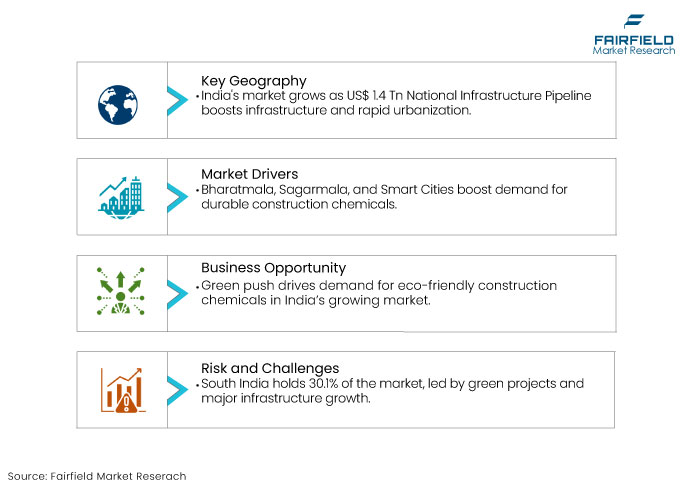
- India’s market is expanding due to massive infrastructure projects and urbanization, with the government investing over USD 1.4 trillion through the National Infrastructure Pipeline (NIP).
- The booming real estate sector, driven by programs such as PMAY and commercial developments, significantly boosts the demand for specialized construction materials.
- Growing adoption of sustainable, eco-friendly solutions accelerates demand for low-VOC adhesives and recyclable waterproofing membranes.
- Concrete admixtures dominate product segments, driven by the need for high-performance concrete in infrastructure projects such as bridges, highways, and skyscrapers.
- North India leads market share at 32.2%, fueled by key infrastructure projects like the Delhi-Meerut Expressway and Smart Cities Mission initiatives.
- South India accounts for a 30.1% market share in 2025, supported by major expansions in Maharashtra, Gujarat, and industrial corridors such as the Bengaluru-Mumbai Industrial Corridor.
- The commercial and industrial sectors hold a 41.5% share, boosted by government initiatives like "Smart Cities Mission" and "Make in India."
A Look Back and a Look Forward - Comparative Analysis
During the historical period, India's construction chemicals market grew steadily, anchored mainly by traditional housing and public infrastructure projects in metropolitan regions. The adoption of advanced chemical solutions remained modest, limited to premium residential, industrial, and government projects, while bulk construction still relies heavily on conventional materials and methods.
Looking ahead to 2030, the market appears poised for accelerated expansion supported by megaprojects, smart cities, ESG mandates, and green building programs. The strong policy push for sustainable urbanization, digital project management adoption, and large private sector investments in real estate and infrastructure are expected to create unprecedented demand for high-performance, durable, and eco-friendly chemical solutions across all construction segments.
Key Growth Determinants
- Massive Infrastructure Expansion Fueling Product Demand
The India construction chemicals market continues to grow due to the aggressive infrastructure expansion supported by substantial government investments.
Under the National Infrastructure Pipeline (NIP), India committed over USD 1.4 trillion between 2020 and 2025, with more than 7,400 projects spanning highways, airports, smart cities, and industrial corridors.
Major projects such as Bharatmala Pariyojana, targeting 65,000 km of new highways, and Sagarmala, focused on port development, directly amplify the demand for durable, high-performance construction materials. Urban development projects under the Smart Cities Mission, involving an estimated INR 2.05 lakh crore investment, have further accelerated the need for chemical solutions that ensure longevity and reduce maintenance.
As India’s urban population grows at over 2% annually and megaprojects move ahead rapidly, the application of specialized chemical products in infrastructure construction has become increasingly critical to meeting quality, speed, and sustainability targets.
- Real estate and urban housing boom boosting material adoption
India’s booming real estate sector has become a major catalyst for rising demand for construction chemicals, backed by strong housing and commercial development momentum. The real estate market valued at approximately USD 200 billion in 2021 is forecast to reach US$ 1 trillion by 2030, driven by urban migration and growing middle-class incomes. Government programs such as Pradhan Mantri Awas Yojana (PMAY) targeting the construction of over 20 million affordable homes have sharply expanded the need for admixtures, sealants, and waterproofing materials. In the commercial segment, top Indian cities are projected to absorb over 700 million square feet of Grade-A office space by 2025, prompting developers to increasingly use high-quality construction chemicals to meet structural standards. As India’s real estate has empowered building smart townships, IT parks, and industrial hubs at an accelerated pace, the boom continues to serve as a crucial pillar in driving adoption across both residential and commercial construction segments.
Key Growth Barriers
- High cost and low awareness are hindering wider market penetration
High costs associated with advanced chemical solutions combined with fragmented awareness levels among small and mid-sized contractors, have slowed broader market penetration in India.
Specialized construction chemicals, such as crystalline waterproofing additives and corrosion inhibitors, typically carry a 10% to 20% premium compared to traditional materials, making them less attractive for cost-sensitive projects in tier-2 and tier-3 cities.
Many small builders, who constitute a significant share of India's housing and small infrastructure construction, still prefer low-cost conventional alternatives due to limited understanding of the long-term benefits. Inadequate training and weak distribution networks in semi-urban and rural regions further restrict access to innovative chemical technologies.
Without stronger outreach programs and cost optimization efforts, many industry participants risk missing out on the proven lifecycle advantages that construction chemicals offer, particularly in terms of durability and maintenance savings.
Market Trends and Opportunities
- Rising demand for sustainable and green construction solutions creating growth opportunities
The surging focus on green buildings and sustainable construction practices in India is opening up significant new market opportunities.
India’s commitment to reduce carbon intensity by 45% by 2030 under its updated NDC (Nationally Determined Contributions) and to achieve net-zero emissions by 2070 is forcing the construction sector to pivot toward low-carbon and energy-efficient materials. The Indian green building market, which already had more than 7 billion square feet of certified projects by 2022, is expected to grow at a CAGR of around 9% through 2028, stimulating demand for low-VOC adhesives, eco-friendly admixtures, and recyclable waterproofing membranes.
Developers aiming for IGBC and GRIHA certifications are increasingly specifying sustainable construction chemicals to align with ESG targets. As urban infrastructure modernizes and ESG-driven investments grow, the construction ecosystem creates a fertile environment for chemical manufacturers to deliver solutions that help meet green compliance and durability expectations.
- Growing Integration of Advanced Materials in Mega Projects Driving Innovation
The increasing use of advanced chemical materials in India’s mega projects is rapidly transforming construction practices and driving innovation. Projects such as the Mumbai Trans Harbour Link, with an investment of around INR 17,843 crore, and the Delhi-Mumbai Industrial Corridor, one of the world’s largest infrastructure undertakings, require next-generation concrete admixtures, self-healing materials, and anti-corrosion systems to meet ambitious performance and longevity targets.
Government initiatives such as the Gati Shakti National Master Plan, focused on multi-modal connectivity and faster project delivery, have intensified the need for fast curing, weather-resistant, and high-durability construction solutions. The rising adoption of innovative materials such as polymer-modified mortars, shrinkage-reducing admixtures, and nanotechnology-based waterproofing agents reflects the construction industry's evolving commitment toward higher quality and lower lifecycle costs.
As India’s infrastructure landscape continues to modernize, the shift toward using high-performance construction chemicals is becoming increasingly mainstream.
Segments Covered in the Report
- Concrete Admixtures Dominate the Product Type Segment with Strong Market Share
Concrete admixtures hold an impeccable market share in 2025, driven by the growing demand for high-performance concrete (HPC). HPC offers superior strength, durability, and longevity, making it ideal for India’s expanding infrastructure projects such as bridges, highways, and high-rise buildings.
The use of admixtures enhances the mechanical properties of concrete, improving resistance to corrosion, freeze-thaw cycles, and abrasion. Sustainability is another major factor as admixtures contribute to resource efficiency by extending the service life of structures.
The shift towards sustainable and cost-effective construction materials amid urbanization and modernization trends bolsters demand for concrete admixtures in India.
Commercial & Industrial Sector Leads Application Segment with 41.5% Market Share
The Commercial & Industrial sector commands a 41.5% share of the market by application. Rapid urbanization, expansion of industrial hubs, development of IT parks, SEZs, and the growth of commercial infrastructure such as malls, airports, and office spaces are key drivers.
The government's flagship initiatives, such as “Smart Cities Mission,” “Make in India,” and industrial corridor developments, are creating massive demand for construction chemicals to ensure high-quality, durable, and sustainable construction. These projects demand superior performance materials such as concrete admixtures, waterproofing systems, and protective coatings, particularly in commercial and industrial construction.
Regional Analysis
- Leading regional market driven by robust infrastructure development
North India is expected to account for a market share of 32.2% in 2025, backed by a surge in infrastructure and urban development projects. Key states such as Delhi, Uttar Pradesh, Haryana, and Punjab are witnessing significant investments.
Major projects include the Delhi-Meerut Expressway, modernization of Delhi International Airport, Smart Cities Mission projects across UP cities (Lucknow, Agra, Kanpur, Varanasi), Ludhiana Mega Food Park, and the East Dedicated Freight Corridor. Haryana’s Manesar-Bawal Investment Region and Panchkula IT Park further boost demand for high-performance construction chemicals.
The region’s ongoing focus on industrial, transportation, and water sanitation infrastructure supports the heavy consumption of concrete admixtures, waterproofing systems, and protective coatings.
- Strong Growth Led by Urbanization and Industrial Corridors
South India accounts for a 30.1% share in the construction chemicals market, propelled by major infrastructure expansions in Maharashtra, Gujarat, and other southern states. Maharashtra’s Navi Mumbai International Airport project, National Investment and Manufacturing Zone (Nagpur), and the Smart Cities Mission (Thane, Pune, Nashik) are key contributors.
Karnataka’s and Tamil Nadu’s participation in the Bengaluru-Mumbai Industrial Corridor further fuels construction chemical demand. Water-based protective coatings are increasingly preferred in South India due to stringent environmental norms and their advantage of reducing VOC emissions by 80%, aligning with sustainability goals. Investments in smart cities and industrial corridors further strengthen this regional market.
- Rapid Industrialization and Smart City Projects Boost Demand in West India
Western India, especially Gujarat, is emerging as a vital region for construction chemicals with projects like Gujarat International Finance Tec-City (GIFT), Dholera Special Investment Region (SIR), and Aviation Park. The Smart Cities Mission covers major cities such as Ahmedabad, Surat, Rajkot, and Vadodara, creating strong demand for durable, eco-friendly construction materials. The dedicated freight corridor improves logistics infrastructure, fostering new commercial developments that demand high-quality admixtures, sealants, and coatings. The rise in the construction of integrated townships and logistics hubs is promoting the adoption of advanced construction chemicals.
Competitive Landscape
India construction chemicals market shows intense competition with Pidilite Industries, Sika India, BASF India, Fosroc India, and Chembond Chemicals dominating the space. These companies aggressively acquire regional players and upgrade their manufacturing plants to strengthen market control. They focus on infrastructure, residential, and industrial construction to drive consistent growth. Saint-Gobain, Chryso India, and MYK Arment invest in strong distributor relationships and expand direct customer engagement. These companies build local teams, launch application centers, and prioritize rapid technical support to emerge as leaders. Innovation in product offerings and on-site services keeps the competitive pressure high.
Key Companies
- Sika AG
- Saint Gobain
- The 3M Company
- MAPEI S.p.A.
- Arkema Group
- B. Fuller Company
- Henkel AG & Co. KGaA
- Ashland Inc.
- Dow Chemical Company
- Pidilite Industries Limited
India Construction Chemicals Market is Segmented as
By Product Type:
- Concrete Admixture
- Water Proofing Chemicals
- Protective Coating
- Adhesives & Sealants
- Concrete Repair Mortar
- Plaster
- Asphalt Additives
By Application:
- Commercial
- Residential
- Industrial
- Institutional
- Infrastructure
By Region:
- North India
- East India
- West India
- South India
- Executive Summary
- Global India Construction Chemicals Market Snapshot
- Future Projections
- Key Market Trends
- Regional Snapshot, by Value, 2026
- Analyst Recommendations
- Market Overview
- Market Definitions and Segmentations
- Market Dynamics
- Drivers
- Restraints
- Market Opportunities
- Value Chain Analysis
- COVID-19 Impact Analysis
- Porter's Five Forces Analysis
- Impact of Russia-Ukraine Conflict
- PESTLE Analysis
- Regulatory Analysis
- Price Trend Analysis
- Current Prices and Future Projections, 2025-2033
- Price Impact Factors
- Global India Construction Chemicals Market Outlook, 2020 - 2033
- Global India Construction Chemicals Market Outlook, by Product Type, Value (US$ Bn), 2020-2033
- Concrete Admixture
- Water Proofing Chemicals
- Protective Coating
- Adhesives & Sealants
- Concrete Repair Mortar
- Plaster
- Asphalt Additives
- Global India Construction Chemicals Market Outlook, by Application, Value (US$ Bn), 2020-2033
- Commercial
- Residential
- Industrial
- Institutional
- Infrastructure
- Global India Construction Chemicals Market Outlook, by Region, Value (US$ Bn), 2020-2033
- North America
- Europe
- Asia Pacific
- Latin America
- Middle East & Africa
- Global India Construction Chemicals Market Outlook, by Product Type, Value (US$ Bn), 2020-2033
- North America India Construction Chemicals Market Outlook, 2020 - 2033
- North America India Construction Chemicals Market Outlook, by Product Type, Value (US$ Bn), 2020-2033
- Concrete Admixture
- Water Proofing Chemicals
- Protective Coating
- Adhesives & Sealants
- Concrete Repair Mortar
- Plaster
- Asphalt Additives
- North America India Construction Chemicals Market Outlook, by Application, Value (US$ Bn), 2020-2033
- Commercial
- Residential
- Industrial
- Institutional
- Infrastructure
- North America India Construction Chemicals Market Outlook, by Country, Value (US$ Bn), 2020-2033
- U.S. India Construction Chemicals Market Outlook, by Product Type, 2020-2033
- U.S. India Construction Chemicals Market Outlook, by Application, 2020-2033
- Canada India Construction Chemicals Market Outlook, by Product Type, 2020-2033
- Canada India Construction Chemicals Market Outlook, by Application, 2020-2033
- BPS Analysis/Market Attractiveness Analysis
- North America India Construction Chemicals Market Outlook, by Product Type, Value (US$ Bn), 2020-2033
- Europe India Construction Chemicals Market Outlook, 2020 - 2033
- Europe India Construction Chemicals Market Outlook, by Product Type, Value (US$ Bn), 2020-2033
- Concrete Admixture
- Water Proofing Chemicals
- Protective Coating
- Adhesives & Sealants
- Concrete Repair Mortar
- Plaster
- Asphalt Additives
- Europe India Construction Chemicals Market Outlook, by Application, Value (US$ Bn), 2020-2033
- Commercial
- Residential
- Industrial
- Institutional
- Infrastructure
- Europe India Construction Chemicals Market Outlook, by Country, Value (US$ Bn), 2020-2033
- Germany India Construction Chemicals Market Outlook, by Product Type, 2020-2033
- Germany India Construction Chemicals Market Outlook, by Application, 2020-2033
- Italy India Construction Chemicals Market Outlook, by Product Type, 2020-2033
- Italy India Construction Chemicals Market Outlook, by Application, 2020-2033
- France India Construction Chemicals Market Outlook, by Product Type, 2020-2033
- France India Construction Chemicals Market Outlook, by Application, 2020-2033
- U.K. India Construction Chemicals Market Outlook, by Product Type, 2020-2033
- U.K. India Construction Chemicals Market Outlook, by Application, 2020-2033
- Spain India Construction Chemicals Market Outlook, by Product Type, 2020-2033
- Spain India Construction Chemicals Market Outlook, by Application, 2020-2033
- Russia India Construction Chemicals Market Outlook, by Product Type, 2020-2033
- Russia India Construction Chemicals Market Outlook, by Application, 2020-2033
- Rest of Europe India Construction Chemicals Market Outlook, by Product Type, 2020-2033
- Rest of Europe India Construction Chemicals Market Outlook, by Application, 2020-2033
- BPS Analysis/Market Attractiveness Analysis
- Europe India Construction Chemicals Market Outlook, by Product Type, Value (US$ Bn), 2020-2033
- Asia Pacific India Construction Chemicals Market Outlook, 2020 - 2033
- Asia Pacific India Construction Chemicals Market Outlook, by Product Type, Value (US$ Bn), 2020-2033
- Concrete Admixture
- Water Proofing Chemicals
- Protective Coating
- Adhesives & Sealants
- Concrete Repair Mortar
- Plaster
- Asphalt Additives
- Asia Pacific India Construction Chemicals Market Outlook, by Application, Value (US$ Bn), 2020-2033
- Commercial
- Residential
- Industrial
- Institutional
- Infrastructure
- Asia Pacific India Construction Chemicals Market Outlook, by Country, Value (US$ Bn), 2020-2033
- China India Construction Chemicals Market Outlook, by Product Type, 2020-2033
- China India Construction Chemicals Market Outlook, by Application, 2020-2033
- Japan India Construction Chemicals Market Outlook, by Product Type, 2020-2033
- Japan India Construction Chemicals Market Outlook, by Application, 2020-2033
- South Korea India Construction Chemicals Market Outlook, by Product Type, 2020-2033
- South Korea India Construction Chemicals Market Outlook, by Application, 2020-2033
- India India Construction Chemicals Market Outlook, by Product Type, 2020-2033
- India India Construction Chemicals Market Outlook, by Application, 2020-2033
- Southeast Asia India Construction Chemicals Market Outlook, by Product Type, 2020-2033
- Southeast Asia India Construction Chemicals Market Outlook, by Application, 2020-2033
- Rest of SAO India Construction Chemicals Market Outlook, by Product Type, 2020-2033
- Rest of SAO India Construction Chemicals Market Outlook, by Application, 2020-2033
- BPS Analysis/Market Attractiveness Analysis
- Asia Pacific India Construction Chemicals Market Outlook, by Product Type, Value (US$ Bn), 2020-2033
- Latin America India Construction Chemicals Market Outlook, 2020 - 2033
- Latin America India Construction Chemicals Market Outlook, by Product Type, Value (US$ Bn), 2020-2033
- Concrete Admixture
- Water Proofing Chemicals
- Protective Coating
- Adhesives & Sealants
- Concrete Repair Mortar
- Plaster
- Asphalt Additives
- Latin America India Construction Chemicals Market Outlook, by Application, Value (US$ Bn), 2020-2033
- Commercial
- Residential
- Industrial
- Institutional
- Infrastructure
- Latin America India Construction Chemicals Market Outlook, by Country, Value (US$ Bn), 2020-2033
- Brazil India Construction Chemicals Market Outlook, by Product Type, 2020-2033
- Brazil India Construction Chemicals Market Outlook, by Application, 2020-2033
- Mexico India Construction Chemicals Market Outlook, by Product Type, 2020-2033
- Mexico India Construction Chemicals Market Outlook, by Application, 2020-2033
- Argentina India Construction Chemicals Market Outlook, by Product Type, 2020-2033
- Argentina India Construction Chemicals Market Outlook, by Application, 2020-2033
- Rest of LATAM India Construction Chemicals Market Outlook, by Product Type, 2020-2033
- Rest of LATAM India Construction Chemicals Market Outlook, by Application, 2020-2033
- BPS Analysis/Market Attractiveness Analysis
- Latin America India Construction Chemicals Market Outlook, by Product Type, Value (US$ Bn), 2020-2033
- Middle East & Africa India Construction Chemicals Market Outlook, 2020 - 2033
- Middle East & Africa India Construction Chemicals Market Outlook, by Product Type, Value (US$ Bn), 2020-2033
- Concrete Admixture
- Water Proofing Chemicals
- Protective Coating
- Adhesives & Sealants
- Concrete Repair Mortar
- Plaster
- Asphalt Additives
- Middle East & Africa India Construction Chemicals Market Outlook, by Application, Value (US$ Bn), 2020-2033
- Commercial
- Residential
- Industrial
- Institutional
- Infrastructure
- Middle East & Africa India Construction Chemicals Market Outlook, by Country, Value (US$ Bn), 2020-2033
- GCC India Construction Chemicals Market Outlook, by Product Type, 2020-2033
- GCC India Construction Chemicals Market Outlook, by Application, 2020-2033
- South Africa India Construction Chemicals Market Outlook, by Product Type, 2020-2033
- South Africa India Construction Chemicals Market Outlook, by Application, 2020-2033
- Egypt India Construction Chemicals Market Outlook, by Product Type, 2020-2033
- Egypt India Construction Chemicals Market Outlook, by Application, 2020-2033
- Nigeria India Construction Chemicals Market Outlook, by Product Type, 2020-2033
- Nigeria India Construction Chemicals Market Outlook, by Application, 2020-2033
- Rest of Middle East India Construction Chemicals Market Outlook, by Product Type, 2020-2033
- Rest of Middle East India Construction Chemicals Market Outlook, by Application, 2020-2033
- BPS Analysis/Market Attractiveness Analysis
- Middle East & Africa India Construction Chemicals Market Outlook, by Product Type, Value (US$ Bn), 2020-2033
- Competitive Landscape
- Company Vs Segment Heatmap
- Company Market Share Analysis, 2025
- Competitive Dashboard
- Company Profiles
- Sika AG
- Company Overview
- Product Portfolio
- Financial Overview
- Business Strategies and Developments
- Saint Gobain
- The 3M Company
- MAPEI S.p.A.
- Arkema Group
- B. Fuller Company
- Henkel AG & Co. KGaA
- Ashland Inc.
- Dow Chemical Company
- Pidilite Industries Limited
- Sika AG
- Appendix
- Research Methodology
- Report Assumptions
- Acronyms and Abbreviations
|
BASE YEAR |
HISTORICAL DATA |
FORECAST PERIOD |
UNITS |
|||
 |
2025 |
 |
2020 - 2025 |
 |
2026 - 2033 |
Value: US$ Million |
|
REPORT FEATURES |
DETAILS |
|
Product Type Coverage |
|
|
End Use Coverage |
|
|
Geographical Coverage |
|
|
Leading Companies |
|
|
Report Highlights |
Key Market Indicators, Macro-micro economic impact analysis, Technological Roadmap, Key Trends, Driver, Restraints, and Future Opportunities & Revenue Pockets, Porter’s 5 Forces Analysis, Historical Trend (2019-2024), Market Estimates and Forecast, Market Dynamics, Industry Trends, Competition Landscape, Category, Region, Country-wise Trends & Analysis, COVID-19 Impact Analysis (Demand and Supply Chain) |
Our Research Methodology
Considering the volatility of business today, traditional approaches to strategizing a game plan can be unfruitful if not detrimental. True ambiguity is no way to determine a forecast. A myriad of predetermined factors must be accounted for such as the degree of risk involved, the magnitude of circumstances, as well as conditions or consequences that are not known or unpredictable. To circumvent binary views that cast uncertainty, the application of market research intelligence to strategically posture, move, and enable actionable outcomes is necessary.
View Methodology
Quality Assured
Rigorous Validation Process

Confidentiality Assured
End-to-end Data Security

Custom Research Services
Tailored To Your Objectives
FAQs
The India Construction Chemicals market size is USD 3.9 Billion in 2026.
The India Construction Chemicals market is projected to grow at a CAGR of 7.5% by 2033.
The India Construction Chemicals market growth is driven by rapid infrastructure development, increasing residential and commercial construction activities, and rising demand for durable and sustainable building materials.
South India is the dominant regional market for the India Construction Chemicals market.
Sika AG, Saint Gobain, MAPEI S.p.A., Pidilite Industries Limited, and Arkema Group are some of the leading industry players in the India Construction Chemicals market.
Related Reports
Built To Rent Residential Market Insights, Competitive Landscape, and Market Forecast 2033
Built to Rent Residential Market to reach USD 76.26 Bn by 2033, growing at 8.9% CAGR, driven by rental demand, housing affordability, and institutional investment.
Building Inspection Services Market Insights, Competitive Landscape, and Market Forecast 2033
Building Inspection Services Market to reach USD 23.93 Bn by 2033, growing at 6.7% CAGR, driven by aging buildings, safety regulations, and real estate demand.
Transformer Protection Equipment Market Forecast - 2033
The global transformer protection equipment market is set to reach US$ 8.66 billion by 2033, growing at a 6.4% CAGR from 2026-2033
Industrial Demand Response Management Systems Market Forecast - 2033
The global industrial demand response management systems market is set to reach US$ 6.81 billion by 2033, growing at an 11.4% CAGR from 2026-2033
Embroidery Machine Market Insights, Competitive Landscape, and Market Forecast 2033
The embroidery machines market will grow from USD 1.85 billion in 2026 to USD 2.64 billion by 2033, driven by customized and branded apparel demand.
Electric Vehicle CNC Turning Centers Market Insights, Competitive Landscape, and Market Forecast 2033
The electric vehicle CNC turning centers market is projected to rise from USD 1.35 billion in 2026 to USD 2.60 billion by 2033, driven by rising EV production.