



Lignin Based Resins Market
Lignin Based Resins Market Size, Share, Insights, Competitive Landscape, and Forecast 2026 to 2033
Lignin Based Resins Market Size and Trend Analysis
How Big Is the Lignin Based Resins Market in 2026?
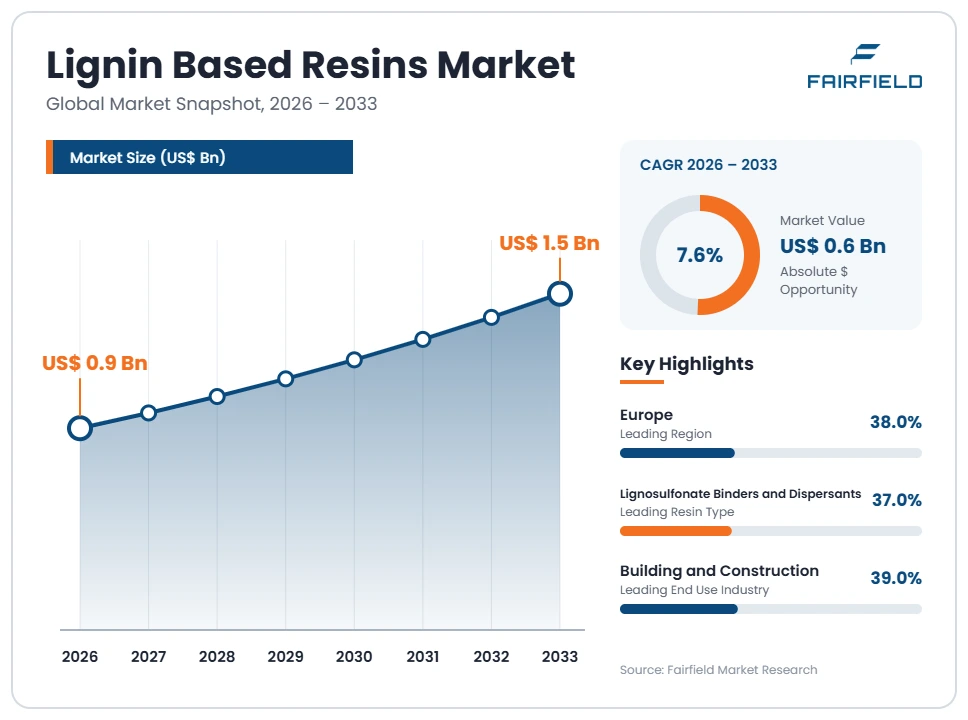
The global lignin based resins market size is expected to be valued at US$ 0.9 billion in 2026 and projected to reach US$ 1.5 billion by 2033, growing at a CAGR of 7.6% between 2026 and 2033.
The market grew at roughly 6.1% a year between 2020 and 2025, reaching about US$ 0.8 billion, with lignosulfonate binders and dispersants carrying most of that volume. Three factors explain the faster pace ahead. Kraft mills that are limited by recovery boiler capacity now have a commercial reason to extract lignin rather than burn it. Formaldehyde emission classes for wood-based panels are pushing adhesive formulators toward phenol replacements. Construction chemical buyers continue to absorb lignosulfonate dispersants at scale. Growth stays modest in absolute terms because the volume available for sale is set by mill energy balances rather than by resin demand, which keeps this a specialty business rather than a commodity one.
Key Report Takeaways
- By Resin Type: Lignosulfonate Binders and Dispersants held 37% share in 2026, while Lignin-Based Polyurethane Polyols are projected to expand at a 10.4% CAGR through 2033, driven by rigid foam and adhesive formulators seeking partial polyol replacement.
- By Feedstock Source: Lignosulfonate held 48% share in 2026, while Kraft Lignin is projected to expand at a 9.6% CAGR through 2033, driven by extraction units installed at pulp mills whose recovery boilers limit pulp output.
- By Application: Wood Panels and Engineered Wood Adhesives held 30% share in 2026, while Carbon Materials are projected to expand at a 12.6% CAGR through 2033, driven by pilot-scale work on low-cost carbon fibre precursors.
- By End Use Industry: Building and Construction held 39% share in 2026, while Automotive and Transportation is projected to expand at a 10.9% CAGR through 2033, driven by bio-content targets in interior panels and friction materials.
- By Geography: Europe held 38% share in 2026, while Asia Pacific is projected to expand at a 10.8% CAGR through 2033, driven by plywood and particleboard capacity additions in China, India and Indonesia.
Global Lignin Based Resins Market Trends and Insights
Drivers Impact Analysis
Two forces account for most of the incremental demand for lignin resin systems through 2033.
| Driver | Impact on CAGR Forecast | Geographic Relevance | Impact Timeline |
| Recovery boiler debottlenecking releasing extractable kraft lignin | High | Europe, North America, Latin America | Medium term (2–4 years) |
| Formaldehyde emission classes and bio-content requirements for wood panels | High | Europe, Asia Pacific | Short term (≤2 years) |
Recovery Boiler Debottlenecking Turns Kraft Mills Into Lignin Suppliers
Mills that have run out of recovery boiler capacity are the main source of new lignin volume reaching resin makers. A mill that cannot burn more black liquor cannot lift pulp output, so removing lignin from the liquor stream clears the bottleneck and creates saleable tonnes at the same time. That dual payback, rather than general interest in bio-based chemistry, decides where extraction plants appear.
The mechanism is simple arithmetic inside the mill. Precipitating lignin with carbon dioxide and acid cuts the solids load on the boiler, letting the digester run harder. Where the boiler is the binding constraint, the extracted material carries almost no opportunity cost and can be priced against phenol. Where the mill is short of energy instead, the same operation destroys value. This is why commercial kraft lignin supply stays concentrated in a small number of mills.
Panel Emission Classes and Bio-Content Rules Pull Lignin Into Adhesive Recipes
Wood panel adhesives are the application where regulation and purchasing policy point the same way. Harmonised formaldehyde emission classes for wood-based panels in the European Union, together with stricter national limits in Germany, Japan and California, have forced resin suppliers to lower free formaldehyde. Partial lignin substitution in phenol-formaldehyde systems supports that work while giving the panel a measurable bio-based content.
The causal link runs through the specification sheet. Panel producers must declare performance under European Union construction product rules and increasingly must evidence renewable content using methods such as EN 16785. A lignin-phenol-formaldehyde resin can satisfy both at once, which a petrochemical resin cannot. Furniture retailers and public procurement bodies have added bio-content preferences to tenders, so the adhesive supplier that can document lignin share wins specification positions that are hard to reverse later.
Restraints Impact Analysis
Two structural constraints keep this market small relative to the abundance of the raw polymer.
| Restraint | Impact on CAGR Forecast | Geographic Relevance | Impact Timeline |
| Opportunity cost of lignin as recovery boiler fuel | High | Global | Long term (≥4 years) |
| Batch and source variability driving requalification cost | Medium | Europe, North America, Asia Pacific | Medium term (2–4 years) |
Lignin’s Fuel Value Inside the Recovery Boiler Caps Available Resin Feedstock
Every tonne of lignin sold is a tonne of fuel taken out of a balanced mill energy system, and that opportunity cost sets the floor price. A kraft mill burns black liquor to raise steam and to recover cooking chemicals, so the lignin is already earning its keep. The mill sells only when the resin price clears the value of the displaced fuel and the purchased energy needed to replace it.
The cost source is specific and measurable. Replacement steam has to come from biomass or natural gas, extraction consumes carbon dioxide, acid and washing capacity, and the filtrate returns sodium and sulphur balance problems to the liquor cycle. Where the boiler has spare capacity, none of that is worth doing. The further constraint is the displaced petrochemical: lignin-phenol substitution only pays when phenol prices are high, so cheap phenol stalls adoption regardless of policy.
Source-to-Source Variability Forces Costly Requalification of Lignin Resin Systems
Lignin is not a single material, and that is the practical barrier to adoption. Molecular weight, sulphur content, ash, functional group density and reactivity all change with wood species, pulping process and extraction route. A resin that bonds correctly with softwood kraft lignin may fail the same test with a hardwood or organosolv grade, so formulators cannot treat suppliers as interchangeable.
The cost shows up as requalification. A panel adhesive must meet a bond strength class and an emission class on every production run, and demonstrating that after a feedstock change means laboratory work, pilot presses and often a fresh declaration of performance. Few buyers will accept a single-source dependency, yet qualifying a second source doubles the effort. Colour and odour add a further limit, ruling lignin out of light-coloured laminates, visible surfaces and many indoor coatings.
Market Opportunities
Concrete Admixtures and Dispersants Open a Volume Outlet for Lignosulfonate Binders
Construction chemicals remain the largest reachable revenue pool for lignosulfonate producers, because the application tolerates colour, accepts variability and buys in bulk. Water-reducing admixtures, grinding aids, dust suppressants and foundry binders together absorb far more tonnage than any adhesive outlet, and they pay predictably. For a sulphite mill, this is the outlet that supports continuous operation rather than campaign production.
The demand comes from ready-mix producers and cement grinders under pressure to cut clinker factor and water content. A lignosulfonate plasticiser is the low-cost option where a polycarboxylate is unnecessary, and blended systems using both are now routine. Foundries buying core and mould binders form a second steady group. Animal feed pelleting adds a regulated but durable niche, since lignosulfonate binders hold feed additive authorisation in the European Union for that specific purpose.
Lignin Polyols and Carbon Precursors Open Higher-Value Resin Revenue Pools
Polyurethane polyols are the nearest high-value opportunity, because polyol prices sit well above phenol and a lignin fraction of 20% to 30% is technically achievable in rigid foam and adhesive systems. Converting even a small share of rigid insulation and wood adhesive polyol demand would lift average selling prices for extracted lignin well beyond the fuel-value floor that governs the rest of the market.
Formulators in insulation, furniture and automotive interiors are the buyers most likely to move first, since they already face bio-content targets and can absorb a qualification programme. Carbon materials sit further out: melt-spun lignin precursor for low-cost carbon fibre remains developmental, but it is the only route that would value lignin on properties rather than on displaced cost. REACH registrations for kraft lignin and lignosulfonates remove a regulatory obstacle for both paths.
Segment Analysis
- By Resin Type: Lignosulfonate Systems Lead While Polyurethane Polyols Scale Faster
Lignosulfonate Binders and Dispersants held 37% of revenue in 2026, the largest share of any resin type, because sulphite mills have sold this material commercially for decades and construction chemical buyers accept it without reformulation. Lignin-Phenol-Formaldehyde Resins followed, supported by plywood and particleboard adhesive demand. Lignin-Based Polyurethane Polyols are the fastest-growing type at a 10.4% CAGR to 2033, expanding from a small base as rigid foam and structural adhesive formulators qualify partial polyol replacement. Lignin Epoxy Systems remain niche, limited by colour and by cure consistency. The commercial implication is a widening price spread: dispersant-grade material competes on cost per tonne, while polyol-grade and epoxy-grade fractions are purified, narrowly specified and sold on performance. Suppliers that can fractionate a single mill stream into both grades capture materially better blended margins than those selling one undifferentiated product.
- By Feedstock Source: Lignosulfonate Holds Volume as Kraft Lignin Gains Ground
Lignosulfonate accounted for 48% of feedstock volume in 2026, reflecting the long-established sulphite pulping base in Norway, Italy and North America and its direct suitability for dispersant use. Kraft Lignin is growing fastest at a 9.6% CAGR, because extraction units are being installed at kraft mills where the recovery boiler, not the digester, limits output. Soda lignin from annual plants serves a small but genuine niche in Asia Pacific, while organosolv lignin remains pilot-scale, valued for low sulphur content and solvent compatibility rather than for volume. The split matters commercially because each route yields a chemically different product. Sulphite liquor delivers a water-soluble sulphonated polymer; kraft extraction delivers a lower-sulphur, less soluble solid that must be further processed for many resin uses. Buyers therefore select feedstock by application chemistry, not by price alone.
- By Application: Wood Panel Adhesives Lead While Carbon Materials Grow Quickest
Wood Panels and Engineered Wood Adhesives represented 30% of application demand in 2026, the single largest outlet, because plywood, particleboard and fibreboard producers buy phenolic resin in volume and face tightening emission limits. Construction Chemicals and Concrete Admixtures followed closely, absorbing most lignosulfonate tonnage. Carbon Materials is the fastest-growing application at a 12.6% CAGR, rising from a very small base as lignin precursor work for carbon fibre and hard carbon moves from laboratory to pilot line. Foundry Binders, Coatings and Adhesives, and Animal Feed Pelleting each provide steady secondary demand. The practical consequence is that near-term revenue depends on two mature, price-sensitive applications, while the applications that would justify premium pricing are still proving themselves. Suppliers therefore fund development from commodity dispersant cash flow rather than from the emerging outlets themselves.
- By End Use Industry: Construction Dominates as Automotive Demand Accelerates
Building and Construction held 39% of end use demand in 2026, combining concrete admixtures, panel adhesives and insulation, which makes this market unusually exposed to construction cycles. Wood Products and Furniture ranked second. Automotive and Transportation is the fastest-growing end use at a 10.9% CAGR, driven by renewable content targets for interior trim, by lignin fillers in friction materials and rubber compounds, and by interest in bio-based polyurethane foam for seating. Agriculture and Animal Feed and Foundry and Metal Casting provide less cyclical volume. The business implication is that suppliers with a construction-only customer base inherit the full volatility of housing starts, while those qualified into automotive specifications gain longer contracts and better pricing. Qualification cycles in vehicle supply chains are long, so the companies entering now are positioning for the second half of the forecast period.
Geography Analysis
- North America Pairs Kraft Lignin Extraction With Foundry and Admixture Demand
North America held 25% of global revenue in 2026 and is forecast to grow at 6.2% a year to 2033. The United States and Canada host several of the earliest commercial kraft lignin extraction installations, built at southern softwood and Canadian mills where recovery boiler capacity constrained pulp production. Demand is concentrated in oilwell cement additives, foundry binders, dust control and concrete admixtures, all applications that tolerate colour and variability. Formaldehyde standards for composite wood products administered by the United States Environmental Protection Agency and by the California Air Resources Board keep pressure on panel adhesive formulation. The main barrier is cheap natural gas and abundant biomass, which raise the implied value of lignin left in the boiler. The regional opportunity lies in automotive and insulation formulators qualifying lignin polyols in existing resin plants.
- Which Region Is Leading the Lignin Based Resins Market?
Europe leads the lignin based resins market with 38% revenue share in 2026 and is forecast to grow at 6.8% annually through 2033. The region combines the world’s deepest lignosulfonate production base, centred on Norway and Italy, with kraft lignin extraction at Nordic mills and an unusually strict regulatory environment. Harmonised formaldehyde emission classes for wood-based panels, declaration-of-performance duties for construction products, and REACH registration obligations together create a formulation environment where documented bio-based content has commercial value. Germany, Finland, Sweden, Norway and Italy account for most consumption, supported by furniture, engineered timber and concrete admixture industries. Public procurement rules that reward renewable content reinforce the pull. The constraint is energy cost: when gas prices rise, the fuel value of lignin rises with them, and mills become less willing to divert material away from the recovery boiler.
- Which Region Is Growing Fastest in the Lignin Based Resins Market?
Asia Pacific is growing fastest, at a 10.8% CAGR between 2026 and 2033, from 24% revenue share in 2026. China, India, Indonesia and Japan are adding plywood, particleboard and fibreboard capacity faster than anywhere else, and those plants are the largest single consumers of phenolic and amino adhesive systems. Chinese and Indian producers also supply soda lignin recovered from non-wood pulping of straw and bagasse, a feedstock route with little presence elsewhere. Concrete admixture demand tracks the region’s cement output, which dominates global production. Japanese formaldehyde limits for interior building materials are among the strictest anywhere and push domestic panel makers toward low-emission adhesive chemistry. The principal risk is price: regional buyers are highly sensitive to the delivered cost of substituted phenol, so adoption slows quickly whenever petrochemical prices soften.
- Latin America Converts Eucalyptus Pulp Scale Into Lignin Feedstock Supply
Latin America accounted for 8% of revenue in 2026 and is projected to grow at 6.5% a year. Brazil and Chile operate some of the largest and most cost-efficient hardwood kraft mills in the world, which makes the region a natural source of extractable lignin and has already supported commercial hardwood kraft lignin offerings. Domestic consumption is narrower, centred on concrete admixtures, mining reagents and dust suppression on unpaved haul roads. The main barriers are limited downstream resin formulation capacity and the need to export extracted lignin to buyers in Europe and North America, which adds freight to a low-value product. The opportunity is local: cement and mining operators represent sizeable captive demand for dispersants, and supplying them avoids the freight penalty that constrains the export model.
- Middle East & Africa Remains an Early-Stage Outlet for Lignin Binder Chemistry
Middle East & Africa held 5% of revenue in 2026, the smallest share, and is forecast to grow at 5.5% annually. There is almost no regional pulping base, so essentially all material is imported, mainly as lignosulfonate for concrete admixtures and for dust control on road and mining projects. Gulf construction programmes and South African mining operations are the identifiable demand centres. The barriers are structural: no local feedstock, limited admixture formulation capacity, and procurement rules that rarely reward bio-based content, which removes the regulatory pull that drives European adoption. The clearest opportunity is in large infrastructure contracts where water reduction in hot-weather concreting is a technical requirement rather than an environmental preference, and where lignosulfonate competes directly on performance and delivered cost.
Competitive Landscape
The lignin based resins market is moderately concentrated. A small number of pulp and specialty chemical companies control nearly all commercially available extracted lignin, simply because supply depends on owning or operating a mill. Borregaard ASA holds a distinctive position through dedicated sulphite capacity built around lignosulfonate and vanillin rather than pulp tonnage. Integrated forest products companies including Stora Enso Oyj, Domtar Corporation, Suzano S.A., UPM-Kymmene Corporation and Rayonier Advanced Materials Inc. supply lignin as a by-product stream alongside their core businesses. Downstream, resin formulators such as Prefere Resins Holding GmbH convert that material into adhesive systems. Consolidation has been limited, because the asset that matters is a mill position rather than a technology.
Competition turns on four things: consistency of specification, sulphur and ash content, the ability to supply a documented bio-based content figure, and delivered cost against the petrochemical being displaced. Technical service matters more than in most chemical markets, because customers must requalify formulations when they switch source. Newer entrants, including LignoStar Group B.V., Lignopure GmbH and Asian Lignin Manufacturing Pvt. Ltd., compete by offering fractionated or application-specific grades rather than bulk liquor solids.
Strategic activity is concentrated on three themes. Mill owners are evaluating extraction where the recovery boiler limits pulp output, since the investment then pays twice. Suppliers are moving toward fractionation and purification so that a single stream can serve dispersant, polyol and epoxy grades at different prices. Formulators are building application laboratories to shorten customer qualification, which is the real bottleneck to adoption.
The direction of travel is toward specification discipline. Vendors that can guarantee a narrow property window, document renewable content and support reformulation are positioning for higher-value resin applications, while those selling undifferentiated material remain exposed to the price of the petrochemical they displace.
Lignin Based Resins Industry Leaders
Borregaard ASA
Stora Enso Oyj
Domtar Corporation
Suzano S.A.
Rayonier Advanced Materials Inc.
Recent Industry Developments
- July 2024: The European Union transitional occupational exposure limit for formaldehyde expired, leaving the lower binding limit of 0.37 mg/m³ in force – tightens plant-level controls wherever phenol-formaldehyde and amino resins are produced or applied.
- December 2024: European Union institutions agreed a one-year delay to the EU Deforestation Regulation, setting 30 December 2025 as the application date for large operators – extends due diligence duties to wood and pulp inputs used for lignin feedstock.
- January 2025: The revised European Union Construction Products Regulation entered into force – widens declaration-of-performance and environmental information duties covering wood-based panels bonded with lignin-modified adhesives.
- 2015: EN 16785 was published, establishing a radiocarbon and elemental analysis method for determining bio-based content – gives formulators an accepted way to substantiate the renewable share of a lignin resin.
Companies Covered in the Report
Borregaard ASA
Stora Enso Oyj
UPM-Kymmene Corporation
Domtar Corporation
Suzano S.A.
Rayonier Advanced Materials Inc.
Sappi Limited
Nippon Paper Industries Co., Ltd.
LignoStar Group B.V.
Prefere Resins Holding GmbH
Lignopure GmbH
Asian Lignin Manufacturing Pvt. Ltd.
Green Agrochem
Lignin Based Resins Market Report Scope
| Metric | Value |
| Study Period | 2020–2033 |
| Market Size 2026 | US$ 0.9 Billion |
| Market Size 2033 | US$ 1.5 Billion |
| CAGR 2026–2033 | 7.6% |
| Absolute Dollar Opportunity | US$ 0.6 Billion |
| Largest Market | Europe, 38% share in 2026 |
| Fastest-Growing Market | Asia Pacific, 10.8% CAGR |
| Market Concentration | Medium |
| Major Players | Borregaard ASA, Stora Enso Oyj, Domtar Corporation, Suzano S.A. |
Lignin Based Resins Market Segmentation
- Executive Summary
- Global Lignin Based Resins Market Snapshot
- Future Projections, 2026–2033
- Key Industry Highlights
- Regional Snapshot
- Market Overview
- Market Definition and Report Scope
- Historical Market Trends
- Market Dynamics
- Drivers
- Recovery Boiler Debottlenecking Turns Kraft Mills Into Lignin Suppliers
- Panel Emission Classes and Bio-Content Rules Pull Lignin Into Adhesive Recipes
- Restraints
- Lignin's Fuel Value Inside the Recovery Boiler Caps Available Resin Feedstock
- Source-to-Source Variability Forces Costly Requalification of Lignin Resin Systems
- Market Opportunities
- Concrete Admixtures and Dispersants Open a Volume Outlet for Lignosulfonate Binders
- Lignin Polyols and Carbon Precursors Open Higher-Value Resin Revenue Pools
- Drivers
- Global Lignin Based Resins Market Outlook, 2020–2033
- Global Lignin Based Resins Market Outlook, by Resin Type, Value (US$ Billion), 2020–2033
- Lignin-Phenol-Formaldehyde Resins
- Lignin-Based Polyurethane Polyols
- Lignin Epoxy Systems
- Lignosulfonate Binders and Dispersants
- Other Lignin Resin Systems
- Global Lignin Based Resins Market Outlook, by Feedstock Source, Value (US$ Billion), 2020–2033
- Kraft Lignin
- Lignosulfonate
- Organosolv Lignin
- Soda Lignin
- Global Lignin Based Resins Market Outlook, by Application, Value (US$ Billion), 2020–2033
- Wood Panels and Engineered Wood Adhesives
- Construction Chemicals and Concrete Admixtures
- Foundry Binders
- Coatings and Adhesives
- Animal Feed Pelleting
- Carbon Materials
- Global Lignin Based Resins Market Outlook, by End Use Industry, Value (US$ Billion), 2020–2033
- Building and Construction
- Wood Products and Furniture
- Automotive and Transportation
- Agriculture and Animal Feed
- Foundry and Metal Casting
- Global Lignin Based Resins Market Outlook, by Region, Value (US$ Billion), 2020–2033
- North America
- Europe
- Asia Pacific
- Latin America
- Middle East & Africa
- Global Lignin Based Resins Market Outlook, by Resin Type, Value (US$ Billion), 2020–2033
- North America Lignin Based Resins Market Outlook, 2020–2033
- North America Lignin Based Resins Market Outlook, by Resin Type, Value (US$ Billion), 2020–2033
- Lignin-Phenol-Formaldehyde Resins
- Lignin-Based Polyurethane Polyols
- Lignin Epoxy Systems
- Lignosulfonate Binders and Dispersants
- Other Lignin Resin Systems
- North America Lignin Based Resins Market Outlook, by Feedstock Source, Value (US$ Billion), 2020–2033
- Kraft Lignin
- Lignosulfonate
- Organosolv Lignin
- Soda Lignin
- North America Lignin Based Resins Market Outlook, by Application, Value (US$ Billion), 2020–2033
- Wood Panels and Engineered Wood Adhesives
- Construction Chemicals and Concrete Admixtures
- Foundry Binders
- Coatings and Adhesives
- Animal Feed Pelleting
- Carbon Materials
- North America Lignin Based Resins Market Outlook, by End Use Industry, Value (US$ Billion), 2020–2033
- Building and Construction
- Wood Products and Furniture
- Automotive and Transportation
- Agriculture and Animal Feed
- Foundry and Metal Casting
- North America Lignin Based Resins Market Outlook, by Country, Value (US$ Billion), 2020–2033
- United States Lignin Based Resins Market Outlook, by Resin Type, 2020–2033
- United States Lignin Based Resins Market Outlook, by Feedstock Source, 2020–2033
- United States Lignin Based Resins Market Outlook, by Application, 2020–2033
- United States Lignin Based Resins Market Outlook, by End Use Industry, 2020–2033
- Canada Lignin Based Resins Market Outlook, by Resin Type, 2020–2033
- Canada Lignin Based Resins Market Outlook, by Feedstock Source, 2020–2033
- Canada Lignin Based Resins Market Outlook, by Application, 2020–2033
- Canada Lignin Based Resins Market Outlook, by End Use Industry, 2020–2033
- North America Lignin Based Resins Market Outlook, by Resin Type, Value (US$ Billion), 2020–2033
- Europe Lignin Based Resins Market Outlook, 2020–2033
- Europe Lignin Based Resins Market Outlook, by Resin Type, Value (US$ Billion), 2020–2033
- Lignin-Phenol-Formaldehyde Resins
- Lignin-Based Polyurethane Polyols
- Lignin Epoxy Systems
- Lignosulfonate Binders and Dispersants
- Other Lignin Resin Systems
- Europe Lignin Based Resins Market Outlook, by Feedstock Source, Value (US$ Billion), 2020–2033
- Kraft Lignin
- Lignosulfonate
- Organosolv Lignin
- Soda Lignin
- Europe Lignin Based Resins Market Outlook, by Application, Value (US$ Billion), 2020–2033
- Wood Panels and Engineered Wood Adhesives
- Construction Chemicals and Concrete Admixtures
- Foundry Binders
- Coatings and Adhesives
- Animal Feed Pelleting
- Carbon Materials
- Europe Lignin Based Resins Market Outlook, by End Use Industry, Value (US$ Billion), 2020–2033
- Building and Construction
- Wood Products and Furniture
- Automotive and Transportation
- Agriculture and Animal Feed
- Foundry and Metal Casting
- Europe Lignin Based Resins Market Outlook, by Country, Value (US$ Billion), 2020–2033
- Norway Lignin Based Resins Market Outlook, by Resin Type, 2020–2033
- Norway Lignin Based Resins Market Outlook, by Feedstock Source, 2020–2033
- Norway Lignin Based Resins Market Outlook, by Application, 2020–2033
- Norway Lignin Based Resins Market Outlook, by End Use Industry, 2020–2033
- Italy Lignin Based Resins Market Outlook, by Resin Type, 2020–2033
- Italy Lignin Based Resins Market Outlook, by Feedstock Source, 2020–2033
- Italy Lignin Based Resins Market Outlook, by Application, 2020–2033
- Italy Lignin Based Resins Market Outlook, by End Use Industry, 2020–2033
- Germany Lignin Based Resins Market Outlook, by Resin Type, 2020–2033
- Germany Lignin Based Resins Market Outlook, by Feedstock Source, 2020–2033
- Germany Lignin Based Resins Market Outlook, by Application, 2020–2033
- Germany Lignin Based Resins Market Outlook, by End Use Industry, 2020–2033
- Finland Lignin Based Resins Market Outlook, by Resin Type, 2020–2033
- Finland Lignin Based Resins Market Outlook, by Feedstock Source, 2020–2033
- Finland Lignin Based Resins Market Outlook, by Application, 2020–2033
- Finland Lignin Based Resins Market Outlook, by End Use Industry, 2020–2033
- Sweden Lignin Based Resins Market Outlook, by Resin Type, 2020–2033
- Sweden Lignin Based Resins Market Outlook, by Feedstock Source, 2020–2033
- Sweden Lignin Based Resins Market Outlook, by Application, 2020–2033
- Sweden Lignin Based Resins Market Outlook, by End Use Industry, 2020–2033
- Europe Lignin Based Resins Market Outlook, by Resin Type, Value (US$ Billion), 2020–2033
- Asia Pacific Lignin Based Resins Market Outlook, 2020–2033
- Asia Pacific Lignin Based Resins Market Outlook, by Resin Type, Value (US$ Billion), 2020–2033
- Lignin-Phenol-Formaldehyde Resins
- Lignin-Based Polyurethane Polyols
- Lignin Epoxy Systems
- Lignosulfonate Binders and Dispersants
- Other Lignin Resin Systems
- Asia Pacific Lignin Based Resins Market Outlook, by Feedstock Source, Value (US$ Billion), 2020–2033
- Kraft Lignin
- Lignosulfonate
- Organosolv Lignin
- Soda Lignin
- Asia Pacific Lignin Based Resins Market Outlook, by Application, Value (US$ Billion), 2020–2033
- Wood Panels and Engineered Wood Adhesives
- Construction Chemicals and Concrete Admixtures
- Foundry Binders
- Coatings and Adhesives
- Animal Feed Pelleting
- Carbon Materials
- Asia Pacific Lignin Based Resins Market Outlook, by End Use Industry, Value (US$ Billion), 2020–2033
- Building and Construction
- Wood Products and Furniture
- Automotive and Transportation
- Agriculture and Animal Feed
- Foundry and Metal Casting
- Asia Pacific Lignin Based Resins Market Outlook, by Country, Value (US$ Billion), 2020–2033
- China Lignin Based Resins Market Outlook, by Resin Type, 2020–2033
- China Lignin Based Resins Market Outlook, by Feedstock Source, 2020–2033
- China Lignin Based Resins Market Outlook, by Application, 2020–2033
- China Lignin Based Resins Market Outlook, by End Use Industry, 2020–2033
- India Lignin Based Resins Market Outlook, by Resin Type, 2020–2033
- India Lignin Based Resins Market Outlook, by Feedstock Source, 2020–2033
- India Lignin Based Resins Market Outlook, by Application, 2020–2033
- India Lignin Based Resins Market Outlook, by End Use Industry, 2020–2033
- Indonesia Lignin Based Resins Market Outlook, by Resin Type, 2020–2033
- Indonesia Lignin Based Resins Market Outlook, by Feedstock Source, 2020–2033
- Indonesia Lignin Based Resins Market Outlook, by Application, 2020–2033
- Indonesia Lignin Based Resins Market Outlook, by End Use Industry, 2020–2033
- Japan Lignin Based Resins Market Outlook, by Resin Type, 2020–2033
- Japan Lignin Based Resins Market Outlook, by Feedstock Source, 2020–2033
- Japan Lignin Based Resins Market Outlook, by Application, 2020–2033
- Japan Lignin Based Resins Market Outlook, by End Use Industry, 2020–2033
- Asia Pacific Lignin Based Resins Market Outlook, by Resin Type, Value (US$ Billion), 2020–2033
- Latin America Lignin Based Resins Market Outlook, 2020–2033
- Latin America Lignin Based Resins Market Outlook, by Resin Type, Value (US$ Billion), 2020–2033
- Lignin-Phenol-Formaldehyde Resins
- Lignin-Based Polyurethane Polyols
- Lignin Epoxy Systems
- Lignosulfonate Binders and Dispersants
- Other Lignin Resin Systems
- Latin America Lignin Based Resins Market Outlook, by Feedstock Source, Value (US$ Billion), 2020–2033
- Kraft Lignin
- Lignosulfonate
- Organosolv Lignin
- Soda Lignin
- Latin America Lignin Based Resins Market Outlook, by Application, Value (US$ Billion), 2020–2033
- Wood Panels and Engineered Wood Adhesives
- Construction Chemicals and Concrete Admixtures
- Foundry Binders
- Coatings and Adhesives
- Animal Feed Pelleting
- Carbon Materials
- Latin America Lignin Based Resins Market Outlook, by End Use Industry, Value (US$ Billion), 2020–2033
- Building and Construction
- Wood Products and Furniture
- Automotive and Transportation
- Agriculture and Animal Feed
- Foundry and Metal Casting
- Latin America Lignin Based Resins Market Outlook, by Country, Value (US$ Billion), 2020–2033
- Brazil Lignin Based Resins Market Outlook, by Resin Type, 2020–2033
- Brazil Lignin Based Resins Market Outlook, by Feedstock Source, 2020–2033
- Brazil Lignin Based Resins Market Outlook, by Application, 2020–2033
- Brazil Lignin Based Resins Market Outlook, by End Use Industry, 2020–2033
- Chile Lignin Based Resins Market Outlook, by Resin Type, 2020–2033
- Chile Lignin Based Resins Market Outlook, by Feedstock Source, 2020–2033
- Chile Lignin Based Resins Market Outlook, by Application, 2020–2033
- Chile Lignin Based Resins Market Outlook, by End Use Industry, 2020–2033
- Latin America Lignin Based Resins Market Outlook, by Resin Type, Value (US$ Billion), 2020–2033
- Middle East & Africa Lignin Based Resins Market Outlook, 2020–2033
- Middle East & Africa Lignin Based Resins Market Outlook, by Resin Type, Value (US$ Billion), 2020–2033
- Lignin-Phenol-Formaldehyde Resins
- Lignin-Based Polyurethane Polyols
- Lignin Epoxy Systems
- Lignosulfonate Binders and Dispersants
- Other Lignin Resin Systems
- Middle East & Africa Lignin Based Resins Market Outlook, by Feedstock Source, Value (US$ Billion), 2020–2033
- Kraft Lignin
- Lignosulfonate
- Organosolv Lignin
- Soda Lignin
- Middle East & Africa Lignin Based Resins Market Outlook, by Application, Value (US$ Billion), 2020–2033
- Wood Panels and Engineered Wood Adhesives
- Construction Chemicals and Concrete Admixtures
- Foundry Binders
- Coatings and Adhesives
- Animal Feed Pelleting
- Carbon Materials
- Middle East & Africa Lignin Based Resins Market Outlook, by End Use Industry, Value (US$ Billion), 2020–2033
- Building and Construction
- Wood Products and Furniture
- Automotive and Transportation
- Agriculture and Animal Feed
- Foundry and Metal Casting
- Middle East & Africa Lignin Based Resins Market Outlook, by Country and Subregion, Value (US$ Billion), 2020–2033
- Gulf Lignin Based Resins Market Outlook, by Resin Type, 2020–2033
- Gulf Lignin Based Resins Market Outlook, by Feedstock Source, 2020–2033
- Gulf Lignin Based Resins Market Outlook, by Application, 2020–2033
- Gulf Lignin Based Resins Market Outlook, by End Use Industry, 2020–2033
- Middle East & Africa Lignin Based Resins Market Outlook, by Resin Type, Value (US$ Billion), 2020–2033
- Competitive Landscape
- Industry Leaders
- Recent Industry Developments
- Company Profiles
- Borregaard ASA
- Stora Enso Oyj
- UPM-Kymmene Corporation
- Domtar Corporation
- Suzano S.A.
- Rayonier Advanced Materials Inc.
- Sappi Limited
- Nippon Paper Industries Co., Ltd.
- LignoStar Group B.V.
- Prefere Resins Holding GmbH
- Lignopure GmbH
- Asian Lignin Manufacturing Pvt. Ltd.
- Green Agrochem
- Appendix
- Research Methodology
- Report Assumptions
- Acronyms and Abbreviations
Resin Type
- Lignin-Phenol-Formaldehyde Resins
- Lignin-Based Polyurethane Polyols
- Lignin Epoxy Systems
- Lignosulfonate Binders and Dispersants
- Other Lignin Resin Systems
Feedstock Source
- Kraft Lignin
- Lignosulfonate
- Organosolv Lignin
- Soda Lignin
Application
- Wood Panels and Engineered Wood Adhesives
- Construction Chemicals and Concrete Admixtures
- Foundry Binders
- Coatings and Adhesives
- Animal Feed Pelleting
- Carbon Materials
End Use Industry
- Building and Construction
- Wood Products and Furniture
- Automotive and Transportation
- Agriculture and Animal Feed
- Foundry and Metal Casting
Regions
- North America
- Europe
- Asia Pacific
- Latin America
- Middle East & Africa
Our Research Methodology
Considering the volatility of business today, traditional approaches to strategizing a game plan can be unfruitful if not detrimental. True ambiguity is no way to determine a forecast. A myriad of predetermined factors must be accounted for such as the degree of risk involved, the magnitude of circumstances, as well as conditions or consequences that are not known or unpredictable. To circumvent binary views that cast uncertainty, the application of market research intelligence to strategically posture, move, and enable actionable outcomes is necessary.
View Methodology
Quality Assured
Rigorous Validation Process

Confidentiality Assured
End-to-end Data Security

Custom Research Services
Tailored To Your Objectives
FAQs
The market is valued at US$ 0.9 billion in 2026, with lignosulfonate binders and dispersants supplying the largest share of commercial volume worldwide.
Revenue is projected to reach US$ 1.5 billion by 2033, expanding at a 7.6% CAGR and adding US$ 0.6 billion over the forecast period.
Lignosulfonate Binders and Dispersants lead with 37% share in 2026, supported by decades of commercial use in construction chemicals and dispersant applications.
Asia Pacific grows fastest at a 10.8% CAGR to 2033, driven by wood panel capacity additions across China, India and Indonesia.
Concentration is medium, because commercial lignin supply depends on owning mill assets, limiting participation to pulp producers and a few specialty formulators.
Related Reports
Marine Oligosaccharides Market Size, Share, Insights, Competitive Landscape, and Forecast 2026 to 2033
The marine oligosaccharides market is projected to grow from US$0.3 billion in 2026 to US$0.6 billion by 2033 at a 10.4% CAGR.
Liquid Crystal Polymer Market Size, Share, Insights, Competitive Landscape, and Forecast 2026 to 2033
The global liquid crystal polymer market is valued at US$1.5 billion in 2026, reaching US$2.7 billion by 2033, growing at an 8.8% CAGR
Rayon Fiber Market Size, Share, Insights, Competitive Landscape, and Forecast 2026 to 2033
The rayon fiber market is projected to grow from US$19.8 billion in 2026 to US$27.5 billion by 2033 at a 4.8% CAGR.
Isopropyl Alcohol Market Size, Share, Insights, Competitive Landscape, and Forecast 2026 to 2033
The global isopropyl alcohol market is valued at US$5.2 billion in 2026, reaching US$6.6 billion by 2033, growing at a 3.5% CAGR
Organic Peroxide Market Size, Share, Insights, Competitive Landscape, and Forecast 2026 to 2033
The organic peroxide market is projected to reach US$2.76 billion by 2033. Explore demand across polymers, rubber, coatings, adhesives, and key regions.
Nitrile Butadiene Rubber (NBR) Latex Market Size, Share, Insights, Competitive Landscape, and Forecast 2026 to 2033
The NBR latex market is projected to reach US$6.09 billion by 2033. Explore demand for nitrile gloves, carboxylated latex, and growth in Asia Pacific.