



Liquid Crystal Polymer Market
Liquid Crystal Polymer Market Size, Share, Insights, Competitive Landscape, and Forecast 2026 to 2033
Liquid Crystal Polymer Market Size and Trend Analysis
What Is Driving Growth in the Liquid Crystal Polymer Market?
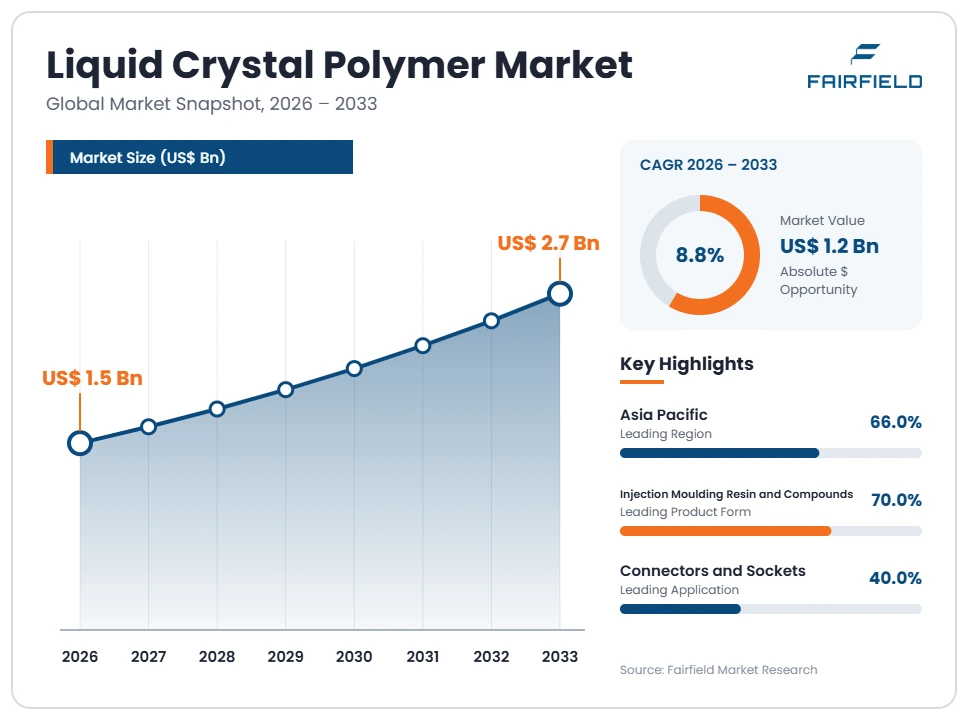
The global liquid crystal polymer market size is expected to be valued at US$ 1.5 billion in 2026 and projected to reach US$ 2.7 billion by 2033, growing at a CAGR of 8.8% between 2026 and 2033.
Between 2020 and 2025 the market grew at roughly 6.8% a year, with a strong connector cycle partly offset by weak consumer device volumes in the middle of the period. Two separate demand engines now drive the forecast. Moulded connectors and small electronic parts need a resin that fills very thin walls and holds dimension through solder reflow, which is what sustains the resin business. High-frequency circuits need a substrate with low dielectric loss and almost no moisture pickup, which is what is expanding the film business. Because these engines respond to different customers, a downturn in one rarely cancels the other, and that structural separation underpins the growth rate.
Key Report Takeaways
- By Product Form: Injection moulding resin and compounds held 70% share in 2026, while extruded and biaxially oriented film is projected to expand at a 13.5% CAGR through 2033, driven by millimetre-wave antenna and flexible circuit substrates.
- By Filler Type: Glass-filled grades held 43% share in 2026, while unfilled grades are projected to grow at an 11.4% CAGR through 2033, because film and fibre extrusion cannot tolerate the abrasive, flow-disrupting fillers used in moulding.
- By Application: Electrical and electronic connectors and sockets held 40% share in 2026, while high-frequency circuits and antenna substrates are projected to expand at a 14.2% CAGR through 2033, as device makers move to higher carrier frequencies.
- By End-Use Industry: Consumer electronics and communication devices held 48% share in 2026, while telecommunication infrastructure is projected to grow at a 12.6% CAGR through 2033, supported by satellite constellations and dense radio deployments.
- By Geography: Asia Pacific held 66% share in 2026, while North America is projected to expand at a 10.4% CAGR through 2033, led by satellite communication hardware, radar modules and semiconductor test equipment.
Global Liquid Crystal Polymer Market Trends and Insights
Drivers Impact Analysis
Two unrelated technical requirements explain almost all demand for thermotropic liquid crystal polymers.
| Driver | Impact on CAGR Forecast | Geographic Relevance | Impact Timeline |
| Thin-wall flow and dimensional stability through solder reflow in miniaturised connectors | High | Asia Pacific, North America, Europe | Short term ≤2 years |
| Low dielectric loss and negligible moisture absorption in high-frequency circuits | High | North America, Asia Pacific, Europe | Medium term 2–4 years |
Thin-Wall Flow and Reflow Stability Make LCP the Default Connector Resin
Connector design sets the first demand engine, and it is a moulding problem rather than an electrical one. Modern board-to-board and fine-pitch connectors have wall sections measured in tenths of a millimetre and pin counts in the hundreds. Most engineering thermoplastics freeze before filling such a cavity. Liquid crystal polymer melts have very low viscosity under shear, so they fill thin, long flow paths that competing resins cannot.
The second half of the requirement is thermal. Surface-mount parts pass through lead-free reflow ovens at peak temperatures well above 250 degrees Celsius, and a connector that warps or blisters at that point destroys the assembly. Liquid crystal polymers have very low thermal expansion and almost no moisture uptake, so parts hold shape through the profiles defined by JEDEC moisture sensitivity and reflow standards. Listings under UL 94 and UL 746 relative thermal index, together with IEC 60695 glow-wire requirements, complete the qualification.
Low Dielectric Loss Makes LCP Film the Substrate of Choice at Millimetre-Wave Frequencies
The second demand engine is electrical and entirely separate from moulding. As carrier frequencies rise into the millimetre-wave bands, transmission loss in the substrate becomes a dominant design constraint. Liquid crystal polymer film has a low dielectric constant, an unusually low dissipation factor and water absorption close to zero, so its electrical behaviour stays stable in humid conditions where polyimide films drift.
The mechanism links material properties to system performance. A lossy substrate forces higher transmit power, shortens range and raises thermal load in a handset or radio unit. Antenna-in-package modules, flexible antenna feeds and high-frequency flexible printed circuits therefore specify liquid crystal polymer film where loss budgets are tight. Design and qualification follow IPC standards for flexible printed circuits and high-frequency laminates, while RoHS and REACH compliance and halogen-free, low-smoke requirements shape the material set available to designers.
Restraints Impact Analysis
Two constraints keep liquid crystal polymer confined to applications that genuinely require it.
| Restraint | Impact on CAGR Forecast | Geographic Relevance | Impact Timeline |
| Resin price relative to competing engineering and high-performance thermoplastics | High | Asia Pacific, Europe, Latin America | Short term ≤2 years |
| Anisotropy, weld line weakness and the narrow base of film production capacity | High | North America, Asia Pacific, Europe | Long term ≥4 years |
Resin Price Keeps Liquid Crystal Polymer Out of General Engineering Applications
Price is the main reason liquid crystal polymer remains a specialty rather than a volume material. It sells at a substantial premium to polyphenylene sulphide, high-temperature polyamides and polyesters, which are the resins designers reach for first. Unless an application genuinely needs sub-millimetre wall filling, reflow stability or very low dielectric loss, the cheaper material wins the specification and the part never converts.
The cost structure explains the premium. Thermotropic aromatic polyesters are built from monomers such as hydroxybenzoic and hydroxynaphthoic acid derivatives that are far more expensive than commodity feedstocks, and polycondensation and post-treatment steps are energy-intensive and slow. Production runs at modest scale compared with mainstream engineering plastics, so unit costs do not fall with volume in the usual way. Buyers consequently use liquid crystal polymer for the smallest part that solves the problem.
Flow Anisotropy and Concentrated Film Capacity Limit Where LCP Can Be Used
The same molecular orientation that gives liquid crystal polymer its strength also creates its design limits. Rigid rod-like molecules align in the flow direction, so parts are much stronger along the flow than across it, and knit lines where two flow fronts meet are mechanically weak. Moulders compensate with gate placement, rib design and fillers, but the anisotropy cannot be removed, and it rules out parts that carry load in several directions.
The film side faces a supply constraint rather than a design one. Producing a balanced biaxially oriented film from a polymer that wants to orient in one direction is genuinely difficult, and capability sits with a very small number of producers. That scarcity, not resin availability, limits how quickly high-frequency applications can scale. Modified polyimide and fluoropolymer films compete directly, while polyphenylene sulphide and polyamides contest connector sockets.
Market Opportunities
Millimetre-Wave Antennas and Satellite Links Open a Film-Led Revenue Pool
Millimetre-wave communication hardware is the largest untapped pool for liquid crystal polymer film. Satellite constellation terminals, phased-array user antennas, automotive radar modules and high-band radio units all need substrates whose loss and moisture behaviour are predictable across temperature and humidity. Each terminal carries a meaningful area of film, and volumes are rising from a small base, which makes this the fastest-expanding value pool in the market.
Film producers with biaxial orientation capability and laminators able to bond copper to a low-surface-energy polymer are positioned to capture it, often working directly with antenna designers rather than through distributors. Demand originates with satellite operators, communication equipment makers and automotive radar suppliers. Supporting developments include new spectrum identified for mobile services at international level, successive releases of mobile standards that assume higher-band operation, and vehicle regulations that make radar-based driver assistance standard equipment.
Test Sockets, Catheters and Sensor Housings Create High-Value Moulded Demand
A second pool sits in small, difficult moulded parts where performance outweighs material cost entirely. Advanced semiconductor test sockets must hold fine pitch alignment at elevated temperature over many thousands of insertion cycles, and liquid crystal polymer is one of very few materials that stays dimensionally stable in that duty. Medical catheter shafts and braided tubing use liquid crystal polymer fibre and resin for thin walls with high burst strength.
Compounders, precision moulders and medical device contract manufacturers can capture this revenue, because the work demands tooling skill rather than tonnage. Demand comes from semiconductor test houses, interventional device makers and automotive sensor suppliers. Supporting developments include rising test intensity for advanced packaging, the move toward smaller catheter profiles in interventional procedures, and sensor housings that must survive engine-bay temperatures without dimensional drift.
Segment Analysis
- By Product Form: Moulding Grades Carry the Revenue While Film Grows Fastest
Injection moulding resin and compounds held 70% share in 2026, the dominant product form, because connectors, sockets, bobbins and chip carriers are moulded in very large unit volumes and have been the core of this polymer’s commercial life for decades. Extruded and biaxially oriented film is the fastest-growing form at a 13.5% CAGR to 2033, driven entirely by high-frequency circuit and antenna demand rather than by any moulding application. Fibre holds a smaller position in ropes, cables, medical braids and protective textiles, where its strength-to-weight ratio and low creep matter. Other forms, including welding rod, powder and coating grades, remain marginal. The business implication is that the two main forms require different assets and different customers, so a producer strong in resin has no automatic advantage in film.
- By Filler Type: Glass-Filled Grades Lead as Unfilled Grades Expand Most Quickly
Glass-filled grades accounted for 43% of value in 2026, the leading filler category, because chopped glass raises stiffness and strength across the weak transverse direction and improves the weld line behaviour that limits unfilled mouldings. Unfilled grades are the fastest-growing category at an 11.4% CAGR through 2033, since film and fibre extrusion cannot accommodate abrasive reinforcement and the high-frequency applications driving film demand require a clean, homogeneous dielectric. Mineral-filled and hybrid glass and mineral grades serve parts needing better surface finish, lower warpage or reduced tool wear. Conductive and specialty filled compounds address electrostatic dissipation and shielding in electronics handling. For producers, the practical consequence is that growth is shifting toward formulations with less filler content, which changes both the cost mix and the compounding asset base required.
- By Application: Connectors Hold the Base While High-Frequency Substrates Surge
Electrical and electronic connectors and sockets represented 40% of demand in 2026, the largest application, reflecting decades of design-in across board-to-board, card edge, memory and fine-pitch connectors where no cheaper resin fills the cavity. High-frequency circuits and antenna substrates are the fastest-growing application at a 14.2% CAGR to 2033, as handset, radio and satellite designers move to frequencies where substrate loss decides the link budget. Chip carriers, bobbins and switches provide steady volume, while automotive electrical and sensor components grow with electrification and radar content. Medical devices and catheters, along with fibre optic and industrial parts, occupy smaller but high-value niches. The commercial implication is that one application pool rewards moulding economics and the other rewards film metallurgy, and few suppliers serve both equally well.
- By End-Use Industry: Consumer Devices Dominate as Telecom Infrastructure Accelerates
Consumer electronics and communication devices generated 48% of market value in 2026, the leading end-use industry, because handsets, tablets, wearables and computing hardware contain the highest concentration of miniaturised connectors and antenna modules. Telecommunication infrastructure is the fastest-growing end use at a 12.6% CAGR through 2033, supported by satellite constellation ground and user terminals, dense radio deployments and the backhaul equipment that accompanies them. Automotive and transportation follows closely, driven by radar sensors, high-voltage connectors and camera modules. Healthcare and medical demand grows through catheters and minimally invasive devices, while industrial and energy applications cover sensors, fibre optic hardware and chemical-resistant parts. The strategic consequence is that infrastructure demand is less cyclical than consumer devices, which gives producers serving it a steadier order book.
Geography Analysis
- Which Region Is Growing Fastest in the Liquid Crystal Polymer Market?
North America is the fastest-growing geography at a 10.4% CAGR between 2026 and 2033, from a 16% share in 2026. Growth comes from applications that sit at the high-value end of the material’s range rather than from volume moulding. Satellite communication hardware, phased-array terminals and defence electronics consume high-frequency film and laminate. Semiconductor test equipment makers specify liquid crystal polymer for sockets and probe hardware as advanced packaging raises test intensity. Medical device manufacturers use fibre and resin in catheter construction. Domestic semiconductor and electronics investment programmes are adding local assembly that was previously offshore. The main barrier is the absence of significant regional polymer production, which leaves buyers dependent on imported resin and film. The clearest opportunity is qualification of locally laminated high-frequency materials, which shortens development cycles for antenna and radar programmes.
- Europe Focuses on Automotive Electronics and Industrial Connector Demand
Europe accounted for 11% of global demand in 2026, the smallest share among the major industrial regions but a technically demanding one. Automotive electronics drives most consumption, with German, French and Italian suppliers using liquid crystal polymer in radar housings, sensor bodies, high-voltage connector components and control unit parts. Industrial connector and switchgear manufacturers add steady volume, and medical device clusters in Ireland, Switzerland and Germany use fibre and precision mouldings. Regulatory practice shapes material choice strongly, with RoHS and REACH compliance, halogen-free specifications and glow-wire performance written into supplier requirements. The structural barrier is the lack of regional resin production and a modest consumer electronics base. The strongest opportunity is radar and sensor content growth, as vehicle safety requirements push driver assistance hardware into every new model.
- Which Region Is Leading the Liquid Crystal Polymer Market?
Asia Pacific leads the liquid crystal polymer market with a 66% share in 2026, because both the production and the consumption of this polymer are concentrated there. Japan hosts most global resin and film capability, with producers who have developed the polymerisation, compounding and biaxial orientation technology over several decades. China is the largest consumer, with enormous connector, handset and flexible circuit manufacturing, and domestic producers have been scaling resin capacity and attempting film production. Taiwan and South Korea supply connectors, antenna modules, semiconductor packaging and display components. Vietnam, Thailand and Malaysia add growing electronics assembly that pulls compound demand with it. Proximity between resin producers, compounders, moulders and device assemblers shortens qualification cycles considerably. The defining change is the gradual emergence of domestic Chinese supply in a product class long dependent on Japanese technology.
- Latin America Builds Modest Demand Through Automotive and Appliance Assembly
Latin America held 4% of the market in 2026 and is expanding at a 7.1% CAGR, a small pool with narrow but real foundations. Mexico is the centre of consumption, where automotive wiring, sensor and electronics assembly plants supply vehicle manufacturers across the region and consume connectors moulded from imported compound. Brazil adds appliance, industrial equipment and telecommunication hardware demand. Barriers are substantial: there is no regional resin or compound production, import duties and freight raise delivered cost on an already expensive material, and precision moulding capability for very thin-wall parts is concentrated in a handful of plants. Design authority usually sits outside the region, so material selection is made elsewhere. The most practical opportunity is localisation of connector moulding for vehicle electrical systems, which would anchor compound demand closer to the assembly lines.
- Middle East & Africa Depends on Imported Components for Specialty Polymer Demand
Middle East & Africa accounted for 3% of global demand in 2026 and is growing at a 6.6% CAGR, the smallest regional pool. Consumption is indirect: the region installs telecommunication infrastructure, data centre hardware and industrial control equipment containing liquid crystal polymer parts, but almost none of those parts are made locally. Gulf states are investing in telecommunication networks, satellite ground stations and electronics assembly as part of diversification programmes, which is slowly creating direct component demand. South Africa has a modest industrial and automotive electronics base. Barriers are structural: no polymer production, limited precision moulding capacity, small design engineering communities and long supply chains for specialty resins. The clearest opportunity lies in satellite ground terminal and antenna assembly, where high-frequency film content is high and regional connectivity programmes are funding deployment.
Competitive Landscape
The liquid crystal polymer market is highly concentrated. A small group of chemical companies, most of them Japanese or American, accounts for the large majority of global resin capacity, and the barrier is technical rather than financial: the monomer chemistry, polycondensation control and compounding know-how required to deliver consistent flow and thermal behaviour took decades to develop. Film is more concentrated still, with balanced biaxially oriented film produced by very few firms worldwide. A second tier of compounders adds filled and specialty formulations from purchased base resin, and Chinese producers have been building resin capacity and working toward film capability, which represents the most significant structural change underway.
Competition is technical and relationship-driven. The first factor is grade portfolio depth, because connector designers, film laminators and medical moulders need different flow, filler and thermal characteristics, and a missing grade loses the design. The second is qualification support, since a resin must earn UL 94 and UL 746 listings, pass glow-wire testing and survive customer reflow profiles before any volume order follows. The third is supply assurance, as device makers will not design in a material with a single uncertain source. Price matters least in film and most in commodity connector grades.
Strategic activity centres on three themes. Producers are expanding film and high-frequency grade capability, deepening compound ranges for automotive radar and medical applications, and securing monomer supply chains that few companies control. Regional capacity additions are aimed at reducing customer concern about single-source dependence.
Strategic direction across the field points toward application specialisation: fewer general-purpose grades, more formulations developed jointly with a specific customer, and growing investment in the film assets that the high-frequency opportunity requires.
Liquid Crystal Polymer Industry Leaders
Polyplastics Co., Ltd.
Celanese Corporation
Sumitomo Chemical Co., Ltd.
Toray Industries, Inc.
Kuraray Co., Ltd.
Recent Industry Developments
- December 2023: The International Telecommunication Union concluded its World Radiocommunication Conference, identifying additional spectrum for mobile services and setting the agenda for higher-frequency studies – strengthening the long-term case for low-loss substrate materials in radio and antenna hardware.
- 2024: The 3rd Generation Partnership Project completed its Release 18 specifications, the first release of the 5G-Advanced generation – extending feature support for higher-band and non-terrestrial links that depend on low-loss antenna substrates.
- July 2024: The European Union general vehicle safety requirements became mandatory for all newly registered vehicles, making advanced driver assistance systems standard equipment – raising radar and sensor content per vehicle and the demand for dimensionally stable housings and substrates.
Companies Covered in the Report
- Polyplastics Co., Ltd.
- Celanese Corporation
- Sumitomo Chemical Co., Ltd.
- Toray Industries, Inc.
- Kuraray Co., Ltd.
- Ueno Fine Chemicals Industry, Ltd.
- Syensqo SA
- Murata Manufacturing Co., Ltd.
- Shenzhen Wote Advanced Materials Co., Ltd.
- Kingfa Sci. & Tech. Co., Ltd.
- RTP Company
- Avient Corporation
Liquid Crystal Polymer Market Report Scope
| Metric | Value |
| Study Period | 2020–2033 |
| Market Size 2026 | US$ 1.5 Billion |
| Market Size 2033 | US$ 2.7 Billion |
| CAGR 2026–2033 | 8.8% |
| Absolute Dollar Opportunity | US$ 1.2 Billion |
| Largest Market | Asia Pacific (66% share in 2026) |
| Fastest-Growing Market | North America (10.4% CAGR) |
| Market Concentration | High |
| Major Players | Polyplastics Co., Ltd., Celanese Corporation, Sumitomo Chemical Co., Ltd., Toray Industries, Inc. |
Liquid Crystal Polymer Market Segmentation
- Executive Summary
- Global Liquid Crystal Polymer Market Snapshot
- Future Projections, 2026–2033
- Key Industry Highlights
- Regional Snapshot
- Market Overview
- Market Definition and Report Scope
- Historical Market Trends
- Market Dynamics
- Drivers
- Thin-Wall Flow and Reflow Stability Make LCP the Default Connector Resin
- Low Dielectric Loss Makes LCP Film the Substrate of Choice at Millimetre-Wave Frequencies
- Restraints
- Resin Price Keeps Liquid Crystal Polymer Out of General Engineering Applications
- Flow Anisotropy and Concentrated Film Capacity Limit Where LCP Can Be Used
- Market Opportunities
- Millimetre-Wave Antennas and Satellite Links Open a Film-Led Revenue Pool
- Test Sockets, Catheters and Sensor Housings Create High-Value Moulded Demand
- Drivers
- Global Liquid Crystal Polymer Market Outlook, 2020–2033
- Global Liquid Crystal Polymer Market Outlook, by Product Form, Value (US$ Billion), 2020–2033
- Injection Moulding Resin and Compounds
- Extruded and Biaxially Oriented Film
- Fibre
- Other Forms
- Global Liquid Crystal Polymer Market Outlook, by Filler Type, Value (US$ Billion), 2020–2033
- Glass-Filled
- Mineral-Filled
- Glass and Mineral Hybrid
- Unfilled
- Conductive and Specialty Filled
- Global Liquid Crystal Polymer Market Outlook, by Application, Value (US$ Billion), 2020–2033
- Electrical and Electronic Connectors and Sockets
- High-Frequency Circuits and Antenna Substrates
- Chip Carriers, Bobbins and Switches
- Automotive Electrical and Sensor Components
- Medical Devices and Catheters
- Fibre Optic and Industrial Components
- Global Liquid Crystal Polymer Market Outlook, by End-Use Industry, Value (US$ Billion), 2020–2033
- Consumer Electronics and Communication Devices
- Telecommunication Infrastructure
- Automotive and Transportation
- Healthcare and Medical
- Industrial and Energy
- Global Liquid Crystal Polymer Market Outlook, by Region, Value (US$ Billion), 2020–2033
- North America
- Europe
- Asia Pacific
- Latin America
- Middle East & Africa
- Global Liquid Crystal Polymer Market Outlook, by Product Form, Value (US$ Billion), 2020–2033
- North America Liquid Crystal Polymer Market Outlook, 2020–2033
- North America Liquid Crystal Polymer Market Outlook, by Product Form, Value (US$ Billion), 2020–2033
- Injection Moulding Resin and Compounds
- Extruded and Biaxially Oriented Film
- Fibre
- Other Forms
- North America Liquid Crystal Polymer Market Outlook, by Filler Type, Value (US$ Billion), 2020–2033
- Glass-Filled
- Mineral-Filled
- Glass and Mineral Hybrid
- Unfilled
- Conductive and Specialty Filled
- North America Liquid Crystal Polymer Market Outlook, by Application, Value (US$ Billion), 2020–2033
- Electrical and Electronic Connectors and Sockets
- High-Frequency Circuits and Antenna Substrates
- Chip Carriers, Bobbins and Switches
- Automotive Electrical and Sensor Components
- Medical Devices and Catheters
- Fibre Optic and Industrial Components
- North America Liquid Crystal Polymer Market Outlook, by End-Use Industry, Value (US$ Billion), 2020–2033
- Consumer Electronics and Communication Devices
- Telecommunication Infrastructure
- Automotive and Transportation
- Healthcare and Medical
- Industrial and Energy
- North America Liquid Crystal Polymer Market Outlook, by Product Form, Value (US$ Billion), 2020–2033
- Europe Liquid Crystal Polymer Market Outlook, 2020–2033
- Europe Liquid Crystal Polymer Market Outlook, by Product Form, Value (US$ Billion), 2020–2033
- Injection Moulding Resin and Compounds
- Extruded and Biaxially Oriented Film
- Fibre
- Other Forms
- Europe Liquid Crystal Polymer Market Outlook, by Filler Type, Value (US$ Billion), 2020–2033
- Glass-Filled
- Mineral-Filled
- Glass and Mineral Hybrid
- Unfilled
- Conductive and Specialty Filled
- Europe Liquid Crystal Polymer Market Outlook, by Application, Value (US$ Billion), 2020–2033
- Electrical and Electronic Connectors and Sockets
- High-Frequency Circuits and Antenna Substrates
- Chip Carriers, Bobbins and Switches
- Automotive Electrical and Sensor Components
- Medical Devices and Catheters
- Fibre Optic and Industrial Components
- Europe Liquid Crystal Polymer Market Outlook, by End-Use Industry, Value (US$ Billion), 2020–2033
- Consumer Electronics and Communication Devices
- Telecommunication Infrastructure
- Automotive and Transportation
- Healthcare and Medical
- Industrial and Energy
- Europe Liquid Crystal Polymer Market Outlook, by Country, Value (US$ Billion), 2020–2033
- Ireland Liquid Crystal Polymer Market Outlook, by Product Form, 2020–2033
- Ireland Liquid Crystal Polymer Market Outlook, by Filler Type, 2020–2033
- Ireland Liquid Crystal Polymer Market Outlook, by Application, 2020–2033
- Ireland Liquid Crystal Polymer Market Outlook, by End-Use Industry, 2020–2033
- Switzerland Liquid Crystal Polymer Market Outlook, by Product Form, 2020–2033
- Switzerland Liquid Crystal Polymer Market Outlook, by Filler Type, 2020–2033
- Switzerland Liquid Crystal Polymer Market Outlook, by Application, 2020–2033
- Switzerland Liquid Crystal Polymer Market Outlook, by End-Use Industry, 2020–2033
- Germany Liquid Crystal Polymer Market Outlook, by Product Form, 2020–2033
- Germany Liquid Crystal Polymer Market Outlook, by Filler Type, 2020–2033
- Germany Liquid Crystal Polymer Market Outlook, by Application, 2020–2033
- Germany Liquid Crystal Polymer Market Outlook, by End-Use Industry, 2020–2033
- Europe Liquid Crystal Polymer Market Outlook, by Product Form, Value (US$ Billion), 2020–2033
- Asia Pacific Liquid Crystal Polymer Market Outlook, 2020–2033
- Asia Pacific Liquid Crystal Polymer Market Outlook, by Product Form, Value (US$ Billion), 2020–2033
- Injection Moulding Resin and Compounds
- Extruded and Biaxially Oriented Film
- Fibre
- Other Forms
- Asia Pacific Liquid Crystal Polymer Market Outlook, by Filler Type, Value (US$ Billion), 2020–2033
- Glass-Filled
- Mineral-Filled
- Glass and Mineral Hybrid
- Unfilled
- Conductive and Specialty Filled
- Asia Pacific Liquid Crystal Polymer Market Outlook, by Application, Value (US$ Billion), 2020–2033
- Electrical and Electronic Connectors and Sockets
- High-Frequency Circuits and Antenna Substrates
- Chip Carriers, Bobbins and Switches
- Automotive Electrical and Sensor Components
- Medical Devices and Catheters
- Fibre Optic and Industrial Components
- Asia Pacific Liquid Crystal Polymer Market Outlook, by End-Use Industry, Value (US$ Billion), 2020–2033
- Consumer Electronics and Communication Devices
- Telecommunication Infrastructure
- Automotive and Transportation
- Healthcare and Medical
- Industrial and Energy
- Asia Pacific Liquid Crystal Polymer Market Outlook, by Country, Value (US$ Billion), 2020–2033
- Japan Liquid Crystal Polymer Market Outlook, by Product Form, 2020–2033
- Japan Liquid Crystal Polymer Market Outlook, by Filler Type, 2020–2033
- Japan Liquid Crystal Polymer Market Outlook, by Application, 2020–2033
- Japan Liquid Crystal Polymer Market Outlook, by End-Use Industry, 2020–2033
- China Liquid Crystal Polymer Market Outlook, by Product Form, 2020–2033
- China Liquid Crystal Polymer Market Outlook, by Filler Type, 2020–2033
- China Liquid Crystal Polymer Market Outlook, by Application, 2020–2033
- China Liquid Crystal Polymer Market Outlook, by End-Use Industry, 2020–2033
- Taiwan Liquid Crystal Polymer Market Outlook, by Product Form, 2020–2033
- Taiwan Liquid Crystal Polymer Market Outlook, by Filler Type, 2020–2033
- Taiwan Liquid Crystal Polymer Market Outlook, by Application, 2020–2033
- Taiwan Liquid Crystal Polymer Market Outlook, by End-Use Industry, 2020–2033
- South Korea Liquid Crystal Polymer Market Outlook, by Product Form, 2020–2033
- South Korea Liquid Crystal Polymer Market Outlook, by Filler Type, 2020–2033
- South Korea Liquid Crystal Polymer Market Outlook, by Application, 2020–2033
- South Korea Liquid Crystal Polymer Market Outlook, by End-Use Industry, 2020–2033
- Vietnam Liquid Crystal Polymer Market Outlook, by Product Form, 2020–2033
- Vietnam Liquid Crystal Polymer Market Outlook, by Filler Type, 2020–2033
- Vietnam Liquid Crystal Polymer Market Outlook, by Application, 2020–2033
- Vietnam Liquid Crystal Polymer Market Outlook, by End-Use Industry, 2020–2033
- Thailand Liquid Crystal Polymer Market Outlook, by Product Form, 2020–2033
- Thailand Liquid Crystal Polymer Market Outlook, by Filler Type, 2020–2033
- Thailand Liquid Crystal Polymer Market Outlook, by Application, 2020–2033
- Thailand Liquid Crystal Polymer Market Outlook, by End-Use Industry, 2020–2033
- Malaysia Liquid Crystal Polymer Market Outlook, by Product Form, 2020–2033
- Malaysia Liquid Crystal Polymer Market Outlook, by Filler Type, 2020–2033
- Malaysia Liquid Crystal Polymer Market Outlook, by Application, 2020–2033
- Malaysia Liquid Crystal Polymer Market Outlook, by End-Use Industry, 2020–2033
- Asia Pacific Liquid Crystal Polymer Market Outlook, by Product Form, Value (US$ Billion), 2020–2033
- Latin America Liquid Crystal Polymer Market Outlook, 2020–2033
- Latin America Liquid Crystal Polymer Market Outlook, by Product Form, Value (US$ Billion), 2020–2033
- Injection Moulding Resin and Compounds
- Extruded and Biaxially Oriented Film
- Fibre
- Other Forms
- Latin America Liquid Crystal Polymer Market Outlook, by Filler Type, Value (US$ Billion), 2020–2033
- Glass-Filled
- Mineral-Filled
- Glass and Mineral Hybrid
- Unfilled
- Conductive and Specialty Filled
- Latin America Liquid Crystal Polymer Market Outlook, by Application, Value (US$ Billion), 2020–2033
- Electrical and Electronic Connectors and Sockets
- High-Frequency Circuits and Antenna Substrates
- Chip Carriers, Bobbins and Switches
- Automotive Electrical and Sensor Components
- Medical Devices and Catheters
- Fibre Optic and Industrial Components
- Latin America Liquid Crystal Polymer Market Outlook, by End-Use Industry, Value (US$ Billion), 2020–2033
- Consumer Electronics and Communication Devices
- Telecommunication Infrastructure
- Automotive and Transportation
- Healthcare and Medical
- Industrial and Energy
- Latin America Liquid Crystal Polymer Market Outlook, by Country, Value (US$ Billion), 2020–2033
- Mexico Liquid Crystal Polymer Market Outlook, by Product Form, 2020–2033
- Mexico Liquid Crystal Polymer Market Outlook, by Filler Type, 2020–2033
- Mexico Liquid Crystal Polymer Market Outlook, by Application, 2020–2033
- Mexico Liquid Crystal Polymer Market Outlook, by End-Use Industry, 2020–2033
- Brazil Liquid Crystal Polymer Market Outlook, by Product Form, 2020–2033
- Brazil Liquid Crystal Polymer Market Outlook, by Filler Type, 2020–2033
- Brazil Liquid Crystal Polymer Market Outlook, by Application, 2020–2033
- Brazil Liquid Crystal Polymer Market Outlook, by End-Use Industry, 2020–2033
- Latin America Liquid Crystal Polymer Market Outlook, by Product Form, Value (US$ Billion), 2020–2033
- Middle East & Africa Liquid Crystal Polymer Market Outlook, 2020–2033
- Middle East & Africa Liquid Crystal Polymer Market Outlook, by Product Form, Value (US$ Billion), 2020–2033
- Injection Moulding Resin and Compounds
- Extruded and Biaxially Oriented Film
- Fibre
- Other Forms
- Middle East & Africa Liquid Crystal Polymer Market Outlook, by Filler Type, Value (US$ Billion), 2020–2033
- Glass-Filled
- Mineral-Filled
- Glass and Mineral Hybrid
- Unfilled
- Conductive and Specialty Filled
- Middle East & Africa Liquid Crystal Polymer Market Outlook, by Application, Value (US$ Billion), 2020–2033
- Electrical and Electronic Connectors and Sockets
- High-Frequency Circuits and Antenna Substrates
- Chip Carriers, Bobbins and Switches
- Automotive Electrical and Sensor Components
- Medical Devices and Catheters
- Fibre Optic and Industrial Components
- Middle East & Africa Liquid Crystal Polymer Market Outlook, by End-Use Industry, Value (US$ Billion), 2020–2033
- Consumer Electronics and Communication Devices
- Telecommunication Infrastructure
- Automotive and Transportation
- Healthcare and Medical
- Industrial and Energy
- Middle East & Africa Liquid Crystal Polymer Market Outlook, by Country and Subregion, Value (US$ Billion), 2020–2033
- Gulf states Liquid Crystal Polymer Market Outlook, by Product Form, 2020–2033
- Gulf states Liquid Crystal Polymer Market Outlook, by Filler Type, 2020–2033
- Gulf states Liquid Crystal Polymer Market Outlook, by Application, 2020–2033
- Gulf states Liquid Crystal Polymer Market Outlook, by End-Use Industry, 2020–2033
- South Africa Liquid Crystal Polymer Market Outlook, by Product Form, 2020–2033
- South Africa Liquid Crystal Polymer Market Outlook, by Filler Type, 2020–2033
- South Africa Liquid Crystal Polymer Market Outlook, by Application, 2020–2033
- South Africa Liquid Crystal Polymer Market Outlook, by End-Use Industry, 2020–2033
- Middle East & Africa Liquid Crystal Polymer Market Outlook, by Product Form, Value (US$ Billion), 2020–2033
- Competitive Landscape
- Industry Leaders
- Recent Industry Developments
- Company Profiles
- Polyplastics Co., Ltd.
- Celanese Corporation
- Sumitomo Chemical Co., Ltd.
- Toray Industries, Inc.
- Kuraray Co., Ltd.
- Ueno Fine Chemicals Industry, Ltd.
- Syensqo SA
- Murata Manufacturing Co., Ltd.
- Shenzhen Wote Advanced Materials Co., Ltd.
- Kingfa Sci. & Tech. Co., Ltd.
- RTP Company
- Avient Corporation
- Appendix
- Research Methodology
- Report Assumptions
- Acronyms and Abbreviations
Product Form
- Injection Moulding Resin and Compounds
- Extruded and Biaxially Oriented Film
- Fibre
- Other Forms
Filler Type
- Glass-Filled
- Mineral-Filled
- Glass and Mineral Hybrid
- Unfilled
- Conductive and Specialty Filled
Application
- Electrical and Electronic Connectors and Sockets
- High-Frequency Circuits and Antenna Substrates
- Chip Carriers, Bobbins and Switches
- Automotive Electrical and Sensor Components
- Medical Devices and Catheters
- Fibre Optic and Industrial Components
End-Use Industry
- Consumer Electronics and Communication Devices
- Telecommunication Infrastructure
- Automotive and Transportation
- Healthcare and Medical
- Industrial and Energy
Regions
- North America
- Europe
- Asia Pacific
- Latin America
- Middle East & Africa
Our Research Methodology
Considering the volatility of business today, traditional approaches to strategizing a game plan can be unfruitful if not detrimental. True ambiguity is no way to determine a forecast. A myriad of predetermined factors must be accounted for such as the degree of risk involved, the magnitude of circumstances, as well as conditions or consequences that are not known or unpredictable. To circumvent binary views that cast uncertainty, the application of market research intelligence to strategically posture, move, and enable actionable outcomes is necessary.
View Methodology
Quality Assured
Rigorous Validation Process

Confidentiality Assured
End-to-end Data Security

Custom Research Services
Tailored To Your Objectives
FAQs
The thermotropic liquid crystal polymer market is valued at US$ 1.5 billion in 2026, covering moulding grades, film, fibre and filled compounds.
The market is projected to reach US$ 2.7 billion by 2033, growing at an 8.8% CAGR and adding US$ 1.2 billion over the forecast period.
Electrical and electronic connectors and sockets lead with 40% share in 2026, because no cheaper resin fills the thin walls these parts require.
North America grows fastest at a 10.4% CAGR to 2033, driven by satellite hardware, automotive radar and semiconductor test socket demand.
Asia Pacific holds the largest share at 66% in 2026, because resin production, film capability and electronics assembly are concentrated there.
Related Reports
Marine Oligosaccharides Market Size, Share, Insights, Competitive Landscape, and Forecast 2026 to 2033
The marine oligosaccharides market is projected to grow from US$0.3 billion in 2026 to US$0.6 billion by 2033 at a 10.4% CAGR.
Lignin Based Resins Market Size, Share, Insights, Competitive Landscape, and Forecast 2026 to 2033
The global lignin based resins market is valued at US$0.9 billion in 2026, reaching US$1.5 billion by 2033, growing at a 7.6% CAGR
Rayon Fiber Market Size, Share, Insights, Competitive Landscape, and Forecast 2026 to 2033
The rayon fiber market is projected to grow from US$19.8 billion in 2026 to US$27.5 billion by 2033 at a 4.8% CAGR.
Isopropyl Alcohol Market Size, Share, Insights, Competitive Landscape, and Forecast 2026 to 2033
The global isopropyl alcohol market is valued at US$5.2 billion in 2026, reaching US$6.6 billion by 2033, growing at a 3.5% CAGR
Organic Peroxide Market Size, Share, Insights, Competitive Landscape, and Forecast 2026 to 2033
The organic peroxide market is projected to reach US$2.76 billion by 2033. Explore demand across polymers, rubber, coatings, adhesives, and key regions.
Nitrile Butadiene Rubber (NBR) Latex Market Size, Share, Insights, Competitive Landscape, and Forecast 2026 to 2033
The NBR latex market is projected to reach US$6.09 billion by 2033. Explore demand for nitrile gloves, carboxylated latex, and growth in Asia Pacific.