



Neurothrombectomy Devices Market
Neurothrombectomy Devices Market Size, Share, Insights, Competitive Landscape, and Forecast 2026 to 2033
Report Overview
Neurothrombectomy Devices Market Size and Trend Analysis
How Fast Is the Neurothrombectomy Devices Market Growing?
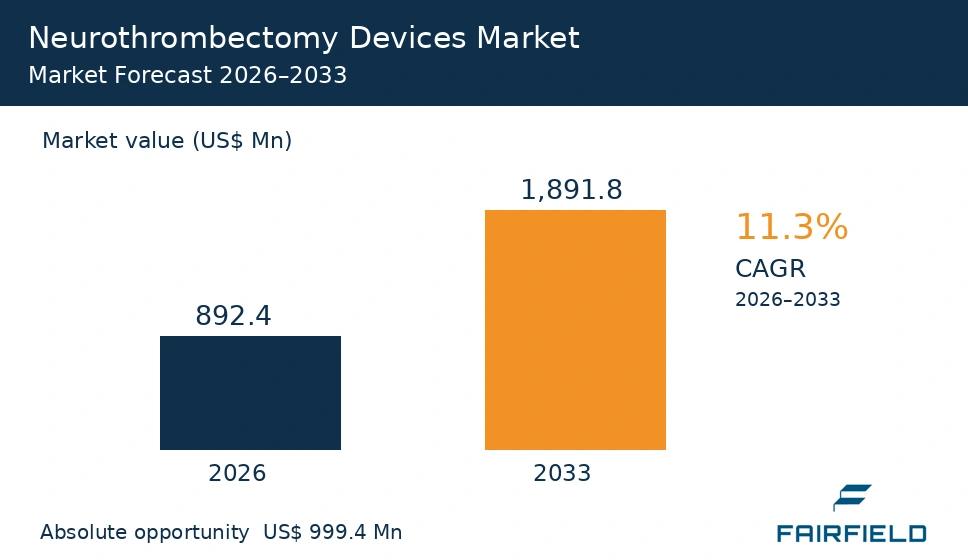
The global neurothrombectomy devices market size is expected to be valued at US$ 892.4 million in 2026 and projected to reach US$ 1,891.8 million by 2033, growing at a CAGR of 11.3% between 2026 and 2033.
Between 2020 and 2025, the market grew at a CAGR of about 10.1%, rising from roughly US$ 500.0 million to about US$ 809.9 million, as trials extended treatment windows to 24 hours, more hospitals became thrombectomy-capable stroke centers, and new studies supported treating large strokes and smaller vessel blockages. The neurothrombectomy devices market covers minimally invasive tools used to remove blood clots from arteries in the brain during an acute ischemic stroke, restoring blood flow and saving brain tissue. Main products include stent retrievers that grab the clot, aspiration catheters and pumps that suck it out, and supporting balloon guide catheters, microcatheters, and guidewires. New computer-assisted aspiration systems are also entering use. In June 2026, Penumbra received FDA clearance for Thunderbolt, the first computer-assisted vacuum thrombectomy device for stroke.
Key Report Takeaways
- By Device Type: Stent Retrievers held about 45% share in 2025, while Aspiration Devices are projected to expand at a 12.8% CAGR through 2033, driven by fast first-pass results, computer-assisted aspiration systems, large-bore catheters, and growing use as a first-line technique.
- By Occlusion Location: Large Vessel Occlusion held about 80% share in 2025, while Medium and Distal Vessel Occlusion is projected to expand at a 15.0% CAGR through 2033, driven by smaller devices and new evidence for treating blockages in smaller brain arteries.
- By End User: Hospitals held about 85% share in 2025, while Specialty Stroke Centers and Clinics are projected to expand at a 12.5% CAGR through 2033, driven by new certified thrombectomy centers, mobile stroke units, and regional stroke care networks.
- By Region: North America held about 42% share in 2025, while Asia Pacific is projected to expand at a 13.5% CAGR through 2033, driven by large stroke populations in China and India, new stroke centers, and growing numbers of trained interventionalists.
Global Neurothrombectomy Devices Market Trends and Insights
Drivers Impact Analysis
Two drivers carry the strongest influence on neurothrombectomy devices market demand during the forecast period.
| Driver | Impact on CAGR Forecast | Geographic Relevance | Impact Timeline |
| Rising stroke burden and ageing population | High | Global | Long term (≥4 years) |
| Expanding clinical evidence and stroke networks | High | North America, Europe, Asia Pacific | Medium term (2-4 years) |
Stroke Burden Is Driving the Neurothrombectomy Devices Market
Rising stroke burden and ageing population are the strongest driver of the neurothrombectomy devices market. More people suffer strokes every year.
The mechanism is that stroke is the second leading cause of death worldwide and a major cause of long-term disability, and most strokes are ischemic, caused by a clot blocking blood flow to the brain. The risk rises sharply with age, high blood pressure, diabetes, obesity, smoking, and atrial fibrillation, all of which are increasing as populations age. Global stroke deaths are projected to rise by about 50% between 2020 and 2050 without better care. Mechanical thrombectomy is the most effective treatment for strokes caused by large vessel blockages, greatly improving the chance of independent living. These trends create steady, growing demand for clot removal devices in every region.
Clinical Evidence Is Expanding the Neurothrombectomy Devices Market
Expanding clinical evidence and stroke networks are expanding the neurothrombectomy devices market. More patients now qualify.
The cause is that landmark trials have shown thrombectomy helps patients up to 24 hours after stroke onset, patients with large core strokes once thought too damaged to benefit, and patients with basilar artery blockages. Guidelines from stroke societies in North America, Europe, and Asia Pacific now recommend thrombectomy for these wider groups. Health systems are building hub-and-spoke stroke networks, certifying thrombectomy-capable centers, using artificial intelligence software to detect large vessel blockages on scans, and adding mobile stroke units. Faster detection and transfer mean more eligible patients reach treatment in time, and direct transfer to angiography suites saves further minutes. These changes steadily increase procedure volumes and device use.
Restraints Impact Analysis
Two restraints limit how quickly the neurothrombectomy devices market grows.
| Restraint | Impact on CAGR Forecast | Geographic Relevance | Impact Timeline |
| Shortage of trained specialists and stroke centers | High | Asia Pacific, Latin America, Middle East & Africa | Long term (≥4 years) |
| High device costs and reimbursement gaps | Medium | Global | Medium term (2-4 years) |
Specialist Shortages Slow the Neurothrombectomy Devices Market
Shortage of trained specialists and stroke centers slows the neurothrombectomy devices market. Many patients cannot reach treatment.
The problem is that thrombectomy requires highly trained neurointerventionalists, angiography suites, anesthesia support, and around-the-clock teams, which are concentrated in large urban hospitals. Many rural areas and lower-income countries have few or no thrombectomy-capable centers, so only a small fraction of eligible patients worldwide receive the procedure. Treatment must happen quickly, and long transfer times reduce benefit or rule patients out. Training new interventionalists takes years, and existing specialists face heavy workloads. Public awareness of stroke symptoms remains low in many places, delaying arrival at hospital. Shortages of anesthesiologists and nurses add further limits. These factors limit procedure growth, especially in Asia Pacific, Latin America, and Middle East & Africa.
Cost and Reimbursement Gaps Restrict the Neurothrombectomy Devices Market
High device costs and reimbursement gaps restrict the neurothrombectomy devices market. Procedures are expensive.
The constraint is that a single thrombectomy can use several catheters, stent retrievers, and aspiration devices, and newer computer-assisted systems add further cost. In many countries, hospital payments for stroke procedures do not fully cover device and staffing costs, making hospitals cautious about expanding services. Public health systems in Asia Pacific, Latin America, and Middle East & Africa often have limited budgets for high-cost devices, and patients may need to pay out of pocket. Volume-based procurement in China has cut device prices sharply. Regulatory approvals for new devices require clinical trials, adding time and expense, and stricter European Union device rules have raised costs. These factors limit access and slow revenue growth.
Market Opportunities
Computer-Assisted Aspiration and Next-Generation Devices Open a Fast-Growth Revenue Pool
Computer-assisted aspiration and next-generation devices open a fast-growth revenue pool. New technology is improving clot removal.
The opportunity comes from devices that remove clots faster and more completely on the first pass, which is strongly linked to better patient outcomes, shorter procedures, and fewer complications. In June 2026, Penumbra won FDA clearance and CE Mark approval for Thunderbolt, which uses modulated aspiration to detect, fatigue, and ingest clots. In April 2026, Rapid Medical won clearance for Tigertriever 25 for large proximal blockages, and Imperative Care has expanded its Zoom aspiration catheters. Smaller devices for medium and distal vessels and radial access tools also widen use. Companies with strong first-pass data, simple setup, and complete product kits can win premium pricing and long-term hospital contracts.
Asia Pacific Stroke Care Expansion Creates a Growth Revenue Pool
Asia Pacific stroke care expansion creates a growth revenue pool. Large patient populations remain undertreated.
The opportunity reflects the very high number of strokes in China and India, along with rising rates in Indonesia, Vietnam, and the Philippines, where thrombectomy access is still limited. Governments are building national stroke center networks in many large cities, training interventionalists, and adding thrombectomy to insurance coverage. China has a large and growing local device industry, and Japan and South Korea have advanced stroke care systems with high procedure rates. Telestroke and artificial intelligence tools help smaller hospitals identify patients for transfer to specialist centers. Local manufacturing is also lowering prices. Companies that offer affordable devices, training programs, and local partnerships can capture strong growth in Asia Pacific over the forecast period.
Segment Analysis
By Device Type: Stent Retrievers Lead While Aspiration Devices Grow Fastest
Stent Retrievers held about 45% share in 2025. Stent retrievers such as Stryker’s Trevo, Medtronic’s Solitaire, and Cerenovus’s EmboTrap were used in the landmark trials that proved thrombectomy works, and they remain widely used alone or in combination with aspiration catheters. Doctors trust their long clinical record and strong outcome data.
Aspiration Devices are the fastest-growing type, expanding at a 12.8% CAGR through 2033. Large-bore aspiration catheters and pumps can remove clots quickly with fewer steps, and computer-assisted systems such as Thunderbolt add new capabilities. Balloon Guide Catheters, Microcatheters, and Other Devices form other segments. For the market, aspiration growth reflects demand for faster, simpler procedures with high first-pass success.
By Occlusion Location: Large Vessel Occlusion Leads While Medium and Distal Vessel Occlusion Grows Fastest
Large Vessel Occlusion held about 80% share in 2025. Blockages in the internal carotid artery, the main middle cerebral artery branch, and the basilar artery cause the most severe strokes and are the main indication for thrombectomy. Most devices and clinical trials have focused on these arteries, and clear guidelines support treatment, making this the most established and predictable segment for device makers.
Medium and Distal Vessel Occlusion is the fastest-growing location, expanding at a 15.0% CAGR through 2033. Smaller stent retrievers and aspiration catheters are being designed for narrower, more fragile arteries deeper in the brain, and ongoing trials are testing benefits. Posterior Circulation Occlusions are included in this segment. For the market, this segment could add many new patients if ongoing trials confirm benefit.
By End User: Hospitals Lead While Specialty Stroke Centers and Clinics Grow Fastest
Hospitals held about 85% share in 2025. Large comprehensive stroke centers in hospitals have angiography suites, neurointerventionalists, intensive care units, and around-the-clock teams needed for thrombectomy. Most procedures happen in these hospitals, which buy devices through group contracts and often stock products from several suppliers to suit different clot types.
Specialty Stroke Centers and Clinics are the fastest-growing end user, expanding at a 12.5% CAGR through 2033. New thrombectomy-capable centers are being certified in smaller cities to shorten travel times. Mobile stroke units and telestroke links help these centers identify patients quickly. Other End Users form a small segment. For the market, growth of new centers widens patient access and adds new device buyers.
Geography Analysis
Which Region Is Leading the Neurothrombectomy Devices Market?
North America is leading the neurothrombectomy devices market with about 42% share in 2025. The United States has a high stroke burden, a large network of certified comprehensive and thrombectomy-capable stroke centers, strong reimbursement, and fast adoption of new devices. Stryker, Medtronic, Penumbra, Imperative Care, and Route 92 Medical are based in the region, and Boston Scientific agreed in January 2026 to acquire Penumbra for about US$ 14.5 billion. Canada adds demand through provincial stroke systems. Key barriers include rural access gaps and specialist shortages. One change shaping the region is rapid adoption of computer-assisted aspiration.
Europe Shapes the Neurothrombectomy Devices Market Through Stroke Research
Europe is a major neurothrombectomy devices market. Germany, France, the United Kingdom, Spain, and the Netherlands have strong stroke care systems with organized ambulance pathways, and many landmark thrombectomy trials were run in European hospitals. Acandis, phenox, and Balt are based in the region and sell widely across hospitals, and Penumbra won CE Mark approval for Thunderbolt in June 2026. Key barriers include tender pricing, stricter device rules, and uneven access across countries. One opportunity is new stroke centers in Central and Eastern Europe, supported by national stroke action plans and European Union health funding.
Which Region Is Growing Fastest in the Neurothrombectomy Devices Market?
Asia Pacific is the fastest-growing neurothrombectomy devices market, expanding at a 13.5% CAGR through 2033. China has the world’s largest number of stroke patients, a growing network of stroke centers, and expanding local device makers, while India is building stroke programs in large cities and training more neurointerventionalists. Japan and South Korea have advanced stroke care and high device use, and Australia has strong stroke networks, including mobile stroke units. Key barriers include price controls, volume-based procurement, and specialist shortages. One change shaping the region is fast growth of trained interventionalists and local device makers in China.
Latin America Grows the Neurothrombectomy Devices Market Through Stroke Programs
Latin America is a growing neurothrombectomy devices market. Brazil, Mexico, Argentina, Colombia, and Chile have high and rising stroke rates and are building organized stroke programs in large public and private hospitals, and Brazil’s public health system has added thrombectomy to coverage. Key barriers include limited stroke centers outside major cities, high device costs, currency swings, and long transfer times. Public awareness campaigns are helping patients arrive sooner. One opportunity is regional stroke networks, supported by telestroke services, specialist training programs, and partnerships with global device makers to expand access in public and private hospitals.
Middle East & Africa Builds the Neurothrombectomy Devices Market Through Specialist Centers
Middle East & Africa is an emerging neurothrombectomy devices market. Saudi Arabia, the United Arab Emirates, and Qatar are building stroke centers and training interventionalists under national health plans, and Israel has advanced stroke care. South Africa and Egypt have growing neurointervention programs in large teaching hospitals, and Kuwait and Oman are adding stroke units. Key barriers include few trained specialists, limited access outside large cities, and low public awareness of stroke symptoms. One opportunity is new stroke centers in large cities, supported by government investment, international training partnerships, and telestroke networks that link smaller hospitals with specialist teams.
Competitive Landscape
The neurothrombectomy devices market is consolidated. Stryker Corporation, Medtronic plc, Penumbra, Inc. (Boston Scientific), Johnson & Johnson MedTech (Cerenovus), and Terumo Corporation (MicroVention) are leading players, while Imperative Care, Rapid Medical, Acandis, phenox, Balt, Route 92 Medical, and Perflow Medical compete strongly. Stryker and Medtronic lead in stent retrievers with Trevo and Solitaire, while Penumbra leads in aspiration with its catheter and pump systems and computer-assisted platforms. A handful of companies hold most of the market because doctors rely on devices backed by large clinical trials and long experience.
Companies compete on first-pass success rates, ease of navigation through brain arteries, catheter size and flexibility, clinical evidence, complete product portfolios, physician training, and pricing. Hospitals often prefer suppliers that offer full kits, from access catheters to retrievers and aspiration systems.
Strategic moves show how competition is changing. In July 2025, Imperative Care won clearance for Zoom 7X. In January 2026, Boston Scientific agreed to acquire Penumbra for about US$ 14.5 billion. In April 2026, Rapid Medical won clearance for Tigertriever 25, and in June 2026, Penumbra won FDA and CE Mark approval for Thunderbolt.
Three themes shape vendor strategy. First, companies are developing computer-assisted and large-bore aspiration tools to raise first-pass success. Second, they are designing smaller devices for medium and distal vessel blockages. Third, they are expanding training and distribution in Asia Pacific and other underserved regions.
Neurothrombectomy Devices Market Industry Leaders
Stryker Corporation Medtronic plc Penumbra, Inc. (Boston Scientific) Johnson & Johnson MedTech (Cerenovus) Terumo Corporation (MicroVention)
Recent Industry Developments
- June 2026: Penumbra received FDA clearance and CE Mark approval for Thunderbolt, the first computer-assisted vacuum thrombectomy platform for acute ischemic stroke - introduces modulated aspiration into the neurothrombectomy devices market.
- April 2026: Rapid Medical received FDA clearance for Tigertriever 25, designed for difficult large vessel occlusions in the internal carotid and middle cerebral arteries - expands adjustable stent retriever options.
- January 2026: Boston Scientific agreed to acquire Penumbra in a deal valued at about US$ 14.5 billion - creates a stronger competitor in neurovascular and thrombectomy devices.
- July 2025: Imperative Care received FDA 510(k) clearance for its Zoom 7X aspiration catheter for acute ischemic stroke - adds a self-orienting tip to its aspiration portfolio.
Companies Covered in the Report
- Stryker Corporation
- Medtronic plc
- Penumbra, Inc. (Boston Scientific)
- Johnson & Johnson MedTech (Cerenovus)
- Terumo Corporation (MicroVention)
- Imperative Care, Inc.
- Rapid Medical
- Acandis GmbH
- phenox GmbH
- Balt Group
- Route 92 Medical
- Perflow Medical
Neurothrombectomy Devices Market Report Scope
This report covers the neurothrombectomy devices market, including stent retrievers, aspiration devices, balloon guide catheters, microcatheters, and other devices, used to treat large vessel and medium and distal vessel occlusions in hospitals, specialty stroke centers and clinics, and other end users. The base year is 2025, and the forecast period runs from 2026 to 2033. All values are expressed in US$ Million.
| Device Type | Stent Retrievers, Aspiration Devices, Balloon Guide Catheters, Microcatheters and Other Devices |
| Occlusion Location | Large Vessel Occlusion, Medium and Distal Vessel Occlusion |
| End User | Hospitals, Specialty Stroke Centers and Clinics, Other End Users |
| Regions | North America, Europe, Asia Pacific, Latin America, Middle East & Africa |
1. Executive Summary
1.1 Neurothrombectomy Devices Market Snapshot
1.2 Future Projections
1.3 Key Market Trends
1.4 Regional Snapshot
2. Market Overview
2.1 Market Definition and Report Scope
2.2 Historical Market Trends
2.3 Market Dynamics
2.3.1 Drivers
2.3.1.1 Stroke Burden Is Driving the Neurothrombectomy Devices Market
2.3.1.2 Clinical Evidence Is Expanding the Neurothrombectomy Devices Market
2.3.2 Restraints
2.3.2.1 Specialist Shortages Slow the Neurothrombectomy Devices Market
2.3.2.2 Cost and Reimbursement Gaps Restrict the Neurothrombectomy Devices Market
2.3.3 Market Opportunities
2.3.3.1 Computer-Assisted Aspiration and Next-Generation Devices Open a Fast-Growth Revenue Pool
2.3.3.2 Asia Pacific Stroke Care Expansion Creates a Growth Revenue Pool
3. Global Neurothrombectomy Devices Market Outlook, 2020–2033
3.1 Global Neurothrombectomy Devices Market Outlook, by Device Type, Value (US$ Million), 2020–2033
3.1.1 Stent Retrievers
3.1.2 Aspiration Devices
3.1.3 Balloon Guide Catheters
3.1.4 Microcatheters and Other Devices
3.2 Global Neurothrombectomy Devices Market Outlook, by Occlusion Location, Value (US$ Million), 2020–2033
3.2.1 Large Vessel Occlusion
3.2.2 Medium and Distal Vessel Occlusion
3.3 Global Neurothrombectomy Devices Market Outlook, by End User, Value (US$ Million), 2020–2033
3.3.1 Hospitals
3.3.2 Specialty Stroke Centers and Clinics
3.3.3 Other End Users
3.4 Global Neurothrombectomy Devices Market Outlook, by Region, Value (US$ Million), 2020–2033
3.4.1 North America
3.4.2 Europe
3.4.3 Asia Pacific
3.4.4 Latin America
3.4.5 Middle East & Africa
4. North America Neurothrombectomy Devices Market Outlook, 2020–2033
4.1 North America Neurothrombectomy Devices Market Outlook, by Device Type, Value (US$ Million), 2020–2033
4.1.1 Stent Retrievers
4.1.2 Aspiration Devices
4.1.3 Balloon Guide Catheters
4.1.4 Microcatheters and Other Devices
4.2 North America Neurothrombectomy Devices Market Outlook, by Occlusion Location, Value (US$ Million), 2020–2033
4.2.1 Large Vessel Occlusion
4.2.2 Medium and Distal Vessel Occlusion
4.3 North America Neurothrombectomy Devices Market Outlook, by End User, Value (US$ Million), 2020–2033
4.3.1 Hospitals
4.3.2 Specialty Stroke Centers and Clinics
4.3.3 Other End Users
4.4 North America Neurothrombectomy Devices Market Outlook, by Country, Value (US$ Million), 2020–2033
4.4.1 United States Neurothrombectomy Devices Market Outlook, by Device Type, 2020–2033
4.4.2 United States Neurothrombectomy Devices Market Outlook, by Occlusion Location, 2020–2033
4.4.3 United States Neurothrombectomy Devices Market Outlook, by End User, 2020–2033
4.4.4 Canada Neurothrombectomy Devices Market Outlook, by Device Type, 2020–2033
4.4.5 Canada Neurothrombectomy Devices Market Outlook, by Occlusion Location, 2020–2033
4.4.6 Canada Neurothrombectomy Devices Market Outlook, by End User, 2020–2033
5. Europe Neurothrombectomy Devices Market Outlook, 2020–2033
5.1 Europe Neurothrombectomy Devices Market Outlook, by Device Type, Value (US$ Million), 2020–2033
5.1.1 Stent Retrievers
5.1.2 Aspiration Devices
5.1.3 Balloon Guide Catheters
5.1.4 Microcatheters and Other Devices
5.2 Europe Neurothrombectomy Devices Market Outlook, by Occlusion Location, Value (US$ Million), 2020–2033
5.2.1 Large Vessel Occlusion
5.2.2 Medium and Distal Vessel Occlusion
5.3 Europe Neurothrombectomy Devices Market Outlook, by End User, Value (US$ Million), 2020–2033
5.3.1 Hospitals
5.3.2 Specialty Stroke Centers and Clinics
5.3.3 Other End Users
5.4 Europe Neurothrombectomy Devices Market Outlook, by Country, Value (US$ Million), 2020–2033
5.4.1 Germany Neurothrombectomy Devices Market Outlook, by Device Type, 2020–2033
5.4.2 Germany Neurothrombectomy Devices Market Outlook, by Occlusion Location, 2020–2033
5.4.3 Germany Neurothrombectomy Devices Market Outlook, by End User, 2020–2033
5.4.4 France Neurothrombectomy Devices Market Outlook, by Device Type, 2020–2033
5.4.5 France Neurothrombectomy Devices Market Outlook, by Occlusion Location, 2020–2033
5.4.6 France Neurothrombectomy Devices Market Outlook, by End User, 2020–2033
5.4.7 United Kingdom Neurothrombectomy Devices Market Outlook, by Device Type, 2020–2033
5.4.8 United Kingdom Neurothrombectomy Devices Market Outlook, by Occlusion Location, 2020–2033
5.4.9 United Kingdom Neurothrombectomy Devices Market Outlook, by End User, 2020–2033
5.4.10 Spain Neurothrombectomy Devices Market Outlook, by Device Type, 2020–2033
5.4.11 Spain Neurothrombectomy Devices Market Outlook, by Occlusion Location, 2020–2033
5.4.12 Spain Neurothrombectomy Devices Market Outlook, by End User, 2020–2033
5.4.13 Netherlands Neurothrombectomy Devices Market Outlook, by Device Type, 2020–2033
5.4.14 Netherlands Neurothrombectomy Devices Market Outlook, by Occlusion Location, 2020–2033
5.4.15 Netherlands Neurothrombectomy Devices Market Outlook, by End User, 2020–2033
6. Asia Pacific Neurothrombectomy Devices Market Outlook, 2020–2033
6.1 Asia Pacific Neurothrombectomy Devices Market Outlook, by Device Type, Value (US$ Million), 2020–2033
6.1.1 Stent Retrievers
6.1.2 Aspiration Devices
6.1.3 Balloon Guide Catheters
6.1.4 Microcatheters and Other Devices
6.2 Asia Pacific Neurothrombectomy Devices Market Outlook, by Occlusion Location, Value (US$ Million), 2020–2033
6.2.1 Large Vessel Occlusion
6.2.2 Medium and Distal Vessel Occlusion
6.3 Asia Pacific Neurothrombectomy Devices Market Outlook, by End User, Value (US$ Million), 2020–2033
6.3.1 Hospitals
6.3.2 Specialty Stroke Centers and Clinics
6.3.3 Other End Users
6.4 Asia Pacific Neurothrombectomy Devices Market Outlook, by Country, Value (US$ Million), 2020–2033
6.4.1 China Neurothrombectomy Devices Market Outlook, by Device Type, 2020–2033
6.4.2 China Neurothrombectomy Devices Market Outlook, by Occlusion Location, 2020–2033
6.4.3 China Neurothrombectomy Devices Market Outlook, by End User, 2020–2033
6.4.4 India Neurothrombectomy Devices Market Outlook, by Device Type, 2020–2033
6.4.5 India Neurothrombectomy Devices Market Outlook, by Occlusion Location, 2020–2033
6.4.6 India Neurothrombectomy Devices Market Outlook, by End User, 2020–2033
6.4.7 Japan Neurothrombectomy Devices Market Outlook, by Device Type, 2020–2033
6.4.8 Japan Neurothrombectomy Devices Market Outlook, by Occlusion Location, 2020–2033
6.4.9 Japan Neurothrombectomy Devices Market Outlook, by End User, 2020–2033
6.4.10 South Korea Neurothrombectomy Devices Market Outlook, by Device Type, 2020–2033
6.4.11 South Korea Neurothrombectomy Devices Market Outlook, by Occlusion Location, 2020–2033
6.4.12 South Korea Neurothrombectomy Devices Market Outlook, by End User, 2020–2033
6.4.13 Australia Neurothrombectomy Devices Market Outlook, by Device Type, 2020–2033
6.4.14 Australia Neurothrombectomy Devices Market Outlook, by Occlusion Location, 2020–2033
6.4.15 Australia Neurothrombectomy Devices Market Outlook, by End User, 2020–2033
7. Latin America Neurothrombectomy Devices Market Outlook, 2020–2033
7.1 Latin America Neurothrombectomy Devices Market Outlook, by Device Type, Value (US$ Million), 2020–2033
7.1.1 Stent Retrievers
7.1.2 Aspiration Devices
7.1.3 Balloon Guide Catheters
7.1.4 Microcatheters and Other Devices
7.2 Latin America Neurothrombectomy Devices Market Outlook, by Occlusion Location, Value (US$ Million), 2020–2033
7.2.1 Large Vessel Occlusion
7.2.2 Medium and Distal Vessel Occlusion
7.3 Latin America Neurothrombectomy Devices Market Outlook, by End User, Value (US$ Million), 2020–2033
7.3.1 Hospitals
7.3.2 Specialty Stroke Centers and Clinics
7.3.3 Other End Users
7.4 Latin America Neurothrombectomy Devices Market Outlook, by Country, Value (US$ Million), 2020–2033
7.4.1 Brazil Neurothrombectomy Devices Market Outlook, by Device Type, 2020–2033
7.4.2 Brazil Neurothrombectomy Devices Market Outlook, by Occlusion Location, 2020–2033
7.4.3 Brazil Neurothrombectomy Devices Market Outlook, by End User, 2020–2033
7.4.4 Mexico Neurothrombectomy Devices Market Outlook, by Device Type, 2020–2033
7.4.5 Mexico Neurothrombectomy Devices Market Outlook, by Occlusion Location, 2020–2033
7.4.6 Mexico Neurothrombectomy Devices Market Outlook, by End User, 2020–2033
7.4.7 Argentina Neurothrombectomy Devices Market Outlook, by Device Type, 2020–2033
7.4.8 Argentina Neurothrombectomy Devices Market Outlook, by Occlusion Location, 2020–2033
7.4.9 Argentina Neurothrombectomy Devices Market Outlook, by End User, 2020–2033
7.4.10 Colombia Neurothrombectomy Devices Market Outlook, by Device Type, 2020–2033
7.4.11 Colombia Neurothrombectomy Devices Market Outlook, by Occlusion Location, 2020–2033
7.4.12 Colombia Neurothrombectomy Devices Market Outlook, by End User, 2020–2033
7.4.13 Chile Neurothrombectomy Devices Market Outlook, by Device Type, 2020–2033
7.4.14 Chile Neurothrombectomy Devices Market Outlook, by Occlusion Location, 2020–2033
7.4.15 Chile Neurothrombectomy Devices Market Outlook, by End User, 2020–2033
8. Middle East & Africa Neurothrombectomy Devices Market Outlook, 2020–2033
8.1 Middle East & Africa Neurothrombectomy Devices Market Outlook, by Device Type, Value (US$ Million), 2020–2033
8.1.1 Stent Retrievers
8.1.2 Aspiration Devices
8.1.3 Balloon Guide Catheters
8.1.4 Microcatheters and Other Devices
8.2 Middle East & Africa Neurothrombectomy Devices Market Outlook, by Occlusion Location, Value (US$ Million), 2020–2033
8.2.1 Large Vessel Occlusion
8.2.2 Medium and Distal Vessel Occlusion
8.3 Middle East & Africa Neurothrombectomy Devices Market Outlook, by End User, Value (US$ Million), 2020–2033
8.3.1 Hospitals
8.3.2 Specialty Stroke Centers and Clinics
8.3.3 Other End Users
8.4 Middle East & Africa Neurothrombectomy Devices Market Outlook, by Country, Value (US$ Million), 2020–2033
8.4.1 Saudi Arabia Neurothrombectomy Devices Market Outlook, by Device Type, 2020–2033
8.4.2 Saudi Arabia Neurothrombectomy Devices Market Outlook, by Occlusion Location, 2020–2033
8.4.3 Saudi Arabia Neurothrombectomy Devices Market Outlook, by End User, 2020–2033
8.4.4 United Arab Emirates Neurothrombectomy Devices Market Outlook, by Device Type, 2020–2033
8.4.5 United Arab Emirates Neurothrombectomy Devices Market Outlook, by Occlusion Location, 2020–2033
8.4.6 United Arab Emirates Neurothrombectomy Devices Market Outlook, by End User, 2020–2033
8.4.7 Qatar Neurothrombectomy Devices Market Outlook, by Device Type, 2020–2033
8.4.8 Qatar Neurothrombectomy Devices Market Outlook, by Occlusion Location, 2020–2033
8.4.9 Qatar Neurothrombectomy Devices Market Outlook, by End User, 2020–2033
8.4.10 Israel Neurothrombectomy Devices Market Outlook, by Device Type, 2020–2033
8.4.11 Israel Neurothrombectomy Devices Market Outlook, by Occlusion Location, 2020–2033
8.4.12 Israel Neurothrombectomy Devices Market Outlook, by End User, 2020–2033
8.4.13 South Africa Neurothrombectomy Devices Market Outlook, by Device Type, 2020–2033
8.4.14 South Africa Neurothrombectomy Devices Market Outlook, by Occlusion Location, 2020–2033
8.4.15 South Africa Neurothrombectomy Devices Market Outlook, by End User, 2020–2033
8.4.16 Egypt Neurothrombectomy Devices Market Outlook, by Device Type, 2020–2033
8.4.17 Egypt Neurothrombectomy Devices Market Outlook, by Occlusion Location, 2020–2033
8.4.18 Egypt Neurothrombectomy Devices Market Outlook, by End User, 2020–2033
8.4.19 Kuwait Neurothrombectomy Devices Market Outlook, by Device Type, 2020–2033
8.4.20 Kuwait Neurothrombectomy Devices Market Outlook, by Occlusion Location, 2020–2033
8.4.21 Kuwait Neurothrombectomy Devices Market Outlook, by End User, 2020–2033
8.4.22 Oman Neurothrombectomy Devices Market Outlook, by Device Type, 2020–2033
8.4.23 Oman Neurothrombectomy Devices Market Outlook, by Occlusion Location, 2020–2033
8.4.24 Oman Neurothrombectomy Devices Market Outlook, by End User, 2020–2033
9. Competitive Landscape
9.1 Neurothrombectomy Devices Market Industry Leaders
9.2 Recent Industry Developments
9.3 Company Profiles
9.3.1 Stryker Corporation
9.3.2 Medtronic plc
9.3.3 Penumbra, Inc. (Boston Scientific)
9.3.4 Johnson & Johnson MedTech (Cerenovus)
9.3.5 Terumo Corporation (MicroVention)
9.3.6 Imperative Care, Inc.
9.3.7 Rapid Medical
9.3.8 Acandis GmbH
9.3.9 phenox GmbH
9.3.10 Balt Group
9.3.11 Route 92 Medical
9.3.12 Perflow Medical
10. Appendix
10.1 Research Methodology
10.2 Report Assumptions
10.3 Acronyms and Abbreviations
| Device Type | Stent Retrievers, Aspiration Devices, Balloon Guide Catheters, Microcatheters and Other Devices |
| Occlusion Location | Large Vessel Occlusion, Medium and Distal Vessel Occlusion |
| End User | Hospitals, Specialty Stroke Centers and Clinics, Other End Users |
| Regions | North America, Europe, Asia Pacific, Latin America, Middle East & Africa |
Our Research Methodology
Considering the volatility of business today, traditional approaches to strategizing a game plan can be unfruitful if not detrimental. True ambiguity is no way to determine a forecast. A myriad of predetermined factors must be accounted for such as the degree of risk involved, the magnitude of circumstances, as well as conditions or consequences that are not known or unpredictable. To circumvent binary views that cast uncertainty, the application of market research intelligence to strategically posture, move, and enable actionable outcomes is necessary.
View Methodology
Quality Assured
Rigorous Validation Process

Confidentiality Assured
End-to-end Data Security

Custom Research Services
Tailored To Your Objectives
FAQs
The global neurothrombectomy devices market is expected to be valued at US$ 892.4 million in 2026, driven by rising stroke cases.
The market is projected to grow at an 11.3% CAGR from 2026 to 2033, reaching about US$ 1,891.8 million by 2033.
North America leads with about 42% share, supported by many certified stroke centers, strong reimbursement, and major device companies based there.
Stent Retrievers dominate with about 45% share, because they have long clinical records and are widely used in stroke treatment.
Key players include Stryker, Medtronic, Penumbra, Cerenovus, and MicroVention, competing on first-pass success, deliverability, evidence, and pricing.
Related Reports
Spine Biologics Market Size, Share, Insights, Competitive Landscape, and Forecast 2026 to 2033
The spine biologics market is projected to reach US$ 5.70 billion by 2033, growing at 5.1% CAGR from US$ 4.02 billion in 2026.
Disposable Medical Sensors Market Size, Share, Insights, Competitive Landscape, and Forecast 2026 to 2033
The disposable medical sensors market is projected to reach US$ 18.31 billion by 2033, growing at 6.4% CAGR from US$ 11.86 billion in 2026.
Cubital Tunnel Syndrome Market Size, Share, Insights, Competitive Landscape, and Forecast 2026 to 2033
The cubital tunnel syndrome market is projected to reach US$ 780.2 million by 2033, growing at 7.2% CAGR from US$ 479.4 million in 2026.
White Glove Services in Delivery Market Size, Share, Insights, Competitive Landscape, and Forecast 2026 to 2033
The global white glove services in delivery market is valued at US$15.60 billion in 2026, reaching US$29.08 billion by 2033, growing at a 9.3% CAGR
Centrifugation-Free Sperm Separation System Market Size, Share, Insights, Competitive Landscape, and Forecast 2026 to 2033
The centrifugation-free sperm separation system market is projected to reach US$ 223.8 million by 2033, growing at 5.3% CAGR from US$ 155.6 million in 2026.
Smart Fertility Trackers Market Size, Share, Insights, Competitive Landscape, and Forecast 2026 to 2033
Explore the smart fertility trackers market, forecast to reach US$3.10 billion by 2033 at 11.8% CAGR, with product, technology, channel, and regional insights.