



Spine Biologics Market
Spine Biologics Market Size, Share, Insights, Competitive Landscape, and Forecast 2026 to 2033
Report Overview
Spine Biologics Market Size and Trend Analysis
How Fast Is the Spine Biologics Market Growing?
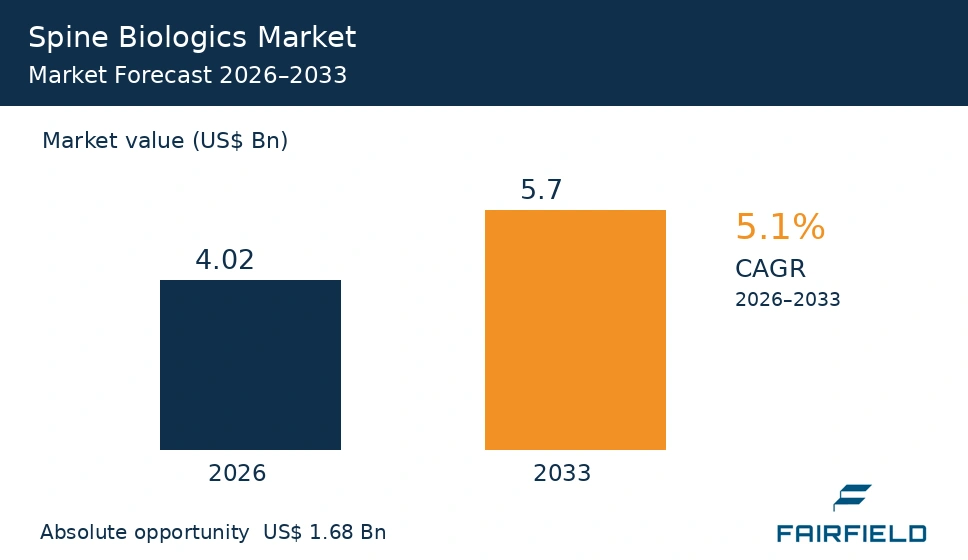
The global spine biologics market size is expected to be valued at US$ 4.02 billion in 2026 and projected to reach US$ 5.70 billion by 2033, growing at a CAGR of 5.1% between 2026 and 2033.
Between 2020 and 2025, the market grew at a CAGR of about 4.5%, rising from roughly US$ 3.07 billion to about US$ 3.82 billion, as elective spine surgeries recovered after pandemic delays, fusion volumes rose with ageing populations, and surgeons adopted new synthetic and cell-based bone grafts. The spine biologics market covers biological and synthetic materials used during spinal surgery to help bones heal and fuse, reducing the need to harvest bone from the patient’s own hip. Main products include spinal allografts such as demineralized bone matrix and machined bone, bone graft substitutes such as ceramics and peptide-enhanced grafts, bone morphogenetic proteins, cell-based matrices, and platelet-rich plasma and bone marrow aspirate concentrate. These products are used in cervical and lumbar fusion, deformity correction, and trauma cases. In February 2026, Medtronic won expanded FDA approval for Infuse bone graft in two-level lumbar fusion.
Key Report Takeaways
- By Product: Spinal Allografts held about 45% share in 2025, while Bone Graft Substitutes are projected to expand at a 6.5% CAGR through 2033, driven by synthetic and peptide-enhanced grafts with clinical proof, steady supply, and no disease transmission risk from donor tissue.
- By Surgery Type: Anterior Cervical Discectomy and Fusion held about 35% share in 2025, while Transforaminal Lumbar Interbody Fusion is projected to expand at a 6.2% CAGR through 2033, driven by minimally invasive techniques and new approved grafts for lumbar cages.
- By End User: Hospitals held about 60% share in 2025, while Specialty Orthopedic and Spine Clinics are projected to expand at a 7.0% CAGR through 2033, driven by the shift of simpler fusion cases to outpatient settings and ambulatory surgery centers.
- By Region: North America held about 46% share in 2025, while Asia Pacific is projected to expand at a 6.6% CAGR through 2033, driven by ageing populations, rising spine surgery volumes, and growing hospital capacity in China, India, and Japan.
Global Spine Biologics Market Trends and Insights
Drivers Impact Analysis
Two drivers carry the strongest influence on spine biologics market demand during the forecast period.
| Driver | Impact on CAGR Forecast | Geographic Relevance | Impact Timeline |
| Ageing population and rising spinal fusion volumes | High | Global | Long term (≥4 years) |
| Clinical evidence and premium approved grafts | Medium | North America, Europe | Medium term (2-4 years) |
Rising Fusion Volumes Are Driving the Spine Biologics Market
Ageing population and rising spinal fusion volumes are the strongest driver of the spine biologics market. More people need spine surgery.
The mechanism is that degenerative disc disease, spinal stenosis, spondylolisthesis, and deformities become more common with age, and the number of people over sixty-five is growing quickly worldwide. Spinal fusion is one of the most common spine procedures, and nearly every fusion uses some form of bone graft to help vertebrae grow together. Obesity, sedentary lifestyles, and osteoporosis add to spinal problems and make healing harder, increasing the need for effective grafts. Better surgical tools and minimally invasive techniques allow surgeons to operate on older and sicker patients. Revision surgeries for failed fusions also add demand. These trends create steady, growing demand for spine biologics across all regions.
Clinical Evidence Is Expanding the Spine Biologics Market
Clinical evidence and premium approved grafts are expanding the spine biologics market. Surgeons want proven results.
The cause is that hundreds of bone graft products are sold in the United States, but only a few have passed the strict FDA premarket approval process with randomized trial data. In June 2025, Cerapedics won FDA premarket approval for PearlMatrix P-15 Peptide Enhanced Bone Graft, the first graft proven to speed lumbar fusion. In February 2026, Medtronic expanded Infuse approval to one- and two-level lumbar fusions. These products command premium prices and attract surgeons who want faster fusion and fewer failed surgeries. Hospitals and payers increasingly look for outcome data before buying. Products backed by strong trials gain wider coverage, better hospital contracts, and greater surgeon confidence, lifting market value.
Restraints Impact Analysis
Two restraints limit how quickly the spine biologics market grows.
| Restraint | Impact on CAGR Forecast | Geographic Relevance | Impact Timeline |
| High product cost and reimbursement pressure | High | Global | Medium term (2-4 years) |
| Safety concerns and regulatory hurdles | Medium | North America, Europe | Long term (≥4 years) |
Cost and Reimbursement Pressure Slow the Spine Biologics Market
High product cost and reimbursement pressure slow the spine biologics market. Hospitals are cutting supply costs.
The problem is that premium bone grafts, growth factors, and cell-based products can cost thousands of dollars per surgery, while hospital payments for spinal fusion are often fixed. Hospitals and ambulatory surgery centers use value analysis committees to limit expensive biologics and choose lower-cost allografts or local autograft when possible. Payers in North America and Europe have questioned the value of some spine fusion procedures and pushed for conservative care first. In Asia Pacific, Latin America, and Middle East & Africa, limited insurance coverage and low hospital budgets restrict use of premium products. Group purchasing contracts, physician-owned distributors, and strong price competition from tissue banks further reduce margins for branded products. These factors slow revenue growth.
Safety and Regulation Restrict the Spine Biologics Market
Safety concerns and regulatory hurdles restrict the spine biologics market. New products face long approval paths.
The constraint is that growth factor grafts have faced past safety concerns, including swelling and complications when used off-label in the cervical spine, which made some surgeons more cautious. Donor tissue products carry a small risk of disease transmission, and tissue banks must follow strict screening and processing rules. Bringing a new graft through FDA premarket approval requires costly randomized trials that can take many years. In Europe, the Medical Device Regulation has increased evidence and documentation requirements for bone graft products. Recalls linked to contaminated tissue have also hurt confidence in some suppliers. Smaller companies often lack funds for large trials, limiting the number of new entrants with proven products. These issues raise development costs and slow new product launches.
Market Opportunities
Synthetic and Cell-Based Grafts Open a Fast-Growth Revenue Pool
Synthetic and cell-based grafts open a fast-growth revenue pool. Surgeons want reliable alternatives to autograft.
The opportunity comes from synthetic bone graft substitutes, peptide-enhanced grafts, and cell-based matrices that offer consistent quality, unlimited supply, and no need for a second surgical site to harvest bone. Kuros Biosciences’s MagnetOs, Cerapedics’s PearlMatrix, and Bioventus’s bone graft products have gained strong surgeon interest, supported by published studies showing reliable fusion rates and steady adoption in both hospitals and outpatient centers. In July 2026, VB Spine received FDA clearance to use Vitoss with interbody cages, including in children and tumor cases. Companies that combine strong clinical evidence, easy handling, fast fusion, and fair pricing can win premium contracts, wider coverage, and long-term surgeon loyalty in every region.
Outpatient Surgery and Asia Pacific Create a Growth Revenue Pool
Outpatient surgery and Asia Pacific create a growth revenue pool. Spine care is moving to new settings.
The opportunity reflects the shift of simpler cervical and lumbar fusions to ambulatory surgery centers and specialty spine clinics, where surgeons choose products that support fast recovery and same-day discharge. New direct marketplaces and tissue bank partnerships are making grafts easier to buy for outpatient centers. In China, India, Japan, and South Korea, ageing populations, growing middle classes, and expanding orthopedic hospitals are raising spine surgery volumes each year. Local tissue banks and manufacturers are increasing supply, and governments are adding orthopedic training programs for younger spine surgeons. Companies that offer cost-effective grafts, surgeon training, and strong distribution can capture growth in these fast-expanding settings and regions.
Segment Analysis
By Product: Spinal Allografts Lead While Bone Graft Substitutes Grow Fastest
Spinal Allografts held about 45% share in 2025. Allografts made from donated human bone, including demineralized bone matrix, cortical fibers, and machined bone, provide a natural scaffold for new bone growth and are widely available from tissue banks. Surgeons trust their long history of use, and many products are priced lower than premium synthetic or growth factor grafts.
Bone Graft Substitutes are the fastest-growing product, expanding at a 6.5% CAGR through 2033. Synthetic ceramics, bioactive glass, and peptide-enhanced grafts offer consistent quality and avoid donor tissue risks. Bone Morphogenetic Proteins, Cell-Based Matrices, and Platelet-Rich Plasma and Bone Marrow Aspirate Concentrate form other segments. For the market, substitute growth reflects rising demand for proven, ready-to-use grafts with strong clinical data.
By Surgery Type: Anterior Cervical Discectomy and Fusion Leads While Transforaminal Lumbar Interbody Fusion Grows Fastest
Anterior Cervical Discectomy and Fusion held about 35% share in 2025. This procedure treats neck pain and nerve compression from damaged cervical discs, and it is one of the most common spine surgeries worldwide. Most cases use a bone graft inside a cage or spacer, and many are now performed in outpatient settings with same-day discharge.
Transforaminal Lumbar Interbody Fusion is the fastest-growing surgery type, expanding at a 6.2% CAGR through 2033. Minimally invasive approaches, robotic navigation, and new grafts approved for lumbar cages support growth. Posterior Lumbar Interbody Fusion and Other Surgeries, including deformity and trauma cases, form other segments. For the market, lumbar fusion growth matters because lumbar procedures make up the majority of fusion volumes.
By End User: Hospitals Lead While Specialty Orthopedic and Spine Clinics Grow Fastest
Hospitals held about 60% share in 2025. Hospitals perform complex multi-level fusions, deformity corrections, trauma cases, and revision surgeries that need large amounts of graft material, and they treat older patients with other health conditions. Large hospital systems buy biologics through group purchasing contracts, often bundled with spinal implants from the same supplier.
Specialty Orthopedic and Spine Clinics are the fastest-growing end user, expanding at a 7.0% CAGR through 2033. Surgeons are moving simpler cervical and lumbar fusions to outpatient centers because they lower costs, shorten stays, and improve patient satisfaction. Ambulatory Surgical Centers form another segment. For the market, outpatient growth favors easy-to-use, ready-to-implant grafts with proven, fast fusion results and predictable costs.
Geography Analysis
Which Region Is Leading the Spine Biologics Market?
North America is leading the spine biologics market with about 46% share in 2025. The United States performs the most spinal fusion surgeries in the world, has well-established reimbursement, and has a large network of tissue banks and spine specialists. Medtronic, DePuy Synthes, Stryker, Globus Medical, Orthofix, Cerapedics, and Bioventus are based or highly active in the region. Canada adds demand from an ageing population. Spine fellowship programs and academic centers also drive early adoption of new grafts. Key barriers include cost pressure and value analysis. One change shaping the region is rapid growth of outpatient spine surgery and premarket-approved grafts.
Europe Shapes the Spine Biologics Market Through Surgical Expertise
Europe is a major spine biologics market. Germany, France, the United Kingdom, Italy, and Spain have large ageing populations and strong spine surgery programs. Kuros Biosciences is based in Switzerland, and several tissue banks and synthetic graft makers operate across the region. The Medical Device Regulation has raised evidence requirements, favoring companies with strong clinical data. Key barriers include tender-based pricing and stricter rules. One opportunity is synthetic grafts with strong clinical data, supported by hospital demand for safe, consistent products. Growing use of minimally invasive and robotic spine surgery also supports premium graft adoption.
Which Region Is Growing Fastest in the Spine Biologics Market?
Asia Pacific is the fastest-growing spine biologics market, expanding at a 6.6% CAGR through 2033. China, Japan, India, South Korea, and Australia have large and ageing populations, rising rates of degenerative spine disease, and fast-growing orthopedic hospitals. China has volume-based procurement for spine implants, which raises procedure volumes while lowering prices. India has growing private hospital chains and medical tourism, and Japan has one of the world’s oldest populations with high rates of spinal stenosis. Key barriers include price controls and limited insurance coverage. One change shaping the region is growth of local tissue banks and graft makers.
Latin America Grows the Spine Biologics Market Through Private Hospitals
Latin America is a growing spine biologics market. Brazil, Mexico, Argentina, Colombia, and Chile have rising spine surgery volumes, ageing populations, and expanding private hospital networks. Brazil has the largest orthopedic device market in the region, a national tissue bank network, and a growing number of trained spine surgeons. Key barriers include currency swings, import costs, and limited public coverage for premium grafts. One opportunity is affordable allograft and synthetic products, supported by surgeon training programs, distributor partnerships, and private insurance growth in large cities. Medical tourism for spine surgery also supports demand in some countries.
Middle East & Africa Builds the Spine Biologics Market Through Hospital Investment
Middle East & Africa is an emerging spine biologics market. Saudi Arabia and the United Arab Emirates are building advanced orthopedic and spine centers under national health plans, and Israel has strong spine surgery expertise. South Africa and Egypt have growing private hospital networks, and Qatar and Kuwait are funding new specialist surgery centers. Key barriers include limited reimbursement, reliance on imports, and few local tissue banks. One opportunity is premium grafts for new specialty hospitals, supported by government investment, surgeon training, international hospital partnerships, and medical tourism programs in large cities. Rising obesity and ageing also increase spine disease rates.
Competitive Landscape
The spine biologics market is consolidated. Medtronic plc, Johnson & Johnson (DePuy Synthes), Stryker Corporation, Globus Medical, Inc., and Orthofix Medical Inc. are leading players, while Bioventus Inc., Cerapedics Inc., Kuros Biosciences AG, Xtant Medical Holdings, MTF Biologics, Alphatec Holdings, and Highridge Medical compete strongly. The largest spine companies sell biologics alongside screws, rods, cages, and navigation systems, giving them strong hospital relationships. Medtronic leads growth factor grafts with Infuse, while specialist firms such as Cerapedics and Kuros compete with clinically proven synthetic and peptide-enhanced grafts.
Companies compete on clinical evidence, fusion speed, safety, handling, price, surgeon training, and bundled contracts with spinal implants. Premarket approval gives a strong advantage because few grafts hold it. Tissue banks and nonprofit suppliers such as MTF Biologics compete on allograft volume and price.
Strategic moves show how competition is changing. In June 2025, Cerapedics won premarket approval for PearlMatrix, and in April 2026, it signed a supplier agreement with Vizient. In February 2026, Medtronic expanded Infuse to two-level lumbar fusion. In July 2026, VB Spine won expanded Vitoss clearances, adding to a portfolio built through recent acquisitions.
Three themes shape vendor strategy. First, companies are investing in randomized trials to win premarket approval and premium pricing. Second, they are bundling biologics with implants, robotics, and navigation. Third, they are expanding into outpatient centers, Asia Pacific, and Latin America with cost-effective grafts and surgeon training.
Spine Biologics Market Industry Leaders
Medtronic plc Johnson & Johnson (DePuy Synthes) Stryker Corporation Globus Medical, Inc. Orthofix Medical Inc.
Recent Industry Developments
- July 2026: VB Spine received two FDA 510(k) clearances expanding Vitoss Bone Graft Substitute for use with interbody cages, including pediatric and tumor-related cases - widens synthetic graft options in the spine biologics market.
- April 2026: Cerapedics announced a supplier agreement with Vizient for PearlMatrix P-15 Peptide Enhanced Bone Graft - expands hospital access to a premarket-approved lumbar fusion graft.
- February 2026: Medtronic received FDA premarket approval for Infuse bone graft in one- and two-level transforaminal lumbar interbody fusion from L2 to S1 - strengthens its growth factor leadership in lumbar fusion.
- June 2025: Cerapedics received FDA premarket approval for PearlMatrix P-15 Peptide Enhanced Bone Graft for single-level lumbar fusion - introduces the first graft proven to accelerate lumbar fusion.
Companies Covered in the Report
- Medtronic plc
- Johnson & Johnson (DePuy Synthes)
- Stryker Corporation
- Globus Medical, Inc.
- Orthofix Medical Inc.
- Bioventus Inc.
- Cerapedics Inc.
- Kuros Biosciences AG
- Xtant Medical Holdings
- MTF Biologics
- Alphatec Holdings
- Highridge Medical
Spine Biologics Market Report Scope
This report covers the spine biologics market, including spinal allografts, bone graft substitutes, bone morphogenetic proteins, cell-based matrices, and platelet-rich plasma and bone marrow aspirate concentrate, used in cervical and lumbar fusion surgeries in hospitals, specialty orthopedic and spine clinics, and ambulatory surgical centers. The base year is 2025, and the forecast period runs from 2026 to 2033. All values are expressed in US$ Billion.
| Product | Spinal Allografts, Bone Graft Substitutes, Bone Morphogenetic Proteins, Cell-Based Matrices, Platelet-Rich Plasma and Bone Marrow Aspirate Concentrate |
| Surgery Type | Anterior Cervical Discectomy and Fusion, Transforaminal Lumbar Interbody Fusion, Posterior Lumbar Interbody Fusion, Other Surgeries |
| End User | Hospitals, Specialty Orthopedic and Spine Clinics, Ambulatory Surgical Centers |
| Regions | North America, Europe, Asia Pacific, Latin America, Middle East & Africa |
1. Executive Summary
1.1 Spine Biologics Market Snapshot
1.2 Future Projections
1.3 Key Market Trends
1.4 Regional Snapshot
2. Market Overview
2.1 Market Definition and Report Scope
2.2 Historical Market Trends
2.3 Market Dynamics
2.3.1 Drivers
2.3.1.1 Rising Fusion Volumes Are Driving the Spine Biologics Market
2.3.1.2 Clinical Evidence Is Expanding the Spine Biologics Market
2.3.2 Restraints
2.3.2.1 Cost and Reimbursement Pressure Slow the Spine Biologics Market
2.3.2.2 Safety and Regulation Restrict the Spine Biologics Market
2.3.3 Market Opportunities
2.3.3.1 Synthetic and Cell-Based Grafts Open a Fast-Growth Revenue Pool
2.3.3.2 Outpatient Surgery and Asia Pacific Create a Growth Revenue Pool
3. Global Spine Biologics Market Outlook, 2020–2033
3.1 Global Spine Biologics Market Outlook, by Product, Value (US$ Billion), 2020–2033
3.1.1 Spinal Allografts
3.1.2 Bone Graft Substitutes
3.1.3 Bone Morphogenetic Proteins
3.1.4 Cell-Based Matrices
3.1.5 Platelet-Rich Plasma and Bone Marrow Aspirate Concentrate
3.2 Global Spine Biologics Market Outlook, by Surgery Type, Value (US$ Billion), 2020–2033
3.2.1 Anterior Cervical Discectomy and Fusion
3.2.2 Transforaminal Lumbar Interbody Fusion
3.2.3 Posterior Lumbar Interbody Fusion
3.2.4 Other Surgeries
3.3 Global Spine Biologics Market Outlook, by End User, Value (US$ Billion), 2020–2033
3.3.1 Hospitals
3.3.2 Specialty Orthopedic and Spine Clinics
3.3.3 Ambulatory Surgical Centers
3.4 Global Spine Biologics Market Outlook, by Region, Value (US$ Billion), 2020–2033
3.4.1 North America
3.4.2 Europe
3.4.3 Asia Pacific
3.4.4 Latin America
3.4.5 Middle East & Africa
4. North America Spine Biologics Market Outlook, 2020–2033
4.1 North America Spine Biologics Market Outlook, by Product, Value (US$ Billion), 2020–2033
4.1.1 Spinal Allografts
4.1.2 Bone Graft Substitutes
4.1.3 Bone Morphogenetic Proteins
4.1.4 Cell-Based Matrices
4.1.5 Platelet-Rich Plasma and Bone Marrow Aspirate Concentrate
4.2 North America Spine Biologics Market Outlook, by Surgery Type, Value (US$ Billion), 2020–2033
4.2.1 Anterior Cervical Discectomy and Fusion
4.2.2 Transforaminal Lumbar Interbody Fusion
4.2.3 Posterior Lumbar Interbody Fusion
4.2.4 Other Surgeries
4.3 North America Spine Biologics Market Outlook, by End User, Value (US$ Billion), 2020–2033
4.3.1 Hospitals
4.3.2 Specialty Orthopedic and Spine Clinics
4.3.3 Ambulatory Surgical Centers
4.4 North America Spine Biologics Market Outlook, by Country, Value (US$ Billion), 2020–2033
4.4.1 United States Spine Biologics Market Outlook, by Product, 2020–2033
4.4.2 United States Spine Biologics Market Outlook, by Surgery Type, 2020–2033
4.4.3 United States Spine Biologics Market Outlook, by End User, 2020–2033
4.4.4 Canada Spine Biologics Market Outlook, by Product, 2020–2033
4.4.5 Canada Spine Biologics Market Outlook, by Surgery Type, 2020–2033
4.4.6 Canada Spine Biologics Market Outlook, by End User, 2020–2033
5. Europe Spine Biologics Market Outlook, 2020–2033
5.1 Europe Spine Biologics Market Outlook, by Product, Value (US$ Billion), 2020–2033
5.1.1 Spinal Allografts
5.1.2 Bone Graft Substitutes
5.1.3 Bone Morphogenetic Proteins
5.1.4 Cell-Based Matrices
5.1.5 Platelet-Rich Plasma and Bone Marrow Aspirate Concentrate
5.2 Europe Spine Biologics Market Outlook, by Surgery Type, Value (US$ Billion), 2020–2033
5.2.1 Anterior Cervical Discectomy and Fusion
5.2.2 Transforaminal Lumbar Interbody Fusion
5.2.3 Posterior Lumbar Interbody Fusion
5.2.4 Other Surgeries
5.3 Europe Spine Biologics Market Outlook, by End User, Value (US$ Billion), 2020–2033
5.3.1 Hospitals
5.3.2 Specialty Orthopedic and Spine Clinics
5.3.3 Ambulatory Surgical Centers
5.4 Europe Spine Biologics Market Outlook, by Country, Value (US$ Billion), 2020–2033
5.4.1 Germany Spine Biologics Market Outlook, by Product, 2020–2033
5.4.2 Germany Spine Biologics Market Outlook, by Surgery Type, 2020–2033
5.4.3 Germany Spine Biologics Market Outlook, by End User, 2020–2033
5.4.4 France Spine Biologics Market Outlook, by Product, 2020–2033
5.4.5 France Spine Biologics Market Outlook, by Surgery Type, 2020–2033
5.4.6 France Spine Biologics Market Outlook, by End User, 2020–2033
5.4.7 United Kingdom Spine Biologics Market Outlook, by Product, 2020–2033
5.4.8 United Kingdom Spine Biologics Market Outlook, by Surgery Type, 2020–2033
5.4.9 United Kingdom Spine Biologics Market Outlook, by End User, 2020–2033
5.4.10 Italy Spine Biologics Market Outlook, by Product, 2020–2033
5.4.11 Italy Spine Biologics Market Outlook, by Surgery Type, 2020–2033
5.4.12 Italy Spine Biologics Market Outlook, by End User, 2020–2033
5.4.13 Spain Spine Biologics Market Outlook, by Product, 2020–2033
5.4.14 Spain Spine Biologics Market Outlook, by Surgery Type, 2020–2033
5.4.15 Spain Spine Biologics Market Outlook, by End User, 2020–2033
5.4.16 Switzerland Spine Biologics Market Outlook, by Product, 2020–2033
5.4.17 Switzerland Spine Biologics Market Outlook, by Surgery Type, 2020–2033
5.4.18 Switzerland Spine Biologics Market Outlook, by End User, 2020–2033
6. Asia Pacific Spine Biologics Market Outlook, 2020–2033
6.1 Asia Pacific Spine Biologics Market Outlook, by Product, Value (US$ Billion), 2020–2033
6.1.1 Spinal Allografts
6.1.2 Bone Graft Substitutes
6.1.3 Bone Morphogenetic Proteins
6.1.4 Cell-Based Matrices
6.1.5 Platelet-Rich Plasma and Bone Marrow Aspirate Concentrate
6.2 Asia Pacific Spine Biologics Market Outlook, by Surgery Type, Value (US$ Billion), 2020–2033
6.2.1 Anterior Cervical Discectomy and Fusion
6.2.2 Transforaminal Lumbar Interbody Fusion
6.2.3 Posterior Lumbar Interbody Fusion
6.2.4 Other Surgeries
6.3 Asia Pacific Spine Biologics Market Outlook, by End User, Value (US$ Billion), 2020–2033
6.3.1 Hospitals
6.3.2 Specialty Orthopedic and Spine Clinics
6.3.3 Ambulatory Surgical Centers
6.4 Asia Pacific Spine Biologics Market Outlook, by Country, Value (US$ Billion), 2020–2033
6.4.1 China Spine Biologics Market Outlook, by Product, 2020–2033
6.4.2 China Spine Biologics Market Outlook, by Surgery Type, 2020–2033
6.4.3 China Spine Biologics Market Outlook, by End User, 2020–2033
6.4.4 Japan Spine Biologics Market Outlook, by Product, 2020–2033
6.4.5 Japan Spine Biologics Market Outlook, by Surgery Type, 2020–2033
6.4.6 Japan Spine Biologics Market Outlook, by End User, 2020–2033
6.4.7 India Spine Biologics Market Outlook, by Product, 2020–2033
6.4.8 India Spine Biologics Market Outlook, by Surgery Type, 2020–2033
6.4.9 India Spine Biologics Market Outlook, by End User, 2020–2033
6.4.10 South Korea Spine Biologics Market Outlook, by Product, 2020–2033
6.4.11 South Korea Spine Biologics Market Outlook, by Surgery Type, 2020–2033
6.4.12 South Korea Spine Biologics Market Outlook, by End User, 2020–2033
6.4.13 Australia Spine Biologics Market Outlook, by Product, 2020–2033
6.4.14 Australia Spine Biologics Market Outlook, by Surgery Type, 2020–2033
6.4.15 Australia Spine Biologics Market Outlook, by End User, 2020–2033
7. Latin America Spine Biologics Market Outlook, 2020–2033
7.1 Latin America Spine Biologics Market Outlook, by Product, Value (US$ Billion), 2020–2033
7.1.1 Spinal Allografts
7.1.2 Bone Graft Substitutes
7.1.3 Bone Morphogenetic Proteins
7.1.4 Cell-Based Matrices
7.1.5 Platelet-Rich Plasma and Bone Marrow Aspirate Concentrate
7.2 Latin America Spine Biologics Market Outlook, by Surgery Type, Value (US$ Billion), 2020–2033
7.2.1 Anterior Cervical Discectomy and Fusion
7.2.2 Transforaminal Lumbar Interbody Fusion
7.2.3 Posterior Lumbar Interbody Fusion
7.2.4 Other Surgeries
7.3 Latin America Spine Biologics Market Outlook, by End User, Value (US$ Billion), 2020–2033
7.3.1 Hospitals
7.3.2 Specialty Orthopedic and Spine Clinics
7.3.3 Ambulatory Surgical Centers
7.4 Latin America Spine Biologics Market Outlook, by Country, Value (US$ Billion), 2020–2033
7.4.1 Brazil Spine Biologics Market Outlook, by Product, 2020–2033
7.4.2 Brazil Spine Biologics Market Outlook, by Surgery Type, 2020–2033
7.4.3 Brazil Spine Biologics Market Outlook, by End User, 2020–2033
7.4.4 Mexico Spine Biologics Market Outlook, by Product, 2020–2033
7.4.5 Mexico Spine Biologics Market Outlook, by Surgery Type, 2020–2033
7.4.6 Mexico Spine Biologics Market Outlook, by End User, 2020–2033
7.4.7 Argentina Spine Biologics Market Outlook, by Product, 2020–2033
7.4.8 Argentina Spine Biologics Market Outlook, by Surgery Type, 2020–2033
7.4.9 Argentina Spine Biologics Market Outlook, by End User, 2020–2033
7.4.10 Colombia Spine Biologics Market Outlook, by Product, 2020–2033
7.4.11 Colombia Spine Biologics Market Outlook, by Surgery Type, 2020–2033
7.4.12 Colombia Spine Biologics Market Outlook, by End User, 2020–2033
7.4.13 Chile Spine Biologics Market Outlook, by Product, 2020–2033
7.4.14 Chile Spine Biologics Market Outlook, by Surgery Type, 2020–2033
7.4.15 Chile Spine Biologics Market Outlook, by End User, 2020–2033
8. Middle East & Africa Spine Biologics Market Outlook, 2020–2033
8.1 Middle East & Africa Spine Biologics Market Outlook, by Product, Value (US$ Billion), 2020–2033
8.1.1 Spinal Allografts
8.1.2 Bone Graft Substitutes
8.1.3 Bone Morphogenetic Proteins
8.1.4 Cell-Based Matrices
8.1.5 Platelet-Rich Plasma and Bone Marrow Aspirate Concentrate
8.2 Middle East & Africa Spine Biologics Market Outlook, by Surgery Type, Value (US$ Billion), 2020–2033
8.2.1 Anterior Cervical Discectomy and Fusion
8.2.2 Transforaminal Lumbar Interbody Fusion
8.2.3 Posterior Lumbar Interbody Fusion
8.2.4 Other Surgeries
8.3 Middle East & Africa Spine Biologics Market Outlook, by End User, Value (US$ Billion), 2020–2033
8.3.1 Hospitals
8.3.2 Specialty Orthopedic and Spine Clinics
8.3.3 Ambulatory Surgical Centers
8.4 Middle East & Africa Spine Biologics Market Outlook, by Country, Value (US$ Billion), 2020–2033
8.4.1 Saudi Arabia Spine Biologics Market Outlook, by Product, 2020–2033
8.4.2 Saudi Arabia Spine Biologics Market Outlook, by Surgery Type, 2020–2033
8.4.3 Saudi Arabia Spine Biologics Market Outlook, by End User, 2020–2033
8.4.4 United Arab Emirates Spine Biologics Market Outlook, by Product, 2020–2033
8.4.5 United Arab Emirates Spine Biologics Market Outlook, by Surgery Type, 2020–2033
8.4.6 United Arab Emirates Spine Biologics Market Outlook, by End User, 2020–2033
8.4.7 Israel Spine Biologics Market Outlook, by Product, 2020–2033
8.4.8 Israel Spine Biologics Market Outlook, by Surgery Type, 2020–2033
8.4.9 Israel Spine Biologics Market Outlook, by End User, 2020–2033
8.4.10 South Africa Spine Biologics Market Outlook, by Product, 2020–2033
8.4.11 South Africa Spine Biologics Market Outlook, by Surgery Type, 2020–2033
8.4.12 South Africa Spine Biologics Market Outlook, by End User, 2020–2033
8.4.13 Egypt Spine Biologics Market Outlook, by Product, 2020–2033
8.4.14 Egypt Spine Biologics Market Outlook, by Surgery Type, 2020–2033
8.4.15 Egypt Spine Biologics Market Outlook, by End User, 2020–2033
8.4.16 Qatar Spine Biologics Market Outlook, by Product, 2020–2033
8.4.17 Qatar Spine Biologics Market Outlook, by Surgery Type, 2020–2033
8.4.18 Qatar Spine Biologics Market Outlook, by End User, 2020–2033
8.4.19 Kuwait Spine Biologics Market Outlook, by Product, 2020–2033
8.4.20 Kuwait Spine Biologics Market Outlook, by Surgery Type, 2020–2033
8.4.21 Kuwait Spine Biologics Market Outlook, by End User, 2020–2033
9. Competitive Landscape
9.1 Spine Biologics Market Industry Leaders
9.2 Recent Industry Developments
9.3 Company Profiles
9.3.1 Medtronic plc
9.3.2 Johnson & Johnson (DePuy Synthes)
9.3.3 Stryker Corporation
9.3.4 Globus Medical, Inc.
9.3.5 Orthofix Medical Inc.
9.3.6 Bioventus Inc.
9.3.7 Cerapedics Inc.
9.3.8 Kuros Biosciences AG
9.3.9 Xtant Medical Holdings
9.3.10 MTF Biologics
9.3.11 Alphatec Holdings
9.3.12 Highridge Medical
10. Appendix
10.1 Research Methodology
10.2 Report Assumptions
10.3 Acronyms and Abbreviations
| Product | Spinal Allografts, Bone Graft Substitutes, Bone Morphogenetic Proteins, Cell-Based Matrices, Platelet-Rich Plasma and Bone Marrow Aspirate Concentrate |
| Surgery Type | Anterior Cervical Discectomy and Fusion, Transforaminal Lumbar Interbody Fusion, Posterior Lumbar Interbody Fusion, Other Surgeries |
| End User | Hospitals, Specialty Orthopedic and Spine Clinics, Ambulatory Surgical Centers |
| Regions | North America, Europe, Asia Pacific, Latin America, Middle East & Africa |
Our Research Methodology
Considering the volatility of business today, traditional approaches to strategizing a game plan can be unfruitful if not detrimental. True ambiguity is no way to determine a forecast. A myriad of predetermined factors must be accounted for such as the degree of risk involved, the magnitude of circumstances, as well as conditions or consequences that are not known or unpredictable. To circumvent binary views that cast uncertainty, the application of market research intelligence to strategically posture, move, and enable actionable outcomes is necessary.
View Methodology
Quality Assured
Rigorous Validation Process

Confidentiality Assured
End-to-end Data Security

Custom Research Services
Tailored To Your Objectives
FAQs
The global spine biologics market is expected to be valued at US$ 4.02 billion in 2026, driven by rising spinal fusion volumes worldwide.
The market is projected to grow at a 5.1% CAGR from 2026 to 2033, reaching about US$ 5.70 billion by 2033.
North America leads with about 46% share, supported by high fusion volumes, strong reimbursement, and major spine companies based there.
Spinal Allografts dominate with about 45% share, because donor bone products are trusted by surgeons, widely available, and often lower priced.
Key players include Medtronic, DePuy Synthes, Stryker, Globus Medical, and Orthofix, competing on clinical evidence, handling, and price.
Related Reports
Disposable Medical Sensors Market Size, Share, Insights, Competitive Landscape, and Forecast 2026 to 2033
The disposable medical sensors market is projected to reach US$ 18.31 billion by 2033, growing at 6.4% CAGR from US$ 11.86 billion in 2026.
Cubital Tunnel Syndrome Market Size, Share, Insights, Competitive Landscape, and Forecast 2026 to 2033
The cubital tunnel syndrome market is projected to reach US$ 780.2 million by 2033, growing at 7.2% CAGR from US$ 479.4 million in 2026.
White Glove Services in Delivery Market Size, Share, Insights, Competitive Landscape, and Forecast 2026 to 2033
The global white glove services in delivery market is valued at US$15.60 billion in 2026, reaching US$29.08 billion by 2033, growing at a 9.3% CAGR
Centrifugation-Free Sperm Separation System Market Size, Share, Insights, Competitive Landscape, and Forecast 2026 to 2033
The centrifugation-free sperm separation system market is projected to reach US$ 223.8 million by 2033, growing at 5.3% CAGR from US$ 155.6 million in 2026.
Smart Fertility Trackers Market Size, Share, Insights, Competitive Landscape, and Forecast 2026 to 2033
Explore the smart fertility trackers market, forecast to reach US$3.10 billion by 2033 at 11.8% CAGR, with product, technology, channel, and regional insights.
Endodontic Instruments Market Size, Share, Insights, Competitive Landscape, and Forecast 2026 to 2033
Explore the endodontic instruments market, forecast to reach US$2.19 billion by 2033 at 6.4% CAGR, with product, application, and regional insights.