



New Drug Compound Testing Market
New Drug Compound Testing Market Size, Share, Insights, Competitive Landscape, and Forecast 2026 to 2033
Report Overview
New Drug Compound Testing Market Size and Trend Analysis
How Fast Is the New Drug Compound Testing Market Growing?
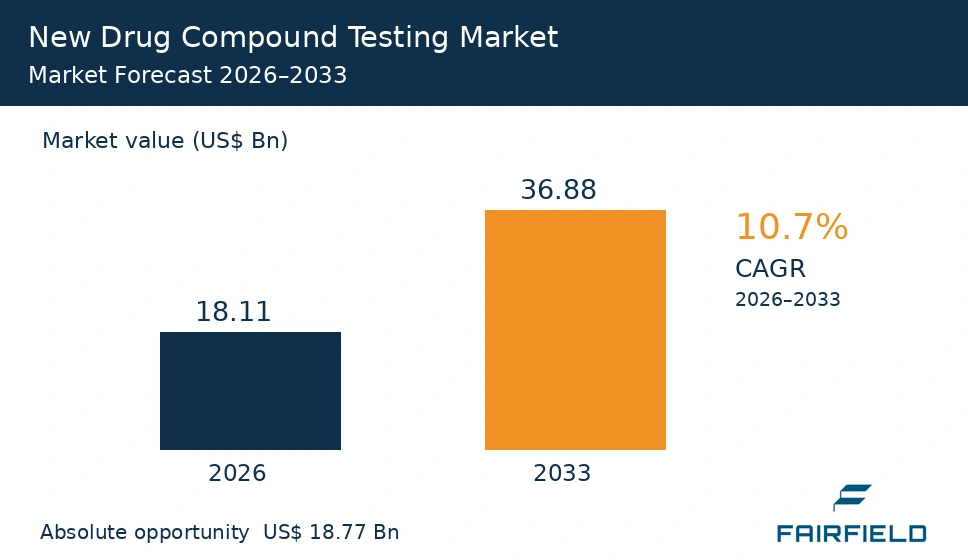
The global new drug compound testing market size is expected to be valued at US$ 18.11 billion in 2026 and projected to reach US$ 36.88 billion by 2033, growing at a CAGR of 10.7% between 2026 and 2033.
Between 2020 and 2025, the market grew at a CAGR of about 9.3%, rising from roughly US$ 10.5 billion to about US$ 16.4 billion, as biotech funding surged in 2020 and 2021, drug makers outsourced more early research to contract research organizations, and new types of drugs such as antibody-drug conjugates, cell and gene therapies, and RNA medicines needed specialized testing. The new drug compound testing market covers laboratory services that test new drug candidates before human trials, including high-throughput screening, hit-to-lead and lead optimization assays, ADME and DMPK studies, in vitro and in vivo pharmacology, safety and toxicology testing, and bioanalysis. Most testing is done by contract research organizations for pharmaceutical and biotech companies. In February 2026, IQVIA agreed to acquire five drug discovery sites from Charles River Laboratories.
Key Report Takeaways
- By Test Type: Safety and Toxicology Testing held about 38% share in 2025, while New Approach Methodologies are projected to expand at a 15.0% CAGR through 2033, driven by FDA support for non-animal methods, organoids, organ-on-a-chip systems, and AI-based toxicity prediction tools.
- By Molecule Type: Small Molecules held about 60% share in 2025, while Biologics are projected to expand at a 12.5% CAGR through 2033, driven by strong pipelines of antibodies, antibody-drug conjugates, bispecifics, and cell and gene therapies that need specialized testing.
- By End User: Pharmaceutical Companies held about 55% share in 2025, while Biotechnology Companies are projected to expand at a 12.0% CAGR through 2033, driven by small biotechs that lack in-house laboratories and rely fully on outsourced compound testing services.
- By Region: North America held about 45% share in 2025, while Asia Pacific is projected to expand at a 13.0% CAGR through 2033, driven by lower testing costs, large contract research capacity, and fast-growing biotech sectors in China, India, and South Korea.
Global New Drug Compound Testing Market Trends and Insights
Drivers Impact Analysis
Two drivers carry the strongest influence on new drug compound testing market demand during the forecast period.
| Driver | Impact on CAGR Forecast | Geographic Relevance | Impact Timeline |
| Rising R&D spending and outsourcing | High | Global | Long term (≥4 years) |
| Growth of complex new drug modalities | Medium | North America, Europe, Asia Pacific | Medium term (2-4 years) |
R&D Outsourcing Is Driving the New Drug Compound Testing Market
Rising R&D spending and outsourcing are the strongest driver of the new drug compound testing market. Drug makers test thousands of compounds to find one new medicine.
The mechanism is that pharmaceutical and biotech companies spend hundreds of billions of dollars a year on research and development, and early testing of new compounds is needed to identify promising candidates and remove unsafe ones before costly human trials. Large drug makers have reduced in-house testing laboratories and now outsource more work to contract research organizations to cut fixed costs, gain specialized skills, and speed up programs. Small and mid-sized biotech companies usually have no laboratories of their own and rely fully on outside partners. Regulators require detailed safety and pharmacology data before trials start. Patent expiries push companies to fill pipelines. These trends create steady demand for testing services.
Complex Modalities Are Expanding the New Drug Compound Testing Market
Growth of complex new drug modalities is expanding the new drug compound testing market. New types of drugs need new types of tests.
The cause is that drug pipelines now include many antibodies, antibody-drug conjugates, bispecific antibodies, peptides, oligonucleotides, mRNA medicines, cell therapies, gene therapies, and protein degraders, along with traditional small molecules. These products need specialized bioanalysis, immunogenicity testing, biodistribution studies, and safety assessments that many drug makers cannot do in-house. GLP-1 and obesity drug programs have also created large testing volumes. In 2026, Charles River agreed to acquire Frontage’s bioanalysis and DMPK laboratories in Pennsylvania for about US$ 470 million, reflecting strong demand for testing of large and small molecules. Precision medicine adds biomarker testing. These trends raise testing value and favor providers with broad expertise.
Restraints Impact Analysis
Two restraints limit how quickly the new drug compound testing market grows.
| Restraint | Impact on CAGR Forecast | Geographic Relevance | Impact Timeline |
| Biotech funding cycles and pricing pressure | High | North America, Europe | Short term (≤2 years) |
| Animal model supply and regulatory shifts | Medium | Global | Medium term (2-4 years) |
Funding Cycles Slow the New Drug Compound Testing Market
Biotech funding cycles and pricing pressure slow the new drug compound testing market. Testing demand rises and falls with investor money.
The problem is that many biotech companies depend on venture capital and public markets to fund research, and when funding tightens, as it did in 2023 and 2024, they cut early research programs, delay studies, and cancel testing contracts. Some small biotechs have closed because they could not raise enough money to reach clinical trials. Large drug makers also review pipelines and cut programs after mergers. Contract research organizations faced lower bookings and cancellations, leading to price competition and capacity cuts. Trade tensions and proposed restrictions on Chinese contract research firms in the United States add uncertainty for buyers. These factors create uneven demand and slow growth in some years and regions.
Supply and Regulation Restrict the New Drug Compound Testing Market
Animal model supply and regulatory shifts restrict the new drug compound testing market. Traditional testing methods are changing.
The constraint is that safety testing has long relied on animal studies, including non-human primates for biologics, and supply problems, import restrictions, and rising costs for these animals have caused delays and price increases. Ethical concerns about animal testing are growing. In April 2025, the FDA announced a plan to phase out animal testing requirements for monoclonal antibodies and other drugs, encouraging new approach methodologies. While this creates new opportunities, it also means testing providers must invest heavily in new technologies, validation, and staff training, and some traditional animal study revenue may decline. Regulators in different countries may move at different speeds. These shifts create transition costs and uncertainty for testing providers.
Market Opportunities
New Approach Methodologies Open a Fast-Growth Revenue Pool
New approach methodologies open a fast-growth revenue pool. Human-relevant tests can be faster and more predictive.
The opportunity comes from rapid growth in organoids, organ-on-a-chip systems, 3D cell models, induced pluripotent stem cell-derived cells, and AI-based computer models that predict how compounds behave in the human body. The FDA roadmap released in April 2025 encourages developers to include these data in investigational new drug applications, beginning with monoclonal antibodies. Contract research organizations are investing to build these capabilities, and in January 2026, Charles River announced plans to acquire PathoQuest to strengthen non-animal biologics testing. These methods can reduce costs, shorten timelines, and improve prediction of human safety. Companies that validate and scale new approach methodologies can win premium pricing and long-term partnerships.
AI-Driven Discovery and Asia Pacific Capacity Create a Growth Revenue Pool
AI-driven discovery and Asia Pacific capacity create a growth revenue pool. Technology and new regions are changing how compounds are tested.
The opportunity reflects the rise of AI-designed molecules, which create large numbers of new compounds that must be synthesized and tested quickly in the laboratory to confirm predictions. Automated laboratories and integrated design-make-test cycles can speed discovery. At the same time, China, India, and South Korea offer large pools of trained scientists and lower testing costs, and contract research firms in the region are expanding chemistry, biology, and safety testing capacity. Biotech start-ups in Asia Pacific are also growing fast. Companies that combine AI platforms, automated testing, and global laboratory networks can capture strong growth across many therapeutic areas, from oncology and immunology to neurology and metabolic disease.
Segment Analysis
By Test Type: Safety and Toxicology Testing Leads While New Approach Methodologies Grow Fastest
Safety and Toxicology Testing held about 38% share in 2025. Regulators require detailed studies of how new compounds affect organs, genes, reproduction, and other body systems before human trials, and these studies are large, long, and expensive. Good Laboratory Practice requirements make outsourced safety testing a major revenue source, since few drug makers keep full in-house safety laboratories.
New Approach Methodologies are the fastest-growing test type, expanding at a 15.0% CAGR through 2033. Organoids, organ-on-a-chip systems, 3D cell models, and AI-based toxicity prediction are gaining regulatory acceptance and can reduce reliance on animal studies. Screening, ADME and DMPK, Pharmacology, and Bioanalysis form further segments. For the market, new methods add high-value services and attract investment from large testing providers.
By Molecule Type: Small Molecules Lead While Biologics Grow Fastest
Small Molecules held about 60% share in 2025. Traditional chemical drugs still make up most compounds in development, and they require large volumes of screening, medicinal chemistry support, ADME studies, and toxicology testing. AI-designed small molecules add new volume, and obesity, oncology, and central nervous system programs keep demand strong. Many small molecule programs also need extensive drug interaction and metabolism testing before human trials.
Biologics are the fastest-growing molecule type, expanding at a 12.5% CAGR through 2033. Antibodies, antibody-drug conjugates, bispecifics, peptides, oligonucleotides, and cell and gene therapies need specialized assays, immunogenicity testing, and biodistribution studies. These products often need custom assays developed for each program. For the market, biologics growth raises testing complexity and value, and rewards providers with advanced bioanalysis and immunology laboratories.
By End User: Pharmaceutical Companies Lead While Biotechnology Companies Grow Fastest
Pharmaceutical Companies held about 55% share in 2025. Large drug makers run the biggest research pipelines and sign long-term outsourcing agreements with contract research organizations for screening, safety, and bioanalysis services. Strategic partnerships with a few preferred providers are common, giving testing companies steady, multi-year revenue.
Biotechnology Companies are the fastest-growing end user, expanding at a 12.0% CAGR through 2033. Small and mid-sized biotechs often have no laboratories and rely on outsourced testing for every step before clinical trials. Academic and Research Institutes form another segment, often funded by government grants. For the market, biotech growth drives demand for flexible, full-service testing, with providers often acting as the outsourced research department for small companies.
Geography Analysis
Which Region Is Leading the New Drug Compound Testing Market?
North America is leading the new drug compound testing market with about 45% share in 2025. The United States has the world’s largest pharmaceutical and biotech research base, the most venture funding for drug start-ups, and strong research clusters in Boston, San Francisco, and San Diego. Charles River Laboratories, Labcorp, IQVIA, and Inotiv are based in the region. The FDA roadmap on new approach methodologies is reshaping testing. Canada adds research capacity. Key barriers include high costs and funding cycles. One change shaping the region is fast adoption of non-animal testing.
Europe Shapes the New Drug Compound Testing Market Through Strong Science and Regulation
Europe is a major new drug compound testing market. The United Kingdom, Germany, France, Switzerland, Denmark, and the Netherlands have large pharmaceutical companies, strong universities, and many biotech start-ups. Eurofins Scientific, Evotec, and Charles River have large laboratory networks in the region. Strict animal welfare rules encourage new approach methodologies. Key barriers include high labor costs and slower biotech funding. One opportunity is validated non-animal testing for European regulators and global drug makers, supported by strong research funding and many organoid and organ-on-a-chip start-ups in the region.
Which Region Is Growing Fastest in the New Drug Compound Testing Market?
Asia Pacific is the fastest-growing new drug compound testing market, expanding at a 13.0% CAGR through 2033. China is home to WuXi AppTec, Pharmaron, and many other contract research firms with large chemistry and biology capacity, while India has Syngene and Jubilant Biosys offering lower-cost services. South Korea, Japan, and Australia have growing biotech sectors and clinical research. Key barriers include geopolitical tensions and data security concerns. One change shaping the region is rapid growth of local biotech companies, especially in China, and growing outsourcing from global drug makers seeking lower costs.
Latin America Grows the New Drug Compound Testing Market Through Research Investment
Latin America is a growing new drug compound testing market. Brazil, Mexico, Argentina, and Chile have growing pharmaceutical industries, universities, and research institutes, and some local laboratories offer bioanalysis and testing services. Global contract research organizations are expanding clinical work in the region, which supports related laboratory services. Key barriers include limited research funding, currency swings, and slow regulatory processes. One opportunity is partnerships between local universities and global testing providers, supported by growing government science budgets and rising local drug development. Lower costs for some laboratory services may also attract outsourced work from North America.
Middle East & Africa Builds the New Drug Compound Testing Market Through Biotech Strategies
Middle East & Africa is an emerging new drug compound testing market. Saudi Arabia, the United Arab Emirates, and Qatar are investing in biotech parks, genomics, and pharmaceutical manufacturing as part of plans to diversify their economies, while Israel has a strong biotech and drug discovery sector. South Africa has research capacity in infectious diseases. Key barriers include limited laboratory infrastructure. One opportunity is partnerships with global contract research firms, supported by government investment, new research universities, and growing interest in local drug development. Biotech clusters in Saudi Arabia and the United Arab Emirates are attracting international scientists.
Competitive Landscape
The new drug compound testing market is moderately consolidated. Charles River Laboratories, WuXi AppTec, Labcorp, Eurofins Scientific, and IQVIA are leading players, while Evotec SE, Pharmaron, Syngene International, Inotiv, Thermo Fisher Scientific, Frontage Holdings, and Jubilant Biosys compete strongly. Large contract research organizations offer integrated services from screening to safety testing, while specialist firms focus on chemistry, bioanalysis, or specific technologies. Many smaller laboratories and academic core facilities also provide testing services.
Companies compete on scientific expertise, speed, data quality, regulatory compliance, range of services, capacity, price, and the ability to support new drug types. Integrated offerings that move compounds from discovery through safety testing and into clinical trials are increasingly valued by clients. Investments in new approach methodologies, automation, and AI tools are becoming key ways to stand out.
Strategic moves show how competition is changing. In January 2026, Charles River announced deals for K.F. (Cambodia) and PathoQuest. In February 2026, IQVIA agreed to buy five discovery sites from Charles River, and later in 2026, Charles River agreed to acquire Frontage’s bioanalysis and DMPK laboratories for about US$ 470 million.
Three themes shape vendor strategy. First, providers are reshaping portfolios through acquisitions and divestments to focus on high-growth services. Second, they are investing in new approach methodologies and AI to respond to regulatory change. Third, they are balancing global capacity across North America, Europe, and Asia Pacific to manage cost and geopolitical risk.
New Drug Compound Testing Market Industry Leaders
Charles River Laboratories WuXi AppTec Labcorp Eurofins Scientific IQVIA
Recent Industry Developments
- February 2026: IQVIA agreed to acquire five drug discovery sites from Charles River Laboratories, including in vitro new approach methodology services and a small molecule AI platform - expands integrated discovery testing in the new drug compound testing market.
- January 2026: Charles River Laboratories announced planned acquisitions of K.F. (Cambodia) Ltd. to secure non-human primate supply and PathoQuest to strengthen non-animal biologics testing - supports both traditional and new testing methods.
- April 2025: The FDA announced a plan to phase out animal testing requirements for monoclonal antibodies and other drugs and released a roadmap encouraging new approach methodologies - shifts demand toward human-relevant testing.
Companies Covered in the Report
- Charles River Laboratories
- WuXi AppTec
- Labcorp
- Eurofins Scientific
- IQVIA
- Evotec SE
- Pharmaron
- Syngene International
- Inotiv
- Thermo Fisher Scientific
- Frontage Holdings
- Jubilant Biosys
New Drug Compound Testing Market Report Scope
This report covers the new drug compound testing market, including safety and toxicology testing, new approach methodologies, screening, ADME and DMPK, pharmacology, and bioanalysis, for small molecules and biologics, used by pharmaceutical companies, biotechnology companies, and academic and research institutes. The base year is 2025, and the forecast period runs from 2026 to 2033. All values are expressed in US$ Billion.
| Test Type | Safety and Toxicology Testing, New Approach Methodologies, Screening, ADME and DMPK, Pharmacology, Bioanalysis |
| Molecule Type | Small Molecules, Biologics |
| End User | Pharmaceutical Companies, Biotechnology Companies, Academic and Research Institutes |
| Regions | North America, Europe, Asia Pacific, Latin America, Middle East & Africa |
1. Executive Summary
1.1 New Drug Compound Testing Market Snapshot
1.2 Future Projections
1.3 Key Market Trends
1.4 Regional Snapshot
2. Market Overview
2.1 Market Definition and Report Scope
2.2 Historical Market Trends
2.3 Market Dynamics
2.3.1 Drivers
2.3.1.1 R&D Outsourcing Is Driving the New Drug Compound Testing Market
2.3.1.2 Complex Modalities Are Expanding the New Drug Compound Testing Market
2.3.2 Restraints
2.3.2.1 Funding Cycles Slow the New Drug Compound Testing Market
2.3.2.2 Supply and Regulation Restrict the New Drug Compound Testing Market
2.3.3 Market Opportunities
2.3.3.1 New Approach Methodologies Open a Fast-Growth Revenue Pool
2.3.3.2 AI-Driven Discovery and Asia Pacific Capacity Create a Growth Revenue Pool
3. Global New Drug Compound Testing Market Outlook, 2020–2033
3.1 Global New Drug Compound Testing Market Outlook, by Test Type, Value (US$ Billion), 2020–2033
3.1.1 Safety and Toxicology Testing
3.1.2 New Approach Methodologies
3.1.3 Screening
3.1.4 ADME and DMPK
3.1.5 Pharmacology
3.1.6 Bioanalysis
3.2 Global New Drug Compound Testing Market Outlook, by Molecule Type, Value (US$ Billion), 2020–2033
3.2.1 Small Molecules
3.2.2 Biologics
3.3 Global New Drug Compound Testing Market Outlook, by End User, Value (US$ Billion), 2020–2033
3.3.1 Pharmaceutical Companies
3.3.2 Biotechnology Companies
3.3.3 Academic and Research Institutes
3.4 Global New Drug Compound Testing Market Outlook, by Region, Value (US$ Billion), 2020–2033
3.4.1 North America
3.4.2 Europe
3.4.3 Asia Pacific
3.4.4 Latin America
3.4.5 Middle East & Africa
4. North America New Drug Compound Testing Market Outlook, 2020–2033
4.1 North America New Drug Compound Testing Market Outlook, by Test Type, Value (US$ Billion), 2020–2033
4.1.1 Safety and Toxicology Testing
4.1.2 New Approach Methodologies
4.1.3 Screening
4.1.4 ADME and DMPK
4.1.5 Pharmacology
4.1.6 Bioanalysis
4.2 North America New Drug Compound Testing Market Outlook, by Molecule Type, Value (US$ Billion), 2020–2033
4.2.1 Small Molecules
4.2.2 Biologics
4.3 North America New Drug Compound Testing Market Outlook, by End User, Value (US$ Billion), 2020–2033
4.3.1 Pharmaceutical Companies
4.3.2 Biotechnology Companies
4.3.3 Academic and Research Institutes
4.4 North America New Drug Compound Testing Market Outlook, by Country, Value (US$ Billion), 2020–2033
4.4.1 United States New Drug Compound Testing Market Outlook, by Test Type, 2020–2033
4.4.2 United States New Drug Compound Testing Market Outlook, by Molecule Type, 2020–2033
4.4.3 United States New Drug Compound Testing Market Outlook, by End User, 2020–2033
4.4.4 Canada New Drug Compound Testing Market Outlook, by Test Type, 2020–2033
4.4.5 Canada New Drug Compound Testing Market Outlook, by Molecule Type, 2020–2033
4.4.6 Canada New Drug Compound Testing Market Outlook, by End User, 2020–2033
5. Europe New Drug Compound Testing Market Outlook, 2020–2033
5.1 Europe New Drug Compound Testing Market Outlook, by Test Type, Value (US$ Billion), 2020–2033
5.1.1 Safety and Toxicology Testing
5.1.2 New Approach Methodologies
5.1.3 Screening
5.1.4 ADME and DMPK
5.1.5 Pharmacology
5.1.6 Bioanalysis
5.2 Europe New Drug Compound Testing Market Outlook, by Molecule Type, Value (US$ Billion), 2020–2033
5.2.1 Small Molecules
5.2.2 Biologics
5.3 Europe New Drug Compound Testing Market Outlook, by End User, Value (US$ Billion), 2020–2033
5.3.1 Pharmaceutical Companies
5.3.2 Biotechnology Companies
5.3.3 Academic and Research Institutes
5.4 Europe New Drug Compound Testing Market Outlook, by Country, Value (US$ Billion), 2020–2033
5.4.1 United Kingdom New Drug Compound Testing Market Outlook, by Test Type, 2020–2033
5.4.2 United Kingdom New Drug Compound Testing Market Outlook, by Molecule Type, 2020–2033
5.4.3 United Kingdom New Drug Compound Testing Market Outlook, by End User, 2020–2033
5.4.4 Germany New Drug Compound Testing Market Outlook, by Test Type, 2020–2033
5.4.5 Germany New Drug Compound Testing Market Outlook, by Molecule Type, 2020–2033
5.4.6 Germany New Drug Compound Testing Market Outlook, by End User, 2020–2033
5.4.7 France New Drug Compound Testing Market Outlook, by Test Type, 2020–2033
5.4.8 France New Drug Compound Testing Market Outlook, by Molecule Type, 2020–2033
5.4.9 France New Drug Compound Testing Market Outlook, by End User, 2020–2033
5.4.10 Switzerland New Drug Compound Testing Market Outlook, by Test Type, 2020–2033
5.4.11 Switzerland New Drug Compound Testing Market Outlook, by Molecule Type, 2020–2033
5.4.12 Switzerland New Drug Compound Testing Market Outlook, by End User, 2020–2033
5.4.13 Denmark New Drug Compound Testing Market Outlook, by Test Type, 2020–2033
5.4.14 Denmark New Drug Compound Testing Market Outlook, by Molecule Type, 2020–2033
5.4.15 Denmark New Drug Compound Testing Market Outlook, by End User, 2020–2033
5.4.16 Netherlands New Drug Compound Testing Market Outlook, by Test Type, 2020–2033
5.4.17 Netherlands New Drug Compound Testing Market Outlook, by Molecule Type, 2020–2033
5.4.18 Netherlands New Drug Compound Testing Market Outlook, by End User, 2020–2033
6. Asia Pacific New Drug Compound Testing Market Outlook, 2020–2033
6.1 Asia Pacific New Drug Compound Testing Market Outlook, by Test Type, Value (US$ Billion), 2020–2033
6.1.1 Safety and Toxicology Testing
6.1.2 New Approach Methodologies
6.1.3 Screening
6.1.4 ADME and DMPK
6.1.5 Pharmacology
6.1.6 Bioanalysis
6.2 Asia Pacific New Drug Compound Testing Market Outlook, by Molecule Type, Value (US$ Billion), 2020–2033
6.2.1 Small Molecules
6.2.2 Biologics
6.3 Asia Pacific New Drug Compound Testing Market Outlook, by End User, Value (US$ Billion), 2020–2033
6.3.1 Pharmaceutical Companies
6.3.2 Biotechnology Companies
6.3.3 Academic and Research Institutes
6.4 Asia Pacific New Drug Compound Testing Market Outlook, by Country, Value (US$ Billion), 2020–2033
6.4.1 China New Drug Compound Testing Market Outlook, by Test Type, 2020–2033
6.4.2 China New Drug Compound Testing Market Outlook, by Molecule Type, 2020–2033
6.4.3 China New Drug Compound Testing Market Outlook, by End User, 2020–2033
6.4.4 India New Drug Compound Testing Market Outlook, by Test Type, 2020–2033
6.4.5 India New Drug Compound Testing Market Outlook, by Molecule Type, 2020–2033
6.4.6 India New Drug Compound Testing Market Outlook, by End User, 2020–2033
6.4.7 South Korea New Drug Compound Testing Market Outlook, by Test Type, 2020–2033
6.4.8 South Korea New Drug Compound Testing Market Outlook, by Molecule Type, 2020–2033
6.4.9 South Korea New Drug Compound Testing Market Outlook, by End User, 2020–2033
6.4.10 Japan New Drug Compound Testing Market Outlook, by Test Type, 2020–2033
6.4.11 Japan New Drug Compound Testing Market Outlook, by Molecule Type, 2020–2033
6.4.12 Japan New Drug Compound Testing Market Outlook, by End User, 2020–2033
6.4.13 Australia New Drug Compound Testing Market Outlook, by Test Type, 2020–2033
6.4.14 Australia New Drug Compound Testing Market Outlook, by Molecule Type, 2020–2033
6.4.15 Australia New Drug Compound Testing Market Outlook, by End User, 2020–2033
7. Latin America New Drug Compound Testing Market Outlook, 2020–2033
7.1 Latin America New Drug Compound Testing Market Outlook, by Test Type, Value (US$ Billion), 2020–2033
7.1.1 Safety and Toxicology Testing
7.1.2 New Approach Methodologies
7.1.3 Screening
7.1.4 ADME and DMPK
7.1.5 Pharmacology
7.1.6 Bioanalysis
7.2 Latin America New Drug Compound Testing Market Outlook, by Molecule Type, Value (US$ Billion), 2020–2033
7.2.1 Small Molecules
7.2.2 Biologics
7.3 Latin America New Drug Compound Testing Market Outlook, by End User, Value (US$ Billion), 2020–2033
7.3.1 Pharmaceutical Companies
7.3.2 Biotechnology Companies
7.3.3 Academic and Research Institutes
7.4 Latin America New Drug Compound Testing Market Outlook, by Country, Value (US$ Billion), 2020–2033
7.4.1 Brazil New Drug Compound Testing Market Outlook, by Test Type, 2020–2033
7.4.2 Brazil New Drug Compound Testing Market Outlook, by Molecule Type, 2020–2033
7.4.3 Brazil New Drug Compound Testing Market Outlook, by End User, 2020–2033
7.4.4 Mexico New Drug Compound Testing Market Outlook, by Test Type, 2020–2033
7.4.5 Mexico New Drug Compound Testing Market Outlook, by Molecule Type, 2020–2033
7.4.6 Mexico New Drug Compound Testing Market Outlook, by End User, 2020–2033
7.4.7 Argentina New Drug Compound Testing Market Outlook, by Test Type, 2020–2033
7.4.8 Argentina New Drug Compound Testing Market Outlook, by Molecule Type, 2020–2033
7.4.9 Argentina New Drug Compound Testing Market Outlook, by End User, 2020–2033
7.4.10 Chile New Drug Compound Testing Market Outlook, by Test Type, 2020–2033
7.4.11 Chile New Drug Compound Testing Market Outlook, by Molecule Type, 2020–2033
7.4.12 Chile New Drug Compound Testing Market Outlook, by End User, 2020–2033
8. Middle East & Africa New Drug Compound Testing Market Outlook, 2020–2033
8.1 Middle East & Africa New Drug Compound Testing Market Outlook, by Test Type, Value (US$ Billion), 2020–2033
8.1.1 Safety and Toxicology Testing
8.1.2 New Approach Methodologies
8.1.3 Screening
8.1.4 ADME and DMPK
8.1.5 Pharmacology
8.1.6 Bioanalysis
8.2 Middle East & Africa New Drug Compound Testing Market Outlook, by Molecule Type, Value (US$ Billion), 2020–2033
8.2.1 Small Molecules
8.2.2 Biologics
8.3 Middle East & Africa New Drug Compound Testing Market Outlook, by End User, Value (US$ Billion), 2020–2033
8.3.1 Pharmaceutical Companies
8.3.2 Biotechnology Companies
8.3.3 Academic and Research Institutes
8.4 Middle East & Africa New Drug Compound Testing Market Outlook, by Country, Value (US$ Billion), 2020–2033
8.4.1 Saudi Arabia New Drug Compound Testing Market Outlook, by Test Type, 2020–2033
8.4.2 Saudi Arabia New Drug Compound Testing Market Outlook, by Molecule Type, 2020–2033
8.4.3 Saudi Arabia New Drug Compound Testing Market Outlook, by End User, 2020–2033
8.4.4 United Arab Emirates New Drug Compound Testing Market Outlook, by Test Type, 2020–2033
8.4.5 United Arab Emirates New Drug Compound Testing Market Outlook, by Molecule Type, 2020–2033
8.4.6 United Arab Emirates New Drug Compound Testing Market Outlook, by End User, 2020–2033
8.4.7 Qatar New Drug Compound Testing Market Outlook, by Test Type, 2020–2033
8.4.8 Qatar New Drug Compound Testing Market Outlook, by Molecule Type, 2020–2033
8.4.9 Qatar New Drug Compound Testing Market Outlook, by End User, 2020–2033
8.4.10 Israel New Drug Compound Testing Market Outlook, by Test Type, 2020–2033
8.4.11 Israel New Drug Compound Testing Market Outlook, by Molecule Type, 2020–2033
8.4.12 Israel New Drug Compound Testing Market Outlook, by End User, 2020–2033
8.4.13 South Africa New Drug Compound Testing Market Outlook, by Test Type, 2020–2033
8.4.14 South Africa New Drug Compound Testing Market Outlook, by Molecule Type, 2020–2033
8.4.15 South Africa New Drug Compound Testing Market Outlook, by End User, 2020–2033
9. Competitive Landscape
9.1 New Drug Compound Testing Market Industry Leaders
9.2 Recent Industry Developments
9.3 Company Profiles
9.3.1 Charles River Laboratories
9.3.2 WuXi AppTec
9.3.3 Labcorp
9.3.4 Eurofins Scientific
9.3.5 IQVIA
9.3.6 Evotec SE
9.3.7 Pharmaron
9.3.8 Syngene International
9.3.9 Inotiv
9.3.10 Thermo Fisher Scientific
9.3.11 Frontage Holdings
9.3.12 Jubilant Biosys
10. Appendix
10.1 Research Methodology
10.2 Report Assumptions
10.3 Acronyms and Abbreviations
| Test Type | Safety and Toxicology Testing, New Approach Methodologies, Screening, ADME and DMPK, Pharmacology, Bioanalysis |
| Molecule Type | Small Molecules, Biologics |
| End User | Pharmaceutical Companies, Biotechnology Companies, Academic and Research Institutes |
| Regions | North America, Europe, Asia Pacific, Latin America, Middle East & Africa |
Our Research Methodology
Considering the volatility of business today, traditional approaches to strategizing a game plan can be unfruitful if not detrimental. True ambiguity is no way to determine a forecast. A myriad of predetermined factors must be accounted for such as the degree of risk involved, the magnitude of circumstances, as well as conditions or consequences that are not known or unpredictable. To circumvent binary views that cast uncertainty, the application of market research intelligence to strategically posture, move, and enable actionable outcomes is necessary.
View Methodology
Quality Assured
Rigorous Validation Process

Confidentiality Assured
End-to-end Data Security

Custom Research Services
Tailored To Your Objectives
FAQs
The market is valued at US$ 18.11 billion in 2026, led by safety testing, small molecules, and North America.
The market is projected to reach US$ 36.88 billion by 2033, growing at a 10.7% CAGR and adding US$ 18.77 billion.
New Approach Methodologies are growing fastest at a 15.0% CAGR through 2033, driven by FDA support for non-animal testing.
Asia Pacific is growing fastest at a 13.0% CAGR through 2033, driven by lower costs and large research capacity.
North America holds the largest share at about 45% in 2025, supported by large research pipelines and biotech funding.
Related Reports
Phosphoramidite Market Size, Share, Insights, Competitive Landscape, and Forecast 2026 to 2033
The phosphoramidite market is projected to reach US$ 1,833.4 million by 2033, growing at 7.7% CAGR from US$ 1,090.8 million in 2026.
Microbial Fermentation Technology Market Size, Share, Insights, Competitive Landscape, and Forecast 2026 to 2033
The microbial fermentation technology market is projected to reach US$ 61.53 billion by 2033, growing at 5.9% CAGR from US$ 41.22 billion in 2026.
Macular Edema and Macular Degeneration Market Size, Share, Insights, Competitive Landscape, and Forecast 2026 to 2033
The macular edema and macular degeneration market is projected to reach US$ 20.97 billion by 2033, growing at 7.3% CAGR from US$ 12.77 billion in 2026.
Heartworm Market Size, Share, Insights, Competitive Landscape, and Forecast 2026 to 2033
The heartworm market is projected to reach US$ 2.66 billion by 2033, growing at 7.0% CAGR from US$ 1.66 billion in 2026.
Cancer Stem Cell Therapeutics Market Size, Share, Insights, Competitive Landscape, and Forecast 2026 to 2033
The cancer stem cell therapeutics market is projected to reach US$ 6.57 billion by 2033, growing at 9.4% CAGR from US$ 3.50 billion in 2026.
Antibody Drug Conjugate Market Size, Share, Insights, Competitive Landscape, and Forecast 2026 to 2033
The antibody drug conjugate market is projected to reach US$ 32.10 billion by 2033, growing at 9.8% CAGR from US$ 16.70 billion in 2026.