



Macular Edema and Macular Degeneration Market
Macular Edema and Macular Degeneration Market Size, Share, Insights, Competitive Landscape, and Forecast 2026 to 2033
Report Overview
Macular Edema and Macular Degeneration Market Size and Trend Analysis
How Fast Is the Macular Edema and Macular Degeneration Market Growing?
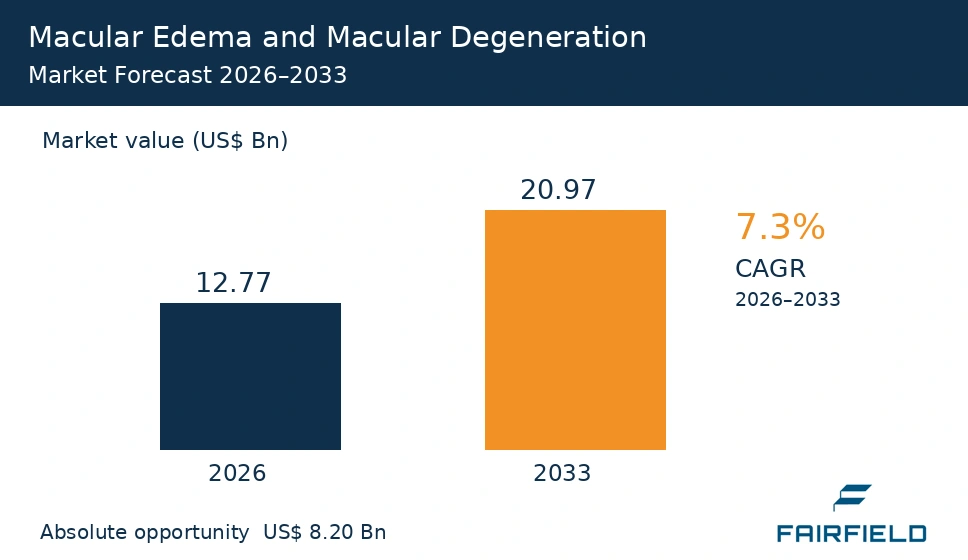
The global macular edema and macular degeneration market size is expected to be valued at US$ 12.77 billion in 2026 and projected to reach US$ 20.97 billion by 2033, growing at a CAGR of 7.3% between 2026 and 2033.
Between 2020 and 2025, the market grew at a CAGR of about 7.5%, rising from roughly US$ 8.3 billion to about US$ 11.9 billion, as eye injection visits recovered after pandemic delays, longer-acting anti-VEGF drugs such as Vabysmo and Eylea HD launched, and the first geographic atrophy treatments were approved. The macular edema and macular degeneration market covers treatments for diseases that damage the macula, the central part of the retina needed for sharp vision. Age-related macular degeneration (AMD) includes wet AMD, where abnormal blood vessels leak fluid, and dry AMD, which can progress to geographic atrophy. Macular edema includes diabetic macular edema (DME), and edema after retinal vein occlusion. Main treatments include anti-VEGF injections, corticosteroid implants, complement inhibitors, and laser therapy. In April 2026, the FDA approved dosing intervals of up to 20 weeks for Regeneron’s Eylea HD in wet AMD and DME.
Key Report Takeaways
- By Disease Type: Macular Degeneration held about 65% share in 2025, while Macular Edema is projected to expand at an 8.4% CAGR through 2033, driven by the rising number of people with diabetes, better retinal screening, and long-acting treatments for diabetic macular edema.
- By Treatment Type: Anti-VEGF Therapy held about 82% share in 2025, while Complement Inhibitors are projected to expand at a 15.0% CAGR through 2033, driven by approved geographic atrophy treatments, aging populations, and growing diagnosis of advanced dry AMD.
- By End User: Hospitals held about 50% share in 2025, while Specialty Eye Clinics are projected to expand at an 8.0% CAGR through 2033, driven by high injection volumes, retina specialist practices, and efficient outpatient treatment workflows for chronic eye disease.
- By Region: North America held about 43% share in 2025, while Asia Pacific is projected to expand at a 10.1% CAGR through 2033, driven by large diabetic populations, aging societies, and better access to retinal care in China, India, and Japan.
Global Macular Edema and Macular Degeneration Market Trends and Insights
Drivers Impact Analysis
Two drivers carry the strongest influence on macular edema and macular degeneration market demand during the forecast period.
| Driver | Impact on CAGR Forecast | Geographic Relevance | Impact Timeline |
| Aging populations and rising diabetes prevalence | High | Global | Long term (≥4 years) |
| Longer-acting and new mechanism therapies | High | North America, Europe, Asia Pacific | Medium term (2-4 years) |
Aging and Diabetes Are Driving the Macular Edema and Macular Degeneration Market
Aging populations and rising diabetes prevalence are the strongest driver of the macular edema and macular degeneration market. More people are at risk of losing central vision.
The mechanism is that AMD is a leading cause of severe vision loss in people over 60, and the number of older adults is rising quickly in North America, Europe, Japan, China, and South Korea. At the same time, hundreds of millions of people worldwide have diabetes, and many develop diabetic retinopathy and diabetic macular edema, which can cause vision loss in working-age adults. Better screening programs, including retinal cameras in primary care and artificial intelligence tools, are detecting more patients. Most patients need repeated injections over many years, which creates long-term treatment demand. Smoking, obesity, and high blood pressure add risk. These trends create steady, high-value demand.
Longer-Acting Therapies Are Expanding the Macular Edema and Macular Degeneration Market
Longer-acting and new mechanism therapies are expanding the macular edema and macular degeneration market. Patients and doctors want fewer injections.
The cause is that standard anti-VEGF treatment often requires eye injections every four to eight weeks, which is a heavy burden for older patients and caregivers, and many patients miss visits and lose vision. New drugs such as Roche’s Vabysmo, which blocks both VEGF and angiopoietin-2, and Regeneron’s high-dose Eylea HD allow longer intervals between injections. In April 2026, the FDA extended Eylea HD dosing to up to every 20 weeks for wet AMD and DME. Complement inhibitors such as Apellis’s Syfovre and Astellas’s Izervay are the first approved treatments for geographic atrophy. Gene therapies and tyrosine kinase inhibitor implants are in late-stage trials. These advances raise treatment value.
Restraints Impact Analysis
Two restraints limit how quickly the macular edema and macular degeneration market grows.
| Restraint | Impact on CAGR Forecast | Geographic Relevance | Impact Timeline |
| Biosimilar competition and price pressure | High | North America, Europe | Medium term (2-4 years) |
| Treatment burden and limited access to retina specialists | Medium | Asia Pacific, Latin America, Middle East & Africa | Long term (≥4 years) |
Biosimilars Slow the Macular Edema and Macular Degeneration Market
Biosimilar competition and price pressure slow the macular edema and macular degeneration market. Cheaper copies are reducing prices of older drugs.
The problem is that patents on blockbuster drugs such as Lucentis and Eylea have expired or are expiring in many markets, and biosimilars from Samsung Bioepis, Sandoz, Biogen, Amgen, Celltrion, Formycon, and Lupin are entering. In June 2026, the FDA approved Lupin’s Ranluspec as an interchangeable ranibizumab biosimilar available in vials and prefilled syringes. Samsung Bioepis has launched Opuviz, an aflibercept biosimilar, in Europe, and it may launch in the United States in January 2027. Off-label use of low-cost bevacizumab is also widespread. Payers push for step therapy with cheaper drugs. These pressures reduce average prices and slow revenue growth.
Treatment Burden Restricts the Macular Edema and Macular Degeneration Market
Treatment burden and limited access to retina specialists restrict the macular edema and macular degeneration market. Many patients cannot get regular care.
The constraint is that eye injections must be given by trained ophthalmologists, usually retina specialists, and patients need frequent clinic visits and imaging. Many older patients depend on family members for transport, and missed visits lead to worse outcomes. In many countries in Asia Pacific, Latin America, and Middle East & Africa, there are too few retina specialists, especially outside major cities, and many patients cannot afford expensive biologic drugs. Geographic atrophy treatments need monthly or every-other-month injections and only slow disease progression, which limits patient uptake. Safety concerns such as intraocular inflammation have also affected some products. These factors limit market reach.
Market Opportunities
Gene Therapies and Sustained-Release Treatments Open a Fast-Growth Revenue Pool
Gene therapies and sustained-release treatments open a fast-growth revenue pool. One-time or twice-yearly treatments could change care.
The opportunity comes from gene therapies that make the eye produce its own anti-VEGF protein, such as programs from AbbVie and REGENXBIO and 4D Molecular Therapeutics, along with tyrosine kinase inhibitor implants and port delivery systems that release drug for many months. These approaches could cut injection numbers sharply, improve vision outcomes in real-world use, and lower total care costs. Several programs are in phase 3 trials. For dry AMD, new oral drugs, photobiomodulation, and cell therapies are also being studied. Companies that prove long-lasting effects with good safety can win premium pricing and strong uptake from patients and retina specialists who want to reduce treatment burden.
Asia Pacific and AI Screening Create a Growth Revenue Pool
Asia Pacific and AI screening create a growth revenue pool. Millions of patients remain undiagnosed.
The opportunity reflects the huge number of people with diabetes and aging populations in China, India, Japan, Indonesia, and South Korea, where access to retinal care is expanding. Artificial intelligence tools that read retinal photos can screen patients for diabetic retinopathy and macular edema in primary care clinics, pharmacies, and mobile vans, finding patients who need treatment earlier. Biosimilars make anti-VEGF therapy more affordable in price-sensitive markets, widening the treated population. Local drug makers are also developing new biosimilars and novel therapies. Companies that combine screening partnerships, affordable treatments, and training for eye doctors can capture strong growth across these large and fast-changing markets over the forecast period.
Segment Analysis
By Disease Type: Macular Degeneration Leads While Macular Edema Grows Fastest
Macular Degeneration held about 65% share in 2025. Wet AMD is the largest source of revenue because patients need frequent anti-VEGF injections for many years, and geographic atrophy treatments are adding a new revenue stream for dry AMD. Aging populations in developed countries keep patient numbers rising, and wet AMD patients often need treatment in both eyes.
Macular Edema is the fastest-growing disease type, expanding at an 8.4% CAGR through 2033. Diabetic macular edema is becoming more common as diabetes spreads worldwide, and retinal vein occlusion and cystoid macular edema add patients. Better screening and long-acting therapies are increasing treatment rates. For the market, macular edema growth widens the patient base for anti-VEGF and steroid treatments.
By Treatment Type: Anti-VEGF Therapy Leads While Complement Inhibitors Grow Fastest
Anti-VEGF Therapy held about 82% share in 2025. Drugs such as Eylea, Eylea HD, Vabysmo, Lucentis, and Beovu, along with biosimilars, are the standard of care for wet AMD, DME, and retinal vein occlusion. Off-label bevacizumab is widely used in cost-sensitive settings, and prefilled syringes and longer dosing intervals are helping branded products keep patients.
Complement Inhibitors are the fastest-growing treatment type, expanding at a 15.0% CAGR through 2033. Syfovre and Izervay slow the growth of geographic atrophy lesions, giving patients with advanced dry AMD their first approved treatment options. Corticosteroids, Laser Therapy, and Other Treatments form further segments. For the market, complement growth adds a new treatment category and expands care to millions of patients with dry AMD who previously had no options.
By End User: Hospitals Lead While Specialty Eye Clinics Grow Fastest
Hospitals held about 50% share in 2025. Hospital eye departments treat many patients with complex retinal disease, run clinical trials, and handle large injection volumes in public health systems in Europe and Asia Pacific. Many hospitals also run diabetic eye screening programs and train new retina specialists.
Specialty Eye Clinics are the fastest-growing end user, expanding at an 8.0% CAGR through 2033. Retina specialist practices and eye clinic chains offer efficient injection workflows, imaging, and follow-up for chronic patients, especially in the United States. Ambulatory Surgical Centers and Other End Users form further segments. For the market, clinic growth supports higher treatment capacity, faster patient scheduling, and better adherence to long-term injection plans.
Geography Analysis
Which Region Is Leading the Macular Edema and Macular Degeneration Market?
North America is leading the macular edema and macular degeneration market with about 43% share in 2025. The United States has high prices for branded anti-VEGF drugs, a large aging population, many retina specialists, and strong Medicare coverage for eye injections and geographic atrophy treatments. Regeneron, Genentech, Apellis, and Astellas subsidiary Iveric Bio drive innovation in the region. Canada adds demand through public coverage. Key barriers include biosimilar price pressure and payer step therapy. One change shaping the region is the expected aflibercept biosimilar launch in 2027, which may lower prices and widen access.
Europe Shapes the Macular Edema and Macular Degeneration Market Through Biosimilar Adoption
Europe is a major macular edema and macular degeneration market. Germany, the United Kingdom, France, Italy, and Spain have large aging populations and strong public eye care programs. Roche, Novartis, and Bayer, which sells Eylea outside the United States, are based in the region. Biosimilars such as Opuviz have launched, and health systems are switching patients to lower-cost options. Key barriers include price controls and slower approval of geographic atrophy drugs. One opportunity is long-acting treatments that reduce clinic capacity pressure in busy public hospitals and eye clinics across the region.
Which Region Is Growing Fastest in the Macular Edema and Macular Degeneration Market?
Asia Pacific is the fastest-growing macular edema and macular degeneration market, expanding at a 10.1% CAGR through 2033. China and India have the world’s largest diabetic populations, and Japan has one of the oldest populations and high rates of polypoidal choroidal vasculopathy, a form of wet AMD common in Asian patients. South Korea hosts biosimilar makers Samsung Bioepis and Celltrion. Key barriers include limited access to retina specialists. One change shaping the region is the rise of affordable biosimilars, along with AI-based screening that finds many more patients with diabetic eye disease in primary care clinics.
Latin America Grows the Macular Edema and Macular Degeneration Market Through Diabetes Care
Latin America is a growing macular edema and macular degeneration market. Brazil, Mexico, Argentina, Colombia, and Chile have high diabetes rates and aging populations, and private eye clinics are expanding anti-VEGF treatment. Public health systems often rely on off-label bevacizumab because of cost. Key barriers include high drug prices, limited specialists outside large cities, and low screening rates. One opportunity is biosimilars and diabetic eye screening programs, supported by growing private health insurance and partnerships with eye hospital chains. Training more retina specialists would also widen access to injections in smaller cities and towns.
Middle East & Africa Builds the Macular Edema and Macular Degeneration Market Through Eye Care Investment
Middle East & Africa is an emerging macular edema and macular degeneration market. Saudi Arabia, the United Arab Emirates, Kuwait, and Qatar have some of the highest diabetes rates in the world and are investing in specialized eye hospitals. Israel has advanced retinal care. South Africa and Egypt have growing private eye care sectors. Key barriers include limited screening and high costs. One opportunity is diabetic eye screening programs linked to treatment, supported by government health investment, national diabetes strategies, and new eye hospitals in large cities. Telemedicine can extend retinal care to remote areas across the region.
Competitive Landscape
The macular edema and macular degeneration market is consolidated. Regeneron Pharmaceuticals, F. Hoffmann-La Roche Ltd., Novartis AG, Bayer AG, and Astellas Pharma Inc. are leading players, while Apellis Pharmaceuticals, AbbVie Inc., Samsung Bioepis, Biogen, Amgen, Lupin Limited, and Ocular Therapeutix compete strongly. Regeneron and Bayer share the Eylea franchise, while Roche leads with Vabysmo and Lucentis. Apellis and Astellas lead in geographic atrophy, and biosimilar makers are gaining share in mature anti-VEGF products. Many biotech companies are developing gene therapies and sustained-release treatments.
Companies compete on visual outcomes, durability between injections, safety, convenience of prefilled syringes, price, payer coverage, and support for retina specialists. Long-acting products are a key battleground, as doctors want to reduce clinic visits. Biosimilar makers compete mainly on price and interchangeability, while innovators defend share through new formulations, higher doses, and label expansions.
Strategic moves show how competition is changing. In November 2025, Regeneron won FDA approval for Eylea HD in retinal vein occlusion and a monthly dosing option. In April 2026, it won extended dosing up to 20 weeks. In June 2026, Lupin won approval for an interchangeable ranibizumab biosimilar, adding price pressure.
Three themes shape vendor strategy. First, innovators are extending dosing intervals and adding new indications to protect market share. Second, biosimilar makers are expanding in Europe, North America, and Asia Pacific. Third, companies are investing in gene therapy, sustained-release implants, and new dry AMD treatments.
Macular Edema and Macular Degeneration Market Industry Leaders
Regeneron Pharmaceuticals F. Hoffmann-La Roche Ltd. Novartis AG Bayer AG Astellas Pharma Inc.
Recent Industry Developments
- June 2026: Lupin received FDA approval for Ranluspec (ranibizumab-hkdz), an interchangeable ranibizumab biosimilar in vials and prefilled syringes for wet AMD, DME, and other retinal diseases - adds price competition in the macular edema and macular degeneration market.
- April 2026: Regeneron received FDA approval for Eylea HD dosing intervals of up to every 20 weeks in wet AMD and DME, with 96-week trial data added to the label - reduces treatment burden for patients.
- November 2025: Regeneron received FDA approval for Eylea HD in macular edema following retinal vein occlusion, along with a monthly dosing option - widens use of high-dose aflibercept.
Companies Covered in the Report
- Regeneron Pharmaceuticals
- F. Hoffmann-La Roche Ltd.
- Novartis AG
- Bayer AG
- Astellas Pharma Inc.
- Apellis Pharmaceuticals
- AbbVie Inc.
- Samsung Bioepis
- Biogen
- Amgen
- Lupin Limited
- Ocular Therapeutix
Macular Edema and Macular Degeneration Market Report Scope
This report covers the macular edema and macular degeneration market, including macular degeneration and macular edema, treated with anti-VEGF therapy, complement inhibitors, corticosteroids, laser therapy, and other treatments, in hospitals, specialty eye clinics, ambulatory surgical centers, and other end users. The base year is 2025, and the forecast period runs from 2026 to 2033. All values are expressed in US$ Billion.
| Disease Type | Macular Degeneration, Macular Edema |
| Treatment Type | Anti-VEGF Therapy, Complement Inhibitors, Corticosteroids, Laser Therapy, Other Treatments |
| End User | Hospitals, Specialty Eye Clinics, Ambulatory Surgical Centers, Other End Users |
| Regions | North America, Europe, Asia Pacific, Latin America, Middle East & Africa |
1. Executive Summary
1.1 Macular Edema and Macular Degeneration Market Snapshot
1.2 Future Projections
1.3 Key Market Trends
1.4 Regional Snapshot
2. Market Overview
2.1 Market Definition and Report Scope
2.2 Historical Market Trends
2.3 Market Dynamics
2.3.1 Drivers
2.3.1.1 Aging and Diabetes Are Driving the Macular Edema and Macular Degeneration Market
2.3.1.2 Longer-Acting Therapies Are Expanding the Macular Edema and Macular Degeneration Market
2.3.2 Restraints
2.3.2.1 Biosimilars Slow the Macular Edema and Macular Degeneration Market
2.3.2.2 Treatment Burden Restricts the Macular Edema and Macular Degeneration Market
2.3.3 Market Opportunities
2.3.3.1 Gene Therapies and Sustained-Release Treatments Open a Fast-Growth Revenue Pool
2.3.3.2 Asia Pacific and AI Screening Create a Growth Revenue Pool
3. Global Macular Edema and Macular Degeneration Market Outlook, 2020–2033
3.1 Global Macular Edema and Macular Degeneration Market Outlook, by Disease Type, Value (US$ Billion), 2020–2033
3.1.1 Macular Degeneration
3.1.2 Macular Edema
3.2 Global Macular Edema and Macular Degeneration Market Outlook, by Treatment Type, Value (US$ Billion), 2020–2033
3.2.1 Anti-VEGF Therapy
3.2.2 Complement Inhibitors
3.2.3 Corticosteroids
3.2.4 Laser Therapy
3.2.5 Other Treatments
3.3 Global Macular Edema and Macular Degeneration Market Outlook, by End User, Value (US$ Billion), 2020–2033
3.3.1 Hospitals
3.3.2 Specialty Eye Clinics
3.3.3 Ambulatory Surgical Centers
3.3.4 Other End Users
3.4 Global Macular Edema and Macular Degeneration Market Outlook, by Region, Value (US$ Billion), 2020–2033
3.4.1 North America
3.4.2 Europe
3.4.3 Asia Pacific
3.4.4 Latin America
3.4.5 Middle East & Africa
4. North America Macular Edema and Macular Degeneration Market Outlook, 2020–2033
4.1 North America Macular Edema and Macular Degeneration Market Outlook, by Disease Type, Value (US$ Billion), 2020–2033
4.1.1 Macular Degeneration
4.1.2 Macular Edema
4.2 North America Macular Edema and Macular Degeneration Market Outlook, by Treatment Type, Value (US$ Billion), 2020–2033
4.2.1 Anti-VEGF Therapy
4.2.2 Complement Inhibitors
4.2.3 Corticosteroids
4.2.4 Laser Therapy
4.2.5 Other Treatments
4.3 North America Macular Edema and Macular Degeneration Market Outlook, by End User, Value (US$ Billion), 2020–2033
4.3.1 Hospitals
4.3.2 Specialty Eye Clinics
4.3.3 Ambulatory Surgical Centers
4.3.4 Other End Users
4.4 North America Macular Edema and Macular Degeneration Market Outlook, by Country, Value (US$ Billion), 2020–2033
4.4.1 United States Macular Edema and Macular Degeneration Market Outlook, by Disease Type, 2020–2033
4.4.2 United States Macular Edema and Macular Degeneration Market Outlook, by Treatment Type, 2020–2033
4.4.3 United States Macular Edema and Macular Degeneration Market Outlook, by End User, 2020–2033
4.4.4 Canada Macular Edema and Macular Degeneration Market Outlook, by Disease Type, 2020–2033
4.4.5 Canada Macular Edema and Macular Degeneration Market Outlook, by Treatment Type, 2020–2033
4.4.6 Canada Macular Edema and Macular Degeneration Market Outlook, by End User, 2020–2033
5. Europe Macular Edema and Macular Degeneration Market Outlook, 2020–2033
5.1 Europe Macular Edema and Macular Degeneration Market Outlook, by Disease Type, Value (US$ Billion), 2020–2033
5.1.1 Macular Degeneration
5.1.2 Macular Edema
5.2 Europe Macular Edema and Macular Degeneration Market Outlook, by Treatment Type, Value (US$ Billion), 2020–2033
5.2.1 Anti-VEGF Therapy
5.2.2 Complement Inhibitors
5.2.3 Corticosteroids
5.2.4 Laser Therapy
5.2.5 Other Treatments
5.3 Europe Macular Edema and Macular Degeneration Market Outlook, by End User, Value (US$ Billion), 2020–2033
5.3.1 Hospitals
5.3.2 Specialty Eye Clinics
5.3.3 Ambulatory Surgical Centers
5.3.4 Other End Users
5.4 Europe Macular Edema and Macular Degeneration Market Outlook, by Country, Value (US$ Billion), 2020–2033
5.4.1 Germany Macular Edema and Macular Degeneration Market Outlook, by Disease Type, 2020–2033
5.4.2 Germany Macular Edema and Macular Degeneration Market Outlook, by Treatment Type, 2020–2033
5.4.3 Germany Macular Edema and Macular Degeneration Market Outlook, by End User, 2020–2033
5.4.4 United Kingdom Macular Edema and Macular Degeneration Market Outlook, by Disease Type, 2020–2033
5.4.5 United Kingdom Macular Edema and Macular Degeneration Market Outlook, by Treatment Type, 2020–2033
5.4.6 United Kingdom Macular Edema and Macular Degeneration Market Outlook, by End User, 2020–2033
5.4.7 France Macular Edema and Macular Degeneration Market Outlook, by Disease Type, 2020–2033
5.4.8 France Macular Edema and Macular Degeneration Market Outlook, by Treatment Type, 2020–2033
5.4.9 France Macular Edema and Macular Degeneration Market Outlook, by End User, 2020–2033
5.4.10 Italy Macular Edema and Macular Degeneration Market Outlook, by Disease Type, 2020–2033
5.4.11 Italy Macular Edema and Macular Degeneration Market Outlook, by Treatment Type, 2020–2033
5.4.12 Italy Macular Edema and Macular Degeneration Market Outlook, by End User, 2020–2033
5.4.13 Spain Macular Edema and Macular Degeneration Market Outlook, by Disease Type, 2020–2033
5.4.14 Spain Macular Edema and Macular Degeneration Market Outlook, by Treatment Type, 2020–2033
5.4.15 Spain Macular Edema and Macular Degeneration Market Outlook, by End User, 2020–2033
5.4.16 United States Macular Edema and Macular Degeneration Market Outlook, by Disease Type, 2020–2033
5.4.17 United States Macular Edema and Macular Degeneration Market Outlook, by Treatment Type, 2020–2033
5.4.18 United States Macular Edema and Macular Degeneration Market Outlook, by End User, 2020–2033
6. Asia Pacific Macular Edema and Macular Degeneration Market Outlook, 2020–2033
6.1 Asia Pacific Macular Edema and Macular Degeneration Market Outlook, by Disease Type, Value (US$ Billion), 2020–2033
6.1.1 Macular Degeneration
6.1.2 Macular Edema
6.2 Asia Pacific Macular Edema and Macular Degeneration Market Outlook, by Treatment Type, Value (US$ Billion), 2020–2033
6.2.1 Anti-VEGF Therapy
6.2.2 Complement Inhibitors
6.2.3 Corticosteroids
6.2.4 Laser Therapy
6.2.5 Other Treatments
6.3 Asia Pacific Macular Edema and Macular Degeneration Market Outlook, by End User, Value (US$ Billion), 2020–2033
6.3.1 Hospitals
6.3.2 Specialty Eye Clinics
6.3.3 Ambulatory Surgical Centers
6.3.4 Other End Users
6.4 Asia Pacific Macular Edema and Macular Degeneration Market Outlook, by Country, Value (US$ Billion), 2020–2033
6.4.1 China Macular Edema and Macular Degeneration Market Outlook, by Disease Type, 2020–2033
6.4.2 China Macular Edema and Macular Degeneration Market Outlook, by Treatment Type, 2020–2033
6.4.3 China Macular Edema and Macular Degeneration Market Outlook, by End User, 2020–2033
6.4.4 India Macular Edema and Macular Degeneration Market Outlook, by Disease Type, 2020–2033
6.4.5 India Macular Edema and Macular Degeneration Market Outlook, by Treatment Type, 2020–2033
6.4.6 India Macular Edema and Macular Degeneration Market Outlook, by End User, 2020–2033
6.4.7 Japan Macular Edema and Macular Degeneration Market Outlook, by Disease Type, 2020–2033
6.4.8 Japan Macular Edema and Macular Degeneration Market Outlook, by Treatment Type, 2020–2033
6.4.9 Japan Macular Edema and Macular Degeneration Market Outlook, by End User, 2020–2033
6.4.10 South Korea Macular Edema and Macular Degeneration Market Outlook, by Disease Type, 2020–2033
6.4.11 South Korea Macular Edema and Macular Degeneration Market Outlook, by Treatment Type, 2020–2033
6.4.12 South Korea Macular Edema and Macular Degeneration Market Outlook, by End User, 2020–2033
7. Latin America Macular Edema and Macular Degeneration Market Outlook, 2020–2033
7.1 Latin America Macular Edema and Macular Degeneration Market Outlook, by Disease Type, Value (US$ Billion), 2020–2033
7.1.1 Macular Degeneration
7.1.2 Macular Edema
7.2 Latin America Macular Edema and Macular Degeneration Market Outlook, by Treatment Type, Value (US$ Billion), 2020–2033
7.2.1 Anti-VEGF Therapy
7.2.2 Complement Inhibitors
7.2.3 Corticosteroids
7.2.4 Laser Therapy
7.2.5 Other Treatments
7.3 Latin America Macular Edema and Macular Degeneration Market Outlook, by End User, Value (US$ Billion), 2020–2033
7.3.1 Hospitals
7.3.2 Specialty Eye Clinics
7.3.3 Ambulatory Surgical Centers
7.3.4 Other End Users
7.4 Latin America Macular Edema and Macular Degeneration Market Outlook, by Country, Value (US$ Billion), 2020–2033
7.4.1 Brazil Macular Edema and Macular Degeneration Market Outlook, by Disease Type, 2020–2033
7.4.2 Brazil Macular Edema and Macular Degeneration Market Outlook, by Treatment Type, 2020–2033
7.4.3 Brazil Macular Edema and Macular Degeneration Market Outlook, by End User, 2020–2033
7.4.4 Mexico Macular Edema and Macular Degeneration Market Outlook, by Disease Type, 2020–2033
7.4.5 Mexico Macular Edema and Macular Degeneration Market Outlook, by Treatment Type, 2020–2033
7.4.6 Mexico Macular Edema and Macular Degeneration Market Outlook, by End User, 2020–2033
7.4.7 Argentina Macular Edema and Macular Degeneration Market Outlook, by Disease Type, 2020–2033
7.4.8 Argentina Macular Edema and Macular Degeneration Market Outlook, by Treatment Type, 2020–2033
7.4.9 Argentina Macular Edema and Macular Degeneration Market Outlook, by End User, 2020–2033
7.4.10 Colombia Macular Edema and Macular Degeneration Market Outlook, by Disease Type, 2020–2033
7.4.11 Colombia Macular Edema and Macular Degeneration Market Outlook, by Treatment Type, 2020–2033
7.4.12 Colombia Macular Edema and Macular Degeneration Market Outlook, by End User, 2020–2033
7.4.13 Chile Macular Edema and Macular Degeneration Market Outlook, by Disease Type, 2020–2033
7.4.14 Chile Macular Edema and Macular Degeneration Market Outlook, by Treatment Type, 2020–2033
7.4.15 Chile Macular Edema and Macular Degeneration Market Outlook, by End User, 2020–2033
8. Middle East & Africa Macular Edema and Macular Degeneration Market Outlook, 2020–2033
8.1 Middle East & Africa Macular Edema and Macular Degeneration Market Outlook, by Disease Type, Value (US$ Billion), 2020–2033
8.1.1 Macular Degeneration
8.1.2 Macular Edema
8.2 Middle East & Africa Macular Edema and Macular Degeneration Market Outlook, by Treatment Type, Value (US$ Billion), 2020–2033
8.2.1 Anti-VEGF Therapy
8.2.2 Complement Inhibitors
8.2.3 Corticosteroids
8.2.4 Laser Therapy
8.2.5 Other Treatments
8.3 Middle East & Africa Macular Edema and Macular Degeneration Market Outlook, by End User, Value (US$ Billion), 2020–2033
8.3.1 Hospitals
8.3.2 Specialty Eye Clinics
8.3.3 Ambulatory Surgical Centers
8.3.4 Other End Users
8.4 Middle East & Africa Macular Edema and Macular Degeneration Market Outlook, by Country, Value (US$ Billion), 2020–2033
8.4.1 Saudi Arabia Macular Edema and Macular Degeneration Market Outlook, by Disease Type, 2020–2033
8.4.2 Saudi Arabia Macular Edema and Macular Degeneration Market Outlook, by Treatment Type, 2020–2033
8.4.3 Saudi Arabia Macular Edema and Macular Degeneration Market Outlook, by End User, 2020–2033
8.4.4 United Arab Emirates Macular Edema and Macular Degeneration Market Outlook, by Disease Type, 2020–2033
8.4.5 United Arab Emirates Macular Edema and Macular Degeneration Market Outlook, by Treatment Type, 2020–2033
8.4.6 United Arab Emirates Macular Edema and Macular Degeneration Market Outlook, by End User, 2020–2033
8.4.7 Kuwait Macular Edema and Macular Degeneration Market Outlook, by Disease Type, 2020–2033
8.4.8 Kuwait Macular Edema and Macular Degeneration Market Outlook, by Treatment Type, 2020–2033
8.4.9 Kuwait Macular Edema and Macular Degeneration Market Outlook, by End User, 2020–2033
8.4.10 Qatar Macular Edema and Macular Degeneration Market Outlook, by Disease Type, 2020–2033
8.4.11 Qatar Macular Edema and Macular Degeneration Market Outlook, by Treatment Type, 2020–2033
8.4.12 Qatar Macular Edema and Macular Degeneration Market Outlook, by End User, 2020–2033
8.4.13 Israel Macular Edema and Macular Degeneration Market Outlook, by Disease Type, 2020–2033
8.4.14 Israel Macular Edema and Macular Degeneration Market Outlook, by Treatment Type, 2020–2033
8.4.15 Israel Macular Edema and Macular Degeneration Market Outlook, by End User, 2020–2033
8.4.16 South Africa Macular Edema and Macular Degeneration Market Outlook, by Disease Type, 2020–2033
8.4.17 South Africa Macular Edema and Macular Degeneration Market Outlook, by Treatment Type, 2020–2033
8.4.18 South Africa Macular Edema and Macular Degeneration Market Outlook, by End User, 2020–2033
8.4.19 Egypt Macular Edema and Macular Degeneration Market Outlook, by Disease Type, 2020–2033
8.4.20 Egypt Macular Edema and Macular Degeneration Market Outlook, by Treatment Type, 2020–2033
8.4.21 Egypt Macular Edema and Macular Degeneration Market Outlook, by End User, 2020–2033
9. Competitive Landscape
9.1 Macular Edema and Macular Degeneration Market Industry Leaders
9.2 Recent Industry Developments
9.3 Company Profiles
9.3.1 Regeneron Pharmaceuticals
9.3.2 F. Hoffmann-La Roche Ltd.
9.3.3 Novartis AG
9.3.4 Bayer AG
9.3.5 Astellas Pharma Inc.
9.3.6 Apellis Pharmaceuticals
9.3.7 AbbVie Inc.
9.3.8 Samsung Bioepis
9.3.9 Biogen
9.3.10 Amgen
9.3.11 Lupin Limited
9.3.12 Ocular Therapeutix
10. Appendix
10.1 Research Methodology
10.2 Report Assumptions
10.3 Acronyms and Abbreviations
| Disease Type | Macular Degeneration, Macular Edema |
| Treatment Type | Anti-VEGF Therapy, Complement Inhibitors, Corticosteroids, Laser Therapy, Other Treatments |
| End User | Hospitals, Specialty Eye Clinics, Ambulatory Surgical Centers, Other End Users |
| Regions | North America, Europe, Asia Pacific, Latin America, Middle East & Africa |
Our Research Methodology
Considering the volatility of business today, traditional approaches to strategizing a game plan can be unfruitful if not detrimental. True ambiguity is no way to determine a forecast. A myriad of predetermined factors must be accounted for such as the degree of risk involved, the magnitude of circumstances, as well as conditions or consequences that are not known or unpredictable. To circumvent binary views that cast uncertainty, the application of market research intelligence to strategically posture, move, and enable actionable outcomes is necessary.
View Methodology
Quality Assured
Rigorous Validation Process

Confidentiality Assured
End-to-end Data Security

Custom Research Services
Tailored To Your Objectives
FAQs
The market is valued at US$ 12.77 billion in 2026, led by macular degeneration, anti-VEGF therapy, and North America.
The market is projected to reach US$ 20.97 billion by 2033, growing at a 7.3% CAGR and adding US$ 8.20 billion.
Complement Inhibitors are growing fastest at a 15.0% CAGR through 2033, driven by newly approved geographic atrophy treatments for dry AMD.
Asia Pacific is growing fastest at a 10.1% CAGR through 2033, driven by large diabetic and aging populations in many countries.
North America holds the largest share at about 43% in 2025, supported by high drug prices and many retina specialists.
Related Reports
Heartworm Market Size, Share, Insights, Competitive Landscape, and Forecast 2026 to 2033
The heartworm market is projected to reach US$ 2.66 billion by 2033, growing at 7.0% CAGR from US$ 1.66 billion in 2026.
Cancer Stem Cell Therapeutics Market Size, Share, Insights, Competitive Landscape, and Forecast 2026 to 2033
The cancer stem cell therapeutics market is projected to reach US$ 6.57 billion by 2033, growing at 9.4% CAGR from US$ 3.50 billion in 2026.
Antibody Drug Conjugate Market Size, Share, Insights, Competitive Landscape, and Forecast 2026 to 2033
The antibody drug conjugate market is projected to reach US$ 32.10 billion by 2033, growing at 9.8% CAGR from US$ 16.70 billion in 2026.
Monogenic Diseases Market Size, Share, Insights, Competitive Landscape, and Forecast 2026 to 2033
Explore the monogenic diseases market, forecast to reach US$34.9 billion by 2033 at 9.4% CAGR, with insights on diseases, offerings, technology, and regions.
Juvenile Macular Degeneration Treatment Market Size, Share, Insights, Competitive Landscape, and Forecast 2026 to 2033
Explore the juvenile macular degeneration treatment market, forecast to reach US$2.08 billion by 2033 at 8.4% CAGR, with offering and regional insights.
Iron Deficiency Anemia Treatment Market Size, Share, Insights, Competitive Landscape, and Forecast 2026 to 2033
Explore the iron deficiency anemia treatment market, forecast to reach US$9.08 billion by 2033 at 8.1% CAGR, with therapy, end-user, and regional insights.