



Iron Deficiency Anemia Treatment Market
Iron Deficiency Anemia Treatment Market Size, Share, Insights, Competitive Landscape, and Forecast 2026 to 2033
Report Overview
Iron Deficiency Anemia Treatment Market Size and Trend Analysis
How Fast Is the Iron Deficiency Anemia Treatment Market Growing?
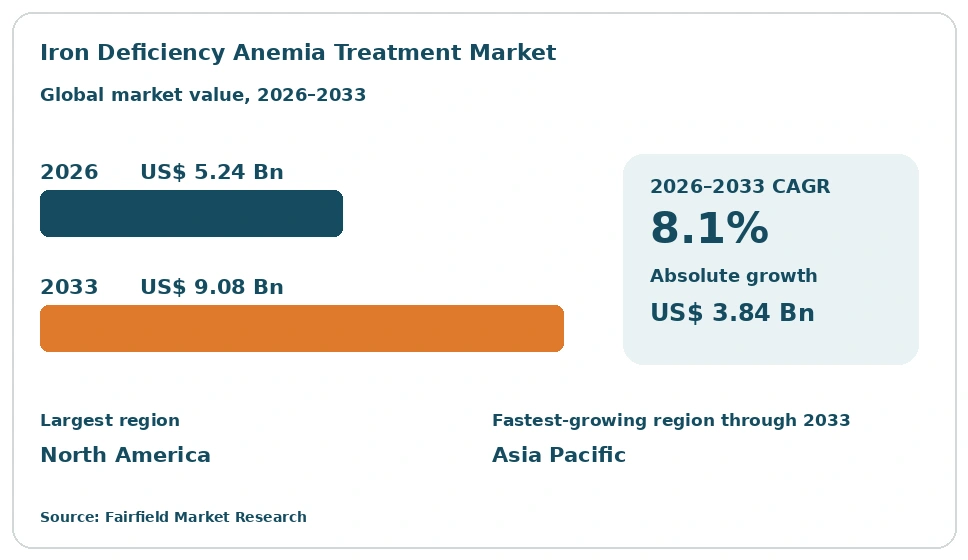
The global iron deficiency anemia treatment market size is expected to be valued at US$ 5.24 billion in 2026 and projected to reach US$ 9.08 billion by 2033, growing at a CAGR of 8.1% between 2026 and 2033.
Between 2020 and 2025, the market grew at a CAGR of about 7.0%, rising from roughly US$ 3.45 billion to US$ 4.85 billion, as screening improved, doctors moved more patients to fast single-dose intravenous iron, heart failure and kidney disease guidelines recommended iron checks, and clinic visits recovered after the pandemic. The iron deficiency anemia treatment market covers medicines that restore iron levels and red blood cells in people whose bodies lack enough iron, including oral iron such as ferrous sulfate, ferrous gluconate, and ferric maltol, and intravenous iron such as ferric carboxymaltose, ferric derisomaltose, iron sucrose, and ferumoxytol. Iron deficiency anemia is the most common form of anemia worldwide, affecting women, children, pregnant women, older adults, and people with chronic kidney disease, heart failure, cancer, and bowel disease. Symptoms include tiredness, weakness, and shortness of breath. In July 2026, Pharmacosmos reported 14% revenue growth.
Key Report Takeaways
- By Therapy Type: Parenteral Iron Therapy held about 60% share in 2025, while Oral Iron Therapy is projected to expand at an 8.8% CAGR through 2033, driven by new better-tolerated oral forms, low cost, wider use in Asia Pacific, and growing online sales.
- By Therapy Area: Inflammatory Bowel Disease held about 30% share in 2025, while Pregnancy and Women’s Health is projected to expand at a 9.4% CAGR through 2033, driven by screening during pregnancy, heavy menstrual bleeding treatment, and national maternal health programs.
- By End User: Hospitals held about 43% share in 2025, while Home Healthcare is projected to expand at a 9.9% CAGR through 2033, driven by oral therapy, home infusion services, and patient preference for convenient care.
- By Region: North America held about 37% share in 2025, while Asia Pacific is projected to expand at a 9.6% CAGR through 2033, driven by very high anemia rates, government anemia programs, and growing use of intravenous iron in India and China.
Global Iron Deficiency Anemia Treatment Market Trends and Insights
Drivers Impact Analysis
Two drivers carry the strongest influence on iron deficiency anemia treatment market demand during the forecast period.
| Driver | Impact on CAGR Forecast | Geographic Relevance | Impact Timeline |
| High prevalence and chronic disease growth | High | Global | Long term (≥4 years) |
| Shift to single-dose intravenous iron | High | North America, Europe, Asia Pacific | Medium term (2-4 years) |
Rising Prevalence Is Driving the Iron Deficiency Anemia Treatment Market
High prevalence and chronic disease growth are the strongest driver of the iron deficiency anemia treatment market. Iron deficiency is extremely common worldwide.
The mechanism is a very large and growing patient pool. Hundreds of millions of people have iron deficiency anemia, including many women of reproductive age, pregnant women, young children, and older adults. Chronic kidney disease, heart failure, cancer, inflammatory bowel disease, and heavy menstrual bleeding all cause or worsen iron deficiency, and these conditions are rising with aging populations and lifestyle changes. Bariatric surgery and the growing use of weight loss medicines can also reduce iron absorption. Updated guidelines now recommend checking iron levels in heart failure and kidney disease patients and treating deficiency even without anemia. Patient blood management programs before surgery also test and treat iron deficiency. These trends steadily increase the number of treated patients.
Intravenous Iron Is Expanding the Iron Deficiency Anemia Treatment Market
The shift to single-dose intravenous iron is expanding the iron deficiency anemia treatment market. Patients and doctors want fast, effective treatment.
The cause is that many patients cannot tolerate oral iron because of stomach upset and constipation, or cannot absorb enough because of bowel disease, kidney disease, or inflammation. Modern intravenous iron products such as CSL Vifor’s Ferinject (Injectafer in the United States) and Pharmacosmos’ Monofer (Monoferric) can replace a full iron dose in one or two short infusions, compared with many weeks of pills or several older infusions. Clinical trials have shown benefits in heart failure, and the FDA approved Injectafer for iron deficiency in heart failure. Hospitals and infusion centers are adopting these products widely. Because intravenous iron costs much more than pills, this shift raises market value.
Restraints Impact Analysis
Two restraints limit how quickly the iron deficiency anemia treatment market grows.
| Restraint | Impact on CAGR Forecast | Geographic Relevance | Impact Timeline |
| Underdiagnosis and low awareness | High | Asia Pacific, Latin America, Middle East & Africa | Long term (≥4 years) |
| Side effects, costs, and generic competition | Medium | Global | Medium term (2-4 years) |
Underdiagnosis Slows the Iron Deficiency Anemia Treatment Market
Underdiagnosis and low awareness slow the iron deficiency anemia treatment market. Many people do not know they are iron deficient.
The problem is that symptoms such as tiredness, poor concentration, and breathlessness are often blamed on stress, aging, or busy lives, so many people never get tested. Doctors may not check iron levels routinely, especially in men, older adults, and people with heart or kidney disease. In many lower-income countries, access to blood tests and follow-up care is limited, and people rely on cheap supplements or diet changes without medical advice. Cultural and dietary factors also play a role. Even when anemia is found, treatment may stop too early. Low awareness of iron deficiency without anemia means many patients are missed. These gaps leave a large share of patients untreated or undertreated.
Side Effects and Costs Restrict the Iron Deficiency Anemia Treatment Market
Side effects, costs, and generic competition restrict the iron deficiency anemia treatment market. Each treatment type has drawbacks.
The constraint is that oral iron commonly causes stomach pain, nausea, and constipation, leading many patients to stop taking it. Intravenous iron is more expensive, needs a clinic visit and trained staff, and carries a small risk of allergic reactions. Some intravenous products can cause low phosphate levels in the blood, which has led to label warnings. Payers in North America and Europe often require patients to try cheaper oral iron first. Generic versions of iron sucrose and other older products lower prices, and generic ferric carboxymaltose is starting to appear in some markets. In many developing countries, out-of-pocket costs limit use of modern therapies. These factors restrain revenue growth.
Market Opportunities
Better-Tolerated Oral Iron Opens a Fast-Growth Revenue Pool
Better-tolerated oral iron opens a fast-growth revenue pool. Patients want pills that work without stomach problems.
The opportunity comes from new oral iron forms such as ferric maltol, sucrosomial iron, iron bisglycinate, and lactoferrin-based products that cause fewer side effects and are absorbed better than traditional salts. ACCRUFeR gained approval in Canada in 2025 for patients who cannot tolerate other oral iron. Alternate-day dosing and combination products with vitamins also improve results. Over-the-counter iron supplements, gummies, and fortified foods reach large consumer markets, especially women and children. E-commerce and pharmacy chains make these products easy to buy without a prescription. Companies that offer effective, easy-to-take oral iron with strong clinical evidence can capture a large and growing patient base worldwide.
Emerging Markets and Maternal Health Create a Growth Revenue Pool
Emerging markets and maternal health programs create a growth revenue pool. Anemia rates are highest in many developing countries.
The opportunity reflects very high anemia rates in India, Pakistan, Bangladesh, Indonesia, Nigeria, and other countries, especially among women and children. Governments are running national programs, such as India’s Anemia Mukt Bharat, that provide screening, iron and folic acid tablets, and intravenous iron for pregnant women with severe anemia. Studies show that single-dose intravenous iron in pregnancy can quickly raise hemoglobin and reduce complications. Local drug makers such as Emcure and Cadila Pharmaceuticals are launching affordable products and awareness campaigns. School-based programs for adolescent girls are also expanding. Companies that partner with governments, offer low-cost formulations, and support training can capture strong growth while improving public health outcomes.
Segment Analysis
By Therapy Type: Parenteral Iron Therapy Leads While Oral Iron Therapy Grows Fastest
Parenteral Iron Therapy held about 60% share in 2025. Intravenous iron products are used for patients who cannot tolerate or absorb oral iron, need fast correction before surgery or during pregnancy, or have chronic kidney disease, heart failure, cancer, or bowel disease. Their higher prices make them the largest segment by revenue, even though fewer patients use them than oral iron.
Oral Iron Therapy is the fastest-growing therapy type, expanding at an 8.8% CAGR through 2033. Pills, capsules, liquids, and gummies are low cost, widely available, and suitable for mild to moderate deficiency. New better-tolerated forms and over-the-counter sales support growth. For the market, oral growth reaches very large patient groups in Asia Pacific and other emerging regions.
By Therapy Area: Inflammatory Bowel Disease Leads While Pregnancy and Women’s Health Grows Fastest
Inflammatory Bowel Disease held about 30% share in 2025. Patients with Crohn’s disease and ulcerative colitis often lose blood and absorb iron poorly, so they frequently need intravenous iron. Guidelines recommend regular iron checks and treatment for these patients. Gastroenterologists increasingly prefer single-dose intravenous products because they avoid gut side effects and work faster.
Pregnancy and Women’s Health is the fastest-growing therapy area, expanding at a 9.4% CAGR through 2033. Pregnant women need more iron, and heavy menstrual bleeding is a major cause of deficiency. Screening programs and safe intravenous iron in later pregnancy support growth. Chronic Kidney Disease, Heart Failure, Cancer, and Others form other therapy areas. Gynecologists are also treating iron deficiency before surgery for fibroids. For the market, women’s health growth expands treated populations.
By End User: Hospitals Lead While Home Healthcare Grows Fastest
Hospitals held about 43% share in 2025. They give intravenous iron to inpatients, surgical patients, pregnant women, and people with kidney disease, heart failure, and cancer, and they diagnose complex cases. Patient blood management programs are mainly run in hospitals and help reduce the need for blood transfusions during and after surgery.
Home Healthcare is the fastest-growing end user, expanding at a 9.9% CAGR through 2033. Most oral iron is taken at home, and home infusion services increasingly deliver intravenous iron to patients who find clinic visits difficult. Specialty Clinics, Infusion Centers, and Dialysis Centers form other important care segments. Telehealth visits help doctors monitor iron levels remotely. For the market, home growth improves convenience and adherence.
Geography Analysis
Which Region Is Leading the Iron Deficiency Anemia Treatment Market?
North America is leading the iron deficiency anemia treatment market with about 37% share in 2025. The United States has high use of intravenous iron products such as Injectafer, Monoferric, Venofer, and Feraheme, supported by insurance coverage, infusion centers, and guidelines for heart failure, kidney disease, and surgery. Daiichi Sankyo’s American Regent, CSL Vifor, and Pharmacosmos are major suppliers. Canada recently approved new oral and intravenous options. Key barriers include payer step therapy and generic competition. Retail clinics also screen for anemia. One change shaping the region is growth of home infusion.
Europe Shapes the Iron Deficiency Anemia Treatment Market Through Patient Blood Management
Europe is a major iron deficiency anemia treatment market. Germany, the United Kingdom, France, Italy, and Spain widely use intravenous iron, and CSL Vifor and Pharmacosmos are based in the region. European guidelines for heart failure and patient blood management before surgery encourage iron testing and treatment. Many hospitals now run dedicated outpatient iron clinics. Key barriers include price controls, tenders, and growing generic competition. Several countries now include iron checks in routine pregnancy care. Hospitals in Spain and Germany run large blood management programs. One opportunity is wider screening in heart failure and older adults.
Which Region Is Growing Fastest in the Iron Deficiency Anemia Treatment Market?
Asia Pacific is the fastest-growing iron deficiency anemia treatment market, expanding at a 9.6% CAGR through 2033. India has one of the world’s highest anemia rates and runs a national anemia program, while local companies such as Emcure and Cadila Pharmaceuticals sell intravenous and oral iron. China has a large patient population and is expanding intravenous iron use. Japan has an aging population with kidney and heart disease. Indonesia, Pakistan, and Bangladesh add large demand. Key barriers include costs. Fortified rice and flour programs also support prevention. One change shaping the region is rising intravenous iron use.
Latin America Grows the Iron Deficiency Anemia Treatment Market Through Public Health Programs
Latin America is a growing iron deficiency anemia treatment market. Brazil, Mexico, Peru, Colombia, and Argentina have high anemia rates among children and women and run public programs for iron supplements and fortified foods. Intravenous iron use is rising in private hospitals and kidney care. Key barriers include limited access to modern therapies in rural areas, budget constraints, and price sensitivity. Local manufacturers in Brazil and Mexico produce generic iron products. Awareness campaigns target mothers and young children. Kidney care centers are major users of intravenous iron. One opportunity is affordable intravenous iron for public hospitals.
Middle East & Africa Builds the Iron Deficiency Anemia Treatment Market Through Maternal Health
Middle East & Africa is an emerging iron deficiency anemia treatment market with very high anemia rates in many countries. Nigeria, Ethiopia, Kenya, and Egypt have large burdens among women and children, and international programs support iron supplementation. Saudi Arabia and the United Arab Emirates use modern intravenous iron in hospitals. Key barriers include limited diagnosis and low health funding levels. Malaria and parasitic infections worsen iron deficiency in some countries. Food fortification programs are expanding. Pharmacies and community health workers distribute many oral iron supplements. One opportunity is maternal health programs using single-dose intravenous iron.
Competitive Landscape
The iron deficiency anemia treatment market is moderately consolidated. CSL Vifor, Pharmacosmos, Daiichi Sankyo, Sanofi, and AbbVie are leading players, while Akebia Therapeutics, Bayer, GSK, Johnson & Johnson, Novartis, Emcure Pharmaceuticals, and Cadila Pharmaceuticals compete strongly. A few companies control the main branded intravenous iron products, including Ferinject, Monofer, Venofer, and Feraheme, while many generic and local manufacturers sell oral iron salts and supplements. Consumer health companies compete in over-the-counter iron products.
Companies compete on clinical evidence, speed of iron replacement, safety, number of infusions needed, price, and support for hospitals and infusion centers. Large outcome trials in heart failure and kidney disease help drive guideline recommendations and adoption. Legal and patent battles over intravenous iron products are common because these products earn high margins. In oral iron, companies compete on tolerability, taste, convenience, and brand recognition.
Strategic moves show how competition is changing. In November 2024, Cadila Pharmaceuticals launched Militol in India. In March 2025, Kye Pharmaceuticals won approval for ACCRUFeR in Canada. In July 2026, Pharmacosmos reported strong revenue growth and set up a Canadian affiliate. These moves show growth in both premium intravenous iron and better-tolerated oral iron, along with expansion into new countries.
Three themes shape vendor strategy. First, companies are generating outcome data to expand intravenous iron use in heart failure, kidney disease, pregnancy, and surgery. Second, they are developing better-tolerated oral forms. Third, they are expanding in Asia Pacific, Latin America, and Middle East & Africa, where anemia rates are highest.
Iron Deficiency Anemia Treatment Market Industry Leaders
- CSL Vifor
- Pharmacosmos
- Daiichi Sankyo
- Sanofi
- AbbVie
Recent Industry Developments
- July 2026: Pharmacosmos reported revenue of DKK 3,827 million for its 2025/26 financial year, up 14%, and expects further growth - shows strong demand for intravenous iron in the iron deficiency anemia treatment market.
- March 2025: Kye Pharmaceuticals announced Canadian approval of ACCRUFeR (ferric maltol) for adults with iron deficiency anemia who cannot tolerate or do not respond to other oral iron - widens oral iron choices.
- November 2024: Cadila Pharmaceuticals launched Militol, an iron supplement combining ferric maltol, folic acid, vitamin C, and vitamin B12 in India - expands affordable oral options in Asia Pacific.
Companies Covered in the Report
- CSL Vifor
- Pharmacosmos
- Daiichi Sankyo
- Sanofi
- AbbVie
- Akebia Therapeutics
- Bayer
- GSK
- Johnson & Johnson
- Novartis
- Emcure Pharmaceuticals
- Cadila Pharmaceuticals
Iron Deficiency Anemia Treatment Market Report Scope
This report covers the iron deficiency anemia treatment market, including oral and parenteral iron therapies, used in inflammatory bowel disease, chronic kidney disease, heart failure, cancer, pregnancy and women’s health, and other therapy areas, delivered in hospitals, home healthcare, specialty clinics, infusion centers, and dialysis centers. The base year is 2025, and the forecast period runs from 2026 to 2033. All values are expressed in US$ Billion.
| Therapy Type | Oral Iron Therapy, Parenteral Iron Therapy |
| Therapy Area | Inflammatory Bowel Disease, Chronic Kidney Disease, Heart Failure, Cancer, Pregnancy and Women’s Health, Others |
| End User | Hospitals, Home Healthcare, Specialty Clinics, Infusion Centers, Dialysis Centers |
| Regions | North America, Europe, Asia Pacific, Latin America, Middle East & Africa |
1. Executive Summary
1.1 Iron Deficiency Anemia Treatment Market Snapshot
1.2 Future Projections
1.3 Key Market Trends
1.4 Regional Snapshot
2. Market Overview
2.1 Market Definition and Report Scope
2.2 Historical Market Trends
2.3 Market Dynamics
2.3.1 Drivers
2.3.1.1 Rising Prevalence Is Driving the Iron Deficiency Anemia Treatment Market
2.3.1.2 Intravenous Iron Is Expanding the Iron Deficiency Anemia Treatment Market
2.3.2 Restraints
2.3.2.1 Underdiagnosis Slows the Iron Deficiency Anemia Treatment Market
2.3.2.2 Side Effects and Costs Restrict the Iron Deficiency Anemia Treatment Market
2.3.3 Market Opportunities
2.3.3.1 Better-Tolerated Oral Iron Opens a Fast-Growth Revenue Pool
2.3.3.2 Emerging Markets and Maternal Health Create a Growth Revenue Pool
3. Global Iron Deficiency Anemia Treatment Market Outlook, 2020–2033
3.1 Global Iron Deficiency Anemia Treatment Market Outlook, by Therapy Type, Value (US$ Billion), 2020–2033
3.1.1 Oral Iron Therapy
3.1.2 Parenteral Iron Therapy
3.2 Global Iron Deficiency Anemia Treatment Market Outlook, by Therapy Area, Value (US$ Billion), 2020–2033
3.2.1 Inflammatory Bowel Disease
3.2.2 Chronic Kidney Disease
3.2.3 Heart Failure
3.2.4 Cancer
3.2.5 Pregnancy and Women's Health
3.2.6 Others
3.3 Global Iron Deficiency Anemia Treatment Market Outlook, by End User, Value (US$ Billion), 2020–2033
3.3.1 Hospitals
3.3.2 Home Healthcare
3.3.3 Specialty Clinics
3.3.4 Infusion Centers
3.3.5 Dialysis Centers
3.4 Global Iron Deficiency Anemia Treatment Market Outlook, by Region, Value (US$ Billion), 2020–2033
3.4.1 North America
3.4.2 Europe
3.4.3 Asia Pacific
3.4.4 Latin America
3.4.5 Middle East & Africa
4. North America Iron Deficiency Anemia Treatment Market Outlook, 2020–2033
4.1 North America Iron Deficiency Anemia Treatment Market Outlook, by Therapy Type, Value (US$ Billion), 2020–2033
4.1.1 Oral Iron Therapy
4.1.2 Parenteral Iron Therapy
4.2 North America Iron Deficiency Anemia Treatment Market Outlook, by Therapy Area, Value (US$ Billion), 2020–2033
4.2.1 Inflammatory Bowel Disease
4.2.2 Chronic Kidney Disease
4.2.3 Heart Failure
4.2.4 Cancer
4.2.5 Pregnancy and Women's Health
4.2.6 Others
4.3 North America Iron Deficiency Anemia Treatment Market Outlook, by End User, Value (US$ Billion), 2020–2033
4.3.1 Hospitals
4.3.2 Home Healthcare
4.3.3 Specialty Clinics
4.3.4 Infusion Centers
4.3.5 Dialysis Centers
4.4 North America Iron Deficiency Anemia Treatment Market Outlook, by Country, Value (US$ Billion), 2020–2033
4.4.1 United States Iron Deficiency Anemia Treatment Market Outlook, by Therapy Type, 2020–2033
4.4.2 United States Iron Deficiency Anemia Treatment Market Outlook, by Therapy Area, 2020–2033
4.4.3 United States Iron Deficiency Anemia Treatment Market Outlook, by End User, 2020–2033
4.4.4 Canada Iron Deficiency Anemia Treatment Market Outlook, by Therapy Type, 2020–2033
4.4.5 Canada Iron Deficiency Anemia Treatment Market Outlook, by Therapy Area, 2020–2033
4.4.6 Canada Iron Deficiency Anemia Treatment Market Outlook, by End User, 2020–2033
5. Europe Iron Deficiency Anemia Treatment Market Outlook, 2020–2033
5.1 Europe Iron Deficiency Anemia Treatment Market Outlook, by Therapy Type, Value (US$ Billion), 2020–2033
5.1.1 Oral Iron Therapy
5.1.2 Parenteral Iron Therapy
5.2 Europe Iron Deficiency Anemia Treatment Market Outlook, by Therapy Area, Value (US$ Billion), 2020–2033
5.2.1 Inflammatory Bowel Disease
5.2.2 Chronic Kidney Disease
5.2.3 Heart Failure
5.2.4 Cancer
5.2.5 Pregnancy and Women's Health
5.2.6 Others
5.3 Europe Iron Deficiency Anemia Treatment Market Outlook, by End User, Value (US$ Billion), 2020–2033
5.3.1 Hospitals
5.3.2 Home Healthcare
5.3.3 Specialty Clinics
5.3.4 Infusion Centers
5.3.5 Dialysis Centers
5.4 Europe Iron Deficiency Anemia Treatment Market Outlook, by Country, Value (US$ Billion), 2020–2033
5.4.1 Germany Iron Deficiency Anemia Treatment Market Outlook, by Therapy Type, 2020–2033
5.4.2 Germany Iron Deficiency Anemia Treatment Market Outlook, by Therapy Area, 2020–2033
5.4.3 Germany Iron Deficiency Anemia Treatment Market Outlook, by End User, 2020–2033
5.4.4 United Kingdom Iron Deficiency Anemia Treatment Market Outlook, by Therapy Type, 2020–2033
5.4.5 United Kingdom Iron Deficiency Anemia Treatment Market Outlook, by Therapy Area, 2020–2033
5.4.6 United Kingdom Iron Deficiency Anemia Treatment Market Outlook, by End User, 2020–2033
5.4.7 France Iron Deficiency Anemia Treatment Market Outlook, by Therapy Type, 2020–2033
5.4.8 France Iron Deficiency Anemia Treatment Market Outlook, by Therapy Area, 2020–2033
5.4.9 France Iron Deficiency Anemia Treatment Market Outlook, by End User, 2020–2033
5.4.10 Italy Iron Deficiency Anemia Treatment Market Outlook, by Therapy Type, 2020–2033
5.4.11 Italy Iron Deficiency Anemia Treatment Market Outlook, by Therapy Area, 2020–2033
5.4.12 Italy Iron Deficiency Anemia Treatment Market Outlook, by End User, 2020–2033
5.4.13 Spain Iron Deficiency Anemia Treatment Market Outlook, by Therapy Type, 2020–2033
5.4.14 Spain Iron Deficiency Anemia Treatment Market Outlook, by Therapy Area, 2020–2033
5.4.15 Spain Iron Deficiency Anemia Treatment Market Outlook, by End User, 2020–2033
6. Asia Pacific Iron Deficiency Anemia Treatment Market Outlook, 2020–2033
6.1 Asia Pacific Iron Deficiency Anemia Treatment Market Outlook, by Therapy Type, Value (US$ Billion), 2020–2033
6.1.1 Oral Iron Therapy
6.1.2 Parenteral Iron Therapy
6.2 Asia Pacific Iron Deficiency Anemia Treatment Market Outlook, by Therapy Area, Value (US$ Billion), 2020–2033
6.2.1 Inflammatory Bowel Disease
6.2.2 Chronic Kidney Disease
6.2.3 Heart Failure
6.2.4 Cancer
6.2.5 Pregnancy and Women's Health
6.2.6 Others
6.3 Asia Pacific Iron Deficiency Anemia Treatment Market Outlook, by End User, Value (US$ Billion), 2020–2033
6.3.1 Hospitals
6.3.2 Home Healthcare
6.3.3 Specialty Clinics
6.3.4 Infusion Centers
6.3.5 Dialysis Centers
6.4 Asia Pacific Iron Deficiency Anemia Treatment Market Outlook, by Country, Value (US$ Billion), 2020–2033
6.4.1 India Iron Deficiency Anemia Treatment Market Outlook, by Therapy Type, 2020–2033
6.4.2 India Iron Deficiency Anemia Treatment Market Outlook, by Therapy Area, 2020–2033
6.4.3 India Iron Deficiency Anemia Treatment Market Outlook, by End User, 2020–2033
6.4.4 China Iron Deficiency Anemia Treatment Market Outlook, by Therapy Type, 2020–2033
6.4.5 China Iron Deficiency Anemia Treatment Market Outlook, by Therapy Area, 2020–2033
6.4.6 China Iron Deficiency Anemia Treatment Market Outlook, by End User, 2020–2033
6.4.7 Japan Iron Deficiency Anemia Treatment Market Outlook, by Therapy Type, 2020–2033
6.4.8 Japan Iron Deficiency Anemia Treatment Market Outlook, by Therapy Area, 2020–2033
6.4.9 Japan Iron Deficiency Anemia Treatment Market Outlook, by End User, 2020–2033
6.4.10 Indonesia Iron Deficiency Anemia Treatment Market Outlook, by Therapy Type, 2020–2033
6.4.11 Indonesia Iron Deficiency Anemia Treatment Market Outlook, by Therapy Area, 2020–2033
6.4.12 Indonesia Iron Deficiency Anemia Treatment Market Outlook, by End User, 2020–2033
6.4.13 Pakistan Iron Deficiency Anemia Treatment Market Outlook, by Therapy Type, 2020–2033
6.4.14 Pakistan Iron Deficiency Anemia Treatment Market Outlook, by Therapy Area, 2020–2033
6.4.15 Pakistan Iron Deficiency Anemia Treatment Market Outlook, by End User, 2020–2033
6.4.16 Bangladesh Iron Deficiency Anemia Treatment Market Outlook, by Therapy Type, 2020–2033
6.4.17 Bangladesh Iron Deficiency Anemia Treatment Market Outlook, by Therapy Area, 2020–2033
6.4.18 Bangladesh Iron Deficiency Anemia Treatment Market Outlook, by End User, 2020–2033
7. Latin America Iron Deficiency Anemia Treatment Market Outlook, 2020–2033
7.1 Latin America Iron Deficiency Anemia Treatment Market Outlook, by Therapy Type, Value (US$ Billion), 2020–2033
7.1.1 Oral Iron Therapy
7.1.2 Parenteral Iron Therapy
7.2 Latin America Iron Deficiency Anemia Treatment Market Outlook, by Therapy Area, Value (US$ Billion), 2020–2033
7.2.1 Inflammatory Bowel Disease
7.2.2 Chronic Kidney Disease
7.2.3 Heart Failure
7.2.4 Cancer
7.2.5 Pregnancy and Women's Health
7.2.6 Others
7.3 Latin America Iron Deficiency Anemia Treatment Market Outlook, by End User, Value (US$ Billion), 2020–2033
7.3.1 Hospitals
7.3.2 Home Healthcare
7.3.3 Specialty Clinics
7.3.4 Infusion Centers
7.3.5 Dialysis Centers
7.4 Latin America Iron Deficiency Anemia Treatment Market Outlook, by Country, Value (US$ Billion), 2020–2033
7.4.1 Brazil Iron Deficiency Anemia Treatment Market Outlook, by Therapy Type, 2020–2033
7.4.2 Brazil Iron Deficiency Anemia Treatment Market Outlook, by Therapy Area, 2020–2033
7.4.3 Brazil Iron Deficiency Anemia Treatment Market Outlook, by End User, 2020–2033
7.4.4 Mexico Iron Deficiency Anemia Treatment Market Outlook, by Therapy Type, 2020–2033
7.4.5 Mexico Iron Deficiency Anemia Treatment Market Outlook, by Therapy Area, 2020–2033
7.4.6 Mexico Iron Deficiency Anemia Treatment Market Outlook, by End User, 2020–2033
7.4.7 Peru Iron Deficiency Anemia Treatment Market Outlook, by Therapy Type, 2020–2033
7.4.8 Peru Iron Deficiency Anemia Treatment Market Outlook, by Therapy Area, 2020–2033
7.4.9 Peru Iron Deficiency Anemia Treatment Market Outlook, by End User, 2020–2033
7.4.10 Colombia Iron Deficiency Anemia Treatment Market Outlook, by Therapy Type, 2020–2033
7.4.11 Colombia Iron Deficiency Anemia Treatment Market Outlook, by Therapy Area, 2020–2033
7.4.12 Colombia Iron Deficiency Anemia Treatment Market Outlook, by End User, 2020–2033
7.4.13 Argentina Iron Deficiency Anemia Treatment Market Outlook, by Therapy Type, 2020–2033
7.4.14 Argentina Iron Deficiency Anemia Treatment Market Outlook, by Therapy Area, 2020–2033
7.4.15 Argentina Iron Deficiency Anemia Treatment Market Outlook, by End User, 2020–2033
8. Middle East & Africa Iron Deficiency Anemia Treatment Market Outlook, 2020–2033
8.1 Middle East & Africa Iron Deficiency Anemia Treatment Market Outlook, by Therapy Type, Value (US$ Billion), 2020–2033
8.1.1 Oral Iron Therapy
8.1.2 Parenteral Iron Therapy
8.2 Middle East & Africa Iron Deficiency Anemia Treatment Market Outlook, by Therapy Area, Value (US$ Billion), 2020–2033
8.2.1 Inflammatory Bowel Disease
8.2.2 Chronic Kidney Disease
8.2.3 Heart Failure
8.2.4 Cancer
8.2.5 Pregnancy and Women's Health
8.2.6 Others
8.3 Middle East & Africa Iron Deficiency Anemia Treatment Market Outlook, by End User, Value (US$ Billion), 2020–2033
8.3.1 Hospitals
8.3.2 Home Healthcare
8.3.3 Specialty Clinics
8.3.4 Infusion Centers
8.3.5 Dialysis Centers
8.4 Middle East & Africa Iron Deficiency Anemia Treatment Market Outlook, by Country, Value (US$ Billion), 2020–2033
8.4.1 Nigeria Iron Deficiency Anemia Treatment Market Outlook, by Therapy Type, 2020–2033
8.4.2 Nigeria Iron Deficiency Anemia Treatment Market Outlook, by Therapy Area, 2020–2033
8.4.3 Nigeria Iron Deficiency Anemia Treatment Market Outlook, by End User, 2020–2033
8.4.4 Ethiopia Iron Deficiency Anemia Treatment Market Outlook, by Therapy Type, 2020–2033
8.4.5 Ethiopia Iron Deficiency Anemia Treatment Market Outlook, by Therapy Area, 2020–2033
8.4.6 Ethiopia Iron Deficiency Anemia Treatment Market Outlook, by End User, 2020–2033
8.4.7 Kenya Iron Deficiency Anemia Treatment Market Outlook, by Therapy Type, 2020–2033
8.4.8 Kenya Iron Deficiency Anemia Treatment Market Outlook, by Therapy Area, 2020–2033
8.4.9 Kenya Iron Deficiency Anemia Treatment Market Outlook, by End User, 2020–2033
8.4.10 Egypt Iron Deficiency Anemia Treatment Market Outlook, by Therapy Type, 2020–2033
8.4.11 Egypt Iron Deficiency Anemia Treatment Market Outlook, by Therapy Area, 2020–2033
8.4.12 Egypt Iron Deficiency Anemia Treatment Market Outlook, by End User, 2020–2033
8.4.13 Saudi Arabia Iron Deficiency Anemia Treatment Market Outlook, by Therapy Type, 2020–2033
8.4.14 Saudi Arabia Iron Deficiency Anemia Treatment Market Outlook, by Therapy Area, 2020–2033
8.4.15 Saudi Arabia Iron Deficiency Anemia Treatment Market Outlook, by End User, 2020–2033
8.4.16 United Arab Emirates Iron Deficiency Anemia Treatment Market Outlook, by Therapy Type, 2020–2033
8.4.17 United Arab Emirates Iron Deficiency Anemia Treatment Market Outlook, by Therapy Area, 2020–2033
8.4.18 United Arab Emirates Iron Deficiency Anemia Treatment Market Outlook, by End User, 2020–2033
9. Competitive Landscape
9.1 Iron Deficiency Anemia Treatment Market Industry Leaders
9.2 Recent Industry Developments
9.3 Company Profiles
9.3.1 CSL Vifor
9.3.2 Pharmacosmos
9.3.3 Daiichi Sankyo
9.3.4 Sanofi
9.3.5 AbbVie
9.3.6 Akebia Therapeutics
9.3.7 Bayer
9.3.8 GSK
9.3.9 Johnson & Johnson
9.3.10 Novartis
9.3.11 Emcure Pharmaceuticals
9.3.12 Cadila Pharmaceuticals
10. Appendix
10.1 Research Methodology
10.2 Report Assumptions
10.3 Acronyms and Abbreviations
| Therapy Type | Oral Iron Therapy, Parenteral Iron Therapy |
| Therapy Area | Inflammatory Bowel Disease, Chronic Kidney Disease, Heart Failure, Cancer, Pregnancy and Women’s Health, Others |
| End User | Hospitals, Home Healthcare, Specialty Clinics, Infusion Centers, Dialysis Centers |
| Regions | North America, Europe, Asia Pacific, Latin America, Middle East & Africa |
Our Research Methodology
Considering the volatility of business today, traditional approaches to strategizing a game plan can be unfruitful if not detrimental. True ambiguity is no way to determine a forecast. A myriad of predetermined factors must be accounted for such as the degree of risk involved, the magnitude of circumstances, as well as conditions or consequences that are not known or unpredictable. To circumvent binary views that cast uncertainty, the application of market research intelligence to strategically posture, move, and enable actionable outcomes is necessary.
View Methodology
Quality Assured
Rigorous Validation Process

Confidentiality Assured
End-to-end Data Security

Custom Research Services
Tailored To Your Objectives
FAQs
The iron deficiency anemia treatment market is valued at US$ 5.24 billion in 2026, led by intravenous iron and North America.
The market is projected to reach US$ 9.08 billion by 2033, growing at an 8.1% CAGR and adding US$ 3.84 billion.
Home healthcare is growing fastest at a 9.9% CAGR through 2033, driven by oral therapy and home infusion services.
Asia Pacific is growing fastest at a 9.6% CAGR through 2033, driven by high anemia rates and government programs in India.
North America holds the largest share at about 37% in 2025, supported by intravenous iron use, insurance coverage, and guidelines.
Related Reports
Monogenic Diseases Market Size, Share, Insights, Competitive Landscape, and Forecast 2026 to 2033
Explore the monogenic diseases market, forecast to reach US$34.9 billion by 2033 at 9.4% CAGR, with insights on diseases, offerings, technology, and regions.
Juvenile Macular Degeneration Treatment Market Size, Share, Insights, Competitive Landscape, and Forecast 2026 to 2033
Explore the juvenile macular degeneration treatment market, forecast to reach US$2.08 billion by 2033 at 8.4% CAGR, with offering and regional insights.
Compounded Bioidentical Hormone Therapy Market Size, Share, Insights, Competitive Landscape, and Forecast 2026 to 2033
Explore the compounded bioidentical hormone therapy market, forecast to reach US$2.87 billion by 2033 at 6.9% CAGR, with hormone, dosage, and regional insights.
Bronchodilators Market Size, Share, Insights, Competitive Landscape, and Forecast 2026 to 2033
Explore the bronchodilators market, forecast to reach US$40.0 billion by 2033 at 4.6% CAGR, with insights on drug classes, devices, channels, and regions.
Asthma Treatment Market Size, Share, Insights, Competitive Landscape, and Forecast 2026 to 2033
Explore the asthma treatment market outlook for 2026–2033, covering drug classes, devices, distribution channels, patient segments, and regions.
AAV Gene Therapy vs Retroviral Gene Therapy Market Size, Share, Insights, Competitive Landscape, and Forecast 2026 to 2033
Explore AAV vs retroviral gene therapy, a market forecast to reach US$23.02 billion by 2033 at 25.4% CAGR, with insights on vectors, uses, and regions.