



Bronchodilators Market
Bronchodilators Market Size, Share, Insights, Competitive Landscape, and Forecast 2026 to 2033
Report Overview
Bronchodilators Market Size and Trend Analysis
How Fast Will the Bronchodilators Market Grow Through 2033?
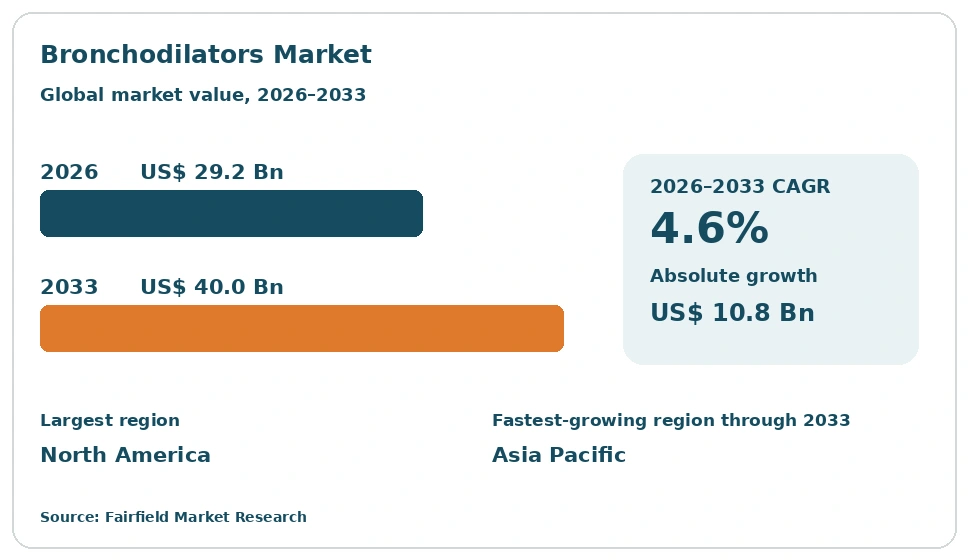
The global Bronchodilators market size is expected to be valued at US$ 29.2 billion in 2026 and projected to reach US$ 40.0 billion by 2033, growing at a CAGR of 4.6% between 2026 and 2033. The class grew at a historical CAGR of 3.4% between 2020 and 2025. Growth now rests on a wider treated population across asthma and chronic obstructive pulmonary disease, steady generic entry into inhaled molecules, and device reformulation tied to propellant rules. The absolute dollar opportunity through 2033 reaches US$ 10.8 billion, concentrated in fixed-dose combination inhalers, reformulated metered-dose products, propellant-free devices and retail supply across middle-income markets, where unit volumes are rising fastest.
Key Report Takeaways
- By Drug Class: Short-acting beta-agonists led with 31.5% share in 2026, while fixed-dose LABA/LAMA combinations are projected to expand at a 6.9% CAGR through 2033, driven by payer preference for single-device maintenance regimens in chronic obstructive pulmonary disease.
- By Route and Delivery Device: Metered-dose inhalers led with 42.8% share in 2026, while soft mist inhalers are projected to expand at a 7.8% CAGR through 2033, driven by propellant-free engineering that sits outside fluorinated-gas restrictions.
- By Distribution Channel: Retail pharmacies led with 48.5% share in 2026, while online pharmacies are projected to expand at an 8.4% CAGR through 2033, driven by refill automation and wider mail-order coverage under commercial insurance plans.
- By Supply and Prescription Status: Generic and substitutable prescription products led with 38.9% share in 2026, while branded generics are projected to expand at a 6.6% CAGR through 2033, driven by tender procurement and local manufacturing incentives in emerging pharmaceutical markets.
- By Region: North America led with 38.4% share in 2026, while Asia Pacific is projected to expand at a 6.8% CAGR through 2033, driven by rising diagnosis rates alongside spirometry access and domestic inhaler capacity in India and China.
Market Trends and Insights
Market Growth Drivers
Wider Diagnosed Population Across Two Indications Broadens the Prescription Base
A wider diagnosed population lifts bronchodilator unit demand because the class is authorised for use in both asthma and chronic obstructive pulmonary disease by the FDA and the EMA. Each new diagnosis starts a repeat-prescription cycle that runs for years, turning diagnosis growth into predictable annual volume rather than one-time sales. Payers plan for that supply as a standing budget line. The cross-indication position also shields manufacturers from demand shifts inside any single respiratory indication.
Wider access to spirometry and to case-finding programmes run by national health services sits behind the shift. Air quality monitoring, tobacco control reporting and occupational health screening move undiagnosed cases into formal care. Ageing populations in high-income countries add chronic obstructive pulmonary disease volume, while paediatric asthma registries widen the asthma base. Earlier referral from primary care extends average treatment duration per patient.
Generic and Device-Generic Pathways Reset Class Economics
Generic entry changes where value sits in the class rather than shrinking it. Originator revenue per unit falls once substitutable products reach retail shelves, yet total treated volume rises because lower unit prices let payers widen formulary access. Automatic substitution rules in retail pharmacy accelerate that shift once approval lands. The result is a class that grows in units faster than in value, rewarding manufacturers with scale, backward-integrated device tooling and low-cost formulation capacity.
Inhaled products are harder to copy than oral tablets, since approval depends on matching the device as well as the molecule. Regulators assess emitted dose, particle size distribution and handling characteristics before granting substitutability. Those requirements keep the number of credible entrants limited across most inhaled molecules. Firms with in-house actuator, canister and valve capability hold a durable position in tender-driven supply.
Restraints Impact Analysis of Market
Inhaler Affordability and Out-of-Pocket Cost Cap Volume Conversion
Cost at the pharmacy counter limits how much diagnosed demand converts into filled prescriptions. In markets without full reimbursement, patients carry a meaningful share of inhaler cost, and refill intervals stretch when budgets tighten. Chronic therapy makes the effect cumulative across a year of refills. Manufacturers see this as leakage between prescriptions written and units dispensed, which caps realised revenue even where diagnosis and treatment rates climb steadily.
Pricing structures differ sharply by country, so the same product can meet a reference price, a tender ceiling or a deductible. Patient assistance programmes, preferred-pharmacy agreements and public procurement all compress net realisation per pack. Where device patents and formulation know-how delay substitutable entry, prices stay elevated for longer. Affordability then acts as a structural constraint on volume rather than a temporary one.
Propellant Regulation Raises Reformulation and Compliance Costs
Fluorinated-gas rules bear directly on metered-dose inhalers, which remain the largest delivery format in the class. Phase-down schedules in Europe and North America restrict the supply of established propellants, raising input costs and forcing portfolio decisions. Smaller manufacturers face reformulation bills, new stability programmes and regulatory filings that are difficult to absorb across a low-margin generic portfolio. Contract manufacturers absorb part of that work, at a price.
Switching propellant is a change to the drug product, not a packaging swap, so it triggers fresh pharmaceutical development, comparative characterisation work and filing review by the FDA and the EMA. Canister coatings, valve elastomers and actuator geometry all need requalification. Capital spending shifts toward filling lines and propellant handling, slowing other projects and concentrating supply among firms able to fund the transition. Filing queues stretch the timeline across whole product families.
Market Opportunities
Low-Carbon Propellant Platforms Open a Reformulation Revenue Cycle
The propellant transition creates a rebuild cycle across an installed base of inhaled products. Manufacturers that qualify low global-warming-potential propellant platforms early can sell contract formulation, device components and licensed technology to firms without that capability. Licensing income arrives before their own reformulated products reach tender. Health systems carrying carbon reduction targets now weigh inhaler footprint in procurement scoring, giving reformulated products a commercial argument beyond price.
Component suppliers gain alongside drug makers, since new propellants change pressure, solvency and material compatibility inside the canister. Demand follows for compatible valves, coated canisters, dose counters and filling equipment. Firms combining formulation and device engineering can sell a complete transition package. Tooling lead times make early qualification a timing advantage. The cycle also reopens tender positions that had settled, letting agile suppliers win volume that incumbents previously held.
Connected Inhalers and Adherence Data Create New Commercial Models
Digital dose tracking turns a commodity device into a service platform carrying recurring revenue. Sensor-enabled inhalers and add-on modules let manufacturers sell refill management and usage reporting to payers and integrated health systems. Contract terms can then span several years instead of a single tender. That shifts negotiation away from unit price toward measured programme value, which matters most in generic-heavy segments where price competition has removed other differentiation.
Clinical bodies have noted prescribing patterns in which reliever supply runs ahead of maintenance supply, and dispensing records make that pattern visible to purchasers. Pharmacy networks, electronic prescribing systems and chronic-care platforms hold the data. Manufacturers packaging this reporting with supply contracts gain a position in population health programmes, while device firms sell sensors, software and analytics as a separate revenue line.
Category-wise Insights
Which Bronchodilator Drug Class Holds the Largest Share?
Short-acting beta-agonists hold the largest position, at 31.5% share in 2026, because reliever products sit in both asthma and chronic obstructive pulmonary disease supply across every income tier. Long-acting muscarinic antagonists follow at 24.2%, with long-acting beta-agonists at 18.6%, short-acting muscarinic antagonists at 5.8% and methylxanthines at 3.5%.
Growth leadership sits elsewhere. Fixed-dose LABA/LAMA combinations hold 16.4% share and are set to expand at a 6.9% CAGR through 2033, as payers consolidate maintenance supply into one device and manufacturers defend price with combination patents. The split matters commercially: reliever volume carries the class on units at low realised value, while combination products carry most of the margin. Firms balancing both avoid concentrated exposure to generic erosion in either half of the portfolio.
What Is Shaping Device Choice in Bronchodilator Delivery?
Regulation and cost structure now shape device choice more than format preference. Metered-dose inhalers led with 42.8% share in 2026, supported by low unit cost, mature filling capacity and wide formulary listing. Dry powder inhalers hold 29.6%, nebulizer solutions 16.3% and oral plus injectable routes 4.2%.
Soft mist inhalers hold 7.1% share and are the growth leader at a 7.8% CAGR through 2033, because propellant-free operation sits outside fluorinated-gas phase-down schedules. Procurement teams in Europe and North America increasingly score inhaler carbon footprint alongside price. Device economics follow: propellant-free and dry powder formats need different tooling, dose-metering components and stability programmes. Manufacturers without that capability face either licensing costs or exclusion from the growing share of tenders that carry explicit environmental criteria.
Retail Pharmacy Networks Anchor Bronchodilator Distribution Economics
Retail pharmacies led distribution with 48.5% share in 2026, because bronchodilators are chronic repeat prescriptions dispensed close to home rather than administered in hospital. Hospital pharmacies hold 29.7%, mostly nebulised and acute-setting supply, while clinics and ambulatory care settings account for 9.4%.
Online pharmacies hold 12.4% and are the fastest-growing channel at an 8.4% CAGR through 2033, helped by refill automation, chronic-care subscription plans and wider mail-order coverage from commercial insurers. The channel shift changes commercial strategy. Retail chains negotiate on net price and preferred placement, while digital channels compete on adherence tracking and delivery reliability. Manufacturers that supply dose counters, reminder tools and refill data gain leverage in both, since dispensing records are what purchasers use to judge programme performance.
Generic Substitution Sets the Price Floor for Bronchodilator Supply
Generic and substitutable prescription products led with 38.9% share in 2026, reflecting the number of inhaled molecules now outside originator exclusivity. Branded originator products hold 36.2%, retaining value through combination formats and proprietary devices. Over-the-counter bronchodilators account for 5.2%, limited to the few markets where regulators permit non-prescription supply.
Branded generics hold 19.7% and grow fastest at a 6.6% CAGR through 2033, carried by tender procurement and local manufacturing incentives across emerging pharmaceutical markets. The structure explains the gap between unit and value growth in this class. Substitutable supply sets the price floor, branded originators hold premium segments, and branded generics occupy the middle ground where prescriber familiarity still carries weight. Manufacturers increasingly run all three commercial models inside a single respiratory portfolio.
Geography Analysis
Which Region Is Leading the Bronchodilators Market?
North America leads with 38.4% share in 2026, on the strength of high diagnosis rates, broad insurance coverage and list prices well above global averages. The United States supplies most of that value, with Canada adding publicly funded volume through provincial drug plans.
Commercial drivers are specific. Pharmacy benefit managers negotiate rebates that keep branded combination inhalers on formulary, while substitution rules move reliever volume toward generics. The FDA has built pathways for substitutable inhaled products, drawing more entrants into the class. Fluorinated-gas phase-down schedules are pushing manufacturers to requalify metered-dose portfolios, and domestic filling capacity is being upgraded to handle alternative propellants. Those investments keep regional value high even as unit prices compress.
Europe’s Propellant Rules Redirect Inhaler Portfolio Planning
Europe holds 26.1% share in 2026, with Germany, the United Kingdom, France, Italy and Spain supplying most volume. Universal coverage keeps prescription rates steady, while reference pricing and tender systems hold net realisation below North American levels.
Environmental regulation is the region’s defining commercial factor. Fluorinated-gas phase-down rules restrict established metered-dose propellants, and several national health services now weigh inhaler carbon footprint in procurement scoring. That has redirected portfolio planning toward dry powder and propellant-free formats, and toward reformulated metered-dose products using low global-warming-potential propellants. The EMA reviews each change as a product variation, adding development and filing cost. Manufacturers with European filling assets are converting lines early to protect tender positions.
Which Region Is Growing Fastest in the Bronchodilators Market?
Asia Pacific grows fastest, at a 6.8% CAGR through 2033, from 24.3% share in 2026. China, India, Japan, South Korea and Australia account for most activity, with India and China contributing both demand and manufacturing capacity.
Growth has clear sources. Spirometry access is widening through primary care upgrades, moving undiagnosed respiratory cases into treatment. Air quality concerns in dense urban centres raise case-finding activity. Domestic manufacturers in India have built inhaler device tooling and formulation capability, supplying local tenders and exporting substitutable products. National insurance schemes in China have added inhaled products to reimbursement lists through volume-based procurement, trading sharply lower prices for guaranteed unit commitments that expand the treated base.
Latin America Builds Volume Through Public Procurement Channels
Latin America holds 6.4% share in 2026, led by Brazil and Mexico, with Argentina, Colombia and Chile adding smaller volumes. Public health systems buy the majority of supply through centralised tenders, making price the dominant selection criterion.
That structure favours branded generics and low-cost substitutable inhalers over premium combination products. Local manufacturing incentives in Brazil have drawn formulation and packaging investment, shortening supply chains and reducing import exposure. Out-of-pocket spending still governs the private retail segment, where affordability limits refill frequency. Regional regulators have aligned parts of their dossier requirements with FDA and EMA standards, which lowers entry cost for established exporters and steadily widens the number of suppliers competing for tender awards.
Middle East & Africa Expands Access Through Essential Medicines Supply
Middle East & Africa accounts for 4.8% share in 2026, the smallest regional position, split between high-income Gulf markets and lower-income African health systems with very different purchasing models.
Gulf states fund branded and combination inhalers through national insurance and hospital procurement, supporting higher realised prices on modest volume. Across much of Africa, supply runs through essential medicines lists, donor-funded programmes and public tenders, where low-cost relievers dominate. Diagnostic capacity remains the binding constraint, since limited spirometry access keeps chronic respiratory cases outside formal treatment. Local filling and packaging capacity is being developed in South Africa, Egypt and Saudi Arabia, reducing import dependence and giving regional suppliers a stronger position in multi-year government contracts.
Competitive Landscape
The bronchodilators market is moderately concentrated at the value level and fragmented at the volume level. A small group of originators holds most branded combination revenue through proprietary inhaler platforms, while a wide field of generic manufacturers supplies the reliever and single-molecule volume that makes up the bulk of units dispensed. That split has widened as inhaled molecules moved past exclusivity. Consolidation now happens around capability rather than scale alone, with firms acquiring device tooling, formulation sites and respiratory portfolios rather than whole companies. The pattern signals a class maturing into two distinct commercial games played by different sets of participants.
Competition runs on device engineering, manufacturing cost and regulatory capability more than on molecule selection. Inhaled products require matched device performance for substitutable approval, so control of actuators, valves, canisters and dose counters decides who can enter. Propellant transition has raised that barrier further, since reformulation demands stability work, comparative characterisation and fresh filings. Contract development organisations and specialist device suppliers have become meaningful participants, selling formulation platforms and components to manufacturers that lack in-house capability. Dry powder and propellant-free formats are drawing the heaviest engineering investment.
Strategic activity concentrates on four areas. Manufacturers are converting filling lines to handle alternative propellants, which protects tender eligibility in regulated markets. Licensing arrangements give generic firms access to proven device platforms without building tooling. Capacity additions in India and China support both domestic tenders and export supply. Digital dose-tracking programmes are being packaged with supply agreements to shift negotiation away from unit price.
Vendor strategy is converging on portfolio breadth across branded, branded generic and substitutable supply, paired with owned device capability and a credible environmental position on propellants.
Industry Leaders
- GSK plc
- AstraZeneca
- Boehringer Ingelheim
- Teva Pharmaceutical Industries
- Viatris
- Cipla
- Chiesi Farmaceutici
- Orion Corporation
Companies Covered in the Report
- GSK plc
- AstraZeneca
- Boehringer Ingelheim
- Teva Pharmaceutical Industries
- Viatris
- Cipla
- Chiesi Farmaceutici
- Orion Corporation
- Sun Pharmaceutical Industries
- Lupin
- Glenmark Pharmaceuticals
- Hikma Pharmaceuticals
- Sandoz Group
- Aptar Pharma
- PARI Pharma
Bronchodilators Market Report Scope
The bronchodilators market is segmented by drug class, route and delivery device, distribution channel, supply and prescription status, and region.
| By Drug Class | Short-Acting Beta-Agonists, Long-Acting Beta-Agonists, Short-Acting Muscarinic Antagonists, Long-Acting Muscarinic Antagonists, Fixed-Dose LABA/LAMA Combinations, Methylxanthines |
| By Route and Delivery Device | Metered-Dose Inhalers, Dry Powder Inhalers, Soft Mist Inhalers, Nebulizer Solutions, Oral and Injectable |
| By Distribution Channel | Retail Pharmacies, Hospital Pharmacies, Online Pharmacies, Clinics and Ambulatory Care Settings |
| By Supply and Prescription Status | Branded Originator Prescription, Branded Generic Prescription, Generic and Substitutable Prescription, Over-the-Counter Bronchodilators |
| By Region | North America, Europe, Asia Pacific, Latin America, Middle East & Africa |
1. Executive Summary
1.1 Bronchodilators Market Snapshot
1.2 Future Projections
1.3 Key Market Trends
1.4 Regional Snapshot
2. Market Overview
2.1 Market Definition and Report Scope
2.2 Historical Market Trends
2.3 Market Dynamics
2.3.1 Drivers
2.3.1.1 Wider Diagnosed Population Across Two Indications Broadens the Prescription Base
2.3.1.2 Generic and Device-Generic Pathways Reset Class Economics
2.3.2 Restraints
2.3.2.1 Inhaler Affordability and Out-of-Pocket Cost Cap Volume Conversion
2.3.2.2 Propellant Regulation Raises Reformulation and Compliance Costs
2.3.3 Market Opportunities
2.3.3.1 Low-Carbon Propellant Platforms Open a Reformulation Revenue Cycle
2.3.3.2 Connected Inhalers and Adherence Data Create New Commercial Models
3. Global Bronchodilators Market Outlook, 2026–2033
3.1 Global Bronchodilators Market Outlook, by Drug Class, Value (US$ Billion), 2026–2033
3.1.1 Short-Acting Beta-Agonists
3.1.2 Long-Acting Beta-Agonists
3.1.3 Short-Acting Muscarinic Antagonists
3.1.4 Long-Acting Muscarinic Antagonists
3.1.5 Fixed-Dose LABA/LAMA Combinations
3.1.6 Methylxanthines
3.2 Global Bronchodilators Market Outlook, by Route and Delivery Device, Value (US$ Billion), 2026–2033
3.2.1 Metered-Dose Inhalers
3.2.2 Dry Powder Inhalers
3.2.3 Soft Mist Inhalers
3.2.4 Nebulizer Solutions
3.2.5 Oral and Injectable
3.3 Global Bronchodilators Market Outlook, by Distribution Channel, Value (US$ Billion), 2026–2033
3.3.1 Retail Pharmacies
3.3.2 Hospital Pharmacies
3.3.3 Online Pharmacies
3.3.4 Clinics and Ambulatory Care Settings
3.4 Global Bronchodilators Market Outlook, by Supply and Prescription Status, Value (US$ Billion), 2026–2033
3.4.1 Branded Originator Prescription
3.4.2 Branded Generic Prescription
3.4.3 Generic and Substitutable Prescription
3.4.4 Over-the-Counter Bronchodilators
3.5 Global Bronchodilators Market Outlook, by Region, Value (US$ Billion), 2026–2033
3.5.1 North America
3.5.2 Europe
3.5.3 Asia Pacific
3.5.4 Latin America
3.5.5 Middle East & Africa
4. North America Bronchodilators Market Outlook, 2026–2033
4.1 North America Bronchodilators Market Outlook, by Drug Class, Value (US$ Billion), 2026–2033
4.1.1 Short-Acting Beta-Agonists
4.1.2 Long-Acting Beta-Agonists
4.1.3 Short-Acting Muscarinic Antagonists
4.1.4 Long-Acting Muscarinic Antagonists
4.1.5 Fixed-Dose LABA/LAMA Combinations
4.1.6 Methylxanthines
4.2 North America Bronchodilators Market Outlook, by Route and Delivery Device, Value (US$ Billion), 2026–2033
4.2.1 Metered-Dose Inhalers
4.2.2 Dry Powder Inhalers
4.2.3 Soft Mist Inhalers
4.2.4 Nebulizer Solutions
4.2.5 Oral and Injectable
4.3 North America Bronchodilators Market Outlook, by Distribution Channel, Value (US$ Billion), 2026–2033
4.3.1 Retail Pharmacies
4.3.2 Hospital Pharmacies
4.3.3 Online Pharmacies
4.3.4 Clinics and Ambulatory Care Settings
4.4 North America Bronchodilators Market Outlook, by Supply and Prescription Status, Value (US$ Billion), 2026–2033
4.4.1 Branded Originator Prescription
4.4.2 Branded Generic Prescription
4.4.3 Generic and Substitutable Prescription
4.4.4 Over-the-Counter Bronchodilators
4.5 North America Bronchodilators Market Outlook, by Country, Value (US$ Billion), 2026–2033
4.5.1 United States Bronchodilators Market Outlook, by Drug Class, 2026–2033
4.5.2 United States Bronchodilators Market Outlook, by Route and Delivery Device, 2026–2033
4.5.3 United States Bronchodilators Market Outlook, by Distribution Channel, 2026–2033
4.5.4 United States Bronchodilators Market Outlook, by Supply and Prescription Status, 2026–2033
4.5.5 Canada Bronchodilators Market Outlook, by Drug Class, 2026–2033
4.5.6 Canada Bronchodilators Market Outlook, by Route and Delivery Device, 2026–2033
4.5.7 Canada Bronchodilators Market Outlook, by Distribution Channel, 2026–2033
4.5.8 Canada Bronchodilators Market Outlook, by Supply and Prescription Status, 2026–2033
5. Europe Bronchodilators Market Outlook, 2026–2033
5.1 Europe Bronchodilators Market Outlook, by Drug Class, Value (US$ Billion), 2026–2033
5.1.1 Short-Acting Beta-Agonists
5.1.2 Long-Acting Beta-Agonists
5.1.3 Short-Acting Muscarinic Antagonists
5.1.4 Long-Acting Muscarinic Antagonists
5.1.5 Fixed-Dose LABA/LAMA Combinations
5.1.6 Methylxanthines
5.2 Europe Bronchodilators Market Outlook, by Route and Delivery Device, Value (US$ Billion), 2026–2033
5.2.1 Metered-Dose Inhalers
5.2.2 Dry Powder Inhalers
5.2.3 Soft Mist Inhalers
5.2.4 Nebulizer Solutions
5.2.5 Oral and Injectable
5.3 Europe Bronchodilators Market Outlook, by Distribution Channel, Value (US$ Billion), 2026–2033
5.3.1 Retail Pharmacies
5.3.2 Hospital Pharmacies
5.3.3 Online Pharmacies
5.3.4 Clinics and Ambulatory Care Settings
5.4 Europe Bronchodilators Market Outlook, by Supply and Prescription Status, Value (US$ Billion), 2026–2033
5.4.1 Branded Originator Prescription
5.4.2 Branded Generic Prescription
5.4.3 Generic and Substitutable Prescription
5.4.4 Over-the-Counter Bronchodilators
5.5 Europe Bronchodilators Market Outlook, by Country, Value (US$ Billion), 2026–2033
5.5.1 Germany Bronchodilators Market Outlook, by Drug Class, 2026–2033
5.5.2 Germany Bronchodilators Market Outlook, by Route and Delivery Device, 2026–2033
5.5.3 Germany Bronchodilators Market Outlook, by Distribution Channel, 2026–2033
5.5.4 Germany Bronchodilators Market Outlook, by Supply and Prescription Status, 2026–2033
5.5.5 United Kingdom Bronchodilators Market Outlook, by Drug Class, 2026–2033
5.5.6 United Kingdom Bronchodilators Market Outlook, by Route and Delivery Device, 2026–2033
5.5.7 United Kingdom Bronchodilators Market Outlook, by Distribution Channel, 2026–2033
5.5.8 United Kingdom Bronchodilators Market Outlook, by Supply and Prescription Status, 2026–2033
5.5.9 France Bronchodilators Market Outlook, by Drug Class, 2026–2033
5.5.10 France Bronchodilators Market Outlook, by Route and Delivery Device, 2026–2033
5.5.11 France Bronchodilators Market Outlook, by Distribution Channel, 2026–2033
5.5.12 France Bronchodilators Market Outlook, by Supply and Prescription Status, 2026–2033
5.5.13 Italy Bronchodilators Market Outlook, by Drug Class, 2026–2033
5.5.14 Italy Bronchodilators Market Outlook, by Route and Delivery Device, 2026–2033
5.5.15 Italy Bronchodilators Market Outlook, by Distribution Channel, 2026–2033
5.5.16 Italy Bronchodilators Market Outlook, by Supply and Prescription Status, 2026–2033
5.5.17 Spain Bronchodilators Market Outlook, by Drug Class, 2026–2033
5.5.18 Spain Bronchodilators Market Outlook, by Route and Delivery Device, 2026–2033
5.5.19 Spain Bronchodilators Market Outlook, by Distribution Channel, 2026–2033
5.5.20 Spain Bronchodilators Market Outlook, by Supply and Prescription Status, 2026–2033
6. Asia Pacific Bronchodilators Market Outlook, 2026–2033
6.1 Asia Pacific Bronchodilators Market Outlook, by Drug Class, Value (US$ Billion), 2026–2033
6.1.1 Short-Acting Beta-Agonists
6.1.2 Long-Acting Beta-Agonists
6.1.3 Short-Acting Muscarinic Antagonists
6.1.4 Long-Acting Muscarinic Antagonists
6.1.5 Fixed-Dose LABA/LAMA Combinations
6.1.6 Methylxanthines
6.2 Asia Pacific Bronchodilators Market Outlook, by Route and Delivery Device, Value (US$ Billion), 2026–2033
6.2.1 Metered-Dose Inhalers
6.2.2 Dry Powder Inhalers
6.2.3 Soft Mist Inhalers
6.2.4 Nebulizer Solutions
6.2.5 Oral and Injectable
6.3 Asia Pacific Bronchodilators Market Outlook, by Distribution Channel, Value (US$ Billion), 2026–2033
6.3.1 Retail Pharmacies
6.3.2 Hospital Pharmacies
6.3.3 Online Pharmacies
6.3.4 Clinics and Ambulatory Care Settings
6.4 Asia Pacific Bronchodilators Market Outlook, by Supply and Prescription Status, Value (US$ Billion), 2026–2033
6.4.1 Branded Originator Prescription
6.4.2 Branded Generic Prescription
6.4.3 Generic and Substitutable Prescription
6.4.4 Over-the-Counter Bronchodilators
6.5 Asia Pacific Bronchodilators Market Outlook, by Country, Value (US$ Billion), 2026–2033
6.5.1 China Bronchodilators Market Outlook, by Drug Class, 2026–2033
6.5.2 China Bronchodilators Market Outlook, by Route and Delivery Device, 2026–2033
6.5.3 China Bronchodilators Market Outlook, by Distribution Channel, 2026–2033
6.5.4 China Bronchodilators Market Outlook, by Supply and Prescription Status, 2026–2033
6.5.5 India Bronchodilators Market Outlook, by Drug Class, 2026–2033
6.5.6 India Bronchodilators Market Outlook, by Route and Delivery Device, 2026–2033
6.5.7 India Bronchodilators Market Outlook, by Distribution Channel, 2026–2033
6.5.8 India Bronchodilators Market Outlook, by Supply and Prescription Status, 2026–2033
6.5.9 Japan Bronchodilators Market Outlook, by Drug Class, 2026–2033
6.5.10 Japan Bronchodilators Market Outlook, by Route and Delivery Device, 2026–2033
6.5.11 Japan Bronchodilators Market Outlook, by Distribution Channel, 2026–2033
6.5.12 Japan Bronchodilators Market Outlook, by Supply and Prescription Status, 2026–2033
6.5.13 South Korea Bronchodilators Market Outlook, by Drug Class, 2026–2033
6.5.14 South Korea Bronchodilators Market Outlook, by Route and Delivery Device, 2026–2033
6.5.15 South Korea Bronchodilators Market Outlook, by Distribution Channel, 2026–2033
6.5.16 South Korea Bronchodilators Market Outlook, by Supply and Prescription Status, 2026–2033
6.5.17 Australia Bronchodilators Market Outlook, by Drug Class, 2026–2033
6.5.18 Australia Bronchodilators Market Outlook, by Route and Delivery Device, 2026–2033
6.5.19 Australia Bronchodilators Market Outlook, by Distribution Channel, 2026–2033
6.5.20 Australia Bronchodilators Market Outlook, by Supply and Prescription Status, 2026–2033
7. Latin America Bronchodilators Market Outlook, 2026–2033
7.1 Latin America Bronchodilators Market Outlook, by Drug Class, Value (US$ Billion), 2026–2033
7.1.1 Short-Acting Beta-Agonists
7.1.2 Long-Acting Beta-Agonists
7.1.3 Short-Acting Muscarinic Antagonists
7.1.4 Long-Acting Muscarinic Antagonists
7.1.5 Fixed-Dose LABA/LAMA Combinations
7.1.6 Methylxanthines
7.2 Latin America Bronchodilators Market Outlook, by Route and Delivery Device, Value (US$ Billion), 2026–2033
7.2.1 Metered-Dose Inhalers
7.2.2 Dry Powder Inhalers
7.2.3 Soft Mist Inhalers
7.2.4 Nebulizer Solutions
7.2.5 Oral and Injectable
7.3 Latin America Bronchodilators Market Outlook, by Distribution Channel, Value (US$ Billion), 2026–2033
7.3.1 Retail Pharmacies
7.3.2 Hospital Pharmacies
7.3.3 Online Pharmacies
7.3.4 Clinics and Ambulatory Care Settings
7.4 Latin America Bronchodilators Market Outlook, by Supply and Prescription Status, Value (US$ Billion), 2026–2033
7.4.1 Branded Originator Prescription
7.4.2 Branded Generic Prescription
7.4.3 Generic and Substitutable Prescription
7.4.4 Over-the-Counter Bronchodilators
7.5 Latin America Bronchodilators Market Outlook, by Country, Value (US$ Billion), 2026–2033
7.5.1 Brazil Bronchodilators Market Outlook, by Drug Class, 2026–2033
7.5.2 Brazil Bronchodilators Market Outlook, by Route and Delivery Device, 2026–2033
7.5.3 Brazil Bronchodilators Market Outlook, by Distribution Channel, 2026–2033
7.5.4 Brazil Bronchodilators Market Outlook, by Supply and Prescription Status, 2026–2033
7.5.5 Mexico Bronchodilators Market Outlook, by Drug Class, 2026–2033
7.5.6 Mexico Bronchodilators Market Outlook, by Route and Delivery Device, 2026–2033
7.5.7 Mexico Bronchodilators Market Outlook, by Distribution Channel, 2026–2033
7.5.8 Mexico Bronchodilators Market Outlook, by Supply and Prescription Status, 2026–2033
7.5.9 Argentina Bronchodilators Market Outlook, by Drug Class, 2026–2033
7.5.10 Argentina Bronchodilators Market Outlook, by Route and Delivery Device, 2026–2033
7.5.11 Argentina Bronchodilators Market Outlook, by Distribution Channel, 2026–2033
7.5.12 Argentina Bronchodilators Market Outlook, by Supply and Prescription Status, 2026–2033
7.5.13 Colombia Bronchodilators Market Outlook, by Drug Class, 2026–2033
7.5.14 Colombia Bronchodilators Market Outlook, by Route and Delivery Device, 2026–2033
7.5.15 Colombia Bronchodilators Market Outlook, by Distribution Channel, 2026–2033
7.5.16 Colombia Bronchodilators Market Outlook, by Supply and Prescription Status, 2026–2033
7.5.17 Chile Bronchodilators Market Outlook, by Drug Class, 2026–2033
7.5.18 Chile Bronchodilators Market Outlook, by Route and Delivery Device, 2026–2033
7.5.19 Chile Bronchodilators Market Outlook, by Distribution Channel, 2026–2033
7.5.20 Chile Bronchodilators Market Outlook, by Supply and Prescription Status, 2026–2033
8. Middle East & Africa Bronchodilators Market Outlook, 2026–2033
8.1 Middle East & Africa Bronchodilators Market Outlook, by Drug Class, Value (US$ Billion), 2026–2033
8.1.1 Short-Acting Beta-Agonists
8.1.2 Long-Acting Beta-Agonists
8.1.3 Short-Acting Muscarinic Antagonists
8.1.4 Long-Acting Muscarinic Antagonists
8.1.5 Fixed-Dose LABA/LAMA Combinations
8.1.6 Methylxanthines
8.2 Middle East & Africa Bronchodilators Market Outlook, by Route and Delivery Device, Value (US$ Billion), 2026–2033
8.2.1 Metered-Dose Inhalers
8.2.2 Dry Powder Inhalers
8.2.3 Soft Mist Inhalers
8.2.4 Nebulizer Solutions
8.2.5 Oral and Injectable
8.3 Middle East & Africa Bronchodilators Market Outlook, by Distribution Channel, Value (US$ Billion), 2026–2033
8.3.1 Retail Pharmacies
8.3.2 Hospital Pharmacies
8.3.3 Online Pharmacies
8.3.4 Clinics and Ambulatory Care Settings
8.4 Middle East & Africa Bronchodilators Market Outlook, by Supply and Prescription Status, Value (US$ Billion), 2026–2033
8.4.1 Branded Originator Prescription
8.4.2 Branded Generic Prescription
8.4.3 Generic and Substitutable Prescription
8.4.4 Over-the-Counter Bronchodilators
8.5 Middle East & Africa Bronchodilators Market Outlook, by Country and Subregion, Value (US$ Billion), 2026–2033
8.5.1 Gulf states Bronchodilators Market Outlook, by Drug Class, 2026–2033
8.5.2 Gulf states Bronchodilators Market Outlook, by Route and Delivery Device, 2026–2033
8.5.3 Gulf states Bronchodilators Market Outlook, by Distribution Channel, 2026–2033
8.5.4 Gulf states Bronchodilators Market Outlook, by Supply and Prescription Status, 2026–2033
8.5.5 South Africa Bronchodilators Market Outlook, by Drug Class, 2026–2033
8.5.6 South Africa Bronchodilators Market Outlook, by Route and Delivery Device, 2026–2033
8.5.7 South Africa Bronchodilators Market Outlook, by Distribution Channel, 2026–2033
8.5.8 South Africa Bronchodilators Market Outlook, by Supply and Prescription Status, 2026–2033
8.5.9 Egypt Bronchodilators Market Outlook, by Drug Class, 2026–2033
8.5.10 Egypt Bronchodilators Market Outlook, by Route and Delivery Device, 2026–2033
8.5.11 Egypt Bronchodilators Market Outlook, by Distribution Channel, 2026–2033
8.5.12 Egypt Bronchodilators Market Outlook, by Supply and Prescription Status, 2026–2033
8.5.13 Saudi Arabia Bronchodilators Market Outlook, by Drug Class, 2026–2033
8.5.14 Saudi Arabia Bronchodilators Market Outlook, by Route and Delivery Device, 2026–2033
8.5.15 Saudi Arabia Bronchodilators Market Outlook, by Distribution Channel, 2026–2033
8.5.16 Saudi Arabia Bronchodilators Market Outlook, by Supply and Prescription Status, 2026–2033
9. Competitive Landscape
9.1 Industry Leaders
9.2 Company Profiles
9.2.1 GSK plc
9.2.2 AstraZeneca
9.2.3 Boehringer Ingelheim
9.2.4 Teva Pharmaceutical Industries
9.2.5 Viatris
9.2.6 Cipla
9.2.7 Chiesi Farmaceutici
9.2.8 Orion Corporation
9.2.9 Sun Pharmaceutical Industries
9.2.10 Lupin
9.2.11 Glenmark Pharmaceuticals
9.2.12 Hikma Pharmaceuticals
9.2.13 Sandoz Group
9.2.14 Aptar Pharma
9.2.15 PARI Pharma
10. Appendix
10.1 Research Methodology
10.2 Report Assumptions
10.3 Acronyms and Abbreviations
| By Drug Class | Short-Acting Beta-Agonists, Long-Acting Beta-Agonists, Short-Acting Muscarinic Antagonists, Long-Acting Muscarinic Antagonists, Fixed-Dose LABA/LAMA Combinations, Methylxanthines |
| By Route and Delivery Device | Metered-Dose Inhalers, Dry Powder Inhalers, Soft Mist Inhalers, Nebulizer Solutions, Oral and Injectable |
| By Distribution Channel | Retail Pharmacies, Hospital Pharmacies, Online Pharmacies, Clinics and Ambulatory Care Settings |
| By Supply and Prescription Status | Branded Originator Prescription, Branded Generic Prescription, Generic and Substitutable Prescription, Over-the-Counter Bronchodilators |
| By Region | North America, Europe, Asia Pacific, Latin America, Middle East & Africa |
Our Research Methodology
Considering the volatility of business today, traditional approaches to strategizing a game plan can be unfruitful if not detrimental. True ambiguity is no way to determine a forecast. A myriad of predetermined factors must be accounted for such as the degree of risk involved, the magnitude of circumstances, as well as conditions or consequences that are not known or unpredictable. To circumvent binary views that cast uncertainty, the application of market research intelligence to strategically posture, move, and enable actionable outcomes is necessary.
View Methodology
Quality Assured
Rigorous Validation Process

Confidentiality Assured
End-to-end Data Security

Custom Research Services
Tailored To Your Objectives
FAQs
The global bronchodilators market is valued at US$ 29.2 billion in 2026, supported by repeat prescription demand across asthma and chronic obstructive pulmonary disease.
The market is projected to reach US$ 40.0 billion by 2033, growing at a 4.6% CAGR, an absolute opportunity of US$ 10.8 billion.
Short-acting beta-agonists led drug class with 31.5% share in 2026, and metered-dose inhalers led delivery with 42.8% share that year.
North America led with 38.4% share in 2026, while Asia Pacific is the fastest-growing region at a 6.8% CAGR through 2033.
Participants include GSK plc, AstraZeneca, Boehringer Ingelheim, Teva Pharmaceutical Industries, Viatris, Cipla, Chiesi Farmaceutici, Orion Corporation, Lupin and Hikma Pharmaceuticals.
Related Reports
Monogenic Diseases Market Size, Share, Insights, Competitive Landscape, and Forecast 2026 to 2033
Explore the monogenic diseases market, forecast to reach US$34.9 billion by 2033 at 9.4% CAGR, with insights on diseases, offerings, technology, and regions.
Juvenile Macular Degeneration Treatment Market Size, Share, Insights, Competitive Landscape, and Forecast 2026 to 2033
Explore the juvenile macular degeneration treatment market, forecast to reach US$2.08 billion by 2033 at 8.4% CAGR, with offering and regional insights.
Iron Deficiency Anemia Treatment Market Size, Share, Insights, Competitive Landscape, and Forecast 2026 to 2033
Explore the iron deficiency anemia treatment market, forecast to reach US$9.08 billion by 2033 at 8.1% CAGR, with therapy, end-user, and regional insights.
Compounded Bioidentical Hormone Therapy Market Size, Share, Insights, Competitive Landscape, and Forecast 2026 to 2033
Explore the compounded bioidentical hormone therapy market, forecast to reach US$2.87 billion by 2033 at 6.9% CAGR, with hormone, dosage, and regional insights.
Asthma Treatment Market Size, Share, Insights, Competitive Landscape, and Forecast 2026 to 2033
Explore the asthma treatment market outlook for 2026–2033, covering drug classes, devices, distribution channels, patient segments, and regions.
AAV Gene Therapy vs Retroviral Gene Therapy Market Size, Share, Insights, Competitive Landscape, and Forecast 2026 to 2033
Explore AAV vs retroviral gene therapy, a market forecast to reach US$23.02 billion by 2033 at 25.4% CAGR, with insights on vectors, uses, and regions.