



AAV Gene Therapy vs Retroviral Gene Therapy Market
AAV Gene Therapy vs Retroviral Gene Therapy Market Size, Share, Insights, Competitive Landscape, and Forecast 2026 to 2033
Report Overview
AAV Gene Therapy vs Retroviral Gene Therapy Market Size and Trend Analysis
How Fast Is the AAV Gene Therapy vs Retroviral Gene Therapy Market Growing?
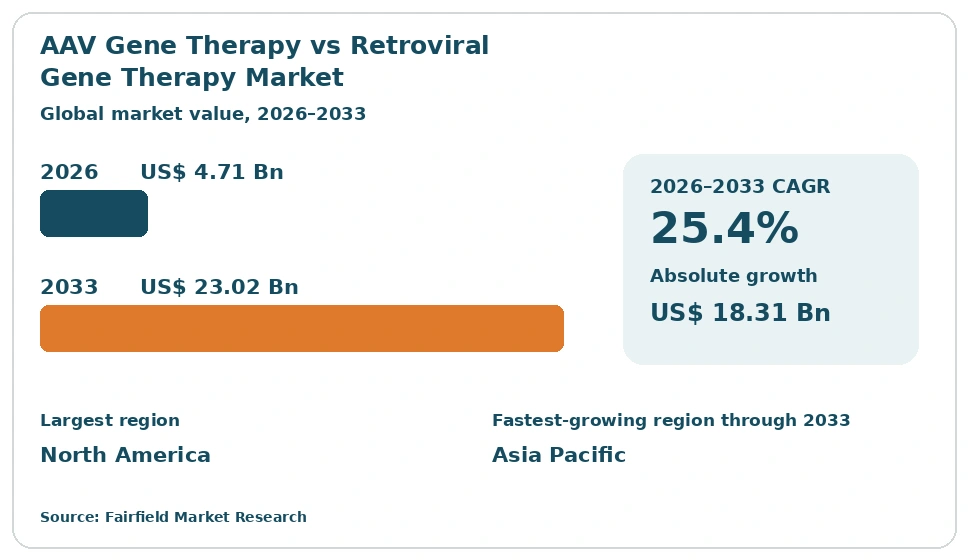
The global AAV gene therapy vs retroviral gene therapy market size is expected to be valued at US$ 4.71 billion in 2026 and projected to reach US$ 23.02 billion by 2033, growing at a CAGR of 25.4% between 2026 and 2033.
Between 2020 and 2025, the market grew at a CAGR of about 25.6%, rising from roughly US$ 1.2 billion to about US$ 3.76 billion, as approved one-time gene therapies for spinal muscular atrophy, Duchenne muscular dystrophy, hemophilia, inherited blindness, and rare blood and metabolic disorders reached more patients, even though several programs faced safety setbacks and slow uptake. This AAV gene therapy vs retroviral gene therapy market compares two main ways of delivering genes. Adeno-associated virus (AAV) vectors are given directly into the body, carry genes into cells such as muscle, liver, eye, and nerve cells, and mostly do not join the patient’s DNA. Retroviral vectors, including gamma-retroviral and lentiviral vectors, insert genes permanently into a patient’s own stem cells outside the body, which are then returned. This report excludes CAR-T cell therapies. In September 2026, the FDA approved Fayuvi, an AAV9 gene therapy for Sanfilippo syndrome type A.
Key Report Takeaways
- By Vector Type: AAV Vectors held about 92% share in 2025, while Lentiviral Vectors are projected to expand at a 26.0% CAGR through 2033, driven by approvals for sickle cell disease, beta-thalassemia, and metachromatic leukodystrophy, and early work on in-vivo lentiviral delivery.
- By Therapeutic Area: Neuromuscular Disorders held about 45% share in 2025, while Hematologic Disorders are projected to expand at a 29.5% CAGR through 2033, driven by one-time treatments for hemophilia, sickle cell disease, and beta-thalassemia that reduce lifelong treatment costs.
- By Route of Administration: Intravenous held about 68% share in 2025, while Central Nervous System Delivery is projected to expand at a 31.0% CAGR through 2033, driven by intrathecal and intracerebral gene therapies for rare brain diseases.
- By Region: North America held about 55% share in 2025, while Asia Pacific is projected to expand at a 28.0% CAGR through 2033, driven by fast-growing gene therapy research, new approvals, and manufacturing investment in China, Japan, and South Korea.
Global AAV Gene Therapy vs Retroviral Gene Therapy Market Trends and Insights
Drivers Impact Analysis
Two drivers carry the strongest influence on AAV gene therapy vs retroviral gene therapy market demand during the forecast period.
| Driver | Impact on CAGR Forecast | Geographic Relevance | Impact Timeline |
| Growing pipeline and approvals for rare diseases | High | North America, Europe, Asia Pacific | Long term (≥4 years) |
| Regulatory incentives and value of one-time cures | Medium | North America, Europe | Medium term (2-4 years) |
Rare Disease Approvals Are Driving the AAV Gene Therapy vs Retroviral Gene Therapy Market
A growing pipeline and approvals for rare diseases are the strongest driver of the AAV gene therapy vs retroviral gene therapy market. Many inherited diseases are caused by a single faulty gene.
The mechanism is that one-time gene therapies can correct or replace faulty genes and provide long-lasting benefit. AAV therapies such as Novartis’s Zolgensma for spinal muscular atrophy, Roche’s Luxturna for inherited blindness, CSL Behring’s Hemgenix for hemophilia B, and Sarepta Therapeutics’ Elevidys for Duchenne muscular dystrophy have reached patients, and new approvals such as Fayuvi in 2026 add more diseases. Lentiviral therapies from bluebird bio and Orchard Therapeutics treat beta-thalassemia, sickle cell disease, cerebral adrenoleukodystrophy, and metachromatic leukodystrophy. Hundreds of programs are in clinical trials for eye, brain, muscle, liver, and blood diseases. Each approval can command very high prices. These trends support strong long-term growth.
Regulatory Incentives Are Expanding the AAV Gene Therapy vs Retroviral Gene Therapy Market
Regulatory incentives and the value of one-time cures are expanding the AAV gene therapy vs retroviral gene therapy market. Regulators are helping rare disease therapies move faster.
The cause is that agencies such as the FDA and the European Medicines Agency offer orphan drug status, breakthrough and regenerative medicine designations, priority review, and accelerated approval for gene therapies that address serious unmet needs. The FDA is also creating new pathways for very rare diseases and platform technologies, which could speed approvals of similar AAV products. Health systems are testing outcome-based payment deals, where payments depend on whether the therapy keeps working. Because one-time treatments can replace years of costly care, such as hemophilia factor infusions or blood transfusions, payers can see long-term savings. These factors encourage investment and support adoption of approved therapies.
Restraints Impact Analysis
Two restraints limit how quickly the AAV gene therapy vs retroviral gene therapy market grows.
| Restraint | Impact on CAGR Forecast | Geographic Relevance | Impact Timeline |
| Safety concerns and regulatory setbacks | High | Global | Medium term (2-4 years) |
| Very high prices and manufacturing complexity | High | Global | Long term (≥4 years) |
Safety Concerns Slow the AAV Gene Therapy vs Retroviral Gene Therapy Market
Safety concerns and regulatory setbacks slow the AAV gene therapy vs retroviral gene therapy market. Several programs have faced serious problems.
The problem is that high doses of AAV vectors can cause liver injury, immune reactions, and blood clotting problems, and some patients have died after treatment. In November 2025, the FDA added a boxed warning for liver injury to Elevidys and limited its use. In February 2026, the FDA rejected REGENXBIO’s application for its Hunter syndrome gene therapy, and a related trial was placed on hold after a tumor case. Retroviral vectors insert into DNA and carry a risk of cancer, which led to a boxed warning for Skysona. Many patients also have antibodies that block AAV vectors, making them ineligible. These issues slow approvals, reduce uptake, and make investors more cautious.
High Prices Restrict the AAV Gene Therapy vs Retroviral Gene Therapy Market
Very high prices and manufacturing complexity restrict the AAV gene therapy vs retroviral gene therapy market. Many gene therapies cost several million dollars.
The constraint is that one-time therapies are priced from about US$ 2 million to more than US$ 4 million per patient, which strains hospital and insurer budgets and limits access in many countries. Some approved therapies have been withdrawn from Europe because of failed price negotiations. Producing viral vectors is slow, costly, and hard to scale, with low yields and strict quality testing. Retroviral therapies require collecting stem cells, modifying them in specialized facilities, and giving patients strong chemotherapy before infusion, which only a small number of treatment centers can do. Long-term follow-up for many years adds cost. These challenges limit patient numbers and revenue growth.
Market Opportunities
Next-Generation Vectors Open a Fast-Growth Revenue Pool
Next-generation vectors open a fast-growth revenue pool. Better vectors can make gene therapy much safer and more effective for patients.
The opportunity comes from engineered AAV capsids that target specific tissues such as the brain, heart, or muscle more efficiently, allowing lower doses with fewer side effects. Companies are using machine learning to design capsids that cross the blood-brain barrier or avoid existing antibodies. Lentiviral vectors are being developed for direct in-vivo delivery, which could remove the need for stem cell collection and chemotherapy. Improved manufacturing methods, including stable producer cell lines and better purification, can cut costs and raise output. Contract manufacturers are expanding capacity. Companies that bring safer, more efficient vectors and lower-cost production can win partnerships and expand gene therapy to larger diseases.
Larger Indications and New Regions Create a Growth Revenue Pool
Larger indications and new regions create a growth revenue pool. Gene therapy is steadily moving beyond ultra-rare diseases into common conditions.
The opportunity reflects programs targeting more common conditions such as Parkinson’s disease, Huntington’s disease, heart failure, age-related eye disease, and hearing loss, which could reach far more patients than current rare disease therapies. Sickle cell disease affects millions of people worldwide, especially in Middle East & Africa, India, and Latin America, creating a large opportunity if costs fall. China, Japan, and South Korea are building gene therapy industries, with local companies developing AAV and lentiviral products. Saudi Arabia and the United Arab Emirates have approved gene therapies for sickle cell disease. Companies that adapt pricing and delivery for these markets can capture strong growth.
Segment Analysis
By Vector Type: AAV Vectors Lead While Lentiviral Vectors Grow Fastest
AAV Vectors held about 92% share in 2025. AAV therapies are given once by infusion or injection and deliver genes directly to target tissues without joining the patient’s DNA in most cases, which lowers cancer risk. Approved products for spinal muscular atrophy, Duchenne muscular dystrophy, hemophilia, inherited blindness, and metabolic diseases generate most revenue in this market.
Lentiviral Vectors are the fastest-growing vector type, expanding at a 26.0% CAGR through 2033. They insert genes permanently into stem cells, giving lasting effects in blood and immune diseases such as sickle cell disease, beta-thalassemia, and metachromatic leukodystrophy. Gamma-Retroviral Vectors form a small, older segment with few active products. For the market, lentiviral growth widens treatment of blood disorders.
By Therapeutic Area: Neuromuscular Disorders Lead While Hematologic Disorders Grow Fastest
Neuromuscular Disorders held about 45% share in 2025. Spinal muscular atrophy and Duchenne muscular dystrophy therapies, such as Zolgensma and Elevidys, generate large revenue because of high prices and strong demand from families of affected children, although safety concerns have slowed some use. Newborn screening for spinal muscular atrophy helps find patients early, when treatment works best.
Hematologic Disorders are the fastest-growing therapeutic area, expanding at a 29.5% CAGR through 2033. AAV therapies for hemophilia A and B and lentiviral therapies for sickle cell disease and beta-thalassemia offer one-time alternatives to lifelong treatment. Ophthalmology, Metabolic Disorders, Neurological Disorders, and Others form other areas. Hemophilia therapies face competition from long-acting drugs. For the market, hematology growth adds large patient groups.
By Route of Administration: Intravenous Leads While Central Nervous System Delivery Grows Fastest
Intravenous held about 68% share in 2025. Most AAV therapies for muscle, liver, and whole-body diseases, as well as stem cell therapies made with retroviral vectors, are given by infusion into a vein. This route reaches many tissues and is familiar to most treatment centers.
Central Nervous System Delivery is the fastest-growing route, expanding at a 31.0% CAGR through 2033. Intrathecal, intracerebroventricular, and direct brain injections deliver genes to the brain and spinal cord for diseases such as Sanfilippo syndrome, Huntington’s disease, and Parkinson’s disease. Subretinal and Intramuscular routes form other segments, used for eye and muscle diseases. Lower doses are often needed for brain delivery, which can improve safety. For the market, CNS growth opens new indications.
Geography Analysis
Which Region Is Leading the AAV Gene Therapy vs Retroviral Gene Therapy Market?
North America is leading the AAV gene therapy vs retroviral gene therapy market with about 55% share in 2025. The United States has the most approved gene therapies, the largest number of clinical trials, strong venture funding, specialized treatment centers, and payers willing to cover high-cost one-time therapies. Leading companies such as Sarepta Therapeutics, BioMarin Pharmaceutical, Ultragenyx, REGENXBIO, and bluebird bio are based in the region. Canada adds research and treatment centers. Key barriers include safety concerns and pricing pressure. Some families travel long distances to treatment centers. One change shaping the region is closer FDA safety review.
Europe Shapes the AAV Gene Therapy vs Retroviral Gene Therapy Market Through Rare Disease Expertise
Europe is a major AAV gene therapy vs retroviral gene therapy market. Germany, France, Italy, the United Kingdom, and the Netherlands have strong rare disease centers and gene therapy research, and Italy pioneered retroviral gene therapy with Strimvelis. Companies such as uniQure, Orchard Therapeutics, and Genethon are based in the region. However, high prices and tough negotiations have led some therapies to be withdrawn from the market. Key barriers include strict health technology assessments and national budget limits. Some countries now pay in installments linked to patient results. One opportunity is outcome-based payment deals.
Which Region Is Growing Fastest in the AAV Gene Therapy vs Retroviral Gene Therapy Market?
Asia Pacific is the fastest-growing AAV gene therapy vs retroviral gene therapy market, expanding at a 28.0% CAGR through 2033. China has a large number of gene therapy clinical trials and local companies developing AAV therapies for hemophilia, eye disease, and neurological disorders. Japan has a fast approval pathway for regenerative and gene therapies. South Korea and Australia have growing gene therapy research and manufacturing. India has a large sickle cell and thalassemia burden. Key barriers include cost and access. Costs are often lower than in North America. One change shaping the region is local vector manufacturing.
Latin America Grows the AAV Gene Therapy vs Retroviral Gene Therapy Market Through Rare Disease Programs
Latin America is a growing AAV gene therapy vs retroviral gene therapy market. Brazil has approved and reimbursed some gene therapies, including treatments for spinal muscular atrophy, often after court cases brought by patient families. Mexico, Argentina, Colombia, and Chile are developing rare disease programs and joining global clinical trials. Key barriers include very high prices and import rules, limited budgets, and very few qualified treatment centers. Some therapies are provided through early access programs before full approval. Clinical trial sites in Brazil and Argentina are growing. One opportunity is regional treatment centers and managed access programs.
Middle East & Africa Builds the AAV Gene Therapy vs Retroviral Gene Therapy Market Through Genetic Disease Programs
Middle East & Africa is an emerging AAV gene therapy vs retroviral gene therapy market. Saudi Arabia and the United Arab Emirates have high rates of inherited diseases, strong government funding, and early approvals of gene therapies for sickle cell disease and other conditions. Israel has strong gene therapy research. Many parts of the region have large sickle cell populations but limited access. Key barriers include costs and few treatment centers. Newborn screening programs are expanding in Saudi Arabia and the United Arab Emirates. Partnerships with global companies support local access. One opportunity is government-funded gene therapy programs.
Competitive Landscape
The AAV gene therapy vs retroviral gene therapy market is consolidated. Novartis, Sarepta Therapeutics, Roche, BioMarin Pharmaceutical, and CSL Behring are leading players and hold most AAV therapy revenue, while Ultragenyx, REGENXBIO, uniQure, bluebird bio, Orchard Therapeutics, Krystal Biotech, and Astellas Pharma compete strongly. In the retroviral segment, a small number of companies, including bluebird bio and Orchard Therapeutics, which is now part of Kyowa Kirin, market lentiviral stem cell therapies. Hundreds of biotech companies have AAV and lentiviral therapies in clinical development.
Companies compete on clinical benefit, long-term durability, safety, manufacturing quality and cost, regulatory approvals, and the ability to secure reimbursement for very high prices. Control of vector manufacturing is a major advantage, so many companies run their own plants or partner closely with contract manufacturers. Capsid engineering platforms and intellectual property are key assets, and licensing deals between platform companies and large drug makers are common.
Strategic moves show how competition is changing. In March 2024, Orchard Therapeutics won FDA approval for Lenmeldy. In November 2025, Sarepta Therapeutics added a boxed warning to Elevidys, and in February 2026, REGENXBIO received a complete response letter for RGX-121. In September 2026, the FDA approved Ultragenyx’s Fayuvi. These moves show that clinical success is possible, but regulators are demanding stronger safety and efficacy evidence.
Three themes shape vendor strategy. First, companies are developing safer, lower-dose AAV capsids and in-vivo lentiviral delivery. Second, they are investing in manufacturing to cut costs and improve quality. Third, they are pursuing outcome-based pricing and expanding into Asia Pacific and Middle East & Africa.
AAV Gene Therapy vs Retroviral Gene Therapy Market Industry Leaders
- Novartis
- Sarepta Therapeutics
- Roche
- BioMarin Pharmaceutical
- CSL Behring
Recent Industry Developments
- September 2026: The FDA approved Fayuvi (rebisufligene etisparvovec), an AAV9 gene therapy developed by Ultragenyx and the first approved treatment for Sanfilippo syndrome type A - expands AAV use in rare brain diseases in the AAV gene therapy vs retroviral gene therapy market.
- February 2026: REGENXBIO received a complete response letter from the FDA for its RGX-121 AAV gene therapy for Hunter syndrome - shows tighter regulatory scrutiny of surrogate endpoints.
- November 2025: Sarepta Therapeutics added a boxed warning for acute liver injury to Elevidys and narrowed its indication after patient deaths - highlights AAV safety concerns at high doses.
- March 2024: Orchard Therapeutics received FDA approval for Lenmeldy, a lentiviral gene therapy for early-onset metachromatic leukodystrophy - adds a retroviral-class stem cell therapy in North America.
Companies Covered in the Report
- Novartis
- Sarepta Therapeutics
- Roche
- BioMarin Pharmaceutical
- CSL Behring
- Ultragenyx
- REGENXBIO
- uniQure
- bluebird bio
- Orchard Therapeutics
- Krystal Biotech
- Astellas Pharma
AAV Gene Therapy vs Retroviral Gene Therapy Market Report Scope
This report covers the AAV gene therapy vs retroviral gene therapy market, including AAV, lentiviral, and gamma-retroviral vector therapies for neuromuscular, hematologic, ophthalmic, metabolic, and neurological disorders, given by intravenous, central nervous system, subretinal, and intramuscular routes, excluding CAR-T cell therapies. The base year is 2025, and the forecast period runs from 2026 to 2033. All values are expressed in US$ Billion.
| Vector Type | AAV Vectors, Lentiviral Vectors, Gamma-Retroviral Vectors |
| Therapeutic Area | Neuromuscular Disorders, Hematologic Disorders, Ophthalmology, Metabolic Disorders, Neurological Disorders, Others |
| Route of Administration | Intravenous, Central Nervous System Delivery, Subretinal, Intramuscular |
| Regions | North America, Europe, Asia Pacific, Latin America, Middle East & Africa |
1. Executive Summary
1.1 AAV Gene Therapy vs Retroviral Gene Therapy Market Snapshot
1.2 Future Projections
1.3 Key Market Trends
1.4 Regional Snapshot
2. Market Overview
2.1 Market Definition and Report Scope
2.2 Historical Market Trends
2.3 Market Dynamics
2.3.1 Drivers
2.3.1.1 Rare Disease Approvals Are Driving the AAV Gene Therapy vs Retroviral Gene Therapy Market
2.3.1.2 Regulatory Incentives Are Expanding the AAV Gene Therapy vs Retroviral Gene Therapy Market
2.3.2 Restraints
2.3.2.1 Safety Concerns Slow the AAV Gene Therapy vs Retroviral Gene Therapy Market
2.3.2.2 High Prices Restrict the AAV Gene Therapy vs Retroviral Gene Therapy Market
2.3.3 Market Opportunities
2.3.3.1 Next-Generation Vectors Open a Fast-Growth Revenue Pool
2.3.3.2 Larger Indications and New Regions Create a Growth Revenue Pool
3. Global AAV Gene Therapy vs Retroviral Gene Therapy Market Outlook, 2020–2033
3.1 Global AAV Gene Therapy vs Retroviral Gene Therapy Market Outlook, by Vector Type, Value (US$ Billion), 2020–2033
3.1.1 AAV Vectors
3.1.2 Lentiviral Vectors
3.1.3 Gamma-Retroviral Vectors
3.2 Global AAV Gene Therapy vs Retroviral Gene Therapy Market Outlook, by Therapeutic Area, Value (US$ Billion), 2020–2033
3.2.1 Neuromuscular Disorders
3.2.2 Hematologic Disorders
3.2.3 Ophthalmology
3.2.4 Metabolic Disorders
3.2.5 Neurological Disorders
3.2.6 Others
3.3 Global AAV Gene Therapy vs Retroviral Gene Therapy Market Outlook, by Route of Administration, Value (US$ Billion), 2020–2033
3.3.1 Intravenous
3.3.2 Central Nervous System Delivery
3.3.3 Subretinal
3.3.4 Intramuscular
3.4 Global AAV Gene Therapy vs Retroviral Gene Therapy Market Outlook, by Region, Value (US$ Billion), 2020–2033
3.4.1 North America
3.4.2 Europe
3.4.3 Asia Pacific
3.4.4 Latin America
3.4.5 Middle East & Africa
4. North America AAV Gene Therapy vs Retroviral Gene Therapy Market Outlook, 2020–2033
4.1 North America AAV Gene Therapy vs Retroviral Gene Therapy Market Outlook, by Vector Type, Value (US$ Billion), 2020–2033
4.1.1 AAV Vectors
4.1.2 Lentiviral Vectors
4.1.3 Gamma-Retroviral Vectors
4.2 North America AAV Gene Therapy vs Retroviral Gene Therapy Market Outlook, by Therapeutic Area, Value (US$ Billion), 2020–2033
4.2.1 Neuromuscular Disorders
4.2.2 Hematologic Disorders
4.2.3 Ophthalmology
4.2.4 Metabolic Disorders
4.2.5 Neurological Disorders
4.2.6 Others
4.3 North America AAV Gene Therapy vs Retroviral Gene Therapy Market Outlook, by Route of Administration, Value (US$ Billion), 2020–2033
4.3.1 Intravenous
4.3.2 Central Nervous System Delivery
4.3.3 Subretinal
4.3.4 Intramuscular
4.4 North America AAV Gene Therapy vs Retroviral Gene Therapy Market Outlook, by Country, Value (US$ Billion), 2020–2033
4.4.1 United States AAV Gene Therapy vs Retroviral Gene Therapy Market Outlook, by Vector Type, 2020–2033
4.4.2 United States AAV Gene Therapy vs Retroviral Gene Therapy Market Outlook, by Therapeutic Area, 2020–2033
4.4.3 United States AAV Gene Therapy vs Retroviral Gene Therapy Market Outlook, by Route of Administration, 2020–2033
4.4.4 Canada AAV Gene Therapy vs Retroviral Gene Therapy Market Outlook, by Vector Type, 2020–2033
4.4.5 Canada AAV Gene Therapy vs Retroviral Gene Therapy Market Outlook, by Therapeutic Area, 2020–2033
4.4.6 Canada AAV Gene Therapy vs Retroviral Gene Therapy Market Outlook, by Route of Administration, 2020–2033
5. Europe AAV Gene Therapy vs Retroviral Gene Therapy Market Outlook, 2020–2033
5.1 Europe AAV Gene Therapy vs Retroviral Gene Therapy Market Outlook, by Vector Type, Value (US$ Billion), 2020–2033
5.1.1 AAV Vectors
5.1.2 Lentiviral Vectors
5.1.3 Gamma-Retroviral Vectors
5.2 Europe AAV Gene Therapy vs Retroviral Gene Therapy Market Outlook, by Therapeutic Area, Value (US$ Billion), 2020–2033
5.2.1 Neuromuscular Disorders
5.2.2 Hematologic Disorders
5.2.3 Ophthalmology
5.2.4 Metabolic Disorders
5.2.5 Neurological Disorders
5.2.6 Others
5.3 Europe AAV Gene Therapy vs Retroviral Gene Therapy Market Outlook, by Route of Administration, Value (US$ Billion), 2020–2033
5.3.1 Intravenous
5.3.2 Central Nervous System Delivery
5.3.3 Subretinal
5.3.4 Intramuscular
5.4 Europe AAV Gene Therapy vs Retroviral Gene Therapy Market Outlook, by Country, Value (US$ Billion), 2020–2033
5.4.1 Germany AAV Gene Therapy vs Retroviral Gene Therapy Market Outlook, by Vector Type, 2020–2033
5.4.2 Germany AAV Gene Therapy vs Retroviral Gene Therapy Market Outlook, by Therapeutic Area, 2020–2033
5.4.3 Germany AAV Gene Therapy vs Retroviral Gene Therapy Market Outlook, by Route of Administration, 2020–2033
5.4.4 France AAV Gene Therapy vs Retroviral Gene Therapy Market Outlook, by Vector Type, 2020–2033
5.4.5 France AAV Gene Therapy vs Retroviral Gene Therapy Market Outlook, by Therapeutic Area, 2020–2033
5.4.6 France AAV Gene Therapy vs Retroviral Gene Therapy Market Outlook, by Route of Administration, 2020–2033
5.4.7 Italy AAV Gene Therapy vs Retroviral Gene Therapy Market Outlook, by Vector Type, 2020–2033
5.4.8 Italy AAV Gene Therapy vs Retroviral Gene Therapy Market Outlook, by Therapeutic Area, 2020–2033
5.4.9 Italy AAV Gene Therapy vs Retroviral Gene Therapy Market Outlook, by Route of Administration, 2020–2033
5.4.10 United Kingdom AAV Gene Therapy vs Retroviral Gene Therapy Market Outlook, by Vector Type, 2020–2033
5.4.11 United Kingdom AAV Gene Therapy vs Retroviral Gene Therapy Market Outlook, by Therapeutic Area, 2020–2033
5.4.12 United Kingdom AAV Gene Therapy vs Retroviral Gene Therapy Market Outlook, by Route of Administration, 2020–2033
5.4.13 Netherlands AAV Gene Therapy vs Retroviral Gene Therapy Market Outlook, by Vector Type, 2020–2033
5.4.14 Netherlands AAV Gene Therapy vs Retroviral Gene Therapy Market Outlook, by Therapeutic Area, 2020–2033
5.4.15 Netherlands AAV Gene Therapy vs Retroviral Gene Therapy Market Outlook, by Route of Administration, 2020–2033
6. Asia Pacific AAV Gene Therapy vs Retroviral Gene Therapy Market Outlook, 2020–2033
6.1 Asia Pacific AAV Gene Therapy vs Retroviral Gene Therapy Market Outlook, by Vector Type, Value (US$ Billion), 2020–2033
6.1.1 AAV Vectors
6.1.2 Lentiviral Vectors
6.1.3 Gamma-Retroviral Vectors
6.2 Asia Pacific AAV Gene Therapy vs Retroviral Gene Therapy Market Outlook, by Therapeutic Area, Value (US$ Billion), 2020–2033
6.2.1 Neuromuscular Disorders
6.2.2 Hematologic Disorders
6.2.3 Ophthalmology
6.2.4 Metabolic Disorders
6.2.5 Neurological Disorders
6.2.6 Others
6.3 Asia Pacific AAV Gene Therapy vs Retroviral Gene Therapy Market Outlook, by Route of Administration, Value (US$ Billion), 2020–2033
6.3.1 Intravenous
6.3.2 Central Nervous System Delivery
6.3.3 Subretinal
6.3.4 Intramuscular
6.4 Asia Pacific AAV Gene Therapy vs Retroviral Gene Therapy Market Outlook, by Country, Value (US$ Billion), 2020–2033
6.4.1 China AAV Gene Therapy vs Retroviral Gene Therapy Market Outlook, by Vector Type, 2020–2033
6.4.2 China AAV Gene Therapy vs Retroviral Gene Therapy Market Outlook, by Therapeutic Area, 2020–2033
6.4.3 China AAV Gene Therapy vs Retroviral Gene Therapy Market Outlook, by Route of Administration, 2020–2033
6.4.4 Japan AAV Gene Therapy vs Retroviral Gene Therapy Market Outlook, by Vector Type, 2020–2033
6.4.5 Japan AAV Gene Therapy vs Retroviral Gene Therapy Market Outlook, by Therapeutic Area, 2020–2033
6.4.6 Japan AAV Gene Therapy vs Retroviral Gene Therapy Market Outlook, by Route of Administration, 2020–2033
6.4.7 South Korea AAV Gene Therapy vs Retroviral Gene Therapy Market Outlook, by Vector Type, 2020–2033
6.4.8 South Korea AAV Gene Therapy vs Retroviral Gene Therapy Market Outlook, by Therapeutic Area, 2020–2033
6.4.9 South Korea AAV Gene Therapy vs Retroviral Gene Therapy Market Outlook, by Route of Administration, 2020–2033
6.4.10 Australia AAV Gene Therapy vs Retroviral Gene Therapy Market Outlook, by Vector Type, 2020–2033
6.4.11 Australia AAV Gene Therapy vs Retroviral Gene Therapy Market Outlook, by Therapeutic Area, 2020–2033
6.4.12 Australia AAV Gene Therapy vs Retroviral Gene Therapy Market Outlook, by Route of Administration, 2020–2033
6.4.13 India AAV Gene Therapy vs Retroviral Gene Therapy Market Outlook, by Vector Type, 2020–2033
6.4.14 India AAV Gene Therapy vs Retroviral Gene Therapy Market Outlook, by Therapeutic Area, 2020–2033
6.4.15 India AAV Gene Therapy vs Retroviral Gene Therapy Market Outlook, by Route of Administration, 2020–2033
7. Latin America AAV Gene Therapy vs Retroviral Gene Therapy Market Outlook, 2020–2033
7.1 Latin America AAV Gene Therapy vs Retroviral Gene Therapy Market Outlook, by Vector Type, Value (US$ Billion), 2020–2033
7.1.1 AAV Vectors
7.1.2 Lentiviral Vectors
7.1.3 Gamma-Retroviral Vectors
7.2 Latin America AAV Gene Therapy vs Retroviral Gene Therapy Market Outlook, by Therapeutic Area, Value (US$ Billion), 2020–2033
7.2.1 Neuromuscular Disorders
7.2.2 Hematologic Disorders
7.2.3 Ophthalmology
7.2.4 Metabolic Disorders
7.2.5 Neurological Disorders
7.2.6 Others
7.3 Latin America AAV Gene Therapy vs Retroviral Gene Therapy Market Outlook, by Route of Administration, Value (US$ Billion), 2020–2033
7.3.1 Intravenous
7.3.2 Central Nervous System Delivery
7.3.3 Subretinal
7.3.4 Intramuscular
7.4 Latin America AAV Gene Therapy vs Retroviral Gene Therapy Market Outlook, by Country, Value (US$ Billion), 2020–2033
7.4.1 Brazil AAV Gene Therapy vs Retroviral Gene Therapy Market Outlook, by Vector Type, 2020–2033
7.4.2 Brazil AAV Gene Therapy vs Retroviral Gene Therapy Market Outlook, by Therapeutic Area, 2020–2033
7.4.3 Brazil AAV Gene Therapy vs Retroviral Gene Therapy Market Outlook, by Route of Administration, 2020–2033
7.4.4 Mexico AAV Gene Therapy vs Retroviral Gene Therapy Market Outlook, by Vector Type, 2020–2033
7.4.5 Mexico AAV Gene Therapy vs Retroviral Gene Therapy Market Outlook, by Therapeutic Area, 2020–2033
7.4.6 Mexico AAV Gene Therapy vs Retroviral Gene Therapy Market Outlook, by Route of Administration, 2020–2033
7.4.7 Argentina AAV Gene Therapy vs Retroviral Gene Therapy Market Outlook, by Vector Type, 2020–2033
7.4.8 Argentina AAV Gene Therapy vs Retroviral Gene Therapy Market Outlook, by Therapeutic Area, 2020–2033
7.4.9 Argentina AAV Gene Therapy vs Retroviral Gene Therapy Market Outlook, by Route of Administration, 2020–2033
7.4.10 Colombia AAV Gene Therapy vs Retroviral Gene Therapy Market Outlook, by Vector Type, 2020–2033
7.4.11 Colombia AAV Gene Therapy vs Retroviral Gene Therapy Market Outlook, by Therapeutic Area, 2020–2033
7.4.12 Colombia AAV Gene Therapy vs Retroviral Gene Therapy Market Outlook, by Route of Administration, 2020–2033
7.4.13 Chile AAV Gene Therapy vs Retroviral Gene Therapy Market Outlook, by Vector Type, 2020–2033
7.4.14 Chile AAV Gene Therapy vs Retroviral Gene Therapy Market Outlook, by Therapeutic Area, 2020–2033
7.4.15 Chile AAV Gene Therapy vs Retroviral Gene Therapy Market Outlook, by Route of Administration, 2020–2033
8. Middle East & Africa AAV Gene Therapy vs Retroviral Gene Therapy Market Outlook, 2020–2033
8.1 Middle East & Africa AAV Gene Therapy vs Retroviral Gene Therapy Market Outlook, by Vector Type, Value (US$ Billion), 2020–2033
8.1.1 AAV Vectors
8.1.2 Lentiviral Vectors
8.1.3 Gamma-Retroviral Vectors
8.2 Middle East & Africa AAV Gene Therapy vs Retroviral Gene Therapy Market Outlook, by Therapeutic Area, Value (US$ Billion), 2020–2033
8.2.1 Neuromuscular Disorders
8.2.2 Hematologic Disorders
8.2.3 Ophthalmology
8.2.4 Metabolic Disorders
8.2.5 Neurological Disorders
8.2.6 Others
8.3 Middle East & Africa AAV Gene Therapy vs Retroviral Gene Therapy Market Outlook, by Route of Administration, Value (US$ Billion), 2020–2033
8.3.1 Intravenous
8.3.2 Central Nervous System Delivery
8.3.3 Subretinal
8.3.4 Intramuscular
8.4 Middle East & Africa AAV Gene Therapy vs Retroviral Gene Therapy Market Outlook, by Country, Value (US$ Billion), 2020–2033
8.4.1 Saudi Arabia AAV Gene Therapy vs Retroviral Gene Therapy Market Outlook, by Vector Type, 2020–2033
8.4.2 Saudi Arabia AAV Gene Therapy vs Retroviral Gene Therapy Market Outlook, by Therapeutic Area, 2020–2033
8.4.3 Saudi Arabia AAV Gene Therapy vs Retroviral Gene Therapy Market Outlook, by Route of Administration, 2020–2033
8.4.4 United Arab Emirates AAV Gene Therapy vs Retroviral Gene Therapy Market Outlook, by Vector Type, 2020–2033
8.4.5 United Arab Emirates AAV Gene Therapy vs Retroviral Gene Therapy Market Outlook, by Therapeutic Area, 2020–2033
8.4.6 United Arab Emirates AAV Gene Therapy vs Retroviral Gene Therapy Market Outlook, by Route of Administration, 2020–2033
8.4.7 Israel AAV Gene Therapy vs Retroviral Gene Therapy Market Outlook, by Vector Type, 2020–2033
8.4.8 Israel AAV Gene Therapy vs Retroviral Gene Therapy Market Outlook, by Therapeutic Area, 2020–2033
8.4.9 Israel AAV Gene Therapy vs Retroviral Gene Therapy Market Outlook, by Route of Administration, 2020–2033
9. Competitive Landscape
9.1 AAV Gene Therapy vs Retroviral Gene Therapy Market Industry Leaders
9.2 Recent Industry Developments
9.3 Company Profiles
9.3.1 Novartis
9.3.2 Sarepta Therapeutics
9.3.3 Roche
9.3.4 BioMarin Pharmaceutical
9.3.5 CSL Behring
9.3.6 Ultragenyx
9.3.7 REGENXBIO
9.3.8 uniQure
9.3.9 bluebird bio
9.3.10 Orchard Therapeutics
9.3.11 Krystal Biotech
9.3.12 Astellas Pharma
10. Appendix
10.1 Research Methodology
10.2 Report Assumptions
10.3 Acronyms and Abbreviations
| Vector Type | AAV Vectors, Lentiviral Vectors, Gamma-Retroviral Vectors |
| Therapeutic Area | Neuromuscular Disorders, Hematologic Disorders, Ophthalmology, Metabolic Disorders, Neurological Disorders, Others |
| Route of Administration | Intravenous, Central Nervous System Delivery, Subretinal, Intramuscular |
| Regions | North America, Europe, Asia Pacific, Latin America, Middle East & Africa |
Our Research Methodology
Considering the volatility of business today, traditional approaches to strategizing a game plan can be unfruitful if not detrimental. True ambiguity is no way to determine a forecast. A myriad of predetermined factors must be accounted for such as the degree of risk involved, the magnitude of circumstances, as well as conditions or consequences that are not known or unpredictable. To circumvent binary views that cast uncertainty, the application of market research intelligence to strategically posture, move, and enable actionable outcomes is necessary.
View Methodology
Quality Assured
Rigorous Validation Process

Confidentiality Assured
End-to-end Data Security

Custom Research Services
Tailored To Your Objectives
FAQs
The market is valued at US$ 4.71 billion in 2026, led by AAV vectors, neuromuscular disorders, and North America.
The market is projected to reach US$ 23.02 billion by 2033, growing at a 25.4% CAGR and adding US$ 18.31 billion.
Lentiviral vectors are growing fastest at a 26.0% CAGR through 2033, driven by sickle cell, thalassemia, and leukodystrophy approvals.
Asia Pacific is growing fastest at a 28.0% CAGR through 2033, driven by gene therapy research and approvals in China and Japan.
North America holds the largest share at about 55% in 2025, supported by approvals, clinical trials, funding, and treatment centers.
Related Reports
Scaffold Technology Market Size, Share, Insights, Competitive Landscape, and Forecast 2026 to 2033
Explore the scaffold technology market, forecast to reach US$7.24 billion by 2033 at 13.7% CAGR, with insights on types, applications, and regions.
Plant Genotyping Equipment Market Size, Share, Insights, Competitive Landscape, and Forecast 2026 to 2033
Explore the plant genotyping equipment market, forecast to reach US$1,566.6 million by 2033 at 7.5% CAGR, with insights on equipment, uses, and regions.
Pet Noise Anxiety Market Size, Share, Insights, Competitive Landscape, and Forecast 2026 to 2033
Explore the pet noise anxiety market, forecast to reach US$2.38 billion by 2033 at 7.7% CAGR, with insights on products, animals, channels, and regions.
Contrast Media/Contrast Agents Market Size, Share, Insights, Competitive Landscape, and Forecast 2026 to 2033
Explore the contrast media market, projected to reach US$13.96 billion by 2033 at 7.9% CAGR, with insights on types, regions, and leading companies.
Asthma Treatment Market Size, Share, Insights, Competitive Landscape, and Forecast 2026 to 2033
Explore the asthma treatment market outlook for 2026–2033, covering drug classes, devices, distribution channels, patient segments, and regions.
Aesthetic Medicine Market Size, Share, Insights, Competitive Landscape, and Forecast 2026 to 2033
Explore the aesthetic medicine market outlook for 2026–2033, covering products, patient groups, end users, regional trends, and leading companies.