



Plant Genotyping Equipment Market
Plant Genotyping Equipment Market Size, Share, Insights, Competitive Landscape, and Forecast 2026 to 2033
Report Overview
Plant Genotyping Equipment Market Size and Trend Analysis
How Fast Is the Plant Genotyping Equipment Market Growing?
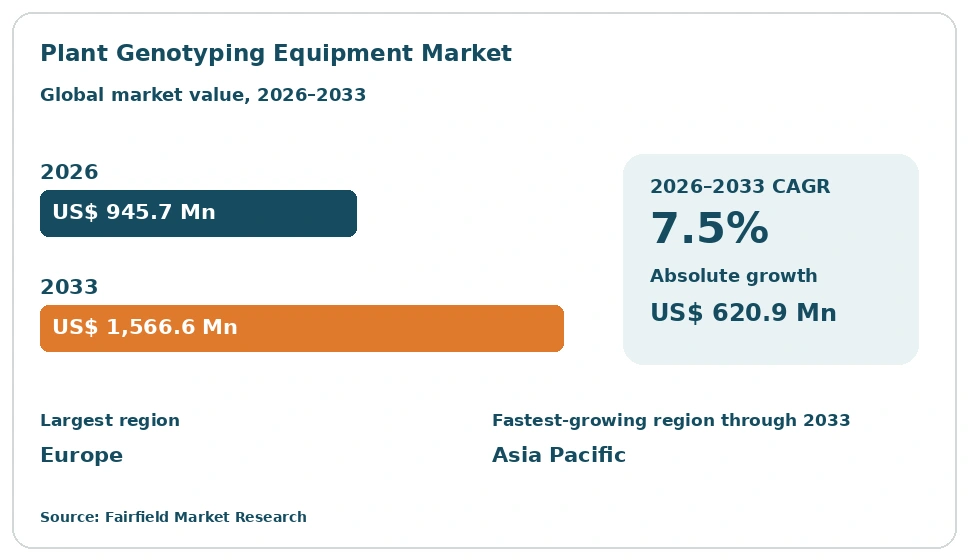
The global plant genotyping equipment market size is expected to be valued at US$ 945.7 million in 2026 and projected to reach US$ 1,566.6 million by 2033, growing at a CAGR of 7.5% between 2026 and 2033.
Between 2020 and 2025, the market grew at a CAGR of about 7.5%, rising from US$ 613.6 million to US$ 879.9 million, as seed companies expanded marker-assisted breeding, sequencing and array costs kept falling, and governments funded crop research to protect food supplies against climate change. The plant genotyping equipment market covers instruments and systems used to read genetic differences in crops and plants, including SNP genotyping arrays and platforms, real-time PCR systems, DNA analyzers and sequencers, liquid handlers, DNA extraction systems, and related software. Breeders use genotyping to select plants with higher yield, disease resistance, drought tolerance, and better quality much faster than traditional field trials alone. Researchers also use it to study plant genomes, check seed purity, and confirm traits. In February 2026, Illumina began co-marketing breeding laboratory software with Breed Bio.
Key Report Takeaways
- By Equipment: SNP Genotyping held about 36.8% share in 2025, while Liquid Handlers are projected to expand at an 8.6% CAGR through 2033, driven by automation of high-throughput breeding labs that process hundreds of thousands to millions of plant samples each year.
- By Application: Breeding held about 41.7% share in 2025, while Product Development is projected to expand at an 8.2% CAGR through 2033, driven by gene editing, trait development, and faster launch of new seed varieties by agricultural biotechnology companies.
- By End User: Research Institutes and Universities held about 42% share in 2025, while Seed and Agricultural Biotechnology Companies are projected to expand at an 8.4% CAGR through 2033, driven by commercial breeding programs.
- By Region: Europe held about 34.2% share in 2025, while Asia Pacific is projected to expand at a 9.2% CAGR through 2033, driven by government crop research programs, food security goals, and growing seed industries in China and India.
Global Plant Genotyping Equipment Market Trends and Insights
Drivers Impact Analysis
Two drivers carry the strongest influence on plant genotyping equipment market demand during the forecast period.
| Driver | Impact on CAGR Forecast | Geographic Relevance | Impact Timeline |
| Food security and climate-resilient crop breeding | High | Global | Long term (≥4 years) |
| Falling genotyping costs and automation | High | North America, Europe, Asia Pacific | Medium term (2-4 years) |
Crop Breeding Needs Are Driving the Plant Genotyping Equipment Market
Food security and climate-resilient crop breeding are the strongest driver of the plant genotyping equipment market. The world needs more food from less land.
The mechanism is that breeders must develop crops that produce higher yields while coping with heat, drought, floods, salty soils, and new pests and diseases. Traditional breeding relies on years of field trials, but genotyping lets breeders test young plants or even seeds for useful genes and keep only the best, saving years of work. Seed companies, public research centers, and international crop institutes now genotype very large numbers of plants every season. Governments in India, China, the United States, and Europe are funding crop genomics programs to protect food supplies. Growing populations and climate change make this work urgent, supporting long-term demand for genotyping instruments and consumables.
Falling Costs Are Expanding the Plant Genotyping Equipment Market
Falling genotyping costs and automation are expanding the plant genotyping equipment market. Testing each sample now costs far less than before.
The cause is steady improvement in technology. The cost of sequencing and high-density SNP arrays has fallen sharply, while new targeted sequencing and genotyping-by-sequencing methods let labs read thousands of markers at low cost. Automated liquid handlers, robotic DNA extraction, and high-throughput PCR systems allow labs to process hundreds of thousands to millions of samples per year with fewer staff. Laboratory information management software tracks samples and delivers results to breeders quickly, as shown by Illumina’s collaboration with Breed Bio. Lower costs make genotyping affordable for smaller seed companies and more crop types, including vegetables, fruits, and minor crops. These trends widen the user base and raise equipment demand.
Restraints Impact Analysis
Two restraints limit how quickly the plant genotyping equipment market grows.
| Restraint | Impact on CAGR Forecast | Geographic Relevance | Impact Timeline |
| High equipment costs and skills shortages | High | Asia Pacific, Latin America, Middle East & Africa | Medium term (2-4 years) |
| Regulatory uncertainty for gene-edited crops | Medium | Europe, Asia Pacific | Long term (≥4 years) |
High Costs Slow the Plant Genotyping Equipment Market
High equipment costs and skills shortages slow the plant genotyping equipment market. Advanced instruments need big budgets and trained staff.
The problem is that sequencers, array scanners, real-time PCR systems, and automated liquid handlers can cost hundreds of thousands of dollars, and labs must also pay for service contracts, consumables, and data storage. Many public research institutes and small seed companies in developing countries cannot afford this equipment. Running genotyping labs and analyzing large data sets requires skilled molecular biologists and bioinformatics experts, who are in short supply. Some organizations choose to send samples to outside service providers rather than buy their own equipment, which reduces instrument sales. Research budgets also depend on government funding, which can change. Import duties raise prices further in some countries. These factors slow equipment adoption, especially in lower-income regions.
Regulatory Uncertainty Restricts the Plant Genotyping Equipment Market
Regulatory uncertainty for gene-edited crops restricts the plant genotyping equipment market. Rules differ widely between countries.
The constraint is that many new breeding programs combine genotyping with gene editing, but countries treat gene-edited crops in very different ways. Some countries, such as the United States, Japan, Argentina, and India, have eased rules for certain edited crops, while others still regulate them like older genetically modified crops. Europe is updating its rules for new genomic techniques, but final approval and implementation take time. Uncertainty about whether edited varieties can be sold makes some companies cautious about investing in large programs. Public concerns about genetic technologies also affect demand in some markets. These issues slow investment in parts of the market and delay commercialization of new varieties.
Market Opportunities
Gene Editing and Trait Development Open a Fast-Growth Revenue Pool
Gene editing and trait development open a fast-growth revenue pool. New breeding tools need genotyping at every step.
The opportunity comes from rapid growth in gene editing tools such as CRISPR, which let scientists make precise changes to plant genes. Every edited plant must be genotyped to confirm the change, check for unwanted effects, and track the trait through breeding generations. Countries such as India, Japan, the United States, and the United Kingdom have created simpler pathways for some edited crops, encouraging investment. Startups and established seed companies are developing crops with better nutrition, longer shelf life, disease resistance, and climate tolerance. Editing programs often test many more plants than older breeding methods. Equipment makers that offer fast, accurate genotyping and integrated software for editing programs can win strong demand from agricultural biotechnology companies.
Emerging Markets and Service Labs Create a Growth Revenue Pool
Emerging markets and genotyping service labs create a growth revenue pool. Many countries are building crop research capacity.
The opportunity reflects strong government and donor investment in crop science in India, China, Brazil, Indonesia, Kenya, Nigeria, and Saudi Arabia. New national research facilities, such as advanced plant phenotyping and genomics centers in India, create demand for genotyping equipment. International crop institutes and regional service labs provide genotyping to many breeders at low cost, and they buy large high-throughput systems. Lower-cost, flexible platforms suited to local crops can open new customer groups. Donor-funded projects often buy equipment for national research centers. Regional training centers help build local skills. Equipment makers that offer training, financing, and local support can build long-term relationships in these fast-growing regions.
Segment Analysis
By Equipment: SNP Genotyping Leads While Liquid Handlers Grow Fastest
SNP Genotyping held about 36.8% share in 2025. Single nucleotide polymorphism platforms, including arrays and targeted assays, read thousands of genetic markers at once and are the main tool for marker-assisted selection and genomic selection in crops such as corn, wheat, rice, and soybean. Their accuracy and low cost per data point make them the largest segment, growing at about 8.1%.
Liquid Handlers are the fastest-growing equipment type, expanding at an 8.6% CAGR through 2033. Automated pipetting systems prepare DNA samples and reactions quickly and accurately, letting labs handle very large sample volumes. Real-time PCR systems, with about 24.3% share, and DNA Analyzers, with about 18.6%, form other segments. For the market, automation growth supports high-throughput breeding.
By Application: Breeding Leads While Product Development Grows Fastest
Breeding held about 41.7% share in 2025. Seed companies and public breeders use genotyping to select parents, test offspring, and speed up the release of improved varieties. Genomic selection and marker-assisted breeding are now standard in major crops, and this segment is growing at about 7.9%.
Product Development is the fastest-growing application, expanding at an 8.2% CAGR through 2033. Agricultural biotechnology companies use genotyping to develop and confirm new traits, including gene-edited varieties, and to prepare regulatory data. Plant Research, with about 30.6% share, and Quality Assessment, with about 11.3%, form other applications. Seed purity and variety identity tests are also growing as seed trade expands. For the market, product development growth supports advanced instruments and high-value consumables.
By End User: Research Institutes and Universities Lead While Seed and Agricultural Biotechnology Companies Grow Fastest
Research Institutes and Universities held about 42% share in 2025. Public research centers, universities, and international crop institutes study plant genomes, develop new breeding methods, and support national breeding programs. Government grants fund much of their equipment, and many institutes share core genotyping facilities across departments and partner organizations. These labs also train the next generation of plant geneticists and breeders.
Seed and Agricultural Biotechnology Companies are the fastest-growing end user, expanding at an 8.4% CAGR through 2033. Commercial breeders run large genotyping labs to develop hybrids and new traits faster, often testing samples from breeding stations in many countries. Vegetable and fruit seed companies are increasing genotyping as costs fall. Contract Research and Testing Laboratories form another segment. Many companies also outsource peak workloads to service labs. For the market, company growth supports high-throughput systems, automation, and software.
Geography Analysis
Which Region Is Leading the Plant Genotyping Equipment Market?
Europe is leading the plant genotyping equipment market with about 34.2% share in 2025. Germany, the Netherlands, France, the United Kingdom, and Belgium host major seed companies, vegetable breeding firms, and plant research institutes that run large genotyping programs. Companies such as LGC and software startups such as Breed Bio are based in the region. The European Union is updating rules on new genomic techniques, which could boost breeding investment. The United Kingdom has created a pathway for precision-bred crops. Key barriers include strict regulation. One change shaping the region is new gene editing rules.
North America Shapes the Plant Genotyping Equipment Market Through Seed Industry Leadership
North America holds about 28.6% of the plant genotyping equipment market. The United States is home to leading seed and biotechnology companies, major equipment makers such as Illumina, Thermo Fisher Scientific, Agilent Technologies, and Bio-Rad Laboratories, and land-grant universities that receive government research funding. Corn and soybean breeding programs genotype very large numbers of samples. Canada has strong canola and wheat research. Key barriers include changing research budgets. Universities across the Midwest run major crop genomics programs. Specialty crop breeders in California also use genotyping widely. One opportunity is automation for large breeding labs.
Which Region Is Growing Fastest in the Plant Genotyping Equipment Market?
Asia Pacific is the fastest-growing plant genotyping equipment market, expanding at a 9.2% CAGR through 2033 from about 24.7% share in 2025. China is investing heavily in seed industry development and crop genomics, while India is building new research facilities, such as the SPROUT facility at the National Institute of Plant Genome Research in New Delhi, and has eased rules for some gene-edited crops. Japan, Australia, and South Korea have strong plant research. Key barriers include costs. International rice and wheat research centers in the region also run large genotyping programs. One change shaping the region is government seed programs.
Latin America Grows the Plant Genotyping Equipment Market Through Large-Scale Agriculture
Latin America holds about 7.1% of the plant genotyping equipment market. Brazil and Argentina are major producers of soybean, corn, sugarcane, and wheat, and they have large seed industries and public research institutes such as Embrapa. Argentina was one of the first countries to create clear rules for gene-edited crops. Mexico, Colombia, and Chile add demand from crop and fruit research. Key barriers include currency swings and limited budgets. Large seed companies run breeding stations across the region to develop varieties for tropical conditions. Growing exports of fruits and grains also raise demand for seed quality testing. One opportunity is genotyping for tropical crops.
Middle East & Africa Builds the Plant Genotyping Equipment Market Through Food Security Programs
Middle East & Africa holds about 5.4% of the plant genotyping equipment market. Saudi Arabia and the United Arab Emirates are investing in crop research for desert agriculture and food security. Kenya, Nigeria, Ethiopia, and South Africa host international crop research centers and national breeding programs for maize, cassava, sorghum, and other staple crops. Key barriers include limited funding, skills shortages, and reliance on imported equipment. Donor groups fund regional genotyping hubs that serve many countries. Training programs are helping build local laboratory skills. Date palm and wheat research are priorities in Saudi Arabia. One opportunity is shared service labs.
Competitive Landscape
The plant genotyping equipment market is moderately consolidated. Illumina, Thermo Fisher Scientific, LGC, Agilent Technologies, and Bio-Rad Laboratories are leading players, while Roche, QIAGEN, PerkinElmer, Standard BioTools, Daicel Corporation, NimaGen, and Hamilton Company compete strongly. The top three suppliers hold roughly half of market revenue, led by Illumina and Thermo Fisher Scientific in arrays and sequencing. Many smaller companies supply PCR reagents, DNA extraction kits, automation, and software.
Companies compete on data quality, throughput, cost per sample, ease of use, flexibility for different crops, and software that turns genetic data into breeding decisions. Instrument makers earn recurring revenue from arrays, reagents, and consumables used with each run, so installed systems create long-term sales. Service and support quality matter because breeding labs work on strict seasonal timelines and cannot afford downtime.
Strategic moves show how competition is changing. In November 2025, the United States Department of Agriculture funded new research projects that support lab equipment demand. In February 2026, Illumina partnered with Breed Bio to connect its arrays with breeding lab software. In September 2026, India opened the SPROUT facility for plant research. These moves show suppliers building complete workflows while governments invest in crop science capacity.
Three themes shape vendor strategy. First, companies are developing lower-cost, higher-throughput genotyping and sequencing solutions for breeders. Second, they are integrating automation and software to manage very large sample volumes. Third, they are expanding in Asia Pacific, Latin America, and Middle East & Africa, where crop research funding is growing.
Plant Genotyping Equipment Market Industry Leaders
- Illumina
- Thermo Fisher Scientific
- LGC
- Agilent Technologies
- Bio-Rad Laboratories
Recent Industry Developments
- September 2026: India inaugurated the SPROUT facility at the National Institute of Plant Genome Research in New Delhi for high-throughput plant phenotyping and precision stress testing - expands crop research capacity linked to the plant genotyping equipment market.
- February 2026: Illumina began a co-marketing collaboration with Breed Bio, whose laboratory software manages microarray genotyping workflows for breeding labs handling up to millions of samples a year - supports high-throughput genotyping automation.
- November 2025: The United States Department of Agriculture’s National Institute of Food and Agriculture awarded US$ 4.4 million to 10 research projects - supports equipment demand at universities and research stations.
Companies Covered in the Report
- Illumina
- Thermo Fisher Scientific
- LGC
- Agilent Technologies
- Bio-Rad Laboratories
- Roche
- QIAGEN
- PerkinElmer
- Standard BioTools
- Daicel Corporation
- NimaGen
- Hamilton Company
Plant Genotyping Equipment Market Report Scope
This report covers the plant genotyping equipment market, including SNP genotyping platforms, real-time PCR systems, DNA analyzers, liquid handlers, and other equipment, used for breeding, plant research, product development, and quality assessment by research institutes and universities, seed and agricultural biotechnology companies, and contract laboratories. The base year is 2025, and the forecast period runs from 2026 to 2033. All values are expressed in US$ Million.
| Equipment | SNP Genotyping, Real-Time PCR, DNA Analyzers, Liquid Handlers, Others |
| Application | Breeding, Plant Research, Product Development, Quality Assessment |
| End User | Research Institutes and Universities, Seed and Agricultural Biotechnology Companies, Contract Research and Testing Laboratories |
| Regions | North America, Europe, Asia Pacific, Latin America, Middle East & Africa |
1. Executive Summary
1.1 Plant Genotyping Equipment Market Snapshot
1.2 Future Projections
1.3 Key Market Trends
1.4 Regional Snapshot
2. Market Overview
2.1 Market Definition and Report Scope
2.2 Historical Market Trends
2.3 Market Dynamics
2.3.1 Drivers
2.3.1.1 Crop Breeding Needs Are Driving the Plant Genotyping Equipment Market
2.3.1.2 Falling Costs Are Expanding the Plant Genotyping Equipment Market
2.3.2 Restraints
2.3.2.1 High Costs Slow the Plant Genotyping Equipment Market
2.3.2.2 Regulatory Uncertainty Restricts the Plant Genotyping Equipment Market
2.3.3 Market Opportunities
2.3.3.1 Gene Editing and Trait Development Open a Fast-Growth Revenue Pool
2.3.3.2 Emerging Markets and Service Labs Create a Growth Revenue Pool
3. Global Plant Genotyping Equipment Market Outlook, 2020–2033
3.1 Global Plant Genotyping Equipment Market Outlook, by Equipment, Value (US$ Million), 2020–2033
3.1.1 SNP Genotyping
3.1.2 Real-Time PCR
3.1.3 DNA Analyzers
3.1.4 Liquid Handlers
3.1.5 Others
3.2 Global Plant Genotyping Equipment Market Outlook, by Application, Value (US$ Million), 2020–2033
3.2.1 Breeding
3.2.2 Plant Research
3.2.3 Product Development
3.2.4 Quality Assessment
3.3 Global Plant Genotyping Equipment Market Outlook, by End User, Value (US$ Million), 2020–2033
3.3.1 Research Institutes and Universities
3.3.2 Seed and Agricultural Biotechnology Companies
3.3.3 Contract Research and Testing Laboratories
3.4 Global Plant Genotyping Equipment Market Outlook, by Region, Value (US$ Million), 2020–2033
3.4.1 North America
3.4.2 Europe
3.4.3 Asia Pacific
3.4.4 Latin America
3.4.5 Middle East & Africa
4. Europe Plant Genotyping Equipment Market Outlook, 2020–2033
4.1 Europe Plant Genotyping Equipment Market Outlook, by Equipment, Value (US$ Million), 2020–2033
4.1.1 SNP Genotyping
4.1.2 Real-Time PCR
4.1.3 DNA Analyzers
4.1.4 Liquid Handlers
4.1.5 Others
4.2 Europe Plant Genotyping Equipment Market Outlook, by Application, Value (US$ Million), 2020–2033
4.2.1 Breeding
4.2.2 Plant Research
4.2.3 Product Development
4.2.4 Quality Assessment
4.3 Europe Plant Genotyping Equipment Market Outlook, by End User, Value (US$ Million), 2020–2033
4.3.1 Research Institutes and Universities
4.3.2 Seed and Agricultural Biotechnology Companies
4.3.3 Contract Research and Testing Laboratories
4.4 Europe Plant Genotyping Equipment Market Outlook, by Country, Value (US$ Million), 2020–2033
4.4.1 Germany Plant Genotyping Equipment Market Outlook, by Equipment, 2020–2033
4.4.2 Germany Plant Genotyping Equipment Market Outlook, by Application, 2020–2033
4.4.3 Germany Plant Genotyping Equipment Market Outlook, by End User, 2020–2033
4.4.4 Netherlands Plant Genotyping Equipment Market Outlook, by Equipment, 2020–2033
4.4.5 Netherlands Plant Genotyping Equipment Market Outlook, by Application, 2020–2033
4.4.6 Netherlands Plant Genotyping Equipment Market Outlook, by End User, 2020–2033
4.4.7 France Plant Genotyping Equipment Market Outlook, by Equipment, 2020–2033
4.4.8 France Plant Genotyping Equipment Market Outlook, by Application, 2020–2033
4.4.9 France Plant Genotyping Equipment Market Outlook, by End User, 2020–2033
4.4.10 United Kingdom Plant Genotyping Equipment Market Outlook, by Equipment, 2020–2033
4.4.11 United Kingdom Plant Genotyping Equipment Market Outlook, by Application, 2020–2033
4.4.12 United Kingdom Plant Genotyping Equipment Market Outlook, by End User, 2020–2033
4.4.13 Belgium Plant Genotyping Equipment Market Outlook, by Equipment, 2020–2033
4.4.14 Belgium Plant Genotyping Equipment Market Outlook, by Application, 2020–2033
4.4.15 Belgium Plant Genotyping Equipment Market Outlook, by End User, 2020–2033
5. North America Plant Genotyping Equipment Market Outlook, 2020–2033
5.1 North America Plant Genotyping Equipment Market Outlook, by Equipment, Value (US$ Million), 2020–2033
5.1.1 SNP Genotyping
5.1.2 Real-Time PCR
5.1.3 DNA Analyzers
5.1.4 Liquid Handlers
5.1.5 Others
5.2 North America Plant Genotyping Equipment Market Outlook, by Application, Value (US$ Million), 2020–2033
5.2.1 Breeding
5.2.2 Plant Research
5.2.3 Product Development
5.2.4 Quality Assessment
5.3 North America Plant Genotyping Equipment Market Outlook, by End User, Value (US$ Million), 2020–2033
5.3.1 Research Institutes and Universities
5.3.2 Seed and Agricultural Biotechnology Companies
5.3.3 Contract Research and Testing Laboratories
5.4 North America Plant Genotyping Equipment Market Outlook, by Country, Value (US$ Million), 2020–2033
5.4.1 United States Plant Genotyping Equipment Market Outlook, by Equipment, 2020–2033
5.4.2 United States Plant Genotyping Equipment Market Outlook, by Application, 2020–2033
5.4.3 United States Plant Genotyping Equipment Market Outlook, by End User, 2020–2033
5.4.4 Canada Plant Genotyping Equipment Market Outlook, by Equipment, 2020–2033
5.4.5 Canada Plant Genotyping Equipment Market Outlook, by Application, 2020–2033
5.4.6 Canada Plant Genotyping Equipment Market Outlook, by End User, 2020–2033
6. Asia Pacific Plant Genotyping Equipment Market Outlook, 2020–2033
6.1 Asia Pacific Plant Genotyping Equipment Market Outlook, by Equipment, Value (US$ Million), 2020–2033
6.1.1 SNP Genotyping
6.1.2 Real-Time PCR
6.1.3 DNA Analyzers
6.1.4 Liquid Handlers
6.1.5 Others
6.2 Asia Pacific Plant Genotyping Equipment Market Outlook, by Application, Value (US$ Million), 2020–2033
6.2.1 Breeding
6.2.2 Plant Research
6.2.3 Product Development
6.2.4 Quality Assessment
6.3 Asia Pacific Plant Genotyping Equipment Market Outlook, by End User, Value (US$ Million), 2020–2033
6.3.1 Research Institutes and Universities
6.3.2 Seed and Agricultural Biotechnology Companies
6.3.3 Contract Research and Testing Laboratories
6.4 Asia Pacific Plant Genotyping Equipment Market Outlook, by Country, Value (US$ Million), 2020–2033
6.4.1 China Plant Genotyping Equipment Market Outlook, by Equipment, 2020–2033
6.4.2 China Plant Genotyping Equipment Market Outlook, by Application, 2020–2033
6.4.3 China Plant Genotyping Equipment Market Outlook, by End User, 2020–2033
6.4.4 India Plant Genotyping Equipment Market Outlook, by Equipment, 2020–2033
6.4.5 India Plant Genotyping Equipment Market Outlook, by Application, 2020–2033
6.4.6 India Plant Genotyping Equipment Market Outlook, by End User, 2020–2033
6.4.7 Japan Plant Genotyping Equipment Market Outlook, by Equipment, 2020–2033
6.4.8 Japan Plant Genotyping Equipment Market Outlook, by Application, 2020–2033
6.4.9 Japan Plant Genotyping Equipment Market Outlook, by End User, 2020–2033
6.4.10 Australia Plant Genotyping Equipment Market Outlook, by Equipment, 2020–2033
6.4.11 Australia Plant Genotyping Equipment Market Outlook, by Application, 2020–2033
6.4.12 Australia Plant Genotyping Equipment Market Outlook, by End User, 2020–2033
6.4.13 South Korea Plant Genotyping Equipment Market Outlook, by Equipment, 2020–2033
6.4.14 South Korea Plant Genotyping Equipment Market Outlook, by Application, 2020–2033
6.4.15 South Korea Plant Genotyping Equipment Market Outlook, by End User, 2020–2033
7. Latin America Plant Genotyping Equipment Market Outlook, 2020–2033
7.1 Latin America Plant Genotyping Equipment Market Outlook, by Equipment, Value (US$ Million), 2020–2033
7.1.1 SNP Genotyping
7.1.2 Real-Time PCR
7.1.3 DNA Analyzers
7.1.4 Liquid Handlers
7.1.5 Others
7.2 Latin America Plant Genotyping Equipment Market Outlook, by Application, Value (US$ Million), 2020–2033
7.2.1 Breeding
7.2.2 Plant Research
7.2.3 Product Development
7.2.4 Quality Assessment
7.3 Latin America Plant Genotyping Equipment Market Outlook, by End User, Value (US$ Million), 2020–2033
7.3.1 Research Institutes and Universities
7.3.2 Seed and Agricultural Biotechnology Companies
7.3.3 Contract Research and Testing Laboratories
7.4 Latin America Plant Genotyping Equipment Market Outlook, by Country, Value (US$ Million), 2020–2033
7.4.1 Brazil Plant Genotyping Equipment Market Outlook, by Equipment, 2020–2033
7.4.2 Brazil Plant Genotyping Equipment Market Outlook, by Application, 2020–2033
7.4.3 Brazil Plant Genotyping Equipment Market Outlook, by End User, 2020–2033
7.4.4 Argentina Plant Genotyping Equipment Market Outlook, by Equipment, 2020–2033
7.4.5 Argentina Plant Genotyping Equipment Market Outlook, by Application, 2020–2033
7.4.6 Argentina Plant Genotyping Equipment Market Outlook, by End User, 2020–2033
7.4.7 Mexico Plant Genotyping Equipment Market Outlook, by Equipment, 2020–2033
7.4.8 Mexico Plant Genotyping Equipment Market Outlook, by Application, 2020–2033
7.4.9 Mexico Plant Genotyping Equipment Market Outlook, by End User, 2020–2033
7.4.10 Colombia Plant Genotyping Equipment Market Outlook, by Equipment, 2020–2033
7.4.11 Colombia Plant Genotyping Equipment Market Outlook, by Application, 2020–2033
7.4.12 Colombia Plant Genotyping Equipment Market Outlook, by End User, 2020–2033
7.4.13 Chile Plant Genotyping Equipment Market Outlook, by Equipment, 2020–2033
7.4.14 Chile Plant Genotyping Equipment Market Outlook, by Application, 2020–2033
7.4.15 Chile Plant Genotyping Equipment Market Outlook, by End User, 2020–2033
8. Middle East & Africa Plant Genotyping Equipment Market Outlook, 2020–2033
8.1 Middle East & Africa Plant Genotyping Equipment Market Outlook, by Equipment, Value (US$ Million), 2020–2033
8.1.1 SNP Genotyping
8.1.2 Real-Time PCR
8.1.3 DNA Analyzers
8.1.4 Liquid Handlers
8.1.5 Others
8.2 Middle East & Africa Plant Genotyping Equipment Market Outlook, by Application, Value (US$ Million), 2020–2033
8.2.1 Breeding
8.2.2 Plant Research
8.2.3 Product Development
8.2.4 Quality Assessment
8.3 Middle East & Africa Plant Genotyping Equipment Market Outlook, by End User, Value (US$ Million), 2020–2033
8.3.1 Research Institutes and Universities
8.3.2 Seed and Agricultural Biotechnology Companies
8.3.3 Contract Research and Testing Laboratories
8.4 Middle East & Africa Plant Genotyping Equipment Market Outlook, by Country, Value (US$ Million), 2020–2033
8.4.1 Saudi Arabia Plant Genotyping Equipment Market Outlook, by Equipment, 2020–2033
8.4.2 Saudi Arabia Plant Genotyping Equipment Market Outlook, by Application, 2020–2033
8.4.3 Saudi Arabia Plant Genotyping Equipment Market Outlook, by End User, 2020–2033
8.4.4 United Arab Emirates Plant Genotyping Equipment Market Outlook, by Equipment, 2020–2033
8.4.5 United Arab Emirates Plant Genotyping Equipment Market Outlook, by Application, 2020–2033
8.4.6 United Arab Emirates Plant Genotyping Equipment Market Outlook, by End User, 2020–2033
8.4.7 Kenya Plant Genotyping Equipment Market Outlook, by Equipment, 2020–2033
8.4.8 Kenya Plant Genotyping Equipment Market Outlook, by Application, 2020–2033
8.4.9 Kenya Plant Genotyping Equipment Market Outlook, by End User, 2020–2033
8.4.10 Nigeria Plant Genotyping Equipment Market Outlook, by Equipment, 2020–2033
8.4.11 Nigeria Plant Genotyping Equipment Market Outlook, by Application, 2020–2033
8.4.12 Nigeria Plant Genotyping Equipment Market Outlook, by End User, 2020–2033
8.4.13 Ethiopia Plant Genotyping Equipment Market Outlook, by Equipment, 2020–2033
8.4.14 Ethiopia Plant Genotyping Equipment Market Outlook, by Application, 2020–2033
8.4.15 Ethiopia Plant Genotyping Equipment Market Outlook, by End User, 2020–2033
8.4.16 South Africa Plant Genotyping Equipment Market Outlook, by Equipment, 2020–2033
8.4.17 South Africa Plant Genotyping Equipment Market Outlook, by Application, 2020–2033
8.4.18 South Africa Plant Genotyping Equipment Market Outlook, by End User, 2020–2033
9. Competitive Landscape
9.1 Plant Genotyping Equipment Market Industry Leaders
9.2 Recent Industry Developments
9.3 Company Profiles
9.3.1 Illumina
9.3.2 Thermo Fisher Scientific
9.3.3 LGC
9.3.4 Agilent Technologies
9.3.5 Bio-Rad Laboratories
9.3.6 Roche
9.3.7 QIAGEN
9.3.8 PerkinElmer
9.3.9 Standard BioTools
9.3.10 Daicel Corporation
9.3.11 NimaGen
9.3.12 Hamilton Company
10. Appendix
10.1 Research Methodology
10.2 Report Assumptions
10.3 Acronyms and Abbreviations
| Equipment | SNP Genotyping, Real-Time PCR, DNA Analyzers, Liquid Handlers, Others |
| Application | Breeding, Plant Research, Product Development, Quality Assessment |
| End User | Research Institutes and Universities, Seed and Agricultural Biotechnology Companies, Contract Research and Testing Laboratories |
| Regions | North America, Europe, Asia Pacific, Latin America, Middle East & Africa |
Our Research Methodology
Considering the volatility of business today, traditional approaches to strategizing a game plan can be unfruitful if not detrimental. True ambiguity is no way to determine a forecast. A myriad of predetermined factors must be accounted for such as the degree of risk involved, the magnitude of circumstances, as well as conditions or consequences that are not known or unpredictable. To circumvent binary views that cast uncertainty, the application of market research intelligence to strategically posture, move, and enable actionable outcomes is necessary.
View Methodology
Quality Assured
Rigorous Validation Process

Confidentiality Assured
End-to-end Data Security

Custom Research Services
Tailored To Your Objectives
FAQs
The plant genotyping equipment market is valued at US$ 945.7 million in 2026, led by SNP genotyping, breeding, and Europe.
The market is projected to reach US$ 1,566.6 million by 2033, growing at a 7.5% CAGR and adding US$ 620.9 million.
Liquid handlers are growing fastest at an 8.6% CAGR through 2033, driven by automation in high-throughput breeding laboratories worldwide.
Asia Pacific is growing fastest at a 9.2% CAGR through 2033, driven by crop research programs and seed industries in China and India.
Europe holds the largest share at about 34.2% in 2025, supported by major seed companies, breeding firms, and research institutes.
Related Reports
Scaffold Technology Market Size, Share, Insights, Competitive Landscape, and Forecast 2026 to 2033
Explore the scaffold technology market, forecast to reach US$7.24 billion by 2033 at 13.7% CAGR, with insights on types, applications, and regions.
Pet Noise Anxiety Market Size, Share, Insights, Competitive Landscape, and Forecast 2026 to 2033
Explore the pet noise anxiety market, forecast to reach US$2.38 billion by 2033 at 7.7% CAGR, with insights on products, animals, channels, and regions.
Contrast Media/Contrast Agents Market Size, Share, Insights, Competitive Landscape, and Forecast 2026 to 2033
Explore the contrast media market, projected to reach US$13.96 billion by 2033 at 7.9% CAGR, with insights on types, regions, and leading companies.
Asthma Treatment Market Size, Share, Insights, Competitive Landscape, and Forecast 2026 to 2033
Explore the asthma treatment market outlook for 2026–2033, covering drug classes, devices, distribution channels, patient segments, and regions.
Aesthetic Medicine Market Size, Share, Insights, Competitive Landscape, and Forecast 2026 to 2033
Explore the aesthetic medicine market outlook for 2026–2033, covering products, patient groups, end users, regional trends, and leading companies.
Kidney Dialysis Centres Market Size, Share, Insights, Competitive Landscape, and Forecast 2026 to 2033
Explore the kidney dialysis centres market outlook for 2026–2033, covering dialysis types, service settings, centre types, regions, and key companies.