



Scaffold Technology Market
Scaffold Technology Market Size, Share, Insights, Competitive Landscape, and Forecast 2026 to 2033
Report Overview
Scaffold Technology Market Size and Trend Analysis
How Fast Is the Scaffold Technology Market Growing?
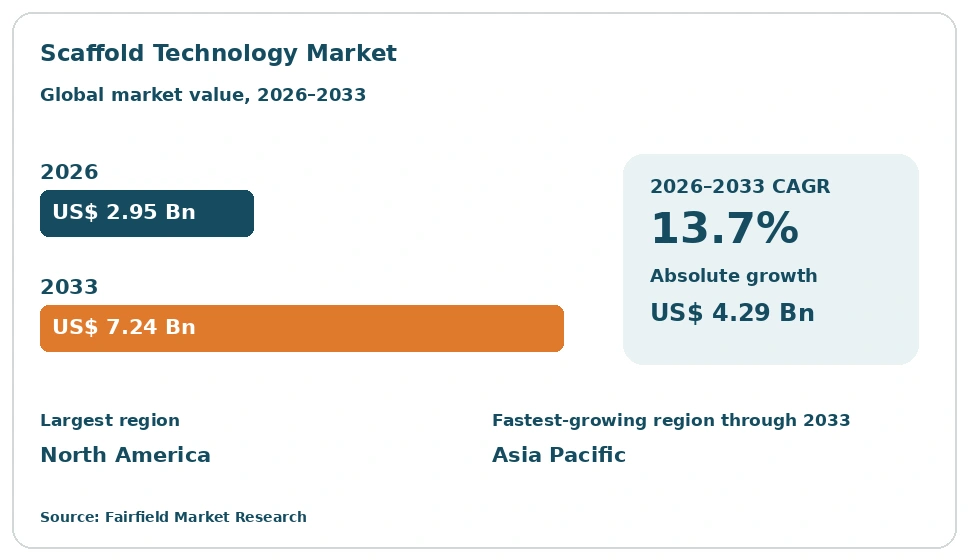
The global scaffold technology market size is expected to be valued at US$ 2.95 billion in 2026 and projected to reach US$ 7.24 billion by 2033, growing at a CAGR of 13.7% between 2026 and 2033.
Between 2020 and 2025, the market grew at a CAGR of about 13.5%, rising from roughly US$ 1.35 billion to US$ 2.54 billion, as drug makers shifted from flat cell cultures to three-dimensional models, stem cell and regenerative medicine research received strong funding, and regulators began accepting animal-free testing methods. The scaffold technology market covers three-dimensional structures that support cell growth, attachment, and tissue formation, including hydrogels, polymeric scaffolds, nanofiber-based scaffolds, and micropatterned surface microplates. Scaffolds mimic the natural support network around cells, called the extracellular matrix, so cells behave more like they do in the body. They are used in 3D cell culture, organoid research, drug discovery, toxicology testing, tissue engineering, and regenerative therapies that repair cartilage, bone, skin, and nerves. In February 2026, Bio-Techne launched a fully synthetic hydrogel for organoid culture.
Key Report Takeaways
- By Type: Hydrogels held about 35.8% share in 2025, while Nanofiber-Based Scaffolds are projected to expand at a 15.2% CAGR through 2033, driven by their close resemblance to natural tissue structure and growing use in nerve, bone, skin, and cardiovascular tissue engineering.
- By Application: Stem Cell Research and Tissue Engineering held about 41.3% share in 2025, while Drug Discovery is projected to expand at a 14.8% CAGR through 2033, driven by demand for predictive 3D and organoid models and regulatory support for animal-free testing methods.
- By End User: Biotechnology and Pharmaceutical Companies held about 45% share in 2025, while Hospitals and Clinics are projected to expand at a 14.6% CAGR through 2033, driven by scaffold-based cartilage, wound, and bone repair products.
- By Region: North America held about 39% share in 2025, while Asia Pacific is projected to expand at a 14.0% CAGR through 2033, driven by growing biotech industries, stem cell research funding, and contract research services in China, Japan, and South Korea.
Global Scaffold Technology Market Trends and Insights
Drivers Impact Analysis
Two drivers carry the strongest influence on scaffold technology market demand during the forecast period.
| Driver | Impact on CAGR Forecast | Geographic Relevance | Impact Timeline |
| Shift to 3D cell culture and animal-free testing | High | North America, Europe, Asia Pacific | Long term (≥4 years) |
| Growth of regenerative medicine and tissue engineering | High | Global | Medium term (2-4 years) |
3D Cell Culture Is Driving the Scaffold Technology Market
The shift to 3D cell culture and animal-free testing is the strongest driver of the scaffold technology market. Researchers want models that behave like real tissue.
The mechanism is that cells grown flat on plastic dishes often behave very differently from cells in the human body, which leads to failed drug candidates and costly late-stage trial failures. Scaffolds let cells grow in three dimensions, forming spheroids, organoids, and tissue-like structures that better predict how drugs will work and whether they are toxic. Regulators are encouraging this shift, with the FDA Modernization Act 2.0 removing the requirement for animal testing before human trials and agencies promoting new approach methodologies. Drug makers are adopting organoid and 3D models for cancer, liver, kidney, and brain research. Companies such as Merck KGaA, Corning, and Bio-Techne are expanding 3D culture portfolios. These trends support strong long-term growth.
Regenerative Medicine Is Expanding the Scaffold Technology Market
Growth of regenerative medicine and tissue engineering is expanding the scaffold technology market. Scaffolds help the body rebuild damaged tissue.
The cause is rising demand for treatments that repair or replace damaged cartilage, bone, skin, blood vessels, nerves, and heart tissue. Aging populations, sports injuries, diabetes-related wounds, and trauma create many patients who could benefit. Scaffolds made from collagen, synthetic polymers, ceramics, and natural materials provide a framework for cells to grow into new tissue. Products such as Vericel’s MACI, an autologous cell scaffold for knee cartilage repair, show commercial success, and Vericel won FDA approval for a new manufacturing facility in 2026. 3D bioprinting allows custom scaffolds shaped to each patient. Funding for stem cell and regenerative medicine research remains strong. These trends raise demand for clinical-grade scaffolds.
Restraints Impact Analysis
Two restraints limit how quickly the scaffold technology market grows.
| Restraint | Impact on CAGR Forecast | Geographic Relevance | Impact Timeline |
| High costs and reproducibility challenges | High | Global | Medium term (2-4 years) |
| Complex regulatory pathways for clinical products | Medium | North America, Europe | Long term (≥4 years) |
High Costs Slow the Scaffold Technology Market
High costs and reproducibility challenges slow the scaffold technology market. Advanced scaffolds are expensive and hard to standardize.
The problem is that 3D culture systems, specialized hydrogels, and engineered scaffolds cost much more than traditional plastic dishes, and they often need special equipment, imaging systems, and trained staff. Many natural matrices, such as those extracted from animal tumors, vary from batch to batch, making results hard to repeat between labs. Scaling 3D models for high-throughput drug screening is also difficult, and analyzing thick 3D samples takes more time. Smaller research labs and companies in developing countries may not afford these tools. Standard methods for building and testing scaffolds are still being developed. These factors slow adoption, especially for routine screening, and push buyers toward lower-cost, defined synthetic products.
Regulatory Complexity Restricts the Scaffold Technology Market
Complex regulatory pathways for clinical products restrict the scaffold technology market. Bringing scaffold therapies to patients takes years.
The constraint is that scaffolds used in patients, especially those combined with living cells, are regulated as medical devices, biologics, or combination products, each with strict requirements for safety, sterility, and clinical evidence. Approval can take many years and cost large amounts of money, and rules differ between the United States, Europe, Japan, and other markets. Manufacturing living cell products at large scale under good manufacturing practice is difficult and expensive. Reimbursement for new regenerative therapies is often uncertain, limiting hospital adoption. Long-term safety data are also needed. Small companies often lack the money to complete large clinical trials. These hurdles slow the move of promising scaffold technologies from the laboratory into routine clinical use.
Market Opportunities
Organoids and Synthetic Matrices Open a Fast-Growth Revenue Pool
Organoids and synthetic matrices open a fast-growth revenue pool. Drug developers want reliable human-relevant models.
The opportunity comes from rapid growth in organoid research, where stem cells grow into mini-organs that mimic the gut, liver, kidney, lung, and brain. These models need high-quality scaffolds and matrices. Fully defined synthetic hydrogels, such as Bio-Techne’s Cultrex Synthetic Hydrogel launched in 2026, reduce batch variation and avoid animal-derived materials. Merck KGaA acquired organoid company HUB Organoids to expand its 3D portfolio. Patient-derived organoids also support personalized cancer treatment selection. Artificial intelligence and lab automation help analyze 3D models at scale. Biobanks of patient organoids are also growing. Companies that offer reproducible matrices, ready-to-use kits, and organoid services can win long-term contracts with pharmaceutical companies and research institutes.
Clinical Regenerative Products Create a Growth Revenue Pool
Clinical regenerative products create a growth revenue pool. Scaffold-based therapies are reaching more patients.
The opportunity reflects growing use of scaffolds in orthopedic, wound care, dental, cardiovascular, and nerve repair products. Collagen and synthetic scaffolds help heal chronic wounds and burns, while bone graft substitutes and cartilage repair products treat injuries and joint damage. 3D printing enables custom implants for complex bone defects. Hospitals in North America, Europe, Japan, and South Korea are adopting these products as evidence grows. Japan has a fast approval pathway for regenerative products. Dental and spinal surgery also use scaffold-based bone grafts widely. Veterinary medicine is another emerging use. Companies that build strong clinical data, manufacturing capacity, and reimbursement support can grow quickly in this high-value segment and earn strong margins.
Segment Analysis
By Type: Hydrogels Lead While Nanofiber-Based Scaffolds Grow Fastest
Hydrogels held about 35.8% share in 2025. These water-rich gels made from natural materials such as collagen, gelatin, and basement membrane extracts, or from synthetic polymers, closely mimic the soft environment around cells. They are widely used in organoid culture, 3D cell culture, drug screening, and wound healing, and they are easy to handle in labs.
Nanofiber-Based Scaffolds are the fastest-growing type, expanding at a 15.2% CAGR through 2033. Made by electrospinning and other methods, they copy the fibrous structure of natural tissue and support cell alignment and growth in nerve, bone, skin, and blood vessel engineering. Polymeric Scaffolds and Micropatterned Surface Microplates form other segments. For the market, nanofiber growth supports advanced tissue engineering.
By Application: Stem Cell Research and Tissue Engineering Lead While Drug Discovery Grows Fastest
Stem Cell Research and Tissue Engineering held about 41.3% share in 2025. Scientists use scaffolds to grow, expand, and guide stem cells into specific tissues and to build engineered tissues for research and therapy. Strong government and private research funding supports this large share across universities and biotech companies.
Drug Discovery is the fastest-growing application, expanding at a 14.8% CAGR through 2033. Pharmaceutical companies use scaffold-based 3D models and organoids to test drug effectiveness and toxicity earlier, reducing late-stage failures and animal testing. Regenerative Medicine and Cancer Research form other applications. Contract research organizations also offer 3D model testing as a service. For the market, drug discovery growth brings high-volume, repeat purchases and long-term supply agreements with drug makers.
By End User: Biotechnology and Pharmaceutical Companies Lead While Hospitals and Clinics Grow Fastest
Biotechnology and Pharmaceutical Companies held about 45% share in 2025. They use scaffolds for drug screening, toxicology, disease modeling, and development of cell and tissue therapies, and they buy large volumes of 3D culture products. Contract research organizations also serve these companies. Large drug makers often run dedicated 3D biology teams and buy scaffolds in bulk under supply contracts.
Hospitals and Clinics are the fastest-growing end user, expanding at a 14.6% CAGR through 2033. They use scaffold-based products for cartilage repair, wound healing, bone grafting, and reconstructive surgery as more products gain approval. Research Laboratories and Academic Institutes form another large segment. Surgeons increasingly use scaffold-based products in sports medicine and plastic surgery. For the market, hospital growth reflects clinical adoption and supports higher-value, regulated products.
Geography Analysis
Which Region Is Leading the Scaffold Technology Market?
North America is leading the scaffold technology market with about 39% share in 2025. The United States has the largest pharmaceutical and biotech industry, strong funding from the National Institutes of Health, many university research centers, and leading suppliers such as Thermo Fisher Scientific, Corning, Becton Dickinson, Bio-Techne, and Vericel. The FDA Modernization Act 2.0 encourages animal-free testing with 3D models. Canada has strong regenerative medicine research. Key barriers include high costs. Venture funding for regenerative medicine startups remains strong. One change shaping the region is fast adoption of organoid-based drug testing.
Europe Shapes the Scaffold Technology Market Through Research and Animal-Free Policies
Europe is a major scaffold technology market. Germany, the United Kingdom, the Netherlands, Switzerland, and France have strong biotech clusters, university research, and organoid pioneers, and Merck KGaA is based in the region. The European Union strongly supports alternatives to animal testing, and the European Medicines Agency regulates advanced therapy medicinal products. Key barriers include complex approval rules and funding limits. The Netherlands is home to major organoid research groups and companies. Several countries fund national programs to replace animal testing. Public research centers also share organoid biobanks across borders. One opportunity is organoid services for drug developers.
Which Region Is Growing Fastest in the Scaffold Technology Market?
Asia Pacific is the fastest-growing scaffold technology market, expanding at a 14.0% CAGR through 2033. China is investing heavily in stem cell research, biomaterials, and contract research services. Japan has a fast approval pathway for regenerative medicine products and leading stem cell research. South Korea is a leader in cell therapy approvals, while India, Singapore, and Australia are expanding biotech research. Key barriers include regulatory differences and cost. Contract research companies in China and India serve global drug makers at lower cost. Universities in Singapore and Australia run leading tissue engineering programs. One change shaping the region is growth of biotech clusters.
Latin America Grows the Scaffold Technology Market Through Academic Research
Latin America is a growing scaffold technology market. Brazil has active university research in biomaterials, tissue engineering, and stem cells, while Mexico and Argentina are developing biotech sectors. Chile and Colombia add research activity. Hospitals are starting to use scaffold-based wound and bone repair products. Key barriers include limited research funding, import costs, and slow regulatory approvals. Collaborations with universities in North America and Europe help transfer knowledge and skills. Diabetes-related wounds are common across the region, raising demand for wound care scaffolds. Local biomaterial startups are also emerging. One opportunity is affordable scaffolds for academic labs and wound care.
Middle East & Africa Builds the Scaffold Technology Market Through Research Investment
Middle East & Africa is an emerging scaffold technology market. Saudi Arabia, the United Arab Emirates, and Qatar are funding biomedical research centers and regenerative medicine programs. Israel has strong biotech companies working on tissue engineering and 3D bioprinting. South Africa and Egypt have university research programs. Key barriers include small research budgets and limited local manufacturing. Governments are building new research hospitals and biotech parks to grow local science capacity. Burn and trauma care also create demand for skin scaffolds. Training programs help build local research skills. Universities are adding tissue engineering courses. One opportunity is partnerships with global suppliers.
Competitive Landscape
The scaffold technology market is moderately fragmented. Thermo Fisher Scientific, Merck KGaA, Corning, Becton Dickinson, and Bio-Techne are leading players in research scaffolds and 3D culture products, while Medtronic, Vericel, REPROCELL, Tecan, 3D Biotek, Nanofiber Solutions, and Akron Biotech compete strongly. Large life science companies supply matrices, hydrogels, and plates to research labs worldwide, while medical device and regenerative medicine companies focus on clinical scaffolds for cartilage, bone, and wound repair. Many startups develop bioinks, nanofibers, and organoid platforms.
Companies compete on product quality, reproducibility, ease of use, compatibility with imaging and automation, regulatory status, and scientific support. Defined, animal-free materials are increasingly important as researchers seek consistent results. Suppliers that offer complete workflows, including scaffolds, media, plates, imaging, and data analysis, can lock in long-term customers. In clinical markets, regulatory approvals and clinical evidence are the main competitive barriers.
Strategic moves show how competition is changing. In December 2024, Merck KGaA agreed to buy HUB Organoids to expand its organoid capabilities. In February 2026, Bio-Techne launched a fully synthetic hydrogel, and in March 2026, Vericel won FDA approval for a new MACI manufacturing facility. These moves show suppliers building organoid and synthetic matrix portfolios while clinical scaffold makers expand capacity.
Three themes shape vendor strategy. First, companies are developing defined synthetic matrices and organoid services for drug discovery. Second, they are adding automation and artificial intelligence to 3D culture workflows. Third, they are expanding in Asia Pacific, where biotech research and regenerative medicine are growing fastest.
Scaffold Technology Market Industry Leaders
- Thermo Fisher Scientific
- Merck KGaA
- Corning
- Becton Dickinson
- Bio-Techne
Recent Industry Developments
- March 2026: Vericel received FDA approval for commercial manufacturing of MACI, an autologous cellularized scaffold for knee cartilage repair, at its new Burlington facility - expands clinical capacity in the scaffold technology market.
- February 2026: Bio-Techne launched Cultrex Synthetic Hydrogel, a fully defined synthetic extracellular matrix for 3D stem cell and organoid culture - reduces batch variability and animal-derived materials.
- December 2024: Merck KGaA agreed to acquire HUB Organoids, a Netherlands-based organoid technology company - strengthens its 3D cell culture and organoid services portfolio.
Companies Covered in the Report
- Thermo Fisher Scientific
- Merck KGaA
- Corning
- Becton Dickinson
- Bio-Techne
- Medtronic
- Vericel
- REPROCELL
- Tecan
- 3D Biotek
- Nanofiber Solutions
- Akron Biotech
Scaffold Technology Market Report Scope
This report covers the scaffold technology market, including hydrogels, polymeric scaffolds, nanofiber-based scaffolds, and micropatterned surface microplates, used for stem cell research and tissue engineering, drug discovery, regenerative medicine, and cancer research by biotechnology and pharmaceutical companies, research laboratories and academic institutes, and hospitals and clinics. The base year is 2025, and the forecast period runs from 2026 to 2033. All values are expressed in US$ Billion.
| Type | Hydrogels, Polymeric Scaffolds, Nanofiber-Based Scaffolds, Micropatterned Surface Microplates |
| Application | Stem Cell Research and Tissue Engineering, Drug Discovery, Regenerative Medicine, Cancer Research |
| End User | Biotechnology and Pharmaceutical Companies, Research Laboratories and Academic Institutes, Hospitals and Clinics |
| Regions | North America, Europe, Asia Pacific, Latin America, Middle East & Africa |
1. Executive Summary
1.1 Scaffold Technology Market Snapshot
1.2 Future Projections
1.3 Key Market Trends
1.4 Regional Snapshot
2. Market Overview
2.1 Market Definition and Report Scope
2.2 Historical Market Trends
2.3 Market Dynamics
2.3.1 Drivers
2.3.1.1 3D Cell Culture Is Driving the Scaffold Technology Market
2.3.1.2 Regenerative Medicine Is Expanding the Scaffold Technology Market
2.3.2 Restraints
2.3.2.1 High Costs Slow the Scaffold Technology Market
2.3.2.2 Regulatory Complexity Restricts the Scaffold Technology Market
2.3.3 Market Opportunities
2.3.3.1 Organoids and Synthetic Matrices Open a Fast-Growth Revenue Pool
2.3.3.2 Clinical Regenerative Products Create a Growth Revenue Pool
3. Global Scaffold Technology Market Outlook, 2020–2033
3.1 Global Scaffold Technology Market Outlook, by Type, Value (US$ Billion), 2020–2033
3.1.1 Hydrogels
3.1.2 Polymeric Scaffolds
3.1.3 Nanofiber-Based Scaffolds
3.1.4 Micropatterned Surface Microplates
3.2 Global Scaffold Technology Market Outlook, by Application, Value (US$ Billion), 2020–2033
3.2.1 Stem Cell Research and Tissue Engineering
3.2.2 Drug Discovery
3.2.3 Regenerative Medicine
3.2.4 Cancer Research
3.3 Global Scaffold Technology Market Outlook, by End User, Value (US$ Billion), 2020–2033
3.3.1 Biotechnology and Pharmaceutical Companies
3.3.2 Research Laboratories and Academic Institutes
3.3.3 Hospitals and Clinics
3.4 Global Scaffold Technology Market Outlook, by Region, Value (US$ Billion), 2020–2033
3.4.1 North America
3.4.2 Europe
3.4.3 Asia Pacific
3.4.4 Latin America
3.4.5 Middle East & Africa
4. North America Scaffold Technology Market Outlook, 2020–2033
4.1 North America Scaffold Technology Market Outlook, by Type, Value (US$ Billion), 2020–2033
4.1.1 Hydrogels
4.1.2 Polymeric Scaffolds
4.1.3 Nanofiber-Based Scaffolds
4.1.4 Micropatterned Surface Microplates
4.2 North America Scaffold Technology Market Outlook, by Application, Value (US$ Billion), 2020–2033
4.2.1 Stem Cell Research and Tissue Engineering
4.2.2 Drug Discovery
4.2.3 Regenerative Medicine
4.2.4 Cancer Research
4.3 North America Scaffold Technology Market Outlook, by End User, Value (US$ Billion), 2020–2033
4.3.1 Biotechnology and Pharmaceutical Companies
4.3.2 Research Laboratories and Academic Institutes
4.3.3 Hospitals and Clinics
4.4 North America Scaffold Technology Market Outlook, by Country, Value (US$ Billion), 2020–2033
4.4.1 United States Scaffold Technology Market Outlook, by Type, 2020–2033
4.4.2 United States Scaffold Technology Market Outlook, by Application, 2020–2033
4.4.3 United States Scaffold Technology Market Outlook, by End User, 2020–2033
4.4.4 Canada Scaffold Technology Market Outlook, by Type, 2020–2033
4.4.5 Canada Scaffold Technology Market Outlook, by Application, 2020–2033
4.4.6 Canada Scaffold Technology Market Outlook, by End User, 2020–2033
5. Europe Scaffold Technology Market Outlook, 2020–2033
5.1 Europe Scaffold Technology Market Outlook, by Type, Value (US$ Billion), 2020–2033
5.1.1 Hydrogels
5.1.2 Polymeric Scaffolds
5.1.3 Nanofiber-Based Scaffolds
5.1.4 Micropatterned Surface Microplates
5.2 Europe Scaffold Technology Market Outlook, by Application, Value (US$ Billion), 2020–2033
5.2.1 Stem Cell Research and Tissue Engineering
5.2.2 Drug Discovery
5.2.3 Regenerative Medicine
5.2.4 Cancer Research
5.3 Europe Scaffold Technology Market Outlook, by End User, Value (US$ Billion), 2020–2033
5.3.1 Biotechnology and Pharmaceutical Companies
5.3.2 Research Laboratories and Academic Institutes
5.3.3 Hospitals and Clinics
5.4 Europe Scaffold Technology Market Outlook, by Country, Value (US$ Billion), 2020–2033
5.4.1 Germany Scaffold Technology Market Outlook, by Type, 2020–2033
5.4.2 Germany Scaffold Technology Market Outlook, by Application, 2020–2033
5.4.3 Germany Scaffold Technology Market Outlook, by End User, 2020–2033
5.4.4 United Kingdom Scaffold Technology Market Outlook, by Type, 2020–2033
5.4.5 United Kingdom Scaffold Technology Market Outlook, by Application, 2020–2033
5.4.6 United Kingdom Scaffold Technology Market Outlook, by End User, 2020–2033
5.4.7 Netherlands Scaffold Technology Market Outlook, by Type, 2020–2033
5.4.8 Netherlands Scaffold Technology Market Outlook, by Application, 2020–2033
5.4.9 Netherlands Scaffold Technology Market Outlook, by End User, 2020–2033
5.4.10 Switzerland Scaffold Technology Market Outlook, by Type, 2020–2033
5.4.11 Switzerland Scaffold Technology Market Outlook, by Application, 2020–2033
5.4.12 Switzerland Scaffold Technology Market Outlook, by End User, 2020–2033
5.4.13 France Scaffold Technology Market Outlook, by Type, 2020–2033
5.4.14 France Scaffold Technology Market Outlook, by Application, 2020–2033
5.4.15 France Scaffold Technology Market Outlook, by End User, 2020–2033
6. Asia Pacific Scaffold Technology Market Outlook, 2020–2033
6.1 Asia Pacific Scaffold Technology Market Outlook, by Type, Value (US$ Billion), 2020–2033
6.1.1 Hydrogels
6.1.2 Polymeric Scaffolds
6.1.3 Nanofiber-Based Scaffolds
6.1.4 Micropatterned Surface Microplates
6.2 Asia Pacific Scaffold Technology Market Outlook, by Application, Value (US$ Billion), 2020–2033
6.2.1 Stem Cell Research and Tissue Engineering
6.2.2 Drug Discovery
6.2.3 Regenerative Medicine
6.2.4 Cancer Research
6.3 Asia Pacific Scaffold Technology Market Outlook, by End User, Value (US$ Billion), 2020–2033
6.3.1 Biotechnology and Pharmaceutical Companies
6.3.2 Research Laboratories and Academic Institutes
6.3.3 Hospitals and Clinics
6.4 Asia Pacific Scaffold Technology Market Outlook, by Country, Value (US$ Billion), 2020–2033
6.4.1 China Scaffold Technology Market Outlook, by Type, 2020–2033
6.4.2 China Scaffold Technology Market Outlook, by Application, 2020–2033
6.4.3 China Scaffold Technology Market Outlook, by End User, 2020–2033
6.4.4 Japan Scaffold Technology Market Outlook, by Type, 2020–2033
6.4.5 Japan Scaffold Technology Market Outlook, by Application, 2020–2033
6.4.6 Japan Scaffold Technology Market Outlook, by End User, 2020–2033
6.4.7 South Korea Scaffold Technology Market Outlook, by Type, 2020–2033
6.4.8 South Korea Scaffold Technology Market Outlook, by Application, 2020–2033
6.4.9 South Korea Scaffold Technology Market Outlook, by End User, 2020–2033
6.4.10 India Scaffold Technology Market Outlook, by Type, 2020–2033
6.4.11 India Scaffold Technology Market Outlook, by Application, 2020–2033
6.4.12 India Scaffold Technology Market Outlook, by End User, 2020–2033
6.4.13 Singapore Scaffold Technology Market Outlook, by Type, 2020–2033
6.4.14 Singapore Scaffold Technology Market Outlook, by Application, 2020–2033
6.4.15 Singapore Scaffold Technology Market Outlook, by End User, 2020–2033
6.4.16 Australia Scaffold Technology Market Outlook, by Type, 2020–2033
6.4.17 Australia Scaffold Technology Market Outlook, by Application, 2020–2033
6.4.18 Australia Scaffold Technology Market Outlook, by End User, 2020–2033
7. Latin America Scaffold Technology Market Outlook, 2020–2033
7.1 Latin America Scaffold Technology Market Outlook, by Type, Value (US$ Billion), 2020–2033
7.1.1 Hydrogels
7.1.2 Polymeric Scaffolds
7.1.3 Nanofiber-Based Scaffolds
7.1.4 Micropatterned Surface Microplates
7.2 Latin America Scaffold Technology Market Outlook, by Application, Value (US$ Billion), 2020–2033
7.2.1 Stem Cell Research and Tissue Engineering
7.2.2 Drug Discovery
7.2.3 Regenerative Medicine
7.2.4 Cancer Research
7.3 Latin America Scaffold Technology Market Outlook, by End User, Value (US$ Billion), 2020–2033
7.3.1 Biotechnology and Pharmaceutical Companies
7.3.2 Research Laboratories and Academic Institutes
7.3.3 Hospitals and Clinics
7.4 Latin America Scaffold Technology Market Outlook, by Country, Value (US$ Billion), 2020–2033
7.4.1 Brazil Scaffold Technology Market Outlook, by Type, 2020–2033
7.4.2 Brazil Scaffold Technology Market Outlook, by Application, 2020–2033
7.4.3 Brazil Scaffold Technology Market Outlook, by End User, 2020–2033
7.4.4 Mexico Scaffold Technology Market Outlook, by Type, 2020–2033
7.4.5 Mexico Scaffold Technology Market Outlook, by Application, 2020–2033
7.4.6 Mexico Scaffold Technology Market Outlook, by End User, 2020–2033
7.4.7 Argentina Scaffold Technology Market Outlook, by Type, 2020–2033
7.4.8 Argentina Scaffold Technology Market Outlook, by Application, 2020–2033
7.4.9 Argentina Scaffold Technology Market Outlook, by End User, 2020–2033
7.4.10 Chile Scaffold Technology Market Outlook, by Type, 2020–2033
7.4.11 Chile Scaffold Technology Market Outlook, by Application, 2020–2033
7.4.12 Chile Scaffold Technology Market Outlook, by End User, 2020–2033
7.4.13 Colombia Scaffold Technology Market Outlook, by Type, 2020–2033
7.4.14 Colombia Scaffold Technology Market Outlook, by Application, 2020–2033
7.4.15 Colombia Scaffold Technology Market Outlook, by End User, 2020–2033
8. Middle East & Africa Scaffold Technology Market Outlook, 2020–2033
8.1 Middle East & Africa Scaffold Technology Market Outlook, by Type, Value (US$ Billion), 2020–2033
8.1.1 Hydrogels
8.1.2 Polymeric Scaffolds
8.1.3 Nanofiber-Based Scaffolds
8.1.4 Micropatterned Surface Microplates
8.2 Middle East & Africa Scaffold Technology Market Outlook, by Application, Value (US$ Billion), 2020–2033
8.2.1 Stem Cell Research and Tissue Engineering
8.2.2 Drug Discovery
8.2.3 Regenerative Medicine
8.2.4 Cancer Research
8.3 Middle East & Africa Scaffold Technology Market Outlook, by End User, Value (US$ Billion), 2020–2033
8.3.1 Biotechnology and Pharmaceutical Companies
8.3.2 Research Laboratories and Academic Institutes
8.3.3 Hospitals and Clinics
8.4 Middle East & Africa Scaffold Technology Market Outlook, by Country, Value (US$ Billion), 2020–2033
8.4.1 Saudi Arabia Scaffold Technology Market Outlook, by Type, 2020–2033
8.4.2 Saudi Arabia Scaffold Technology Market Outlook, by Application, 2020–2033
8.4.3 Saudi Arabia Scaffold Technology Market Outlook, by End User, 2020–2033
8.4.4 United Arab Emirates Scaffold Technology Market Outlook, by Type, 2020–2033
8.4.5 United Arab Emirates Scaffold Technology Market Outlook, by Application, 2020–2033
8.4.6 United Arab Emirates Scaffold Technology Market Outlook, by End User, 2020–2033
8.4.7 Qatar Scaffold Technology Market Outlook, by Type, 2020–2033
8.4.8 Qatar Scaffold Technology Market Outlook, by Application, 2020–2033
8.4.9 Qatar Scaffold Technology Market Outlook, by End User, 2020–2033
8.4.10 Israel Scaffold Technology Market Outlook, by Type, 2020–2033
8.4.11 Israel Scaffold Technology Market Outlook, by Application, 2020–2033
8.4.12 Israel Scaffold Technology Market Outlook, by End User, 2020–2033
8.4.13 South Africa Scaffold Technology Market Outlook, by Type, 2020–2033
8.4.14 South Africa Scaffold Technology Market Outlook, by Application, 2020–2033
8.4.15 South Africa Scaffold Technology Market Outlook, by End User, 2020–2033
8.4.16 Egypt Scaffold Technology Market Outlook, by Type, 2020–2033
8.4.17 Egypt Scaffold Technology Market Outlook, by Application, 2020–2033
8.4.18 Egypt Scaffold Technology Market Outlook, by End User, 2020–2033
9. Competitive Landscape
9.1 Scaffold Technology Market Industry Leaders
9.2 Recent Industry Developments
9.3 Company Profiles
9.3.1 Thermo Fisher Scientific
9.3.2 Merck KGaA
9.3.3 Corning
9.3.4 Becton Dickinson
9.3.5 Bio-Techne
9.3.6 Medtronic
9.3.7 Vericel
9.3.8 REPROCELL
9.3.9 Tecan
9.3.10 3D Biotek
9.3.11 Nanofiber Solutions
9.3.12 Akron Biotech
10. Appendix
10.1 Research Methodology
10.2 Report Assumptions
10.3 Acronyms and Abbreviations
| Type | Hydrogels, Polymeric Scaffolds, Nanofiber-Based Scaffolds, Micropatterned Surface Microplates |
| Application | Stem Cell Research and Tissue Engineering, Drug Discovery, Regenerative Medicine, Cancer Research |
| End User | Biotechnology and Pharmaceutical Companies, Research Laboratories and Academic Institutes, Hospitals and Clinics |
| Regions | North America, Europe, Asia Pacific, Latin America, Middle East & Africa |
Our Research Methodology
Considering the volatility of business today, traditional approaches to strategizing a game plan can be unfruitful if not detrimental. True ambiguity is no way to determine a forecast. A myriad of predetermined factors must be accounted for such as the degree of risk involved, the magnitude of circumstances, as well as conditions or consequences that are not known or unpredictable. To circumvent binary views that cast uncertainty, the application of market research intelligence to strategically posture, move, and enable actionable outcomes is necessary.
View Methodology
Quality Assured
Rigorous Validation Process

Confidentiality Assured
End-to-end Data Security

Custom Research Services
Tailored To Your Objectives
FAQs
The scaffold technology market is valued at US$ 2.95 billion in 2026, led by hydrogels, stem cell research, and North America.
The market is projected to reach US$ 7.24 billion by 2033, growing at a 13.7% CAGR and adding US$ 4.29 billion.
Nanofiber-based scaffolds are growing fastest at a 15.2% CAGR through 2033, driven by advanced nerve, bone, and skin tissue engineering.
Asia Pacific is growing fastest at a 14.0% CAGR through 2033, driven by biotech growth and stem cell research funding.
North America holds the largest share at about 39% in 2025, supported by a large biotech industry and strong research funding.
Related Reports
Plant Genotyping Equipment Market Size, Share, Insights, Competitive Landscape, and Forecast 2026 to 2033
Explore the plant genotyping equipment market, forecast to reach US$1,566.6 million by 2033 at 7.5% CAGR, with insights on equipment, uses, and regions.
Pet Noise Anxiety Market Size, Share, Insights, Competitive Landscape, and Forecast 2026 to 2033
Explore the pet noise anxiety market, forecast to reach US$2.38 billion by 2033 at 7.7% CAGR, with insights on products, animals, channels, and regions.
Contrast Media/Contrast Agents Market Size, Share, Insights, Competitive Landscape, and Forecast 2026 to 2033
Explore the contrast media market, projected to reach US$13.96 billion by 2033 at 7.9% CAGR, with insights on types, regions, and leading companies.
Asthma Treatment Market Size, Share, Insights, Competitive Landscape, and Forecast 2026 to 2033
Explore the asthma treatment market outlook for 2026–2033, covering drug classes, devices, distribution channels, patient segments, and regions.
Aesthetic Medicine Market Size, Share, Insights, Competitive Landscape, and Forecast 2026 to 2033
Explore the aesthetic medicine market outlook for 2026–2033, covering products, patient groups, end users, regional trends, and leading companies.
Kidney Dialysis Centres Market Size, Share, Insights, Competitive Landscape, and Forecast 2026 to 2033
Explore the kidney dialysis centres market outlook for 2026–2033, covering dialysis types, service settings, centre types, regions, and key companies.