



Pet Noise Anxiety Market
Pet Noise Anxiety Market Size, Share, Insights, Competitive Landscape, and Forecast 2026 to 2033
Report Overview
Pet Noise Anxiety Market Size and Trend Analysis
How Fast Is the Pet Noise Anxiety Market Growing?
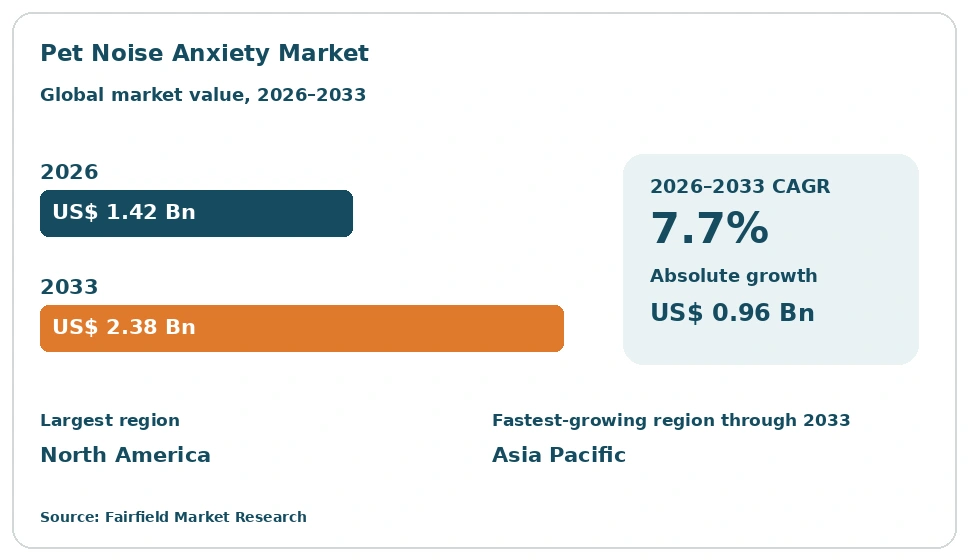
The global pet noise anxiety market size is expected to be valued at US$ 1.42 billion in 2026 and projected to reach US$ 2.38 billion by 2033, growing at a CAGR of 7.7% between 2026 and 2033.
Between 2020 and 2025, the market grew at a CAGR of about 6.8%, rising from roughly US$ 0.95 billion to about US$ 1.32 billion, as pet adoption surged during the pandemic, many new owners noticed fear and stress in their animals, and spending on pet health and wellness rose sharply. The pet noise anxiety market covers products and treatments that help dogs, cats, and other pets cope with fear of loud sounds such as fireworks, thunderstorms, traffic, construction, and gunshots. Products include prescription medicines such as dexmedetomidine oral gel, imepitoin, and tasipimidine, calming supplements, pheromone diffusers and collars, anxiety wraps and vests, noise-reducing earmuffs, calming music, and behavior training tools. Noise fear is one of the most common behavior problems in dogs. In May 2026, Orion received FDA approval for Tessie, to be sold in the United States by Zoetis.
Key Report Takeaways
- By Product Type: Supplements and Calming Aids held about 45% share in 2025, while Wearable Anxiety Solutions are projected to expand at a 9.2% CAGR through 2033, driven by anxiety vests, noise-blocking earmuffs, and smart devices that owners can use without a prescription.
- By Animal Type: Dogs held about 59% share in 2025, while Cats are projected to expand at an 8.3% CAGR through 2033, driven by rising cat ownership, growing awareness of feline stress, and new cat-specific calming products and medicines.
- By Distribution Channel: Offline Channels held about 63.6% share in 2025, while Online Channels are projected to expand at a 9.5% CAGR through 2033, driven by e-commerce, subscriptions, and online veterinary pharmacies.
- By Region: North America held about 46.7% share in 2025, while Asia Pacific is projected to expand at an 8.6% CAGR through 2033, driven by fast-growing pet ownership, rising incomes, and pet humanization in China, Japan, and India.
Global Pet Noise Anxiety Market Trends and Insights
Drivers Impact Analysis
Two drivers carry the strongest influence on pet noise anxiety market demand during the forecast period.
| Driver | Impact on CAGR Forecast | Geographic Relevance | Impact Timeline |
| Pet humanization and rising pet ownership | High | Global | Long term (≥4 years) |
| New veterinary medicines and awareness | High | North America, Europe | Medium term (2-4 years) |
Pet Humanization Is Driving the Pet Noise Anxiety Market
Pet humanization and rising pet ownership are the strongest driver of the pet noise anxiety market. Owners now treat pets as family members.
The mechanism is that owners who see pets as family are more willing to spend money on their emotional wellbeing, not just food and basic care. Pet ownership rose sharply during the pandemic, especially among younger adults, and many of these owners now notice signs of fear such as shaking, hiding, barking, and destructive behavior during fireworks and storms. Urban living adds more noise from traffic, construction, and neighbors. Social media and pet influencers share advice about calming products, raising awareness. Seasonal events such as New Year, Diwali, Independence Day, and Bonfire Night create predictable spikes in demand. Pet insurance also covers more behavior treatments. These trends support steady long-term spending on calming products.
New Medicines Are Expanding the Pet Noise Anxiety Market
New veterinary medicines and growing awareness are expanding the pet noise anxiety market. Vets now have more approved treatments.
The cause is the arrival of medicines designed specifically for noise fear. Zoetis markets Sileo, a dexmedetomidine oral gel for noise aversion in dogs, and Boehringer Ingelheim offers Pexion in some markets. In May 2026, the FDA approved Orion’s Tessie (tasipimidine), the first drug approved in the United States to treat both noise aversion and separation anxiety in dogs, with Zoetis set to launch it. In Europe, Domes Pharma has launched Tessie for dogs and Bonqat for cats. Veterinary groups encourage vets to ask about fear and stress during routine visits. These new options raise diagnosis and treatment rates, increasing the value of prescription products.
Restraints Impact Analysis
Two restraints limit how quickly the pet noise anxiety market grows.
| Restraint | Impact on CAGR Forecast | Geographic Relevance | Impact Timeline |
| Limited evidence for many supplements | Medium | Global | Long term (≥4 years) |
| Cost and low awareness in developing markets | High | Asia Pacific, Latin America, Middle East & Africa | Medium term (2-4 years) |
Limited Evidence Slows the Pet Noise Anxiety Market
Limited scientific evidence for many supplements slows the pet noise anxiety market. Owners are unsure which products work.
The problem is that many calming chews, treats, and oils on the market have little or no clinical proof that they reduce noise fear. Rules for pet supplements are less strict than for medicines, so product quality and ingredient levels vary widely. Some owners try several products, see little change, and give up. Veterinarians may be cautious about recommending unproven products. Prescription medicines are better studied but can cause side effects such as drowsiness or vomiting, and some owners worry about giving drugs to their pets. Behavior training works well but takes time and effort. Online reviews often give mixed results for the same product. These concerns slow repeat purchases and reduce trust in parts of the market.
Cost and Awareness Restrict the Pet Noise Anxiety Market
Cost and low awareness in developing markets restrict the pet noise anxiety market. Many owners do not see noise fear as a health problem.
The constraint is that in many parts of Asia Pacific, Latin America, and Middle East & Africa, spending on pets focuses on food and basic veterinary care, and many owners view fear of fireworks or storms as normal behavior rather than a treatable condition. Prescription medicines and premium products can be expensive compared with local incomes. Access to veterinary behavior specialists is limited outside large cities, and new medicines often launch first in North America and Europe. Regulatory approval for new drugs varies by country and can take years. These factors limit market growth in regions with large and growing pet populations.
Market Opportunities
Wearables and Smart Devices Open a Fast-Growth Revenue Pool
Wearables and smart devices open a fast-growth revenue pool. Owners want drug-free solutions.
The opportunity comes from anxiety vests that apply gentle pressure, noise-cancelling earmuffs for dogs, calming collars, and smart devices that play soothing sounds or track heart rate and activity to detect stress. These products are easy to use, do not need a prescription, and appeal to owners who prefer natural approaches. Connected devices can alert owners when a pet becomes anxious and send data to vets for better treatment plans. Companies such as ThunderWorks and smart collar makers are innovating in this space. Combining wearables with apps, training content, and subscriptions can create recurring revenue. Rental and trial programs could also lower the barrier for first-time buyers. Brands that prove effectiveness through studies can win strong loyalty.
Cats and Online Channels Create a Growth Revenue Pool
Cats and online channels create a growth revenue pool. Both are under-served today.
The opportunity reflects rising cat ownership in cities worldwide and growing understanding that cats also suffer from noise stress, often hiding it better than dogs. New cat-specific medicines such as Bonqat, pheromone products such as Feliway, and calming treats are expanding the cat segment. At the same time, e-commerce sites, subscription boxes, and online veterinary pharmacies make it easier for owners to buy calming products before predictable events such as fireworks seasons. Telehealth vet visits allow faster prescriptions. Brands that build strong online marketing, education, and seasonal campaigns can reach many new customers, especially in Asia Pacific where online pet shopping is growing quickly. Bundles that combine supplements, pheromones, and wearables also raise average order values.
Segment Analysis
By Product Type: Supplements and Calming Aids Lead While Wearable Anxiety Solutions Grow Fastest
Supplements and Calming Aids held about 45% share in 2025. They include calming chews, treats, oils, probiotics, and pheromone diffusers, sprays, and collars that owners can buy without a prescription in pet stores, supermarkets, and online. Easy access and lower prices make them the largest product group.
Wearable Anxiety Solutions are the fastest-growing product type, expanding at a 9.2% CAGR through 2033. Pressure vests, earmuffs, calming collars, and smart wearables offer drug-free support during fireworks and storms. Medications, including prescription drugs approved for noise aversion, form another important segment, while Behavioral Therapy and Training Products help pets learn to cope over time. For the market, wearable growth expands non-drug options and attracts owners who avoid medicines.
By Animal Type: Dogs Lead While Cats Grow Fastest
Dogs held about 59% share in 2025. Dogs often show strong reactions to loud noises, such as shaking, panting, hiding, and trying to escape, and most approved medicines and calming products target them. High dog ownership in North America and Europe supports this large share.
Cats are the fastest-growing animal type, expanding at an 8.3% CAGR through 2033. Owners and vets are becoming more aware of feline stress, which is often hidden, and new cat-specific medicines, pheromones, and supplements are arriving. Rising cat ownership in apartments and cities supports growth. Other Pets, including horses, form another segment. Vets increasingly ask about stress during routine cat visits. For the market, cat growth opens a large and under-treated customer group.
By Distribution Channel: Offline Channels Lead While Online Channels Grow Fastest
Offline Channels held about 63.6% share in 2025. Veterinary clinics and hospitals sell prescription medicines and give advice, while pet specialty stores and supermarkets sell supplements, pheromones, and wearables. Owners often trust in-person recommendations from vets and store staff, especially when choosing a product for the first time. Clinics also see pets right after stressful events, which creates sales opportunities. Large pet store chains run seasonal displays before fireworks events.
Online Channels are the fastest-growing distribution channel, expanding at a 9.5% CAGR through 2033. E-commerce platforms, brand websites, online pharmacies, and subscription services offer convenience, wide choice, reviews, and home delivery before fireworks seasons. Telehealth supports online prescriptions. Online pharmacies also send reminders before holidays with fireworks. For the market, online growth widens reach to owners in smaller towns and creates repeat sales through subscriptions.
Geography Analysis
Which Region Is Leading the Pet Noise Anxiety Market?
North America is leading the pet noise anxiety market with about 46.7% share in 2025. The United States market reached about US$ 625 million in 2025, supported by very high pet ownership, strong spending on pet health, many veterinary clinics, and growing pet insurance. Fireworks around Independence Day and New Year create strong seasonal demand. Zoetis will launch Tessie in the United States, adding to existing medicines such as Sileo. Canada has similar trends. Key barriers include high prices. Thunderstorms in the Midwest and South also cause frequent pet stress. One change shaping the region is rapid growth of online pet pharmacies.
Europe Shapes the Pet Noise Anxiety Market Through Fireworks Seasons and Innovation
Europe holds about 18.6% of the pet noise anxiety market. The United Kingdom, Germany, France, the Netherlands, and Italy have high pet ownership and strong animal welfare awareness, and fireworks around New Year and Bonfire Night cause widespread pet stress. Companies such as Ceva Santé Animale, Vetoquinol, Virbac, and Orion are based in the region, and Domes Pharma has launched new products for dogs and cats. Some cities restrict fireworks. Key barriers include strict veterinary drug rules. Animal welfare groups run campaigns about fireworks each year. Pet insurance is also growing in the region. One opportunity is new cat treatments.
Which Region Is Growing Fastest in the Pet Noise Anxiety Market?
Asia Pacific is the fastest-growing pet noise anxiety market, expanding at an 8.6% CAGR through 2033. China has a rapidly growing pet population, especially cats, and strong online pet shopping. Japan and South Korea have aging populations who treat pets as family and spend heavily on pet wellness. India has fast-growing dog ownership and festivals such as Diwali that involve heavy fireworks use. Australia has high pet ownership and storm-related anxiety. Key barriers include low awareness and limited product approvals. Local brands are launching lower-priced calming products. One change shaping the region is fast online sales growth.
Latin America Grows the Pet Noise Anxiety Market Through Pet Ownership
Latin America is a growing pet noise anxiety market. Brazil has one of the world’s largest pet populations, and Mexico, Argentina, Colombia, and Chile also have high dog and cat ownership. Fireworks during New Year, Christmas, and national holidays cause common pet stress, and some cities in Brazil and Chile have restricted noisy fireworks to protect animals. Pet stores and online sellers are expanding calming product ranges. Key barriers include price sensitivity and limited veterinary access. Veterinary clinic chains are growing in large cities. Many owners also buy products through social media sellers. One opportunity is affordable supplements and wearables.
Middle East & Africa Builds the Pet Noise Anxiety Market Through Premium Pet Care
Middle East & Africa is an emerging pet noise anxiety market. The United Arab Emirates and Saudi Arabia have growing pet ownership among high-income households and expatriates, and premium pet stores and veterinary clinics are expanding. South Africa has high dog ownership and strong awareness of fireworks-related stress. Israel and Egypt add demand. Key barriers include small market size, limited product availability, and low awareness in many countries. Online pet stores are expanding delivery across the region. Hot weather and loud celebrations add stress for pets. Many owners first learn about calming products online. One opportunity is premium calming products sold through vet clinics.
Competitive Landscape
The pet noise anxiety market is moderately fragmented. Ceva Santé Animale, Zoetis, Nestlé Purina PetCare, Vetoquinol, and Virbac are leading players, together holding about 40% of the market, with Ceva Santé Animale leading at more than 11%. Orion, Boehringer Ingelheim Animal Health, Elanco Animal Health, Domes Pharma, ThunderWorks, PetIQ, and Mars Petcare compete strongly. Hundreds of smaller brands sell calming supplements, treats, and wearables, especially online.
Companies compete on clinical evidence, veterinarian trust, brand recognition, ease of use, price, and availability across vet clinics, pet stores, and e-commerce. Animal health companies focus on prescription medicines and pheromone products backed by studies, while consumer brands compete through marketing, packaging, flavors, and influencer campaigns. Seasonal promotions before fireworks and storm seasons are an important part of competition.
Strategic moves show how competition is changing. In February 2025, PetHonesty expanded its supplement range with liquid calming products. In December 2025, Domes Pharma launched Tessie and Bonqat in Europe. In May 2026, Orion won FDA approval for Tessie, which Zoetis will sell in the United States. These moves show competition shifting toward approved prescription medicines while consumer brands keep expanding over-the-counter choices.
Three themes shape vendor strategy. First, companies are developing new prescription medicines for dogs and cats. Second, they are building drug-free wearables, smart devices, and supplements with stronger evidence. Third, they are growing online sales and expanding in Asia Pacific and Latin America, where pet ownership is rising fast.
Pet Noise Anxiety Market Industry Leaders
- Ceva Santé Animale
- Zoetis
- Nestlé Purina PetCare
- Vetoquinol
- Virbac
Recent Industry Developments
- May 2026: Orion received FDA approval for Tessie (tasipimidine) oral solution to treat noise aversion and separation anxiety in dogs, with Zoetis holding exclusive United States sales rights - adds a new prescription option in the pet noise anxiety market.
- December 2025: Domes Pharma launched Tessie for dogs and Bonqat for cats in European markets - expands prescription calming treatments in Europe.
- February 2025: PetHonesty added a liquid calming supplement line - widens over-the-counter options for pet owners.
Companies Covered in the Report
- Ceva Santé Animale
- Zoetis
- Nestlé Purina PetCare
- Vetoquinol
- Virbac
- Orion
- Boehringer Ingelheim Animal Health
- Elanco Animal Health
- Domes Pharma
- ThunderWorks
- PetIQ
- Mars Petcare
Pet Noise Anxiety Market Report Scope
This report covers the pet noise anxiety market, including medications, supplements and calming aids, wearable anxiety solutions, and behavioral therapy and training products for dogs, cats, and other pets, sold through offline channels such as veterinary clinics and pet stores and online channels. The base year is 2025, and the forecast period runs from 2026 to 2033. All values are expressed in US$ Billion.
| Product Type | Medications, Supplements and Calming Aids, Wearable Anxiety Solutions, Behavioral Therapy and Training Products |
| Animal Type | Dogs, Cats, Other Pets |
| Distribution Channel | Offline Channels, Online Channels |
| Regions | North America, Europe, Asia Pacific, Latin America, Middle East & Africa |
1. Executive Summary
1.1 Pet Noise Anxiety Market Snapshot
1.2 Future Projections
1.3 Key Market Trends
1.4 Regional Snapshot
2. Market Overview
2.1 Market Definition and Report Scope
2.2 Historical Market Trends
2.3 Market Dynamics
2.3.1 Drivers
2.3.1.1 Pet Humanization Is Driving the Pet Noise Anxiety Market
2.3.1.2 New Medicines Are Expanding the Pet Noise Anxiety Market
2.3.2 Restraints
2.3.2.1 Limited Evidence Slows the Pet Noise Anxiety Market
2.3.2.2 Cost and Awareness Restrict the Pet Noise Anxiety Market
2.3.3 Market Opportunities
2.3.3.1 Wearables and Smart Devices Open a Fast-Growth Revenue Pool
2.3.3.2 Cats and Online Channels Create a Growth Revenue Pool
3. Global Pet Noise Anxiety Market Outlook, 2020–2033
3.1 Global Pet Noise Anxiety Market Outlook, by Product Type, Value (US$ Billion), 2020–2033
3.1.1 Medications
3.1.2 Supplements and Calming Aids
3.1.3 Wearable Anxiety Solutions
3.1.4 Behavioral Therapy and Training Products
3.2 Global Pet Noise Anxiety Market Outlook, by Animal Type, Value (US$ Billion), 2020–2033
3.2.1 Dogs
3.2.2 Cats
3.2.3 Other Pets
3.3 Global Pet Noise Anxiety Market Outlook, by Distribution Channel, Value (US$ Billion), 2020–2033
3.3.1 Offline Channels
3.3.2 Online Channels
3.4 Global Pet Noise Anxiety Market Outlook, by Region, Value (US$ Billion), 2020–2033
3.4.1 North America
3.4.2 Europe
3.4.3 Asia Pacific
3.4.4 Latin America
3.4.5 Middle East & Africa
4. North America Pet Noise Anxiety Market Outlook, 2020–2033
4.1 North America Pet Noise Anxiety Market Outlook, by Product Type, Value (US$ Billion), 2020–2033
4.1.1 Medications
4.1.2 Supplements and Calming Aids
4.1.3 Wearable Anxiety Solutions
4.1.4 Behavioral Therapy and Training Products
4.2 North America Pet Noise Anxiety Market Outlook, by Animal Type, Value (US$ Billion), 2020–2033
4.2.1 Dogs
4.2.2 Cats
4.2.3 Other Pets
4.3 North America Pet Noise Anxiety Market Outlook, by Distribution Channel, Value (US$ Billion), 2020–2033
4.3.1 Offline Channels
4.3.2 Online Channels
4.4 North America Pet Noise Anxiety Market Outlook, by Country, Value (US$ Billion), 2020–2033
4.4.1 United States Pet Noise Anxiety Market Outlook, by Product Type, 2020–2033
4.4.2 United States Pet Noise Anxiety Market Outlook, by Animal Type, 2020–2033
4.4.3 United States Pet Noise Anxiety Market Outlook, by Distribution Channel, 2020–2033
4.4.4 Canada Pet Noise Anxiety Market Outlook, by Product Type, 2020–2033
4.4.5 Canada Pet Noise Anxiety Market Outlook, by Animal Type, 2020–2033
4.4.6 Canada Pet Noise Anxiety Market Outlook, by Distribution Channel, 2020–2033
5. Europe Pet Noise Anxiety Market Outlook, 2020–2033
5.1 Europe Pet Noise Anxiety Market Outlook, by Product Type, Value (US$ Billion), 2020–2033
5.1.1 Medications
5.1.2 Supplements and Calming Aids
5.1.3 Wearable Anxiety Solutions
5.1.4 Behavioral Therapy and Training Products
5.2 Europe Pet Noise Anxiety Market Outlook, by Animal Type, Value (US$ Billion), 2020–2033
5.2.1 Dogs
5.2.2 Cats
5.2.3 Other Pets
5.3 Europe Pet Noise Anxiety Market Outlook, by Distribution Channel, Value (US$ Billion), 2020–2033
5.3.1 Offline Channels
5.3.2 Online Channels
5.4 Europe Pet Noise Anxiety Market Outlook, by Country, Value (US$ Billion), 2020–2033
5.4.1 United Kingdom Pet Noise Anxiety Market Outlook, by Product Type, 2020–2033
5.4.2 United Kingdom Pet Noise Anxiety Market Outlook, by Animal Type, 2020–2033
5.4.3 United Kingdom Pet Noise Anxiety Market Outlook, by Distribution Channel, 2020–2033
5.4.4 Germany Pet Noise Anxiety Market Outlook, by Product Type, 2020–2033
5.4.5 Germany Pet Noise Anxiety Market Outlook, by Animal Type, 2020–2033
5.4.6 Germany Pet Noise Anxiety Market Outlook, by Distribution Channel, 2020–2033
5.4.7 France Pet Noise Anxiety Market Outlook, by Product Type, 2020–2033
5.4.8 France Pet Noise Anxiety Market Outlook, by Animal Type, 2020–2033
5.4.9 France Pet Noise Anxiety Market Outlook, by Distribution Channel, 2020–2033
5.4.10 Netherlands Pet Noise Anxiety Market Outlook, by Product Type, 2020–2033
5.4.11 Netherlands Pet Noise Anxiety Market Outlook, by Animal Type, 2020–2033
5.4.12 Netherlands Pet Noise Anxiety Market Outlook, by Distribution Channel, 2020–2033
5.4.13 Italy Pet Noise Anxiety Market Outlook, by Product Type, 2020–2033
5.4.14 Italy Pet Noise Anxiety Market Outlook, by Animal Type, 2020–2033
5.4.15 Italy Pet Noise Anxiety Market Outlook, by Distribution Channel, 2020–2033
6. Asia Pacific Pet Noise Anxiety Market Outlook, 2020–2033
6.1 Asia Pacific Pet Noise Anxiety Market Outlook, by Product Type, Value (US$ Billion), 2020–2033
6.1.1 Medications
6.1.2 Supplements and Calming Aids
6.1.3 Wearable Anxiety Solutions
6.1.4 Behavioral Therapy and Training Products
6.2 Asia Pacific Pet Noise Anxiety Market Outlook, by Animal Type, Value (US$ Billion), 2020–2033
6.2.1 Dogs
6.2.2 Cats
6.2.3 Other Pets
6.3 Asia Pacific Pet Noise Anxiety Market Outlook, by Distribution Channel, Value (US$ Billion), 2020–2033
6.3.1 Offline Channels
6.3.2 Online Channels
6.4 Asia Pacific Pet Noise Anxiety Market Outlook, by Country, Value (US$ Billion), 2020–2033
6.4.1 China Pet Noise Anxiety Market Outlook, by Product Type, 2020–2033
6.4.2 China Pet Noise Anxiety Market Outlook, by Animal Type, 2020–2033
6.4.3 China Pet Noise Anxiety Market Outlook, by Distribution Channel, 2020–2033
6.4.4 Japan Pet Noise Anxiety Market Outlook, by Product Type, 2020–2033
6.4.5 Japan Pet Noise Anxiety Market Outlook, by Animal Type, 2020–2033
6.4.6 Japan Pet Noise Anxiety Market Outlook, by Distribution Channel, 2020–2033
6.4.7 South Korea Pet Noise Anxiety Market Outlook, by Product Type, 2020–2033
6.4.8 South Korea Pet Noise Anxiety Market Outlook, by Animal Type, 2020–2033
6.4.9 South Korea Pet Noise Anxiety Market Outlook, by Distribution Channel, 2020–2033
6.4.10 India Pet Noise Anxiety Market Outlook, by Product Type, 2020–2033
6.4.11 India Pet Noise Anxiety Market Outlook, by Animal Type, 2020–2033
6.4.12 India Pet Noise Anxiety Market Outlook, by Distribution Channel, 2020–2033
6.4.13 Australia Pet Noise Anxiety Market Outlook, by Product Type, 2020–2033
6.4.14 Australia Pet Noise Anxiety Market Outlook, by Animal Type, 2020–2033
6.4.15 Australia Pet Noise Anxiety Market Outlook, by Distribution Channel, 2020–2033
7. Latin America Pet Noise Anxiety Market Outlook, 2020–2033
7.1 Latin America Pet Noise Anxiety Market Outlook, by Product Type, Value (US$ Billion), 2020–2033
7.1.1 Medications
7.1.2 Supplements and Calming Aids
7.1.3 Wearable Anxiety Solutions
7.1.4 Behavioral Therapy and Training Products
7.2 Latin America Pet Noise Anxiety Market Outlook, by Animal Type, Value (US$ Billion), 2020–2033
7.2.1 Dogs
7.2.2 Cats
7.2.3 Other Pets
7.3 Latin America Pet Noise Anxiety Market Outlook, by Distribution Channel, Value (US$ Billion), 2020–2033
7.3.1 Offline Channels
7.3.2 Online Channels
7.4 Latin America Pet Noise Anxiety Market Outlook, by Country, Value (US$ Billion), 2020–2033
7.4.1 Brazil Pet Noise Anxiety Market Outlook, by Product Type, 2020–2033
7.4.2 Brazil Pet Noise Anxiety Market Outlook, by Animal Type, 2020–2033
7.4.3 Brazil Pet Noise Anxiety Market Outlook, by Distribution Channel, 2020–2033
7.4.4 Mexico Pet Noise Anxiety Market Outlook, by Product Type, 2020–2033
7.4.5 Mexico Pet Noise Anxiety Market Outlook, by Animal Type, 2020–2033
7.4.6 Mexico Pet Noise Anxiety Market Outlook, by Distribution Channel, 2020–2033
7.4.7 Argentina Pet Noise Anxiety Market Outlook, by Product Type, 2020–2033
7.4.8 Argentina Pet Noise Anxiety Market Outlook, by Animal Type, 2020–2033
7.4.9 Argentina Pet Noise Anxiety Market Outlook, by Distribution Channel, 2020–2033
7.4.10 Colombia Pet Noise Anxiety Market Outlook, by Product Type, 2020–2033
7.4.11 Colombia Pet Noise Anxiety Market Outlook, by Animal Type, 2020–2033
7.4.12 Colombia Pet Noise Anxiety Market Outlook, by Distribution Channel, 2020–2033
7.4.13 Chile Pet Noise Anxiety Market Outlook, by Product Type, 2020–2033
7.4.14 Chile Pet Noise Anxiety Market Outlook, by Animal Type, 2020–2033
7.4.15 Chile Pet Noise Anxiety Market Outlook, by Distribution Channel, 2020–2033
8. Middle East & Africa Pet Noise Anxiety Market Outlook, 2020–2033
8.1 Middle East & Africa Pet Noise Anxiety Market Outlook, by Product Type, Value (US$ Billion), 2020–2033
8.1.1 Medications
8.1.2 Supplements and Calming Aids
8.1.3 Wearable Anxiety Solutions
8.1.4 Behavioral Therapy and Training Products
8.2 Middle East & Africa Pet Noise Anxiety Market Outlook, by Animal Type, Value (US$ Billion), 2020–2033
8.2.1 Dogs
8.2.2 Cats
8.2.3 Other Pets
8.3 Middle East & Africa Pet Noise Anxiety Market Outlook, by Distribution Channel, Value (US$ Billion), 2020–2033
8.3.1 Offline Channels
8.3.2 Online Channels
8.4 Middle East & Africa Pet Noise Anxiety Market Outlook, by Country, Value (US$ Billion), 2020–2033
8.4.1 United Arab Emirates Pet Noise Anxiety Market Outlook, by Product Type, 2020–2033
8.4.2 United Arab Emirates Pet Noise Anxiety Market Outlook, by Animal Type, 2020–2033
8.4.3 United Arab Emirates Pet Noise Anxiety Market Outlook, by Distribution Channel, 2020–2033
8.4.4 Saudi Arabia Pet Noise Anxiety Market Outlook, by Product Type, 2020–2033
8.4.5 Saudi Arabia Pet Noise Anxiety Market Outlook, by Animal Type, 2020–2033
8.4.6 Saudi Arabia Pet Noise Anxiety Market Outlook, by Distribution Channel, 2020–2033
8.4.7 South Africa Pet Noise Anxiety Market Outlook, by Product Type, 2020–2033
8.4.8 South Africa Pet Noise Anxiety Market Outlook, by Animal Type, 2020–2033
8.4.9 South Africa Pet Noise Anxiety Market Outlook, by Distribution Channel, 2020–2033
8.4.10 Israel Pet Noise Anxiety Market Outlook, by Product Type, 2020–2033
8.4.11 Israel Pet Noise Anxiety Market Outlook, by Animal Type, 2020–2033
8.4.12 Israel Pet Noise Anxiety Market Outlook, by Distribution Channel, 2020–2033
8.4.13 Egypt Pet Noise Anxiety Market Outlook, by Product Type, 2020–2033
8.4.14 Egypt Pet Noise Anxiety Market Outlook, by Animal Type, 2020–2033
8.4.15 Egypt Pet Noise Anxiety Market Outlook, by Distribution Channel, 2020–2033
9. Competitive Landscape
9.1 Pet Noise Anxiety Market Industry Leaders
9.2 Recent Industry Developments
9.3 Company Profiles
9.3.1 Ceva Santé Animale
9.3.2 Zoetis
9.3.3 Nestlé Purina PetCare
9.3.4 Vetoquinol
9.3.5 Virbac
9.3.6 Orion
9.3.7 Boehringer Ingelheim Animal Health
9.3.8 Elanco Animal Health
9.3.9 Domes Pharma
9.3.10 ThunderWorks
9.3.11 PetIQ
9.3.12 Mars Petcare
10. Appendix
10.1 Research Methodology
10.2 Report Assumptions
10.3 Acronyms and Abbreviations
| Product Type | Medications, Supplements and Calming Aids, Wearable Anxiety Solutions, Behavioral Therapy and Training Products |
| Animal Type | Dogs, Cats, Other Pets |
| Distribution Channel | Offline Channels, Online Channels |
| Regions | North America, Europe, Asia Pacific, Latin America, Middle East & Africa |
Our Research Methodology
Considering the volatility of business today, traditional approaches to strategizing a game plan can be unfruitful if not detrimental. True ambiguity is no way to determine a forecast. A myriad of predetermined factors must be accounted for such as the degree of risk involved, the magnitude of circumstances, as well as conditions or consequences that are not known or unpredictable. To circumvent binary views that cast uncertainty, the application of market research intelligence to strategically posture, move, and enable actionable outcomes is necessary.
View Methodology
Quality Assured
Rigorous Validation Process

Confidentiality Assured
End-to-end Data Security

Custom Research Services
Tailored To Your Objectives
FAQs
The pet noise anxiety market is valued at US$ 1.42 billion in 2026, led by supplements and calming aids, dogs, and North America.
The market is projected to reach US$ 2.38 billion by 2033, growing at a 7.7% CAGR and adding US$ 0.96 billion.
Wearable anxiety solutions are growing fastest at a 9.2% CAGR through 2033, driven by drug-free vests, earmuffs, and smart devices.
Asia Pacific is growing fastest at an 8.6% CAGR through 2033, driven by rising pet ownership, incomes, and pet humanization.
North America holds the largest share at about 46.7% in 2025, supported by high pet ownership and spending on pet health.
Related Reports
Scaffold Technology Market Size, Share, Insights, Competitive Landscape, and Forecast 2026 to 2033
Explore the scaffold technology market, forecast to reach US$7.24 billion by 2033 at 13.7% CAGR, with insights on types, applications, and regions.
Plant Genotyping Equipment Market Size, Share, Insights, Competitive Landscape, and Forecast 2026 to 2033
Explore the plant genotyping equipment market, forecast to reach US$1,566.6 million by 2033 at 7.5% CAGR, with insights on equipment, uses, and regions.
Contrast Media/Contrast Agents Market Size, Share, Insights, Competitive Landscape, and Forecast 2026 to 2033
Explore the contrast media market, projected to reach US$13.96 billion by 2033 at 7.9% CAGR, with insights on types, regions, and leading companies.
Asthma Treatment Market Size, Share, Insights, Competitive Landscape, and Forecast 2026 to 2033
Explore the asthma treatment market outlook for 2026–2033, covering drug classes, devices, distribution channels, patient segments, and regions.
Aesthetic Medicine Market Size, Share, Insights, Competitive Landscape, and Forecast 2026 to 2033
Explore the aesthetic medicine market outlook for 2026–2033, covering products, patient groups, end users, regional trends, and leading companies.
Kidney Dialysis Centres Market Size, Share, Insights, Competitive Landscape, and Forecast 2026 to 2033
Explore the kidney dialysis centres market outlook for 2026–2033, covering dialysis types, service settings, centre types, regions, and key companies.