



Contrast Media/Contrast Agents Market
Contrast Media/Contrast Agents Market Size, Share, Insights, Competitive Landscape, and Forecast 2026 to 2033
Report Overview
Contrast Media Market Size and Trend Analysis
How Fast Is the Contrast Media Market Growing?
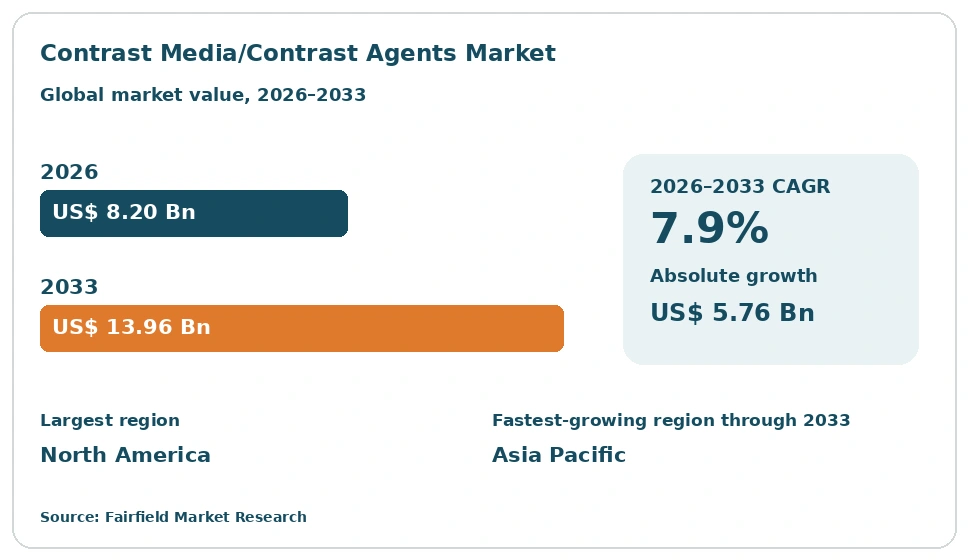
The global contrast media market size is expected to be valued at US$ 8.20 billion in 2026 and projected to reach US$ 13.96 billion by 2033, growing at a CAGR of 7.9% between 2026 and 2033.
Between 2020 and 2025, the market grew at a CAGR of about 6.8%, rising from roughly US$ 5.5 billion to US$ 7.65 billion, as imaging volumes recovered after pandemic delays, a global shortage of iodinated contrast in 2022 briefly disrupted supply, and hospitals added more CT and MRI scanners to handle rising cancer and heart disease cases. The contrast media market, also called the contrast agents market, covers substances given to patients to make blood vessels, organs, and tissues show up more clearly on medical images. Main types include iodinated contrast for X-ray and CT, gadolinium-based contrast agents for MRI, barium sulfate for digestive tract imaging, and microbubble agents for ultrasound. They help doctors find tumors, blocked arteries, strokes, infections, and injuries. Most are injected into veins or arteries. In June 2026, Bayer received FDA approval for Ambelvist, a low-dose MRI contrast agent.
Key Report Takeaways
- By Type: Iodinated Contrast Media held about 55% share in 2025, while Microbubble Contrast Agents are projected to expand at a 9.4% CAGR through 2033, driven by radiation-free ultrasound imaging of the liver, heart, and kidneys and wider use in children and patients with kidney problems.
- By Indication: Cardiovascular Disease held about 48% share in 2025, while Oncology is projected to expand at an 8.8% CAGR through 2033, driven by rising cancer cases, more cancer screening and staging scans, and repeated imaging to track treatment response.
- By End User: Hospitals held about 60% share in 2025, while Diagnostic Imaging Centers are projected to expand at a 9.0% CAGR through 2033, driven by the shift of routine CT and MRI scans to lower-cost outpatient settings.
- By Region: North America held about 38% share in 2025, while Asia Pacific is projected to expand at a 9.5% CAGR through 2033, driven by fast installation of CT and MRI scanners, aging populations, and wider health insurance in China and India.
Global Contrast Media Market Trends and Insights
Drivers Impact Analysis
Two drivers carry the strongest influence on contrast media market demand during the forecast period.
| Driver | Impact on CAGR Forecast | Geographic Relevance | Impact Timeline |
| Rising chronic disease and imaging volumes | High | Global | Long term (≥4 years) |
| Growth of CT and MRI installations | High | Asia Pacific, Latin America, Middle East & Africa | Medium term (2-4 years) |
Imaging Volumes Are Driving the Contrast Media Market
Rising chronic disease and imaging volumes are the strongest driver of the contrast media market. Doctors order more scans every year.
The mechanism is a growing number of patients with cancer, heart disease, stroke, kidney disease, and digestive problems, many of whom need contrast-enhanced scans for diagnosis, treatment planning, and follow-up. Aging populations in North America, Europe, Japan, and China increase the number of people with these conditions. Cancer patients often need repeated CT and MRI scans to check whether treatments are working. Emergency departments use contrast CT to find strokes, blood clots, and internal injuries quickly. Cardiac catheterization and angiography procedures also use large amounts of iodinated contrast. Each scan uses a dose of contrast, so higher scan volumes directly raise product sales. These trends support steady long-term growth.
Scanner Growth Is Expanding the Contrast Media Market
Growth of CT and MRI installations is expanding the contrast media market. More scanners mean more contrast use.
The cause is strong investment in imaging equipment, especially in Asia Pacific, Latin America, and Middle East & Africa, where many hospitals and diagnostic centers are adding their first CT and MRI machines. China and India are expanding public hospital networks and private diagnostic chains, while governments are funding cancer and heart disease screening programs. New scanners are faster and allow more scans per day. Advanced techniques such as cardiac CT, perfusion imaging, and contrast-enhanced mammography need contrast agents. Companies such as GE HealthCare, Bayer, Bracco Imaging, and Guerbet sell both contrast media and injectors, supporting adoption. These trends raise contrast media demand per hospital and per country.
Restraints Impact Analysis
Two restraints limit how quickly the contrast media market grows.
| Restraint | Impact on CAGR Forecast | Geographic Relevance | Impact Timeline |
| Safety concerns and adverse reactions | Medium | Global | Long term (≥4 years) |
| Pricing pressure and supply risks | High | North America, Europe, Asia Pacific | Short term (≤2 years) |
Safety Concerns Slow the Contrast Media Market
Safety concerns and adverse reactions slow the contrast media market. Some patients cannot safely receive contrast.
The problem is that iodinated contrast can cause allergic-like reactions and may harm kidney function in some patients, while gadolinium agents have been linked to a rare skin and organ condition called nephrogenic systemic fibrosis in people with severe kidney disease. Studies have also found that small amounts of gadolinium can stay in the brain and body, leading regulators in Europe to restrict some older linear agents. Doctors therefore screen patients carefully, use lower doses, and sometimes choose scans without contrast. New imaging methods and artificial intelligence tools that improve non-contrast scans may reduce contrast use for some exams. Patients with past reactions often receive pre-medication or alternative scans. These concerns limit growth in certain patient groups.
Pricing Pressure Restricts the Contrast Media Market
Pricing pressure and supply risks restrict the contrast media market. Hospitals push hard for lower prices.
The constraint is that many leading contrast agents have lost patent protection, and generic versions from companies in China, India, and South Korea sell at lower prices. Hospital group purchasing organizations and national tenders in Europe and China cut prices further. At the same time, production depends on a small number of plants and raw materials such as iodine, which comes mainly from Chile and Japan. The 2022 shutdown of a major plant in China caused a global iodinated contrast shortage, forcing hospitals to delay scans. Rising energy and transport costs also squeeze margins. Many hospitals now keep larger safety stocks and buy from more than one supplier. These factors limit revenue growth even as scan volumes rise.
Market Opportunities
Low-Dose and Novel Agents Open a Fast-Growth Revenue Pool
Low-dose and novel contrast agents open a fast-growth revenue pool. Doctors want safer agents that work well at lower doses.
The opportunity comes from new high-relaxivity gadolinium agents, such as Bayer’s Ambelvist (gadoquatrane) and Guerbet and Bracco’s gadopiclenol, which give clear MRI images at about half the usual gadolinium dose. Microbubble ultrasound agents offer radiation-free imaging and can be used in patients with kidney problems. Contrast-enhanced mammography is spreading as an alternative to breast MRI, and Bayer’s Ultravist was approved for this use in India in 2026. Targeted and molecular contrast agents for cancer and inflammation are also in development. Companies that bring safer, lower-dose, and specialized agents to market can earn premium prices and protect against generic competition.
Emerging Markets and Smart Injection Systems Create a Growth Revenue Pool
Emerging markets and smart injection systems create a growth revenue pool. Imaging access is expanding fast in many countries.
The opportunity reflects rapid growth of diagnostic imaging in China, India, Indonesia, Brazil, Mexico, Saudi Arabia, and Egypt, where new hospitals and diagnostic chains need reliable contrast supply. Companies are building local plants and partnerships to lower costs and secure supply, as GE HealthCare did with its US$ 138 million investment in Cork, Ireland. Smart power injectors, multi-dose packaging, and software that tracks contrast doses help hospitals reduce waste and improve safety. Artificial intelligence that tailors doses to each patient is also emerging. Companies that combine contrast agents, injectors, and digital tools can build strong long-term customer relationships and steady recurring sales.
Segment Analysis
By Type: Iodinated Contrast Media Leads While Microbubble Contrast Agents Grow Fastest
Iodinated Contrast Media held about 55% share in 2025. These agents are used in CT scans, X-rays, angiography, and cardiac catheterization, which are among the most common imaging procedures worldwide. Large scan volumes in emergency, cancer, and heart care make iodinated agents the largest type.
Microbubble Contrast Agents are the fastest-growing type, expanding at a 9.4% CAGR through 2033. Tiny gas-filled bubbles improve ultrasound images of the heart, liver, kidneys, and blood flow without radiation, and they are safe for many patients who cannot receive other agents. Gadolinium-Based Contrast Agents for MRI and Barium-Based Contrast Media for digestive imaging form other segments. Pediatric use is also rising because microbubbles avoid radiation. For the market, microbubble growth widens contrast use beyond traditional radiology departments.
By Indication: Cardiovascular Disease Leads While Oncology Grows Fastest
Cardiovascular Disease held about 48% share in 2025. Contrast agents are used in coronary angiography, cardiac CT, stroke imaging, and vascular studies to find blocked or narrowed arteries, aneurysms, and blood clots. High rates of heart disease and stroke worldwide support this large share.
Oncology is the fastest-growing indication, expanding at an 8.8% CAGR through 2033. Cancer patients need contrast-enhanced CT, MRI, and mammography for screening, diagnosis, staging, treatment planning, and repeated follow-up scans. Neurological, Gastrointestinal, Musculoskeletal, and Other Indications form other segments. Contrast-enhanced breast imaging and liver cancer surveillance are growing uses. Lung cancer screening programs also lead to more follow-up scans with contrast when doctors find suspicious nodules. For the market, oncology growth increases repeat scans per patient.
By End User: Hospitals Lead While Diagnostic Imaging Centers Grow Fastest
Hospitals held about 60% share in 2025. They perform emergency CT scans, cardiac catheterization, interventional procedures, and complex imaging for inpatients, using large volumes of contrast media every day. Large hospital groups often buy contrast through multi-year contracts that include injectors and service, and stroke centers rely on fast contrast CT around the clock.
Diagnostic Imaging Centers are the fastest-growing end user, expanding at a 9.0% CAGR through 2033. Outpatient centers offer CT, MRI, and ultrasound scans at lower cost and with shorter waiting times, and payers increasingly move routine scans to these settings. Ambulatory Surgical Centers and Specialty Clinics form other segments. Diagnostic chains in India and China are opening many new centers in smaller cities. Many centers now offer evening and weekend scans. For the market, imaging center growth adds steady outpatient demand.
Geography Analysis
Which Region Is Leading the Contrast Media Market?
North America is leading the contrast media market with about 38% share in 2025. The United States performs very large numbers of CT, MRI, and cardiac procedures, supported by high healthcare spending, wide insurance coverage, and many hospitals and outpatient imaging centers. New agents such as Ambelvist and gadopiclenol often launch first there. GE HealthCare, Bayer, Bracco Imaging, and Lantheus Holdings have strong positions in the region. Canada adds demand through public hospitals. Key barriers include pricing pressure. Shortages in 2022 led hospitals to adopt dose-saving practices. One change shaping the region is growth of outpatient imaging centers.
Europe Shapes the Contrast Media Market Through Safety Standards
Europe is a major contrast media market. Germany, France, Italy, the United Kingdom, and Spain have large imaging volumes and aging populations, and leading companies such as Bayer, Bracco Imaging, and Guerbet are based in the region. European regulators restricted older linear gadolinium agents, shifting demand toward macrocyclic and low-dose products. Public tenders keep prices low in many countries. Key barriers include price controls and generic competition. Many hospitals use multi-dose packs to cut waste. Breast cancer screening programs are adding contrast-enhanced mammography in some countries. One opportunity is low-dose MRI agents.
Which Region Is Growing Fastest in the Contrast Media Market?
Asia Pacific is the fastest-growing contrast media market, expanding at a 9.5% CAGR through 2033. China has rapidly growing CT and MRI capacity and local producers such as Jiangsu Hengrui Pharmaceuticals and Beijing Beilu Pharmaceutical. India is expanding diagnostic chains and approved new uses such as contrast-enhanced mammography. Japan has one of the highest numbers of CT and MRI scanners per person, while South Korea and Australia add steady demand. Key barriers include strict price tenders. National programs in China and India are also funding cancer screening. One change shaping the region is fast scanner installation.
Latin America Grows the Contrast Media Market Through Imaging Investment
Latin America is a growing contrast media market. Brazil and Mexico are adding CT and MRI scanners in private hospitals and diagnostic chains, while public health systems expand cancer and heart care. Argentina, Colombia, Peru, and Chile add demand, and Chile is a major global source of iodine. Key barriers include currency swings, budget limits, and uneven access outside large cities. Private diagnostic chains are expanding quickly in large cities. Cancer centers in Brazil and Mexico are adding MRI capacity. Medical societies are also promoting safe contrast use. One opportunity is affordable generic agents for public hospitals.
Middle East & Africa Builds the Contrast Media Market Through Hospital Growth
Middle East & Africa is an emerging contrast media market. Saudi Arabia, the United Arab Emirates, and Qatar are building advanced hospitals and cancer centers with modern CT and MRI scanners. Egypt, South Africa, Nigeria, and Kenya are expanding diagnostic imaging, though access remains limited in rural areas. Key barriers include high costs, few radiologists, and reliance on imports. Medical tourism in the United Arab Emirates adds demand for advanced imaging. Cancer and heart centers are a priority in national health plans. Mobile CT units are reaching some rural areas. One opportunity is supplying new hospitals and diagnostic chains.
Competitive Landscape
The contrast media market is consolidated. GE HealthCare, Bayer, Bracco Imaging, Guerbet, and Lantheus Holdings are leading players and together hold most global revenue, while Fresenius Kabi, Jiangsu Hengrui Pharmaceuticals, Beijing Beilu Pharmaceutical, Taejoon Pharm, J.B. Chemicals & Pharmaceuticals, Unijules Life Sciences, and iMAX Diagnostic Imaging compete strongly. The leaders own well-known brands across iodinated, gadolinium, and ultrasound agents, while generic makers in China, India, and South Korea compete mainly on price.
Companies compete on image quality, safety, dose efficiency, supply reliability, price, and service. Many leaders also sell power injectors, syringes, and dose management software, which helps them secure long-term hospital contracts. Strong manufacturing capacity and secure iodine and gadolinium supply have become more important since the 2022 shortage. Regulatory approvals for new indications also help protect branded products from generic competition.
Strategic moves show how competition is changing. In February 2025, GE HealthCare announced a US$ 138 million plant investment in Ireland. In February 2026, Bayer won approval in India for Ultravist in contrast-enhanced mammography, and in June 2026, it won FDA approval for low-dose Ambelvist. These moves show leaders investing in supply security and new low-dose agents to stay ahead of generics.
Three themes shape vendor strategy. First, companies are launching high-relaxivity, low-dose MRI agents and new indications. Second, they are combining contrast agents with injectors and digital dose management tools. Third, they are expanding manufacturing and distribution in Asia Pacific, Latin America, and Middle East & Africa.
Contrast Media Market Industry Leaders
- GE HealthCare
- Bayer
- Bracco Imaging
- Guerbet
- Lantheus Holdings
Recent Industry Developments
- June 2026: Bayer received FDA approval for Ambelvist (gadoquatrane), a macrocyclic MRI contrast agent offering the lowest gadolinium dose available in the United States - advances low-dose imaging in the contrast media market.
- February 2026: India’s Central Drugs Standard Control Organisation approved Bayer’s Ultravist (iopromide) for contrast-enhanced mammography - expands iodinated contrast use in breast imaging.
- February 2025: GE HealthCare announced a US$ 138 million investment in a new contrast media manufacturing facility in Cork, Ireland - strengthens supply security for Europe and other regions.
Companies Covered in the Report
- GE HealthCare
- Bayer
- Bracco Imaging
- Guerbet
- Lantheus Holdings
- Fresenius Kabi
- Jiangsu Hengrui Pharmaceuticals
- Beijing Beilu Pharmaceutical
- Taejoon Pharm
- J.B. Chemicals & Pharmaceuticals
- Unijules Life Sciences
- iMAX Diagnostic Imaging
Contrast Media/Contrast Agents Market Report Scope
This report covers the contrast media market, including iodinated contrast media, gadolinium-based contrast agents, barium-based contrast media, and microbubble contrast agents, used for cardiovascular, oncology, neurological, gastrointestinal, musculoskeletal, and other indications in hospitals, diagnostic imaging centers, ambulatory surgical centers, and specialty clinics. The base year is 2025, and the forecast period runs from 2026 to 2033. All values are expressed in US$ Billion.
| Type | Iodinated Contrast Media, Gadolinium-Based Contrast Agents, Barium-Based Contrast Media, Microbubble Contrast Agents |
| Indication | Cardiovascular Disease, Oncology, Neurological Disorders, Gastrointestinal Disorders, Musculoskeletal Disorders, Others |
| End User | Hospitals, Diagnostic Imaging Centers, Ambulatory Surgical Centers, Specialty Clinics |
| Regions | North America, Europe, Asia Pacific, Latin America, Middle East & Africa |
1. Executive Summary
1.1 Contrast Media/Contrast Agents Market Snapshot
1.2 Future Projections
1.3 Key Market Trends
1.4 Regional Snapshot
2. Market Overview
2.1 Market Definition and Report Scope
2.2 Historical Market Trends
2.3 Market Dynamics
2.3.1 Drivers
2.3.1.1 Imaging Volumes Are Driving the Contrast Media Market
2.3.1.2 Scanner Growth Is Expanding the Contrast Media Market
2.3.2 Restraints
2.3.2.1 Safety Concerns Slow the Contrast Media Market
2.3.2.2 Pricing Pressure Restricts the Contrast Media Market
2.3.3 Market Opportunities
2.3.3.1 Low-Dose and Novel Agents Open a Fast-Growth Revenue Pool
2.3.3.2 Emerging Markets and Smart Injection Systems Create a Growth Revenue Pool
3. Global Contrast Media/Contrast Agents Market Outlook, 2020–2033
3.1 Global Contrast Media/Contrast Agents Market Outlook, by Type, Value (US$ Billion), 2020–2033
3.1.1 Iodinated Contrast Media
3.1.2 Gadolinium-Based Contrast Agents
3.1.3 Barium-Based Contrast Media
3.1.4 Microbubble Contrast Agents
3.2 Global Contrast Media/Contrast Agents Market Outlook, by Indication, Value (US$ Billion), 2020–2033
3.2.1 Cardiovascular Disease
3.2.2 Oncology
3.2.3 Neurological Disorders
3.2.4 Gastrointestinal Disorders
3.2.5 Musculoskeletal Disorders
3.2.6 Others
3.3 Global Contrast Media/Contrast Agents Market Outlook, by End User, Value (US$ Billion), 2020–2033
3.3.1 Hospitals
3.3.2 Diagnostic Imaging Centers
3.3.3 Ambulatory Surgical Centers
3.3.4 Specialty Clinics
3.4 Global Contrast Media/Contrast Agents Market Outlook, by Region, Value (US$ Billion), 2020–2033
3.4.1 North America
3.4.2 Europe
3.4.3 Asia Pacific
3.4.4 Latin America
3.4.5 Middle East & Africa
4. North America Contrast Media/Contrast Agents Market Outlook, 2020–2033
4.1 North America Contrast Media/Contrast Agents Market Outlook, by Type, Value (US$ Billion), 2020–2033
4.1.1 Iodinated Contrast Media
4.1.2 Gadolinium-Based Contrast Agents
4.1.3 Barium-Based Contrast Media
4.1.4 Microbubble Contrast Agents
4.2 North America Contrast Media/Contrast Agents Market Outlook, by Indication, Value (US$ Billion), 2020–2033
4.2.1 Cardiovascular Disease
4.2.2 Oncology
4.2.3 Neurological Disorders
4.2.4 Gastrointestinal Disorders
4.2.5 Musculoskeletal Disorders
4.2.6 Others
4.3 North America Contrast Media/Contrast Agents Market Outlook, by End User, Value (US$ Billion), 2020–2033
4.3.1 Hospitals
4.3.2 Diagnostic Imaging Centers
4.3.3 Ambulatory Surgical Centers
4.3.4 Specialty Clinics
4.4 North America Contrast Media/Contrast Agents Market Outlook, by Country, Value (US$ Billion), 2020–2033
4.4.1 United States Contrast Media/Contrast Agents Market Outlook, by Type, 2020–2033
4.4.2 United States Contrast Media/Contrast Agents Market Outlook, by Indication, 2020–2033
4.4.3 United States Contrast Media/Contrast Agents Market Outlook, by End User, 2020–2033
4.4.4 Canada Contrast Media/Contrast Agents Market Outlook, by Type, 2020–2033
4.4.5 Canada Contrast Media/Contrast Agents Market Outlook, by Indication, 2020–2033
4.4.6 Canada Contrast Media/Contrast Agents Market Outlook, by End User, 2020–2033
5. Europe Contrast Media/Contrast Agents Market Outlook, 2020–2033
5.1 Europe Contrast Media/Contrast Agents Market Outlook, by Type, Value (US$ Billion), 2020–2033
5.1.1 Iodinated Contrast Media
5.1.2 Gadolinium-Based Contrast Agents
5.1.3 Barium-Based Contrast Media
5.1.4 Microbubble Contrast Agents
5.2 Europe Contrast Media/Contrast Agents Market Outlook, by Indication, Value (US$ Billion), 2020–2033
5.2.1 Cardiovascular Disease
5.2.2 Oncology
5.2.3 Neurological Disorders
5.2.4 Gastrointestinal Disorders
5.2.5 Musculoskeletal Disorders
5.2.6 Others
5.3 Europe Contrast Media/Contrast Agents Market Outlook, by End User, Value (US$ Billion), 2020–2033
5.3.1 Hospitals
5.3.2 Diagnostic Imaging Centers
5.3.3 Ambulatory Surgical Centers
5.3.4 Specialty Clinics
5.4 Europe Contrast Media/Contrast Agents Market Outlook, by Country, Value (US$ Billion), 2020–2033
5.4.1 Germany Contrast Media/Contrast Agents Market Outlook, by Type, 2020–2033
5.4.2 Germany Contrast Media/Contrast Agents Market Outlook, by Indication, 2020–2033
5.4.3 Germany Contrast Media/Contrast Agents Market Outlook, by End User, 2020–2033
5.4.4 France Contrast Media/Contrast Agents Market Outlook, by Type, 2020–2033
5.4.5 France Contrast Media/Contrast Agents Market Outlook, by Indication, 2020–2033
5.4.6 France Contrast Media/Contrast Agents Market Outlook, by End User, 2020–2033
5.4.7 Italy Contrast Media/Contrast Agents Market Outlook, by Type, 2020–2033
5.4.8 Italy Contrast Media/Contrast Agents Market Outlook, by Indication, 2020–2033
5.4.9 Italy Contrast Media/Contrast Agents Market Outlook, by End User, 2020–2033
5.4.10 United Kingdom Contrast Media/Contrast Agents Market Outlook, by Type, 2020–2033
5.4.11 United Kingdom Contrast Media/Contrast Agents Market Outlook, by Indication, 2020–2033
5.4.12 United Kingdom Contrast Media/Contrast Agents Market Outlook, by End User, 2020–2033
5.4.13 Spain Contrast Media/Contrast Agents Market Outlook, by Type, 2020–2033
5.4.14 Spain Contrast Media/Contrast Agents Market Outlook, by Indication, 2020–2033
5.4.15 Spain Contrast Media/Contrast Agents Market Outlook, by End User, 2020–2033
6. Asia Pacific Contrast Media/Contrast Agents Market Outlook, 2020–2033
6.1 Asia Pacific Contrast Media/Contrast Agents Market Outlook, by Type, Value (US$ Billion), 2020–2033
6.1.1 Iodinated Contrast Media
6.1.2 Gadolinium-Based Contrast Agents
6.1.3 Barium-Based Contrast Media
6.1.4 Microbubble Contrast Agents
6.2 Asia Pacific Contrast Media/Contrast Agents Market Outlook, by Indication, Value (US$ Billion), 2020–2033
6.2.1 Cardiovascular Disease
6.2.2 Oncology
6.2.3 Neurological Disorders
6.2.4 Gastrointestinal Disorders
6.2.5 Musculoskeletal Disorders
6.2.6 Others
6.3 Asia Pacific Contrast Media/Contrast Agents Market Outlook, by End User, Value (US$ Billion), 2020–2033
6.3.1 Hospitals
6.3.2 Diagnostic Imaging Centers
6.3.3 Ambulatory Surgical Centers
6.3.4 Specialty Clinics
6.4 Asia Pacific Contrast Media/Contrast Agents Market Outlook, by Country, Value (US$ Billion), 2020–2033
6.4.1 China Contrast Media/Contrast Agents Market Outlook, by Type, 2020–2033
6.4.2 China Contrast Media/Contrast Agents Market Outlook, by Indication, 2020–2033
6.4.3 China Contrast Media/Contrast Agents Market Outlook, by End User, 2020–2033
6.4.4 India Contrast Media/Contrast Agents Market Outlook, by Type, 2020–2033
6.4.5 India Contrast Media/Contrast Agents Market Outlook, by Indication, 2020–2033
6.4.6 India Contrast Media/Contrast Agents Market Outlook, by End User, 2020–2033
6.4.7 Japan Contrast Media/Contrast Agents Market Outlook, by Type, 2020–2033
6.4.8 Japan Contrast Media/Contrast Agents Market Outlook, by Indication, 2020–2033
6.4.9 Japan Contrast Media/Contrast Agents Market Outlook, by End User, 2020–2033
6.4.10 South Korea Contrast Media/Contrast Agents Market Outlook, by Type, 2020–2033
6.4.11 South Korea Contrast Media/Contrast Agents Market Outlook, by Indication, 2020–2033
6.4.12 South Korea Contrast Media/Contrast Agents Market Outlook, by End User, 2020–2033
6.4.13 Australia Contrast Media/Contrast Agents Market Outlook, by Type, 2020–2033
6.4.14 Australia Contrast Media/Contrast Agents Market Outlook, by Indication, 2020–2033
6.4.15 Australia Contrast Media/Contrast Agents Market Outlook, by End User, 2020–2033
7. Latin America Contrast Media/Contrast Agents Market Outlook, 2020–2033
7.1 Latin America Contrast Media/Contrast Agents Market Outlook, by Type, Value (US$ Billion), 2020–2033
7.1.1 Iodinated Contrast Media
7.1.2 Gadolinium-Based Contrast Agents
7.1.3 Barium-Based Contrast Media
7.1.4 Microbubble Contrast Agents
7.2 Latin America Contrast Media/Contrast Agents Market Outlook, by Indication, Value (US$ Billion), 2020–2033
7.2.1 Cardiovascular Disease
7.2.2 Oncology
7.2.3 Neurological Disorders
7.2.4 Gastrointestinal Disorders
7.2.5 Musculoskeletal Disorders
7.2.6 Others
7.3 Latin America Contrast Media/Contrast Agents Market Outlook, by End User, Value (US$ Billion), 2020–2033
7.3.1 Hospitals
7.3.2 Diagnostic Imaging Centers
7.3.3 Ambulatory Surgical Centers
7.3.4 Specialty Clinics
7.4 Latin America Contrast Media/Contrast Agents Market Outlook, by Country, Value (US$ Billion), 2020–2033
7.4.1 Brazil Contrast Media/Contrast Agents Market Outlook, by Type, 2020–2033
7.4.2 Brazil Contrast Media/Contrast Agents Market Outlook, by Indication, 2020–2033
7.4.3 Brazil Contrast Media/Contrast Agents Market Outlook, by End User, 2020–2033
7.4.4 Mexico Contrast Media/Contrast Agents Market Outlook, by Type, 2020–2033
7.4.5 Mexico Contrast Media/Contrast Agents Market Outlook, by Indication, 2020–2033
7.4.6 Mexico Contrast Media/Contrast Agents Market Outlook, by End User, 2020–2033
7.4.7 Argentina Contrast Media/Contrast Agents Market Outlook, by Type, 2020–2033
7.4.8 Argentina Contrast Media/Contrast Agents Market Outlook, by Indication, 2020–2033
7.4.9 Argentina Contrast Media/Contrast Agents Market Outlook, by End User, 2020–2033
7.4.10 Colombia Contrast Media/Contrast Agents Market Outlook, by Type, 2020–2033
7.4.11 Colombia Contrast Media/Contrast Agents Market Outlook, by Indication, 2020–2033
7.4.12 Colombia Contrast Media/Contrast Agents Market Outlook, by End User, 2020–2033
7.4.13 Peru Contrast Media/Contrast Agents Market Outlook, by Type, 2020–2033
7.4.14 Peru Contrast Media/Contrast Agents Market Outlook, by Indication, 2020–2033
7.4.15 Peru Contrast Media/Contrast Agents Market Outlook, by End User, 2020–2033
7.4.16 Chile Contrast Media/Contrast Agents Market Outlook, by Type, 2020–2033
7.4.17 Chile Contrast Media/Contrast Agents Market Outlook, by Indication, 2020–2033
7.4.18 Chile Contrast Media/Contrast Agents Market Outlook, by End User, 2020–2033
8. Middle East & Africa Contrast Media/Contrast Agents Market Outlook, 2020–2033
8.1 Middle East & Africa Contrast Media/Contrast Agents Market Outlook, by Type, Value (US$ Billion), 2020–2033
8.1.1 Iodinated Contrast Media
8.1.2 Gadolinium-Based Contrast Agents
8.1.3 Barium-Based Contrast Media
8.1.4 Microbubble Contrast Agents
8.2 Middle East & Africa Contrast Media/Contrast Agents Market Outlook, by Indication, Value (US$ Billion), 2020–2033
8.2.1 Cardiovascular Disease
8.2.2 Oncology
8.2.3 Neurological Disorders
8.2.4 Gastrointestinal Disorders
8.2.5 Musculoskeletal Disorders
8.2.6 Others
8.3 Middle East & Africa Contrast Media/Contrast Agents Market Outlook, by End User, Value (US$ Billion), 2020–2033
8.3.1 Hospitals
8.3.2 Diagnostic Imaging Centers
8.3.3 Ambulatory Surgical Centers
8.3.4 Specialty Clinics
8.4 Middle East & Africa Contrast Media/Contrast Agents Market Outlook, by Country, Value (US$ Billion), 2020–2033
8.4.1 Saudi Arabia Contrast Media/Contrast Agents Market Outlook, by Type, 2020–2033
8.4.2 Saudi Arabia Contrast Media/Contrast Agents Market Outlook, by Indication, 2020–2033
8.4.3 Saudi Arabia Contrast Media/Contrast Agents Market Outlook, by End User, 2020–2033
8.4.4 United Arab Emirates Contrast Media/Contrast Agents Market Outlook, by Type, 2020–2033
8.4.5 United Arab Emirates Contrast Media/Contrast Agents Market Outlook, by Indication, 2020–2033
8.4.6 United Arab Emirates Contrast Media/Contrast Agents Market Outlook, by End User, 2020–2033
8.4.7 Qatar Contrast Media/Contrast Agents Market Outlook, by Type, 2020–2033
8.4.8 Qatar Contrast Media/Contrast Agents Market Outlook, by Indication, 2020–2033
8.4.9 Qatar Contrast Media/Contrast Agents Market Outlook, by End User, 2020–2033
8.4.10 Egypt Contrast Media/Contrast Agents Market Outlook, by Type, 2020–2033
8.4.11 Egypt Contrast Media/Contrast Agents Market Outlook, by Indication, 2020–2033
8.4.12 Egypt Contrast Media/Contrast Agents Market Outlook, by End User, 2020–2033
8.4.13 South Africa Contrast Media/Contrast Agents Market Outlook, by Type, 2020–2033
8.4.14 South Africa Contrast Media/Contrast Agents Market Outlook, by Indication, 2020–2033
8.4.15 South Africa Contrast Media/Contrast Agents Market Outlook, by End User, 2020–2033
8.4.16 Nigeria Contrast Media/Contrast Agents Market Outlook, by Type, 2020–2033
8.4.17 Nigeria Contrast Media/Contrast Agents Market Outlook, by Indication, 2020–2033
8.4.18 Nigeria Contrast Media/Contrast Agents Market Outlook, by End User, 2020–2033
8.4.19 Kenya Contrast Media/Contrast Agents Market Outlook, by Type, 2020–2033
8.4.20 Kenya Contrast Media/Contrast Agents Market Outlook, by Indication, 2020–2033
8.4.21 Kenya Contrast Media/Contrast Agents Market Outlook, by End User, 2020–2033
9. Competitive Landscape
9.1 Contrast Media Market Industry Leaders
9.2 Recent Industry Developments
9.3 Company Profiles
9.3.1 GE HealthCare
9.3.2 Bayer
9.3.3 Bracco Imaging
9.3.4 Guerbet
9.3.5 Lantheus Holdings
9.3.6 Fresenius Kabi
9.3.7 Jiangsu Hengrui Pharmaceuticals
9.3.8 Beijing Beilu Pharmaceutical
9.3.9 Taejoon Pharm
9.3.10 J.B. Chemicals & Pharmaceuticals
9.3.11 Unijules Life Sciences
9.3.12 iMAX Diagnostic Imaging
10. Appendix
10.1 Research Methodology
10.2 Report Assumptions
10.3 Acronyms and Abbreviations
| Type | Iodinated Contrast Media, Gadolinium-Based Contrast Agents, Barium-Based Contrast Media, Microbubble Contrast Agents |
| Indication | Cardiovascular Disease, Oncology, Neurological Disorders, Gastrointestinal Disorders, Musculoskeletal Disorders, Others |
| End User | Hospitals, Diagnostic Imaging Centers, Ambulatory Surgical Centers, Specialty Clinics |
| Regions | North America, Europe, Asia Pacific, Latin America, Middle East & Africa |
Our Research Methodology
Considering the volatility of business today, traditional approaches to strategizing a game plan can be unfruitful if not detrimental. True ambiguity is no way to determine a forecast. A myriad of predetermined factors must be accounted for such as the degree of risk involved, the magnitude of circumstances, as well as conditions or consequences that are not known or unpredictable. To circumvent binary views that cast uncertainty, the application of market research intelligence to strategically posture, move, and enable actionable outcomes is necessary.
View Methodology
Quality Assured
Rigorous Validation Process

Confidentiality Assured
End-to-end Data Security

Custom Research Services
Tailored To Your Objectives
FAQs
The contrast media market is valued at US$ 8.20 billion in 2026, led by iodinated agents, cardiovascular imaging, and North America.
The market is projected to reach US$ 13.96 billion by 2033, growing at a 7.9% CAGR and adding US$ 5.76 billion.
Microbubble contrast agents are growing fastest at a 9.4% CAGR through 2033, driven by radiation-free ultrasound imaging of key organs.
Asia Pacific is growing fastest at a 9.5% CAGR through 2033, driven by CT and MRI installations and aging populations.
North America holds the largest share at about 38% in 2025, supported by high scan volumes, spending, and early access to new agents.
Related Reports
Scaffold Technology Market Size, Share, Insights, Competitive Landscape, and Forecast 2026 to 2033
Explore the scaffold technology market, forecast to reach US$7.24 billion by 2033 at 13.7% CAGR, with insights on types, applications, and regions.
Plant Genotyping Equipment Market Size, Share, Insights, Competitive Landscape, and Forecast 2026 to 2033
Explore the plant genotyping equipment market, forecast to reach US$1,566.6 million by 2033 at 7.5% CAGR, with insights on equipment, uses, and regions.
Pet Noise Anxiety Market Size, Share, Insights, Competitive Landscape, and Forecast 2026 to 2033
Explore the pet noise anxiety market, forecast to reach US$2.38 billion by 2033 at 7.7% CAGR, with insights on products, animals, channels, and regions.
Asthma Treatment Market Size, Share, Insights, Competitive Landscape, and Forecast 2026 to 2033
Explore the asthma treatment market outlook for 2026–2033, covering drug classes, devices, distribution channels, patient segments, and regions.
Aesthetic Medicine Market Size, Share, Insights, Competitive Landscape, and Forecast 2026 to 2033
Explore the aesthetic medicine market outlook for 2026–2033, covering products, patient groups, end users, regional trends, and leading companies.
Kidney Dialysis Centres Market Size, Share, Insights, Competitive Landscape, and Forecast 2026 to 2033
Explore the kidney dialysis centres market outlook for 2026–2033, covering dialysis types, service settings, centre types, regions, and key companies.