



Aesthetic Medicine Market
Aesthetic Medicine Market Size, Share, Insights, Competitive Landscape, and Forecast 2026 to 2033
Report Overview
Aesthetic Medicine Market Size and Trend Analysis
How Fast Is the Aesthetic Medicine Market Growing?
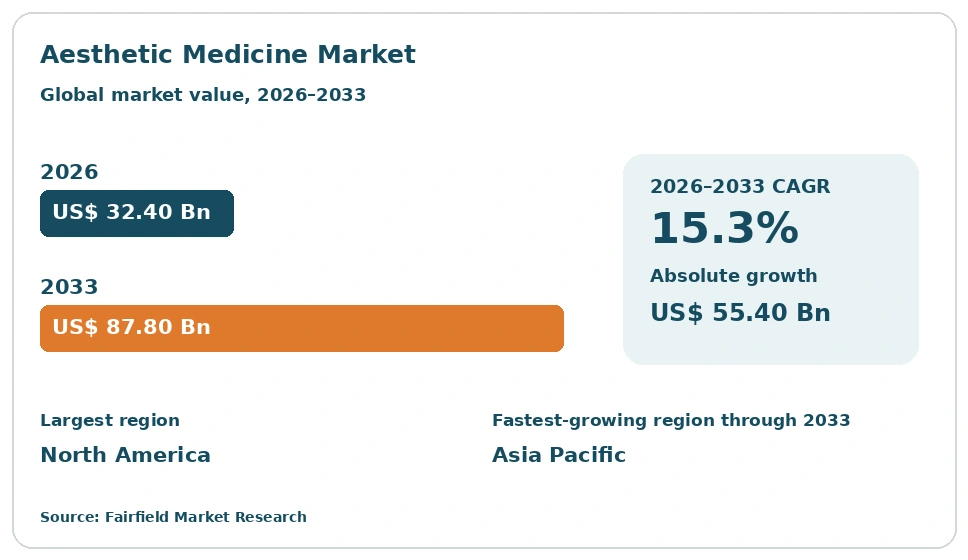
The global aesthetic medicine market size is expected to be valued at US$ 32.40 billion in 2026 and projected to reach US$ 87.80 billion by 2033, growing at a CAGR of 15.3% between 2026 and 2033.
Between 2020 and 2025, the market grew at a CAGR of about 17.6%, rising from roughly US$ 12.5 billion to about US$ 28.1 billion, as clinics reopened after pandemic closures, video calls and social media raised interest in facial appearance, and younger patients began using preventive treatments. The aesthetic medicine market covers minimally invasive and surgical procedures and products that improve appearance, including botulinum toxin injections, hyaluronic acid dermal fillers, biostimulators, laser and radiofrequency skin treatments, body contouring, hair removal, chemical peels, breast implants, and physician-dispensed skincare. Treatments are delivered by dermatologists, plastic surgeons, and trained injectors in clinics, hospitals, and medical spas. Weight loss from GLP-1 medicines is creating new demand for facial volume and skin tightening treatments. In October 2026, Galderma agreed to acquire ZO Skin Health for US$ 1.5 billion.
Key Report Takeaways
- By Product: Injectables held about 48% share in 2025, while Energy-Based Devices are projected to expand at a 16.4% CAGR through 2033, driven by skin tightening, body contouring, and multi-technology platforms that treat several concerns with little downtime.
- By Gender: Female patients held about 85% share in 2025, while Male patients are projected to expand at a 17.2% CAGR through 2033, driven by workplace appearance concerns, social media influence, and reduced stigma around cosmetic treatment.
- By End User: Hospitals held about 33% share in 2025, while Medical Spas and Beauty Centers are projected to expand at a 16.2% CAGR through 2033, driven by convenient locations, membership models, and lower prices.
- By Region: North America held about 39.5% share in 2025, while Asia Pacific is projected to expand at a 16.5% CAGR through 2033, driven by rising incomes, beauty culture in South Korea and China, and medical tourism.
Global Aesthetic Medicine Market Trends and Insights
Drivers Impact Analysis
Two drivers carry the strongest influence on aesthetic medicine market demand during the forecast period.
| Driver | Impact on CAGR Forecast | Geographic Relevance | Impact Timeline |
| Demand for minimally invasive treatments | High | Global | Long term (≥4 years) |
| GLP-1 weight loss and aging populations | High | North America, Europe, Asia Pacific | Medium term (2-4 years) |
Minimally Invasive Demand Is Driving the Aesthetic Medicine Market
Demand for minimally invasive treatments is the strongest driver of the aesthetic medicine market. People want visible results without surgery.
The mechanism is that injectables and energy-based treatments take minutes, need little or no recovery time, and cost far less than surgery. Patients can have botulinum toxin or filler treatments during a lunch break and return to work the same day. Social media, video calls, and celebrity culture have made these treatments common and accepted, especially among people in their twenties and thirties who use them to prevent signs of aging. Repeat visits every few months create steady revenue for clinics and product makers. New products with longer duration, more natural results, and new treatment areas keep attracting patients. Clinics also use financing plans and memberships to make treatment easier to afford. These trends support strong long-term growth.
GLP-1 Weight Loss Is Expanding the Aesthetic Medicine Market
GLP-1 weight loss and aging populations are expanding the aesthetic medicine market. Both trends create new treatment needs.
The cause is the rapid uptake of weight loss medicines such as semaglutide and tirzepatide. Fast weight loss can cause facial hollowing, sagging skin, and loss of volume, often described as medication-related facial changes. Patients are turning to dermal fillers, biostimulators, and skin tightening devices to restore their appearance, and companies such as Galderma and AbbVie are developing products and training for this group. At the same time, aging populations in North America, Europe, Japan, and China want to look younger for longer, and many older adults have money to spend. Many of these patients have never had aesthetic treatment before. These trends widen the patient pool for aesthetic treatments.
Restraints Impact Analysis
Two restraints limit how quickly the aesthetic medicine market grows.
| Restraint | Impact on CAGR Forecast | Geographic Relevance | Impact Timeline |
| Out-of-pocket costs and economic sensitivity | High | Global | Short term (≤2 years) |
| Safety risks and unqualified practitioners | Medium | Global | Long term (≥4 years) |
Out-of-Pocket Costs Slow the Aesthetic Medicine Market
Out-of-pocket costs and economic sensitivity slow the aesthetic medicine market. Insurance does not pay for cosmetic treatment.
The problem is that patients must pay for every procedure themselves, so spending falls when household budgets are tight. High inflation and interest rates in 2023 and 2024 caused some patients to delay treatments or visit clinics less often, and several device companies reported weaker sales as clinics postponed buying expensive equipment. Treatments must be repeated to maintain results, which adds up to large yearly costs. Price competition from discount clinics and new low-cost products also reduces margins for established brands. Currency swings affect demand in emerging markets. Some patients also switch to cheaper at-home devices and skincare instead of clinic visits. These factors make the market sensitive to economic cycles.
Safety Risks Restrict the Aesthetic Medicine Market
Safety risks and unqualified practitioners restrict the aesthetic medicine market. Poorly performed treatments can cause serious and lasting harm.
The constraint is that complications such as infection, blocked blood vessels, vision loss, burns, scarring, and drooping eyelids can occur, especially when treatments are performed by people without proper training. Counterfeit and unapproved products sold online add further risk. In many countries, rules on who can inject fillers and toxins are weak or poorly enforced, leading to negative news stories that damage public trust. Governments in the United Kingdom and elsewhere are introducing licensing schemes for non-surgical cosmetic procedures, which add compliance costs. Strict device and product approval rules also slow launches. Social media can quickly spread stories about bad results. These issues limit growth and increase regulation across many countries.
Market Opportunities
Regenerative and Combination Treatments Open a Fast-Growth Revenue Pool
Regenerative and combination treatments open a fast-growth revenue pool. Patients increasingly want natural-looking, longer-lasting, and subtle results.
The opportunity comes from biostimulators that help the body build its own collagen, such as poly-L-lactic acid and calcium hydroxylapatite, along with polynucleotides, exosomes, and skin boosters. Clinics increasingly combine injectables, energy-based devices, and medical-grade skincare into treatment plans that improve skin quality as well as wrinkles and volume. Companies offering complete portfolios, such as Galderma with its injectables and skincare brands, can capture more spending per patient. New indications such as temple hollowing, jawline definition, and neck bands also expand use. Patients often pay more for treatment plans than for single sessions. Strong clinical data and injector training are key to winning this premium segment.
Men and Emerging Markets Create a Growth Revenue Pool
Men and emerging markets create a growth revenue pool. Large new patient groups are starting aesthetic treatment for the first time. Many first visits begin with a simple toxin treatment.
The opportunity reflects rising interest among men in jawline definition, hair restoration, wrinkle reduction, and body contouring, driven by workplace competition and social media. Men now form a fast-growing share of patients in many clinics. At the same time, rising incomes in China, India, Brazil, Mexico, Saudi Arabia, and the United Arab Emirates are creating many new consumers. South Korea and Thailand attract medical tourists for aesthetic care. Lower-priced products from local makers help widen access in these countries. Companies that tailor marketing, training, and pricing for these groups and build local distribution can capture strong growth in under-penetrated markets.
Segment Analysis
By Product: Injectables Lead While Energy-Based Devices Grow Fastest
Injectables held about 48% share in 2025. They include botulinum toxins that relax wrinkle-causing muscles and hyaluronic acid fillers that restore volume and shape. Their low cost per session, quick results, and need for repeat treatment every few months make them the largest and most profitable product group.
Energy-Based Devices are the fastest-growing product, expanding at a 16.4% CAGR through 2033. Lasers, radiofrequency, ultrasound, and microneedling systems tighten skin, reduce fat, remove hair, and improve texture and pigmentation. Multi-technology platforms let clinics treat many concerns with one system. Implants, Skincare, and At-Home Devices form other segments. At-home devices for hair removal and skin care are also gaining popularity. For the market, device growth expands treatment options and clinic investment.
By Gender: Female Patients Lead While Male Patients Grow Fastest
Female patients held about 85% share in 2025. Women have long been the main users of aesthetic treatments, especially wrinkle relaxers, fillers, skin rejuvenation, and body contouring. Many women begin preventive treatments in their twenties and continue through later life, creating long-term demand.
Male patients are the fastest-growing segment, expanding at a 17.2% CAGR through 2033. Men are seeking treatments for forehead lines, jawline and chin shape, hair loss, excess sweating, and stubborn fat. Reduced stigma, social media, and workplace pressure support growth, and clinics are designing male-focused services and marketing. Some products now have trial data that includes more men. For the market, male growth adds a large, under-treated patient group and supports higher procedure volumes.
By End User: Hospitals Lead While Medical Spas and Beauty Centers Grow Fastest
Hospitals held about 33% share in 2025. They perform surgical procedures such as breast augmentation and facelifts and offer complex non-surgical treatments with full medical support, which makes them trusted by patients seeking safety. Hospitals also treat complications from procedures done elsewhere and handle reconstructive cases.
Medical Spas and Beauty Centers are the fastest-growing end user, expanding at a 16.2% CAGR through 2033. They offer injectables, laser treatments, and skincare in convenient retail locations with flexible hours, membership plans, and lower prices. Many chains are expanding quickly. Dermatology Clinics and Ambulatory Surgical Centers form other segments. Private equity firms are investing in these chains. For the market, medical spa growth increases access, patient visits, and repeat product sales.
Geography Analysis
Which Region Is Leading the Aesthetic Medicine Market?
North America is leading the aesthetic medicine market with about 39.5% share in 2025. The United States market was about US$ 8.4 billion in 2025, supported by high consumer spending, strong awareness, many board-certified dermatologists and plastic surgeons, and a fast-growing network of medical spas. Leading companies such as AbbVie, Evolus, and Revance Therapeutics are based there, and the Food and Drug Administration has approved many neuromodulators and fillers. Canada adds strong demand. Key barriers include price sensitivity and practitioner rules. Many treatments are sold through memberships and loyalty programs. One change shaping the region is demand from GLP-1 users.
Europe Shapes the Aesthetic Medicine Market Through Product Innovation
Europe is a major aesthetic medicine market. Germany, France, Italy, Spain, and the United Kingdom have large numbers of clinics and patients, and many leading companies, including Galderma, Merz Aesthetics, Ipsen, and Teoxane, are based in the region. New products often launch there before reaching other markets. The United Kingdom is introducing licensing for non-surgical cosmetic procedures, while European Union device rules now cover some aesthetic products without a medical purpose. Key barriers include stricter regulation. Many patients travel within the region for lower-cost care. One opportunity is regenerative and skin quality treatments.
Which Region Is Growing Fastest in the Aesthetic Medicine Market?
Asia Pacific is the fastest-growing aesthetic medicine market, expanding at a 16.5% CAGR through 2033. South Korea is a global center for aesthetic treatments, with companies such as Hugel and many clinics serving medical tourists. China has a large and fast-growing market for injectables and devices, supported by local manufacturers and rising incomes. Japan, Thailand, India, and Australia add strong demand, with India growing quickly in large cities. Key barriers include counterfeit products and unlicensed providers. Regulators in China are approving more local toxins and fillers. One change shaping the region is growing male and younger patient demand.
Latin America Grows the Aesthetic Medicine Market Through Medical Tourism
Latin America is a growing aesthetic medicine market. Brazil is one of the world’s largest markets for aesthetic procedures and has many experienced plastic surgeons, while Mexico and Colombia attract medical tourists from North America with lower prices. Argentina and Chile have strong demand for injectables and body treatments. Peru is also growing as a destination for cosmetic surgery. Beauty culture and social media support very high procedure rates. Key barriers include currency swings, economic instability, and safety concerns at unregulated clinics. Social media trends strongly influence treatment choices. One opportunity is training and premium products for growing clinic chains.
Middle East & Africa Builds the Aesthetic Medicine Market Through High Spending
Middle East & Africa is an emerging aesthetic medicine market. Saudi Arabia, the United Arab Emirates, Qatar, and Kuwait have high incomes and strong demand for injectables, laser treatments, and body contouring, with Dubai serving as a regional hub for medical tourism. Israel is home to device makers such as InMode and Sisram Medical. South Africa and Egypt have growing private clinic sectors, and Morocco attracts some medical tourists. Key barriers include limited regulation in some countries. Young populations and social media use support rising demand. One opportunity is premium clinics and training programs for expanding urban markets.
Competitive Landscape
The aesthetic medicine market is moderately fragmented. AbbVie, Galderma, Merz Aesthetics, Bausch Health, and Ipsen are leading players, while Evolus, Revance Therapeutics, Hugel, InMode, Cynosure Lutronic, Sisram Medical, and Teoxane compete strongly. A few large companies dominate injectables through well-known toxin and filler brands, while the device market includes many laser, radiofrequency, and body contouring makers. Local manufacturers in South Korea and China are gaining share with lower-priced products.
Companies compete on brand trust, clinical evidence, natural-looking results, duration, safety, price, and injector training. Large injectable companies use loyalty programs, practice support, and bundled product portfolios to keep clinics. Device makers compete on multi-technology platforms, treatment speed, and financing options for clinics. New indications and treatment areas are an important way to grow sales.
Strategic moves show how competition is changing. In February 2026, the FDA accepted Galderma’s resubmitted application for liquid relabotulinumtoxinA. In March 2026, Galderma won approval for Restylane Contour in temple hollowing. In October 2026, Galderma agreed to buy ZO Skin Health for US$ 1.5 billion. These moves show leaders building complete portfolios that combine injectables, devices, and medical-grade skincare.
Three themes shape vendor strategy. First, companies are expanding into regenerative treatments, biostimulators, and skin quality products. Second, they are targeting new patient groups, including men and people losing weight with GLP-1 medicines. Third, they are growing in Asia Pacific, Latin America, and Middle East & Africa through local partners and training.
Aesthetic Medicine Market Industry Leaders
- AbbVie
- Galderma
- Merz Aesthetics
- Bausch Health
- Ipsen
Recent Industry Developments
- October 2026: Galderma agreed to acquire ZO Skin Health for an enterprise value of US$ 1.5 billion - adds a physician-dispensed skincare brand with about 16,500 accounts and strengthens its portfolio in the aesthetic medicine market.
- March 2026: Galderma received FDA approval for Restylane Contour to correct temple hollowing - expands hyaluronic acid filler use for volume loss, including after weight loss.
- February 2026: The FDA accepted Galderma’s resubmitted biologics license application for relabotulinumtoxinA, a ready-to-use liquid neuromodulator - could add a new toxin option in North America.
Companies Covered in the Report
- AbbVie
- Galderma
- Merz Aesthetics
- Bausch Health
- Ipsen
- Evolus
- Revance Therapeutics
- Hugel
- InMode
- Cynosure Lutronic
- Sisram Medical
- Teoxane
Aesthetic Medicine Market Report Scope
This report covers the aesthetic medicine market, including injectables such as botulinum toxins and dermal fillers, energy-based devices, implants, skincare, and at-home devices, used by female and male patients, and delivered through hospitals, dermatology clinics, medical spas and beauty centers, and ambulatory surgical centers. The base year is 2025, and the forecast period runs from 2026 to 2033. All values are expressed in US$ Billion.
| Product | Injectables, Energy-Based Devices, Implants, Skincare, At-Home Devices |
| Gender | Female, Male |
| End User | Hospitals, Dermatology Clinics, Medical Spas and Beauty Centers, Ambulatory Surgical Centers |
| Regions | North America, Europe, Asia Pacific, Latin America, Middle East & Africa |
1. Executive Summary
1.1 Aesthetic Medicine Market Snapshot
1.2 Future Projections
1.3 Key Market Trends
1.4 Regional Snapshot
2. Market Overview
2.1 Market Definition and Report Scope
2.2 Historical Market Trends
2.3 Market Dynamics
2.3.1 Drivers
2.3.1.1 Minimally Invasive Demand Is Driving the Aesthetic Medicine Market
2.3.1.2 GLP-1 Weight Loss Is Expanding the Aesthetic Medicine Market
2.3.2 Restraints
2.3.2.1 Out-of-Pocket Costs Slow the Aesthetic Medicine Market
2.3.2.2 Safety Risks Restrict the Aesthetic Medicine Market
2.3.3 Market Opportunities
2.3.3.1 Regenerative and Combination Treatments Open a Fast-Growth Revenue Pool
2.3.3.2 Men and Emerging Markets Create a Growth Revenue Pool
3. Global Aesthetic Medicine Market Outlook, 2020–2033
3.1 Global Aesthetic Medicine Market Outlook, by Product, Value (US$ Billion), 2020–2033
3.1.1 Injectables
3.1.2 Energy-Based Devices
3.1.3 Implants
3.1.4 Skincare
3.1.5 At-Home Devices
3.2 Global Aesthetic Medicine Market Outlook, by Gender, Value (US$ Billion), 2020–2033
3.2.1 Female
3.2.2 Male
3.3 Global Aesthetic Medicine Market Outlook, by End User, Value (US$ Billion), 2020–2033
3.3.1 Hospitals
3.3.2 Dermatology Clinics
3.3.3 Medical Spas and Beauty Centers
3.3.4 Ambulatory Surgical Centers
3.4 Global Aesthetic Medicine Market Outlook, by Region, Value (US$ Billion), 2020–2033
3.4.1 North America
3.4.2 Europe
3.4.3 Asia Pacific
3.4.4 Latin America
3.4.5 Middle East & Africa
4. North America Aesthetic Medicine Market Outlook, 2020–2033
4.1 North America Aesthetic Medicine Market Outlook, by Product, Value (US$ Billion), 2020–2033
4.1.1 Injectables
4.1.2 Energy-Based Devices
4.1.3 Implants
4.1.4 Skincare
4.1.5 At-Home Devices
4.2 North America Aesthetic Medicine Market Outlook, by Gender, Value (US$ Billion), 2020–2033
4.2.1 Female
4.2.2 Male
4.3 North America Aesthetic Medicine Market Outlook, by End User, Value (US$ Billion), 2020–2033
4.3.1 Hospitals
4.3.2 Dermatology Clinics
4.3.3 Medical Spas and Beauty Centers
4.3.4 Ambulatory Surgical Centers
4.4 North America Aesthetic Medicine Market Outlook, by Country, Value (US$ Billion), 2020–2033
4.4.1 United States Aesthetic Medicine Market Outlook, by Product, 2020–2033
4.4.2 United States Aesthetic Medicine Market Outlook, by Gender, 2020–2033
4.4.3 United States Aesthetic Medicine Market Outlook, by End User, 2020–2033
4.4.4 Canada Aesthetic Medicine Market Outlook, by Product, 2020–2033
4.4.5 Canada Aesthetic Medicine Market Outlook, by Gender, 2020–2033
4.4.6 Canada Aesthetic Medicine Market Outlook, by End User, 2020–2033
5. Europe Aesthetic Medicine Market Outlook, 2020–2033
5.1 Europe Aesthetic Medicine Market Outlook, by Product, Value (US$ Billion), 2020–2033
5.1.1 Injectables
5.1.2 Energy-Based Devices
5.1.3 Implants
5.1.4 Skincare
5.1.5 At-Home Devices
5.2 Europe Aesthetic Medicine Market Outlook, by Gender, Value (US$ Billion), 2020–2033
5.2.1 Female
5.2.2 Male
5.3 Europe Aesthetic Medicine Market Outlook, by End User, Value (US$ Billion), 2020–2033
5.3.1 Hospitals
5.3.2 Dermatology Clinics
5.3.3 Medical Spas and Beauty Centers
5.3.4 Ambulatory Surgical Centers
5.4 Europe Aesthetic Medicine Market Outlook, by Country, Value (US$ Billion), 2020–2033
5.4.1 Germany Aesthetic Medicine Market Outlook, by Product, 2020–2033
5.4.2 Germany Aesthetic Medicine Market Outlook, by Gender, 2020–2033
5.4.3 Germany Aesthetic Medicine Market Outlook, by End User, 2020–2033
5.4.4 France Aesthetic Medicine Market Outlook, by Product, 2020–2033
5.4.5 France Aesthetic Medicine Market Outlook, by Gender, 2020–2033
5.4.6 France Aesthetic Medicine Market Outlook, by End User, 2020–2033
5.4.7 Italy Aesthetic Medicine Market Outlook, by Product, 2020–2033
5.4.8 Italy Aesthetic Medicine Market Outlook, by Gender, 2020–2033
5.4.9 Italy Aesthetic Medicine Market Outlook, by End User, 2020–2033
5.4.10 Spain Aesthetic Medicine Market Outlook, by Product, 2020–2033
5.4.11 Spain Aesthetic Medicine Market Outlook, by Gender, 2020–2033
5.4.12 Spain Aesthetic Medicine Market Outlook, by End User, 2020–2033
5.4.13 United Kingdom Aesthetic Medicine Market Outlook, by Product, 2020–2033
5.4.14 United Kingdom Aesthetic Medicine Market Outlook, by Gender, 2020–2033
5.4.15 United Kingdom Aesthetic Medicine Market Outlook, by End User, 2020–2033
6. Asia Pacific Aesthetic Medicine Market Outlook, 2020–2033
6.1 Asia Pacific Aesthetic Medicine Market Outlook, by Product, Value (US$ Billion), 2020–2033
6.1.1 Injectables
6.1.2 Energy-Based Devices
6.1.3 Implants
6.1.4 Skincare
6.1.5 At-Home Devices
6.2 Asia Pacific Aesthetic Medicine Market Outlook, by Gender, Value (US$ Billion), 2020–2033
6.2.1 Female
6.2.2 Male
6.3 Asia Pacific Aesthetic Medicine Market Outlook, by End User, Value (US$ Billion), 2020–2033
6.3.1 Hospitals
6.3.2 Dermatology Clinics
6.3.3 Medical Spas and Beauty Centers
6.3.4 Ambulatory Surgical Centers
6.4 Asia Pacific Aesthetic Medicine Market Outlook, by Country, Value (US$ Billion), 2020–2033
6.4.1 South Korea Aesthetic Medicine Market Outlook, by Product, 2020–2033
6.4.2 South Korea Aesthetic Medicine Market Outlook, by Gender, 2020–2033
6.4.3 South Korea Aesthetic Medicine Market Outlook, by End User, 2020–2033
6.4.4 China Aesthetic Medicine Market Outlook, by Product, 2020–2033
6.4.5 China Aesthetic Medicine Market Outlook, by Gender, 2020–2033
6.4.6 China Aesthetic Medicine Market Outlook, by End User, 2020–2033
6.4.7 Japan Aesthetic Medicine Market Outlook, by Product, 2020–2033
6.4.8 Japan Aesthetic Medicine Market Outlook, by Gender, 2020–2033
6.4.9 Japan Aesthetic Medicine Market Outlook, by End User, 2020–2033
6.4.10 Thailand Aesthetic Medicine Market Outlook, by Product, 2020–2033
6.4.11 Thailand Aesthetic Medicine Market Outlook, by Gender, 2020–2033
6.4.12 Thailand Aesthetic Medicine Market Outlook, by End User, 2020–2033
6.4.13 India Aesthetic Medicine Market Outlook, by Product, 2020–2033
6.4.14 India Aesthetic Medicine Market Outlook, by Gender, 2020–2033
6.4.15 India Aesthetic Medicine Market Outlook, by End User, 2020–2033
6.4.16 Australia Aesthetic Medicine Market Outlook, by Product, 2020–2033
6.4.17 Australia Aesthetic Medicine Market Outlook, by Gender, 2020–2033
6.4.18 Australia Aesthetic Medicine Market Outlook, by End User, 2020–2033
7. Latin America Aesthetic Medicine Market Outlook, 2020–2033
7.1 Latin America Aesthetic Medicine Market Outlook, by Product, Value (US$ Billion), 2020–2033
7.1.1 Injectables
7.1.2 Energy-Based Devices
7.1.3 Implants
7.1.4 Skincare
7.1.5 At-Home Devices
7.2 Latin America Aesthetic Medicine Market Outlook, by Gender, Value (US$ Billion), 2020–2033
7.2.1 Female
7.2.2 Male
7.3 Latin America Aesthetic Medicine Market Outlook, by End User, Value (US$ Billion), 2020–2033
7.3.1 Hospitals
7.3.2 Dermatology Clinics
7.3.3 Medical Spas and Beauty Centers
7.3.4 Ambulatory Surgical Centers
7.4 Latin America Aesthetic Medicine Market Outlook, by Country, Value (US$ Billion), 2020–2033
7.4.1 Brazil Aesthetic Medicine Market Outlook, by Product, 2020–2033
7.4.2 Brazil Aesthetic Medicine Market Outlook, by Gender, 2020–2033
7.4.3 Brazil Aesthetic Medicine Market Outlook, by End User, 2020–2033
7.4.4 Mexico Aesthetic Medicine Market Outlook, by Product, 2020–2033
7.4.5 Mexico Aesthetic Medicine Market Outlook, by Gender, 2020–2033
7.4.6 Mexico Aesthetic Medicine Market Outlook, by End User, 2020–2033
7.4.7 Colombia Aesthetic Medicine Market Outlook, by Product, 2020–2033
7.4.8 Colombia Aesthetic Medicine Market Outlook, by Gender, 2020–2033
7.4.9 Colombia Aesthetic Medicine Market Outlook, by End User, 2020–2033
7.4.10 Argentina Aesthetic Medicine Market Outlook, by Product, 2020–2033
7.4.11 Argentina Aesthetic Medicine Market Outlook, by Gender, 2020–2033
7.4.12 Argentina Aesthetic Medicine Market Outlook, by End User, 2020–2033
7.4.13 Chile Aesthetic Medicine Market Outlook, by Product, 2020–2033
7.4.14 Chile Aesthetic Medicine Market Outlook, by Gender, 2020–2033
7.4.15 Chile Aesthetic Medicine Market Outlook, by End User, 2020–2033
7.4.16 Peru Aesthetic Medicine Market Outlook, by Product, 2020–2033
7.4.17 Peru Aesthetic Medicine Market Outlook, by Gender, 2020–2033
7.4.18 Peru Aesthetic Medicine Market Outlook, by End User, 2020–2033
8. Middle East & Africa Aesthetic Medicine Market Outlook, 2020–2033
8.1 Middle East & Africa Aesthetic Medicine Market Outlook, by Product, Value (US$ Billion), 2020–2033
8.1.1 Injectables
8.1.2 Energy-Based Devices
8.1.3 Implants
8.1.4 Skincare
8.1.5 At-Home Devices
8.2 Middle East & Africa Aesthetic Medicine Market Outlook, by Gender, Value (US$ Billion), 2020–2033
8.2.1 Female
8.2.2 Male
8.3 Middle East & Africa Aesthetic Medicine Market Outlook, by End User, Value (US$ Billion), 2020–2033
8.3.1 Hospitals
8.3.2 Dermatology Clinics
8.3.3 Medical Spas and Beauty Centers
8.3.4 Ambulatory Surgical Centers
8.4 Middle East & Africa Aesthetic Medicine Market Outlook, by Country, Value (US$ Billion), 2020–2033
8.4.1 Saudi Arabia Aesthetic Medicine Market Outlook, by Product, 2020–2033
8.4.2 Saudi Arabia Aesthetic Medicine Market Outlook, by Gender, 2020–2033
8.4.3 Saudi Arabia Aesthetic Medicine Market Outlook, by End User, 2020–2033
8.4.4 United Arab Emirates Aesthetic Medicine Market Outlook, by Product, 2020–2033
8.4.5 United Arab Emirates Aesthetic Medicine Market Outlook, by Gender, 2020–2033
8.4.6 United Arab Emirates Aesthetic Medicine Market Outlook, by End User, 2020–2033
8.4.7 Qatar Aesthetic Medicine Market Outlook, by Product, 2020–2033
8.4.8 Qatar Aesthetic Medicine Market Outlook, by Gender, 2020–2033
8.4.9 Qatar Aesthetic Medicine Market Outlook, by End User, 2020–2033
8.4.10 Kuwait Aesthetic Medicine Market Outlook, by Product, 2020–2033
8.4.11 Kuwait Aesthetic Medicine Market Outlook, by Gender, 2020–2033
8.4.12 Kuwait Aesthetic Medicine Market Outlook, by End User, 2020–2033
8.4.13 Israel Aesthetic Medicine Market Outlook, by Product, 2020–2033
8.4.14 Israel Aesthetic Medicine Market Outlook, by Gender, 2020–2033
8.4.15 Israel Aesthetic Medicine Market Outlook, by End User, 2020–2033
8.4.16 South Africa Aesthetic Medicine Market Outlook, by Product, 2020–2033
8.4.17 South Africa Aesthetic Medicine Market Outlook, by Gender, 2020–2033
8.4.18 South Africa Aesthetic Medicine Market Outlook, by End User, 2020–2033
8.4.19 Egypt Aesthetic Medicine Market Outlook, by Product, 2020–2033
8.4.20 Egypt Aesthetic Medicine Market Outlook, by Gender, 2020–2033
8.4.21 Egypt Aesthetic Medicine Market Outlook, by End User, 2020–2033
8.4.22 Morocco Aesthetic Medicine Market Outlook, by Product, 2020–2033
8.4.23 Morocco Aesthetic Medicine Market Outlook, by Gender, 2020–2033
8.4.24 Morocco Aesthetic Medicine Market Outlook, by End User, 2020–2033
9. Competitive Landscape
9.1 Aesthetic Medicine Market Industry Leaders
9.2 Recent Industry Developments
9.3 Company Profiles
9.3.1 AbbVie
9.3.2 Galderma
9.3.3 Merz Aesthetics
9.3.4 Bausch Health
9.3.5 Ipsen
9.3.6 Evolus
9.3.7 Revance Therapeutics
9.3.8 Hugel
9.3.9 InMode
9.3.10 Cynosure Lutronic
9.3.11 Sisram Medical
9.3.12 Teoxane
10. Appendix
10.1 Research Methodology
10.2 Report Assumptions
10.3 Acronyms and Abbreviations
| Product | Injectables, Energy-Based Devices, Implants, Skincare, At-Home Devices |
| Gender | Female, Male |
| End User | Hospitals, Dermatology Clinics, Medical Spas and Beauty Centers, Ambulatory Surgical Centers |
| Regions | North America, Europe, Asia Pacific, Latin America, Middle East & Africa |
Our Research Methodology
Considering the volatility of business today, traditional approaches to strategizing a game plan can be unfruitful if not detrimental. True ambiguity is no way to determine a forecast. A myriad of predetermined factors must be accounted for such as the degree of risk involved, the magnitude of circumstances, as well as conditions or consequences that are not known or unpredictable. To circumvent binary views that cast uncertainty, the application of market research intelligence to strategically posture, move, and enable actionable outcomes is necessary.
View Methodology
Quality Assured
Rigorous Validation Process

Confidentiality Assured
End-to-end Data Security

Custom Research Services
Tailored To Your Objectives
FAQs
The aesthetic medicine market is valued at US$ 32.40 billion in 2026, led by injectables, female patients, and North America.
The market is projected to reach US$ 87.80 billion by 2033, growing at a 15.3% CAGR and adding US$ 55.40 billion.
Energy-based devices are growing fastest at a 16.4% CAGR through 2033, driven by skin tightening, body contouring, and multi-technology platforms.
Asia Pacific is growing fastest at a 16.5% CAGR through 2033, driven by rising incomes, beauty culture, and aesthetic medical tourism.
North America holds the largest share at about 39.5% in 2025, supported by high spending, awareness, and many medical spas.
Related Reports
Asthma Treatment Market Size, Share, Insights, Competitive Landscape, and Forecast 2026 to 2033
Explore the asthma treatment market outlook for 2026–2033, covering drug classes, devices, distribution channels, patient segments, and regions.
Kidney Dialysis Centres Market Size, Share, Insights, Competitive Landscape, and Forecast 2026 to 2033
Explore the kidney dialysis centres market outlook for 2026–2033, covering dialysis types, service settings, centre types, regions, and key companies.
Cervical Cancer Treatment Market Size, Share, Insights, Competitive Landscape, and Forecast 2026 to 2033
Explore the cervical cancer treatment market outlook for 2026–2033, covering therapies, cancer types, end users, regional trends, and key companies.
Gout Therapeutic Market Size, Share, Insights, Competitive Landscape, and Forecast 2026 to 2033
The global gout therapeutic market is valued at US$2.9 billion in 2026, reaching US$4.7 billion by 2033, growing at a 7.1% CAGR
Small Molecule API Market Size, Share, Insights, Competitive Landscape, and Forecast 2026 to 2033
Explore the small molecule API market outlook for 2026–2033, including synthesis, manufacturing, therapeutic applications, regions, and competitors.
Medical Marijuana Market Size, Share, Insights, Competitive Landscape, and Forecast 2026 to 2033
Explore the medical marijuana market outlook for 2026–2033, including product forms, distribution channels, regional trends, and competitive insights.