



Cancer Stem Cell Therapeutics Market
Cancer Stem Cell Therapeutics Market Size, Share, Insights, Competitive Landscape, and Forecast 2026 to 2033
Report Overview
Cancer Stem Cell Therapeutics Market Size and Trend Analysis
How Fast Is the Cancer Stem Cell Therapeutics Market Growing?
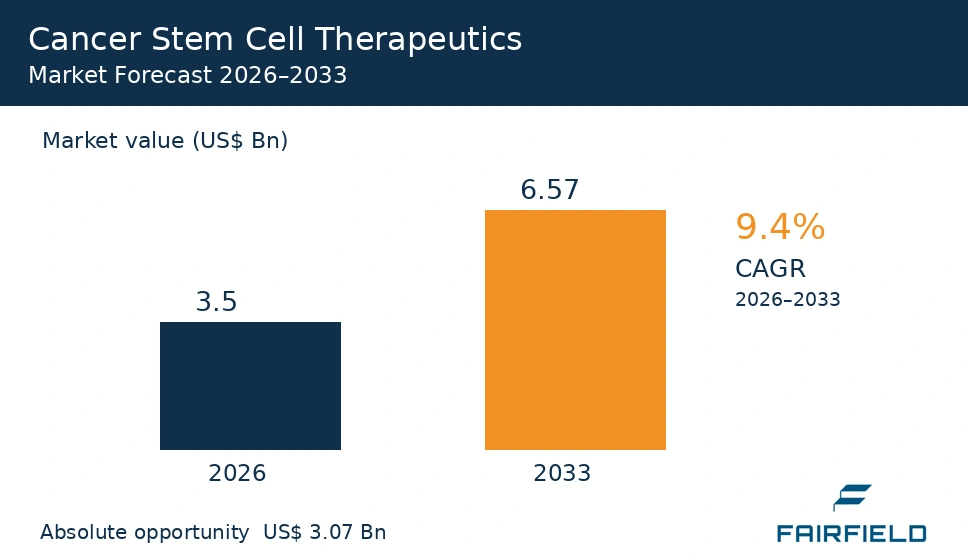
The global cancer stem cell therapeutics market size is expected to be valued at US$ 3.50 billion in 2026 and projected to reach US$ 6.57 billion by 2033, growing at a CAGR of 9.4% between 2026 and 2033.
Between 2020 and 2025, the market grew at a CAGR of about 8.8%, rising from roughly US$ 2.1 billion to about US$ 3.2 billion, as cancer cases rose worldwide, stem cell transplant volumes recovered after pandemic delays, and drug developers increased research into tumor relapse and drug resistance. The cancer stem cell therapeutics market covers treatments that target cancer stem cells, a small group of cells inside tumors that can renew themselves, resist chemotherapy and radiation, and drive relapse and metastasis, as well as stem cell-based cancer therapies such as autologous and allogeneic stem cell transplants. Targeted approaches include pathway inhibitors acting on Notch, Wnt, Hedgehog, STAT3, and FAK signalling, monoclonal antibodies, antibody-drug conjugates, and immunotherapies aimed at stem cell markers such as CD44, CD133, and CD123. In November 2026, Verastem Oncology reported US$ 24.0 million in quarterly net revenue for its Avmapki Fakzynja Co-pack.
Key Report Takeaways
- By Mode of Action: Targeted Cancer Stem Cell Therapeutics held about 58% share in 2025, while Stem Cell-based Cancer Therapy is projected to expand at a 10.2% CAGR through 2033, driven by rising transplant volumes, new cell sources, and engineered stem cell products.
- By Cancer Type: Breast Cancer held about 25% share in 2025, while Lung Cancer is projected to expand at an 11.7% CAGR through 2033, driven by high lung cancer incidence, frequent drug resistance, and growing research on stem-like cells in non-small cell lung cancer.
- By End User: Hospitals held about 45% share in 2025, while Research Institutes and CROs are projected to expand at an 11.0% CAGR through 2033, driven by increasing early-stage cancer stem cell research, organoid models, and outsourced drug discovery programs.
- By Region: North America held about 37% share in 2025, while Asia Pacific is projected to expand at an 11.5% CAGR through 2033, driven by rising cancer cases, fast-growing biotech sectors, and expanding clinical trial activity in China and Japan.
Global Cancer Stem Cell Therapeutics Market Trends and Insights
Drivers Impact Analysis
Two drivers carry the strongest influence on cancer stem cell therapeutics market demand during the forecast period.
| Driver | Impact on CAGR Forecast | Geographic Relevance | Impact Timeline |
| Rising cancer incidence and relapse rates | High | Global | Long term (≥4 years) |
| Growing research funding and pipeline activity | Medium | North America, Europe, Asia Pacific | Medium term (2-4 years) |
Rising Cancer Burden Is Driving the Cancer Stem Cell Therapeutics Market
Rising cancer incidence and relapse rates are the strongest driver of the cancer stem cell therapeutics market. Many patients relapse after standard treatment.
The mechanism is that cancer is one of the leading causes of death worldwide, and the number of new cases keeps rising as populations age and lifestyle risk factors spread. Even when chemotherapy, radiation, or targeted drugs shrink tumors, a small group of cancer stem cells can survive and later cause the cancer to return or spread. Doctors and drug developers increasingly see targeting these cells as key to preventing relapse and improving long-term survival. Blood cancers such as leukemia, lymphoma, and multiple myeloma also rely heavily on stem cell transplants. Breast, lung, colorectal, pancreatic, and brain cancers show high resistance linked to stem-like cells. These trends create strong demand for new therapies.
Research Funding Is Expanding the Cancer Stem Cell Therapeutics Market
Growing research funding and pipeline activity are expanding the cancer stem cell therapeutics market. Scientists are learning more about how these cells work.
The cause is that governments, cancer charities, pharmaceutical companies, and biotech investors are spending heavily on oncology research, and cancer stem cells have become a major focus. New tools such as single-cell sequencing, organoids, CRISPR screening, and advanced imaging help researchers identify stem cell markers and signalling pathways. Companies are testing drugs against FAK, Notch, Wnt, Hedgehog, and STAT3 pathways, along with antibodies, antibody-drug conjugates, and CAR-T cells aimed at stem cell markers. In May 2025, the FDA granted accelerated approval to Verastem’s Avmapki Fakzynja Co-pack, which includes the FAK inhibitor defactinib, for KRAS-mutated ovarian cancer. These advances support pipeline growth.
Restraints Impact Analysis
Two restraints limit how quickly the cancer stem cell therapeutics market grows.
| Restraint | Impact on CAGR Forecast | Geographic Relevance | Impact Timeline |
| High clinical failure rates and complex biology | High | Global | Long term (≥4 years) |
| High treatment costs and regulatory hurdles | Medium | Asia Pacific, Latin America, Middle East & Africa | Medium term (2-4 years) |
Clinical Failures Slow the Cancer Stem Cell Therapeutics Market
High clinical failure rates and complex biology slow the cancer stem cell therapeutics market. Targeting cancer stem cells has proven difficult.
The problem is that cancer stem cells are hard to identify and isolate, because their markers vary between tumor types, patients, and even within the same tumor, and normal cells can become stem-like under stress. The pathways that control cancer stem cells, such as Notch, Wnt, and Hedgehog, are also important for healthy stem cells, so blocking them can cause serious side effects. Several high-profile drugs designed to target cancer stem cells failed in late-stage trials, leading some companies to stop programs or close. Measuring whether a drug actually kills cancer stem cells in patients is also challenging. These failures make investors cautious and slow development.
High Costs Restrict the Cancer Stem Cell Therapeutics Market
High treatment costs and regulatory hurdles restrict the cancer stem cell therapeutics market. Advanced therapies are expensive to develop and deliver.
The constraint is that stem cell transplants, cell therapies, and new targeted cancer drugs can cost hundreds of thousands of dollars per patient, including hospital stays, donor matching, cell processing, and follow-up care. Many health systems and insurers in Asia Pacific, Latin America, and Middle East & Africa cannot cover these costs widely, limiting access. Manufacturing cell-based products requires specialized facilities and strict quality control. Regulators require large, long trials for cancer drugs, and stem cell products face extra safety reviews because of risks such as tumor formation. Ethical concerns around some stem cell sources add complexity. These factors slow market growth and limit patient access in many countries.
Market Opportunities
Combination Therapies and Precision Oncology Open a Fast-Growth Revenue Pool
Combination therapies and precision oncology open a fast-growth revenue pool. Targeting cancer stem cells alongside standard treatment may prevent relapse.
The opportunity comes from combining cancer stem cell-targeted drugs with chemotherapy, targeted therapies, immunotherapies, and radiation to attack both the bulk tumor and resistant stem-like cells. Verastem’s co-pack, which pairs a RAF/MEK inhibitor with the FAK inhibitor defactinib, shows how combination approaches can reach the market, and the company reported a priority review for a new blister pack in 2026. Biomarker tests that identify patients with high stem cell activity can help select the right patients for treatment. Antibody-drug conjugates and bispecific antibodies aimed at stem cell markers are also advancing. Companies that develop combinations with clear biomarkers can win premium pricing and faster approvals.
Cell Therapies and Asia Pacific Growth Create a Growth Revenue Pool
Cell therapies and Asia Pacific growth create a growth revenue pool. New stem cell-based treatments and new markets are emerging.
The opportunity reflects rapid progress in stem cell-based cancer therapies, including improved stem cell transplants, cord blood products, engineered hematopoietic stem cells, mesenchymal stem cell therapies, and induced pluripotent stem cell-derived immune cells such as iPSC-derived natural killer cells and CAR-T cells. In December 2024, the FDA approved Mesoblast’s Ryoncil, a mesenchymal stromal cell therapy for graft-versus-host disease after transplant. At the same time, China, Japan, South Korea, and India are expanding cancer research, cell therapy manufacturing, and clinical trials. Companies that partner with regional biotech firms and hospitals can capture strong growth across the region’s large markets.
Segment Analysis
By Mode of Action: Targeted Cancer Stem Cell Therapeutics Lead While Stem Cell-based Cancer Therapy Grows Fastest
Targeted Cancer Stem Cell Therapeutics held about 58% share in 2025. This segment includes pathway inhibitors, monoclonal antibodies, antibody-drug conjugates, and immunotherapies designed to kill or block cancer stem cells, along with research products used to study them. Strong pipeline activity and new approvals support this segment’s leading position, and research tools such as isolation kits and assays add steady revenue.
Stem Cell-based Cancer Therapy is the fastest-growing mode of action, expanding at a 10.2% CAGR through 2033. Autologous and allogeneic stem cell transplants remain essential for blood cancers, and new cell sources, expanded cord blood products, and engineered stem cells are improving outcomes and widening access. For the market, cell therapy growth adds high-value treatment revenue and encourages new manufacturing investment.
By Cancer Type: Breast Cancer Leads While Lung Cancer Grows Fastest
Breast Cancer held about 25% share in 2025. Breast cancer is one of the most common cancers worldwide, and breast cancer stem cells marked by CD44 and ALDH have been widely studied, especially in triple-negative breast cancer, which often resists standard treatment and relapses early. Many clinical trials focus on this cancer type.
Lung Cancer is the fastest-growing cancer type, expanding at an 11.7% CAGR through 2033. Lung cancer causes the most cancer deaths worldwide, and stem-like cells contribute to resistance against chemotherapy and targeted drugs. Blood Cancer, Colorectal Cancer, Brain Cancer, Pancreatic Cancer, and Other Cancers form further segments. For the market, lung cancer growth supports large new programs and combination trials in many countries worldwide.
By End User: Hospitals Lead While Research Institutes and CROs Grow Fastest
Hospitals held about 45% share in 2025. Hospitals and cancer centers perform stem cell transplants, give targeted cancer drugs, and run many clinical trials, making them the main buyers of cancer stem cell therapeutics. Large academic medical centers lead in advanced treatments, and many hospitals are adding cell therapy units to deliver transplants and engineered cell products.
Research Institutes and CROs are the fastest-growing end user, expanding at an 11.0% CAGR through 2033. Universities, cancer research institutes, and contract research organizations study cancer stem cells and test new drugs using organoids and animal models. Specialty Clinics and Other End Users form further segments. For the market, research growth fuels the future drug pipeline and increases demand for research products and outsourced testing services.
Geography Analysis
Which Region Is Leading the Cancer Stem Cell Therapeutics Market?
North America is leading the cancer stem cell therapeutics market with about 37% share in 2025. The United States has the world’s largest cancer research funding base, many leading cancer centers, and a large number of biotech companies developing cancer stem cell-targeted drugs and cell therapies. The FDA has approved several stem cell-related products, including Mesoblast’s Ryoncil and Verastem’s co-pack, and Medicare covers several transplant types. Canada adds strong academic research. Key barriers include high treatment costs and payer pressure. One change shaping the region is a growing focus on combination therapies and biomarker-led trials.
Europe Shapes the Cancer Stem Cell Therapeutics Market Through Strong Research Networks
Europe is a major cancer stem cell therapeutics market. Germany, the United Kingdom, France, Italy, Spain, and the Netherlands have strong cancer research institutes and active stem cell transplant programs. Merck KGaA and other pharmaceutical companies in the region run oncology research, and the European Medicines Agency offers conditional approval pathways for promising therapies. Public health systems cover many transplants. Key barriers include strict regulation and price controls. One opportunity is academic-industry partnerships for early-stage drug programs, supported by large public research grants and strong cancer charities such as those in the United Kingdom.
Which Region Is Growing Fastest in the Cancer Stem Cell Therapeutics Market?
Asia Pacific is the fastest-growing cancer stem cell therapeutics market, expanding at an 11.5% CAGR through 2033. China is forecast to grow at about 11.9% a year, supported by rising cancer cases, a fast-growing biotech sector, and many clinical trials. Japan has advanced regenerative medicine rules and granted conditional approvals for its first induced pluripotent stem cell products in 2026. South Korea and India are expanding cell therapy research. Key barriers include uneven reimbursement. One change shaping the region is fast clinical trial growth, as global drug makers run more studies in China and South Korea.
Latin America Grows the Cancer Stem Cell Therapeutics Market Through Expanding Cancer Care
Latin America is a growing cancer stem cell therapeutics market. Brazil, Mexico, Argentina, Colombia, and Chile are expanding cancer centers and stem cell transplant programs, and Brazil has a large public health system that covers many transplants. Clinical trials from global drug companies are increasing in the region. Key barriers include limited funding, high drug prices, and uneven access to specialized care outside major cities. One opportunity is clinical trial partnerships and transplant program expansion, supported by growing private hospital networks and rising cancer awareness. International drug makers are also adding the region to global trials to speed patient enrollment.
Middle East & Africa Builds the Cancer Stem Cell Therapeutics Market Through Healthcare Investment
Middle East & Africa is an emerging cancer stem cell therapeutics market. Saudi Arabia, the United Arab Emirates, and Qatar are investing in specialized cancer centers, stem cell transplant units, and precision medicine programs, while Israel has strong biotech and cancer research sectors. South Africa and Egypt have growing cancer care systems and expanding oncology training programs for doctors and nurses in major cities. Key barriers include limited specialized centers and high treatment costs. One opportunity is partnerships with leading cancer centers and research hospitals, supported by government health investment, medical tourism, and growing genomic medicine programs across the region.
Competitive Landscape
The cancer stem cell therapeutics market is fragmented. Merck KGaA, AbbVie Inc., Thermo Fisher Scientific, Verastem Oncology, and Mesoblast Limited are leading players, while Bristol Myers Squibb, Stemline Therapeutics, Lineage Cell Therapeutics, STEMCELL Technologies, Miltenyi Biotec, Bio-Techne, and Fate Therapeutics compete strongly. Large pharmaceutical companies develop targeted drugs, antibodies, and combinations that act on stem cell pathways, while biotech companies focus on single programs or cell therapies. Life science tools companies supply cell isolation kits, media, antibodies, and assays used in cancer stem cell research.
Companies compete on clinical efficacy, safety, ability to prevent relapse, biomarker strategies, manufacturing capability, research tool quality, and partnerships with cancer centers. Because many early cancer stem cell drugs failed, companies now emphasize combination approaches, patient selection, and solid biomarker data. Licensing deals and collaborations between pharmaceutical companies, biotechs, and academic groups are common.
Strategic moves show how competition is changing. In December 2024, Mesoblast won FDA approval for Ryoncil. In May 2025, Verastem won accelerated approval for its co-pack containing the FAK inhibitor defactinib, and in November 2026, it reported US$ 24.0 million in quarterly revenue and a priority review for a new blister pack.
Three themes shape vendor strategy. First, companies are combining cancer stem cell-targeted drugs with established cancer treatments. Second, they are developing biomarkers to select patients most likely to benefit. Third, they are expanding cell therapies and clinical trials in Asia Pacific, Europe, and other growing regions.
Cancer Stem Cell Therapeutics Market Industry Leaders
Merck KGaA AbbVie Inc. Thermo Fisher Scientific Verastem Oncology Mesoblast Limited
Recent Industry Developments
- November 2026: Verastem Oncology reported US$ 24.0 million in third-quarter net product revenue for its Avmapki Fakzynja Co-pack, and the FDA accepted a new blister pack NDA under priority review - shows growing uptake of FAK-targeting combinations in the cancer stem cell therapeutics market.
- May 2025: Verastem Oncology received FDA accelerated approval for the Avmapki Fakzynja Co-pack, combining avutometinib and the FAK inhibitor defactinib, for KRAS-mutated recurrent low-grade serous ovarian cancer - adds a therapy that targets drug resistance pathways.
- December 2024: Mesoblast received FDA approval for Ryoncil, a mesenchymal stromal cell therapy for children with steroid-refractory acute graft-versus-host disease - supports stem cell-based therapy use after cancer transplants.
Companies Covered in the Report
- Merck KGaA
- AbbVie Inc.
- Thermo Fisher Scientific
- Verastem Oncology
- Mesoblast Limited
- Bristol Myers Squibb
- Stemline Therapeutics
- Lineage Cell Therapeutics
- STEMCELL Technologies
- Miltenyi Biotec
- Bio-Techne
- Fate Therapeutics
Cancer Stem Cell Therapeutics Market Report Scope
This report covers the cancer stem cell therapeutics market, including targeted cancer stem cell therapeutics and stem cell-based cancer therapy, used for breast, lung, blood, colorectal, brain, pancreatic, and other cancers in hospitals, research institutes and CROs, specialty clinics, and other end users. The base year is 2025, and the forecast period runs from 2026 to 2033. All values are expressed in US$ Billion.
| Mode of Action | Targeted Cancer Stem Cell Therapeutics, Stem Cell-based Cancer Therapy |
| Cancer Type | Breast Cancer, Lung Cancer, Blood Cancer, Colorectal Cancer, Brain Cancer, Pancreatic Cancer, Other Cancers |
| End User | Hospitals, Research Institutes and CROs, Specialty Clinics, Other End Users |
| Regions | North America, Europe, Asia Pacific, Latin America, Middle East & Africa |
1. Executive Summary
1.1 Cancer Stem Cell Therapeutics Market Snapshot
1.2 Future Projections
1.3 Key Market Trends
1.4 Regional Snapshot
2. Market Overview
2.1 Market Definition and Report Scope
2.2 Historical Market Trends
2.3 Market Dynamics
2.3.1 Drivers
2.3.1.1 Rising Cancer Burden Is Driving the Cancer Stem Cell Therapeutics Market
2.3.1.2 Research Funding Is Expanding the Cancer Stem Cell Therapeutics Market
2.3.2 Restraints
2.3.2.1 Clinical Failures Slow the Cancer Stem Cell Therapeutics Market
2.3.2.2 High Costs Restrict the Cancer Stem Cell Therapeutics Market
2.3.3 Market Opportunities
2.3.3.1 Combination Therapies and Precision Oncology Open a Fast-Growth Revenue Pool
2.3.3.2 Cell Therapies and Asia Pacific Growth Create a Growth Revenue Pool
3. Global Cancer Stem Cell Therapeutics Market Outlook, 2020–2033
3.1 Global Cancer Stem Cell Therapeutics Market Outlook, by Mode of Action, Value (US$ Billion), 2020–2033
3.1.1 Targeted Cancer Stem Cell Therapeutics
3.1.2 Stem Cell-based Cancer Therapy
3.2 Global Cancer Stem Cell Therapeutics Market Outlook, by Cancer Type, Value (US$ Billion), 2020–2033
3.2.1 Breast Cancer
3.2.2 Lung Cancer
3.2.3 Blood Cancer
3.2.4 Colorectal Cancer
3.2.5 Brain Cancer
3.2.6 Pancreatic Cancer
3.2.7 Other Cancers
3.3 Global Cancer Stem Cell Therapeutics Market Outlook, by End User, Value (US$ Billion), 2020–2033
3.3.1 Hospitals
3.3.2 Research Institutes and CROs
3.3.3 Specialty Clinics
3.3.4 Other End Users
3.4 Global Cancer Stem Cell Therapeutics Market Outlook, by Region, Value (US$ Billion), 2020–2033
3.4.1 North America
3.4.2 Europe
3.4.3 Asia Pacific
3.4.4 Latin America
3.4.5 Middle East & Africa
4. North America Cancer Stem Cell Therapeutics Market Outlook, 2020–2033
4.1 North America Cancer Stem Cell Therapeutics Market Outlook, by Mode of Action, Value (US$ Billion), 2020–2033
4.1.1 Targeted Cancer Stem Cell Therapeutics
4.1.2 Stem Cell-based Cancer Therapy
4.2 North America Cancer Stem Cell Therapeutics Market Outlook, by Cancer Type, Value (US$ Billion), 2020–2033
4.2.1 Breast Cancer
4.2.2 Lung Cancer
4.2.3 Blood Cancer
4.2.4 Colorectal Cancer
4.2.5 Brain Cancer
4.2.6 Pancreatic Cancer
4.2.7 Other Cancers
4.3 North America Cancer Stem Cell Therapeutics Market Outlook, by End User, Value (US$ Billion), 2020–2033
4.3.1 Hospitals
4.3.2 Research Institutes and CROs
4.3.3 Specialty Clinics
4.3.4 Other End Users
4.4 North America Cancer Stem Cell Therapeutics Market Outlook, by Country, Value (US$ Billion), 2020–2033
4.4.1 United States Cancer Stem Cell Therapeutics Market Outlook, by Mode of Action, 2020–2033
4.4.2 United States Cancer Stem Cell Therapeutics Market Outlook, by Cancer Type, 2020–2033
4.4.3 United States Cancer Stem Cell Therapeutics Market Outlook, by End User, 2020–2033
4.4.4 Canada Cancer Stem Cell Therapeutics Market Outlook, by Mode of Action, 2020–2033
4.4.5 Canada Cancer Stem Cell Therapeutics Market Outlook, by Cancer Type, 2020–2033
4.4.6 Canada Cancer Stem Cell Therapeutics Market Outlook, by End User, 2020–2033
5. Europe Cancer Stem Cell Therapeutics Market Outlook, 2020–2033
5.1 Europe Cancer Stem Cell Therapeutics Market Outlook, by Mode of Action, Value (US$ Billion), 2020–2033
5.1.1 Targeted Cancer Stem Cell Therapeutics
5.1.2 Stem Cell-based Cancer Therapy
5.2 Europe Cancer Stem Cell Therapeutics Market Outlook, by Cancer Type, Value (US$ Billion), 2020–2033
5.2.1 Breast Cancer
5.2.2 Lung Cancer
5.2.3 Blood Cancer
5.2.4 Colorectal Cancer
5.2.5 Brain Cancer
5.2.6 Pancreatic Cancer
5.2.7 Other Cancers
5.3 Europe Cancer Stem Cell Therapeutics Market Outlook, by End User, Value (US$ Billion), 2020–2033
5.3.1 Hospitals
5.3.2 Research Institutes and CROs
5.3.3 Specialty Clinics
5.3.4 Other End Users
5.4 Europe Cancer Stem Cell Therapeutics Market Outlook, by Country, Value (US$ Billion), 2020–2033
5.4.1 Germany Cancer Stem Cell Therapeutics Market Outlook, by Mode of Action, 2020–2033
5.4.2 Germany Cancer Stem Cell Therapeutics Market Outlook, by Cancer Type, 2020–2033
5.4.3 Germany Cancer Stem Cell Therapeutics Market Outlook, by End User, 2020–2033
5.4.4 United Kingdom Cancer Stem Cell Therapeutics Market Outlook, by Mode of Action, 2020–2033
5.4.5 United Kingdom Cancer Stem Cell Therapeutics Market Outlook, by Cancer Type, 2020–2033
5.4.6 United Kingdom Cancer Stem Cell Therapeutics Market Outlook, by End User, 2020–2033
5.4.7 France Cancer Stem Cell Therapeutics Market Outlook, by Mode of Action, 2020–2033
5.4.8 France Cancer Stem Cell Therapeutics Market Outlook, by Cancer Type, 2020–2033
5.4.9 France Cancer Stem Cell Therapeutics Market Outlook, by End User, 2020–2033
5.4.10 Italy Cancer Stem Cell Therapeutics Market Outlook, by Mode of Action, 2020–2033
5.4.11 Italy Cancer Stem Cell Therapeutics Market Outlook, by Cancer Type, 2020–2033
5.4.12 Italy Cancer Stem Cell Therapeutics Market Outlook, by End User, 2020–2033
5.4.13 Spain Cancer Stem Cell Therapeutics Market Outlook, by Mode of Action, 2020–2033
5.4.14 Spain Cancer Stem Cell Therapeutics Market Outlook, by Cancer Type, 2020–2033
5.4.15 Spain Cancer Stem Cell Therapeutics Market Outlook, by End User, 2020–2033
5.4.16 Netherlands Cancer Stem Cell Therapeutics Market Outlook, by Mode of Action, 2020–2033
5.4.17 Netherlands Cancer Stem Cell Therapeutics Market Outlook, by Cancer Type, 2020–2033
5.4.18 Netherlands Cancer Stem Cell Therapeutics Market Outlook, by End User, 2020–2033
6. Asia Pacific Cancer Stem Cell Therapeutics Market Outlook, 2020–2033
6.1 Asia Pacific Cancer Stem Cell Therapeutics Market Outlook, by Mode of Action, Value (US$ Billion), 2020–2033
6.1.1 Targeted Cancer Stem Cell Therapeutics
6.1.2 Stem Cell-based Cancer Therapy
6.2 Asia Pacific Cancer Stem Cell Therapeutics Market Outlook, by Cancer Type, Value (US$ Billion), 2020–2033
6.2.1 Breast Cancer
6.2.2 Lung Cancer
6.2.3 Blood Cancer
6.2.4 Colorectal Cancer
6.2.5 Brain Cancer
6.2.6 Pancreatic Cancer
6.2.7 Other Cancers
6.3 Asia Pacific Cancer Stem Cell Therapeutics Market Outlook, by End User, Value (US$ Billion), 2020–2033
6.3.1 Hospitals
6.3.2 Research Institutes and CROs
6.3.3 Specialty Clinics
6.3.4 Other End Users
6.4 Asia Pacific Cancer Stem Cell Therapeutics Market Outlook, by Country, Value (US$ Billion), 2020–2033
6.4.1 China Cancer Stem Cell Therapeutics Market Outlook, by Mode of Action, 2020–2033
6.4.2 China Cancer Stem Cell Therapeutics Market Outlook, by Cancer Type, 2020–2033
6.4.3 China Cancer Stem Cell Therapeutics Market Outlook, by End User, 2020–2033
6.4.4 Japan Cancer Stem Cell Therapeutics Market Outlook, by Mode of Action, 2020–2033
6.4.5 Japan Cancer Stem Cell Therapeutics Market Outlook, by Cancer Type, 2020–2033
6.4.6 Japan Cancer Stem Cell Therapeutics Market Outlook, by End User, 2020–2033
6.4.7 South Korea Cancer Stem Cell Therapeutics Market Outlook, by Mode of Action, 2020–2033
6.4.8 South Korea Cancer Stem Cell Therapeutics Market Outlook, by Cancer Type, 2020–2033
6.4.9 South Korea Cancer Stem Cell Therapeutics Market Outlook, by End User, 2020–2033
6.4.10 India Cancer Stem Cell Therapeutics Market Outlook, by Mode of Action, 2020–2033
6.4.11 India Cancer Stem Cell Therapeutics Market Outlook, by Cancer Type, 2020–2033
6.4.12 India Cancer Stem Cell Therapeutics Market Outlook, by End User, 2020–2033
7. Latin America Cancer Stem Cell Therapeutics Market Outlook, 2020–2033
7.1 Latin America Cancer Stem Cell Therapeutics Market Outlook, by Mode of Action, Value (US$ Billion), 2020–2033
7.1.1 Targeted Cancer Stem Cell Therapeutics
7.1.2 Stem Cell-based Cancer Therapy
7.2 Latin America Cancer Stem Cell Therapeutics Market Outlook, by Cancer Type, Value (US$ Billion), 2020–2033
7.2.1 Breast Cancer
7.2.2 Lung Cancer
7.2.3 Blood Cancer
7.2.4 Colorectal Cancer
7.2.5 Brain Cancer
7.2.6 Pancreatic Cancer
7.2.7 Other Cancers
7.3 Latin America Cancer Stem Cell Therapeutics Market Outlook, by End User, Value (US$ Billion), 2020–2033
7.3.1 Hospitals
7.3.2 Research Institutes and CROs
7.3.3 Specialty Clinics
7.3.4 Other End Users
7.4 Latin America Cancer Stem Cell Therapeutics Market Outlook, by Country, Value (US$ Billion), 2020–2033
7.4.1 Brazil Cancer Stem Cell Therapeutics Market Outlook, by Mode of Action, 2020–2033
7.4.2 Brazil Cancer Stem Cell Therapeutics Market Outlook, by Cancer Type, 2020–2033
7.4.3 Brazil Cancer Stem Cell Therapeutics Market Outlook, by End User, 2020–2033
7.4.4 Mexico Cancer Stem Cell Therapeutics Market Outlook, by Mode of Action, 2020–2033
7.4.5 Mexico Cancer Stem Cell Therapeutics Market Outlook, by Cancer Type, 2020–2033
7.4.6 Mexico Cancer Stem Cell Therapeutics Market Outlook, by End User, 2020–2033
7.4.7 Argentina Cancer Stem Cell Therapeutics Market Outlook, by Mode of Action, 2020–2033
7.4.8 Argentina Cancer Stem Cell Therapeutics Market Outlook, by Cancer Type, 2020–2033
7.4.9 Argentina Cancer Stem Cell Therapeutics Market Outlook, by End User, 2020–2033
7.4.10 Colombia Cancer Stem Cell Therapeutics Market Outlook, by Mode of Action, 2020–2033
7.4.11 Colombia Cancer Stem Cell Therapeutics Market Outlook, by Cancer Type, 2020–2033
7.4.12 Colombia Cancer Stem Cell Therapeutics Market Outlook, by End User, 2020–2033
7.4.13 Chile Cancer Stem Cell Therapeutics Market Outlook, by Mode of Action, 2020–2033
7.4.14 Chile Cancer Stem Cell Therapeutics Market Outlook, by Cancer Type, 2020–2033
7.4.15 Chile Cancer Stem Cell Therapeutics Market Outlook, by End User, 2020–2033
8. Middle East & Africa Cancer Stem Cell Therapeutics Market Outlook, 2020–2033
8.1 Middle East & Africa Cancer Stem Cell Therapeutics Market Outlook, by Mode of Action, Value (US$ Billion), 2020–2033
8.1.1 Targeted Cancer Stem Cell Therapeutics
8.1.2 Stem Cell-based Cancer Therapy
8.2 Middle East & Africa Cancer Stem Cell Therapeutics Market Outlook, by Cancer Type, Value (US$ Billion), 2020–2033
8.2.1 Breast Cancer
8.2.2 Lung Cancer
8.2.3 Blood Cancer
8.2.4 Colorectal Cancer
8.2.5 Brain Cancer
8.2.6 Pancreatic Cancer
8.2.7 Other Cancers
8.3 Middle East & Africa Cancer Stem Cell Therapeutics Market Outlook, by End User, Value (US$ Billion), 2020–2033
8.3.1 Hospitals
8.3.2 Research Institutes and CROs
8.3.3 Specialty Clinics
8.3.4 Other End Users
8.4 Middle East & Africa Cancer Stem Cell Therapeutics Market Outlook, by Country, Value (US$ Billion), 2020–2033
8.4.1 Saudi Arabia Cancer Stem Cell Therapeutics Market Outlook, by Mode of Action, 2020–2033
8.4.2 Saudi Arabia Cancer Stem Cell Therapeutics Market Outlook, by Cancer Type, 2020–2033
8.4.3 Saudi Arabia Cancer Stem Cell Therapeutics Market Outlook, by End User, 2020–2033
8.4.4 United Arab Emirates Cancer Stem Cell Therapeutics Market Outlook, by Mode of Action, 2020–2033
8.4.5 United Arab Emirates Cancer Stem Cell Therapeutics Market Outlook, by Cancer Type, 2020–2033
8.4.6 United Arab Emirates Cancer Stem Cell Therapeutics Market Outlook, by End User, 2020–2033
8.4.7 Qatar Cancer Stem Cell Therapeutics Market Outlook, by Mode of Action, 2020–2033
8.4.8 Qatar Cancer Stem Cell Therapeutics Market Outlook, by Cancer Type, 2020–2033
8.4.9 Qatar Cancer Stem Cell Therapeutics Market Outlook, by End User, 2020–2033
8.4.10 Israel Cancer Stem Cell Therapeutics Market Outlook, by Mode of Action, 2020–2033
8.4.11 Israel Cancer Stem Cell Therapeutics Market Outlook, by Cancer Type, 2020–2033
8.4.12 Israel Cancer Stem Cell Therapeutics Market Outlook, by End User, 2020–2033
8.4.13 South Africa Cancer Stem Cell Therapeutics Market Outlook, by Mode of Action, 2020–2033
8.4.14 South Africa Cancer Stem Cell Therapeutics Market Outlook, by Cancer Type, 2020–2033
8.4.15 South Africa Cancer Stem Cell Therapeutics Market Outlook, by End User, 2020–2033
8.4.16 Egypt Cancer Stem Cell Therapeutics Market Outlook, by Mode of Action, 2020–2033
8.4.17 Egypt Cancer Stem Cell Therapeutics Market Outlook, by Cancer Type, 2020–2033
8.4.18 Egypt Cancer Stem Cell Therapeutics Market Outlook, by End User, 2020–2033
9. Competitive Landscape
9.1 Cancer Stem Cell Therapeutics Market Industry Leaders
9.2 Recent Industry Developments
9.3 Company Profiles
9.3.1 Merck KGaA
9.3.2 AbbVie Inc.
9.3.3 Thermo Fisher Scientific
9.3.4 Verastem Oncology
9.3.5 Mesoblast Limited
9.3.6 Bristol Myers Squibb
9.3.7 Stemline Therapeutics
9.3.8 Lineage Cell Therapeutics
9.3.9 STEMCELL Technologies
9.3.10 Miltenyi Biotec
9.3.11 Bio-Techne
9.3.12 Fate Therapeutics
10. Appendix
10.1 Research Methodology
10.2 Report Assumptions
10.3 Acronyms and Abbreviations
| Mode of Action | Targeted Cancer Stem Cell Therapeutics, Stem Cell-based Cancer Therapy |
| Cancer Type | Breast Cancer, Lung Cancer, Blood Cancer, Colorectal Cancer, Brain Cancer, Pancreatic Cancer, Other Cancers |
| End User | Hospitals, Research Institutes and CROs, Specialty Clinics, Other End Users |
| Regions | North America, Europe, Asia Pacific, Latin America, Middle East & Africa |
Our Research Methodology
Considering the volatility of business today, traditional approaches to strategizing a game plan can be unfruitful if not detrimental. True ambiguity is no way to determine a forecast. A myriad of predetermined factors must be accounted for such as the degree of risk involved, the magnitude of circumstances, as well as conditions or consequences that are not known or unpredictable. To circumvent binary views that cast uncertainty, the application of market research intelligence to strategically posture, move, and enable actionable outcomes is necessary.
View Methodology
Quality Assured
Rigorous Validation Process

Confidentiality Assured
End-to-end Data Security

Custom Research Services
Tailored To Your Objectives
FAQs
The market is valued at US$ 3.50 billion in 2026, led by targeted therapeutics, breast cancer, hospitals, and North America.
The market is projected to reach US$ 6.57 billion by 2033, growing at a 9.4% CAGR and adding US$ 3.07 billion.
Lung Cancer is growing fastest at an 11.7% CAGR through 2033, driven by high incidence and frequent drug resistance.
Asia Pacific is growing fastest at an 11.5% CAGR through 2033, driven by rising cancer cases and biotech growth.
North America holds the largest share at about 37% in 2025, supported by strong research funding and FDA approvals.
Related Reports
Antibody Drug Conjugate Market Size, Share, Insights, Competitive Landscape, and Forecast 2026 to 2033
The antibody drug conjugate market is projected to reach US$ 32.10 billion by 2033, growing at 9.8% CAGR from US$ 16.70 billion in 2026.
Monogenic Diseases Market Size, Share, Insights, Competitive Landscape, and Forecast 2026 to 2033
Explore the monogenic diseases market, forecast to reach US$34.9 billion by 2033 at 9.4% CAGR, with insights on diseases, offerings, technology, and regions.
Juvenile Macular Degeneration Treatment Market Size, Share, Insights, Competitive Landscape, and Forecast 2026 to 2033
Explore the juvenile macular degeneration treatment market, forecast to reach US$2.08 billion by 2033 at 8.4% CAGR, with offering and regional insights.
Iron Deficiency Anemia Treatment Market Size, Share, Insights, Competitive Landscape, and Forecast 2026 to 2033
Explore the iron deficiency anemia treatment market, forecast to reach US$9.08 billion by 2033 at 8.1% CAGR, with therapy, end-user, and regional insights.
Compounded Bioidentical Hormone Therapy Market Size, Share, Insights, Competitive Landscape, and Forecast 2026 to 2033
Explore the compounded bioidentical hormone therapy market, forecast to reach US$2.87 billion by 2033 at 6.9% CAGR, with hormone, dosage, and regional insights.
Bronchodilators Market Size, Share, Insights, Competitive Landscape, and Forecast 2026 to 2033
Explore the bronchodilators market, forecast to reach US$40.0 billion by 2033 at 4.6% CAGR, with insights on drug classes, devices, channels, and regions.