



Heartworm Market
Heartworm Market Size, Share, Insights, Competitive Landscape, and Forecast 2026 to 2033
Report Overview
Heartworm Market Size and Trend Analysis
How Fast Is the Heartworm Market Growing?
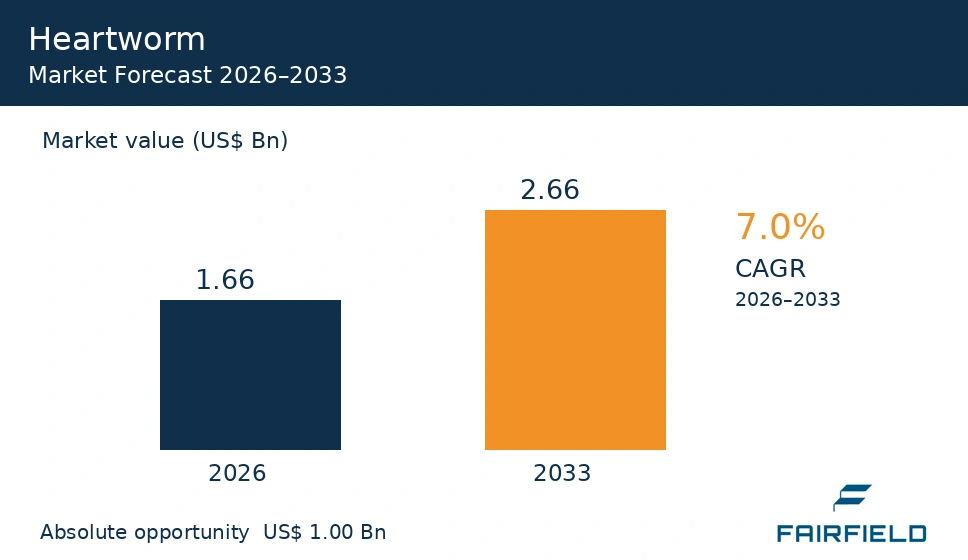
The global heartworm market size is expected to be valued at US$ 1.66 billion in 2026 and projected to reach US$ 2.66 billion by 2033, growing at a CAGR of 7.0% between 2026 and 2033.
Between 2020 and 2025, the market grew at a CAGR of about 6.2%, rising from roughly US$ 1.15 billion to about US$ 1.55 billion, as pet adoption rose during the pandemic, veterinarians pushed year-round prevention, and new combination products that protect against heartworm, fleas, ticks, and intestinal worms in one dose gained strong sales. The heartworm market covers products that prevent, diagnose, and treat heartworm disease, a serious and sometimes fatal infection caused by the parasitic worm Dirofilaria immitis, which is spread by mosquitoes and lives in the heart and lungs of infected dogs, cats, and other animals. Main products include monthly oral chewables, topical spot-ons, and long-acting injectables containing macrocyclic lactones such as moxidectin, ivermectin, milbemycin oxime, and selamectin, along with antigen test kits and adulticide treatments such as melarsomine. In December 2025, Elanco received FDA conditional approval for Credelio Quattro-CA1 for New World screwworm in dogs.
Key Report Takeaways
- By Mode of Delivery: Oral Chewables held about 65% share in 2025, while Injectables are projected to expand at a 9.5% CAGR through 2033, driven by six- and twelve-month protection, better compliance, and veterinarian-administered dosing that removes the need for monthly reminders.
- By Animal Type: Dogs held about 90% share in 2025, while Cats are projected to expand at an 8.5% CAGR through 2033, driven by rising awareness of feline heartworm disease, new combination products for cats, and growing cat ownership worldwide.
- By Distribution Channel: Veterinary Hospitals and Clinics held about 55% share in 2025, while Online Pharmacies are projected to expand at a 10.0% CAGR through 2033, driven by convenient home delivery, auto-ship subscriptions, and competitive pricing for monthly preventives.
- By Region: North America held about 60% share in 2025, while Asia Pacific is projected to expand at a 9.0% CAGR through 2033, driven by rising pet ownership, growing veterinary care spending, and warm climates in China, India, Japan, and Australia.
Global Heartworm Market Trends and Insights
Drivers Impact Analysis
Two drivers carry the strongest influence on heartworm market demand during the forecast period.
| Driver | Impact on CAGR Forecast | Geographic Relevance | Impact Timeline |
| Rising pet ownership and humanization of pets | High | Global | Long term (≥4 years) |
| Spread of mosquitoes and heartworm disease | Medium | North America, Europe, Asia Pacific | Medium term (2-4 years) |
Pet Ownership Is Driving the Heartworm Market
Rising pet ownership and humanization of pets are the strongest driver of the heartworm market. Owners treat pets like family members.
The mechanism is that the number of pet dogs and cats keeps rising worldwide, with hundreds of millions of dogs and cats in homes, and owners are spending more on veterinary care, premium food, and preventive medicine. Many owners now buy year-round heartworm prevention on veterinarian advice instead of only seasonal treatment, creating steady monthly demand. Pet insurance and wellness plans, which often include parasite prevention, are growing in North America and Europe. Combination products that protect against heartworm, fleas, ticks, and intestinal worms in a single chewable make prevention easier and more valuable. Young pet owners also research pet health online. These trends create strong, recurring demand.
Disease Spread Is Expanding the Heartworm Market
Spread of mosquitoes and heartworm disease is expanding the heartworm market. Heartworm is appearing in new areas.
The cause is that warmer temperatures, longer mosquito seasons, and changing rainfall are allowing mosquitoes that carry heartworm to survive in more regions and for more months each year. Heartworm is common across the southern United States and has spread into northern states and Canada. Moving and rehoming dogs from high-risk areas, including after natural disasters, also spreads infection. In Europe, heartworm is spreading from southern countries such as Italy and Spain into central and eastern areas. The American Heartworm Society recommends year-round prevention and annual testing for all dogs. Reports of resistance to some preventives increase testing. These trends support higher prevention and diagnostic demand in both established and new markets.
Restraints Impact Analysis
Two restraints limit how quickly the heartworm market grows.
| Restraint | Impact on CAGR Forecast | Geographic Relevance | Impact Timeline |
| Low compliance and cost concerns | High | Global | Medium term (2-4 years) |
| Drug resistance and treatment drug shortages | Medium | North America | Long term (≥4 years) |
Low Compliance Slows the Heartworm Market
Low compliance and cost concerns slow the heartworm market. Many pets are not fully protected.
The problem is that many dog and cat owners do not give heartworm preventives every month, skip doses in winter, or never start prevention at all, especially for cats, which many owners do not consider at risk. Monthly premium combination products can be expensive, and rising living costs push some owners to cut veterinary spending or delay annual checkups and tests. In many countries in Asia Pacific, Latin America, and Middle East & Africa, awareness of heartworm disease is low, veterinary access is limited, and many pets receive little preventive care. Prescription requirements add a barrier for some owners. Generic preventives also put pressure on prices. These factors limit market growth and leave many pets at risk of infection.
Resistance and Shortages Restrict the Heartworm Market
Drug resistance and treatment drug shortages restrict the heartworm market. Some parasites are becoming harder to control.
The constraint is that researchers have confirmed heartworm strains with resistance to macrocyclic lactone preventives, especially in the Mississippi River region of the United States, which can cause prevention failures and raise concerns among veterinarians and owners. Treatment for infected dogs is long, costly, and stressful, requiring months of exercise restriction and multiple melarsomine injections, and supply problems for melarsomine have occurred in the past. Few new drug classes for heartworm have reached the market in recent decades. Developing new antiparasitic molecules takes many years and large investment. Cats have no approved adulticide treatment, so infected cats can only receive supportive care. These issues limit treatment options and make prevention even more important for pet owners.
Market Opportunities
Long-Acting and Combination Products Open a Fast-Growth Revenue Pool
Long-acting and combination products open a fast-growth revenue pool. Owners want simple, complete protection.
The opportunity comes from injectable products that protect dogs for six or twelve months in a single visit, such as Zoetis’s ProHeart range, which solve the problem of missed monthly doses. Combination chewables that protect against heartworm, fleas, ticks, and intestinal worms, such as Zoetis’s Simparica Trio, Boehringer Ingelheim’s NexGard PLUS, and Elanco’s Credelio Quattro, command premium prices and are widely recommended by veterinarians. In October 2025, the FDA expanded Credelio Quattro’s label to include Lyme disease prevention. Companies that combine broad parasite coverage, convenient dosing, long-lasting protection, and strong safety data can win premium pricing, loyal customers, and strong veterinary support in every region.
Asia Pacific and Digital Channels Create a Growth Revenue Pool
Asia Pacific and digital channels create a growth revenue pool. Pet care is growing quickly in new markets.
The opportunity reflects rapid growth in pet ownership and veterinary spending in China, Japan, South Korea, India, Thailand, and Australia, where warm, humid climates support mosquitoes that carry heartworm. Rising incomes and urban lifestyles are making pets more common in homes, and veterinary clinic chains are expanding. At the same time, online pharmacies, e-commerce platforms, telehealth services, and subscription models let owners order preventives and receive reminders automatically, improving compliance. Point-of-care test kits support more frequent testing in clinics. Companies that invest in awareness campaigns, local partnerships, affordable products, and digital sales can capture strong growth in these large and developing pet health markets.
Segment Analysis
By Mode of Delivery: Oral Chewables Lead While Injectables Grow Fastest
Oral Chewables held about 65% share in 2025. Monthly flavored chewables are easy to give, well accepted by dogs, and often combine heartworm prevention with flea, tick, and intestinal worm control, making them the most popular choice among veterinarians and owners. Leading brands include Heartgard, Simparica Trio, NexGard PLUS, and Credelio Quattro, and generic ivermectin chewables serve price-sensitive owners.
Injectables are the fastest-growing mode of delivery, expanding at a 9.5% CAGR through 2033. Long-acting moxidectin injections given by veterinarians protect dogs for six or twelve months, improving compliance and reducing missed doses. Topical Spot-ons form another segment, popular for cats and dogs that refuse oral products. For the market, injectable growth supports premium veterinary services and more frequent clinic visits.
By Animal Type: Dogs Lead While Cats Grow Fastest
Dogs held about 90% share in 2025. Dogs are the main host for heartworm, and infection can cause severe heart and lung damage, so veterinarians strongly recommend year-round prevention and annual testing for all dogs in risk areas. Most products and treatments are designed for dogs, and dog owners are more likely to follow year-round prevention advice from veterinarians.
Cats are the fastest-growing animal type, expanding at an 8.5% CAGR through 2033. Cats can develop heartworm-associated respiratory disease even from a few worms, and there is no approved treatment, so prevention is especially important. New feline combination products are increasing awareness. Other Animals, including ferrets, form a small segment. For the market, cat growth widens the treated pet population, especially among indoor cats that can still be bitten by mosquitoes.
By Distribution Channel: Veterinary Hospitals and Clinics Lead While Online Pharmacies Grow Fastest
Veterinary Hospitals and Clinics held about 55% share in 2025. Veterinarians test pets for heartworm, prescribe preventives, give injectable products, and treat infected animals, making clinics the main point of sale. Many clinics bundle prevention into wellness plans, which spread the cost over monthly payments and improve compliance. Annual testing visits also create chances to sell preventives.
Online Pharmacies are the fastest-growing channel, expanding at a 10.0% CAGR through 2033. Owners increasingly order preventives through online pharmacies and clinic-linked web stores, with auto-ship and reminder services. Retail Pharmacies and Pet Stores form another segment. For the market, online growth supports convenience and compliance, as reminders and automatic deliveries help owners avoid missed doses. Many manufacturers also sell through clinic-branded online stores to protect veterinary relationships.
Geography Analysis
Which Region Is Leading the Heartworm Market?
North America is leading the heartworm market with about 60% share in 2025. The United States has high heartworm rates, especially in southern states, very high pet ownership, strong veterinary care, and guidance from the American Heartworm Society recommending year-round prevention and annual testing. Zoetis, Elanco, Merck Animal Health, and IDEXX Laboratories are based in the region, and Boehringer Ingelheim has a large animal health business there. Canada adds rising demand as heartworm spreads north. Key barriers include cost concerns and resistance. One change shaping the region is fast growth of combination products and long-acting injectables.
Europe Shapes the Heartworm Market Through Rising Disease Awareness
Europe is a major heartworm market. Italy, Spain, Portugal, Greece, and France have the highest heartworm rates, while cases are increasing in central and eastern countries as mosquito ranges expand. Boehringer Ingelheim, Virbac, Ceva Santé Animale, and Vetoquinol are based in the region. Pet travel and dog adoption across borders within Europe add risk. Key barriers include lower awareness in northern countries and seasonal use. One opportunity is prevention programs in regions where heartworm is newly emerging, supported by veterinary associations and better diagnostic testing. Growing pet insurance coverage also supports preventive care.
Which Region Is Growing Fastest in the Heartworm Market?
Asia Pacific is the fastest-growing heartworm market, expanding at a 9.0% CAGR through 2033. Japan and Australia have well-established heartworm prevention markets with high testing rates, while China, South Korea, India, Thailand, and Indonesia are seeing fast growth in pet ownership, pet insurance, and veterinary clinics. Warm, humid climates support year-round mosquito activity in much of the region. Key barriers include low awareness, price sensitivity, and limited veterinary access in rural areas. One change shaping the region is rapid growth of online pet pharmacies and veterinary clinic chains in large and mid-sized cities.
Latin America Grows the Heartworm Market Through Pet Care Spending
Latin America is a growing heartworm market. Brazil, Mexico, Argentina, Colombia, and Chile have large dog populations and warm climates where heartworm is common, especially in coastal areas. Brazil has one of the world’s largest pet markets and a growing number of veterinary schools. Veterinary clinic chains and pet stores are expanding. Key barriers include cost concerns, low testing rates, and use of unregistered products. One opportunity is affordable preventives and awareness campaigns with veterinarians, supported by growing pet insurance and rising spending on premium pet care. Mosquito-heavy coastal and tropical areas offer strong demand for year-round prevention products.
Middle East & Africa Builds the Heartworm Market Through Growing Pet Ownership
Middle East & Africa is an emerging heartworm market. Israel has an established veterinary sector and heartworm cases, while the United Arab Emirates and Saudi Arabia have rising pet ownership among expatriate and local families. South Africa and Egypt have growing companion animal care and new veterinary clinics. Key barriers include low awareness and limited veterinary access. One opportunity is education programs for veterinarians and owners, supported by new veterinary clinics, pet stores, and online platforms in large cities. Warm climates in much of the region also support mosquito activity, increasing the need for prevention and regular testing of dogs and cats.
Competitive Landscape
The heartworm market is consolidated. Zoetis Inc., Boehringer Ingelheim, Elanco Animal Health, Merck Animal Health, and Virbac are leading players, while Ceva Santé Animale, IDEXX Laboratories, Vetoquinol, Norbrook Laboratories, PetIQ, Heska Corporation, and Bionote compete strongly. A small number of large animal health companies own the leading branded preventives, including Heartgard, Simparica Trio, NexGard PLUS, ProHeart, Revolution, and Credelio Quattro. Diagnostic companies such as IDEXX and Zoetis supply heartworm antigen tests, while generic makers sell lower-cost ivermectin and milbemycin products.
Companies compete on breadth of parasite coverage, duration of protection, safety in puppies, kittens, and dogs with sensitive genes, palatability, convenience, price, veterinary relationships, and direct-to-consumer marketing. Strong veterinary recommendations drive most sales, so companies invest heavily in clinic education, loyalty programs, and rebates. Television and online advertising directly to pet owners has also become important.
Strategic moves show how competition is changing. In October 2024, Elanco won approval for Credelio Quattro, entering the combination chewable segment. In October 2025, it expanded the label to Lyme disease prevention, and in December 2025, it gained conditional approval for New World screwworm, widening coverage.
Three themes shape vendor strategy. First, companies are adding more parasites to single products to win premium pricing. Second, they are developing long-acting injectables and products for cats. Third, they are expanding online sales, subscriptions, and awareness programs in Asia Pacific, Latin America, and Europe.
Heartworm Market Industry Leaders
Zoetis Inc. Boehringer Ingelheim Elanco Animal Health Merck Animal Health Virbac
Recent Industry Developments
- December 2025: Elanco received FDA conditional approval for Credelio Quattro-CA1 to treat New World screwworm in dogs, adding to its heartworm, flea, tick, and intestinal worm coverage - strengthens its broad-spectrum position in the heartworm market.
- October 2025: Elanco received FDA approval to expand Credelio Quattro and Credelio labels to include Lyme disease prevention and protection against the longhorned tick - adds value to its monthly heartworm combination chewable.
- October 2024: Elanco received FDA approval for Credelio Quattro, a monthly chewable that prevents heartworm disease and controls fleas, ticks, roundworms, hookworms, and tapeworms - intensifies competition among combination preventives.
Companies Covered in the Report
- Zoetis Inc.
- Boehringer Ingelheim
- Elanco Animal Health
- Merck Animal Health
- Virbac
- Ceva Santé Animale
- IDEXX Laboratories
- Vetoquinol
- Norbrook Laboratories
- PetIQ
- Heska Corporation
- Bionote
Heartworm Market Report Scope
This report covers the heartworm market, including oral chewables, injectables, and topical spot-ons, along with diagnostic test kits and treatments, for dogs, cats, and other animals, sold through veterinary hospitals and clinics, online pharmacies, and retail pharmacies and pet stores. The base year is 2025, and the forecast period runs from 2026 to 2033. All values are expressed in US$ Billion.
| Mode of Delivery | Oral Chewables, Injectables, Topical Spot-ons |
| Animal Type | Dogs, Cats, Other Animals |
| Distribution Channel | Veterinary Hospitals and Clinics, Online Pharmacies, Retail Pharmacies and Pet Stores |
| Regions | North America, Europe, Asia Pacific, Latin America, Middle East & Africa |
1. Executive Summary
1.1 Heartworm Market Snapshot
1.2 Future Projections
1.3 Key Market Trends
1.4 Regional Snapshot
2. Market Overview
2.1 Market Definition and Report Scope
2.2 Historical Market Trends
2.3 Market Dynamics
2.3.1 Drivers
2.3.1.1 Pet Ownership Is Driving the Heartworm Market
2.3.1.2 Disease Spread Is Expanding the Heartworm Market
2.3.2 Restraints
2.3.2.1 Low Compliance Slows the Heartworm Market
2.3.2.2 Resistance and Shortages Restrict the Heartworm Market
2.3.3 Market Opportunities
2.3.3.1 Long-Acting and Combination Products Open a Fast-Growth Revenue Pool
2.3.3.2 Asia Pacific and Digital Channels Create a Growth Revenue Pool
3. Global Heartworm Market Outlook, 2020–2033
3.1 Global Heartworm Market Outlook, by Mode of Delivery, Value (US$ Billion), 2020–2033
3.1.1 Oral Chewables
3.1.2 Injectables
3.1.3 Topical Spot-ons
3.2 Global Heartworm Market Outlook, by Animal Type, Value (US$ Billion), 2020–2033
3.2.1 Dogs
3.2.2 Cats
3.2.3 Other Animals
3.3 Global Heartworm Market Outlook, by Distribution Channel, Value (US$ Billion), 2020–2033
3.3.1 Veterinary Hospitals and Clinics
3.3.2 Online Pharmacies
3.3.3 Retail Pharmacies and Pet Stores
3.4 Global Heartworm Market Outlook, by Region, Value (US$ Billion), 2020–2033
3.4.1 North America
3.4.2 Europe
3.4.3 Asia Pacific
3.4.4 Latin America
3.4.5 Middle East & Africa
4. North America Heartworm Market Outlook, 2020–2033
4.1 North America Heartworm Market Outlook, by Mode of Delivery, Value (US$ Billion), 2020–2033
4.1.1 Oral Chewables
4.1.2 Injectables
4.1.3 Topical Spot-ons
4.2 North America Heartworm Market Outlook, by Animal Type, Value (US$ Billion), 2020–2033
4.2.1 Dogs
4.2.2 Cats
4.2.3 Other Animals
4.3 North America Heartworm Market Outlook, by Distribution Channel, Value (US$ Billion), 2020–2033
4.3.1 Veterinary Hospitals and Clinics
4.3.2 Online Pharmacies
4.3.3 Retail Pharmacies and Pet Stores
4.4 North America Heartworm Market Outlook, by Country, Value (US$ Billion), 2020–2033
4.4.1 United States Heartworm Market Outlook, by Mode of Delivery, 2020–2033
4.4.2 United States Heartworm Market Outlook, by Animal Type, 2020–2033
4.4.3 United States Heartworm Market Outlook, by Distribution Channel, 2020–2033
4.4.4 Canada Heartworm Market Outlook, by Mode of Delivery, 2020–2033
4.4.5 Canada Heartworm Market Outlook, by Animal Type, 2020–2033
4.4.6 Canada Heartworm Market Outlook, by Distribution Channel, 2020–2033
5. Europe Heartworm Market Outlook, 2020–2033
5.1 Europe Heartworm Market Outlook, by Mode of Delivery, Value (US$ Billion), 2020–2033
5.1.1 Oral Chewables
5.1.2 Injectables
5.1.3 Topical Spot-ons
5.2 Europe Heartworm Market Outlook, by Animal Type, Value (US$ Billion), 2020–2033
5.2.1 Dogs
5.2.2 Cats
5.2.3 Other Animals
5.3 Europe Heartworm Market Outlook, by Distribution Channel, Value (US$ Billion), 2020–2033
5.3.1 Veterinary Hospitals and Clinics
5.3.2 Online Pharmacies
5.3.3 Retail Pharmacies and Pet Stores
5.4 Europe Heartworm Market Outlook, by Country, Value (US$ Billion), 2020–2033
5.4.1 Italy Heartworm Market Outlook, by Mode of Delivery, 2020–2033
5.4.2 Italy Heartworm Market Outlook, by Animal Type, 2020–2033
5.4.3 Italy Heartworm Market Outlook, by Distribution Channel, 2020–2033
5.4.4 Spain Heartworm Market Outlook, by Mode of Delivery, 2020–2033
5.4.5 Spain Heartworm Market Outlook, by Animal Type, 2020–2033
5.4.6 Spain Heartworm Market Outlook, by Distribution Channel, 2020–2033
5.4.7 Portugal Heartworm Market Outlook, by Mode of Delivery, 2020–2033
5.4.8 Portugal Heartworm Market Outlook, by Animal Type, 2020–2033
5.4.9 Portugal Heartworm Market Outlook, by Distribution Channel, 2020–2033
5.4.10 France Heartworm Market Outlook, by Mode of Delivery, 2020–2033
5.4.11 France Heartworm Market Outlook, by Animal Type, 2020–2033
5.4.12 France Heartworm Market Outlook, by Distribution Channel, 2020–2033
6. Asia Pacific Heartworm Market Outlook, 2020–2033
6.1 Asia Pacific Heartworm Market Outlook, by Mode of Delivery, Value (US$ Billion), 2020–2033
6.1.1 Oral Chewables
6.1.2 Injectables
6.1.3 Topical Spot-ons
6.2 Asia Pacific Heartworm Market Outlook, by Animal Type, Value (US$ Billion), 2020–2033
6.2.1 Dogs
6.2.2 Cats
6.2.3 Other Animals
6.3 Asia Pacific Heartworm Market Outlook, by Distribution Channel, Value (US$ Billion), 2020–2033
6.3.1 Veterinary Hospitals and Clinics
6.3.2 Online Pharmacies
6.3.3 Retail Pharmacies and Pet Stores
6.4 Asia Pacific Heartworm Market Outlook, by Country, Value (US$ Billion), 2020–2033
6.4.1 Japan Heartworm Market Outlook, by Mode of Delivery, 2020–2033
6.4.2 Japan Heartworm Market Outlook, by Animal Type, 2020–2033
6.4.3 Japan Heartworm Market Outlook, by Distribution Channel, 2020–2033
6.4.4 Australia Heartworm Market Outlook, by Mode of Delivery, 2020–2033
6.4.5 Australia Heartworm Market Outlook, by Animal Type, 2020–2033
6.4.6 Australia Heartworm Market Outlook, by Distribution Channel, 2020–2033
6.4.7 China Heartworm Market Outlook, by Mode of Delivery, 2020–2033
6.4.8 China Heartworm Market Outlook, by Animal Type, 2020–2033
6.4.9 China Heartworm Market Outlook, by Distribution Channel, 2020–2033
6.4.10 South Korea Heartworm Market Outlook, by Mode of Delivery, 2020–2033
6.4.11 South Korea Heartworm Market Outlook, by Animal Type, 2020–2033
6.4.12 South Korea Heartworm Market Outlook, by Distribution Channel, 2020–2033
6.4.13 India Heartworm Market Outlook, by Mode of Delivery, 2020–2033
6.4.14 India Heartworm Market Outlook, by Animal Type, 2020–2033
6.4.15 India Heartworm Market Outlook, by Distribution Channel, 2020–2033
6.4.16 Thailand Heartworm Market Outlook, by Mode of Delivery, 2020–2033
6.4.17 Thailand Heartworm Market Outlook, by Animal Type, 2020–2033
6.4.18 Thailand Heartworm Market Outlook, by Distribution Channel, 2020–2033
6.4.19 Indonesia Heartworm Market Outlook, by Mode of Delivery, 2020–2033
6.4.20 Indonesia Heartworm Market Outlook, by Animal Type, 2020–2033
6.4.21 Indonesia Heartworm Market Outlook, by Distribution Channel, 2020–2033
7. Latin America Heartworm Market Outlook, 2020–2033
7.1 Latin America Heartworm Market Outlook, by Mode of Delivery, Value (US$ Billion), 2020–2033
7.1.1 Oral Chewables
7.1.2 Injectables
7.1.3 Topical Spot-ons
7.2 Latin America Heartworm Market Outlook, by Animal Type, Value (US$ Billion), 2020–2033
7.2.1 Dogs
7.2.2 Cats
7.2.3 Other Animals
7.3 Latin America Heartworm Market Outlook, by Distribution Channel, Value (US$ Billion), 2020–2033
7.3.1 Veterinary Hospitals and Clinics
7.3.2 Online Pharmacies
7.3.3 Retail Pharmacies and Pet Stores
7.4 Latin America Heartworm Market Outlook, by Country, Value (US$ Billion), 2020–2033
7.4.1 Brazil Heartworm Market Outlook, by Mode of Delivery, 2020–2033
7.4.2 Brazil Heartworm Market Outlook, by Animal Type, 2020–2033
7.4.3 Brazil Heartworm Market Outlook, by Distribution Channel, 2020–2033
7.4.4 Mexico Heartworm Market Outlook, by Mode of Delivery, 2020–2033
7.4.5 Mexico Heartworm Market Outlook, by Animal Type, 2020–2033
7.4.6 Mexico Heartworm Market Outlook, by Distribution Channel, 2020–2033
7.4.7 Argentina Heartworm Market Outlook, by Mode of Delivery, 2020–2033
7.4.8 Argentina Heartworm Market Outlook, by Animal Type, 2020–2033
7.4.9 Argentina Heartworm Market Outlook, by Distribution Channel, 2020–2033
7.4.10 Colombia Heartworm Market Outlook, by Mode of Delivery, 2020–2033
7.4.11 Colombia Heartworm Market Outlook, by Animal Type, 2020–2033
7.4.12 Colombia Heartworm Market Outlook, by Distribution Channel, 2020–2033
7.4.13 Chile Heartworm Market Outlook, by Mode of Delivery, 2020–2033
7.4.14 Chile Heartworm Market Outlook, by Animal Type, 2020–2033
7.4.15 Chile Heartworm Market Outlook, by Distribution Channel, 2020–2033
8. Middle East & Africa Heartworm Market Outlook, 2020–2033
8.1 Middle East & Africa Heartworm Market Outlook, by Mode of Delivery, Value (US$ Billion), 2020–2033
8.1.1 Oral Chewables
8.1.2 Injectables
8.1.3 Topical Spot-ons
8.2 Middle East & Africa Heartworm Market Outlook, by Animal Type, Value (US$ Billion), 2020–2033
8.2.1 Dogs
8.2.2 Cats
8.2.3 Other Animals
8.3 Middle East & Africa Heartworm Market Outlook, by Distribution Channel, Value (US$ Billion), 2020–2033
8.3.1 Veterinary Hospitals and Clinics
8.3.2 Online Pharmacies
8.3.3 Retail Pharmacies and Pet Stores
8.4 Middle East & Africa Heartworm Market Outlook, by Country, Value (US$ Billion), 2020–2033
8.4.1 Israel Heartworm Market Outlook, by Mode of Delivery, 2020–2033
8.4.2 Israel Heartworm Market Outlook, by Animal Type, 2020–2033
8.4.3 Israel Heartworm Market Outlook, by Distribution Channel, 2020–2033
8.4.4 United Arab Emirates Heartworm Market Outlook, by Mode of Delivery, 2020–2033
8.4.5 United Arab Emirates Heartworm Market Outlook, by Animal Type, 2020–2033
8.4.6 United Arab Emirates Heartworm Market Outlook, by Distribution Channel, 2020–2033
8.4.7 Saudi Arabia Heartworm Market Outlook, by Mode of Delivery, 2020–2033
8.4.8 Saudi Arabia Heartworm Market Outlook, by Animal Type, 2020–2033
8.4.9 Saudi Arabia Heartworm Market Outlook, by Distribution Channel, 2020–2033
8.4.10 South Africa Heartworm Market Outlook, by Mode of Delivery, 2020–2033
8.4.11 South Africa Heartworm Market Outlook, by Animal Type, 2020–2033
8.4.12 South Africa Heartworm Market Outlook, by Distribution Channel, 2020–2033
8.4.13 Egypt Heartworm Market Outlook, by Mode of Delivery, 2020–2033
8.4.14 Egypt Heartworm Market Outlook, by Animal Type, 2020–2033
8.4.15 Egypt Heartworm Market Outlook, by Distribution Channel, 2020–2033
9. Competitive Landscape
9.1 Heartworm Market Industry Leaders
9.2 Recent Industry Developments
9.3 Company Profiles
9.3.1 Zoetis Inc.
9.3.2 Boehringer Ingelheim
9.3.3 Elanco Animal Health
9.3.4 Merck Animal Health
9.3.5 Virbac
9.3.6 Ceva Santé Animale
9.3.7 IDEXX Laboratories
9.3.8 Vetoquinol
9.3.9 Norbrook Laboratories
9.3.10 PetIQ
9.3.11 Heska Corporation
9.3.12 Bionote
10. Appendix
10.1 Research Methodology
10.2 Report Assumptions
10.3 Acronyms and Abbreviations
| Mode of Delivery | Oral Chewables, Injectables, Topical Spot-ons |
| Animal Type | Dogs, Cats, Other Animals |
| Distribution Channel | Veterinary Hospitals and Clinics, Online Pharmacies, Retail Pharmacies and Pet Stores |
| Regions | North America, Europe, Asia Pacific, Latin America, Middle East & Africa |
Our Research Methodology
Considering the volatility of business today, traditional approaches to strategizing a game plan can be unfruitful if not detrimental. True ambiguity is no way to determine a forecast. A myriad of predetermined factors must be accounted for such as the degree of risk involved, the magnitude of circumstances, as well as conditions or consequences that are not known or unpredictable. To circumvent binary views that cast uncertainty, the application of market research intelligence to strategically posture, move, and enable actionable outcomes is necessary.
View Methodology
Quality Assured
Rigorous Validation Process

Confidentiality Assured
End-to-end Data Security

Custom Research Services
Tailored To Your Objectives
FAQs
The market is valued at US$ 1.66 billion in 2026, led by oral chewables, dogs, veterinary clinics, and North America.
The market is projected to reach US$ 2.66 billion by 2033, growing at a 7.0% CAGR and adding US$ 1.00 billion.
Injectables are growing fastest at a 9.5% CAGR through 2033, driven by long-acting protection and better owner compliance.
Asia Pacific is growing fastest at a 9.0% CAGR through 2033, driven by rising pet ownership and veterinary spending.
North America holds the largest share at about 60% in 2025, supported by high disease rates and year-round prevention.
Related Reports
Macular Edema and Macular Degeneration Market Size, Share, Insights, Competitive Landscape, and Forecast 2026 to 2033
The macular edema and macular degeneration market is projected to reach US$ 20.97 billion by 2033, growing at 7.3% CAGR from US$ 12.77 billion in 2026.
Cancer Stem Cell Therapeutics Market Size, Share, Insights, Competitive Landscape, and Forecast 2026 to 2033
The cancer stem cell therapeutics market is projected to reach US$ 6.57 billion by 2033, growing at 9.4% CAGR from US$ 3.50 billion in 2026.
Antibody Drug Conjugate Market Size, Share, Insights, Competitive Landscape, and Forecast 2026 to 2033
The antibody drug conjugate market is projected to reach US$ 32.10 billion by 2033, growing at 9.8% CAGR from US$ 16.70 billion in 2026.
Monogenic Diseases Market Size, Share, Insights, Competitive Landscape, and Forecast 2026 to 2033
Explore the monogenic diseases market, forecast to reach US$34.9 billion by 2033 at 9.4% CAGR, with insights on diseases, offerings, technology, and regions.
Juvenile Macular Degeneration Treatment Market Size, Share, Insights, Competitive Landscape, and Forecast 2026 to 2033
Explore the juvenile macular degeneration treatment market, forecast to reach US$2.08 billion by 2033 at 8.4% CAGR, with offering and regional insights.
Iron Deficiency Anemia Treatment Market Size, Share, Insights, Competitive Landscape, and Forecast 2026 to 2033
Explore the iron deficiency anemia treatment market, forecast to reach US$9.08 billion by 2033 at 8.1% CAGR, with therapy, end-user, and regional insights.