



Phosphoramidite Market
Phosphoramidite Market Size, Share, Insights, Competitive Landscape, and Forecast 2026 to 2033
Report Overview
Phosphoramidite Market Size and Trend Analysis
How Fast Is the Phosphoramidite Market Growing?
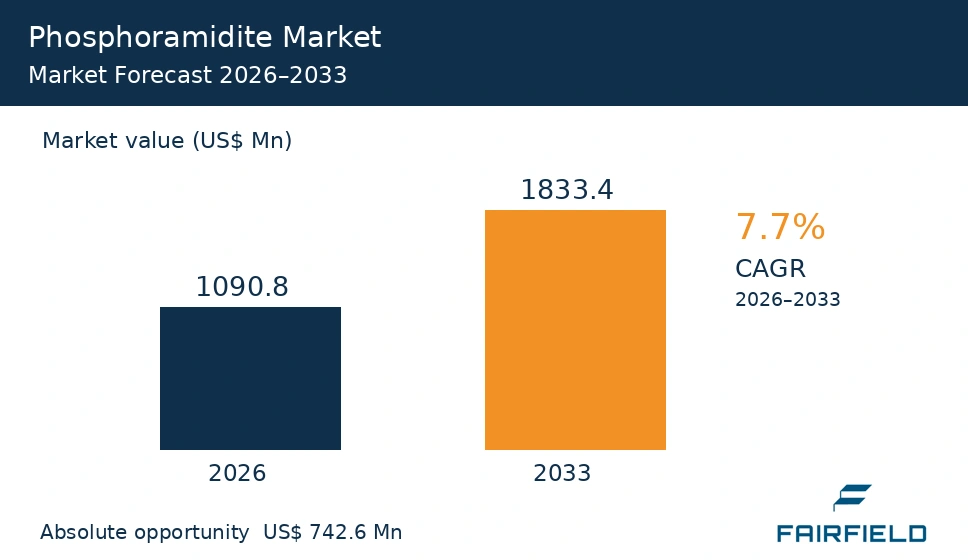
The global phosphoramidite market size is expected to be valued at US$ 1,090.8 million in 2026 and projected to reach US$ 1,833.4 million by 2033, growing at a CAGR of 7.7% between 2026 and 2033.
Between 2020 and 2025, the market grew at a CAGR of about 7.7%, rising from roughly US$ 700.0 million to about US$ 1,012.8 million, as the pandemic created huge demand for PCR primers and probes, approvals of antisense and siRNA medicines increased, and gene synthesis and CRISPR research expanded. The phosphoramidite market covers the chemical building blocks used to make synthetic DNA and RNA strands, called oligonucleotides, one base at a time. Each phosphoramidite carries a protected nucleoside, such as adenine, cytosine, guanine, thymine, or uracil, and is added step by step on automated synthesizers in a highly efficient chemical cycle. Main products include standard DNA phosphoramidites, RNA phosphoramidites, modified phosphoramidites such as 2’-O-methyl, 2’-fluoro, and locked nucleic acids, and labeled phosphoramidites for dyes and quenchers. In October 2026, Agilent added a new oligonucleotide laboratory in Colorado.
Key Report Takeaways
- By Type: DNA Phosphoramidites held about 52% share in 2025, while RNA Phosphoramidites are projected to expand at an 8.5% CAGR through 2033, driven by siRNA medicines, CRISPR guide RNAs, and rising demand for chemically modified RNA building blocks.
- By Application: Drug Discovery and Development held about 55% share in 2025, while Genomics and Synthetic Biology is projected to expand at a 9.0% CAGR through 2033, driven by gene synthesis, CRISPR editing, and DNA data storage research.
- By End User: Pharmaceutical and Biotechnology Companies held about 60% share in 2025, while Contract Development and Manufacturing Organizations are projected to expand at a 9.5% CAGR through 2033, driven by outsourcing of commercial oligonucleotide production.
- By Region: North America held about 40% share in 2025, while Asia Pacific is projected to expand at an 8.5% CAGR through 2033, driven by large phosphoramidite production in China, growing CDMO capacity, and rising research spending in India and Japan.
Global Phosphoramidite Market Trends and Insights
Drivers Impact Analysis
Two drivers carry the strongest influence on phosphoramidite market demand during the forecast period.
| Driver | Impact on CAGR Forecast | Geographic Relevance | Impact Timeline |
| Growth of oligonucleotide therapeutics | High | Global | Long term (≥4 years) |
| Expansion of genomics, diagnostics, and gene editing | Medium | North America, Europe, Asia Pacific | Medium term (2-4 years) |
Oligonucleotide Therapeutics Are Driving the Phosphoramidite Market
Growth of oligonucleotide therapeutics is the strongest driver of the phosphoramidite market. More nucleic acid medicines are reaching patients.
The mechanism is that antisense oligonucleotides and small interfering RNA drugs are made almost entirely from phosphoramidites, and each commercial drug can require hundreds of kilograms to several tonnes of building blocks per year. Approvals such as Ionis’s Tryngolza in December 2024 and Geron’s Rytelo in June 2024, along with growing sales of Alnylam’s siRNA medicines, have proven the value of these therapies. Many new candidates target common diseases such as high cholesterol, hypertension, and heart disease, which need far larger production volumes than rare disease drugs. Hundreds of oligonucleotide programs are now in clinical trials. These trends create strong, long-term demand for high-purity GMP phosphoramidites.
Genomics and Gene Editing Are Expanding the Phosphoramidite Market
Expansion of genomics, diagnostics, and gene editing is expanding the phosphoramidite market. Synthetic DNA and RNA are used everywhere.
The cause is that PCR tests, next-generation sequencing, microarrays, and molecular diagnostics all rely on synthetic primers, probes, and adapters made from phosphoramidites. CRISPR gene editing uses synthetic guide RNAs, and gene synthesis companies build long DNA strands for research, vaccines, and synthetic biology. Universities, research institutes, and biotech companies order millions of custom oligonucleotides every year. Infectious disease testing, cancer genomics, and newborn screening add steady diagnostic demand. Labeled phosphoramidites carrying fluorescent dyes support real-time PCR. Research funding from governments and foundations in North America, Europe, and Asia Pacific supports large and growing order volumes. These trends create broad and recurring demand across research and clinical markets.
Restraints Impact Analysis
Two restraints limit how quickly the phosphoramidite market grows.
| Restraint | Impact on CAGR Forecast | Geographic Relevance | Impact Timeline |
| High purity requirements and manufacturing cost | High | Global | Medium term (2-4 years) |
| Emerging enzymatic synthesis alternatives | Medium | North America, Europe | Long term (≥4 years) |
Purity and Cost Demands Slow the Phosphoramidite Market
High purity requirements and manufacturing cost slow the phosphoramidite market. Therapeutic-grade products are hard to make.
The problem is that small impurities in phosphoramidites can carry into every strand of an oligonucleotide drug, so regulators and drug makers demand very high purity, tight specifications, and detailed impurity testing. Producing GMP-grade phosphoramidites requires specialized reactors, chromatography purification, moisture-free handling, and strict quality systems, which need large investment. Modified building blocks, such as 2’-fluoro and locked nucleic acids, are complex and costly to make. Phosphoramidites are sensitive to water and air, requiring careful storage and cold-chain shipping. Price pressure from large buyers and long qualification times with drug makers squeeze margins for smaller suppliers and slow new entry. These factors raise barriers to entry and limit supply expansion.
Enzymatic Alternatives Restrict the Phosphoramidite Market
Emerging enzymatic synthesis alternatives restrict the phosphoramidite market. New methods may reduce chemical use.
The constraint is that traditional solid-phase phosphoramidite synthesis uses large amounts of organic solvents, such as acetonitrile, creating hazardous waste and high disposal costs, especially at commercial scale. Enzymatic DNA synthesis and enzymatic ligation methods use water-based processes and could make longer strands with less waste. In October 2026, Agilent opened a laboratory focused on enzymatic ligation to complement solid-phase synthesis. Several startups are developing enzymatic DNA synthesizers for research labs. Although these methods are still early, they could reduce demand for some phosphoramidites over time. Supply chain dependence on a few raw material and solvent sources also adds risk, as shortages can delay production for many customers. These factors push suppliers to invest in greener processes.
Market Opportunities
Modified and GMP-Grade Phosphoramidites Open a Fast-Growth Revenue Pool
Modified and GMP-grade phosphoramidites open a fast-growth revenue pool. Drug makers need advanced building blocks.
The opportunity comes from the shift toward chemically modified oligonucleotides that last longer in the body, resist breakdown, and reach new tissues. Building blocks such as 2’-O-methyl, 2’-fluoro, 2’-MOE, locked nucleic acids, and GalNAc-linked reagents command much higher prices than standard DNA phosphoramidites. In August 2025, Hongene signed a licensing agreement with UMass Chan Medical School to supply extended nucleic acid phosphoramidites for research. Drug makers also want secure second sources for approved medicines. Companies that offer high-purity GMP products, reliable large-scale supply, detailed impurity data, and custom chemistry services can win long-term supply contracts, premium pricing, and loyal customers among drug developers in every region.
Asia Pacific Manufacturing and Outsourcing Create a Growth Revenue Pool
Asia Pacific manufacturing and outsourcing create a growth revenue pool. Production is scaling quickly in the region.
The opportunity reflects strong growth in phosphoramidite and oligonucleotide manufacturing in China, India, Japan, and South Korea, where companies offer competitive prices and fast delivery. Hongene has built one of the world’s largest phosphoramidite production capacities in Shanghai. At the same time, drug developers in North America and Europe are outsourcing commercial oligonucleotide production to CDMOs, which buy phosphoramidites in large volumes. Supply diversification policies and trade concerns are also encouraging new plants in different regions, including India and Singapore. Growing local biotech sectors add research demand. Companies that build regional capacity, secure raw materials, meet global quality standards, and partner with CDMOs can capture strong growth.
Segment Analysis
By Type: DNA Phosphoramidites Lead While RNA Phosphoramidites Grow Fastest
DNA Phosphoramidites held about 52% share in 2025. Standard DNA building blocks are used to make PCR primers, probes, sequencing adapters, gene fragments, and antisense drugs, giving them the widest range of uses. Research labs, diagnostic companies, and custom oligonucleotide suppliers buy them in large volumes every day, and prices are lower than for RNA or modified products.
RNA Phosphoramidites are the fastest-growing type, expanding at an 8.5% CAGR through 2033. RNA building blocks with protective groups and chemical modifications are needed to make siRNA drugs, CRISPR guide RNAs, and aptamers. Modified, Labeled, and Other Phosphoramidites form other segments, including dyes, quenchers, and linkers. For the market, RNA growth reflects the rise of siRNA medicines and gene editing.
By Application: Drug Discovery and Development Leads While Genomics and Synthetic Biology Grows Fastest
Drug Discovery and Development held about 55% share in 2025. Oligonucleotide drug developers use large amounts of phosphoramidites for research, clinical trial material, and commercial production. Each successful drug can increase demand from grams to tonnes as it moves from early research to clinical trials and commercial launch, making late-stage programs the most valuable customers.
Genomics and Synthetic Biology is the fastest-growing application, expanding at a 9.0% CAGR through 2033. Gene synthesis, CRISPR screening libraries, DNA data storage, and synthetic biology projects need large numbers of custom oligonucleotides. Diagnostics Development and Other Applications form other segments. For the market, genomics growth supports broad research demand from universities, biotech startups, and gene synthesis companies, and spreads revenue across many customers.
By End User: Pharmaceutical and Biotechnology Companies Lead While CDMOs Grow Fastest
Pharmaceutical and Biotechnology Companies held about 60% share in 2025. Drug developers buy phosphoramidites for in-house research and manufacturing of antisense and siRNA drugs, and large firms sign long-term supply contracts. Quality, impurity data, regulatory support, and supply security are key buying factors, and approved drugs often lock in a supplier for many years.
Contract Development and Manufacturing Organizations are the fastest-growing end user, expanding at a 9.5% CAGR through 2033. Drug makers increasingly outsource oligonucleotide production to specialist CDMOs such as Agilent, Nitto Avecia, and WuXi STA, which run large synthesizers and buy building blocks in bulk. Academic and Research Institutes and Diagnostic Companies form other segments. For the market, CDMO growth concentrates large-volume buying among fewer, larger customers.
Geography Analysis
Which Region Is Leading the Phosphoramidite Market?
North America is leading the phosphoramidite market with about 40% share in 2025. The United States has the largest number of oligonucleotide drug developers, including Ionis, Alnylam, and Arrowhead, along with strong research funding, genomics companies, and diagnostic manufacturers. Thermo Fisher Scientific, Maravai’s Glen Research, Agilent, and ChemGenes operate key production sites in the region. Canada adds research demand and oligonucleotide manufacturing capacity. Key barriers include high costs and supply dependence on imports. One change shaping the region is growth of commercial-scale oligonucleotide manufacturing for siRNA drugs that treat common heart and metabolic diseases.
Europe Shapes the Phosphoramidite Market Through Specialty Chemistry
Europe is a major phosphoramidite market. Germany, the United Kingdom, France, Switzerland, and Denmark have strong pharmaceutical, biotech, and research sectors. Merck KGaA produces phosphoramidites in Hamburg, and LGC Biosearch Technologies and emp BIOTECH are based in the region. Key barriers include strict environmental rules on solvents and high energy costs. One opportunity is supply for European oligonucleotide CDMOs, supported by new drug programs and growing demand for supply chain security. Academic genomics programs and diagnostic makers also create steady demand for research-grade products, and Denmark hosts strong expertise in locked nucleic acid chemistry.
Which Region Is Growing Fastest in the Phosphoramidite Market?
Asia Pacific is the fastest-growing phosphoramidite market, expanding at an 8.5% CAGR through 2033. China has become a global production hub, led by Hongene Biotech, with large-scale phosphoramidite and nucleotide plants in Shanghai. India has growing chemical and CDMO capacity, including Carbolink India, while Japan and South Korea have advanced oligonucleotide research and manufacturing. Singapore and Australia add demand through biotech investment and research institutes. Key barriers include trade restrictions, export controls, and quality concerns among some Western buyers. One change shaping the region is rapid growth of CDMO capacity serving global drug developers.
Latin America Grows the Phosphoramidite Market Through Diagnostics
Latin America is a growing phosphoramidite market. Brazil, Mexico, Argentina, Colombia, and Chile have expanding molecular diagnostics, agricultural genomics, and university research programs. Brazil has a large research base, a growing biotech sector, and public research institutes that develop diagnostic tests. Key barriers include import dependence, currency swings, and limited local production. One opportunity is supply for PCR testing and genomics labs, supported by public health programs, research funding, and growing partnerships with global life science suppliers. Agricultural biotechnology and crop genomics also create demand for synthetic DNA primers and probes. Growing clinical trial activity in the region adds further demand.
Middle East & Africa Builds the Phosphoramidite Market Through Research Investment
Middle East & Africa is an emerging phosphoramidite market. Saudi Arabia, the United Arab Emirates, and Qatar are investing in genomics programs and research centers, and Israel has a strong biotech sector with active research in RNA medicines and diagnostics. South Africa and Egypt have growing molecular diagnostics capacity and university research programs in infectious disease. Key barriers include import dependence, long shipping times, and limited local manufacturing. Universities and hospitals in large cities are building new molecular biology labs. One opportunity is research and diagnostic supply for national genome programs, supported by government funding, new laboratories, precision medicine plans, and partnerships with global suppliers.
Competitive Landscape
The phosphoramidite market is moderately consolidated. Thermo Fisher Scientific Inc., Merck KGaA, Hongene Biotech Corporation, LGC Biosearch Technologies, and Maravai LifeSciences (Glen Research) are leading players, while Agilent Technologies, ChemGenes Corporation, emp BIOTECH, Carbolink India, PolyOrg, Gene Link, and Rasayan compete strongly. A small number of large suppliers provide most GMP-grade phosphoramidites for commercial oligonucleotide drugs, while many specialty firms focus on modified, labeled, and custom building blocks for research and diagnostics. Thermo Fisher produces therapeutic-grade products in Milwaukee, and Hongene operates very large capacity in Shanghai.
Companies compete on purity, impurity control, batch consistency, regulatory documentation, production scale, delivery speed, range of modifications, and price. Long-term supply agreements with drug developers and CDMOs are especially valuable and hard to win, because switching suppliers for an approved drug requires regulatory work.
Strategic moves show how competition is changing. In December 2024, Ionis won FDA approval for Tryngolza, adding commercial demand for modified building blocks. In August 2025, Hongene licensed extended nucleic acid chemistry from UMass Chan Medical School. In October 2026, Agilent added an enzymatic ligation laboratory in Colorado.
Three themes shape vendor strategy. First, suppliers are expanding GMP capacity for large-volume siRNA and antisense drugs. Second, they are adding novel modified chemistries, licensed technologies, and custom synthesis services. Third, they are building regional supply in North America, Europe, and Asia Pacific while developing greener processes.
Phosphoramidite Market Industry Leaders
Thermo Fisher Scientific Inc. Merck KGaA Hongene Biotech Corporation LGC Biosearch Technologies Maravai LifeSciences (Glen Research)
Recent Industry Developments
- October 2026: Agilent Technologies added new laboratory space in Boulder, Colorado, focused on enzymatic ligation to complement solid-phase phosphoramidite synthesis, with customer programs starting in November 2026 - signals hybrid manufacturing approaches in the phosphoramidite market.
- August 2025: Hongene Biotech signed a non-exclusive licensing agreement with UMass Chan Medical School to produce and supply extended nucleic acid phosphoramidites and modified oligonucleotides for research - expands access to next-generation RNA chemistry.
- December 2024: Ionis Pharmaceuticals received FDA approval for Tryngolza (olezarsen), a GalNAc-conjugated antisense medicine - adds commercial demand for modified phosphoramidites.
Companies Covered in the Report
- Thermo Fisher Scientific Inc.
- Merck KGaA
- Hongene Biotech Corporation
- LGC Biosearch Technologies
- Maravai LifeSciences (Glen Research)
- Agilent Technologies, Inc.
- ChemGenes Corporation
- emp BIOTECH GmbH
- Carbolink India Pvt. Ltd.
- PolyOrg Inc.
- Gene Link Inc.
- Rasayan Inc.
Phosphoramidite Market Report Scope
This report covers the phosphoramidite market, including DNA, RNA, modified, labeled, and other phosphoramidites, used in drug discovery and development, genomics and synthetic biology, diagnostics development, and other applications by pharmaceutical and biotechnology companies, CDMOs, academic and research institutes, and diagnostic companies. The base year is 2025, and the forecast period runs from 2026 to 2033. All values are expressed in US$ Million.
| Type | DNA Phosphoramidites, RNA Phosphoramidites, Modified Phosphoramidites, Labeled and Other Phosphoramidites |
| Application | Drug Discovery and Development, Genomics and Synthetic Biology, Diagnostics Development, Other Applications |
| End User | Pharmaceutical and Biotechnology Companies, Contract Development and Manufacturing Organizations, Academic and Research Institutes, Diagnostic Companies |
| Regions | North America, Europe, Asia Pacific, Latin America, Middle East & Africa |
1. Executive Summary
1.1 Phosphoramidite Market Snapshot
1.2 Future Projections
1.3 Key Market Trends
1.4 Regional Snapshot
2. Market Overview
2.1 Market Definition and Report Scope
2.2 Historical Market Trends
2.3 Market Dynamics
2.3.1 Drivers
2.3.1.1 Oligonucleotide Therapeutics Are Driving the Phosphoramidite Market
2.3.1.2 Genomics and Gene Editing Are Expanding the Phosphoramidite Market
2.3.2 Restraints
2.3.2.1 Purity and Cost Demands Slow the Phosphoramidite Market
2.3.2.2 Enzymatic Alternatives Restrict the Phosphoramidite Market
2.3.3 Market Opportunities
2.3.3.1 Modified and GMP-Grade Phosphoramidites Open a Fast-Growth Revenue Pool
2.3.3.2 Asia Pacific Manufacturing and Outsourcing Create a Growth Revenue Pool
3. Global Phosphoramidite Market Outlook, 2020–2033
3.1 Global Phosphoramidite Market Outlook, by Type, Value (US$ Million), 2020–2033
3.1.1 DNA Phosphoramidites
3.1.2 RNA Phosphoramidites
3.1.3 Modified Phosphoramidites
3.1.4 Labeled and Other Phosphoramidites
3.2 Global Phosphoramidite Market Outlook, by Application, Value (US$ Million), 2020–2033
3.2.1 Drug Discovery and Development
3.2.2 Genomics and Synthetic Biology
3.2.3 Diagnostics Development
3.2.4 Other Applications
3.3 Global Phosphoramidite Market Outlook, by End User, Value (US$ Million), 2020–2033
3.3.1 Pharmaceutical and Biotechnology Companies
3.3.2 Contract Development and Manufacturing Organizations
3.3.3 Academic and Research Institutes
3.3.4 Diagnostic Companies
3.4 Global Phosphoramidite Market Outlook, by Region, Value (US$ Million), 2020–2033
3.4.1 North America
3.4.2 Europe
3.4.3 Asia Pacific
3.4.4 Latin America
3.4.5 Middle East & Africa
4. North America Phosphoramidite Market Outlook, 2020–2033
4.1 North America Phosphoramidite Market Outlook, by Type, Value (US$ Million), 2020–2033
4.1.1 DNA Phosphoramidites
4.1.2 RNA Phosphoramidites
4.1.3 Modified Phosphoramidites
4.1.4 Labeled and Other Phosphoramidites
4.2 North America Phosphoramidite Market Outlook, by Application, Value (US$ Million), 2020–2033
4.2.1 Drug Discovery and Development
4.2.2 Genomics and Synthetic Biology
4.2.3 Diagnostics Development
4.2.4 Other Applications
4.3 North America Phosphoramidite Market Outlook, by End User, Value (US$ Million), 2020–2033
4.3.1 Pharmaceutical and Biotechnology Companies
4.3.2 Contract Development and Manufacturing Organizations
4.3.3 Academic and Research Institutes
4.3.4 Diagnostic Companies
4.4 North America Phosphoramidite Market Outlook, by Country, Value (US$ Million), 2020–2033
4.4.1 United States Phosphoramidite Market Outlook, by Type, 2020–2033
4.4.2 United States Phosphoramidite Market Outlook, by Application, 2020–2033
4.4.3 United States Phosphoramidite Market Outlook, by End User, 2020–2033
4.4.4 Canada Phosphoramidite Market Outlook, by Type, 2020–2033
4.4.5 Canada Phosphoramidite Market Outlook, by Application, 2020–2033
4.4.6 Canada Phosphoramidite Market Outlook, by End User, 2020–2033
5. Europe Phosphoramidite Market Outlook, 2020–2033
5.1 Europe Phosphoramidite Market Outlook, by Type, Value (US$ Million), 2020–2033
5.1.1 DNA Phosphoramidites
5.1.2 RNA Phosphoramidites
5.1.3 Modified Phosphoramidites
5.1.4 Labeled and Other Phosphoramidites
5.2 Europe Phosphoramidite Market Outlook, by Application, Value (US$ Million), 2020–2033
5.2.1 Drug Discovery and Development
5.2.2 Genomics and Synthetic Biology
5.2.3 Diagnostics Development
5.2.4 Other Applications
5.3 Europe Phosphoramidite Market Outlook, by End User, Value (US$ Million), 2020–2033
5.3.1 Pharmaceutical and Biotechnology Companies
5.3.2 Contract Development and Manufacturing Organizations
5.3.3 Academic and Research Institutes
5.3.4 Diagnostic Companies
5.4 Europe Phosphoramidite Market Outlook, by Country, Value (US$ Million), 2020–2033
5.4.1 Germany Phosphoramidite Market Outlook, by Type, 2020–2033
5.4.2 Germany Phosphoramidite Market Outlook, by Application, 2020–2033
5.4.3 Germany Phosphoramidite Market Outlook, by End User, 2020–2033
5.4.4 United Kingdom Phosphoramidite Market Outlook, by Type, 2020–2033
5.4.5 United Kingdom Phosphoramidite Market Outlook, by Application, 2020–2033
5.4.6 United Kingdom Phosphoramidite Market Outlook, by End User, 2020–2033
5.4.7 France Phosphoramidite Market Outlook, by Type, 2020–2033
5.4.8 France Phosphoramidite Market Outlook, by Application, 2020–2033
5.4.9 France Phosphoramidite Market Outlook, by End User, 2020–2033
5.4.10 Switzerland Phosphoramidite Market Outlook, by Type, 2020–2033
5.4.11 Switzerland Phosphoramidite Market Outlook, by Application, 2020–2033
5.4.12 Switzerland Phosphoramidite Market Outlook, by End User, 2020–2033
5.4.13 Denmark Phosphoramidite Market Outlook, by Type, 2020–2033
5.4.14 Denmark Phosphoramidite Market Outlook, by Application, 2020–2033
5.4.15 Denmark Phosphoramidite Market Outlook, by End User, 2020–2033
6. Asia Pacific Phosphoramidite Market Outlook, 2020–2033
6.1 Asia Pacific Phosphoramidite Market Outlook, by Type, Value (US$ Million), 2020–2033
6.1.1 DNA Phosphoramidites
6.1.2 RNA Phosphoramidites
6.1.3 Modified Phosphoramidites
6.1.4 Labeled and Other Phosphoramidites
6.2 Asia Pacific Phosphoramidite Market Outlook, by Application, Value (US$ Million), 2020–2033
6.2.1 Drug Discovery and Development
6.2.2 Genomics and Synthetic Biology
6.2.3 Diagnostics Development
6.2.4 Other Applications
6.3 Asia Pacific Phosphoramidite Market Outlook, by End User, Value (US$ Million), 2020–2033
6.3.1 Pharmaceutical and Biotechnology Companies
6.3.2 Contract Development and Manufacturing Organizations
6.3.3 Academic and Research Institutes
6.3.4 Diagnostic Companies
6.4 Asia Pacific Phosphoramidite Market Outlook, by Country, Value (US$ Million), 2020–2033
6.4.1 China Phosphoramidite Market Outlook, by Type, 2020–2033
6.4.2 China Phosphoramidite Market Outlook, by Application, 2020–2033
6.4.3 China Phosphoramidite Market Outlook, by End User, 2020–2033
6.4.4 India Phosphoramidite Market Outlook, by Type, 2020–2033
6.4.5 India Phosphoramidite Market Outlook, by Application, 2020–2033
6.4.6 India Phosphoramidite Market Outlook, by End User, 2020–2033
6.4.7 Japan Phosphoramidite Market Outlook, by Type, 2020–2033
6.4.8 Japan Phosphoramidite Market Outlook, by Application, 2020–2033
6.4.9 Japan Phosphoramidite Market Outlook, by End User, 2020–2033
6.4.10 South Korea Phosphoramidite Market Outlook, by Type, 2020–2033
6.4.11 South Korea Phosphoramidite Market Outlook, by Application, 2020–2033
6.4.12 South Korea Phosphoramidite Market Outlook, by End User, 2020–2033
6.4.13 Singapore Phosphoramidite Market Outlook, by Type, 2020–2033
6.4.14 Singapore Phosphoramidite Market Outlook, by Application, 2020–2033
6.4.15 Singapore Phosphoramidite Market Outlook, by End User, 2020–2033
6.4.16 Australia Phosphoramidite Market Outlook, by Type, 2020–2033
6.4.17 Australia Phosphoramidite Market Outlook, by Application, 2020–2033
6.4.18 Australia Phosphoramidite Market Outlook, by End User, 2020–2033
7. Latin America Phosphoramidite Market Outlook, 2020–2033
7.1 Latin America Phosphoramidite Market Outlook, by Type, Value (US$ Million), 2020–2033
7.1.1 DNA Phosphoramidites
7.1.2 RNA Phosphoramidites
7.1.3 Modified Phosphoramidites
7.1.4 Labeled and Other Phosphoramidites
7.2 Latin America Phosphoramidite Market Outlook, by Application, Value (US$ Million), 2020–2033
7.2.1 Drug Discovery and Development
7.2.2 Genomics and Synthetic Biology
7.2.3 Diagnostics Development
7.2.4 Other Applications
7.3 Latin America Phosphoramidite Market Outlook, by End User, Value (US$ Million), 2020–2033
7.3.1 Pharmaceutical and Biotechnology Companies
7.3.2 Contract Development and Manufacturing Organizations
7.3.3 Academic and Research Institutes
7.3.4 Diagnostic Companies
7.4 Latin America Phosphoramidite Market Outlook, by Country, Value (US$ Million), 2020–2033
7.4.1 Brazil Phosphoramidite Market Outlook, by Type, 2020–2033
7.4.2 Brazil Phosphoramidite Market Outlook, by Application, 2020–2033
7.4.3 Brazil Phosphoramidite Market Outlook, by End User, 2020–2033
7.4.4 Mexico Phosphoramidite Market Outlook, by Type, 2020–2033
7.4.5 Mexico Phosphoramidite Market Outlook, by Application, 2020–2033
7.4.6 Mexico Phosphoramidite Market Outlook, by End User, 2020–2033
7.4.7 Argentina Phosphoramidite Market Outlook, by Type, 2020–2033
7.4.8 Argentina Phosphoramidite Market Outlook, by Application, 2020–2033
7.4.9 Argentina Phosphoramidite Market Outlook, by End User, 2020–2033
7.4.10 Colombia Phosphoramidite Market Outlook, by Type, 2020–2033
7.4.11 Colombia Phosphoramidite Market Outlook, by Application, 2020–2033
7.4.12 Colombia Phosphoramidite Market Outlook, by End User, 2020–2033
7.4.13 Chile Phosphoramidite Market Outlook, by Type, 2020–2033
7.4.14 Chile Phosphoramidite Market Outlook, by Application, 2020–2033
7.4.15 Chile Phosphoramidite Market Outlook, by End User, 2020–2033
8. Middle East & Africa Phosphoramidite Market Outlook, 2020–2033
8.1 Middle East & Africa Phosphoramidite Market Outlook, by Type, Value (US$ Million), 2020–2033
8.1.1 DNA Phosphoramidites
8.1.2 RNA Phosphoramidites
8.1.3 Modified Phosphoramidites
8.1.4 Labeled and Other Phosphoramidites
8.2 Middle East & Africa Phosphoramidite Market Outlook, by Application, Value (US$ Million), 2020–2033
8.2.1 Drug Discovery and Development
8.2.2 Genomics and Synthetic Biology
8.2.3 Diagnostics Development
8.2.4 Other Applications
8.3 Middle East & Africa Phosphoramidite Market Outlook, by End User, Value (US$ Million), 2020–2033
8.3.1 Pharmaceutical and Biotechnology Companies
8.3.2 Contract Development and Manufacturing Organizations
8.3.3 Academic and Research Institutes
8.3.4 Diagnostic Companies
8.4 Middle East & Africa Phosphoramidite Market Outlook, by Country, Value (US$ Million), 2020–2033
8.4.1 Saudi Arabia Phosphoramidite Market Outlook, by Type, 2020–2033
8.4.2 Saudi Arabia Phosphoramidite Market Outlook, by Application, 2020–2033
8.4.3 Saudi Arabia Phosphoramidite Market Outlook, by End User, 2020–2033
8.4.4 United Arab Emirates Phosphoramidite Market Outlook, by Type, 2020–2033
8.4.5 United Arab Emirates Phosphoramidite Market Outlook, by Application, 2020–2033
8.4.6 United Arab Emirates Phosphoramidite Market Outlook, by End User, 2020–2033
8.4.7 Qatar Phosphoramidite Market Outlook, by Type, 2020–2033
8.4.8 Qatar Phosphoramidite Market Outlook, by Application, 2020–2033
8.4.9 Qatar Phosphoramidite Market Outlook, by End User, 2020–2033
8.4.10 Israel Phosphoramidite Market Outlook, by Type, 2020–2033
8.4.11 Israel Phosphoramidite Market Outlook, by Application, 2020–2033
8.4.12 Israel Phosphoramidite Market Outlook, by End User, 2020–2033
8.4.13 South Africa Phosphoramidite Market Outlook, by Type, 2020–2033
8.4.14 South Africa Phosphoramidite Market Outlook, by Application, 2020–2033
8.4.15 South Africa Phosphoramidite Market Outlook, by End User, 2020–2033
8.4.16 Egypt Phosphoramidite Market Outlook, by Type, 2020–2033
8.4.17 Egypt Phosphoramidite Market Outlook, by Application, 2020–2033
8.4.18 Egypt Phosphoramidite Market Outlook, by End User, 2020–2033
9. Competitive Landscape
9.1 Phosphoramidite Market Industry Leaders
9.2 Recent Industry Developments
9.3 Company Profiles
9.3.1 Thermo Fisher Scientific Inc.
9.3.2 Merck KGaA
9.3.3 Hongene Biotech Corporation
9.3.4 LGC Biosearch Technologies
9.3.5 Maravai LifeSciences (Glen Research)
9.3.6 Agilent Technologies, Inc.
9.3.7 ChemGenes Corporation
9.3.8 emp BIOTECH GmbH
9.3.9 Carbolink India Pvt. Ltd.
9.3.10 PolyOrg Inc.
9.3.11 Gene Link Inc.
9.3.12 Rasayan Inc.
10. Appendix
10.1 Research Methodology
10.2 Report Assumptions
10.3 Acronyms and Abbreviations
| Type | DNA Phosphoramidites, RNA Phosphoramidites, Modified Phosphoramidites, Labeled and Other Phosphoramidites |
| Application | Drug Discovery and Development, Genomics and Synthetic Biology, Diagnostics Development, Other Applications |
| End User | Pharmaceutical and Biotechnology Companies, Contract Development and Manufacturing Organizations, Academic and Research Institutes, Diagnostic Companies |
| Regions | North America, Europe, Asia Pacific, Latin America, Middle East & Africa |
Our Research Methodology
Considering the volatility of business today, traditional approaches to strategizing a game plan can be unfruitful if not detrimental. True ambiguity is no way to determine a forecast. A myriad of predetermined factors must be accounted for such as the degree of risk involved, the magnitude of circumstances, as well as conditions or consequences that are not known or unpredictable. To circumvent binary views that cast uncertainty, the application of market research intelligence to strategically posture, move, and enable actionable outcomes is necessary.
View Methodology
Quality Assured
Rigorous Validation Process

Confidentiality Assured
End-to-end Data Security

Custom Research Services
Tailored To Your Objectives
FAQs
The global phosphoramidite market is expected to be valued at US$ 1,090.8 million in 2026, driven by oligonucleotide drug demand.
The market is projected to grow at a 7.7% CAGR from 2026 to 2033, reaching about US$ 1,833.4 million by 2033.
North America leads with about 40% share, supported by many oligonucleotide drug developers, strong research funding, and several major suppliers.
DNA Phosphoramidites dominate with about 52% share, because they are used in primers, probes, gene synthesis, and many antisense drugs.
Key players include Thermo Fisher Scientific, Merck KGaA, Hongene Biotech, and LGC Biosearch Technologies, competing on purity and supply.
Related Reports
New Drug Compound Testing Market Size, Share, Insights, Competitive Landscape, and Forecast 2026 to 2033
The new drug compound testing market is projected to reach US$ 36.88 billion by 2033, growing at 10.7% CAGR from US$ 18.11 billion in 2026.
Microbial Fermentation Technology Market Size, Share, Insights, Competitive Landscape, and Forecast 2026 to 2033
The microbial fermentation technology market is projected to reach US$ 61.53 billion by 2033, growing at 5.9% CAGR from US$ 41.22 billion in 2026.
Macular Edema and Macular Degeneration Market Size, Share, Insights, Competitive Landscape, and Forecast 2026 to 2033
The macular edema and macular degeneration market is projected to reach US$ 20.97 billion by 2033, growing at 7.3% CAGR from US$ 12.77 billion in 2026.
Heartworm Market Size, Share, Insights, Competitive Landscape, and Forecast 2026 to 2033
The heartworm market is projected to reach US$ 2.66 billion by 2033, growing at 7.0% CAGR from US$ 1.66 billion in 2026.
Cancer Stem Cell Therapeutics Market Size, Share, Insights, Competitive Landscape, and Forecast 2026 to 2033
The cancer stem cell therapeutics market is projected to reach US$ 6.57 billion by 2033, growing at 9.4% CAGR from US$ 3.50 billion in 2026.
Antibody Drug Conjugate Market Size, Share, Insights, Competitive Landscape, and Forecast 2026 to 2033
The antibody drug conjugate market is projected to reach US$ 32.10 billion by 2033, growing at 9.8% CAGR from US$ 16.70 billion in 2026.