



Offshore Support Vessel Market
Offshore Support Vessel Market Size, Share, Insights, Competitive Landscape, and Forecast 2026 to 2033
Report Overview
Offshore Support Vessel Market Size and Trend Analysis
How Fast Is the Offshore Support Vessel Market Growing?
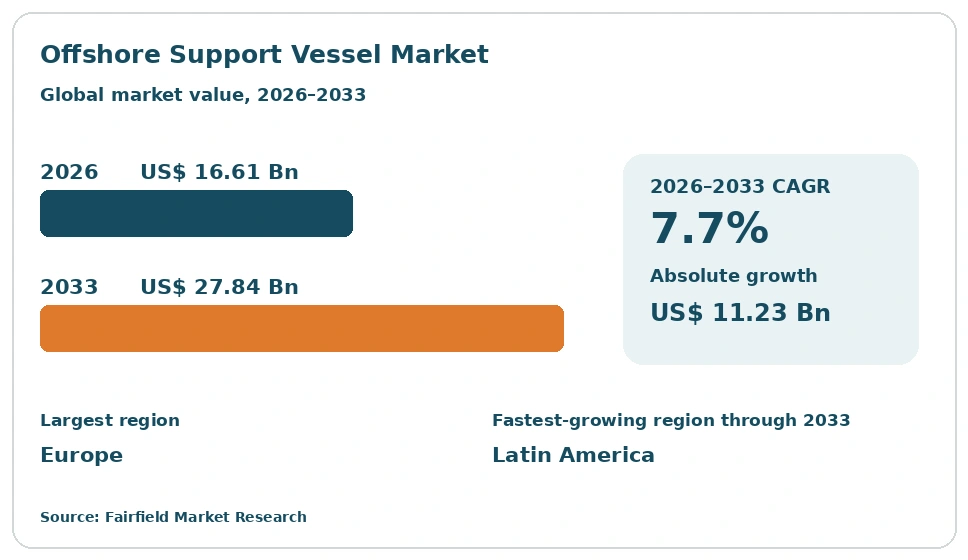
The global offshore support vessel market size is expected to be valued at US$ 16.61 billion in 2026 and projected to reach US$ 27.84 billion by 2033, growing at a CAGR of 7.7% between 2026 and 2033.
Between 2020 and 2025, the market grew at a CAGR of about 6.1%, rising from roughly US$ 11.5 billion to about US$ 15.4 billion, as offshore oil and gas spending recovered after the 2020 price crash, operators scrapped older vessels, few new ships were built, and day rates and vessel use rose sharply, while offshore wind created new demand. The offshore support vessel market covers ships that serve offshore oil and gas platforms, drilling rigs, subsea projects, and offshore wind farms. Main types include platform supply vessels (PSVs) that carry fuel, water, mud, and equipment; anchor handling tug supply (AHTS) vessels that tow rigs and set anchors; multipurpose support vessels; construction support vessels; crew boats; and service operation vessels for wind farms. In February 2026, Tidewater agreed to buy Wilson Sons Ultratug Offshore for about US$ 500 million, adding 22 vessels in Brazil.
Key Report Takeaways
- By Vessel Type: Platform Supply Vessels held about 35% share in 2025, while Service Operation Vessels are projected to expand at an 11.0% CAGR through 2033, driven by offshore wind farm construction and maintenance in Europe, Asia Pacific, and North America.
- By Water Depth: Shallow Water held about 55% share in 2025, while Deepwater is projected to expand at a 9.0% CAGR through 2033, driven by large deepwater oil projects in Brazil, Guyana, Suriname, Namibia, and other frontier basins.
- By End Use: Oil and Gas held about 80% share in 2025, while Offshore Wind is projected to expand at a 13.0% CAGR through 2033, driven by new wind farms, floating wind projects, and long-term maintenance needs.
- By Region: Europe held about 30% share in 2025, while Latin America is projected to expand at a 9.2% CAGR through 2033, driven by Petrobras deepwater expansion in Brazil, rapid growth in Guyana, and new projects in Suriname and Mexico.
Global Offshore Support Vessel Market Trends and Insights
Drivers Impact Analysis
Two drivers carry the strongest influence on offshore support vessel market demand during the forecast period.
| Driver | Impact on CAGR Forecast | Geographic Relevance | Impact Timeline |
| Offshore oil and gas investment | High | Latin America, Middle East & Africa, Asia Pacific | Medium term (2-4 years) |
| Offshore wind build-out | High | Europe, Asia Pacific, North America | Long term (≥4 years) |
Offshore Oil and Gas Is Driving the Offshore Support Vessel Market
Offshore oil and gas investment is the strongest driver of the offshore support vessel market. Energy companies are spending more on offshore fields.
The mechanism is that every offshore drilling rig, production platform, and floating production vessel needs a steady flow of supplies, crew, and support. After years of low spending, oil companies are developing large deepwater fields in Brazil, Guyana, Suriname, Namibia, Nigeria, and Angola, and national oil companies in Saudi Arabia, the United Arab Emirates, and Qatar are expanding offshore output. Offshore projects often have lower costs per barrel and lower emissions than many onshore fields, making them attractive. Each new floating production unit requires several support vessels for many years. Energy security concerns after recent supply disruptions have also encouraged investment. These trends raise vessel demand and day rates across major offshore regions.
Offshore Wind Is Expanding the Offshore Support Vessel Market
The offshore wind build-out is expanding the offshore support vessel market. Wind farms need specialized vessels for decades.
The cause is the rapid growth of offshore wind in Europe, China, Taiwan, South Korea, Japan, and North America. Building wind farms requires vessels to carry crews, components, and cables, while operating them for 25 to 30 years requires daily crew transfers and maintenance. Service operation vessels and commissioning service operation vessels with motion-compensated gangways let technicians walk safely onto turbines, and crew transfer vessels serve sites close to shore. Bernhard Schulte Offshore took delivery of its fourth new commissioning service operation vessel from Ulstein in 2026. Floating wind projects in deeper waters will need even more support. Many oil and gas vessel owners are converting ships or ordering new ones for wind work. These trends add long-term demand.
Restraints Impact Analysis
Two restraints limit how quickly the offshore support vessel market grows.
| Restraint | Impact on CAGR Forecast | Geographic Relevance | Impact Timeline |
| Oil price volatility and energy transition uncertainty | High | Global | Short term (≤2 years) |
| Aging fleet, high newbuild costs, and crew shortages | Medium | Global | Medium term (2-4 years) |
Oil Price Volatility Slows the Offshore Support Vessel Market
Oil price volatility and energy transition uncertainty slow the offshore support vessel market. Vessel demand follows oil company spending.
The problem is that when oil prices fall, energy companies cut offshore budgets, delay projects, and release vessels from contracts, as seen sharply in 2015 to 2017 and in 2020. Many vessel owners went bankrupt or restructured during those downturns. Long-term climate policies and the shift to renewable energy create uncertainty about future oil and gas demand, so some investors and banks are reluctant to finance new offshore vessels. Offshore wind has also faced setbacks, including project cancellations, cost increases, and policy changes in the United States. Interest rates and supply chain costs affect project timing. These factors make vessel demand and earnings uneven from year to year.
Aging Fleet Restricts the Offshore Support Vessel Market
An aging fleet, high newbuild costs, and crew shortages restrict the offshore support vessel market. Few new vessels are being built.
The constraint is that much of the global fleet was built during the boom before 2015, and many vessels are now old, less efficient, and costly to maintain. Building new vessels is expensive, especially with hybrid batteries, methanol-ready engines, and advanced gangways, and shipyard capacity is limited. Owners remain cautious about ordering, which keeps fleet supply tight but limits overall market expansion. Skilled crews, including officers and dynamic positioning operators, are in short supply, raising wage costs. Stricter emission rules require upgrades to older ships. Accidents and vessel losses also add costs. Dry-docking and repair yards are also busy, causing delays. These factors raise operating expenses and limit the ability to meet growing demand quickly.
Market Opportunities
Offshore Wind Service Vessels Open a Fast-Growth Revenue Pool
Offshore wind service vessels open a fast-growth revenue pool. Wind farm operators sign long-term vessel contracts.
The opportunity comes from hundreds of offshore wind turbines being installed each year, each needing regular inspection and maintenance throughout its life. Service operation vessels with gangways, cranes, accommodation, and warehouses can stay offshore for weeks, improving technician productivity. Wind farm operators often sign multi-year charters, which provide stable revenue compared with oil and gas spot markets. Demand is growing in the North Sea, the Baltic Sea, and Asia Pacific, and floating wind in deeper waters will create new needs. Shipbuilders such as Ulstein and Vard are delivering advanced hybrid vessels. Owners that invest early in modern, low-emission wind vessels can secure strong long-term earnings and high use rates.
Fleet Consolidation and Low-Emission Vessels Create a Growth Revenue Pool
Fleet consolidation and low-emission vessels create a growth revenue pool. Larger, greener fleets can earn better charter rates.
The opportunity reflects ongoing consolidation, as companies such as Tidewater and DOF Group buy vessels and competitors to gain scale, pricing power, and regional reach. Tidewater’s purchase of Wilson Sons Ultratug Offshore expands its fleet in Brazil, while DOF Group is high-grading its fleet by selling older vessels and buying construction support vessels. Energy companies increasingly prefer vessels with battery hybrid systems, shore power connections, and future-fuel readiness to cut emissions. Shareholder returns have improved as fleets grow and day rates rise. Owners that upgrade fleets, offer digital fuel monitoring, and win long-term contracts with major operators can earn premium day rates and stable cash flows.
Segment Analysis
By Vessel Type: Platform Supply Vessels Lead While Service Operation Vessels Grow Fastest
Platform Supply Vessels held about 35% share in 2025. These vessels carry drilling fluids, cement, fuel, water, food, and equipment between ports and offshore installations, and they are needed for almost every drilling and production operation. Large fleets in Europe, Latin America, and Middle East & Africa keep this the largest vessel segment.
Service Operation Vessels are the fastest-growing vessel type, expanding at an 11.0% CAGR through 2033. They house technicians, spare parts, and motion-compensated gangways for offshore wind farm maintenance and construction. Anchor Handling Tug Supply Vessels, Multipurpose Support Vessels, Construction Support Vessels, and Crew Boats form other segments. For the market, wind vessel growth diversifies revenue away from oil and gas and supports newbuild orders.
By Water Depth: Shallow Water Leads While Deepwater Grows Fastest
Shallow Water held about 55% share in 2025. Many offshore fields and platforms in Middle East & Africa, Asia Pacific, and the North Sea are in shallower waters, where smaller and older vessels can operate. Steady production and maintenance activity supports this large share across many regions.
Deepwater is the fastest-growing water depth, expanding at a 9.0% CAGR through 2033. Large deepwater projects in Brazil, Guyana, Suriname, and Namibia need larger, high-specification vessels with dynamic positioning and greater cargo capacity. Ultra-Deepwater forms another high-value segment. Contracts in these areas are often long and well paid. For the market, deepwater growth raises demand for premium vessels and supports higher day rates.
By End Use: Oil and Gas Leads While Offshore Wind Grows Fastest
Oil and Gas held about 80% share in 2025. Offshore drilling, production, subsea construction, and decommissioning require constant vessel support, and oil and gas companies are the largest charterers of offshore support vessels. Decommissioning of old platforms in the North Sea and elsewhere adds steady work for supply and construction vessels.
Offshore Wind is the fastest-growing end use, expanding at a 13.0% CAGR through 2033. Wind farm construction, cable laying, commissioning, and long-term maintenance require specialized vessels. Other end uses include offshore mining, aquaculture, and government work. Wind farm operators value vessels with low emissions and comfortable accommodation for technicians. For the market, wind growth provides long-term, stable contracts and helps owners reduce reliance on oil price cycles.
Geography Analysis
North America Shapes the Offshore Support Vessel Market Through Deepwater and Wind
North America is a major offshore support vessel market. The United States has large deepwater oil and gas production off Texas and Louisiana, where Tidewater, SEACOR Marine, and Hornbeck Offshore operate. Offshore wind projects off the east coast are creating demand for Jones Act-compliant service vessels, although policy changes have slowed some projects. Mexico and Canada add offshore activity. Key barriers include policy uncertainty and cabotage rules. New deepwater projects continue despite oil price swings. Vessel owners also serve rig moves and subsea work. Decommissioning of old platforms adds work in shallow waters. One opportunity is wind vessel demand.
Which Region Is Leading the Offshore Support Vessel Market?
Europe is leading the offshore support vessel market with about 30% share in 2025. Norway and the United Kingdom have large North Sea oil and gas industries and many leading vessel owners, including DOF Group, Solstad Offshore, and Siem Offshore. Germany, the Netherlands, and Denmark are major offshore wind markets that use many service operation vessels. Shipbuilders such as Ulstein and Vard build advanced low-emission vessels. Key barriers include declining North Sea output and high costs. Strict emission rules in Norway favor battery hybrid vessels. One change shaping the region is the shift of vessels toward offshore wind.
Asia Pacific Grows the Offshore Support Vessel Market Through Wind and Gas
Asia Pacific is a large and growing offshore support vessel market. China, Taiwan, South Korea, and Japan are building offshore wind farms, while Malaysia, Indonesia, Australia, and India have offshore oil and gas fields and new gas projects. Chinese and Singaporean shipyards build many offshore vessels. ONGC in India charters many support vessels. Key barriers include price competition and older fleets. Decommissioning of old fields in Malaysia and Thailand adds work. Local owners often compete on price. Gas projects in Australia need large vessels. One opportunity is wind service vessels for new Asian wind markets.
Which Region Is Growing Fastest in the Offshore Support Vessel Market?
Latin America is the fastest-growing offshore support vessel market, expanding at a 9.2% CAGR through 2033. Brazil is one of the world’s largest offshore oil producers, with Petrobras adding many floating production units in pre-salt fields, and Tidewater is expanding its Brazilian fleet to 28 vessels. Guyana is growing oil output rapidly, while Suriname and Mexico are developing new projects. Key barriers include local content rules and vessel accidents. Shipyards in Brazil are reviving to build local vessels. Day rates in the region are among the highest worldwide. One change shaping the region is high demand for Brazil-flagged vessels.
Middle East & Africa Builds the Offshore Support Vessel Market Through Oil and Gas Expansion
Middle East & Africa is an important offshore support vessel market. Saudi Arabia, the United Arab Emirates, and Qatar are expanding offshore oil and gas production, creating strong demand for supply vessels and crew boats. Nigeria, Angola, and Namibia are developing deepwater projects. Key barriers include security risks, local content rules, and payment delays in some countries. Large offshore gas fields in Qatar need many supply vessels. Local shipowners are growing with support from national oil companies. Egypt is also expanding offshore gas output. New discoveries in Namibia attract global owners. One opportunity is long-term contracts with national oil companies.
Competitive Landscape
The offshore support vessel market is fragmented. Tidewater, DOF Group, Solstad Offshore, BOURBON, and SEACOR Marine are leading players, while Siem Offshore, Hornbeck Offshore, Edison Chouest Offshore, Vroon, Bernhard Schulte Offshore, Havila Shipping, and Island Offshore compete strongly. Tidewater operates the world’s largest fleet of offshore support vessels, while Norwegian owners lead in high-specification vessels for harsh environments. Many regional owners in Asia Pacific, Middle East & Africa, and Latin America serve national oil companies.
Companies compete on vessel quality and age, fleet size, safety records, dynamic positioning capability, fuel efficiency, emissions, local presence, and day rates. Long-term charters with major oil companies and wind farm operators provide stable revenue, while spot markets offer higher but less predictable earnings. Local content rules in Brazil, Nigeria, and other countries favor owners with local fleets and partners.
Strategic moves show how competition is changing. In February 2026, Tidewater agreed to buy Wilson Sons Ultratug Offshore, greatly expanding its fleet in Brazil. In July 2026, DOF Group sold older supply vessels and bought new construction support vessels, while Bernhard Schulte Offshore took delivery of a new hybrid wind service vessel. These moves show consolidation in oil and gas and steady investment in modern vessels for offshore wind.
Three themes shape vendor strategy. First, owners are consolidating to gain scale and pricing power. Second, they are renewing fleets with hybrid, low-emission, and future-fuel-ready vessels. Third, they are expanding in Latin America and offshore wind markets in Europe and Asia Pacific.
Offshore Support Vessel Market Industry Leaders
- Tidewater
- DOF Group
- Solstad Offshore
- BOURBON
- SEACOR Marine
Recent Industry Developments
- July 2026: DOF Group agreed to buy two construction support vessels under construction in China and to sell four platform supply vessels - high-grades its fleet in the offshore support vessel market.
- July 2026: Bernhard Schulte Offshore took delivery of Windea Clarke, a hybrid, methanol-ready commissioning service operation vessel built by Ulstein - expands its offshore wind fleet to seven vessels.
- February 2026: Tidewater agreed to acquire Wilson Sons Ultratug Offshore for about US$ 500 million, adding 22 platform supply vessels - grows its fleet in Brazil from 6 to 28 vessels.
Companies Covered in the Report
- Tidewater
- DOF Group
- Solstad Offshore
- BOURBON
- SEACOR Marine
- Siem Offshore
- Hornbeck Offshore
- Edison Chouest Offshore
- Vroon
- Bernhard Schulte Offshore
- Havila Shipping
- Island Offshore
Offshore Support Vessel Market Report Scope
This report covers the offshore support vessel market, including platform supply vessels, anchor handling tug supply vessels, multipurpose support vessels, construction support vessels, crew boats, and service operation vessels, used in shallow water, deepwater, and ultra-deepwater for oil and gas, offshore wind, and other end uses. The base year is 2025, and the forecast period runs from 2026 to 2033. All values are expressed in US$ Billion.
| Vessel Type | Platform Supply Vessels, Anchor Handling Tug Supply Vessels, Multipurpose Support Vessels, Construction Support Vessels, Crew Boats, Service Operation Vessels |
| Water Depth | Shallow Water, Deepwater, Ultra-Deepwater |
| End Use | Oil and Gas, Offshore Wind, Others |
| Regions | North America, Europe, Asia Pacific, Latin America, Middle East & Africa |
1. Executive Summary
1.1 Offshore Support Vessel Market Snapshot
1.2 Future Projections
1.3 Key Market Trends
1.4 Regional Snapshot
2. Market Overview
2.1 Market Definition and Report Scope
2.2 Historical Market Trends
2.3 Market Dynamics
2.3.1 Drivers
2.3.1.1 Offshore Oil and Gas Is Driving the Offshore Support Vessel Market
2.3.1.2 Offshore Wind Is Expanding the Offshore Support Vessel Market
2.3.2 Restraints
2.3.2.1 Oil Price Volatility Slows the Offshore Support Vessel Market
2.3.2.2 Aging Fleet Restricts the Offshore Support Vessel Market
2.3.3 Market Opportunities
2.3.3.1 Offshore Wind Service Vessels Open a Fast-Growth Revenue Pool
2.3.3.2 Fleet Consolidation and Low-Emission Vessels Create a Growth Revenue Pool
3. Global Offshore Support Vessel Market Outlook, 2020–2033
3.1 Global Offshore Support Vessel Market Outlook, by Vessel Type, Value (US$ Billion), 2020–2033
3.1.1 Platform Supply Vessels
3.1.2 Anchor Handling Tug Supply Vessels
3.1.3 Multipurpose Support Vessels
3.1.4 Construction Support Vessels
3.1.5 Crew Boats
3.1.6 Service Operation Vessels
3.2 Global Offshore Support Vessel Market Outlook, by Water Depth, Value (US$ Billion), 2020–2033
3.2.1 Shallow Water
3.2.2 Deepwater
3.2.3 Ultra-Deepwater
3.3 Global Offshore Support Vessel Market Outlook, by End Use, Value (US$ Billion), 2020–2033
3.3.1 Oil and Gas
3.3.2 Offshore Wind
3.3.3 Others
3.4 Global Offshore Support Vessel Market Outlook, by Region, Value (US$ Billion), 2020–2033
3.4.1 North America
3.4.2 Europe
3.4.3 Asia Pacific
3.4.4 Latin America
3.4.5 Middle East & Africa
4. North America Offshore Support Vessel Market Outlook, 2020–2033
4.1 North America Offshore Support Vessel Market Outlook, by Vessel Type, Value (US$ Billion), 2020–2033
4.1.1 Platform Supply Vessels
4.1.2 Anchor Handling Tug Supply Vessels
4.1.3 Multipurpose Support Vessels
4.1.4 Construction Support Vessels
4.1.5 Crew Boats
4.1.6 Service Operation Vessels
4.2 North America Offshore Support Vessel Market Outlook, by Water Depth, Value (US$ Billion), 2020–2033
4.2.1 Shallow Water
4.2.2 Deepwater
4.2.3 Ultra-Deepwater
4.3 North America Offshore Support Vessel Market Outlook, by End Use, Value (US$ Billion), 2020–2033
4.3.1 Oil and Gas
4.3.2 Offshore Wind
4.3.3 Others
4.4 North America Offshore Support Vessel Market Outlook, by Country, Value (US$ Billion), 2020–2033
4.4.1 United States Offshore Support Vessel Market Outlook, by Vessel Type, 2020–2033
4.4.2 United States Offshore Support Vessel Market Outlook, by Water Depth, 2020–2033
4.4.3 United States Offshore Support Vessel Market Outlook, by End Use, 2020–2033
4.4.4 Mexico Offshore Support Vessel Market Outlook, by Vessel Type, 2020–2033
4.4.5 Mexico Offshore Support Vessel Market Outlook, by Water Depth, 2020–2033
4.4.6 Mexico Offshore Support Vessel Market Outlook, by End Use, 2020–2033
4.4.7 Canada Offshore Support Vessel Market Outlook, by Vessel Type, 2020–2033
4.4.8 Canada Offshore Support Vessel Market Outlook, by Water Depth, 2020–2033
4.4.9 Canada Offshore Support Vessel Market Outlook, by End Use, 2020–2033
5. Europe Offshore Support Vessel Market Outlook, 2020–2033
5.1 Europe Offshore Support Vessel Market Outlook, by Vessel Type, Value (US$ Billion), 2020–2033
5.1.1 Platform Supply Vessels
5.1.2 Anchor Handling Tug Supply Vessels
5.1.3 Multipurpose Support Vessels
5.1.4 Construction Support Vessels
5.1.5 Crew Boats
5.1.6 Service Operation Vessels
5.2 Europe Offshore Support Vessel Market Outlook, by Water Depth, Value (US$ Billion), 2020–2033
5.2.1 Shallow Water
5.2.2 Deepwater
5.2.3 Ultra-Deepwater
5.3 Europe Offshore Support Vessel Market Outlook, by End Use, Value (US$ Billion), 2020–2033
5.3.1 Oil and Gas
5.3.2 Offshore Wind
5.3.3 Others
5.4 Europe Offshore Support Vessel Market Outlook, by Country, Value (US$ Billion), 2020–2033
5.4.1 Norway Offshore Support Vessel Market Outlook, by Vessel Type, 2020–2033
5.4.2 Norway Offshore Support Vessel Market Outlook, by Water Depth, 2020–2033
5.4.3 Norway Offshore Support Vessel Market Outlook, by End Use, 2020–2033
5.4.4 United Kingdom Offshore Support Vessel Market Outlook, by Vessel Type, 2020–2033
5.4.5 United Kingdom Offshore Support Vessel Market Outlook, by Water Depth, 2020–2033
5.4.6 United Kingdom Offshore Support Vessel Market Outlook, by End Use, 2020–2033
5.4.7 Germany Offshore Support Vessel Market Outlook, by Vessel Type, 2020–2033
5.4.8 Germany Offshore Support Vessel Market Outlook, by Water Depth, 2020–2033
5.4.9 Germany Offshore Support Vessel Market Outlook, by End Use, 2020–2033
5.4.10 Netherlands Offshore Support Vessel Market Outlook, by Vessel Type, 2020–2033
5.4.11 Netherlands Offshore Support Vessel Market Outlook, by Water Depth, 2020–2033
5.4.12 Netherlands Offshore Support Vessel Market Outlook, by End Use, 2020–2033
5.4.13 Denmark Offshore Support Vessel Market Outlook, by Vessel Type, 2020–2033
5.4.14 Denmark Offshore Support Vessel Market Outlook, by Water Depth, 2020–2033
5.4.15 Denmark Offshore Support Vessel Market Outlook, by End Use, 2020–2033
6. Asia Pacific Offshore Support Vessel Market Outlook, 2020–2033
6.1 Asia Pacific Offshore Support Vessel Market Outlook, by Vessel Type, Value (US$ Billion), 2020–2033
6.1.1 Platform Supply Vessels
6.1.2 Anchor Handling Tug Supply Vessels
6.1.3 Multipurpose Support Vessels
6.1.4 Construction Support Vessels
6.1.5 Crew Boats
6.1.6 Service Operation Vessels
6.2 Asia Pacific Offshore Support Vessel Market Outlook, by Water Depth, Value (US$ Billion), 2020–2033
6.2.1 Shallow Water
6.2.2 Deepwater
6.2.3 Ultra-Deepwater
6.3 Asia Pacific Offshore Support Vessel Market Outlook, by End Use, Value (US$ Billion), 2020–2033
6.3.1 Oil and Gas
6.3.2 Offshore Wind
6.3.3 Others
6.4 Asia Pacific Offshore Support Vessel Market Outlook, by Country, Value (US$ Billion), 2020–2033
6.4.1 China Offshore Support Vessel Market Outlook, by Vessel Type, 2020–2033
6.4.2 China Offshore Support Vessel Market Outlook, by Water Depth, 2020–2033
6.4.3 China Offshore Support Vessel Market Outlook, by End Use, 2020–2033
6.4.4 Taiwan Offshore Support Vessel Market Outlook, by Vessel Type, 2020–2033
6.4.5 Taiwan Offshore Support Vessel Market Outlook, by Water Depth, 2020–2033
6.4.6 Taiwan Offshore Support Vessel Market Outlook, by End Use, 2020–2033
6.4.7 South Korea Offshore Support Vessel Market Outlook, by Vessel Type, 2020–2033
6.4.8 South Korea Offshore Support Vessel Market Outlook, by Water Depth, 2020–2033
6.4.9 South Korea Offshore Support Vessel Market Outlook, by End Use, 2020–2033
6.4.10 Japan Offshore Support Vessel Market Outlook, by Vessel Type, 2020–2033
6.4.11 Japan Offshore Support Vessel Market Outlook, by Water Depth, 2020–2033
6.4.12 Japan Offshore Support Vessel Market Outlook, by End Use, 2020–2033
6.4.13 Malaysia Offshore Support Vessel Market Outlook, by Vessel Type, 2020–2033
6.4.14 Malaysia Offshore Support Vessel Market Outlook, by Water Depth, 2020–2033
6.4.15 Malaysia Offshore Support Vessel Market Outlook, by End Use, 2020–2033
6.4.16 Indonesia Offshore Support Vessel Market Outlook, by Vessel Type, 2020–2033
6.4.17 Indonesia Offshore Support Vessel Market Outlook, by Water Depth, 2020–2033
6.4.18 Indonesia Offshore Support Vessel Market Outlook, by End Use, 2020–2033
6.4.19 Australia Offshore Support Vessel Market Outlook, by Vessel Type, 2020–2033
6.4.20 Australia Offshore Support Vessel Market Outlook, by Water Depth, 2020–2033
6.4.21 Australia Offshore Support Vessel Market Outlook, by End Use, 2020–2033
6.4.22 India Offshore Support Vessel Market Outlook, by Vessel Type, 2020–2033
6.4.23 India Offshore Support Vessel Market Outlook, by Water Depth, 2020–2033
6.4.24 India Offshore Support Vessel Market Outlook, by End Use, 2020–2033
6.4.25 Thailand Offshore Support Vessel Market Outlook, by Vessel Type, 2020–2033
6.4.26 Thailand Offshore Support Vessel Market Outlook, by Water Depth, 2020–2033
6.4.27 Thailand Offshore Support Vessel Market Outlook, by End Use, 2020–2033
7. Latin America Offshore Support Vessel Market Outlook, 2020–2033
7.1 Latin America Offshore Support Vessel Market Outlook, by Vessel Type, Value (US$ Billion), 2020–2033
7.1.1 Platform Supply Vessels
7.1.2 Anchor Handling Tug Supply Vessels
7.1.3 Multipurpose Support Vessels
7.1.4 Construction Support Vessels
7.1.5 Crew Boats
7.1.6 Service Operation Vessels
7.2 Latin America Offshore Support Vessel Market Outlook, by Water Depth, Value (US$ Billion), 2020–2033
7.2.1 Shallow Water
7.2.2 Deepwater
7.2.3 Ultra-Deepwater
7.3 Latin America Offshore Support Vessel Market Outlook, by End Use, Value (US$ Billion), 2020–2033
7.3.1 Oil and Gas
7.3.2 Offshore Wind
7.3.3 Others
7.4 Latin America Offshore Support Vessel Market Outlook, by Country, Value (US$ Billion), 2020–2033
7.4.1 Brazil Offshore Support Vessel Market Outlook, by Vessel Type, 2020–2033
7.4.2 Brazil Offshore Support Vessel Market Outlook, by Water Depth, 2020–2033
7.4.3 Brazil Offshore Support Vessel Market Outlook, by End Use, 2020–2033
7.4.4 Mexico Offshore Support Vessel Market Outlook, by Vessel Type, 2020–2033
7.4.5 Mexico Offshore Support Vessel Market Outlook, by Water Depth, 2020–2033
7.4.6 Mexico Offshore Support Vessel Market Outlook, by End Use, 2020–2033
8. Middle East & Africa Offshore Support Vessel Market Outlook, 2020–2033
8.1 Middle East & Africa Offshore Support Vessel Market Outlook, by Vessel Type, Value (US$ Billion), 2020–2033
8.1.1 Platform Supply Vessels
8.1.2 Anchor Handling Tug Supply Vessels
8.1.3 Multipurpose Support Vessels
8.1.4 Construction Support Vessels
8.1.5 Crew Boats
8.1.6 Service Operation Vessels
8.2 Middle East & Africa Offshore Support Vessel Market Outlook, by Water Depth, Value (US$ Billion), 2020–2033
8.2.1 Shallow Water
8.2.2 Deepwater
8.2.3 Ultra-Deepwater
8.3 Middle East & Africa Offshore Support Vessel Market Outlook, by End Use, Value (US$ Billion), 2020–2033
8.3.1 Oil and Gas
8.3.2 Offshore Wind
8.3.3 Others
8.4 Middle East & Africa Offshore Support Vessel Market Outlook, by Country, Value (US$ Billion), 2020–2033
8.4.1 Saudi Arabia Offshore Support Vessel Market Outlook, by Vessel Type, 2020–2033
8.4.2 Saudi Arabia Offshore Support Vessel Market Outlook, by Water Depth, 2020–2033
8.4.3 Saudi Arabia Offshore Support Vessel Market Outlook, by End Use, 2020–2033
8.4.4 United Arab Emirates Offshore Support Vessel Market Outlook, by Vessel Type, 2020–2033
8.4.5 United Arab Emirates Offshore Support Vessel Market Outlook, by Water Depth, 2020–2033
8.4.6 United Arab Emirates Offshore Support Vessel Market Outlook, by End Use, 2020–2033
8.4.7 Qatar Offshore Support Vessel Market Outlook, by Vessel Type, 2020–2033
8.4.8 Qatar Offshore Support Vessel Market Outlook, by Water Depth, 2020–2033
8.4.9 Qatar Offshore Support Vessel Market Outlook, by End Use, 2020–2033
8.4.10 Nigeria Offshore Support Vessel Market Outlook, by Vessel Type, 2020–2033
8.4.11 Nigeria Offshore Support Vessel Market Outlook, by Water Depth, 2020–2033
8.4.12 Nigeria Offshore Support Vessel Market Outlook, by End Use, 2020–2033
8.4.13 Egypt Offshore Support Vessel Market Outlook, by Vessel Type, 2020–2033
8.4.14 Egypt Offshore Support Vessel Market Outlook, by Water Depth, 2020–2033
8.4.15 Egypt Offshore Support Vessel Market Outlook, by End Use, 2020–2033
9. Competitive Landscape
9.1 Offshore Support Vessel Market Industry Leaders
9.2 Recent Industry Developments
9.3 Company Profiles
9.3.1 Tidewater
9.3.2 DOF Group
9.3.3 Solstad Offshore
9.3.4 BOURBON
9.3.5 SEACOR Marine
9.3.6 Siem Offshore
9.3.7 Hornbeck Offshore
9.3.8 Edison Chouest Offshore
9.3.9 Vroon
9.3.10 Bernhard Schulte Offshore
9.3.11 Havila Shipping
9.3.12 Island Offshore
10. Appendix
10.1 Research Methodology
10.2 Report Assumptions
10.3 Acronyms and Abbreviations
| Vessel Type | Platform Supply Vessels, Anchor Handling Tug Supply Vessels, Multipurpose Support Vessels, Construction Support Vessels, Crew Boats, Service Operation Vessels |
| Water Depth | Shallow Water, Deepwater, Ultra-Deepwater |
| End Use | Oil and Gas, Offshore Wind, Others |
| Regions | North America, Europe, Asia Pacific, Latin America, Middle East & Africa |
Our Research Methodology
Considering the volatility of business today, traditional approaches to strategizing a game plan can be unfruitful if not detrimental. True ambiguity is no way to determine a forecast. A myriad of predetermined factors must be accounted for such as the degree of risk involved, the magnitude of circumstances, as well as conditions or consequences that are not known or unpredictable. To circumvent binary views that cast uncertainty, the application of market research intelligence to strategically posture, move, and enable actionable outcomes is necessary.
View Methodology
Quality Assured
Rigorous Validation Process

Confidentiality Assured
End-to-end Data Security

Custom Research Services
Tailored To Your Objectives
FAQs
The offshore support vessel market is valued at US$ 16.61 billion in 2026, led by platform supply vessels and Europe.
The market is projected to reach US$ 27.84 billion by 2033, growing at a 7.7% CAGR and adding US$ 11.23 billion.
Offshore wind is growing fastest at a 13.0% CAGR through 2033, driven by new wind farms and long-term maintenance needs.
Latin America is growing fastest at a 9.2% CAGR through 2033, driven by deepwater oil in Brazil and Guyana.
Europe holds the largest share at about 30% in 2025, supported by North Sea oil and gas and offshore wind.
Related Reports
Automotive Pinion Gear Market Size, Share, Insights, Competitive Landscape, and Forecast 2026 to 2033
The global automotive pinion gear market is valued at US$14.01 billion in 2026, reaching US$18.57 billion by 2033, growing at a 4.1% CAGR
Automotive CMOS Image Sensor Market Size, Share, Insights, Competitive Landscape, and Forecast 2026 to 2033
The global automotive CMOS image sensor market is valued at US$4.1 billion in 2026, reaching US$9.8 billion by 2033, growing at a 13.2% CAGR
Automotive Electric Vacuum Pump Market Size, Share, Insights, Competitive Landscape, and Forecast 2026 to 2033
Explore the automotive electric vacuum pump market outlook for 2026–2033, covering pump types, propulsion, vehicles, regions, and key companies.
EV Contactor Relay Market Size, Share, Insights, Competitive Landscape, and Forecast 2026 to 2033
The global EV contactor relay market is valued at US$2.4 billion in 2026, reaching US$6.3 billion by 2033, growing at a 14.8% CAGR
Locomotive Market Size, Share, Insights, Competitive Landscape, and Forecast 2026 to 2033
The locomotive market is projected to reach US$29.5 billion by 2033. Explore propulsion trends, freight and passenger demand, and regional growth.
Li-ion Battery Management Systems Market Size, Share, Insights, Competitive Landscape, and Forecast 2026 to 2033
The Li-ion battery management systems market is projected to reach US$30.2 billion by 2033. Explore trends by topology, pack voltage, and application.