



Polyphenylene Market
Polyphenylene Market Insights, Competitive Landscape, and Market Forecast - 2033
Polyphenylene Market Size, Share, and Growth Forecast 2026 – 2033
Key Market Highlights
- The global Polyphenylene Market size is likely to be valued at USD 4.3 Billion in 2026 and is expected to reach USD 7.7 Billion by 2033, growing at a CAGR of 8.6% during the forecast period from 2026 to 2033.
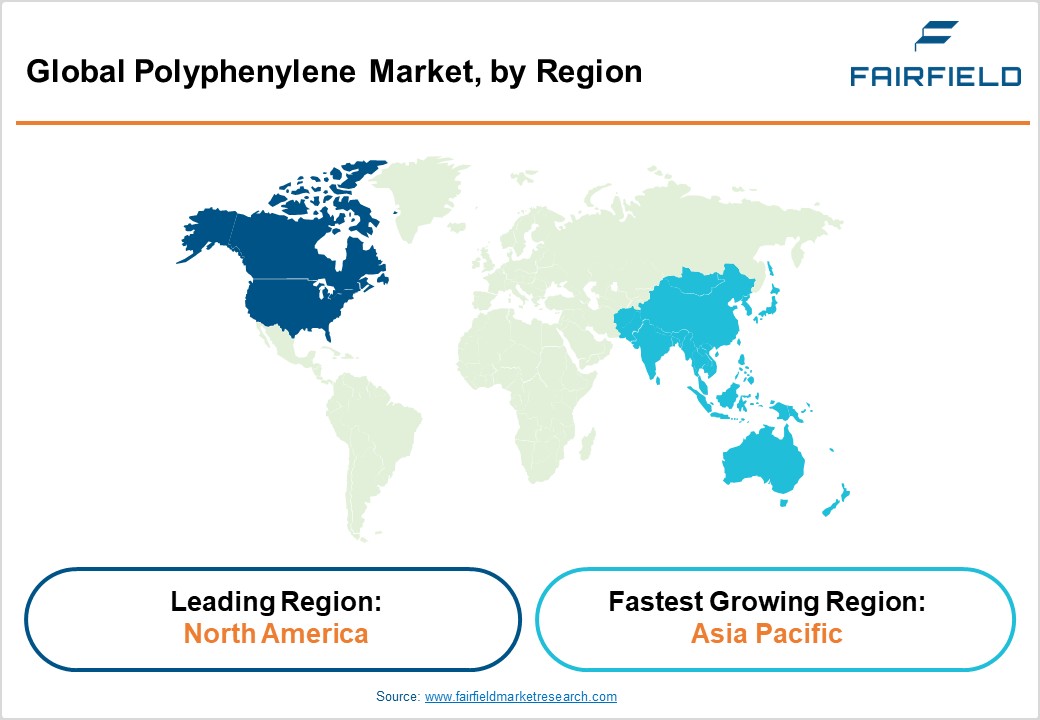
- North America dominates the polyphenylene market with approximately 40% revenue share, driven by robust electronics, defense, and automotive manufacturing sectors alongside the U.S. CHIPS Act-backed semiconductor investments.
- Asia Pacific is the fastest-growing region, led by China, Japan, and India, fueled by surging EV sales, semiconductor fab expansions, and large-scale electronics manufacturing under government-backed incentive programs.
- Polyphenylene Sulfide (PPS) leads the product type segment with approximately 55% market share, owing to its superior thermal stability, chemical resistance, and broad applicability across automotive and electronics end-uses.
- The Automotive and Transportation segment is the fastest growing end-user industry, driven by rapid global EV adoption, vehicle lightweighting initiatives, and demand for high-performance thermal management polymer solutions.
- Polyphenylene materials for EV battery thermal management and next-generation semiconductor fabrication equipment in Asia Pacific represent the most significant commercial opportunities through 2033, supported by over USD 10 billion in regional semiconductor investment programs.
Market Dynamics
Market Growth Drivers
- Rising Demand from the Electrical and Electronics Industry
The proliferation of miniaturized and high-density electronic assemblies is a pivotal driver for the polyphenylene market. Polyphenylene sulfide (PPS) and polyphenylene ether (PPE) are extensively used in connectors, circuit breakers, relay switches, and semiconductor components owing to their outstanding dielectric properties and flame retardancy. According to the International Energy Agency (IEA), global electricity demand is projected to grow by over 3% annually through 2026, fueling further investment in power distribution equipment that heavily uses high-performance polymers. The accelerating rollout of 5G networks and advanced semiconductor packaging technologies globally is translating into expanded consumption of polyphenylene-based materials in insulation and structural applications.
- Automotive Lightweighting and EV Adoption
The global shift toward electric vehicles (EVs) is a compelling growth catalyst for the polyphenylene market. Polyphenylene sulfide is increasingly used in battery housings, thermal management systems, and under-the-hood components due to its resistance to chemicals and elevated temperatures. The International Organization of Motor Vehicle Manufacturers (OICA) reported that global EV sales surpassed almost a million units in 2023, a figure that has continued to rise significantly through 2024-2025. Automakers are systematically replacing metal parts with polymer composites, including polyphenylene, to reduce vehicle weight and meet stringent emissions standards. This structural shift in vehicle architecture is expected to maintain consistent demand from the automotive and transportation segment through 2033.
Market Restraints
- High Production Costs and Raw Material Volatility
The synthesis of polyphenylene compounds, particularly PPS and PPO, involves complex polymerization processes requiring costly monomers such as p-dichlorobenzene and sodium sulfide. Volatile crude oil prices directly impact the cost of these petrochemical precursors, thereby squeezing manufacturer margins. According to the U.S. Energy Information Administration (EIA), crude oil prices experienced fluctuations exceeding 30% between 2022 and 2024, exacerbating cost unpredictability. These elevated and unstable production costs restrict broader adoption, especially among cost-sensitive applications and smaller fabricators, thus acting as a tangible restraint on market expansion.
- Processing Challenges and Limited Recyclability
Despite their superior performance, polyphenylene-based polymers present notable processing difficulties. High melt viscosities and narrow processing windows for materials like PPS require specialized high-temperature extrusion and injection molding equipment, increasing capital expenditure for manufacturers. Additionally, growing regulatory emphasis on circular economy principles in the European Union, including the EU Ecodesign for Sustainable Products Regulation (ESPR) enacted in 2024 where places pressure on engineering plastic suppliers to demonstrate end-of-life recyclability. The inherent chemical resistance that makes polyphenylene valuable also hinders conventional recycling methods, creating a structural challenge for market participants and potentially influencing procurement decisions by sustainability-conscious buyers.
Market Opportunities
- Expansion in Asia Pacific Semiconductor and 5G Infrastructure
Asia Pacific represents the fastest-growing regional opportunity for the polyphenylene market, driven by massive government-backed investments in domestic semiconductor and telecom infrastructure. China's "Made in China 2025" initiative, India's India Semiconductor Mission (ISM) which has allocated over USD 10 billion to semiconductor manufacturing and South Korea's and Japan's chip expansion programs are collectively creating robust demand for specialty polymers used in semiconductor fabrication equipment. Polyphenylene ether and PPS are critical materials in chip-processing equipment components and advanced PCB substrates. With 5G base station deployments accelerating across ASEAN, Japan, and India, the consumption of high-frequency, low-loss dielectric materials, including modified polyphenylene ether, is set to see exponential growth through the forecast period.
- Next-Generation Automotive Applications: Thermal Management in EVs
The electrification megatrend offers a strategic opportunity for polyphenylene market participants to develop next-generation thermal management solutions. Battery electric vehicles require sophisticated cooling and insulation systems where polyphenylene sulfide excels due to its low thermal expansion and chemical inertness. The U.S. Department of Energy (DOE) has announced that thermal management constitutes up to 40% of an EV battery's engineering challenge, highlighting the significance of advanced polymer solutions. Companies developing tailored PPS grades with enhanced flame-retardant and dimensional stability characteristics specifically for EV battery management systems stand to capture significant incremental revenue. The projected addition of over 200 million EVs globally by 2030 underscores the scale of this commercial opportunity.
Segmental Insights
- Product Type Analysis
Within the product type category, Polyphenylene Sulfide (PPS) holds the dominant position, commanding approximately 55% of the global polyphenylene market share. This leadership is underpinned by PPS's exceptional combination of thermal stability, inherent flame retardancy, and resistance to a wide range of chemicals and solvents. These properties make PPS the material of choice for automotive fuel systems, electronic connectors, and industrial filtration membranes. Major producers such as Toray Industries and DIC Corporation have continued to invest in expanding PPS production capacities in response to growing demand from the EV and electronics sectors. The versatility of PPS in both injection-molded and fiber-form applications further consolidates its position as the leading segment.
- End-user Industry Analysis
The Electrical and Electronics segment stands as the leading end-user industry in the polyphenylene market, accounting for approximately 42% of total revenue. The segment's leadership is driven by the pervasive use of polyphenylene materials in printed circuit boards, electronic housings, switchgear components, and high-frequency communication devices. The expansion of data centers the International Data Corporation (IDC) estimates that global data center infrastructure investment exceeded USD 300 billion in 2024 alongside the mass deployment of IoT devices and advanced metering infrastructure, is generating incremental demand for thermally and electrically stable polymer materials. The segment's dominance is expected to persist through 2033, reinforced by continued digitization and the global build-out of smart manufacturing and energy infrastructure.
Regional Insights
- North America Polyphenylene Market Trends
North America holds a leading share of approximately 40% in the global polyphenylene market, anchored by robust end-user demand from the United States. The U.S. market benefits from a strong automotive OEM base in Michigan and the Southeast, sustained demand from its advanced electronics and defense manufacturing sectors, and significant policy tailwinds. The CHIPS and Science Act (2022), which committed over USD 52 billion toward domestic semiconductor manufacturing, has driven new fab investments by Intel, TSMC, and Samsung, each representing a high-growth consumption avenue for specialty polymers.
On the regulatory front, the U.S. Environmental Protection Agency (EPA) and NFPA standards mandate high flame-retardancy requirements in electrical enclosures, benefiting inherently flame-retardant polyphenylene sulfide over halogenated alternatives. The presence of key producers and a sophisticated chemical distribution network further reinforces North America's market leadership position.
- Europe Polyphenylene Market Trends
Europe maintains a significant share in the global polyphenylene market, with Germany, France, and U.K. serving as principal demand centers. Germany's position as a global automotive engineering hub, home to Volkswagen Group, BMW, and Mercedes-Benz, ensures consistent polyphenylene consumption in powertrain, sensor housing, and EV battery management components. The EU's Green Deal and the mandate to phase out internal combustion engine vehicles by 2035 is accelerating the transition to EV-oriented polymer solutions.
Regulatory harmonization under REACH and the RoHS Directive is pushing European manufacturers to favor polyphenylene-based materials that comply with strict substance restrictions. Spain and France are emerging as growth markets driven by renewable energy equipment manufacturing, where polyphenylene-based components are used in solar inverters and wind turbine systems sectors, receiving over billions in EU clean energy investments through 2030.
- Asia Pacific Polyphenylene Market Trends
Asia Pacific is the fastest-growing regional market, propelled by rapid industrialization, electronics manufacturing scale-up, and aggressive EV adoption across China, Japan, and India. China dominates regional consumption, with its position as the world's largest EV market and electronics manufacturer generating unparalleled volumes of polyphenylene demand. China's EV sales reached over 9 million units in 2023, reinforcing demand for PPS in battery systems and structural components. Japan, home to market leaders Toray Industries and Kureha Corporation, remains pivotal for high-value PPS fiber and film applications.
India's electronics manufacturing sector is experiencing rapid expansion, supported by the Production Linked Incentive (PLI) scheme with allocations exceeding INR crores across electronics and advanced chemicals. ASEAN nations, including Vietnam and Thailand, are attracting significant electronic component manufacturing foreign direct investment, further expanding the regional polyphenylene demand base. The convergence of manufacturing cost advantages and surging domestic consumption positions Asia Pacific as the primary growth engine of the global polyphenylene market through 2033.
Competitive Landscape
The global polyphenylene market exhibits a moderately consolidated structure, with a handful of large multinational chemical and specialty polymer companies accounting for the majority of production capacity and revenue. Key players such as BASF, SABIC, Celanese Corporation, and Toray Industries leverage extensive R&D infrastructure, vertically integrated supply chains, and global distribution networks as primary competitive differentiators. Strategic moves center on capacity expansions in the Asia Pacific, the development of application-specific polymer grades for EV and semiconductor applications, and sustainability-focused product innovation. Collaborative agreements with automotive OEMs and electronics manufacturers for co-development of customized materials are an increasingly prominent business model trend.
Key Developments
- In March 2025, Toray Industries announced a capacity expansion of its Torelina™ PPS resin production facility in Japan, targeting a 20% increase in output to meet rising EV and electronics demand in Asia Pacific.
- In November 2024, BASF launched a new line of Ultrason® PPE/PPS blends with enhanced thermal and flame-retardant properties, specifically formulated for high-voltage EV battery management and charging infrastructure components.
- In June 2024, Celanese Corporation entered into a long-term supply agreement with a major North American EV manufacturer to provide specialty PPS compounds for under-hood and battery housing applications, strengthening its automotive segment positioning.
Companies Covered in Polyphenylene Market
- DIC Corporation
- Toray Industries
- Celanese Corporation
- SABIC
- BASF
- LG Chem
- Kureha Corporation
- Ensinger
- Evonik Industries
- Solvay S.A.
- Teijin Limited
- Tosoh Corporation
- Asahi Kasei Corporation
Market Segmentation
By Product Type
- Polyphenylene Sulfide (PPS)
- Polyphenylene Oxide (PPO)
- Polyphenylene Ether (PPE)
By End-user Industry
- Electrical and Electronics
- Automotive and Transportation
- Others (Industrial, Aerospace, Medical, Consumer Goods)
By Region
- North America
- Europe
- Asia Pacific
- Latin America
- Middle East & Africa
- Executive Summary
- Global Polyphenylene Market Snapshot
- Future Projections
- Key Market Trends
- Regional Snapshot, by Value, 2026
- Analyst Recommendations
- Market Overview
- Market Definitions and Segmentations
- Market Dynamics
- Drivers
- Restraints
- Market Opportunities
- Value Chain Analysis
- COVID-19 Impact Analysis
- Porter's Five Forces Analysis
- Impact of Russia-Ukraine Conflict
- PESTLE Analysis
- Regulatory Analysis
- Price Trend Analysis
- Current Prices and Future Projections, 2025-2033
- Price Impact Factors
- Global Polyphenylene Market Outlook, 2020 - 2033
- Global Polyphenylene Market Outlook, by Product Type, Value (US$ Bn), 2020-2033
- Polyphenylene Sulfide
- Polyphenylene Oxide
- Polyphenylene Ether
- Global Polyphenylene Market Outlook, by End-user Industry , Value (US$ Bn), 2020-2033
- Electrical and Electronics
- Automotive and Transportation
- Others
- Global Polyphenylene Market Outlook, by Region, Value (US$ Bn), 2020-2033
- North America
- Europe
- Asia Pacific
- Latin America
- Middle East & Africa
- Global Polyphenylene Market Outlook, by Product Type, Value (US$ Bn), 2020-2033
- North America Polyphenylene Market Outlook, 2020 - 2033
- North America Polyphenylene Market Outlook, by Product Type, Value (US$ Bn), 2020-2033
- Polyphenylene Sulfide
- Polyphenylene Oxide
- Polyphenylene Ether
- North America Polyphenylene Market Outlook, by End-user Industry , Value (US$ Bn), 2020-2033
- Electrical and Electronics
- Automotive and Transportation
- Others
- North America Polyphenylene Market Outlook, by Country, Value (US$ Bn), 2020-2033
- U.S. Polyphenylene Market Outlook, by Product Type, 2020-2033
- U.S. Polyphenylene Market Outlook, by End-user Industry , 2020-2033
- Canada Polyphenylene Market Outlook, by Product Type, 2020-2033
- Canada Polyphenylene Market Outlook, by End-user Industry , 2020-2033
- BPS Analysis/Market Attractiveness Analysis
- North America Polyphenylene Market Outlook, by Product Type, Value (US$ Bn), 2020-2033
- Europe Polyphenylene Market Outlook, 2020 - 2033
- Europe Polyphenylene Market Outlook, by Product Type, Value (US$ Bn), 2020-2033
- Polyphenylene Sulfide
- Polyphenylene Oxide
- Polyphenylene Ether
- Europe Polyphenylene Market Outlook, by End-user Industry , Value (US$ Bn), 2020-2033
- Electrical and Electronics
- Automotive and Transportation
- Others
- Europe Polyphenylene Market Outlook, by Country, Value (US$ Bn), 2020-2033
- Germany Polyphenylene Market Outlook, by Product Type, 2020-2033
- Germany Polyphenylene Market Outlook, by End-user Industry , 2020-2033
- Italy Polyphenylene Market Outlook, by Product Type, 2020-2033
- Italy Polyphenylene Market Outlook, by End-user Industry , 2020-2033
- France Polyphenylene Market Outlook, by Product Type, 2020-2033
- France Polyphenylene Market Outlook, by End-user Industry , 2020-2033
- U.K. Polyphenylene Market Outlook, by Product Type, 2020-2033
- U.K. Polyphenylene Market Outlook, by End-user Industry , 2020-2033
- Spain Polyphenylene Market Outlook, by Product Type, 2020-2033
- Spain Polyphenylene Market Outlook, by End-user Industry , 2020-2033
- Russia Polyphenylene Market Outlook, by Product Type, 2020-2033
- Russia Polyphenylene Market Outlook, by End-user Industry , 2020-2033
- Rest of Europe Polyphenylene Market Outlook, by Product Type, 2020-2033
- Rest of Europe Polyphenylene Market Outlook, by End-user Industry , 2020-2033
- BPS Analysis/Market Attractiveness Analysis
- Europe Polyphenylene Market Outlook, by Product Type, Value (US$ Bn), 2020-2033
- Asia Pacific Polyphenylene Market Outlook, 2020 - 2033
- Asia Pacific Polyphenylene Market Outlook, by Product Type, Value (US$ Bn), 2020-2033
- Polyphenylene Sulfide
- Polyphenylene Oxide
- Polyphenylene Ether
- Asia Pacific Polyphenylene Market Outlook, by End-user Industry , Value (US$ Bn), 2020-2033
- Electrical and Electronics
- Automotive and Transportation
- Others
- Asia Pacific Polyphenylene Market Outlook, by Country, Value (US$ Bn), 2020-2033
- China Polyphenylene Market Outlook, by Product Type, 2020-2033
- China Polyphenylene Market Outlook, by End-user Industry , 2020-2033
- Japan Polyphenylene Market Outlook, by Product Type, 2020-2033
- Japan Polyphenylene Market Outlook, by End-user Industry , 2020-2033
- South Korea Polyphenylene Market Outlook, by Product Type, 2020-2033
- South Korea Polyphenylene Market Outlook, by End-user Industry , 2020-2033
- India Polyphenylene Market Outlook, by Product Type, 2020-2033
- India Polyphenylene Market Outlook, by End-user Industry , 2020-2033
- Southeast Asia Polyphenylene Market Outlook, by Product Type, 2020-2033
- Southeast Asia Polyphenylene Market Outlook, by End-user Industry , 2020-2033
- Rest of SAO Polyphenylene Market Outlook, by Product Type, 2020-2033
- Rest of SAO Polyphenylene Market Outlook, by End-user Industry , 2020-2033
- BPS Analysis/Market Attractiveness Analysis
- Asia Pacific Polyphenylene Market Outlook, by Product Type, Value (US$ Bn), 2020-2033
- Latin America Polyphenylene Market Outlook, 2020 - 2033
- Latin America Polyphenylene Market Outlook, by Product Type, Value (US$ Bn), 2020-2033
- Polyphenylene Sulfide
- Polyphenylene Oxide
- Polyphenylene Ether
- Latin America Polyphenylene Market Outlook, by End-user Industry , Value (US$ Bn), 2020-2033
- Electrical and Electronics
- Automotive and Transportation
- Others
- Latin America Polyphenylene Market Outlook, by Country, Value (US$ Bn), 2020-2033
- Brazil Polyphenylene Market Outlook, by Product Type, 2020-2033
- Brazil Polyphenylene Market Outlook, by End-user Industry , 2020-2033
- Mexico Polyphenylene Market Outlook, by Product Type, 2020-2033
- Mexico Polyphenylene Market Outlook, by End-user Industry , 2020-2033
- Argentina Polyphenylene Market Outlook, by Product Type, 2020-2033
- Argentina Polyphenylene Market Outlook, by End-user Industry , 2020-2033
- Rest of LATAM Polyphenylene Market Outlook, by Product Type, 2020-2033
- Rest of LATAM Polyphenylene Market Outlook, by End-user Industry , 2020-2033
- BPS Analysis/Market Attractiveness Analysis
- Latin America Polyphenylene Market Outlook, by Product Type, Value (US$ Bn), 2020-2033
- Middle East & Africa Polyphenylene Market Outlook, 2020 - 2033
- Middle East & Africa Polyphenylene Market Outlook, by Product Type, Value (US$ Bn), 2020-2033
- Polyphenylene Sulfide
- Polyphenylene Oxide
- Polyphenylene Ether
- Middle East & Africa Polyphenylene Market Outlook, by End-user Industry , Value (US$ Bn), 2020-2033
- Electrical and Electronics
- Automotive and Transportation
- Others
- Middle East & Africa Polyphenylene Market Outlook, by Country, Value (US$ Bn), 2020-2033
- GCC Polyphenylene Market Outlook, by Product Type, 2020-2033
- GCC Polyphenylene Market Outlook, by End-user Industry , 2020-2033
- South Africa Polyphenylene Market Outlook, by Product Type, 2020-2033
- South Africa Polyphenylene Market Outlook, by End-user Industry , 2020-2033
- Egypt Polyphenylene Market Outlook, by Product Type, 2020-2033
- Egypt Polyphenylene Market Outlook, by End-user Industry , 2020-2033
- Nigeria Polyphenylene Market Outlook, by Product Type, 2020-2033
- Nigeria Polyphenylene Market Outlook, by End-user Industry , 2020-2033
- Rest of Middle East Polyphenylene Market Outlook, by Product Type, 2020-2033
- Rest of Middle East Polyphenylene Market Outlook, by End-user Industry , 2020-2033
- BPS Analysis/Market Attractiveness Analysis
- Middle East & Africa Polyphenylene Market Outlook, by Product Type, Value (US$ Bn), 2020-2033
- Competitive Landscape
- Company Vs Segment Heatmap
- Company Market Share Analysis, 2025
- Competitive Dashboard
- Company Profiles
- DIC Corporation
- Company Overview
- Product Portfolio
- Financial Overview
- Business Strategies and Developments
- Toray Industries
- Celanese Corporation
- SABIC
- BASF
- LG Chem
- Kureha Corporation
- Ensinger
- Evonik Industries
- DIC Corporation
- Appendix
- Research Methodology
- Report Assumptions
- Acronyms and Abbreviations
|
BASE YEAR |
HISTORICAL DATA |
FORECAST PERIOD |
UNITS |
|||
 |
2025 |
 |
2020 - 2025 |
 |
2026 - 2033 |
Value: US$ Billion |
|
REPORT FEATURES |
DETAILS |
|
By Product Type Coverage |
|
|
By Application Coverage |
|
|
Geographical Coverage |
|
|
Leading Companies |
|
|
Report Highlights |
Key Market Indicators, Macro-micro economic impact analysis, Technological Roadmap, Key Trends, Driver, Restraints, and Future Opportunities & Revenue Pockets, Porter’s 5 Forces Analysis, Historical Trend (2019-2024), Market Estimates and Forecast, Market Dynamics, Industry Trends, Competition Landscape, Category, Region, Country-wise Trends & Analysis, COVID-19 Impact Analysis (Demand and Supply Chain) |
Our Research Methodology
Considering the volatility of business today, traditional approaches to strategizing a game plan can be unfruitful if not detrimental. True ambiguity is no way to determine a forecast. A myriad of predetermined factors must be accounted for such as the degree of risk involved, the magnitude of circumstances, as well as conditions or consequences that are not known or unpredictable. To circumvent binary views that cast uncertainty, the application of market research intelligence to strategically posture, move, and enable actionable outcomes is necessary.
View Methodology
Quality Assured
Rigorous Validation Process

Confidentiality Assured
End-to-end Data Security

Custom Research Services
Tailored To Your Objectives
FAQs
The Polyphenylene market size is valued at USD 4.3 Billion in 2026.
The Polyphenylene market is projected to grow at a CAGR of 8.6% by 2033, reaching USD 7.7 Billion.
The Polyphenylene Market growth drivers include electrification demand, electronics miniaturization, and industrial durability needs.
North America is a dominating region for Polyphenylene Market.
DIC Corporation, Solvay, Toray Industries, Celanese Corporation, and SABIC are some leading industry players in the Polyphenylene Market.
Related Reports
Hydrogen Cyanide Market
Hydrogen Cyanide Market reaches USD 3.98 Billion by 2033 from USD 2.85 Billion in 2026, growing at 4.9% CAGR, with Chemicals & Plastics leading at 57%.
Seed Treatment Fungicides Market Insights, Competitive Landscape, and Market Forecast 2033
Seed Treatment Fungicides Market to reach USD 5.74 Bn by 2033, growing at 6.9% CAGR, driven by crop protection, disease control, and sustainable farming.
SDHI Fungicide Market Insights, Competitive Landscape, and Market Forecast 2033
SDHI Fungicide Market to reach USD 3.89 Bn by 2033, growing at 7.8% CAGR, driven by crop protection, disease control, and resistance management.
Lithium Manganese Iron Phosphate (LMFP) Battery Market Forecast - 2033
The global lithium manganese iron phosphate (LMFP) battery market is set to reach US$ 7.24 billion by 2033, growing at a 22.0% CAGR from 2026-2033
Ball Clay Market Insights, Competitive Landscape, and Market Forecast - 2033
Ball clay market is valued at USD 1.65 Billion in 2026 and projected to reach USD 2.26 Billion by 2033, expanding at a CAGR of 4.6%.
N-Vinylformamide Market Insights, Competitive Landscape, and Market Forecast - 2033
N-vinylformamide market is valued at USD 420.00 Million in 2026 and projected to reach USD 683.30 Million by 2033, expanding at a CAGR of 7.2%.