



Reusable Water Bottles Market
Reusable Water Bottles Market Insights, Competitive Landscape, and Market Forecast - 2033
Reusable Water Bottles Market Growth and Industry Forecast
- The global reusable water bottles market is projected to reach USD 11.3 Bn in 2026.
- It is further expected to grow to USD 16.2 Bn by 2032, registering a CAGR of 5% during 2026-2033.
Reusable Water Bottles Market Summary: Key Insights & Trends
- Insulated bottles dominate with a 62% market share in 2023, led by Hydro Flask and Thermos.
- Collapsible bottles are the fastest-growing product type, fueled by urban, travel, and silicone-based innovations.
- Plastic bottles (34.6% share in 2025) lead materials, while stainless steel emerges as the fastest-growing eco-friendly option.
- Everyday use is the top usage segment, while sports bottles expand rapidly with Gen Z and fitness trends.
- 16–27 Oz bottles remain the most popular size, but 32 Oz bottles show the strongest growth.
- Mid-range US$ 15–20 bottles dominate, while the premium US$ 25+ segment grows fastest with smart innovations.
- Supermarkets/Hypermarkets lead sales with 34.8% share, but online retail is the fastest-growing, projected to hit US$ 5.5 Bn by 2033.
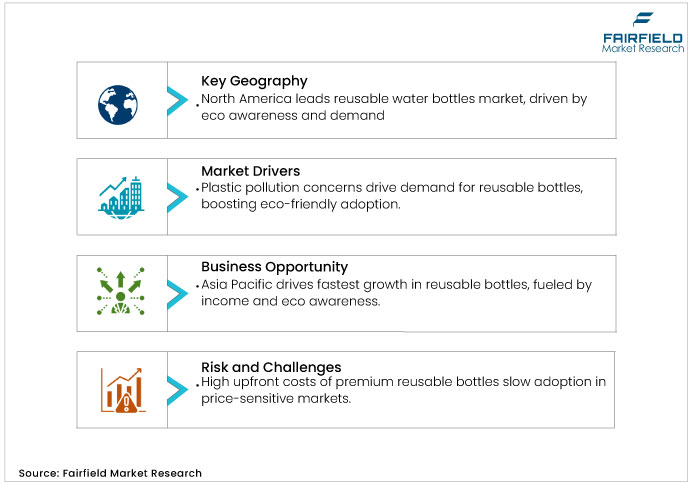
- North America leads globally with 28.5% share in 2025, while Asia Pacific records the fastest growth at 10.5% share.
Key Growth Drivers
- Rising Environmental Awareness and Plastic Pollution Concerns Fuel Reusable Bottles Demand
Growing awareness of plastic pollution’s environmental impact is a key driver for the reusable water bottles market. Single-use plastics contribute significantly to landfill waste and ocean pollution, with over 8 million metric tons of plastic entering oceans annually. Consumers are increasingly adopting reusable bottles made from stainless steel, glass, and BPA-free plastics to reduce their ecological footprint. A 2021 Global Sustainability Study indicated that 70% of consumers in the Americas prioritize eco-friendly products, boosting demand for sustainable alternatives. Government regulations, such as the EU’s 2021 single-use plastic ban, have further encouraged the shift toward reusable options. Brands such as S’well and Klean Kanteen have capitalized on this trend by offering stylish, durable bottles, appealing to eco-conscious consumers. This driver aligns with global sustainability goals, ensuring continued market growth.
- Health and Hydration Trends Drive Global Adoption of Reusable Water Bottles
The growing emphasis on health and wellness significantly drives the reusable water bottles. Consumers are increasingly health-conscious, prioritizing hydration as part of active lifestyles, with 69% of Gen Z purchasing reusable bottles in 2023 for convenience and health benefits. Stainless steel and glass bottles, which maintain water purity and avoid chemical leaching, are particularly popular. The rise in outdoor activities, such as hiking and gym-going, has increased demand for durable, insulated bottles that keep beverages at desired temperatures. Brands such as Hydro Flask and CamelBak offer products tailored for sports and travel, enhancing market appeal. Additionally, reusable bottles reduce exposure to harmful chemicals such as BPA, found in some disposable plastics, aligning with consumer health priorities. This trend is expected to persist, supporting market growth through 2032.
- Technological Advancements and Smart Innovations Strengthen Reusable Water Bottles Market Growth
Innovations in bottle design and technology are propelling the market forward. Manufacturers are integrating smart features, such as LARQ’s UV-C LED technology for automatic water purification, enhancing product functionality. Collapsible and infuser bottles cater to convenience-driven consumers, while insulated bottles, holding a 62% market share, dominate due to their temperature retention capabilities. Advances in material science have led to lightweight, durable options such as BPA-free polymers and silicone, appealing to diverse consumer needs. Companies such as Hydro Flask and Thermos invest heavily in R&D to offer aesthetic and functional designs, driving premium product sales.
Key Growth Restraints
- Higher Upfront Costs Limit Consumer Access to Eco-Friendly Alternatives
The reusable water bottles market faces challenges due to the higher upfront costs of premium products compared to single-use plastics. High-quality stainless steel or glass bottles, such as those from S’well or Hydro Flask, often retail above USD 25, deterring price-sensitive consumers, particularly in developing regions. While reusable bottles offer long-term savings, the initial investment can be a barrier for low-income households. In markets such as the Asia Pacific, where disposable bottles remain cheaper, adoption rates are slower despite growing environmental awareness. Manufacturers must balance quality and affordability to expand reach, which could limit growth in price-sensitive segments.
- Durability Issues and Hygiene Concerns Impact Consumer Confidence in Products
Reusable water bottles require regular cleaning and proper care to maintain effectiveness, posing a restraint on market growth. Glass bottles, while eco-friendly, are fragile and heavier, making them less practical for travel or sports. Aluminum bottles often need protective coatings, adding to maintenance complexity. Improper cleaning can lead to bacterial growth, deterring consumers concerned about hygiene. These factors may discourage adoption, particularly among busy consumers who prioritize convenience, potentially slowing market expansion in certain demographics.
Reusable Water Bottles Market Trends and Opportunities
- Emerging Economies Offer Untapped Growth Potential for Sustainable Hydration Solutions
The reusable water bottles market has significant growth potential in emerging markets, particularly in Asia Pacific, which is projected to be the fastest-growing region with a 10.5% share in 2025. Rising disposable incomes, urbanization, and increasing environmental awareness in countries such as China and India drive demand. China, the largest bottled water consumer globally, consumed 27.8 billion gallons in 2020, indicating a massive market for reusable alternatives. Government initiatives promoting sustainability, such as India’s Swachh Bharat campaign, further support adoption. Brands such as Tupperware and SIGG can capitalize by offering affordable, localized products, boosting market penetration and growth through 2032.
- Smart Packaging and Connected Features Transform Consumer Experience in Hydration
The integration of smart packaging technologies presents a significant opportunity for the reusable water bottles market. Features such as UV-C purification, temperature monitoring, and hydration tracking apps appeal to tech-savvy consumers. LARQ’s self-cleaning bottles, for instance, use UV-C LED technology to purify water every two hours, gaining traction among premium buyers. Smart bottles with Bluetooth connectivity, offered by brands such as Hydro Flask, enhance user experience by tracking water intake. These innovations cater to the growing demand for convenience and health-focused products, particularly in urban markets. As R&D in smart packaging advances, manufacturers can differentiate their offerings, driving premium segment growth and contributing to the market’s projected USD 14.9 Bn valuation by 2032.
Segment-wise Trends & Analysis
- Insulated Bottles Lead Market While Collapsible Designs Show Rapid Growth
Insulated bottles lead by holding a 62% share in 2023 due to their ability to maintain beverage temperatures for extended periods. Popular among sports enthusiasts and travelers, brands such as Hydro Flask and Thermos dominate this segment with durable, stainless steel designs. These bottles appeal to consumers prioritizing functionality and sustainability. Collapsible bottles are the fastest-growing segment, driven by their portability and space-saving design, ideal for urban consumers and travelers.
- Affordable Plastics Dominate While Stainless Steel Emerges as Growth Leader
Plastic bottles, particularly BPA-free options, lead with a 34.6% share in 2025 due to their affordability and lightweight nature. Brands such as Nalgene and Tupperware dominate this segment, catering to cost-conscious consumers. Stainless steel bottles are the fastest-growing segment, driven by their durability, insulation properties, and eco-friendly appeal. With consumers prioritizing sustainability, brands such as Klean Kanteen and S’well see rising demand, particularly in North America and Europe. Stainless steel’s resistance to chemical leaching and ability to maintain temperature makes it ideal for sports and travel, supporting its rapid growth through 2032.
- Consumer Routines Favor Everyday Use, Athletic Lifestyles Fuel Sports Growth
The everyday usage segment dominates the reusable water bottle market, as consumers increasingly integrate these bottles into their daily routines, including work, school, and commuting. Leading brands such as Contigo and CamelBak capture a significant market share by offering leak-proof, portable, and user-friendly designs that cater to these needs.
Meanwhile, the sports and fitness segment is the fastest-growing, driven by the global rise in health-conscious lifestyles, outdoor activities, and athletic engagement. Durable and insulated bottles from brands like Hydro Flask and Nathan Sports are particularly popular among athletes. This growth is further fueled by the fact that 69% of Gen Z consumers prioritize hydration during workouts. Support from organizations and environmental initiatives also contributes to the market expansion. For instance, as of August 2025, Beaches Go Green, a 501(c) non-profit based in Jacksonville, has distributed over 36,000 reusable water bottles through local community programs, promoting sustainable consumption. The convergence of lifestyle integration, fitness trends, and environmental awareness ensures continued strong growth for reusable water bottles, with robust market expansion projected through 2032.
- Mid-Size Bottles Dominate Market While Larger Options Expand Rapidly
The 16-27 Oz size segment leads the reusable water bottles market due to its versatility for everyday and sports use. Brands such as CamelBak and S’well offer bottles in this range, balancing portability and capacity. The 32 Oz segment is the fastest growing, driven by consumers seeking larger capacities for extended hydration during travel, workouts, or outdoor activities. Hydro Flask and Nalgene dominate this segment, with durable, insulated options gaining traction. The trend toward larger bottles aligns with active lifestyles and sustainability goals, contributing to robust growth through 2032.
- Affordable Mid-Range Bottles Lead, Premium Segment Shows Strongest Expansion
The US$ 15-20 price range leads the reusable water bottles market, offering a balance of affordability and quality. Brands such as Contigo and Tupperware cater to this segment, appealing to middle-class consumers. The US$ 25 and above segment is the fastest growing, driven by demand for premium, feature-rich bottles with smart technology and superior materials such as stainless steel. LARQ and S’well lead this segment, with innovations such as UV-C purification driving sales among affluent, tech-savvy consumers. This segment’s growth reflects rising disposable incomes and is expected to accelerate through 2032.
- Supermarkets Drive Sales While Online Platforms Record Fastest Growth
Supermarkets and hypermarkets lead the reusable water bottles market, accounting for 34.8% of sales in 2025 due to their wide reach and accessibility. Retailers such as Walmart stock brands such as CamelBak and Brita, attracting diverse consumers. Online retailers are the fastest-growing channel, driven by the rise in e-commerce and convenience. Platforms such as Amazon and brand websites offer extensive product ranges, with online sales projected to reach USD 5.5 Bn by 2032. The shift to online shopping, accelerated by the pandemic, supports this segment’s rapid growth, with brands such as Hydro Flask leveraging digital marketing to boost sales.
Regional Trends & Analysis
- North America Leads Adoption Driven by Sustainability and Outdoor Lifestyle Trends
North America leads the Reusable Water Bottles Market with a 28.5% revenue share in 2025, driven by strong environmental awareness in the U.S. The U.S. market, valued at USD 2.06 Bn in 2024, is projected to grow at a CAGR of 4.5% through 2030. Consumers prioritize sustainable products, with 70% favoring eco-friendly bottles per a 2021 sustainability study. Government initiatives, such as California’s plastic reduction policies, and the popularity of outdoor activities fuel demand for stainless steel and insulated bottles from brands such as Hydro Flask and Klean Kanteen. Urbanization and health-conscious trends further drive adoption.
- European Regulations and Recycling Initiatives Strengthen Sustainable Hydration Adoption
Europe is a key market for reusable water bottles, led by Germany, the UK, and France. Environmental regulations, such as the EU’s 2021 single-use plastic ban, drive demand for eco-friendly alternatives. Germany’s focus on sustainability and high recycling rates (97% for PET bottles in Norway) supports market growth. Brands such as SIGG and BRITA thrive by offering glass and stainless steel bottles. The region’s active lifestyle culture and rising disposable incomes further boost demand for premium, insulated bottles, contributing to steady market expansion through 2032.
- Asia Pacific Emerges Fastest-Growing Region With Rising Sustainability Awareness
Asia Pacific, holding a 10.5% market share in 2025, is the fastest-growing region for reusable water bottles, driven by China and India. China’s bottled water market grew from 19 billion liters in 2010 to 37 billion liters in 2015, with projections reaching US$76.2 billion by 2027. India’s urbanization and rising disposable incomes are fueling demand, supported by government initiatives like the Swachh Bharat campaign promoting BPA-free and stainless steel bottles. According to the Food Packaging Forum Foundation, PET bottles under 0.5 liters are banned in India, while larger bottles will follow a deposit-return scheme implemented by manufacturers, sellers, and traders. Growing environmental awareness, lifestyle integration, and fitness trends further boost adoption. Brands such as Tupperware and Lock & Lock are targeting eco-conscious consumers, positioning Asia Pacific for sustained growth in the reusable water bottle market.
Competitive Landscape Analysis
The Reusable Water Bottles Market features intense competition among top players focusing on sustainability, innovation, and digital marketing. Companies such as Hydro Flask emphasize premium insulated designs with eco-materials, while S'well leverages stylish aesthetics for lifestyle branding. Strategies include R&D for smart features (e.g., CamelBak's app integration) and partnerships with retailers for wider reach, aiming to capture 15-20% shares through customization and global expansions.
Key Companies
- Tupperware Brands Corporation
- SIGG Switzerland AG, GmbH
- CamelBak Products, LLC
- Klean Kanteen
- Contigo (Ignite USA, LLC)
- Aquasana Inc.
- Hydaway
- Nalgene (Nalge Nunc International Corp.)
- S’well Corporation
- Hydro Flask
- Thermos L.L.C.
- BRITA GmbH
- Bulletin Brands, Inc.
- O2COOL, LLC
- Nathan Sports, Inc.
- Cool Gear, International LLC
- Zhejiang Haers Vacuum Containers Co., Ltd.
- Lock & Lock Co., Ltd.
- Bubba Brands, Inc.
- B Water & Beverages, Inc.
- Brita, LP.
Global Reusable Water Bottles Market Segmentation-
By Product Type
- Filtered
- Plain
- Insulated
- Collapsible
- Infuser
- Growlers
By Material Type
- Metal
- Glass
- Polymer
- Silicone
By Primary Usage
- Everyday
- Sports
- Travel
- Other Utilities
By Size
- 8 to 12 Oz
- 16 to 27 Oz
- 32 Oz
- 40 Oz
- 64 Oz
- 1 Gallon and Above
By Price Range
- Below US$ 10
- US$ 10 to US$ 15
- US$ 15 to US$ 20
- US$ 20 to US$ 25
- US$ 25 and Above
By Sales Channel
- Direct Sales
- Supermarkets/Hypermarkets
- Specialty Stores
- Independent Stores
- Online Retailers
By Region
- North America
- Europe
- Asia-Pacific
- Latin America
- Middle East & Africa
- Executive Summary
- Global Reusable Water Bottles Market Snapshot
- Future Projections
- Key Market Trends
- Regional Snapshot, by Value, 2026
- Analyst Recommendations
- Market Overview
- Market Definitions and Segmentations
- Market Dynamics
- Drivers
- Restraints
- Market Opportunities
- Value Chain Analysis
- COVID-19 Impact Analysis
- Porter's Five Forces Analysis
- Impact of Russia-Ukraine Conflict
- PESTLE Analysis
- Regulatory Analysis
- Price Trend Analysis
- Current Prices and Future Projections, 2025-2033
- Price Impact Factors
- Global Reusable Water Bottles Market Outlook, 2020 - 2033
- Global Reusable Water Bottles Market Outlook, by Product Type, Value (US$ Mn), 2020-2033
- Filtered
- Plain
- Insulated
- Collapsible
- Infuser
- Growlers
- Global Reusable Water Bottles Market Outlook, by Material Type, Value (US$ Mn), 2020-2033
- Metal
- Glass
- Polymer
- Silicone
- Global Reusable Water Bottles Market Outlook, by Primary Usage, Value (US$ Mn), 2020-2033
- Everyday
- Sports
- Travel
- Other Utilities
- Global Reusable Water Bottles Market Outlook, by Size, Value (US$ Mn), 2020-2033
- 8 to 12 Oz
- 16 to 27 Oz
- 32 Oz
- 40 Oz
- 64 Oz
- 1 Gallon and Above
- Global Reusable Water Bottles Market Outlook, by Region, Value (US$ Mn), 2020-2033
- North America
- Europe
- Asia Pacific
- Latin America
- Middle East & Africa
- Global Reusable Water Bottles Market Outlook, by Product Type, Value (US$ Mn), 2020-2033
- North America Reusable Water Bottles Market Outlook, 2020 - 2033
- North America Reusable Water Bottles Market Outlook, by Product Type, Value (US$ Mn), 2020-2033
- Filtered
- Plain
- Insulated
- Collapsible
- Infuser
- Growlers
- North America Reusable Water Bottles Market Outlook, by Material Type, Value (US$ Mn), 2020-2033
- Metal
- Glass
- Polymer
- Silicone
- North America Reusable Water Bottles Market Outlook, by Primary Usage, Value (US$ Mn), 2020-2033
- Everyday
- Sports
- Travel
- Other Utilities
- North America Reusable Water Bottles Market Outlook, by Size, Value (US$ Mn), 2020-2033
- 8 to 12 Oz
- 16 to 27 Oz
- 32 Oz
- 40 Oz
- 64 Oz
- 1 Gallon and Above
- North America Reusable Water Bottles Market Outlook, by Country, Value (US$ Mn), 2020-2033
- U.S. Reusable Water Bottles Market Outlook, by Product Type, 2020-2033
- U.S. Reusable Water Bottles Market Outlook, by Material Type, 2020-2033
- U.S. Reusable Water Bottles Market Outlook, by Primary Usage, 2020-2033
- U.S. Reusable Water Bottles Market Outlook, by Size, 2020-2033
- Canada Reusable Water Bottles Market Outlook, by Product Type, 2020-2033
- Canada Reusable Water Bottles Market Outlook, by Material Type, 2020-2033
- Canada Reusable Water Bottles Market Outlook, by Primary Usage, 2020-2033
- Canada Reusable Water Bottles Market Outlook, by Size, 2020-2033
- BPS Analysis/Market Attractiveness Analysis
- North America Reusable Water Bottles Market Outlook, by Product Type, Value (US$ Mn), 2020-2033
- Europe Reusable Water Bottles Market Outlook, 2020 - 2033
- Europe Reusable Water Bottles Market Outlook, by Product Type, Value (US$ Mn), 2020-2033
- Filtered
- Plain
- Insulated
- Collapsible
- Infuser
- Growlers
- Europe Reusable Water Bottles Market Outlook, by Material Type, Value (US$ Mn), 2020-2033
- Metal
- Glass
- Polymer
- Silicone
- Europe Reusable Water Bottles Market Outlook, by Primary Usage, Value (US$ Mn), 2020-2033
- Everyday
- Sports
- Travel
- Other Utilities
- Europe Reusable Water Bottles Market Outlook, by Size, Value (US$ Mn), 2020-2033
- 8 to 12 Oz
- 16 to 27 Oz
- 32 Oz
- 40 Oz
- 64 Oz
- 1 Gallon and Above
- Europe Reusable Water Bottles Market Outlook, by Country, Value (US$ Mn), 2020-2033
- Germany Reusable Water Bottles Market Outlook, by Product Type, 2020-2033
- Germany Reusable Water Bottles Market Outlook, by Material Type, 2020-2033
- Germany Reusable Water Bottles Market Outlook, by Primary Usage, 2020-2033
- Germany Reusable Water Bottles Market Outlook, by Size, 2020-2033
- Italy Reusable Water Bottles Market Outlook, by Product Type, 2020-2033
- Italy Reusable Water Bottles Market Outlook, by Material Type, 2020-2033
- Italy Reusable Water Bottles Market Outlook, by Primary Usage, 2020-2033
- Italy Reusable Water Bottles Market Outlook, by Size, 2020-2033
- France Reusable Water Bottles Market Outlook, by Product Type, 2020-2033
- France Reusable Water Bottles Market Outlook, by Material Type, 2020-2033
- France Reusable Water Bottles Market Outlook, by Primary Usage, 2020-2033
- France Reusable Water Bottles Market Outlook, by Size, 2020-2033
- U.K. Reusable Water Bottles Market Outlook, by Product Type, 2020-2033
- U.K. Reusable Water Bottles Market Outlook, by Material Type, 2020-2033
- U.K. Reusable Water Bottles Market Outlook, by Primary Usage, 2020-2033
- U.K. Reusable Water Bottles Market Outlook, by Size, 2020-2033
- Spain Reusable Water Bottles Market Outlook, by Product Type, 2020-2033
- Spain Reusable Water Bottles Market Outlook, by Material Type, 2020-2033
- Spain Reusable Water Bottles Market Outlook, by Primary Usage, 2020-2033
- Spain Reusable Water Bottles Market Outlook, by Size, 2020-2033
- Russia Reusable Water Bottles Market Outlook, by Product Type, 2020-2033
- Russia Reusable Water Bottles Market Outlook, by Material Type, 2020-2033
- Russia Reusable Water Bottles Market Outlook, by Primary Usage, 2020-2033
- Russia Reusable Water Bottles Market Outlook, by Size, 2020-2033
- Rest of Europe Reusable Water Bottles Market Outlook, by Product Type, 2020-2033
- Rest of Europe Reusable Water Bottles Market Outlook, by Material Type, 2020-2033
- Rest of Europe Reusable Water Bottles Market Outlook, by Primary Usage, 2020-2033
- Rest of Europe Reusable Water Bottles Market Outlook, by Size, 2020-2033
- BPS Analysis/Market Attractiveness Analysis
- Europe Reusable Water Bottles Market Outlook, by Product Type, Value (US$ Mn), 2020-2033
- Asia Pacific Reusable Water Bottles Market Outlook, 2020 - 2033
- Asia Pacific Reusable Water Bottles Market Outlook, by Product Type, Value (US$ Mn), 2020-2033
- Filtered
- Plain
- Insulated
- Collapsible
- Infuser
- Growlers
- Asia Pacific Reusable Water Bottles Market Outlook, by Material Type, Value (US$ Mn), 2020-2033
- Metal
- Glass
- Polymer
- Silicone
- Asia Pacific Reusable Water Bottles Market Outlook, by Primary Usage, Value (US$ Mn), 2020-2033
- Everyday
- Sports
- Travel
- Other Utilities
- Asia Pacific Reusable Water Bottles Market Outlook, by Size, Value (US$ Mn), 2020-2033
- 8 to 12 Oz
- 16 to 27 Oz
- 32 Oz
- 40 Oz
- 64 Oz
- 1 Gallon and Above
- Asia Pacific Reusable Water Bottles Market Outlook, by Country, Value (US$ Mn), 2020-2033
- China Reusable Water Bottles Market Outlook, by Product Type, 2020-2033
- China Reusable Water Bottles Market Outlook, by Material Type, 2020-2033
- China Reusable Water Bottles Market Outlook, by Primary Usage, 2020-2033
- China Reusable Water Bottles Market Outlook, by Size, 2020-2033
- Japan Reusable Water Bottles Market Outlook, by Product Type, 2020-2033
- Japan Reusable Water Bottles Market Outlook, by Material Type, 2020-2033
- Japan Reusable Water Bottles Market Outlook, by Primary Usage, 2020-2033
- Japan Reusable Water Bottles Market Outlook, by Size, 2020-2033
- South Korea Reusable Water Bottles Market Outlook, by Product Type, 2020-2033
- South Korea Reusable Water Bottles Market Outlook, by Material Type, 2020-2033
- South Korea Reusable Water Bottles Market Outlook, by Primary Usage, 2020-2033
- South Korea Reusable Water Bottles Market Outlook, by Size, 2020-2033
- India Reusable Water Bottles Market Outlook, by Product Type, 2020-2033
- India Reusable Water Bottles Market Outlook, by Material Type, 2020-2033
- India Reusable Water Bottles Market Outlook, by Primary Usage, 2020-2033
- India Reusable Water Bottles Market Outlook, by Size, 2020-2033
- Southeast Asia Reusable Water Bottles Market Outlook, by Product Type, 2020-2033
- Southeast Asia Reusable Water Bottles Market Outlook, by Material Type, 2020-2033
- Southeast Asia Reusable Water Bottles Market Outlook, by Primary Usage, 2020-2033
- Southeast Asia Reusable Water Bottles Market Outlook, by Size, 2020-2033
- Rest of SAO Reusable Water Bottles Market Outlook, by Product Type, 2020-2033
- Rest of SAO Reusable Water Bottles Market Outlook, by Material Type, 2020-2033
- Rest of SAO Reusable Water Bottles Market Outlook, by Primary Usage, 2020-2033
- Rest of SAO Reusable Water Bottles Market Outlook, by Size, 2020-2033
- BPS Analysis/Market Attractiveness Analysis
- Asia Pacific Reusable Water Bottles Market Outlook, by Product Type, Value (US$ Mn), 2020-2033
- Latin America Reusable Water Bottles Market Outlook, 2020 - 2033
- Latin America Reusable Water Bottles Market Outlook, by Product Type, Value (US$ Mn), 2020-2033
- Filtered
- Plain
- Insulated
- Collapsible
- Infuser
- Growlers
- Latin America Reusable Water Bottles Market Outlook, by Material Type, Value (US$ Mn), 2020-2033
- Metal
- Glass
- Polymer
- Silicone
- Latin America Reusable Water Bottles Market Outlook, by Primary Usage, Value (US$ Mn), 2020-2033
- Everyday
- Sports
- Travel
- Other Utilities
- Latin America Reusable Water Bottles Market Outlook, by Size, Value (US$ Mn), 2020-2033
- 8 to 12 Oz
- 16 to 27 Oz
- 32 Oz
- 40 Oz
- 64 Oz
- 1 Gallon and Above
- Latin America Reusable Water Bottles Market Outlook, by Country, Value (US$ Mn), 2020-2033
- Brazil Reusable Water Bottles Market Outlook, by Product Type, 2020-2033
- Brazil Reusable Water Bottles Market Outlook, by Material Type, 2020-2033
- Brazil Reusable Water Bottles Market Outlook, by Primary Usage, 2020-2033
- Brazil Reusable Water Bottles Market Outlook, by Size, 2020-2033
- Mexico Reusable Water Bottles Market Outlook, by Product Type, 2020-2033
- Mexico Reusable Water Bottles Market Outlook, by Material Type, 2020-2033
- Mexico Reusable Water Bottles Market Outlook, by Primary Usage, 2020-2033
- Mexico Reusable Water Bottles Market Outlook, by Size, 2020-2033
- Argentina Reusable Water Bottles Market Outlook, by Product Type, 2020-2033
- Argentina Reusable Water Bottles Market Outlook, by Material Type, 2020-2033
- Argentina Reusable Water Bottles Market Outlook, by Primary Usage, 2020-2033
- Argentina Reusable Water Bottles Market Outlook, by Size, 2020-2033
- Rest of LATAM Reusable Water Bottles Market Outlook, by Product Type, 2020-2033
- Rest of LATAM Reusable Water Bottles Market Outlook, by Material Type, 2020-2033
- Rest of LATAM Reusable Water Bottles Market Outlook, by Primary Usage, 2020-2033
- Rest of LATAM Reusable Water Bottles Market Outlook, by Size, 2020-2033
- BPS Analysis/Market Attractiveness Analysis
- Latin America Reusable Water Bottles Market Outlook, by Product Type, Value (US$ Mn), 2020-2033
- Middle East & Africa Reusable Water Bottles Market Outlook, 2020 - 2033
- Middle East & Africa Reusable Water Bottles Market Outlook, by Product Type, Value (US$ Mn), 2020-2033
- Filtered
- Plain
- Insulated
- Collapsible
- Infuser
- Growlers
- Middle East & Africa Reusable Water Bottles Market Outlook, by Material Type, Value (US$ Mn), 2020-2033
- Metal
- Glass
- Polymer
- Silicone
- Middle East & Africa Reusable Water Bottles Market Outlook, by Primary Usage, Value (US$ Mn), 2020-2033
- Everyday
- Sports
- Travel
- Other Utilities
- Middle East & Africa Reusable Water Bottles Market Outlook, by Size, Value (US$ Mn), 2020-2033
- 8 to 12 Oz
- 16 to 27 Oz
- 32 Oz
- 40 Oz
- 64 Oz
- 1 Gallon and Above
- Middle East & Africa Reusable Water Bottles Market Outlook, by Country, Value (US$ Mn), 2020-2033
- GCC Reusable Water Bottles Market Outlook, by Product Type, 2020-2033
- GCC Reusable Water Bottles Market Outlook, by Material Type, 2020-2033
- GCC Reusable Water Bottles Market Outlook, by Primary Usage, 2020-2033
- GCC Reusable Water Bottles Market Outlook, by Size, 2020-2033
- South Africa Reusable Water Bottles Market Outlook, by Product Type, 2020-2033
- South Africa Reusable Water Bottles Market Outlook, by Material Type, 2020-2033
- South Africa Reusable Water Bottles Market Outlook, by Primary Usage, 2020-2033
- South Africa Reusable Water Bottles Market Outlook, by Size, 2020-2033
- Egypt Reusable Water Bottles Market Outlook, by Product Type, 2020-2033
- Egypt Reusable Water Bottles Market Outlook, by Material Type, 2020-2033
- Egypt Reusable Water Bottles Market Outlook, by Primary Usage, 2020-2033
- Egypt Reusable Water Bottles Market Outlook, by Size, 2020-2033
- Nigeria Reusable Water Bottles Market Outlook, by Product Type, 2020-2033
- Nigeria Reusable Water Bottles Market Outlook, by Material Type, 2020-2033
- Nigeria Reusable Water Bottles Market Outlook, by Primary Usage, 2020-2033
- Nigeria Reusable Water Bottles Market Outlook, by Size, 2020-2033
- Rest of Middle East Reusable Water Bottles Market Outlook, by Product Type, 2020-2033
- Rest of Middle East Reusable Water Bottles Market Outlook, by Material Type, 2020-2033
- Rest of Middle East Reusable Water Bottles Market Outlook, by Primary Usage, 2020-2033
- Rest of Middle East Reusable Water Bottles Market Outlook, by Size, 2020-2033
- BPS Analysis/Market Attractiveness Analysis
- Middle East & Africa Reusable Water Bottles Market Outlook, by Product Type, Value (US$ Mn), 2020-2033
- Competitive Landscape
- Company Vs Segment Heatmap
- Company Market Share Analysis, 2025
- Competitive Dashboard
- Company Profiles
- Tupperware Brands Corporation
- Company Overview
- Product Portfolio
- Financial Overview
- Business Strategies and Developments
- SIGG Switzerland AG, GmbH
- CamelBak Products, LLC
- Klean Kanteen
- Contigo (Ignite USA, LLC)
- Aquasana Inc.
- Hydaway
- Nalgene (Nalge Nunc International Corp.)
- S’well Corporation
- Hydro Flask
- Tupperware Brands Corporation
- Appendix
- Research Methodology
- Report Assumptions
- Acronyms and Abbreviations
|
BASE YEAR |
HISTORICAL DATA |
FORECAST PERIOD |
UNITS |
|||
 |
2025 |
 |
2019 - 2024 |
 |
2026 - 2033 |
Value: US$ Billion |
|
REPORT FEATURES |
DETAILS |
|
Product Type Coverage |
|
|
Material Type Coverage |
|
|
Primary Usage Coverage |
|
|
Size Coverage |
|
|
Price Range Coverage |
|
|
Sales Channel Coverage |
|
|
Geographical Coverage |
|
|
Leading Companies |
|
|
Report Highlights |
Key Market Indicators, Macro-micro economic impact analysis, Technological Roadmap, Key Trends, Driver, Restraints, and Future Opportunities & Revenue Pockets, Porter’s 5 Forces Analysis, Historical Trend (2019-2024), Market Estimates and Forecast, Market Dynamics, Industry Trends, Competition Landscape, Category, Region, Country-wise Trends & Analysis, COVID-19 Impact Analysis (Demand and Supply Chain) |
Our Research Methodology
Considering the volatility of business today, traditional approaches to strategizing a game plan can be unfruitful if not detrimental. True ambiguity is no way to determine a forecast. A myriad of predetermined factors must be accounted for such as the degree of risk involved, the magnitude of circumstances, as well as conditions or consequences that are not known or unpredictable. To circumvent binary views that cast uncertainty, the application of market research intelligence to strategically posture, move, and enable actionable outcomes is necessary.
View Methodology
Quality Assured
Rigorous Validation Process

Confidentiality Assured
End-to-end Data Security

Custom Research Services
Tailored To Your Objectives
FAQs
The reusable water bottles market size is USD 11.3 Bn in 2026.
The reusable water bottles market is projected to grow at 5% CAGR by 2033.
The reusable water bottles market growth drivers include rising environmental awareness, health & hydration trends, and smart innovations.
North America is a dominating region for the reusable water bottles market.
Hydro Flask, Thermos, S’well, CamelBak, and Klean Kanteen are some leading industry players in the reusable water bottles market.
Related Reports
E-commerce Last-mile Delivery Market Insights, Competitive Landscape, and Market Forecast 2033
The E-commerce last-mile delivery market is valued at USD 145.00 Bn in 2026 and projected to reach USD 275.58 Bn by 2033, growing at a 9.6% CAGR
Stone Plastic Composite Flooring Market Insights, Competitive Landscape, and Market Forecast 2033
The stone plastic composite flooring market to reach USD9.64 Bn by 2033, growing at 10.8% CAGR from USD4.70 Bn in 2026, driven by high flooring demand worldwide
Recycled and Bio-Based Flooring Market Insights, Competitive Landscape, and Market Forecast 2033
The recycled and bio-based flooring market reaches USD 6.50 Bn by 2033, growing at 9.7% CAGR from USD 3.40 Bn in 2026, driven by sustainable construction
Lithium-Ion Battery Safety Systems Market Insights, Competitive Landscape, and Market Forecast 2033
The lithium-ion battery safety systems market reaches USD 6.35 Bn by 2033, growing at 13.6% CAGR from USD 2.60 Bn in 2026, driven by battery safety needs
Fans And Blowers Market Forecast - 2033
The global fans and blowers market is set to reach US$ 27.45 Bn by 2033, growing at a 5.8% CAGR, driven by rising demand for efficient ventilation
Diabetic Footwear Market Insights, Competitive Landscape, and Market Forecast 2033
The diabetic footwear market will grow from USD 5.60 billion in 2026 to USD 9.85 billion by 2033, driven by rising diabetes prevalence and foot care awareness.