



Self-driving Cars Market
Self-driving Cars Market Insights, Competitive Landscape, and Market Forecast - 2033
Global Self-driving Cars Market Forecast
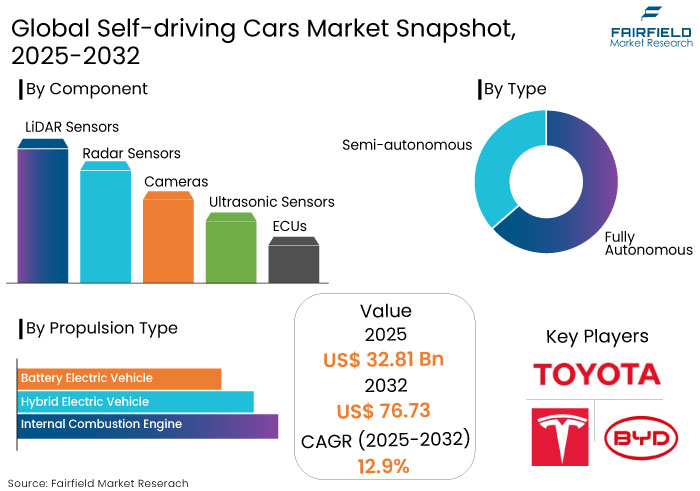
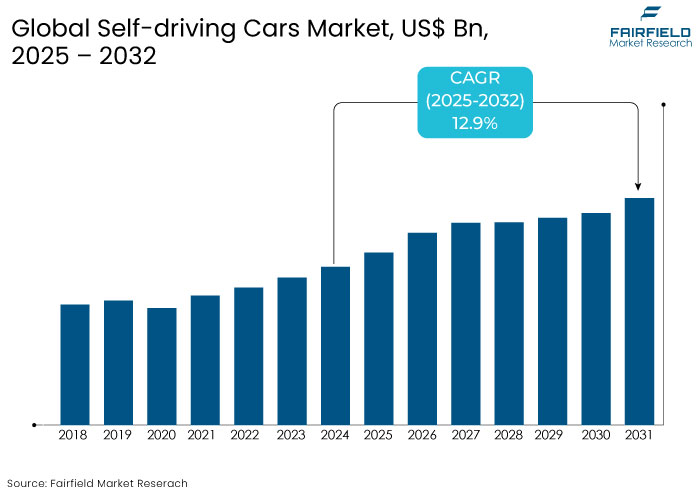
- The Self-driving Cars Market is valued at USD 25.7 Bn in 2026 and is projected to reach USD 204.6 Bn, growing at a CAGR of 35% by 2033
Self-driving Cars Market Insights
Key Growth Determinants
- High Demand for Safe and Efficient Transportation Systems
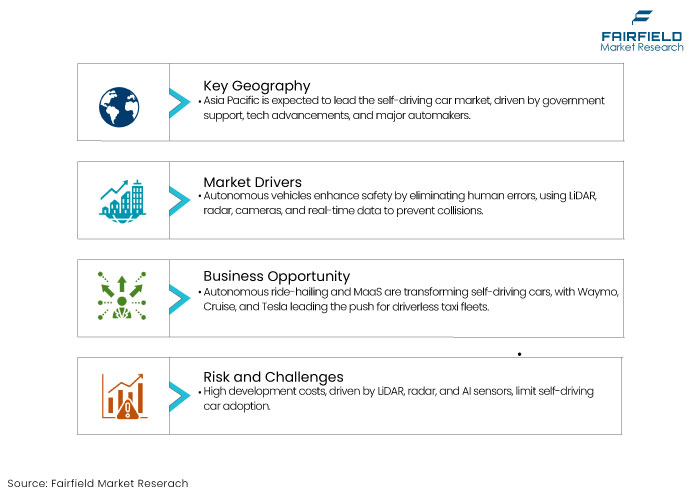
Safety is one of the biggest selling points of autonomous vehicles, as these eliminate human errors that contribute to most road accidents. Self-driving technology incorporates LiDAR, radar, cameras, and real-time data analytics to ensure a safer driving experience. Such systems can anticipate and prevent collisions, making autonomous vehicles a promising solution for reducing traffic-related fatalities.
Self-driving cars offer improved efficiency by optimizing traffic flow and reducing congestion. Ride-hailing services, logistics companies, and urban planners increasingly invest in autonomous fleets to enhance mobility while reducing environmental impact.
Vehicle automation can improve fuel efficiency by optimizing driving patterns, leading to an estimated 8% to 13% increase in congested traffic speeds. Governments worldwide are implementing regulations and incentives to support the adoption of self-driving technology, further fueling the self-driving cars market growth.
- Surging Investments and Strategic Partnerships in the Automotive Industry
The self-driving car industry is witnessing an influx of investments from technology giants and automakers, accelerating research and development. Companies like Google’s Waymo, Apple, Uber, and key automakers such as Ford, General Motors, and Toyota are investing billions into autonomous driving technology.
Strategic partnerships between software companies, semiconductor manufacturers, and automotive brands are driving innovation at a rapid pace. Collaborations with AI chipmakers like NVIDIA and Qualcomm enable the integration of high-performance computing solutions into self-driving systems.
Government initiatives, including funding programs and policy support, encourage investment in autonomous vehicle infrastructure. Expansion of autonomous ride-sharing services, delivery fleets, and commercial trucking solutions is also fueling market growth. By 2030, it is estimated that up to 10% of global new car sales could be Level 3 vehicles, which allow drivers to take their eyes off the road and hands off the wheel under certain conditions.
Key Growth Barriers
- High Development Costs and Limited Infrastructure to Impede Market Growth
One of the key restraints for the self-driving cars market is the high cost of development and deployment of autonomous cars. Building autonomous vehicles requires innovative technologies such as LiDAR, radar, AI-powered sensors, and real-time computing, significantly increasing production expenses.
A single LiDAR sensor can cost thousands of dollars, making mass adoption of autonomous vehicles costly. Setting up the necessary smart infrastructure, including vehicle-to-infrastructure (V2I) communication systems, 5G networks, and AI-driven traffic management, demands massive investments from governments and private sectors.
Self-driving Cars Market Trends and Opportunities
- Emergence of Autonomous Ride-hailing and Mobility-as-a-Service
One of the biggest game-changers in the self-driving cars market is the rise of autonomous ride-hailing and Mobility-as-a-Service (MaaS). Companies like Waymo, Cruise, and Tesla are racing to deploy self-driving taxi fleets that eliminate the need for human drivers, making ride-hailing services more affordable and widely accessible.
MaaS solutions, where users subscribe to autonomous vehicle services instead of owning a car, could reshape the auto industry by moving away from traditional car ownership. As technology improves and regulations catch up, self-driving taxis and shared autonomous fleets will disrupt traditional transportation models and create a multi-billion-dollar market. The mobility-as-a-service sector is anticipated to rise from US$ 412 Bn in 2025 to US$ 1,698 Bn by 2032, exhibiting a CAGR of 19.4%.
- Increasing Adoption of Self-driving Trucks Worldwide
The trucking industry faces a significant driver shortage, with current estimates indicating a deficit of around 50,000 qualified drivers. This shortage is projected to double by 2030. Autonomous trucks offer a solution by handling long-haul routes, thereby mitigating the impact of driver shortages.
Autonomous trucking also presents environmental advantages. Research indicates that self-driving trucks can increase energy efficiency by up to 32% compared to traditional trucking methods, contributing to reduced greenhouse gas emissions. This factor is estimated to propel demand and augment the global self-driving cars market.
Segments Covered in the Report
- Semi-autonomous Cars Dominate Due to Regulatory Support for Safety Features
Semi-autonomous vehicles, classified under Levels 1 to 3 of automation, integrate Advanced Driver Assistance Systems (ADAS) such as adaptive cruise control, lane-keeping assistance, and automated parking. Such features enhance driving safety and convenience, making these increasingly popular among consumers in the self-driving cars market.
The substantial market share of the semi-autonomous type of cars is attributed to the various benefits these vehicles offer, including improved safety and partial automation, which appeal to a broad range of consumers. Governments worldwide are encouraging the integration of technologies like emergency braking systems and collision avoidance, which are key components of semi-autonomous cars.
- Versatility and Cost-effectiveness of Cameras Make it the Leading Component
Camera systems are currently the leading component segment in the self-driving cars market. These play a pivotal role in enabling vehicles to interpret their surroundings by capturing high-resolution images. The images are then processed to identify objects, read traffic signs, and monitor lane markings.
The integration of cameras is essential for functions such as adaptive cruise control, lane-keeping assistance, and pedestrian detection, all of which are critical for semi-autonomous and fully autonomous driving. Dominance of camera systems is attributed to their versatility and cost-effectiveness compared to other sensor types like LiDAR. Cameras provide detailed visual information, which, combined with novel image processing algorithms, allows for a comprehensive understanding of the driving environment.
Regional Analysis
- Favorable Government Norms to Propel Opportunities in Asia Pacific
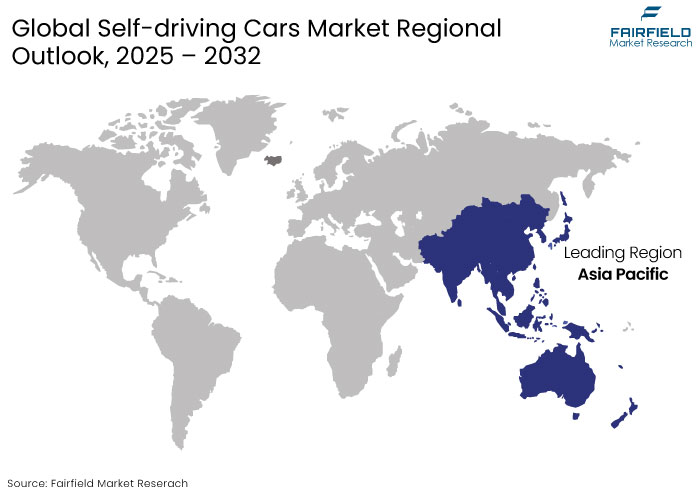
Asia Pacific is estimated to remain the predominant market for self-driving cars over the projected period. It is set to be propelled by government efforts, technical progress, and the presence of leading automotive manufacturers.
Countries like China and South Korea are leading the region's expansion. As of August 2024, China has granted 16,000 test licenses for driverless vehicles and has designated almost 20,000 miles of public roads for autonomous vehicle testing. The nation's ambitious objective to guarantee that 70% of new vehicles possess Level 2 or Level 3 autonomy by 2025 illustrates its dedication to deploying autonomous vehicles.
The swift proliferation of robotaxi services by firms like Baidu Co., Ltd., and WeRide in several cities in China has fostered a strong ecosystem for self-driving technology. South Korea intends to sell at least one Level 4 vehicle by 2027.
- Europe to See Steady Growth Amid Investments in Autonomous Technology
Europe is emerging as a leading player in the self-driving cars market, driven by strong government policies, investments in autonomous technology, and a well-developed automotive industry. Europe is home to global automotive giants such as Volkswagen (Audi), BMW, Mercedes-Benz, Volvo, and Renault, all investing in self-driving technology.
Volkswagen Group has partnered with Argo AI for autonomous driving solutions, while Mercedes-Benz became the first automaker to receive regulatory approval for Level 3 autonomous driving (Drive Pilot).
Volvo has collaborated with Luminar and NVIDIA to enhance AI and LiDAR-based autonomous vehicle systems. Cities in Europe are testing autonomous public transport solutions, including self-driving shuttles and robotaxis. France, the Netherlands, and Spain have launched multiple pilot programs for self-driving electric taxis and shared mobility services.
The U.K. is investing in AV infrastructure and aims to have self-driving cars on roads by 2025, supported by a US$ 100 Mn funding initiative. The European Union (EU) and national governments are actively working on regulations for autonomous vehicles, ensuring safety and legal clarity for deployment.
Fairfield’s Competitive Landscape Analysis
The self-driving cars market is witnessing intense competition, with key players driving innovation through AI, LiDAR, and advanced sensor technologies. Leading OEMs and automotive manufacturers are integrating autonomous driving capabilities into their vehicles, while tech giants like Google (Waymo) and Apple invest heavily in autonomous mobility solutions.
Partnerships and acquisitions remain crucial as companies collaborate to enhance ADAS (Advanced Driver Assistance Systems) and full automation. The regulatory landscape and safety concerns shape market strategies, influencing research and development investments and deployment timelines. The industry is poised for rapid transformation, with robotaxi services and autonomous freight transport expected to be major growth drivers.
Key Market Companies
- Toyota Motor Corporation
- Tesla
- BYD Co., Ltd.
- Volkswagen Group
- Ford Motor Company
- Hyundai Motor Group
- General Motors
- Honda Motor Co., Ltd.
- Stellantis NV
- Mercedes-Benz Group AG
- BMW Group
- Renault Group
- Geely Auto
- Great Wall Motor
Recent Industry Developments
- In October 2024, Tesla launched the Cybercab, a fully automated robotaxi priced at less than US$ 30,000, constructed without a steering wheel or pedals.
- In October 2024, Toyota Motor Corporation signed a partnership deal with Suzuki Motor Corporation to build a battery electric car. The new model is exclusively developed as a Battery Electric Vehicle (BEV).
- In June 2024, Cruise LLC, a subsidiary of General Motors, announced the resumption of manual driving in Phoenix, Houston, and Dallas, with monitored operations continuing in Phoenix and Dallas.
Global Self-driving Cars Market is Segmented as-
By Type
- Fully Autonomous
- Semi-autonomous
By Component
- LiDAR Sensors
- Radar Sensors
- Cameras
- Ultrasonic Sensors
- ECUs (Electronic Control Units)
By Vehicle Type
- Passenger Vehicle
- Commercial Vehicles
By Propulsion Type
- Internal Combustion Engine (ICE)
- Hybrid Electric Vehicle (HEV)
- Battery Electric Vehicle (BEV)
By Region
- North America
- Europe
- Asia Pacific
- Latin America
- Middle East & Africa
- Executive Summary
- Global Self-driving Cars Market Snapshot
- Future Projections
- Key Market Trends
- Regional Snapshot, by Value, 2026
- Analyst Recommendations
- Market Overview
- Market Definitions and Segmentations
- Market Dynamics
- Drivers
- Restraints
- Market Opportunities
- Value Chain Analysis
- COVID-19 Impact Analysis
- Porter's Fiver Forces Analysis
- Impact of Russia-Ukraine Conflict
- PESTLE Analysis
- Regulatory Analysis
- Price Trend Analysis
- Current Prices and Future Projections, 2025-2033
- Price Impact Factors
- Global Self-driving Cars Market Outlook, 2020 - 2033
- Global Self-driving Cars Market Outlook, by Type, Value (US$ Mn), 2020-2033
- Fully Autonomous
- Semi-autonomous
- Global Self-driving Cars Market Outlook, by Component, Value (US$ Mn), 2020-2033
- LiDAR Sensors
- Radar Sensors
- Cameras
- Ultrasonic Sensors
- ECUs (Electronic Control Units)
- Global Self-driving Cars Market Outlook, by Type, Value (US$ Mn), 2020-2033
- 3. Global Self-driving Cars Market Outlook, by Vehicle Type , Value (US$ Mn), 2020-2033
- 3.1. Passenger Vehicle
- 3.2. Commercial Vehicles
- Global Self-driving Cars Market Outlook, by Propulsion Type, Value (US$ Mn), 2020-2033
- 4.1. Internal Combustion Engine (ICE)
- 4.2. Hybrid Electric Vehicle (HEV)
- 4.3. Battery Electric Vehicle (BEV)
- Global Self-driving Cars Market Outlook, by Region, Value (US$ Mn), 2020-2033
- 5.1. North America
- 5.2. Europe
- 5.3. Asia Pacific
- 5.4. Latin America
- 5.5. Middle East & Africa
- North America Self-driving Cars Market Outlook, 2020 - 2033
- North America Self-driving Cars Market Outlook, by Type, Value (US$ Mn), 2020-2033
- Fully Autonomous
- Semi-autonomous
- North America Self-driving Cars Market Outlook, by Component, Value (US$ Mn), 2020-2033
- LiDAR Sensors
- Radar Sensors
- Cameras
- Ultrasonic Sensors
- ECUs (Electronic Control Units)
- North America Self-driving Cars Market Outlook, by Type, Value (US$ Mn), 2020-2033
- 3. North America Self-driving Cars Market Outlook, by Vehicle Type , Value (US$ Mn), 2020-2033
- 3.1. Passenger Vehicle
- 3.2. Commercial Vehicles
- North America Self-driving Cars Market Outlook, by Propulsion Type, Value (US$ Mn), 2020-2033
- 4.1. Internal Combustion Engine (ICE)
- 4.2. Hybrid Electric Vehicle (HEV)
- 4.3. Battery Electric Vehicle (BEV)
- North America Self-driving Cars Market Outlook, by Country, Value (US$ Mn), 2020-2033
- 5.1. U.S. Self-driving Cars Market Outlook, by Type, 2020-2033
- 5.2. U.S. Self-driving Cars Market Outlook, by Component, 2020-2033
- 5.3. U.S. Self-driving Cars Market Outlook, by Vehicle Type , 2020-2033
- 5.4. U.S. Self-driving Cars Market Outlook, by Propulsion Type, 2020-2033
- 5.5. Canada Self-driving Cars Market Outlook, by Type, 2020-2033
- 5.6. Canada Self-driving Cars Market Outlook, by Component, 2020-2033
- 5.7. Canada Self-driving Cars Market Outlook, by Vehicle Type , 2020-2033
- 5.8. Canada Self-driving Cars Market Outlook, by Propulsion Type, 2020-2033
- BPS Analysis/Market Attractiveness Analysis
- Europe Self-driving Cars Market Outlook, 2020 - 2033
- Europe Self-driving Cars Market Outlook, by Type, Value (US$ Mn), 2020-2033
- Fully Autonomous
- Semi-autonomous
- Europe Self-driving Cars Market Outlook, by Component, Value (US$ Mn), 2020-2033
- LiDAR Sensors
- Radar Sensors
- Cameras
- Ultrasonic Sensors
- ECUs (Electronic Control Units)
- Europe Self-driving Cars Market Outlook, by Type, Value (US$ Mn), 2020-2033
- 3. Europe Self-driving Cars Market Outlook, by Vehicle Type , Value (US$ Mn), 2020-2033
- 3.1. Passenger Vehicle
- 3.2. Commercial Vehicles
- Europe Self-driving Cars Market Outlook, by Propulsion Type, Value (US$ Mn), 2020-2033
- 4.1. Internal Combustion Engine (ICE)
- 4.2. Hybrid Electric Vehicle (HEV)
- 4.3. Battery Electric Vehicle (BEV)
- Europe Self-driving Cars Market Outlook, by Country, Value (US$ Mn), 2020-2033
- 5.1. Germany Self-driving Cars Market Outlook, by Type, 2020-2033
- 5.2. Germany Self-driving Cars Market Outlook, by Component, 2020-2033
- 5.3. Germany Self-driving Cars Market Outlook, by Vehicle Type , 2020-2033
- 5.4. Germany Self-driving Cars Market Outlook, by Propulsion Type, 2020-2033
- 5.5. Italy Self-driving Cars Market Outlook, by Type, 2020-2033
- 5.6. Italy Self-driving Cars Market Outlook, by Component, 2020-2033
- 5.7. Italy Self-driving Cars Market Outlook, by Vehicle Type , 2020-2033
- 5.8. Italy Self-driving Cars Market Outlook, by Propulsion Type, 2020-2033
- 5.9. France Self-driving Cars Market Outlook, by Type, 2020-2033
- 5.10. France Self-driving Cars Market Outlook, by Component, 2020-2033
- 5.11. France Self-driving Cars Market Outlook, by Vehicle Type , 2020-2033
- 5.12. France Self-driving Cars Market Outlook, by Propulsion Type, 2020-2033
- 5.13. U.K. Self-driving Cars Market Outlook, by Type, 2020-2033
- 5.14. U.K. Self-driving Cars Market Outlook, by Component, 2020-2033
- 5.15. U.K. Self-driving Cars Market Outlook, by Vehicle Type , 2020-2033
- 5.16. U.K. Self-driving Cars Market Outlook, by Propulsion Type, 2020-2033
- 5.17. Spain Self-driving Cars Market Outlook, by Type, 2020-2033
- 5.18. Spain Self-driving Cars Market Outlook, by Component, 2020-2033
- 5.19. Spain Self-driving Cars Market Outlook, by Vehicle Type , 2020-2033
- 5.20. Spain Self-driving Cars Market Outlook, by Propulsion Type, 2020-2033
- 5.21. Russia Self-driving Cars Market Outlook, by Type, 2020-2033
- 5.22. Russia Self-driving Cars Market Outlook, by Component, 2020-2033
- 5.23. Russia Self-driving Cars Market Outlook, by Vehicle Type , 2020-2033
- 5.24. Russia Self-driving Cars Market Outlook, by Propulsion Type, 2020-2033
- 5.25. Rest of Europe Self-driving Cars Market Outlook, by Type, 2020-2033
- 5.26. Rest of Europe Self-driving Cars Market Outlook, by Component, 2020-2033
- 5.27. Rest of Europe Self-driving Cars Market Outlook, by Vehicle Type , 2020-2033
- 5.28. Rest of Europe Self-driving Cars Market Outlook, by Propulsion Type, 2020-2033
- BPS Analysis/Market Attractiveness Analysis
- Asia Pacific Self-driving Cars Market Outlook, 2020 - 2033
- Asia Pacific Self-driving Cars Market Outlook, by Type, Value (US$ Mn), 2020-2033
- Fully Autonomous
- Semi-autonomous
- Asia Pacific Self-driving Cars Market Outlook, by Component, Value (US$ Mn), 2020-2033
- LiDAR Sensors
- Radar Sensors
- Cameras
- Ultrasonic Sensors
- ECUs (Electronic Control Units)
- Asia Pacific Self-driving Cars Market Outlook, by Type, Value (US$ Mn), 2020-2033
- 3. Asia Pacific Self-driving Cars Market Outlook, by Vehicle Type , Value (US$ Mn), 2020-2033
- 3.1. Passenger Vehicle
- 3.2. Commercial Vehicles
- Asia Pacific Self-driving Cars Market Outlook, by Propulsion Type, Value (US$ Mn), 2020-2033
- 4.1. Internal Combustion Engine (ICE)
- 4.2. Hybrid Electric Vehicle (HEV)
- 4.3. Battery Electric Vehicle (BEV)
- Asia Pacific Self-driving Cars Market Outlook, by Country, Value (US$ Mn), 2020-2033
- 5.1. China Self-driving Cars Market Outlook, by Type, 2020-2033
- 5.2. China Self-driving Cars Market Outlook, by Component, 2020-2033
- 5.3. China Self-driving Cars Market Outlook, by Vehicle Type , 2020-2033
- 5.4. China Self-driving Cars Market Outlook, by Propulsion Type, 2020-2033
- 5.5. Japan Self-driving Cars Market Outlook, by Type, 2020-2033
- 5.6. Japan Self-driving Cars Market Outlook, by Component, 2020-2033
- 5.7. Japan Self-driving Cars Market Outlook, by Vehicle Type , 2020-2033
- 5.8. Japan Self-driving Cars Market Outlook, by Propulsion Type, 2020-2033
- 5.9. South Korea Self-driving Cars Market Outlook, by Type, 2020-2033
- 5.10. South Korea Self-driving Cars Market Outlook, by Component, 2020-2033
- 5.11. South Korea Self-driving Cars Market Outlook, by Vehicle Type , 2020-2033
- 5.12. South Korea Self-driving Cars Market Outlook, by Propulsion Type, 2020-2033
- 5.13. India Self-driving Cars Market Outlook, by Type, 2020-2033
- 5.14. India Self-driving Cars Market Outlook, by Component, 2020-2033
- 5.15. India Self-driving Cars Market Outlook, by Vehicle Type , 2020-2033
- 5.16. India Self-driving Cars Market Outlook, by Propulsion Type, 2020-2033
- 5.17. Southeast Asia Self-driving Cars Market Outlook, by Type, 2020-2033
- 5.18. Southeast Asia Self-driving Cars Market Outlook, by Component, 2020-2033
- 5.19. Southeast Asia Self-driving Cars Market Outlook, by Vehicle Type , 2020-2033
- 5.20. Southeast Asia Self-driving Cars Market Outlook, by Propulsion Type, 2020-2033
- 5.21. Rest of SAO Self-driving Cars Market Outlook, by Type, 2020-2033
- 5.22. Rest of SAO Self-driving Cars Market Outlook, by Component, 2020-2033
- 5.23. Rest of SAO Self-driving Cars Market Outlook, by Vehicle Type , 2020-2033
- 5.24. Rest of SAO Self-driving Cars Market Outlook, by Propulsion Type, 2020-2033
- BPS Analysis/Market Attractiveness Analysis
- Latin America Self-driving Cars Market Outlook, 2020 - 2033
- Latin America Self-driving Cars Market Outlook, by Type, Value (US$ Mn), 2020-2033
- Fully Autonomous
- Semi-autonomous
- Latin America Self-driving Cars Market Outlook, by Component, Value (US$ Mn), 2020-2033
- LiDAR Sensors
- Radar Sensors
- Cameras
- Ultrasonic Sensors
- ECUs (Electronic Control Units)
- Latin America Self-driving Cars Market Outlook, by Type, Value (US$ Mn), 2020-2033
- 3. Latin America Self-driving Cars Market Outlook, by Vehicle Type , Value (US$ Mn), 2020-2033
- 3.1. Passenger Vehicle
- 3.2. Commercial Vehicles
- Latin America Self-driving Cars Market Outlook, by Propulsion Type, Value (US$ Mn), 2020-2033
- 4.1. Internal Combustion Engine (ICE)
- 4.2. Hybrid Electric Vehicle (HEV)
- 4.3. Battery Electric Vehicle (BEV)
- Latin America Self-driving Cars Market Outlook, by Country, Value (US$ Mn), 2020-2033
- 5.1. Brazil Self-driving Cars Market Outlook, by Type, 2020-2033
- 5.2. Brazil Self-driving Cars Market Outlook, by Component, 2020-2033
- 5.3. Brazil Self-driving Cars Market Outlook, by Vehicle Type , 2020-2033
- 5.4. Brazil Self-driving Cars Market Outlook, by Propulsion Type, 2020-2033
- 5.5. Mexico Self-driving Cars Market Outlook, by Type, 2020-2033
- 5.6. Mexico Self-driving Cars Market Outlook, by Component, 2020-2033
- 5.7. Mexico Self-driving Cars Market Outlook, by Vehicle Type , 2020-2033
- 5.8. Mexico Self-driving Cars Market Outlook, by Propulsion Type, 2020-2033
- 5.9. Argentina Self-driving Cars Market Outlook, by Type, 2020-2033
- 5.10. Argentina Self-driving Cars Market Outlook, by Component, 2020-2033
- 5.11. Argentina Self-driving Cars Market Outlook, by Vehicle Type , 2020-2033
- 5.12. Argentina Self-driving Cars Market Outlook, by Propulsion Type, 2020-2033
- 5.13. Rest of LATAM Self-driving Cars Market Outlook, by Type, 2020-2033
- 5.14. Rest of LATAM Self-driving Cars Market Outlook, by Component, 2020-2033
- 5.15. Rest of LATAM Self-driving Cars Market Outlook, by Vehicle Type , 2020-2033
- 5.16. Rest of LATAM Self-driving Cars Market Outlook, by Propulsion Type, 2020-2033
- BPS Analysis/Market Attractiveness Analysis
- Middle East & Africa Self-driving Cars Market Outlook, 2020 - 2033
- Middle East & Africa Self-driving Cars Market Outlook, by Type, Value (US$ Mn), 2020-2033
- Fully Autonomous
- Semi-autonomous
- Middle East & Africa Self-driving Cars Market Outlook, by Component, Value (US$ Mn), 2020-2033
- LiDAR Sensors
- Radar Sensors
- Cameras
- Ultrasonic Sensors
- ECUs (Electronic Control Units)
- Middle East & Africa Self-driving Cars Market Outlook, by Type, Value (US$ Mn), 2020-2033
- 3. Middle East & Africa Self-driving Cars Market Outlook, by Vehicle Type , Value (US$ Mn), 2020-2033
- 3.1. Passenger Vehicle
- 3.2. Commercial Vehicles
- Middle East & Africa Self-driving Cars Market Outlook, by Propulsion Type, Value (US$ Mn), 2020-2033
- 4.1. Internal Combustion Engine (ICE)
- 4.2. Hybrid Electric Vehicle (HEV)
- 4.3. Battery Electric Vehicle (BEV)
- Middle East & Africa Self-driving Cars Market Outlook, by Country, Value (US$ Mn), 2020-2033
- 5.1. GCC Self-driving Cars Market Outlook, by Type, 2020-2033
- 5.2. GCC Self-driving Cars Market Outlook, by Component, 2020-2033
- 5.3. GCC Self-driving Cars Market Outlook, by Vehicle Type , 2020-2033
- 5.4. GCC Self-driving Cars Market Outlook, by Propulsion Type, 2020-2033
- 5.5. South Africa Self-driving Cars Market Outlook, by Type, 2020-2033
- 5.6. South Africa Self-driving Cars Market Outlook, by Component, 2020-2033
- 5.7. South Africa Self-driving Cars Market Outlook, by Vehicle Type , 2020-2033
- 5.8. South Africa Self-driving Cars Market Outlook, by Propulsion Type, 2020-2033
- 5.9. Egypt Self-driving Cars Market Outlook, by Type, 2020-2033
- 5.10. Egypt Self-driving Cars Market Outlook, by Component, 2020-2033
- 5.11. Egypt Self-driving Cars Market Outlook, by Vehicle Type , 2020-2033
- 5.12. Egypt Self-driving Cars Market Outlook, by Propulsion Type, 2020-2033
- 5.13. Nigeria Self-driving Cars Market Outlook, by Type, 2020-2033
- 5.14. Nigeria Self-driving Cars Market Outlook, by Component, 2020-2033
- 5.15. Nigeria Self-driving Cars Market Outlook, by Vehicle Type , 2020-2033
- 5.16. Nigeria Self-driving Cars Market Outlook, by Propulsion Type, 2020-2033
- 5.17. Rest of Middle East Self-driving Cars Market Outlook, by Type, 2020-2033
- 5.18. Rest of Middle East Self-driving Cars Market Outlook, by Component, 2020-2033
- 5.19. Rest of Middle East Self-driving Cars Market Outlook, by Vehicle Type , 2020-2033
- 5.20. Rest of Middle East Self-driving Cars Market Outlook, by Propulsion Type, 2020-2033
- BPS Analysis/Market Attractiveness Analysis
- Competitive Landscape
- Company Vs Segment Heatmap
- Company Market Share Analysis, 2025
- Competitive Dashboard
- Company Profiles
- Toyota Motor Corporation
- Company Overview
- Product Portfolio
- Financial Overview
- Business Strategies and Developments
- Tesla
- BYD Co., Ltd.
- Volkswagen Group
- Ford Motor Company
- Hyundai Motor Group
- General Motors
- Honda Motor Co., Ltd.
- Stellantis NV
- Mercedes-Benz Group AG
- Toyota Motor Corporation
- Appendix
- Research Methodology
- Report Assumptions
- Acronyms and Abbreviations
|
BASE YEAR |
HISTORICAL DATA |
FORECAST PERIOD |
UNITS |
|||
 |
2025 |
 |
2019 - 2024 |
 |
2026 - 2033 |
Value: US$ Billion |
|
REPORT FEATURES |
DETAILS |
|
Type Coverage |
|
|
Component Coverage |
|
|
Vehicle Type Coverage |
|
|
Propulsion Type Coverage |
|
|
Geographical Coverage |
|
|
Leading Companies |
|
|
Report Highlights |
Key Market Indicators, Macro-micro economic impact analysis, Technological Roadmap, Key Trends, Driver, Restraints, and Future Opportunities & Revenue Pockets, Porter’s 5 Forces Analysis, Historical Trend (2019-2024), Market Estimates and Forecast, Market Dynamics, Industry Trends, Competition Landscape, Category, Region, Country-wise Trends & Analysis, COVID-19 Impact Analysis (Demand and Supply Chain) |
Our Research Methodology
Considering the volatility of business today, traditional approaches to strategizing a game plan can be unfruitful if not detrimental. True ambiguity is no way to determine a forecast. A myriad of predetermined factors must be accounted for such as the degree of risk involved, the magnitude of circumstances, as well as conditions or consequences that are not known or unpredictable. To circumvent binary views that cast uncertainty, the application of market research intelligence to strategically posture, move, and enable actionable outcomes is necessary.
View Methodology
Quality Assured
Rigorous Validation Process

Confidentiality Assured
End-to-end Data Security

Custom Research Services
Tailored To Your Objectives
FAQs
The self-driving cars market is estimated to be valued at US$ 25.7 Bn in 2026.
Asia Pacific is projected to account for the largest share in 2025.
The self-driving cars industry is estimated to rise at a CAGR of 34.50% from 2026 to 2032.
The industry for self-driving cars is estimated to reach a value of US$ 204.6 Bn by 2033.
Toyota Motor Corporation, Tesla, and BYD Co., Ltd. are a few key market players.
Related Reports
Industrial Diesel Turbocharger Insights, Competitive Landscape, and Market Forecast 2026 to 2033
The global industrial diesel turbocharger market will reach US$ 6.94 Bn by 2033, growing at 5.4% CAGR, driven by fuel efficiency and engine performance
Smart EV Charging Adapters and Plug Converters Market
The global smart EV charging adapters and plug converters market will reach US$ 2,408.35 Mn by 2033, growing at a 19.8% CAGR, driven by rising EV adoption
MCS Charge Points Market
The global MCS charge points market will reach US$ 2,364.39 Mn by 2033, growing at a 28.0% CAGR, driven by rising demand for high-power EV charging
Battery Swap-Ready Pack Systems for Urban Fleets Market
The global battery swap-ready pack systems for urban fleets market will reach US$ 5.80 Billion by 2033, growing at a 22.5% CAGR from 2026-2033
Intercity Bus Travel Market Insights, Competitive Landscape, and Market Forecast 2033
The global intercity bus travel market is valued at USD 58.0 Bn in 2026 and is projected to reach USD 83.81 Bn by 2033, growing at 5.4% CAGR overall
Cognitive Electronic Warfare Market Insights, Competitive Landscape, and Market Forecast - 2033
The cognitive electronic warfare market is valued at USD 3.10 billion in 2026 and is projected to reach USD 8.66 billion by 2033, growing at 15.8% CAGR.