



Shrink Films Market
Shrink Films Market Size, Share, Insights, Competitive Landscape, and Forecast 2026 to 2033
Shrink Films Market Size and Trend Analysis
How Fast Is the Shrink Films Market Growing?
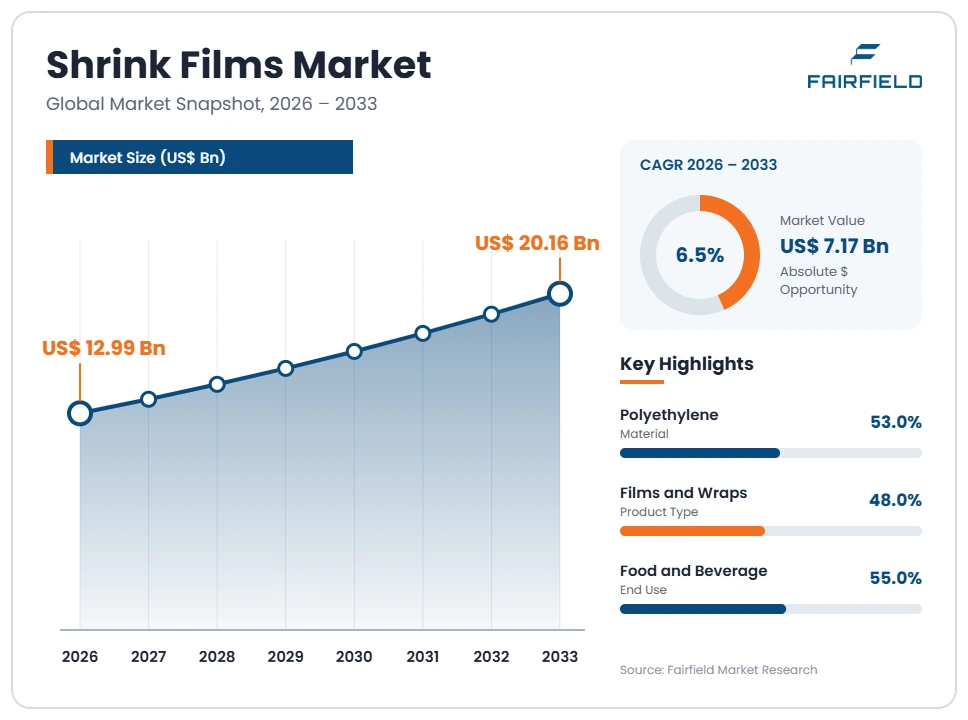
The global shrink films market size is expected to be valued at US$ 12.99 billion in 2026 and projected to reach US$ 20.16 billion by 2033, growing at a CAGR of 6.5% between 2026 and 2033.
Between 2020 and 2025, the market grew at a CAGR of about 6.0%, rising from roughly US$ 9.17 billion to about US$ 12.27 billion, as packaged food and beverage demand increased, e-commerce shipments surged, and brand owners used shrink sleeves and wraps for shelf appeal and tamper evidence. The shrink films market covers plastic films that shrink tightly around a product or group of products when heat is applied. Main materials include polyethylene, polyolefin, polyvinyl chloride, PET and PETG, and polypropylene. Products include films and wraps, sleeves and labels, hoods, and bags. Shrink films are used for multipacks of bottles and cans, fresh meat and cheese, frozen foods, consumer goods, pharmaceuticals, electronics, printed media, and pallet loads. In April 2026, CD&R completed its US$ 10.3 billion acquisition of Sealed Air.
Key Report Takeaways
- By Material: Polyethylene held about 53% share in 2025, while Polyolefin is projected to expand at a 7.5% CAGR through 2033, driven by its clarity, strength, food-safe properties, and suitability for automated wrapping of retail products, bakery goods, and consumer items.
- By Product Type: Films and Wraps held about 48% share in 2025, while Sleeves and Labels are projected to expand at an 8.0% CAGR through 2033, driven by brand owners seeking full-body graphics, tamper evidence, and eye-catching shelf presence for beverages and personal care products.
- By End Use: Food and Beverage held about 55% share in 2025, while Pharmaceuticals and Healthcare is projected to expand at a 7.8% CAGR through 2033, driven by tamper-evident bands, secure multipacks, and growing medicine and supplement consumption across emerging markets.
- By Region: North America held about 31% share in 2025, while Asia Pacific is projected to expand at an 8.0% CAGR through 2033, driven by growing packaged food and beverage consumption, rising retail and e-commerce sales, and expanding manufacturing in China, India, and Indonesia.
Global Shrink Films Market Trends and Insights
Drivers Impact Analysis
Two drivers carry the strongest influence on shrink films market demand during the forecast period.
| Driver | Impact on CAGR Forecast | Geographic Relevance | Impact Timeline |
| Growth of packaged food and beverage consumption | High | Global | Long term (≥4 years) |
| E-commerce growth and demand for secure packaging | High | North America, Asia Pacific, Europe | Medium term (2-4 years) |
Packaged Food and Beverage Growth Is Driving the Shrink Films Market
Growth of packaged food and beverage consumption is the strongest driver of the shrink films market. These industries use shrink films in large volumes.
The mechanism is that beverage makers use polyethylene shrink film to bundle bottles and cans into multipacks, meat and cheese processors use barrier shrink bags to extend shelf life, and frozen food and bakery producers use polyolefin wraps to protect products and display them clearly. Busy lifestyles, urbanization, and the spread of supermarkets and convenience stores increase demand for packaged and ready-to-eat foods, especially in Asia Pacific, Latin America, and Middle East & Africa. Shrink film is often cheaper and lighter than cardboard trays or rigid packaging. Retail promotions also rely on shrink-bundled multipacks. These factors create large, steady demand for shrink films worldwide.
E-Commerce Growth Is Expanding the Shrink Films Market
E-commerce growth and demand for secure packaging are expanding the shrink films market. More products ship directly to homes.
The cause is that online retail requires packaging that protects products from dust, moisture, tampering, and damage during handling and shipping, and shrink films provide a tight, low-cost, lightweight protective layer. Retailers and fulfillment centers use shrink wrap for bundling items, protecting books, games, electronics, and household goods, and securing pallet loads. Tamper-evident shrink bands and sleeves help brands protect product safety and reduce theft. Automated wrapping machines in warehouses use shrink films at high speed. As online shopping grows in North America, Asia Pacific, and Europe, demand for secure, efficient shrink packaging continues to rise across many product categories, from groceries and cosmetics to electronics and household goods.
Restraints Impact Analysis
Two restraints limit how quickly the shrink films market grows.
| Restraint | Impact on CAGR Forecast | Geographic Relevance | Impact Timeline |
| Plastic waste rules and sustainability pressure | High | Europe, North America, Asia Pacific | Long term (≥4 years) |
| Raw material price volatility | Medium | Global | Medium term (2-4 years) |
Plastic Waste Rules Slow the Shrink Films Market
Plastic waste rules and sustainability pressure slow the shrink films market. Governments and brands want less plastic.
The problem is that shrink films are single-use plastics, and many are difficult to recycle, especially PVC films and printed multilayer sleeves that contaminate recycling streams. The European Union packaging rules require all packaging to be recyclable and set reduction targets, while plastic taxes in the United Kingdom, Spain, and other countries raise costs for non-recycled plastic. Several United States states have introduced extended producer responsibility laws. Some brand owners are replacing shrink-wrapped multipacks with cardboard clips or paper-based solutions. These rules force film makers to reformulate products, invest in recycled content, and accept slower growth in some regions, even as they develop new recyclable products that may eventually restore demand.
Raw Material Volatility Restricts the Shrink Films Market
Raw material price volatility restricts the shrink films market. Resin prices change quickly.
The constraint is that shrink films are made from polyethylene, polypropylene, PVC, and PET resins, whose prices follow crude oil, natural gas, and petrochemical supply conditions. Sudden price increases from plant outages, hurricanes, trade restrictions, and conflicts can raise film costs sharply. Film converters often have fixed-price contracts with large food and beverage customers, making it difficult to pass costs on quickly. Recycled resin supply is limited and often more expensive than virgin resin. Energy costs for film extrusion are high in Europe. These factors squeeze margins, discourage investment, and make pricing unpredictable for film producers and their customers. Smaller converters with limited purchasing power are hit hardest, which encourages consolidation and long-term resin supply agreements with large petrochemical producers.
Market Opportunities
Recyclable Mono-Material and Thin-Gauge Films Open a Premium Revenue Pool
Recyclable mono-material and thin-gauge films open a premium revenue pool. Brands want sustainable packaging that performs well.
The opportunity comes from demand for all-polyethylene and all-polyolefin shrink films that fit existing recycling streams, films with post-consumer recycled content, and thinner films that use less plastic while keeping strength and clarity. Multilayer extrusion technology allows film makers to produce thinner gauges with high tear resistance. Recyclable shrink sleeves using new PET and polyolefin materials are replacing PVC sleeves. Brand owners are willing to pay more for films that help them meet sustainability targets and comply with new rules. Companies that combine sustainable materials, technical service, and reliable supply can win long-term contracts with major food, beverage, and consumer goods brands, and help those brands report progress on their public packaging commitments.
Shrink Sleeves and Asia Pacific Growth Create a Growth Revenue Pool
Shrink sleeves and Asia Pacific growth create a growth revenue pool. Packaging needs are expanding quickly.
The opportunity reflects rising use of shrink sleeves for full-body branding on beverages, dairy, personal care, and household products, along with fast growth of packaged goods in China, India, Indonesia, Vietnam, and Thailand. Rising incomes and modern retail are increasing demand for attractive, convenient packaging. Local beverage and food companies are expanding production capacity. In February 2026, Amcor highlighted that its combination with Berry Global created a leading polyethylene shrink portfolio in North America, showing how scale matters. Companies with local production and sleeve printing capabilities can capture fast-growing demand in the region. Investment in digital printing for short-run sleeves can also help suppliers serve smaller local brands and seasonal promotions profitably.
Segment Analysis
- By Material: Polyethylene Leads While Polyolefin Grows Fastest
Polyethylene held about 53% share in 2025. Polyethylene shrink films are strong, low-cost, and widely used to bundle beverage bottles and cans, wrap pallet loads, and package industrial goods. They are easy to process on high-speed equipment and are recyclable in polyethylene film streams, which supports their continued use as rules tighten.
Polyolefin is the fastest-growing material, expanding at a 7.5% CAGR through 2033. Polyolefin shrink films offer excellent clarity, strength, and food safety, and they are replacing PVC films for retail wrapping of bakery goods, frozen pizzas, toys, and consumer items. Cross-linked versions provide thinner gauges and higher strength. Polyvinyl Chloride, PET and PETG, Polypropylene, and Others form other segments. For the market, polyolefin growth supports cleaner and more recyclable packaging.
- By Product Type: Films and Wraps Lead While Sleeves and Labels Grow Fastest
Films and Wraps held about 48% share in 2025. Rolls of shrink film are used for bundling, overwrapping, and pallet wrapping across food, beverage, consumer goods, and industrial products. High volumes in beverage multipacks, retail overwraps, and pallet wrapping give this product type the largest share, and automated shrink tunnels on packaging lines support steady consumption every day.
Sleeves and Labels are the fastest-growing product type, expanding at an 8.0% CAGR through 2033. Shrink sleeves cover the full container with high-quality printed graphics, fit unusual bottle shapes, and provide tamper evidence. Beverage, dairy, personal care, and household brands use them for shelf impact. Hoods, Bags, and Others form other segments. Shrink hoods protect pallet loads of bricks, bags, and appliances. For the market, sleeve growth raises value through printing and design.
- By End Use: Food and Beverage Leads While Pharmaceuticals and Healthcare Grows Fastest
Food and Beverage held about 55% share in 2025. Beverage multipacks, fresh meat and cheese bags, frozen food wraps, bakery packaging, and dairy sleeves use large volumes of shrink film. Daily consumption and high packaging turnover give this end use the largest share, and barrier shrink bags help meat and cheese processors extend shelf life and reduce food waste.
Pharmaceuticals and Healthcare is the fastest-growing end use, expanding at a 7.8% CAGR through 2033. Medicine bottles, supplements, and medical devices use tamper-evident shrink bands and secure bundles. Consumer Goods, Industrial Packaging, Electronics, and Others form other segments. Consumer goods makers use shrink films for cosmetics, toys, and household products, while electronics makers use them for protective wrapping. For the market, healthcare growth adds high-value, safety-focused demand.
Geography Analysis
- Which Region Is Leading the Shrink Films Market?
North America is leading the shrink films market with about 31% share in 2025. The United States has a huge packaged food and beverage industry, large e-commerce and retail sectors, and widespread use of automated wrapping and bundling equipment. Amcor, Sealed Air, Sigma Plastics Group, Clysar, Intertape Polymer Group, and Bonset America have strong positions in the region. Canada and Mexico add demand from food processing and manufacturing. Key barriers include state packaging laws and resin price swings. One change shaping the region is consolidation, highlighted by the Amcor and Berry Global combination and the CD&R acquisition of Sealed Air.
- Europe Shapes the Shrink Films Market Through Sustainability Rules
Europe is a major shrink films market. Germany, France, the United Kingdom, Italy, and Spain have large food, beverage, and consumer goods industries and advanced packaging machinery makers. Klöckner Pentaplast and Coveris are based in the region. The European Union packaging rules are pushing film makers toward recyclable mono-material films and recycled content. Key barriers include plastic taxes, high energy costs, and brand shifts to paper packaging. One opportunity is recyclable shrink sleeves and thin-gauge films that meet new rules, supported by strong demand from large food and beverage brands with public sustainability commitments and by deposit return systems that require easy-to-separate sleeves.
- Which Region Is Growing Fastest in the Shrink Films Market?
Asia Pacific is the fastest-growing shrink films market, expanding at an 8.0% CAGR through 2033. China has the world's largest manufacturing base and growing packaged food and beverage consumption, while India's rising incomes and modern retail drive strong demand. Japan is home to Fuji Seal International, a leading shrink sleeve producer. Indonesia, Vietnam, and Thailand are expanding beverage and food production. Polyplex and other regional producers serve local customers. Key barriers include price competition. One change shaping the region is fast growth of e-commerce and shrink sleeve labeling, as local beverage and dairy brands upgrade packaging to compete for shelf space.
- Latin America Grows the Shrink Films Market Through Beverage Demand
Latin America is a growing shrink films market. Brazil, Mexico, Argentina, Colombia, and Chile have large beverage, meat, dairy, and consumer goods industries that use shrink films for multipacks and food packaging. Brazil and Argentina are major meat exporters that use barrier shrink bags. Key barriers include currency swings, economic cycles, and import costs for resins and equipment. One opportunity is shrink films and sleeves for expanding beverage, dairy, and personal care brands, supported by modern retail growth and rising consumer spending. Mexico also benefits from food and beverage exports to North America, which need durable multipack and pallet packaging.
- Middle East & Africa Builds the Shrink Films Market Through Food and Beverage Growth
Middle East & Africa is an emerging shrink films market. Saudi Arabia and the United Arab Emirates have growing bottled water, juice, dairy, and food processing industries, supported by large regional resin producers. South Africa, Egypt, and Nigeria use shrink films for beverages, dairy, and consumer goods sold through growing supermarket chains. Rising populations and urbanization increase demand for packaged water, soft drinks, and staple foods. Key barriers include limited recycling systems and reliance on imported equipment. One opportunity is shrink packaging for new food and beverage plants, logistics hubs, and retail chains built under national diversification and food security programs.
Competitive Landscape
The shrink films market is fragmented. Amcor plc, Sealed Air Corporation, Klöckner Pentaplast, Coveris, and Fuji Seal International are leading players, while CCL Industries, Intertape Polymer Group, Sigma Plastics Group, Clysar, Syfan Manufacturing, Bonset America, and Polyplex compete strongly. Hundreds of regional film extruders and sleeve converters serve local food, beverage, and consumer goods customers, especially in Asia Pacific and Latin America. Large global brands often buy from several suppliers to secure supply and manage costs. Shrink sleeves are more concentrated, with a smaller group of printers able to produce high-quality, complex designs at scale.
Companies compete on film clarity, shrink performance, strength, thin-gauge technology, recyclability, recycled content, printing quality for sleeves, machine compatibility, technical service, supply reliability, and price. Integrated suppliers that offer both films and packaging equipment can lock in customers through complete systems.
Strategic moves show how competition is changing. In April 2025, Amcor completed its combination with Berry Global, and in February 2026, it highlighted its leading polyethylene shrink portfolio in North America. In April 2026, CD&R completed its acquisition of Sealed Air, and in May 2026, Sealed Air launched its PrimeVac shrinkable rollstock for automated food packaging lines.
Three themes shape vendor strategy. First, companies are developing recyclable mono-material and thin-gauge films. Second, they are combining films with equipment and service. Third, they are expanding sleeve and film capacity in Asia Pacific.
Shrink Films Market Industry Leaders
- Amcor plc
- Sealed Air Corporation
- Klöckner Pentaplast
- Coveris
- Fuji Seal International, Inc.
Recent Industry Developments
- May 2026: Sealed Air launched Cryovac Shrinkable Rollstock PrimeVac, a 40-micron shrinkable film with an EVOH barrier designed to work with Flow-Vac loading and Cryovac vacuum chamber machines - helps food processors improve throughput as they face labor shortages.
- April 2026: Sealed Air completed its acquisition by funds affiliated with CD&R at an enterprise value of about US$ 10.3 billion, becoming a privately held company - gives a major shrink film supplier long-term investment backing.
- February 2026: Amcor announced that its 2025 combination with Berry Global gave it the most comprehensive polyethylene shrink film and label portfolio in the industry, making it the largest maker of PE overwrap films in North America - strengthens its position in beverage and industrial overwrap.
- April 2025: Amcor completed its all-stock combination with Berry Global - created a global packaging leader with expanded shrink film, stretch film, and flexible packaging capacity.
Companies Covered in the Report
- Amcor plc
- Sealed Air Corporation
- Klöckner Pentaplast
- Coveris
- Fuji Seal International, Inc.
- CCL Industries Inc.
- Intertape Polymer Group
- Sigma Plastics Group
- Clysar LLC
- Syfan Manufacturing
- Bonset America Corporation
- Polyplex Corporation Ltd.
Shrink Films Market Report Scope
| Metric | Value |
| Study Period | 2020-2033 |
| Market Size 2026 | US$ 12.99 Billion |
| Market Size 2033 | US$ 20.16 Billion |
| CAGR 2026-2033 | 6.5% |
| Absolute Dollar Opportunity | US$ 7.17 Billion |
| Largest Market | North America |
| Fastest-Growing Market | Asia Pacific |
| Market Concentration | Fragmented |
| Major Players | Amcor plc, Sealed Air Corporation, Klöckner Pentaplast, Coveris, Fuji Seal International, Inc. |
Shrink Films Market Segmentation
- Executive Summary
- Shrink Films Market Snapshot
- Future Projections
- Key Market Trends
- Regional Snapshot
- Market Overview
- Market Definition and Report Scope
- Historical Market Trends
- Market Dynamics
- Drivers
- Packaged Food and Beverage Growth Is Driving the Shrink Films Market
- E-Commerce Growth Is Expanding the Shrink Films Market
- Restraints
- Plastic Waste Rules Slow the Shrink Films Market
- Raw Material Volatility Restricts the Shrink Films Market
- Market Opportunities
- Recyclable Mono-Material and Thin-Gauge Films Open a Premium Revenue Pool
- Shrink Sleeves and Asia Pacific Growth Create a Growth Revenue Pool
- Drivers
- Global Shrink Films Market Outlook, 2020–2033
- Global Shrink Films Market Outlook, by Material, Value (US$ Billion), 2020–2033
- Polyethylene
- Polyolefin
- Polyvinyl Chloride
- PET and PETG
- Polypropylene
- Others
- Global Shrink Films Market Outlook, by Product Type, Value (US$ Billion), 2020–2033
- Films and Wraps
- Sleeves and Labels
- Hoods
- Bags
- Others
- Global Shrink Films Market Outlook, by End Use, Value (US$ Billion), 2020–2033
- Food and Beverage
- Pharmaceuticals and Healthcare
- Consumer Goods
- Industrial Packaging
- Electronics
- Others
- Global Shrink Films Market Outlook, by Region, Value (US$ Billion), 2020–2033
- North America
- Europe
- Asia Pacific
- Latin America
- Middle East & Africa
- Global Shrink Films Market Outlook, by Material, Value (US$ Billion), 2020–2033
- North America Shrink Films Market Outlook, 2020–2033
- North America Shrink Films Market Outlook, by Material, Value (US$ Billion), 2020–2033
- Polyethylene
- Polyolefin
- Polyvinyl Chloride
- PET and PETG
- Polypropylene
- Others
- North America Shrink Films Market Outlook, by Product Type, Value (US$ Billion), 2020–2033
- Films and Wraps
- Sleeves and Labels
- Hoods
- Bags
- Others
- North America Shrink Films Market Outlook, by End Use, Value (US$ Billion), 2020–2033
- Food and Beverage
- Pharmaceuticals and Healthcare
- Consumer Goods
- Industrial Packaging
- Electronics
- Others
- North America Shrink Films Market Outlook, by Country, Value (US$ Billion), 2020–2033
- United States Shrink Films Market Outlook, by Material, 2020–2033
- United States Shrink Films Market Outlook, by Product Type, 2020–2033
- United States Shrink Films Market Outlook, by End Use, 2020–2033
- Canada Shrink Films Market Outlook, by Material, 2020–2033
- Canada Shrink Films Market Outlook, by Product Type, 2020–2033
- Canada Shrink Films Market Outlook, by End Use, 2020–2033
- Mexico Shrink Films Market Outlook, by Material, 2020–2033
- Mexico Shrink Films Market Outlook, by Product Type, 2020–2033
- Mexico Shrink Films Market Outlook, by End Use, 2020–2033
- North America Shrink Films Market Outlook, by Material, Value (US$ Billion), 2020–2033
- Europe Shrink Films Market Outlook, 2020–2033
- Europe Shrink Films Market Outlook, by Material, Value (US$ Billion), 2020–2033
- Polyethylene
- Polyolefin
- Polyvinyl Chloride
- PET and PETG
- Polypropylene
- Others
- Europe Shrink Films Market Outlook, by Product Type, Value (US$ Billion), 2020–2033
- Films and Wraps
- Sleeves and Labels
- Hoods
- Bags
- Others
- Europe Shrink Films Market Outlook, by End Use, Value (US$ Billion), 2020–2033
- Food and Beverage
- Pharmaceuticals and Healthcare
- Consumer Goods
- Industrial Packaging
- Electronics
- Others
- Europe Shrink Films Market Outlook, by Country, Value (US$ Billion), 2020–2033
- Germany Shrink Films Market Outlook, by Material, 2020–2033
- Germany Shrink Films Market Outlook, by Product Type, 2020–2033
- Germany Shrink Films Market Outlook, by End Use, 2020–2033
- France Shrink Films Market Outlook, by Material, 2020–2033
- France Shrink Films Market Outlook, by Product Type, 2020–2033
- France Shrink Films Market Outlook, by End Use, 2020–2033
- United Kingdom Shrink Films Market Outlook, by Material, 2020–2033
- United Kingdom Shrink Films Market Outlook, by Product Type, 2020–2033
- United Kingdom Shrink Films Market Outlook, by End Use, 2020–2033
- Italy Shrink Films Market Outlook, by Material, 2020–2033
- Italy Shrink Films Market Outlook, by Product Type, 2020–2033
- Italy Shrink Films Market Outlook, by End Use, 2020–2033
- Spain Shrink Films Market Outlook, by Material, 2020–2033
- Spain Shrink Films Market Outlook, by Product Type, 2020–2033
- Spain Shrink Films Market Outlook, by End Use, 2020–2033
- Europe Shrink Films Market Outlook, by Material, Value (US$ Billion), 2020–2033
- Asia Pacific Shrink Films Market Outlook, 2020–2033
- Asia Pacific Shrink Films Market Outlook, by Material, Value (US$ Billion), 2020–2033
- Polyethylene
- Polyolefin
- Polyvinyl Chloride
- PET and PETG
- Polypropylene
- Others
- Asia Pacific Shrink Films Market Outlook, by Product Type, Value (US$ Billion), 2020–2033
- Films and Wraps
- Sleeves and Labels
- Hoods
- Bags
- Others
- Asia Pacific Shrink Films Market Outlook, by End Use, Value (US$ Billion), 2020–2033
- Food and Beverage
- Pharmaceuticals and Healthcare
- Consumer Goods
- Industrial Packaging
- Electronics
- Others
- Asia Pacific Shrink Films Market Outlook, by Country, Value (US$ Billion), 2020–2033
- China Shrink Films Market Outlook, by Material, 2020–2033
- China Shrink Films Market Outlook, by Product Type, 2020–2033
- China Shrink Films Market Outlook, by End Use, 2020–2033
- India Shrink Films Market Outlook, by Material, 2020–2033
- India Shrink Films Market Outlook, by Product Type, 2020–2033
- India Shrink Films Market Outlook, by End Use, 2020–2033
- Japan Shrink Films Market Outlook, by Material, 2020–2033
- Japan Shrink Films Market Outlook, by Product Type, 2020–2033
- Japan Shrink Films Market Outlook, by End Use, 2020–2033
- Indonesia Shrink Films Market Outlook, by Material, 2020–2033
- Indonesia Shrink Films Market Outlook, by Product Type, 2020–2033
- Indonesia Shrink Films Market Outlook, by End Use, 2020–2033
- Vietnam Shrink Films Market Outlook, by Material, 2020–2033
- Vietnam Shrink Films Market Outlook, by Product Type, 2020–2033
- Vietnam Shrink Films Market Outlook, by End Use, 2020–2033
- Thailand Shrink Films Market Outlook, by Material, 2020–2033
- Thailand Shrink Films Market Outlook, by Product Type, 2020–2033
- Thailand Shrink Films Market Outlook, by End Use, 2020–2033
- Asia Pacific Shrink Films Market Outlook, by Material, Value (US$ Billion), 2020–2033
- Latin America Shrink Films Market Outlook, 2020–2033
- Latin America Shrink Films Market Outlook, by Material, Value (US$ Billion), 2020–2033
- Polyethylene
- Polyolefin
- Polyvinyl Chloride
- PET and PETG
- Polypropylene
- Others
- Latin America Shrink Films Market Outlook, by Product Type, Value (US$ Billion), 2020–2033
- Films and Wraps
- Sleeves and Labels
- Hoods
- Bags
- Others
- Latin America Shrink Films Market Outlook, by End Use, Value (US$ Billion), 2020–2033
- Food and Beverage
- Pharmaceuticals and Healthcare
- Consumer Goods
- Industrial Packaging
- Electronics
- Others
- Latin America Shrink Films Market Outlook, by Country, Value (US$ Billion), 2020–2033
- Brazil Shrink Films Market Outlook, by Material, 2020–2033
- Brazil Shrink Films Market Outlook, by Product Type, 2020–2033
- Brazil Shrink Films Market Outlook, by End Use, 2020–2033
- Mexico Shrink Films Market Outlook, by Material, 2020–2033
- Mexico Shrink Films Market Outlook, by Product Type, 2020–2033
- Mexico Shrink Films Market Outlook, by End Use, 2020–2033
- Argentina Shrink Films Market Outlook, by Material, 2020–2033
- Argentina Shrink Films Market Outlook, by Product Type, 2020–2033
- Argentina Shrink Films Market Outlook, by End Use, 2020–2033
- Colombia Shrink Films Market Outlook, by Material, 2020–2033
- Colombia Shrink Films Market Outlook, by Product Type, 2020–2033
- Colombia Shrink Films Market Outlook, by End Use, 2020–2033
- Chile Shrink Films Market Outlook, by Material, 2020–2033
- Chile Shrink Films Market Outlook, by Product Type, 2020–2033
- Chile Shrink Films Market Outlook, by End Use, 2020–2033
- Latin America Shrink Films Market Outlook, by Material, Value (US$ Billion), 2020–2033
- Middle East & Africa Shrink Films Market Outlook, 2020–2033
- Middle East & Africa Shrink Films Market Outlook, by Material, Value (US$ Billion), 2020–2033
- Polyethylene
- Polyolefin
- Polyvinyl Chloride
- PET and PETG
- Polypropylene
- Others
- Middle East & Africa Shrink Films Market Outlook, by Product Type, Value (US$ Billion), 2020–2033
- Films and Wraps
- Sleeves and Labels
- Hoods
- Bags
- Others
- Middle East & Africa Shrink Films Market Outlook, by End Use, Value (US$ Billion), 2020–2033
- Food and Beverage
- Pharmaceuticals and Healthcare
- Consumer Goods
- Industrial Packaging
- Electronics
- Others
- Middle East & Africa Shrink Films Market Outlook, by Country, Value (US$ Billion), 2020–2033
- Saudi Arabia Shrink Films Market Outlook, by Material, 2020–2033
- Saudi Arabia Shrink Films Market Outlook, by Product Type, 2020–2033
- Saudi Arabia Shrink Films Market Outlook, by End Use, 2020–2033
- United Arab Emirates Shrink Films Market Outlook, by Material, 2020–2033
- United Arab Emirates Shrink Films Market Outlook, by Product Type, 2020–2033
- United Arab Emirates Shrink Films Market Outlook, by End Use, 2020–2033
- South Africa Shrink Films Market Outlook, by Material, 2020–2033
- South Africa Shrink Films Market Outlook, by Product Type, 2020–2033
- South Africa Shrink Films Market Outlook, by End Use, 2020–2033
- Egypt Shrink Films Market Outlook, by Material, 2020–2033
- Egypt Shrink Films Market Outlook, by Product Type, 2020–2033
- Egypt Shrink Films Market Outlook, by End Use, 2020–2033
- Nigeria Shrink Films Market Outlook, by Material, 2020–2033
- Nigeria Shrink Films Market Outlook, by Product Type, 2020–2033
- Nigeria Shrink Films Market Outlook, by End Use, 2020–2033
- Middle East & Africa Shrink Films Market Outlook, by Material, Value (US$ Billion), 2020–2033
- Competitive Landscape
- Shrink Films Market Industry Leaders
- Recent Industry Developments
- Company Profiles
- Amcor plc
- Sealed Air Corporation
- Klöckner Pentaplast
- Coveris
- Fuji Seal International, Inc.
- CCL Industries Inc.
- Intertape Polymer Group
- Sigma Plastics Group
- Clysar LLC
- Syfan Manufacturing
- Bonset America Corporation
- Polyplex Corporation Ltd.
- Appendix
- Research Methodology
- Report Assumptions
- Acronyms and Abbreviations
Material
- Polyethylene
- Polyolefin
- Polyvinyl Chloride
- PET and PETG
- Polypropylene
- Others
Product Type
- Films and Wraps
- Sleeves and Labels
- Hoods
- Bags
- Others
End Use
- Food and Beverage
- Pharmaceuticals and Healthcare
- Consumer Goods
- Industrial Packaging
- Electronics
- Others
Regions
- North America
- Europe
- Asia Pacific
- Latin America
- Middle East & Africa
Our Research Methodology
Considering the volatility of business today, traditional approaches to strategizing a game plan can be unfruitful if not detrimental. True ambiguity is no way to determine a forecast. A myriad of predetermined factors must be accounted for such as the degree of risk involved, the magnitude of circumstances, as well as conditions or consequences that are not known or unpredictable. To circumvent binary views that cast uncertainty, the application of market research intelligence to strategically posture, move, and enable actionable outcomes is necessary.
View Methodology
Quality Assured
Rigorous Validation Process

Confidentiality Assured
End-to-end Data Security

Custom Research Services
Tailored To Your Objectives
FAQs
The global shrink films market is expected to be valued at US$ 12.99 billion in 2026, driven by food, beverage, and online retail demand.
The market is projected to grow at a 6.5% CAGR from 2026 to 2033, reaching about US$ 20.16 billion by 2033.
North America leads with about 31% share, supported by a large packaged food and beverage industry and widespread automated wrapping.
Asia Pacific is growing fastest at an 8.0% CAGR, driven by packaged food demand, retail growth, and expanding manufacturing in China and India.
Key players include Amcor, Sealed Air, Klöckner Pentaplast, Coveris, and Fuji Seal, competing on film performance, sustainability, printing, and price.
Related Reports
Silica Coating Market Size, Share, Insights, Competitive Landscape, and Forecast 2026 to 2033
The global silica coating market is valued at US$5.10 billion in 2026, reaching US$7.40 billion by 2033, growing at a 5.5% CAGR
Rigid Packaging Market Size, Share, Insights, Competitive Landscape, and Forecast 2026 to 2033
The global rigid packaging market is valued at US$345.6 billion in 2026, reaching US$496.1 billion by 2033, growing at a 5.3% CAGR
Recycled Plastics Market Size, Share, Insights, Competitive Landscape, and Forecast 2026 to 2033
The global recycled plastics market is valued at US$67.3 billion in 2026, reaching US$127.0 billion by 2033, growing at a 9.5% CAGR
Pigments Market Size, Share, Insights, Competitive Landscape, and Forecast 2026 to 2033
The global pigments market is valued at US$34.7 billion in 2026, reaching US$51.2 billion by 2033, growing at a 5.7% CAGR
Manufacturing OEM Coatings Market Size, Share, Insights, Competitive Landscape, and Forecast 2026 to 2033
The global manufacturing OEM coatings market is valued at US$12.14 billion in 2026, reaching US$19.48 billion by 2033, growing at a 7.0% CAGR
Lithium Hydroxide Market Size, Share, Insights, Competitive Landscape, and Forecast 2026 to 2033
The global lithium hydroxide market is valued at US$740.6 million in 2026, reaching US$1,345.2 million by 2033, growing at an 8.9% CAGR