



Silica Coating Market
Silica Coating Market Size, Share, Insights, Competitive Landscape, and Forecast 2026 to 2033
Silica Coating Market Size and Trend Analysis
How Fast Is the Silica Coating Market Growing?
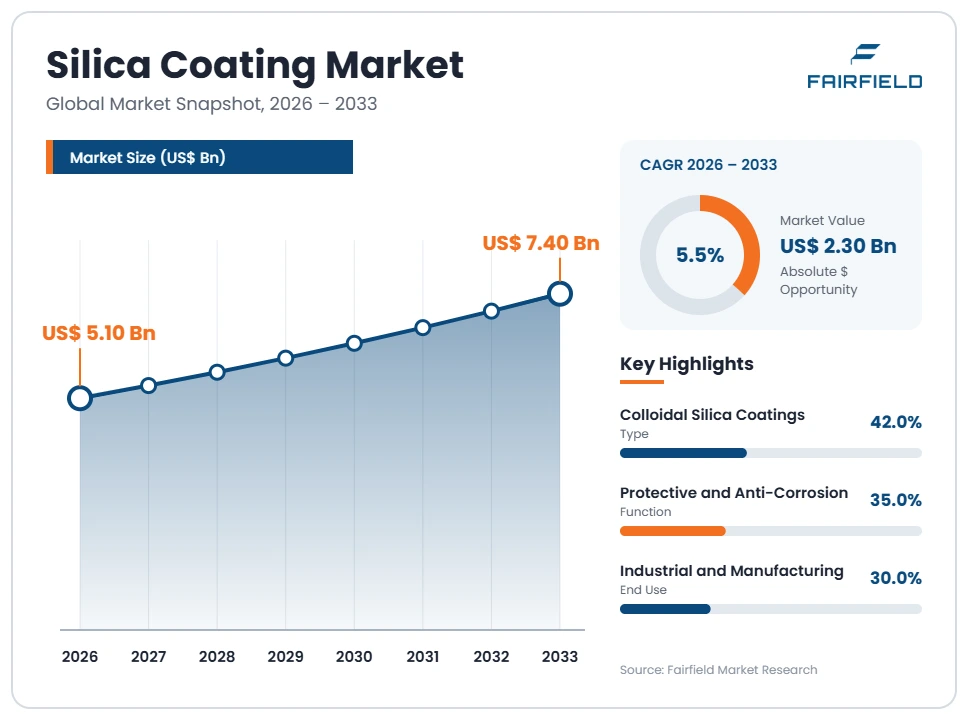
The global silica coating market size is expected to be valued at US$ 5.10 billion in 2026 and projected to reach US$ 7.40 billion by 2033, growing at a CAGR of 5.5% between 2026 and 2033.
Between 2020 and 2025, the market grew at a CAGR of about 6.2%, rising from roughly US$ 3.55 billion to about US$ 4.80 billion, as electronics production expanded, solar panel installations surged, and manufacturers adopted silica-based coatings to replace hazardous chromate treatments and improve scratch, heat, and corrosion resistance. The silica coating market covers coatings and surface treatments made with silicon dioxide, including colloidal silica, sol-gel silica, fumed and precipitated silica, and silica nanocoatings. These coatings provide anti-reflective, anti-corrosion, scratch-resistant, hydrophobic and self-cleaning, heat-resistant, and electrical insulating properties. They are used on solar glass, electronics and semiconductors, automotive parts, architectural glass, electrical steel, cookware, optical lenses, and industrial equipment. In April 2026, Nouryon expanded colloidal silica capacity in China.
Key Report Takeaways
- By Type: Colloidal Silica Coatings held about 42% share in 2025, while Sol-Gel Silica Coatings are projected to expand at a 7.0% CAGR through 2033, driven by low-temperature processing, chromate-free corrosion protection, and growing use on solar glass, aerospace parts, and optical surfaces.
- By Function: Protective and Anti-Corrosion held about 35% share in 2025, while Anti-Reflective is projected to expand at a 7.5% CAGR through 2033, driven by rising solar module production, display panel demand, and optical lens coatings that improve light transmission.
- By End Use: Industrial and Manufacturing held about 30% share in 2025, while Solar Energy is projected to expand at an 8.0% CAGR through 2033, driven by record photovoltaic installations, anti-reflective and anti-soiling cover glass coatings, and expanding solar glass capacity in Asia Pacific.
- By Region: Asia Pacific held about 38.5% share in 2025, while India is projected to expand at a 7.5% CAGR through 2033, driven by solar manufacturing incentives, electronics assembly growth, automotive production, and expanding construction and glass industries.
Global Silica Coating Market Trends and Insights
Drivers Impact Analysis
Two drivers carry the strongest influence on silica coating market demand during the forecast period.
| Driver | Impact on CAGR Forecast | Geographic Relevance | Impact Timeline |
| Growth of solar energy and electronics production | High | Asia Pacific, North America, Europe | Long term (≥4 years) |
| Replacement of hazardous coatings and rising performance needs | High | Europe, North America | Medium term (2-4 years) |
Solar and Electronics Growth Is Driving the Silica Coating Market
Growth of solar energy and electronics production is the strongest driver of the silica coating market. Both industries rely on silica coatings.
The mechanism is that solar panel makers apply porous silica anti-reflective coatings to cover glass to increase light transmission and power output, and every new module adds coating demand. Global solar installations have reached record levels, led by China, India, the United States, and Europe. Electronics and semiconductor makers use silica coatings for insulation, planarization, protection of circuit boards, and polishing slurries, and demand is rising with data centers, electric vehicles, and consumer devices. Display panels and camera lenses use silica-based anti-reflective and anti-fingerprint layers. These industries are expanding fastest in Asia Pacific, creating large and growing demand for silica coatings.
Replacement of Hazardous Coatings Is Expanding the Silica Coating Market
Replacement of hazardous coatings and rising performance needs are expanding the silica coating market. Manufacturers want safer, stronger surfaces.
The cause is that hexavalent chromium coatings, long used for corrosion protection on aerospace, automotive, and metal parts, are being restricted in Europe and the United States because of health risks, and sol-gel silica coatings offer a safer alternative. PFAS restrictions are also pushing cookware and industrial coating makers toward silica-based non-stick and easy-clean coatings. Automakers use silica coatings for scratch-resistant clearcoats, headlamp protection, and underbody corrosion protection. Electrical steel coatings using colloidal silica improve the efficiency of transformers and EV motors. These trends increase demand for high-performance, environmentally safer silica coatings across many industries, and they help manufacturers meet stricter health, safety, and environmental rules without losing performance.
Restraints Impact Analysis
Two restraints limit how quickly the silica coating market grows.
| Restraint | Impact on CAGR Forecast | Geographic Relevance | Impact Timeline |
| High processing costs and technical complexity | Medium | Global | Medium term (2-4 years) |
| Competition from alternative coating technologies | Medium | Global | Long term (≥4 years) |
High Costs and Complexity Slow the Silica Coating Market
High processing costs and technical complexity slow the silica coating market. Advanced silica coatings are hard to apply.
The problem is that sol-gel and nanosilica coatings often require precise control of chemistry, humidity, film thickness, and curing temperature, and defects can reduce performance or appearance. High-purity silica precursors such as silanes and alkoxides are expensive and depend on energy-intensive silicon production. Applying coatings to large solar glass sheets, complex parts, or delicate optics requires special equipment and skilled workers. Some silica coatings can crack if applied too thickly or exposed to sudden temperature changes. Smaller manufacturers may lack the expertise to adopt new systems. These challenges increase costs and slow adoption, especially among price-sensitive customers in emerging markets, who often choose cheaper conventional coatings even when silica coatings offer longer life and better performance.
Alternative Technologies Restrict the Silica Coating Market
Competition from alternative coating technologies restricts the silica coating market. Customers have other options.
The constraint is that vacuum-deposited coatings such as sputtered metal oxides and magnesium fluoride offer excellent optical performance for high-end lenses and displays, while polymer coatings, fluoropolymers, ceramic coatings, and zinc-based systems compete in protective and corrosion applications. Some solar manufacturers are testing textured glass and other anti-reflective approaches. Silicone, polyurethane, and epoxy coatings remain cheaper and familiar for many industrial users. Price pressure from low-cost producers in China also reduces margins for silica coating suppliers. These alternatives limit faster market penetration and force silica coating makers to prove clear performance and cost advantages through field testing, long-term durability data, and close technical support for customers during product trials and line conversions.
Market Opportunities
Solar Anti-Reflective and Anti-Soiling Coatings Open a High-Growth Revenue Pool
Solar anti-reflective and anti-soiling coatings open a high-growth revenue pool. Solar manufacturers want more power per panel.
The opportunity comes from rapid growth of solar glass production and the need to raise module efficiency, since a good anti-reflective silica coating can increase light transmission by about 2-3%. Bifacial modules, which capture light on both sides, need coatings on both glass surfaces, doubling coating demand per panel. Anti-soiling and hydrophobic silica coatings reduce dust buildup in desert installations in Middle East & Africa, India, and the United States, lowering cleaning costs. Coatings with better durability can maintain performance over 25 to 30 years. Suppliers that offer durable, low-cost coatings can win large contracts with leading solar glass makers and module producers.
Electronics, EV, and Electrical Steel Coatings Create a Premium Revenue Pool
Electronics, EV, and electrical steel coatings create a premium revenue pool. Advanced industries need high-purity materials.
The opportunity reflects rising demand for colloidal silica in electrical steel coatings for transformers and EV motors, semiconductor polishing and insulation, battery separator coatings, and protective coatings for circuit boards and sensors. Power grid upgrades and electric vehicle growth increase demand for efficient electrical steel. In April 2026, Nouryon expanded production of premium colloidal silica in Guangzhou to serve electrical steel, non-stick, and catalyst coatings across Asia Pacific. Suppliers with high-purity products, local production, and application labs can earn premium prices and long-term relationships with electronics, steel, and automotive customers. Battery makers also use silica-coated separators to improve heat resistance and safety, adding a fast-growing new application as EV and energy storage production expands.
Segment Analysis
- By Type: Colloidal Silica Coatings Lead While Sol-Gel Silica Coatings Grow Fastest
Colloidal Silica Coatings held about 42% share in 2025. Colloidal silica consists of tiny silica particles dispersed in water, making it easy to blend into waterborne coatings for scratch resistance, anti-slip, binding, and insulation. It is widely used in electrical steel, cookware, paper, electronics, and investment casting. Its water-based nature supports low-VOC formulations, and large producers offer many grades with different particle sizes and surface treatments.
Sol-Gel Silica Coatings are the fastest-growing type, expanding at a 7.0% CAGR through 2033. Sol-gel processes create thin, uniform silica films at low temperatures, supporting anti-reflective solar glass, optical coatings, and chromate-free corrosion protection on aerospace and automotive parts. Fumed and Precipitated Silica Coatings and Silica Nanocoatings form other segments. For the market, sol-gel growth supports advanced, environmentally safer functional coatings.
- By Function: Protective and Anti-Corrosion Leads While Anti-Reflective Grows Fastest
Protective and Anti-Corrosion held about 35% share in 2025. Silica coatings protect metals, glass, and plastics from corrosion, scratches, heat, and chemicals in industrial, automotive, and construction applications. Broad use across many industries gives this function the largest share, and growing replacement of chromate and PFAS-based coatings adds steady demand for silica-based protective systems on aerospace parts, cookware, and steel.
Anti-Reflective is the fastest-growing function, expanding at a 7.5% CAGR through 2033. Solar glass, display panels, camera lenses, and eyewear use silica anti-reflective coatings to improve light transmission and reduce glare. Hydrophobic and Self-Cleaning, Insulating, and Others form other segments. Hydrophobic and self-cleaning coatings are growing in building glass, solar panels, and automotive windows. For the market, anti-reflective growth links demand to solar expansion.
- By End Use: Industrial and Manufacturing Leads While Solar Energy Grows Fastest
Industrial and Manufacturing held about 30% share in 2025. Metal processing, electrical steel, cookware, machinery, and industrial equipment makers use silica coatings for protection and performance. A broad customer base, many small and large manufacturers, and steady replacement demand give this end use the largest share. Electrical steel coatings for transformers and motors are an important and growing part of this segment.
Solar Energy is the fastest-growing end use, expanding at an 8.0% CAGR through 2033. Solar glass makers apply anti-reflective and anti-soiling silica coatings to raise module output. Electronics and Semiconductors, Automotive, Construction, and Others form other segments. Electronics and semiconductor makers use silica coatings for insulation, protection, and polishing, while automakers use them for scratch-resistant clearcoats and glass. For the market, solar growth adds large volume demand.
Geography Analysis
- Why Is North America Important to the Silica Coating Market?
North America is a major silica coating market with about 24% share in 2025. The United States has large aerospace, automotive, semiconductor, and solar industries, and federal incentives are supporting new domestic solar module and semiconductor plants. Cabot, W. R. Grace, and PPG are based in the region, and Wacker produces pyrogenic silica in Tennessee. Defense and aerospace rules are speeding the shift from chromate coatings to sol-gel alternatives. Canada and Mexico add automotive demand. Key barriers include high costs. One change shaping the region is reshoring of solar glass and electronics production, which brings new coating lines and supply contracts to domestic silica suppliers.
- Europe Shapes the Silica Coating Market Through Regulation and Innovation
Europe is a major silica coating market with about 22% share in 2025. Germany, France, the Netherlands, Italy, and the United Kingdom have strong automotive, aerospace, glass, and specialty chemical industries. Evonik, Nouryon, Wacker, and Merck are based in the region. European Union restrictions on hexavalent chromium and PFAS are pushing manufacturers toward silica-based alternatives. Key barriers include high energy costs and weak industrial demand. One opportunity is chromate-free and PFAS-free coatings for aerospace, automotive, and cookware, supported by strong research programs and close cooperation between chemical suppliers and manufacturers in Germany and France.
- Which Region Is Leading the Silica Coating Market?
Asia Pacific is leading the silica coating market with about 38.5% share in 2025, while India is the fastest-growing country, expanding at a 7.5% CAGR through 2033. China dominates global solar glass, electronics, electrical steel, and cookware production. Japan is home to Nissan Chemical, Fuso Chemical, AGC, and Tosoh, leading suppliers of high-purity silica. South Korea has strong semiconductor and display industries. India's solar manufacturing incentives drive demand. Key barriers include price competition. One change shaping the region is fast expansion of solar glass capacity, together with new semiconductor and display plants in China, South Korea, and India.
- Latin America Grows the Silica Coating Market Through Solar and Industrial Demand
Latin America is a growing silica coating market. Brazil, Mexico, Chile, Argentina, and Colombia use silica coatings in automotive, construction, glass, and industrial applications. Brazil and Chile are adding large solar power capacity, and Mexico has a major automotive and electronics manufacturing base serving North America. Key barriers include limited local production of advanced coatings and reliance on imports. One opportunity is anti-soiling and anti-reflective coatings for utility-scale solar farms in high-sunlight areas, along with protective coatings for automotive parts and mining equipment. Growing glass production in Brazil and Mexico also supports demand for silica-based surface treatments and architectural glass coatings.
- Middle East & Africa Builds the Silica Coating Market Through Solar Investment
Middle East & Africa is an emerging silica coating market. Saudi Arabia, the United Arab Emirates, Egypt, Morocco, and South Africa are building large solar power projects, where dust and sand make anti-soiling coatings valuable. Construction and glass industries also use silica coatings for building facades and windows, and rising infrastructure spending supports demand. Key barriers include limited local manufacturing, reliance on imported materials, and harsh heat and sand conditions that test coating durability. One opportunity is anti-soiling coatings for desert solar plants, where reduced cleaning needs can save water and lower operating costs.
Competitive Landscape
The silica coating market is moderately fragmented. Evonik Industries AG, Nouryon, Cabot Corporation, W. R. Grace & Co., and Wacker Chemie AG are leading suppliers of silica materials used in coatings, while PPG Industries, Nissan Chemical, Fuso Chemical, AGC, Merck KGaA, Covestro, and Tosoh compete strongly in specialty silica, sol-gel, and anti-reflective coatings. Many regional producers in China and India supply lower-cost colloidal and precipitated silica, while specialized coating formulators serve solar, optics, and aerospace customers. Large silica producers often sell raw materials to paint companies and glass makers rather than finished coatings, so partnerships across the value chain are common.
Companies compete on silica purity, particle size control, coating performance, durability, ease of dispersion, regulatory compliance, application support, local production, supply reliability, and price. Long qualification periods with solar glass, electronics, and aerospace customers create strong relationships and make it difficult for new suppliers to win business quickly.
Strategic moves show how competition is changing. In June 2024, Evonik commissioned a new plant for easy-to-disperse fumed silica at Rheinfelden. In November 2025, Nouryon opened an innovation center in Shanghai, and in April 2026, it expanded colloidal silica capacity in Guangzhou. In January 2026, Biesterfeld began distributing Evonik silica products to coating customers in Austria and Switzerland.
Three themes shape vendor strategy. First, suppliers are expanding capacity in Asia Pacific near customers. Second, they are developing high-purity and easy-to-use grades. Third, they are targeting chromate-free, PFAS-free, and solar applications.
Silica Coating Market Industry Leaders
- Evonik Industries AG
- Nouryon
- Cabot Corporation
- W. R. Grace & Co.
- Wacker Chemie AG
Recent Industry Developments
- April 2026: Nouryon announced it is expanding production capacity for premium Levasil colloidal silica at its site in Guangzhou, China, to serve emissions control catalysts, electrical steel coatings, and non-stick cookware coatings - improves supply reliability and shortens lead times for customers across Asia Pacific.
- January 2026: Biesterfeld took over distribution of Evonik high-performance silica products, including ACEMATT, AEROSIL, and SIPERNAT, for paint and coating customers in Austria and Switzerland - strengthens local access to silica additives for coatings.
- November 2025: Nouryon opened an innovation center in Shanghai with eight specialized laboratories, including one dedicated to Levasil colloidal silica - supports faster development of silica-based coatings and catalyst applications.
- June 2024: Evonik commissioned a plant for AEROSIL Easy-to-Disperse fumed silica at its Rheinfelden site in Germany - simplifies incorporation of silica into paints and coatings and strengthens global supply.
Companies Covered in the Report
- Evonik Industries AG
- Nouryon
- Cabot Corporation
- W. R. Grace & Co.
- Wacker Chemie AG
- PPG Industries, Inc.
- Nissan Chemical Corporation
- Fuso Chemical Co., Ltd.
- AGC Inc.
- Merck KGaA
- Covestro AG
- Tosoh Corporation
Silica Coating Market Report Scope
| Metric | Value |
| Study Period | 2020-2033 |
| Market Size 2026 | US$ 5.10 Billion |
| Market Size 2033 | US$ 7.40 Billion |
| CAGR 2026-2033 | 5.5% |
| Absolute Dollar Opportunity | US$ 2.30 Billion |
| Largest Market | Asia Pacific |
| Fastest-Growing Market | India |
| Market Concentration | Moderately Fragmented |
| Major Players | Evonik Industries AG, Nouryon, Cabot Corporation, W. R. Grace & Co., Wacker Chemie AG |
Silica Coating Market Segmentation
- Executive Summary
- Silica Coating Market Snapshot
- Future Projections
- Key Market Trends
- Regional Snapshot
- Market Overview
- Market Definition and Report Scope
- Historical Market Trends
- Market Dynamics
- Drivers
- Solar and Electronics Growth Is Driving the Silica Coating Market
- Replacement of Hazardous Coatings Is Expanding the Silica Coating Market
- Restraints
- High Costs and Complexity Slow the Silica Coating Market
- Alternative Technologies Restrict the Silica Coating Market
- Market Opportunities
- Solar Anti-Reflective and Anti-Soiling Coatings Open a High-Growth Revenue Pool
- Electronics, EV, and Electrical Steel Coatings Create a Premium Revenue Pool
- Drivers
- Global Silica Coating Market Outlook, 2020–2033
- Global Silica Coating Market Outlook, by Type, Value (US$ Billion), 2020–2033
- Colloidal Silica Coatings
- Sol-Gel Silica Coatings
- Fumed and Precipitated Silica Coatings
- Silica Nanocoatings
- Global Silica Coating Market Outlook, by Function, Value (US$ Billion), 2020–2033
- Protective and Anti-Corrosion
- Anti-Reflective
- Hydrophobic and Self-Cleaning
- Insulating
- Others
- Global Silica Coating Market Outlook, by End Use, Value (US$ Billion), 2020–2033
- Industrial and Manufacturing
- Solar Energy
- Electronics and Semiconductors
- Automotive
- Construction
- Others
- Global Silica Coating Market Outlook, by Region, Value (US$ Billion), 2020–2033
- North America
- Europe
- Asia Pacific
- Latin America
- Middle East & Africa
- Global Silica Coating Market Outlook, by Type, Value (US$ Billion), 2020–2033
- North America Silica Coating Market Outlook, 2020–2033
- North America Silica Coating Market Outlook, by Type, Value (US$ Billion), 2020–2033
- Colloidal Silica Coatings
- Sol-Gel Silica Coatings
- Fumed and Precipitated Silica Coatings
- Silica Nanocoatings
- North America Silica Coating Market Outlook, by Function, Value (US$ Billion), 2020–2033
- Protective and Anti-Corrosion
- Anti-Reflective
- Hydrophobic and Self-Cleaning
- Insulating
- Others
- North America Silica Coating Market Outlook, by End Use, Value (US$ Billion), 2020–2033
- Industrial and Manufacturing
- Solar Energy
- Electronics and Semiconductors
- Automotive
- Construction
- Others
- North America Silica Coating Market Outlook, by Country, Value (US$ Billion), 2020–2033
- United States Silica Coating Market Outlook, by Type, 2020–2033
- United States Silica Coating Market Outlook, by Function, 2020–2033
- United States Silica Coating Market Outlook, by End Use, 2020–2033
- Canada Silica Coating Market Outlook, by Type, 2020–2033
- Canada Silica Coating Market Outlook, by Function, 2020–2033
- Canada Silica Coating Market Outlook, by End Use, 2020–2033
- Mexico Silica Coating Market Outlook, by Type, 2020–2033
- Mexico Silica Coating Market Outlook, by Function, 2020–2033
- Mexico Silica Coating Market Outlook, by End Use, 2020–2033
- North America Silica Coating Market Outlook, by Type, Value (US$ Billion), 2020–2033
- Europe Silica Coating Market Outlook, 2020–2033
- Europe Silica Coating Market Outlook, by Type, Value (US$ Billion), 2020–2033
- Colloidal Silica Coatings
- Sol-Gel Silica Coatings
- Fumed and Precipitated Silica Coatings
- Silica Nanocoatings
- Europe Silica Coating Market Outlook, by Function, Value (US$ Billion), 2020–2033
- Protective and Anti-Corrosion
- Anti-Reflective
- Hydrophobic and Self-Cleaning
- Insulating
- Others
- Europe Silica Coating Market Outlook, by End Use, Value (US$ Billion), 2020–2033
- Industrial and Manufacturing
- Solar Energy
- Electronics and Semiconductors
- Automotive
- Construction
- Others
- Europe Silica Coating Market Outlook, by Country, Value (US$ Billion), 2020–2033
- Germany Silica Coating Market Outlook, by Type, 2020–2033
- Germany Silica Coating Market Outlook, by Function, 2020–2033
- Germany Silica Coating Market Outlook, by End Use, 2020–2033
- France Silica Coating Market Outlook, by Type, 2020–2033
- France Silica Coating Market Outlook, by Function, 2020–2033
- France Silica Coating Market Outlook, by End Use, 2020–2033
- Netherlands Silica Coating Market Outlook, by Type, 2020–2033
- Netherlands Silica Coating Market Outlook, by Function, 2020–2033
- Netherlands Silica Coating Market Outlook, by End Use, 2020–2033
- Italy Silica Coating Market Outlook, by Type, 2020–2033
- Italy Silica Coating Market Outlook, by Function, 2020–2033
- Italy Silica Coating Market Outlook, by End Use, 2020–2033
- United Kingdom Silica Coating Market Outlook, by Type, 2020–2033
- United Kingdom Silica Coating Market Outlook, by Function, 2020–2033
- United Kingdom Silica Coating Market Outlook, by End Use, 2020–2033
- Europe Silica Coating Market Outlook, by Type, Value (US$ Billion), 2020–2033
- Asia Pacific Silica Coating Market Outlook, 2020–2033
- Asia Pacific Silica Coating Market Outlook, by Type, Value (US$ Billion), 2020–2033
- Colloidal Silica Coatings
- Sol-Gel Silica Coatings
- Fumed and Precipitated Silica Coatings
- Silica Nanocoatings
- Asia Pacific Silica Coating Market Outlook, by Function, Value (US$ Billion), 2020–2033
- Protective and Anti-Corrosion
- Anti-Reflective
- Hydrophobic and Self-Cleaning
- Insulating
- Others
- Asia Pacific Silica Coating Market Outlook, by End Use, Value (US$ Billion), 2020–2033
- Industrial and Manufacturing
- Solar Energy
- Electronics and Semiconductors
- Automotive
- Construction
- Others
- Asia Pacific Silica Coating Market Outlook, by Country, Value (US$ Billion), 2020–2033
- India Silica Coating Market Outlook, by Type, 2020–2033
- India Silica Coating Market Outlook, by Function, 2020–2033
- India Silica Coating Market Outlook, by End Use, 2020–2033
- China Silica Coating Market Outlook, by Type, 2020–2033
- China Silica Coating Market Outlook, by Function, 2020–2033
- China Silica Coating Market Outlook, by End Use, 2020–2033
- Japan Silica Coating Market Outlook, by Type, 2020–2033
- Japan Silica Coating Market Outlook, by Function, 2020–2033
- Japan Silica Coating Market Outlook, by End Use, 2020–2033
- South Korea Silica Coating Market Outlook, by Type, 2020–2033
- South Korea Silica Coating Market Outlook, by Function, 2020–2033
- South Korea Silica Coating Market Outlook, by End Use, 2020–2033
- Asia Pacific Silica Coating Market Outlook, by Type, Value (US$ Billion), 2020–2033
- Latin America Silica Coating Market Outlook, 2020–2033
- Latin America Silica Coating Market Outlook, by Type, Value (US$ Billion), 2020–2033
- Colloidal Silica Coatings
- Sol-Gel Silica Coatings
- Fumed and Precipitated Silica Coatings
- Silica Nanocoatings
- Latin America Silica Coating Market Outlook, by Function, Value (US$ Billion), 2020–2033
- Protective and Anti-Corrosion
- Anti-Reflective
- Hydrophobic and Self-Cleaning
- Insulating
- Others
- Latin America Silica Coating Market Outlook, by End Use, Value (US$ Billion), 2020–2033
- Industrial and Manufacturing
- Solar Energy
- Electronics and Semiconductors
- Automotive
- Construction
- Others
- Latin America Silica Coating Market Outlook, by Country, Value (US$ Billion), 2020–2033
- Brazil Silica Coating Market Outlook, by Type, 2020–2033
- Brazil Silica Coating Market Outlook, by Function, 2020–2033
- Brazil Silica Coating Market Outlook, by End Use, 2020–2033
- Mexico Silica Coating Market Outlook, by Type, 2020–2033
- Mexico Silica Coating Market Outlook, by Function, 2020–2033
- Mexico Silica Coating Market Outlook, by End Use, 2020–2033
- Chile Silica Coating Market Outlook, by Type, 2020–2033
- Chile Silica Coating Market Outlook, by Function, 2020–2033
- Chile Silica Coating Market Outlook, by End Use, 2020–2033
- Argentina Silica Coating Market Outlook, by Type, 2020–2033
- Argentina Silica Coating Market Outlook, by Function, 2020–2033
- Argentina Silica Coating Market Outlook, by End Use, 2020–2033
- Colombia Silica Coating Market Outlook, by Type, 2020–2033
- Colombia Silica Coating Market Outlook, by Function, 2020–2033
- Colombia Silica Coating Market Outlook, by End Use, 2020–2033
- Latin America Silica Coating Market Outlook, by Type, Value (US$ Billion), 2020–2033
- Middle East & Africa Silica Coating Market Outlook, 2020–2033
- Middle East & Africa Silica Coating Market Outlook, by Type, Value (US$ Billion), 2020–2033
- Colloidal Silica Coatings
- Sol-Gel Silica Coatings
- Fumed and Precipitated Silica Coatings
- Silica Nanocoatings
- Middle East & Africa Silica Coating Market Outlook, by Function, Value (US$ Billion), 2020–2033
- Protective and Anti-Corrosion
- Anti-Reflective
- Hydrophobic and Self-Cleaning
- Insulating
- Others
- Middle East & Africa Silica Coating Market Outlook, by End Use, Value (US$ Billion), 2020–2033
- Industrial and Manufacturing
- Solar Energy
- Electronics and Semiconductors
- Automotive
- Construction
- Others
- Middle East & Africa Silica Coating Market Outlook, by Country, Value (US$ Billion), 2020–2033
- Saudi Arabia Silica Coating Market Outlook, by Type, 2020–2033
- Saudi Arabia Silica Coating Market Outlook, by Function, 2020–2033
- Saudi Arabia Silica Coating Market Outlook, by End Use, 2020–2033
- United Arab Emirates Silica Coating Market Outlook, by Type, 2020–2033
- United Arab Emirates Silica Coating Market Outlook, by Function, 2020–2033
- United Arab Emirates Silica Coating Market Outlook, by End Use, 2020–2033
- Egypt Silica Coating Market Outlook, by Type, 2020–2033
- Egypt Silica Coating Market Outlook, by Function, 2020–2033
- Egypt Silica Coating Market Outlook, by End Use, 2020–2033
- Morocco Silica Coating Market Outlook, by Type, 2020–2033
- Morocco Silica Coating Market Outlook, by Function, 2020–2033
- Morocco Silica Coating Market Outlook, by End Use, 2020–2033
- South Africa Silica Coating Market Outlook, by Type, 2020–2033
- South Africa Silica Coating Market Outlook, by Function, 2020–2033
- South Africa Silica Coating Market Outlook, by End Use, 2020–2033
- Middle East & Africa Silica Coating Market Outlook, by Type, Value (US$ Billion), 2020–2033
- Competitive Landscape
- Silica Coating Market Industry Leaders
- Recent Industry Developments
- Company Profiles
- Evonik Industries AG
- Nouryon
- Cabot Corporation
- W. R. Grace & Co.
- Wacker Chemie AG
- PPG Industries, Inc.
- Nissan Chemical Corporation
- Fuso Chemical Co., Ltd.
- AGC Inc.
- Merck KGaA
- Covestro AG
- Tosoh Corporation
- Appendix
- Research Methodology
- Report Assumptions
- Acronyms and Abbreviations
Type
- Colloidal Silica Coatings
- Sol-Gel Silica Coatings
- Fumed and Precipitated Silica Coatings
- Silica Nanocoatings
Function
- Protective and Anti-Corrosion
- Anti-Reflective
- Hydrophobic and Self-Cleaning
- Insulating
- Others
End Use
- Industrial and Manufacturing
- Solar Energy
- Electronics and Semiconductors
- Automotive
- Construction
- Others
Regions
- North America
- Europe
- Asia Pacific
- Latin America
- Middle East & Africa
Our Research Methodology
Considering the volatility of business today, traditional approaches to strategizing a game plan can be unfruitful if not detrimental. True ambiguity is no way to determine a forecast. A myriad of predetermined factors must be accounted for such as the degree of risk involved, the magnitude of circumstances, as well as conditions or consequences that are not known or unpredictable. To circumvent binary views that cast uncertainty, the application of market research intelligence to strategically posture, move, and enable actionable outcomes is necessary.
View Methodology
Quality Assured
Rigorous Validation Process

Confidentiality Assured
End-to-end Data Security

Custom Research Services
Tailored To Your Objectives
FAQs
The global silica coating market is expected to be valued at US$ 5.10 billion in 2026, driven by solar, electronics, and industrial demand.
The market is projected to grow at a 5.5% CAGR from 2026 to 2033, reaching about US$ 7.40 billion by 2033.
Asia Pacific leads with about 38.5% share, supported by solar glass, electronics, and electrical steel production in China, Japan, and India.
India is growing fastest at a 7.5% CAGR, driven by solar manufacturing incentives, electronics assembly growth, and expanding automotive production.
Key players include Evonik, Nouryon, Cabot, Grace, and Wacker, competing on purity, performance, application support, local supply, and price.
Related Reports
Shrink Films Market Size, Share, Insights, Competitive Landscape, and Forecast 2026 to 2033
The global shrink films market is valued at US$12.99 billion in 2026, reaching US$20.16 billion by 2033, growing at a 6.5% CAGR
Rigid Packaging Market Size, Share, Insights, Competitive Landscape, and Forecast 2026 to 2033
The global rigid packaging market is valued at US$345.6 billion in 2026, reaching US$496.1 billion by 2033, growing at a 5.3% CAGR
Recycled Plastics Market Size, Share, Insights, Competitive Landscape, and Forecast 2026 to 2033
The global recycled plastics market is valued at US$67.3 billion in 2026, reaching US$127.0 billion by 2033, growing at a 9.5% CAGR
Pigments Market Size, Share, Insights, Competitive Landscape, and Forecast 2026 to 2033
The global pigments market is valued at US$34.7 billion in 2026, reaching US$51.2 billion by 2033, growing at a 5.7% CAGR
Manufacturing OEM Coatings Market Size, Share, Insights, Competitive Landscape, and Forecast 2026 to 2033
The global manufacturing OEM coatings market is valued at US$12.14 billion in 2026, reaching US$19.48 billion by 2033, growing at a 7.0% CAGR
Lithium Hydroxide Market Size, Share, Insights, Competitive Landscape, and Forecast 2026 to 2033
The global lithium hydroxide market is valued at US$740.6 million in 2026, reaching US$1,345.2 million by 2033, growing at an 8.9% CAGR