



Sore Throat Lozenges Market
Sore Throat Lozenges Market Insights, Competitive Landscape, and Market Forecast - 2033
Global Sore Throat Lozenges Market: Comprehensive Strategic Analysis
Executive Summary & Key Highlights
- The Sore Throat Lozenges Market is valued at USD 6.2 billion in 2026 and is projected to reach USD 10.2 billion, growing at a CAGR of 6% by 2033.
- Hard candy lozenges lead the product landscape with ~55% share, driven by strong retail pharmacy availability, long-lasting relief perception, and high consumer familiarity.
- Seasonal respiratory infections remain the strongest market driver, triggering cyclical demand spikes and reinforcing retail and e-commerce purchase behavior.
- Functional immunity-support lozenges present a key growth opportunity as wellness-driven consumers seek zinc, vitamin C, and probiotic-based formulations.
- Herbal and Ayurvedic lozenges gain momentum as natural ingredient preferences accelerate across Asia-Pacific and premium online pharmacy channels.
- Asia-Pacific represents the fastest-expanding regional cluster, led by rising adoption in China and India across OTC and herbal product categories.
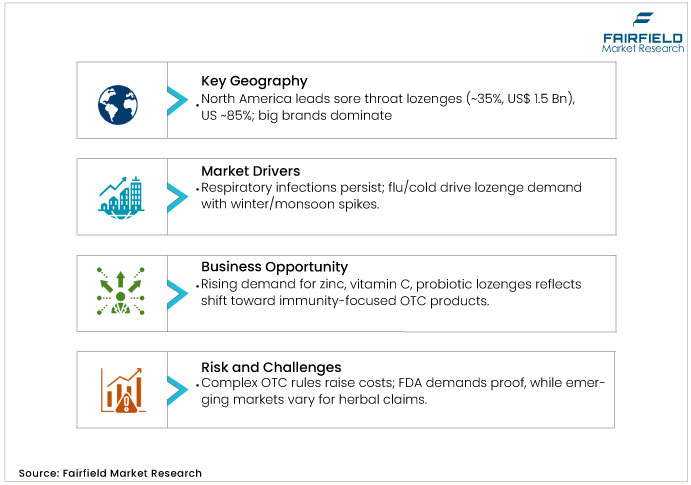
- North America remains the highest-value region with ~35% share, supported by strong OTC penetration and brand-led competition from major multinationals.
Market Dynamics: Drivers, Restraints, and Opportunities Analysis
Market Drivers
- Elevated Prevalence of Seasonal Respiratory Infections and Chronic Throat Conditions
Epidemiological trends show sustained respiratory infection prevalence across developed and emerging markets, with WHO seasonal influenza documentation and post-COVID awareness reinforcing demand. Data highlights common cold and seasonal influenza as the primary consumption drivers, with cyclical spikes during winter and monsoon seasons in tropical regions.
This pattern supports consistent global expansion, though regional seasonality shapes inventory planning and distribution timing. Companies aligning supply chain reliability with peak seasonal demand gain competitive advantage, while disruptions risk market share loss, and the stability of this driver remains tied to ongoing seasonal infection exposure despite annual flu severity variations.
- Accelerating Urbanization and Environmental Pollution Exposure
Rapid urbanization in Asia-Pacific, especially in China and India, has increased exposure to pollution and throat irritation triggers, with World Bank documentation linking urban population growth to rising respiratory irritation. Market Insights identifies pollution-related throat discomfort and urban stress as major demand drivers, particularly in high-pollution metropolitan hubs.
Regional market analysis suggests this trend may contribute an estimated 20–25% of growth in Asia-Pacific through 2033. Companies tailoring formulations for pollution-induced irritation and strengthening metropolitan distribution networks are positioned for accelerated gains, while the momentum of this driver hinges on ongoing urbanization and mixed air-quality improvement patterns across key markets.
Market Restraints
- Regulatory Complexity and Natural Ingredient Substantiation Requirements
Regulatory frameworks governing natural ingredient claims, active ingredient validation, and therapeutic benefit substantiation increase compliance complexity and development costs. The U.S. FDA requires safety and efficacy validation for OTC lozenges, while emerging markets vary in rigor, creating challenges for herbal and natural ingredient documentation across regions.
This regulatory variation is estimated to suppress market growth by 5–8%, disproportionately affecting smaller manufacturers with limited regulatory resources. Companies investing in regulatory infrastructure and multi-market compliance capabilities are better positioned to adapt, while long-term impact depends on whether regulatory evolution trends toward harmonization or heightened stringency based on evidence of natural ingredient efficacy.
- Price Sensitivity and Margin Compression in Emerging Markets
Developing market consumers exhibit strong price sensitivity toward OTC throat lozenges, limiting margin realization and constraining innovation investment. Research shows average selling prices in emerging regions are 40–50% lower than in developed markets due to purchasing power gaps and intense cost-focused competition.
This dynamic is estimated to suppress profitability expansion by 10–15 %, even as volume demand remains stable. Manufacturers adopting tiered portfolios and cost-optimized formulations for emerging markets are better positioned than those maintaining uniform global pricing, especially where consumer arbitrage and regulatory pricing scrutiny increase competitive pressure.
Market Opportunities
- Functional and Immunity-Focused Lozenge Innovation
The growing demand for multifunctional lozenges containing zinc, vitamin C, probiotics, and herbal immune-support ingredients is creating a clear differentiation opportunity in the mature OTC category. Post-pandemic health awareness has shifted consumer preference toward immunity support rather than symptomatic relief alone, with research identifying functional lozenges as a high-growth segment.
This segment represents a significant global opportunity through 2033, concentrated in North America and Western Europe, where willingness to pay for functional benefits is higher. Strategic relevance encompasses brand repositioning and penetration into younger and wellness-focused demographics; however, implementation barriers, such as clinical evidence requirements and regulatory complexities, necessitate investment in research capabilities and compliance expertise.
- Natural and Herbal Ingredient Formulation Expansion
Rising consumer preference for natural and herbal ingredients, especially Ayurvedic formulations with tulsi, turmeric, and ginger, is creating strong differentiation and premium positioning potential. Market Insights notes the accelerating adoption of herbal products in India and the Asia-Pacific region, with organic-certified herbal lozenges growing at rates exceeding 8% annually, driven by trust in traditional medicine and the perceived safety of herbal products over synthetics.
The estimated ~US$500 million addressable opportunity through 2033 extends to global sore throat lozenges markets, where Ayurvedic and herbal products are gaining traction via e-commerce and specialty retail. Strategic relevance now spans both cost-sensitive emerging markets and premium Western segments, though implementation requires overcoming supply-chain complexity, natural ingredient consistency challenges, and regulatory substantiation requirements.
Regional Market Assessment: Strategic Geography Analysis
- North America Market
North America holds the largest share at ~35% of sore throat lozenges market, valued at around US$1.5 billion in 2025, with the U.S. accounting for ~85% of that value. Market maturity, regulatory oversight from FDA and Health Canada, and high OTC adoption shape a consolidated landscape where Procter & Gamble, GlaxoSmithKline, Reckitt Benckiser, and Mondelez collectively hold 50–60% share.
Growth is driven by aging demographics, seasonal influenza, voice strain among professional groups, and strong self-care behavior reinforced by healthcare systems. Investment prioritizes formulation refinement, e-commerce capability, and digital consumer engagement, with limited M&A activity and niche positioning through natural, sugar-free, and allergy-friendly innovation.
- Europe Market
The European sore throat lozenges market is projected to reach more than US$2.5 billion by 2033, with Germany holding ~27.4% share and the United Kingdom 20–25%, reflecting strong pharmacy networks and mature OTC usage. Growth varies by region, with Western Europe showing stable maturity while Central and Eastern Europe accelerate due to rising disposable income and pharmacy modernization.
Market drivers include demographic aging, sustainability-focused purchasing, and regulatory emphasis on evidence-based natural ingredients. Competition is shaped by multinational and heritage brands such as Ricola and German pharmaceutical manufacturers, with investment focused on sustainability, herbal clinical validation, and e-commerce expansion as digital adoption accelerates across the region.
- Asia-Pacific Market
The Asia-Pacific region is the fastest-growing, projected to exceed US$1.5 billion by 2033, led by China with 45–50% value share and India as the fastest-growing sore throat lozenges market. Growth is driven by pollution-linked throat irritation, large youth populations, rising middle-class spending, and strong cultural alignment with traditional medicine systems such as Ayurveda and TCM.
Demand acceleration is reinforced by post-pandemic wellness priorities, digital commerce expansion, and widespread adoption of herbal formulations. Regulatory conditions vary significantly, with China’s NMPA requiring structured validation, while India’s Ayurvedic framework eases access. Competition is highly fragmented across global, regional, and local manufacturers, with investment concentrated in e-commerce, manufacturing expansion, and traditional medicine-based innovation.
Segmentation Analysis: Category-Wise Strategic Assessment
- Product Type Analysis
Hard candy lozenges hold the leading position with ~55% share of the sore throat lozenges market, supported by long dissolution time, strong brand familiarity, and pricing advantages from simplified manufacturing. Competitive momentum centers on sugar-free variants, natural ingredients, and flavor innovation, while established retail presence and consumer habits reinforce switching resistance.
Soft lozenges capture 20–30% share and are growing faster than hard candy formats, driven by pediatric and elderly demand, convenience preferences, and faster dissolution. Compressed lozenges represent less than 15% share with limited growth potential, while demographic-targeted development and pharmacy-focused distribution strategies remain key to expansion.
- Medication Type Analysis
The OTC segment dominates with ~80% share of the sore throat lozenges market, driven by strong consumer reliance on accessible, prescription-free sore throat remedies and wide pharmacy availability. High brand competition, extensive marketing investment, and favourable regulatory classification support continued strength, reinforced by convenience-driven self-care behavior and direct-to-consumer marketing.
The prescription segment holds 15–35% share and is gaining traction for clinical-grade formulations targeting severe symptoms and immunocompromised patients. Growth is supported by healthcare provider adoption for post-operative and chronic needs, requiring clinical validation and provider engagement, creating differentiation opportunities for companies investing in specialized medical positioning.
- Distribution Channel Analysis
Retail pharmacies lead distribution over 40% share of sore throat lozenges market, supported by convenience, wide network coverage, and immediate access during acute symptoms. Pharmacist recommendations, in-store visibility, and trusted consumer relationships reinforce this channel’s structural advantage and sustained dominance across developed and emerging markets.
Online pharmacy and e-commerce channels are the fastest-growing, expanding at 12–15% annually due to rising digital adoption, convenience demand, and improved reach into underserved areas. Growth strategies now favor omnichannel models combining retail pharmacy presence with optimized e-commerce capabilities, while drug stores gain momentum through community-focused positioning and differentiated product assortments.
Competitive Landscape: Market Structure and Strategic Positioning
The global sore throat lozenge market landscape shows moderate consolidation, with Procter & Gamble, GlaxoSmithKline, Reckitt Benckiser, Mondelez International, and Ricola collectively holding 40–50% share alongside persistent fragmentation. Barriers to entry are moderate, requiring US$20–50 million for formulation, compliance, and distribution, while contract manufacturing keeps production barriers low and regulatory approval remains the most significant constraint.
Competitive strength is driven by innovation and digital capabilities rather than scale, enabling mid-sized and regional manufacturers to compete through cultural alignment, local flavor preferences, and price positioning. E-commerce, social media, and drug store networks support emerging market access, while pharmacy shelf presence and regulatory rigor continue to shape competitive dynamics in developed markets.
Key Players
- Reckitt Benckiser Group plc
- GlaxoSmithKline plc
- Pfizer Inc.
- Procter & Gamble Co.
- Sanofi S.A.
- Novartis AG
- Bayer AG
- Prestige Consumer Healthcare Inc.
- Mondelez International, Inc.
- Doetsch Grether AG
- Bliss GVS Pharma Ltd
- Thornton & Ross Ltd
- Bausch Health Companies Inc.
- Ricola AG
- Aenova Group
Global Sore Throat Lozenges Market Segmentation-
By Product:
- Hard candy lozenges
- Soft lozenges
- Compressed lozenges
By Type:
- OTC
- Prescription
By Distribution Channel:
- Hospital
- Retail Pharmacies
- Drug stores
- Online pharmacies
By Region:
- North America
- Latin America
- Europe
- Asia Pacific
- Middle East and Africa
- Executive Summary
- Global Sore Throat Lozenges Market Snapshot
- Future Projections
- Key Market Trends
- Regional Snapshot, by Value, 2026
- Analyst Recommendations
- Market Overview
- Market Definitions and Segmentations
- Market Dynamics
- Drivers
- Restraints
- Market Opportunities
- Value Chain Analysis
- COVID-19 Impact Analysis
- Porter's Five Forces Analysis
- Impact of Russia-Ukraine Conflict
- PESTLE Analysis
- Regulatory Analysis
- Price Trend Analysis
- Current Prices and Future Projections, 2025-2033
- Price Impact Factors
- Global Sore Throat Lozenges Market Outlook, 2020 - 2033
- Global Sore Throat Lozenges Market Outlook, by Product, Value (US$ Mn), 2020-2033
- Hard candy lozenges
- Soft lozenges
- Compressed lozenges
- Global Sore Throat Lozenges Market Outlook, by Type, Value (US$ Mn), 2020-2033
- OTC
- Prescription
- Global Sore Throat Lozenges Market Outlook, by Distribution Channel, Value (US$ Mn), 2020-2033
- Hospital
- Retail Pharmacies
- Drug stores
- Online pharmacies
- Global Sore Throat Lozenges Market Outlook, by Region, Value (US$ Mn), 2020-2033
- North America
- Europe
- Asia Pacific
- Latin America
- Middle East & Africa
- Global Sore Throat Lozenges Market Outlook, by Product, Value (US$ Mn), 2020-2033
- North America Sore Throat Lozenges Market Outlook, 2020 - 2033
- North America Sore Throat Lozenges Market Outlook, by Product, Value (US$ Mn), 2020-2033
- Hard candy lozenges
- Soft lozenges
- Compressed lozenges
- North America Sore Throat Lozenges Market Outlook, by Type, Value (US$ Mn), 2020-2033
- OTC
- Prescription
- North America Sore Throat Lozenges Market Outlook, by Distribution Channel, Value (US$ Mn), 2020-2033
- Hospital
- Retail Pharmacies
- Drug stores
- Online pharmacies
- North America Sore Throat Lozenges Market Outlook, by Country, Value (US$ Mn), 2020-2033
- U.S. Sore Throat Lozenges Market Outlook, by Product, 2020-2033
- U.S. Sore Throat Lozenges Market Outlook, by Type, 2020-2033
- U.S. Sore Throat Lozenges Market Outlook, by Distribution Channel, 2020-2033
- Canada Sore Throat Lozenges Market Outlook, by Product, 2020-2033
- Canada Sore Throat Lozenges Market Outlook, by Type, 2020-2033
- Canada Sore Throat Lozenges Market Outlook, by Distribution Channel, 2020-2033
- BPS Analysis/Market Attractiveness Analysis
- North America Sore Throat Lozenges Market Outlook, by Product, Value (US$ Mn), 2020-2033
- Europe Sore Throat Lozenges Market Outlook, 2020 - 2033
- Europe Sore Throat Lozenges Market Outlook, by Product, Value (US$ Mn), 2020-2033
- Hard candy lozenges
- Soft lozenges
- Compressed lozenges
- Europe Sore Throat Lozenges Market Outlook, by Type, Value (US$ Mn), 2020-2033
- OTC
- Prescription
- Europe Sore Throat Lozenges Market Outlook, by Distribution Channel, Value (US$ Mn), 2020-2033
- Hospital
- Retail Pharmacies
- Drug stores
- Online pharmacies
- Europe Sore Throat Lozenges Market Outlook, by Country, Value (US$ Mn), 2020-2033
- Germany Sore Throat Lozenges Market Outlook, by Product, 2020-2033
- Germany Sore Throat Lozenges Market Outlook, by Type, 2020-2033
- Germany Sore Throat Lozenges Market Outlook, by Distribution Channel, 2020-2033
- Italy Sore Throat Lozenges Market Outlook, by Product, 2020-2033
- Italy Sore Throat Lozenges Market Outlook, by Type, 2020-2033
- Italy Sore Throat Lozenges Market Outlook, by Distribution Channel, 2020-2033
- France Sore Throat Lozenges Market Outlook, by Product, 2020-2033
- France Sore Throat Lozenges Market Outlook, by Type, 2020-2033
- France Sore Throat Lozenges Market Outlook, by Distribution Channel, 2020-2033
- U.K. Sore Throat Lozenges Market Outlook, by Product, 2020-2033
- U.K. Sore Throat Lozenges Market Outlook, by Type, 2020-2033
- U.K. Sore Throat Lozenges Market Outlook, by Distribution Channel, 2020-2033
- Spain Sore Throat Lozenges Market Outlook, by Product, 2020-2033
- Spain Sore Throat Lozenges Market Outlook, by Type, 2020-2033
- Spain Sore Throat Lozenges Market Outlook, by Distribution Channel, 2020-2033
- Russia Sore Throat Lozenges Market Outlook, by Product, 2020-2033
- Russia Sore Throat Lozenges Market Outlook, by Type, 2020-2033
- Russia Sore Throat Lozenges Market Outlook, by Distribution Channel, 2020-2033
- Rest of Europe Sore Throat Lozenges Market Outlook, by Product, 2020-2033
- Rest of Europe Sore Throat Lozenges Market Outlook, by Type, 2020-2033
- Rest of Europe Sore Throat Lozenges Market Outlook, by Distribution Channel, 2020-2033
- BPS Analysis/Market Attractiveness Analysis
- Europe Sore Throat Lozenges Market Outlook, by Product, Value (US$ Mn), 2020-2033
- Asia Pacific Sore Throat Lozenges Market Outlook, 2020 - 2033
- Asia Pacific Sore Throat Lozenges Market Outlook, by Product, Value (US$ Mn), 2020-2033
- Hard candy lozenges
- Soft lozenges
- Compressed lozenges
- Asia Pacific Sore Throat Lozenges Market Outlook, by Type, Value (US$ Mn), 2020-2033
- OTC
- Prescription
- Asia Pacific Sore Throat Lozenges Market Outlook, by Distribution Channel, Value (US$ Mn), 2020-2033
- Hospital
- Retail Pharmacies
- Drug stores
- Online pharmacies
- Asia Pacific Sore Throat Lozenges Market Outlook, by Country, Value (US$ Mn), 2020-2033
- China Sore Throat Lozenges Market Outlook, by Product, 2020-2033
- China Sore Throat Lozenges Market Outlook, by Type, 2020-2033
- China Sore Throat Lozenges Market Outlook, by Distribution Channel, 2020-2033
- Japan Sore Throat Lozenges Market Outlook, by Product, 2020-2033
- Japan Sore Throat Lozenges Market Outlook, by Type, 2020-2033
- Japan Sore Throat Lozenges Market Outlook, by Distribution Channel, 2020-2033
- South Korea Sore Throat Lozenges Market Outlook, by Product, 2020-2033
- South Korea Sore Throat Lozenges Market Outlook, by Type, 2020-2033
- South Korea Sore Throat Lozenges Market Outlook, by Distribution Channel, 2020-2033
- India Sore Throat Lozenges Market Outlook, by Product, 2020-2033
- India Sore Throat Lozenges Market Outlook, by Type, 2020-2033
- India Sore Throat Lozenges Market Outlook, by Distribution Channel, 2020-2033
- Southeast Asia Sore Throat Lozenges Market Outlook, by Product, 2020-2033
- Southeast Asia Sore Throat Lozenges Market Outlook, by Type, 2020-2033
- Southeast Asia Sore Throat Lozenges Market Outlook, by Distribution Channel, 2020-2033
- Rest of SAO Sore Throat Lozenges Market Outlook, by Product, 2020-2033
- Rest of SAO Sore Throat Lozenges Market Outlook, by Type, 2020-2033
- Rest of SAO Sore Throat Lozenges Market Outlook, by Distribution Channel, 2020-2033
- BPS Analysis/Market Attractiveness Analysis
- Asia Pacific Sore Throat Lozenges Market Outlook, by Product, Value (US$ Mn), 2020-2033
- Latin America Sore Throat Lozenges Market Outlook, 2020 - 2033
- Latin America Sore Throat Lozenges Market Outlook, by Product, Value (US$ Mn), 2020-2033
- Hard candy lozenges
- Soft lozenges
- Compressed lozenges
- Latin America Sore Throat Lozenges Market Outlook, by Type, Value (US$ Mn), 2020-2033
- OTC
- Prescription
- Latin America Sore Throat Lozenges Market Outlook, by Distribution Channel, Value (US$ Mn), 2020-2033
- Hospital
- Retail Pharmacies
- Drug stores
- Online pharmacies
- Latin America Sore Throat Lozenges Market Outlook, by Country, Value (US$ Mn), 2020-2033
- Brazil Sore Throat Lozenges Market Outlook, by Product, 2020-2033
- Brazil Sore Throat Lozenges Market Outlook, by Type, 2020-2033
- Brazil Sore Throat Lozenges Market Outlook, by Distribution Channel, 2020-2033
- Mexico Sore Throat Lozenges Market Outlook, by Product, 2020-2033
- Mexico Sore Throat Lozenges Market Outlook, by Type, 2020-2033
- Mexico Sore Throat Lozenges Market Outlook, by Distribution Channel, 2020-2033
- Argentina Sore Throat Lozenges Market Outlook, by Product, 2020-2033
- Argentina Sore Throat Lozenges Market Outlook, by Type, 2020-2033
- Argentina Sore Throat Lozenges Market Outlook, by Distribution Channel, 2020-2033
- Rest of LATAM Sore Throat Lozenges Market Outlook, by Product, 2020-2033
- Rest of LATAM Sore Throat Lozenges Market Outlook, by Type, 2020-2033
- Rest of LATAM Sore Throat Lozenges Market Outlook, by Distribution Channel, 2020-2033
- BPS Analysis/Market Attractiveness Analysis
- Latin America Sore Throat Lozenges Market Outlook, by Product, Value (US$ Mn), 2020-2033
- Middle East & Africa Sore Throat Lozenges Market Outlook, 2020 - 2033
- Middle East & Africa Sore Throat Lozenges Market Outlook, by Product, Value (US$ Mn), 2020-2033
- Hard candy lozenges
- Soft lozenges
- Compressed lozenges
- Middle East & Africa Sore Throat Lozenges Market Outlook, by Type, Value (US$ Mn), 2020-2033
- OTC
- Prescription
- Middle East & Africa Sore Throat Lozenges Market Outlook, by Distribution Channel, Value (US$ Mn), 2020-2033
- Hospital
- Retail Pharmacies
- Drug stores
- Online pharmacies
- Middle East & Africa Sore Throat Lozenges Market Outlook, by Country, Value (US$ Mn), 2020-2033
- GCC Sore Throat Lozenges Market Outlook, by Product, 2020-2033
- GCC Sore Throat Lozenges Market Outlook, by Type, 2020-2033
- GCC Sore Throat Lozenges Market Outlook, by Distribution Channel, 2020-2033
- South Africa Sore Throat Lozenges Market Outlook, by Product, 2020-2033
- South Africa Sore Throat Lozenges Market Outlook, by Type, 2020-2033
- South Africa Sore Throat Lozenges Market Outlook, by Distribution Channel, 2020-2033
- Egypt Sore Throat Lozenges Market Outlook, by Product, 2020-2033
- Egypt Sore Throat Lozenges Market Outlook, by Type, 2020-2033
- Egypt Sore Throat Lozenges Market Outlook, by Distribution Channel, 2020-2033
- Nigeria Sore Throat Lozenges Market Outlook, by Product, 2020-2033
- Nigeria Sore Throat Lozenges Market Outlook, by Type, 2020-2033
- Nigeria Sore Throat Lozenges Market Outlook, by Distribution Channel, 2020-2033
- Rest of Middle East Sore Throat Lozenges Market Outlook, by Product, 2020-2033
- Rest of Middle East Sore Throat Lozenges Market Outlook, by Type, 2020-2033
- Rest of Middle East Sore Throat Lozenges Market Outlook, by Distribution Channel, 2020-2033
- BPS Analysis/Market Attractiveness Analysis
- Middle East & Africa Sore Throat Lozenges Market Outlook, by Product, Value (US$ Mn), 2020-2033
- Competitive Landscape
- Company Vs Segment Heatmap
- Company Market Share Analysis, 2025
- Competitive Dashboard
- Company Profiles
- Reckitt Benckiser Group plc
- Company Overview
- Product Portfolio
- Financial Overview
- Business Strategies and Developments
- GlaxoSmithKline plc
- Pfizer Inc.
- Procter & Gamble Co.
- Sanofi S.A.
- Novartis AG
- Bayer AG
- Prestige Consumer Healthcare Inc.
- Mondelez International, Inc.
- Doetsch Grether AG
- Reckitt Benckiser Group plc
- Appendix
- Research Methodology
- Report Assumptions
- Acronyms and Abbreviations
|
BASE YEAR |
HISTORICAL DATA |
FORECAST PERIOD |
UNITS |
|||
 |
2025 |
 |
2019 - 2025 |
 |
2026 - 2033 |
Value: US$ Billion |
|
REPORT FEATURES |
DETAILS |
|
By Product Coverage |
|
|
By Type Coverage |
|
|
By Distribution Channel Coverage |
|
|
Geographical Coverage |
|
|
Leading Companies |
|
|
Report Highlights |
Key Market Indicators, Macro-micro economic impact analysis, Technological Roadmap, Key Trends, Driver, Restraints, and Future Opportunities & Revenue Pockets, Porter’s 5 Forces Analysis, Historical Trend (2019-2024), Market Estimates and Forecast, Market Dynamics, Industry Trends, Competition Landscape, Category, Region, Country-wise Trends & Analysis, COVID-19 Impact Analysis (Demand and Supply Chain) |
Our Research Methodology
Considering the volatility of business today, traditional approaches to strategizing a game plan can be unfruitful if not detrimental. True ambiguity is no way to determine a forecast. A myriad of predetermined factors must be accounted for such as the degree of risk involved, the magnitude of circumstances, as well as conditions or consequences that are not known or unpredictable. To circumvent binary views that cast uncertainty, the application of market research intelligence to strategically posture, move, and enable actionable outcomes is necessary.
View Methodology
Quality Assured
Rigorous Validation Process

Confidentiality Assured
End-to-end Data Security

Custom Research Services
Tailored To Your Objectives
FAQs
The global sore throat lozenges market size is USD 6.2 Billion in 2026.
The sore throat lozenges market is projected to grow at a 6% CAGR through 2033.
The sore throat lozenges market growth is driven by seasonal respiratory infections, pollution exposure, and rising demand for natural/functional formulations.
North America is the dominant region for the sore throat lozenges market.
Reckitt Benckiser, GlaxoSmithKline, Pfizer, Procter & Gamble, and Ricola are some leading industry players in the sore throat lozenges market.
Related Reports
Precision Medicine Market Insights, Competitive Landscape, and Market Forecast 2033
Precision Medicine Market is projected to reach US$405.17 billion by 2033, driven by genomics, companion diagnostics, oncology, and personalized therapies.
Hollow Fiber Filtration Market Insights, Competitive Landscape, and Market Forecast 2026–2033
The hollow fiber filtration market will grow from US$1.10 Bn in 2026 to US$2.80 Bn by 2033 at a 14.3% CAGR, driven by biologics & single-use bioprocessing.
Orthopedic Biomaterials Market Insights, Competitive Landscape, and Market Forecast 2026–2033
The orthopedic biomaterials market will grow from US$28.50 Bn in 2026 to US$48.21 Bn by 2033 at a 7.8% CAGR, driven by rising musculoskeletal disorders.
Tangential Flow Filtration Market Insights, Competitive Landscape, and Market Forecast 2026–2033
Tangential Flow Filtration Market is projected to reach US$5.25 billion by 2033, driven by biologics, biosimilars, and single-use bioprocessing demand.
Cannabis Testing Services Market Insights, Competitive Landscape, and Market Forecast 2026–2033
Cannabis Testing Services Market is projected to reach US$7.14 billion by 2033, driven by regulatory compliance, COA requirements, and quality testing.
Oncology Market Insights, Competitive Landscape, and Market Forecast 2033
Oncology Market to reach US$179.13 Bn by 2033, driven by rising cancer cases, targeted therapies, cell and gene therapies, and Asia Pacific growth.