



Steel Pipe Market
Steel Pipe Market Size, Share, Insights, Competitive Landscape, and Forecast 2026 to 2033
Steel Pipe Market
Steel Pipe Market Size and Trend Analysis
How Fast Is the Steel Pipe Market Growing?
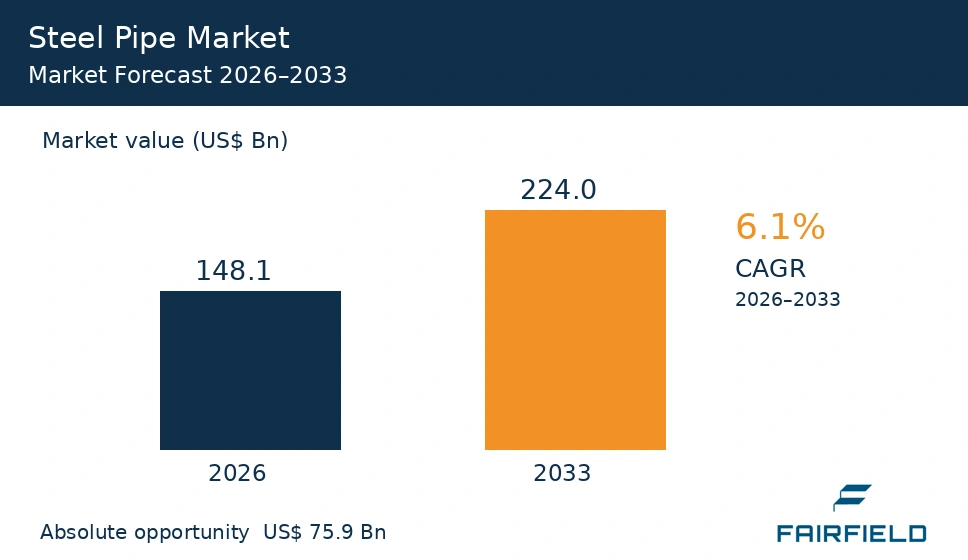
The global steel pipe market size is expected to be valued at US$ 148.1 billion in 2026 and projected to reach US$ 224.0 billion by 2033, growing at a CAGR of 6.1% between 2026 and 2033.
Between 2020 and 2025, the market grew at a CAGR of about 4.5%, rising from roughly US$ 112.0 billion to about US$ 139.6 billion, as oil and gas drilling recovered after the pandemic, governments funded water, gas, and construction infrastructure, and steel prices spiked in 2021 and 2022 before easing. The steel pipe market covers hollow steel products used to carry oil, gas, water, steam, and chemicals, and to build structures and machinery. Products are made by seamless, electric resistance welded (ERW), and submerged arc welded (SAW) processes in carbon, alloy, and stainless steel. Key users include oil and gas, construction, power plants, automotive, and mechanical engineering. In July 2026, SMS group agreed to supply two seamless tube plants to Baosteel Steel Pipe in China.
Key Report Takeaways
-
By Technology: Seamless held about 44% share in 2025, while SAW is projected to expand at a 6.8% CAGR through 2033, driven by large-diameter oil, gas, hydrogen, and water transmission pipelines and growing offshore wind foundation and structural pipe demand.
-
By Material: Carbon Steel held about 75% share in 2025, while Stainless Steel is projected to expand at a 7.0% CAGR through 2033, driven by corrosion-resistant needs in chemicals, food processing, water treatment, hydrogen systems, and liquefied natural gas facilities.
-
By Application: Oil and Gas held about 35% share in 2025, while Construction and Infrastructure is projected to expand at a 6.9% CAGR through 2033, driven by urbanization, water supply and sewer projects, building frames, and government infrastructure spending in India and other emerging markets.
-
By Region: Asia Pacific held about 58% share in 2025, while India is projected to expand at a 8.5% CAGR through 2033, driven by city gas distribution, water supply programs, oil and gas pipelines, and rising domestic steel pipe production.
Global Steel Pipe Market Trends and Insights
Drivers Impact Analysis
Two drivers carry the strongest influence on steel pipe market demand during the forecast period.
| Driver | Impact on CAGR Forecast | Geographic Relevance | Impact Timeline |
| Oil and gas exploration and pipeline investment | High | Global | Medium term (2-4 years) |
| Infrastructure, water, and construction spending | High | Asia Pacific, Middle East & Africa, North America | Long term (≥4 years) |
Oil and Gas Investment Is Driving the Steel Pipe Market
Oil and gas exploration and pipeline investment are the strongest driver of the steel pipe market. The energy industry is the largest buyer of high-value pipes.
The mechanism is that drilling wells requires oil country tubular goods such as casing and tubing, and moving oil and gas requires line pipe for gathering systems and long-distance pipelines. Investment in natural gas and liquefied natural gas projects is rising in North America, Middle East & Africa, and Asia Pacific to meet energy security needs. Deepwater and high-pressure wells need premium seamless pipes and connections. In March 2026, Vallourec reported contracts for about 36,000 tonnes of premium tubes for around 140 wells in Indonesia. As drilling and pipeline projects continue, demand for high-value steel pipes stays strong.
Infrastructure and Construction Spending Are Expanding the Steel Pipe Market
Infrastructure, water, and construction spending are expanding the steel pipe market. Governments are investing heavily in public works.
The cause is that growing cities need water supply, sewage, gas distribution, district heating, and fire protection networks, along with steel frames, piling, and scaffolding for buildings, bridges, and transport projects. India's Jal Jeevan Mission and city gas distribution program, China's urban renewal projects, and infrastructure laws in the United States support large pipe orders. Steel pipe is also used in solar panel mounting structures, offshore wind foundations, and power plants. In April 2026, Hoa Phat opened a steel pipe factory in Tay Ninh, Vietnam, raising its pipe capacity to about 1.2 million tonnes. These projects support steady volume growth across many industries and help balance cycles in energy demand.
Restraints Impact Analysis
Two restraints limit how quickly the steel pipe market grows.
| Restraint | Impact on CAGR Forecast | Geographic Relevance | Impact Timeline |
| Steel price volatility and raw material costs | High | Global | Medium term (2-4 years) |
| Trade barriers, overcapacity, and substitute materials | Medium | Global | Long term (≥4 years) |
Steel Price Volatility Slows the Steel Pipe Market
Steel price volatility and raw material costs slow the steel pipe market. Pipe makers face swings in input costs.
The problem is that steel pipe prices depend on hot-rolled coil, plate, billets, iron ore, coking coal, scrap, and alloys such as nickel and chromium, all of which can change sharply with global supply and demand. Energy costs for steelmaking and pipe processing also vary widely, especially in Europe. Buyers may delay orders when prices rise or wait for lower prices, while pipe makers may struggle to pass on costs under fixed-price contracts. Oil price swings change drilling activity and demand for oil country tubular goods. These factors make revenue and margins uncertain and slow investment in new capacity. Carbon pricing in Europe and new carbon border rules add further cost pressure on steel-based products.
Trade Barriers and Substitutes Restrict the Steel Pipe Market
Trade barriers, overcapacity, and substitute materials restrict the steel pipe market. Competition and policy changes affect pipe makers.
The constraint is that large steel capacity in China and other countries creates oversupply and low prices in export markets, leading many governments to impose anti-dumping duties, tariffs, and import quotas on steel pipes. The United States has kept tariffs on steel imports and conducted reviews of duties on oil country tubular goods from China. These measures disrupt trade flows and raise costs for buyers. In water, gas distribution, and plumbing, plastic pipes such as polyethylene and PVC, along with ductile iron and composite pipes, compete with steel because they resist corrosion and are lighter. These factors limit growth in some segments, especially small-diameter water and plumbing pipe, where plastic products keep gaining share.
Market Opportunities
Premium Energy and Hydrogen-Ready Pipes Open a Premium Revenue Pool
Premium energy and hydrogen-ready pipes open a premium revenue pool. New energy projects need advanced pipe solutions.
The opportunity comes from premium seamless pipes and connections for deepwater, high-pressure, and sour gas wells, along with hydrogen-ready line pipe, carbon capture and storage pipelines, geothermal wells, and liquefied natural gas facilities. These projects need special steel grades, tight tolerances, and testing, which command higher prices. Tenaris and Vallourec offer premium connections and services, and in June 2026, Vallourec signed a memorandum with Ultra Corpotech to add threading capacity in India. Pipe makers with advanced metallurgy, coating, and service capabilities can capture premium margins as energy companies invest in new projects and the energy transition. Low-carbon steel made in electric arc furnaces also lets pipe makers meet the emission goals of large energy buyers.
India and Emerging Market Infrastructure Create a Growth Revenue Pool
India and emerging market infrastructure create a growth revenue pool. Fast-growing economies need large pipe volumes.
The opportunity reflects strong government spending on water supply, sewage, city gas networks, oil and gas pipelines, housing, and transport in India, along with infrastructure programs in Indonesia, Vietnam, the Philippines, Saudi Arabia, and Egypt. Welspun, Jindal SAW, APL Apollo, and other Indian makers are adding capacity to meet domestic and export demand. Local content rules and import duties favor domestic production in many of these countries. Companies that build plants near growing markets, offer competitive prices, and supply large public projects can capture this growth and win long-term contracts with utilities and energy companies. Export demand from Middle East & Africa pipeline projects also supports Indian producers.
Segment Analysis
By Technology: Seamless Leads While SAW Grows Fastest
Seamless held about 44% share in 2025. Seamless pipes are made from solid billets without welded seams, giving them high strength and pressure resistance. They are used for oil country tubular goods, high-pressure boilers, hydraulic systems, and automotive parts. High value per tonne and strong demand from drilling give this technology the largest share by value. Tenaris, Vallourec, TMK, and Baosteel are major producers.
SAW is the fastest-growing technology, expanding at a 6.8% CAGR through 2033. Submerged arc welded pipes in large diameters and thick walls carry oil, gas, hydrogen, and water over long distances and serve offshore wind and structural uses. Welspun and Jindal SAW in India are major suppliers. ERW forms another segment, widely used for construction, water, and line pipe. For the market, SAW growth supports pipeline projects.
By Material: Carbon Steel Leads While Stainless Steel Grows Fastest
Carbon Steel held about 75% share in 2025. Carbon steel pipes are strong, affordable, and easy to weld, making them the standard choice for oil and gas, water, construction, and structural uses. Large production volumes and wide use across industries give this material the largest share.
Stainless Steel is the fastest-growing material, expanding at a 7.0% CAGR through 2033. Stainless pipes resist corrosion and high temperatures, and they are used in chemicals, pharmaceuticals, food processing, water treatment, hydrogen, and liquefied natural gas plants. New stainless pipe plants in India and China are adding capacity for domestic and export buyers. Alloy Steel forms another segment, used in power plants and high-pressure wells. For the market, stainless growth adds premium volumes.
By Application: Oil and Gas Leads While Construction and Infrastructure Grows Fastest
Oil and Gas held about 35% share in 2025. Drilling, production, gathering, and transmission use large volumes of casing, tubing, and line pipe, and many products need premium grades and connections. High value per tonne and large pipeline projects give this application the largest share.
Construction and Infrastructure is the fastest-growing application, expanding at a 6.9% CAGR through 2033. Water supply, sewers, fire protection, building frames, piling, scaffolding, bridges, and solar structures use steel pipes and hollow sections. Government infrastructure programs in India, China, and the United States support demand, along with large housing and metro rail projects. Power Plant, Automotive and Transportation, Mechanical Engineering, Chemical and Petrochemical, and Others form other segments. For the market, infrastructure growth adds steady volumes.
Geography Analysis
Why Is North America Important to the Steel Pipe Market?
North America is important to the steel pipe market because of its large oil and gas drilling and pipeline industry. The United States is the world's largest oil and gas producer and uses large volumes of oil country tubular goods and line pipe in the Permian Basin and other shale regions. Tenaris, Vallourec, Nippon Steel's U.S. Steel, and Atkore operate in the region. Federal infrastructure spending supports water and construction pipe. Canada and Mexico add demand. Key barriers include tariffs and drilling cycles. One change shaping the region is growing natural gas export projects in Texas and Louisiana.
Europe Shapes the Steel Pipe Market Through Energy Transition Projects
Europe is a major steel pipe market. Germany, Italy, France, Romania, Spain, and the United Kingdom have large pipe industries, and Tenaris, Vallourec, Salzgitter, and Marcegaglia are active in the region. In May 2026, Tenaris agreed to acquire Artrom Steel Tubes in Romania for €86 million. Hydrogen networks, carbon capture pipelines, offshore wind foundations, and district heating create new demand. Key barriers include high energy costs, carbon pricing, and low-cost imports. One opportunity is hydrogen-ready pipe for planned European hydrogen networks, along with carbon capture pipelines in the North Sea and district heating networks in cities across Germany and Poland.
Which Region Is Leading the Steel Pipe Market?
Asia Pacific is leading the steel pipe market with about 58% share in 2025, and India is the fastest-growing country, expanding at a 8.5% CAGR through 2033. China is the world's largest steel pipe producer and consumer, home to Baosteel, TPCO, and Youfa, while Japan has Nippon Steel and JFE Steel. India has Welspun, Jindal SAW, and APL Apollo, and Vietnam has Hoa Phat. Key barriers include overcapacity and strong price competition. One change shaping the region is new seamless and welded pipe capacity in India and Vietnam.
Latin America Grows the Steel Pipe Market Through Oil and Gas Development
Latin America is a growing steel pipe market with strong oil and gas development. Brazil's offshore pre-salt fields, Argentina's Vaca Muerta shale formation, Mexico's oil and gas sector, and Guyana's new offshore fields use large volumes of oil country tubular goods and line pipe. Tenaris has major plants in Argentina and Mexico, and Vallourec has operations in Brazil. Water and construction projects add demand. Key barriers include economic swings, currency volatility, and import duties. One opportunity is pipelines and wells for Vaca Muerta and Brazil's offshore projects, including new gas export pipelines.
Middle East & Africa Builds the Steel Pipe Market Through Energy and Water Projects
Middle East & Africa is a major and growing steel pipe market with large energy and water projects. Saudi Arabia, the United Arab Emirates, Qatar, and Kuwait are expanding oil and gas production, gas processing, and liquefied natural gas capacity, and they require large volumes of premium pipes. Desalination and water transmission projects add demand. Egypt, Nigeria, Mozambique, and South Africa have growing energy and infrastructure needs. Key barriers include project delays and price competition from Asian mills. One opportunity is local pipe manufacturing supported by national localization programs, such as Saudi Arabia's drive to build domestic supply chains for energy and water projects.
Competitive Landscape
The steel pipe market is fragmented. Tenaris, Vallourec, Nippon Steel, JFE Steel, and China Baowu are leading players, while ArcelorMittal, TMK, Welspun, Jindal SAW, TPCO, Youfa, and Hoa Phat compete strongly. A few global producers lead in premium seamless pipes and connections for the energy industry, while thousands of regional mills produce welded pipes for construction, water, and general industry. China alone has many large and small pipe makers, and local producers dominate most domestic markets because of freight costs and trade barriers. Consolidation is slowly increasing as large groups buy regional mills to widen their product range.
Companies compete on product quality, steel grades, premium connections, size range, production capacity, delivery reliability, coating and testing services, local presence, certifications, and price. Long-term supply agreements with oil and gas companies and pipeline operators are important for premium producers.
Strategic moves show how competition is changing. In April 2026, Hoa Phat opened new pipe capacity in Vietnam, and in May 2026, Tenaris agreed to buy Artrom Steel Tubes. In June 2026, Vallourec agreed to add threading capacity in India, and Baosteel Steel Pipe ordered new seamless plants in July 2026.
Three themes shape vendor strategy. First, producers are expanding premium energy products and services. Second, they are adding capacity near growing markets in India, Vietnam, and Europe. Third, they are developing hydrogen-ready and low-carbon pipes made with electric arc furnace steel.
Steel Pipe Market Industry Leaders
- Tenaris S.A.
- Vallourec S.A.
- Nippon Steel Corporation
- JFE Steel Corporation
- China Baowu Steel Group
Recent Industry Developments
-
July 2026: SMS group agreed to supply two PQF seamless tube plants to Baosteel Steel Pipe in China - expands advanced seamless pipe capacity at one of the region's largest producers.
-
June 2026: Vallourec signed a memorandum of understanding with Ultra Corpotech to deploy new premium threading capacities in India - strengthens local supply of premium oil country tubular goods.
-
May 2026: Tenaris agreed to acquire Artrom Steel Tubes S.A. in Romania for €86 million, adding steelmaking capacity of about 450,000 tonnes per year and seamless pipe rolling capacity of up to 200,000 tonnes, with closing expected in the fourth quarter of 2026 - expands its European industrial pipe footprint.
-
April 2026: Hoa Phat inaugurated a steel pipe factory in Tay Ninh, Vietnam, raising its steel pipe capacity to about 1.2 million tonnes - adds major welded pipe capacity in Asia Pacific.
Companies Covered in the Report
-
Tenaris S.A.
-
Vallourec S.A.
-
Nippon Steel Corporation
-
JFE Steel Corporation
-
China Baowu Steel Group (Baosteel)
-
ArcelorMittal S.A.
-
TMK Group
-
Welspun Corp Ltd.
-
Jindal SAW Ltd.
-
Tianjin Pipe Corporation (TPCO)
-
Tianjin Youfa Steel Pipe Group
-
Hoa Phat Group
Steel Pipe Market Report Scope
This report covers the steel pipe market, including seamless, ERW, and SAW technologies, carbon, alloy, and stainless steel materials, and oil and gas, construction and infrastructure, power plant, automotive and transportation, mechanical engineering, chemical and petrochemical, and other applications. The base year is 2025, and the forecast period runs from 2026 to 2033. All values are expressed in US$ Billion.
| Technology | Seamless, ERW, SAW |
| Material | Carbon Steel, Alloy Steel, Stainless Steel |
| Application | Oil and Gas, Construction and Infrastructure, Power Plant, Automotive and Transportation, Mechanical Engineering, Chemical and Petrochemical, Others |
| Regions | North America, Europe, Asia Pacific, Latin America, Middle East & Africa |
1. Executive Summary
1.1 Steel Pipe Market Snapshot
1.2 Future Projections
1.3 Key Market Trends
1.4 Regional Snapshot
2. Market Overview
2.1 Market Definition and Report Scope
2.2 Historical Market Trends
2.3 Market Dynamics
2.3.1 Drivers
2.3.1.1 Oil and Gas Investment Is Driving the Steel Pipe Market
2.3.1.2 Infrastructure and Construction Spending Are Expanding the Steel Pipe Market
2.3.2 Restraints
2.3.2.1 Steel Price Volatility Slows the Steel Pipe Market
2.3.2.2 Trade Barriers and Substitutes Restrict the Steel Pipe Market
2.3.3 Market Opportunities
2.3.3.1 Premium Energy and Hydrogen-Ready Pipes Open a Premium Revenue Pool
2.3.3.2 India and Emerging Market Infrastructure Create a Growth Revenue Pool
3. Global Steel Pipe Market Outlook, 2020–2033
3.1 Global Steel Pipe Market Outlook, by Technology, Value (US$ Billion), 2020–2033
3.1.1 Seamless
3.1.2 ERW
3.1.3 SAW
3.2 Global Steel Pipe Market Outlook, by Material, Value (US$ Billion), 2020–2033
3.2.1 Carbon Steel
3.2.2 Alloy Steel
3.2.3 Stainless Steel
3.3 Global Steel Pipe Market Outlook, by Application, Value (US$ Billion), 2020–2033
3.3.1 Oil and Gas
3.3.2 Construction and Infrastructure
3.3.3 Power Plant
3.3.4 Automotive and Transportation
3.3.5 Mechanical Engineering
3.3.6 Chemical and Petrochemical
3.3.7 Others
3.4 Global Steel Pipe Market Outlook, by Region, Value (US$ Billion), 2020–2033
3.4.1 North America
3.4.2 Europe
3.4.3 Asia Pacific
3.4.4 Latin America
3.4.5 Middle East & Africa
4. North America Steel Pipe Market Outlook, 2020–2033
4.1 North America Steel Pipe Market Outlook, by Technology, Value (US$ Billion), 2020–2033
4.1.1 Seamless
4.1.2 ERW
4.1.3 SAW
4.2 North America Steel Pipe Market Outlook, by Material, Value (US$ Billion), 2020–2033
4.2.1 Carbon Steel
4.2.2 Alloy Steel
4.2.3 Stainless Steel
4.3 North America Steel Pipe Market Outlook, by Application, Value (US$ Billion), 2020–2033
4.3.1 Oil and Gas
4.3.2 Construction and Infrastructure
4.3.3 Power Plant
4.3.4 Automotive and Transportation
4.3.5 Mechanical Engineering
4.3.6 Chemical and Petrochemical
4.3.7 Others
4.4 North America Steel Pipe Market Outlook, by Country, Value (US$ Billion), 2020–2033
4.4.1 United States Steel Pipe Market Outlook, by Technology, 2020–2033
4.4.2 United States Steel Pipe Market Outlook, by Material, 2020–2033
4.4.3 United States Steel Pipe Market Outlook, by Application, 2020–2033
4.4.4 Canada Steel Pipe Market Outlook, by Technology, 2020–2033
4.4.5 Canada Steel Pipe Market Outlook, by Material, 2020–2033
4.4.6 Canada Steel Pipe Market Outlook, by Application, 2020–2033
4.4.7 Mexico Steel Pipe Market Outlook, by Technology, 2020–2033
4.4.8 Mexico Steel Pipe Market Outlook, by Material, 2020–2033
4.4.9 Mexico Steel Pipe Market Outlook, by Application, 2020–2033
5. Europe Steel Pipe Market Outlook, 2020–2033
5.1 Europe Steel Pipe Market Outlook, by Technology, Value (US$ Billion), 2020–2033
5.1.1 Seamless
5.1.2 ERW
5.1.3 SAW
5.2 Europe Steel Pipe Market Outlook, by Material, Value (US$ Billion), 2020–2033
5.2.1 Carbon Steel
5.2.2 Alloy Steel
5.2.3 Stainless Steel
5.3 Europe Steel Pipe Market Outlook, by Application, Value (US$ Billion), 2020–2033
5.3.1 Oil and Gas
5.3.2 Construction and Infrastructure
5.3.3 Power Plant
5.3.4 Automotive and Transportation
5.3.5 Mechanical Engineering
5.3.6 Chemical and Petrochemical
5.3.7 Others
5.4 Europe Steel Pipe Market Outlook, by Country, Value (US$ Billion), 2020–2033
5.4.1 Germany Steel Pipe Market Outlook, by Technology, 2020–2033
5.4.2 Germany Steel Pipe Market Outlook, by Material, 2020–2033
5.4.3 Germany Steel Pipe Market Outlook, by Application, 2020–2033
5.4.4 Italy Steel Pipe Market Outlook, by Technology, 2020–2033
5.4.5 Italy Steel Pipe Market Outlook, by Material, 2020–2033
5.4.6 Italy Steel Pipe Market Outlook, by Application, 2020–2033
5.4.7 France Steel Pipe Market Outlook, by Technology, 2020–2033
5.4.8 France Steel Pipe Market Outlook, by Material, 2020–2033
5.4.9 France Steel Pipe Market Outlook, by Application, 2020–2033
5.4.10 Romania Steel Pipe Market Outlook, by Technology, 2020–2033
5.4.11 Romania Steel Pipe Market Outlook, by Material, 2020–2033
5.4.12 Romania Steel Pipe Market Outlook, by Application, 2020–2033
5.4.13 Spain Steel Pipe Market Outlook, by Technology, 2020–2033
5.4.14 Spain Steel Pipe Market Outlook, by Material, 2020–2033
5.4.15 Spain Steel Pipe Market Outlook, by Application, 2020–2033
5.4.16 United Kingdom Steel Pipe Market Outlook, by Technology, 2020–2033
5.4.17 United Kingdom Steel Pipe Market Outlook, by Material, 2020–2033
5.4.18 United Kingdom Steel Pipe Market Outlook, by Application, 2020–2033
5.4.19 Poland Steel Pipe Market Outlook, by Technology, 2020–2033
5.4.20 Poland Steel Pipe Market Outlook, by Material, 2020–2033
5.4.21 Poland Steel Pipe Market Outlook, by Application, 2020–2033
6. Asia Pacific Steel Pipe Market Outlook, 2020–2033
6.1 Asia Pacific Steel Pipe Market Outlook, by Technology, Value (US$ Billion), 2020–2033
6.1.1 Seamless
6.1.2 ERW
6.1.3 SAW
6.2 Asia Pacific Steel Pipe Market Outlook, by Material, Value (US$ Billion), 2020–2033
6.2.1 Carbon Steel
6.2.2 Alloy Steel
6.2.3 Stainless Steel
6.3 Asia Pacific Steel Pipe Market Outlook, by Application, Value (US$ Billion), 2020–2033
6.3.1 Oil and Gas
6.3.2 Construction and Infrastructure
6.3.3 Power Plant
6.3.4 Automotive and Transportation
6.3.5 Mechanical Engineering
6.3.6 Chemical and Petrochemical
6.3.7 Others
6.4 Asia Pacific Steel Pipe Market Outlook, by Country, Value (US$ Billion), 2020–2033
6.4.1 India Steel Pipe Market Outlook, by Technology, 2020–2033
6.4.2 India Steel Pipe Market Outlook, by Material, 2020–2033
6.4.3 India Steel Pipe Market Outlook, by Application, 2020–2033
6.4.4 China Steel Pipe Market Outlook, by Technology, 2020–2033
6.4.5 China Steel Pipe Market Outlook, by Material, 2020–2033
6.4.6 China Steel Pipe Market Outlook, by Application, 2020–2033
6.4.7 Japan Steel Pipe Market Outlook, by Technology, 2020–2033
6.4.8 Japan Steel Pipe Market Outlook, by Material, 2020–2033
6.4.9 Japan Steel Pipe Market Outlook, by Application, 2020–2033
6.4.10 Vietnam Steel Pipe Market Outlook, by Technology, 2020–2033
6.4.11 Vietnam Steel Pipe Market Outlook, by Material, 2020–2033
6.4.12 Vietnam Steel Pipe Market Outlook, by Application, 2020–2033
7. Latin America Steel Pipe Market Outlook, 2020–2033
7.1 Latin America Steel Pipe Market Outlook, by Technology, Value (US$ Billion), 2020–2033
7.1.1 Seamless
7.1.2 ERW
7.1.3 SAW
7.2 Latin America Steel Pipe Market Outlook, by Material, Value (US$ Billion), 2020–2033
7.2.1 Carbon Steel
7.2.2 Alloy Steel
7.2.3 Stainless Steel
7.3 Latin America Steel Pipe Market Outlook, by Application, Value (US$ Billion), 2020–2033
7.3.1 Oil and Gas
7.3.2 Construction and Infrastructure
7.3.3 Power Plant
7.3.4 Automotive and Transportation
7.3.5 Mechanical Engineering
7.3.6 Chemical and Petrochemical
7.3.7 Others
7.4 Latin America Steel Pipe Market Outlook, by Country, Value (US$ Billion), 2020–2033
7.4.1 Brazil Steel Pipe Market Outlook, by Technology, 2020–2033
7.4.2 Brazil Steel Pipe Market Outlook, by Material, 2020–2033
7.4.3 Brazil Steel Pipe Market Outlook, by Application, 2020–2033
7.4.4 Argentina Steel Pipe Market Outlook, by Technology, 2020–2033
7.4.5 Argentina Steel Pipe Market Outlook, by Material, 2020–2033
7.4.6 Argentina Steel Pipe Market Outlook, by Application, 2020–2033
7.4.7 Mexico Steel Pipe Market Outlook, by Technology, 2020–2033
7.4.8 Mexico Steel Pipe Market Outlook, by Material, 2020–2033
7.4.9 Mexico Steel Pipe Market Outlook, by Application, 2020–2033
8. Middle East & Africa Steel Pipe Market Outlook, 2020–2033
8.1 Middle East & Africa Steel Pipe Market Outlook, by Technology, Value (US$ Billion), 2020–2033
8.1.1 Seamless
8.1.2 ERW
8.1.3 SAW
8.2 Middle East & Africa Steel Pipe Market Outlook, by Material, Value (US$ Billion), 2020–2033
8.2.1 Carbon Steel
8.2.2 Alloy Steel
8.2.3 Stainless Steel
8.3 Middle East & Africa Steel Pipe Market Outlook, by Application, Value (US$ Billion), 2020–2033
8.3.1 Oil and Gas
8.3.2 Construction and Infrastructure
8.3.3 Power Plant
8.3.4 Automotive and Transportation
8.3.5 Mechanical Engineering
8.3.6 Chemical and Petrochemical
8.3.7 Others
8.4 Middle East & Africa Steel Pipe Market Outlook, by Country, Value (US$ Billion), 2020–2033
8.4.1 Saudi Arabia Steel Pipe Market Outlook, by Technology, 2020–2033
8.4.2 Saudi Arabia Steel Pipe Market Outlook, by Material, 2020–2033
8.4.3 Saudi Arabia Steel Pipe Market Outlook, by Application, 2020–2033
8.4.4 United Arab Emirates Steel Pipe Market Outlook, by Technology, 2020–2033
8.4.5 United Arab Emirates Steel Pipe Market Outlook, by Material, 2020–2033
8.4.6 United Arab Emirates Steel Pipe Market Outlook, by Application, 2020–2033
8.4.7 Qatar Steel Pipe Market Outlook, by Technology, 2020–2033
8.4.8 Qatar Steel Pipe Market Outlook, by Material, 2020–2033
8.4.9 Qatar Steel Pipe Market Outlook, by Application, 2020–2033
8.4.10 Kuwait Steel Pipe Market Outlook, by Technology, 2020–2033
8.4.11 Kuwait Steel Pipe Market Outlook, by Material, 2020–2033
8.4.12 Kuwait Steel Pipe Market Outlook, by Application, 2020–2033
8.4.13 Egypt Steel Pipe Market Outlook, by Technology, 2020–2033
8.4.14 Egypt Steel Pipe Market Outlook, by Material, 2020–2033
8.4.15 Egypt Steel Pipe Market Outlook, by Application, 2020–2033
8.4.16 Nigeria Steel Pipe Market Outlook, by Technology, 2020–2033
8.4.17 Nigeria Steel Pipe Market Outlook, by Material, 2020–2033
8.4.18 Nigeria Steel Pipe Market Outlook, by Application, 2020–2033
8.4.19 South Africa Steel Pipe Market Outlook, by Technology, 2020–2033
8.4.20 South Africa Steel Pipe Market Outlook, by Material, 2020–2033
8.4.21 South Africa Steel Pipe Market Outlook, by Application, 2020–2033
9. Competitive Landscape
9.1 Steel Pipe Market Industry Leaders
9.2 Recent Industry Developments
9.3 Company Profiles
9.3.1 Tenaris S.A.
9.3.2 Vallourec S.A.
9.3.3 Nippon Steel Corporation
9.3.4 JFE Steel Corporation
9.3.5 China Baowu Steel Group (Baosteel)
9.3.6 ArcelorMittal S.A.
9.3.7 TMK Group
9.3.8 Welspun Corp Ltd.
9.3.9 Jindal SAW Ltd.
9.3.10 Tianjin Pipe Corporation (TPCO)
9.3.11 Tianjin Youfa Steel Pipe Group
9.3.12 Hoa Phat Group
10. Appendix
10.1 Research Methodology
10.2 Report Assumptions
10.3 Acronyms and Abbreviations
| Technology | Seamless, ERW, SAW |
| Material | Carbon Steel, Alloy Steel, Stainless Steel |
| Application | Oil and Gas, Construction and Infrastructure, Power Plant, Automotive and Transportation, Mechanical Engineering, Chemical and Petrochemical, Others |
| Regions | North America, Europe, Asia Pacific, Latin America, Middle East & Africa |
Our Research Methodology
Considering the volatility of business today, traditional approaches to strategizing a game plan can be unfruitful if not detrimental. True ambiguity is no way to determine a forecast. A myriad of predetermined factors must be accounted for such as the degree of risk involved, the magnitude of circumstances, as well as conditions or consequences that are not known or unpredictable. To circumvent binary views that cast uncertainty, the application of market research intelligence to strategically posture, move, and enable actionable outcomes is necessary.
View Methodology
Quality Assured
Rigorous Validation Process

Confidentiality Assured
End-to-end Data Security

Custom Research Services
Tailored To Your Objectives
FAQs
The global steel pipe market is expected to be valued at US$ 148.1 billion in 2026, driven by energy and infrastructure investment.
The market is projected to grow at a 6.1% CAGR from 2026 to 2033, reaching about US$ 224.0 billion by 2033.
Asia Pacific leads with about 58% share, supported by the world's largest steel pipe production and consumption in China.
India is growing fastest at a 8.5% CAGR, driven by water supply programs, city gas networks, pipelines, and new pipe capacity.
Key players include Tenaris, Vallourec, Nippon Steel, JFE Steel, and China Baowu, competing on quality, premium products, capacity, and price.
Related Reports
Mining Locomotive Market Size, Share, Insights, Competitive Landscape, and Forecast 2026 to 2033
The mining locomotive market is projected to grow from US$1.4 billion in 2026 to US$2.1 billion by 2033 at a 6.0% CAGR.
Iron and Steel Market Size, Share, Insights, Competitive Landscape, and Forecast 2026 to 2033
The global iron and steel market is valued at US$1,720.0 billion in 2026, reaching US$2,060.0 billion by 2033, growing at a 2.6% CAGR
Aluminum Casting Market Size, Share, Insights, Competitive Landscape, and Forecast 2026 to 2033
The global aluminum casting market is valued at US$110.50 billion in 2026, reaching US$151.90 billion by 2033, growing at a 4.7% CAGR
Copper Wire & Cable Market Size, Share, Insights, Competitive Landscape, and Forecast 2026 to 2033
Copper wire and cable market to reach US$ 352.62 billion by 2033 at an 8.6% CAGR. Explore voltage, installation and regional trends.
Ni-based Superalloys Market Size, Share, Insights, Competitive Landscape, and Forecast 2026 to 2033
Ni-based superalloys market rises from US$10.35Bn in 2026 to US$18.92Bn by 2033 at 9.0% CAGR. Explore trends, segments and key companies.
Expanded Metal Foils Market Size, Share, Insights, Competitive Landscape, and Forecast 2026 to 2033
The global expanded metal foils market is valued at US$0.5 billion in 2026, reaching US$0.9 billion by 2033, growing at an 8.8% CAGR